A FOCUS ON THE MEDIA CAMPAIGNS USED BY THE MINISTRY OF TOURISM IN LESOTHO
By
‘Makatleho Moroke 205524751
A dissertation submitted in partial fulfilment of the requirements for the degree of
Masters of Business Administration
Graduate School of Business Faculty of Management Studies
Supervisor: Mr. A. Bozas Co-supervisor: Mr. M. Challenor
2008
DECLARATION
This research has not been previously accepted for any degree and is not being currently considered for any other university.
I declare that this Dissertation contains my own work except where specifically acknowledged.
Signed_______________________________
Date__________________________________
ACKNOWLEDGEMENTS
Sincere gratitute to my supervisor Mr. Alec Bozas for his invaluable academic guidance and lots of tolerance in making this document possible. Thank you once more for holding my hand through this dark forest.
My appreciation also goes to my son, Tsebo and his grandmother (may their souls rest in peace), whom I almost gave up finishing this programme because of their passing away. I know you would have been proud of me.
I would also like to thank my husband for his encouragement and support, Nchafatso and Mohanoe for their support and patience (guys, this is for you). My sister, I can’t thank you enough for taking care of my children and my mother for her undying love.
Above all, I thank my Heavenly Father for granting me this opportinity and letting the Holy Spirit to guide me through.
ABSTRACT
This research sets out to examine how media are utilised by the Ministry of Tourism, Environment and Culture through the Lesotho Tourism Development Corporation in collaboration with specific leisure tourists destinations to promote domestic leisure tourism in Lesotho.
The research relied on the use of unstructured interviews based on interview schedule in order to elicit comment, opinion and information from respondents. The researcher also used questionnaire to establish the appropriate media that could be used by the Ministry of Tourism, Environment and Culture through the Lesotho Tourism Development Co-operation to promote leisure tourism in the country. Through these interviews and questionniare, problems that surround media promotion of domestic leisure tourism were also identified. These problems include financial constraints and limitations that are set by the Government in choosing the type of media that has to be used by the Lesotho Tourism Development Corporation to promote tourism in the country.
The study discovered other weak areas in the Lesotho Tourism Development Corporation’s marketing of domestic tourism. Suitable recommendations have been made as to how such flaws could be addressed in order that it could increase the numbers of domestic leisure tourists.
Table of Contents
DECLARATION ... 1
ACKNOWLEDGEMENTS ... 2
ABSTRACT ... 3
LIST OF FIGURES ... 7
LIST OF TABLES ... 8
LIST OF ACRONYMS ... 9
CHAPTER 1: ... 10
INTRODUCTION AND OVERVIEW OF THE RESEARCH ... 10
1.1 Introduction ... 10
1.2 Background and Context ... 11
1.3 Problem Statement ... 13
1.4 Research Objectives ... 14
1.5 Importance/Significance of the Study ... 14
1.6 Research Design and Methodology ... 14
1.6.1 Ethical Requirements ... 15
1.6.2 Representative Sampling ... 15
1.6. 3 Sources of Information ... 15
1.6.4 Data Analysis ... 16
1.7 Limitations of the Study ... 16
1.8 Structure of the Study: ... 16
1.9 Conclusion ... 19
CHAPTER 2: ... 20
LITERATURE REVIEW ... 20
2.1 Introduction ... 20
2.2 Definition of Terms ... 20
2.2.1 Tourism ... 21
2.2.2 Leisure Tourism ... 21
2.2.3 Domestic Tourism ... 22
2.2.4 Tourist Destination ... 22
2.2.5 Attraction ... 22
2.2.6 Media ... 23
2.2.7 Tourism Policy ... 24
2.2.8 Background of LTDC ... 24
2.3 Theoritical Framework on the Objectives ... 26
2.4 Criteria for Assessment ... 30
2.4.1 SWOT Analysis ... 30
2.4.3 Porter’s Five Forces ... 31
2.5 Other Factors used for Assessement ... 32
2.5.1 Marketing ... 32
2.5.2 Economics ... 34
2.5.3 Strategy ... 35
2.5.5 Research Methods ... 37
2.6 Conclusion ... 37
CHAPTER 3: ... 39
RESEARCH METHODOLOGY ... 39
3.1 Introduction ... 39
3.2 Aim and Objectives of the Study ... 39
3.3 Data Collection Strategies ... 40
3.4 Sampling Technique ... 40
3.4.1 Population ... 41
3.4.2 Sample Size ... 41
3.4.3 Validity ... 42
3.4.4 Reliability ... 43
3.5 Research Design and Methodology ... 43
3.5.1 Description and Purpose ... 43
3.5.2 Construction Of Instruments ... 45
3.5.3 Recruitment of Study Participants ... 49
3.6 Problems Encountered in the Field ... 49
3.7 Ethical Considerations ... 51
3.8 Data Analysis ... 51
3.9 Conclusion ... 52
CHAPTER 4: ... 53
FINDINGS ... 53
4.1 Introduction ... 53
4.2 Findings of the Questionniares ... 54
4.2.1 Background Information of the Participants ... 54
4.2.2 Organisation’s Issues on Domestic Tourism: ... 55
4.2.3 Personal Views Regarding Domestic Tourism:... 57
4.3 Findings of the Personal Interviews ... 61
4.3.1 Characteristics of Respondents ... 61
4.3.2 Tourism Patterns in Lesotho - 2001-2006 ... 62
4.3.3 Factors that Influence Lesotho Tourism. ... 64
4.3.4 Types of Media at the LTDC ... 65
4.2.5 Problems in Media Tourism Promotions ... 67
4.3 Conclusion ... 68
CHAPTER 5: ... 70
INTERPRETATION & DISCUSSION ... 70
5.1 Introduction ... 70
5.2 Findings ... 71
5.2.1 Findings of the Questionnaire ... 71
5.2.2 Findings of the Personal Interviews ... 74
5.3 Techniques of Assessment ... 77
5.3.1 SWOT to Assess the LTDC Environment ... 77
5.3.2 Porter’s Five Forces to Assess the LTDC ... 78
5.4 Other Factors of Assessement ... 80
5.4.1 Marketing ... 80
5.4.2 Economics ... 82
5.4.3 Strategy ... 83
5.4.4 Management Information Systems and Supply Chain ... 85
5.4.5 Research Methods ... 86
5.5 Conclusion ... 86
CHAPTER 6: ... 87
CONCLUSIONS AND RECOMMENDATIONS ... 87
6.1 Introduction ... 87
6.2 Conclusion ... 87
6.3 Recommendations ... 88
6.4 Suggestions for Future Research ... 90
6.5 Conclusion ... 90
References ... 91
APPENDICES ... 98
Appendix 1 ... 99
QUESTIONNAIRE ... 99
INTERVIEW GUIDE TO LTDC ... 103
LIST OF FIGURES
No. Description Page
1.1 Organisation of the study 18
2.1 SWOT analysis technique 31
2.2 Porter’s five forces model 32
2.3 Fishbone diagram 33
2.4 Organisations’ hierarchiacal structure 36
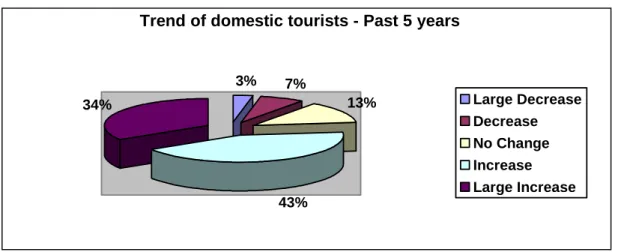
4.1 Used media in various tourists attractions 59 4.2 Effective media for domestic target market 60 4.3 Trend of domestic tourists from the past 5 years 63 4.4 International tourists from 2004 – 2007 66
5.1 Organisation of the chapter 74
5.2 Fishbone diagram 85
5.3 Organisation’s hierarchiacal structure 87
LIST OF TABLES
No. Description Page
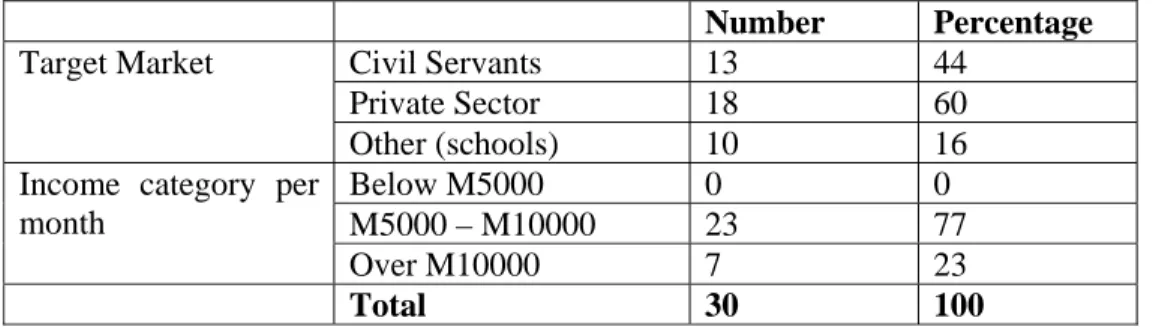
4.1 Characteristics of the respondents 58 4.2 Characteristics of the target market 60 4.3 Suitable meida for domestic targe market 61 4.4 Co-operation in the tourism industry 61 4.5 Respondents’ feelings about tourism in Lesotho 64 4.6 Characteristics of the respondents 65 4.7 Lesotho’s tourism influencing factors 68
4.8 Types of media at the LTDC 70
LIST OF ACRONYMS BBC - British Broadcasting Co-operation LTB - Lesotho Tourist Board
LTDC - Lesotho Tourism Development Co-operation MTEC - Ministry of Tourism, Environment and Culture RSA - Republic of South Africa
SABC - South African Broadcasting Co-operation SADC - Southern African Development Community LTV - Lesotho Television
CHAPTER 1: INTRODUCTION AND OVERVIEW OF THE RESEARCH
1.1 Introduction
The tourism industry is perceived to be one of the principal contributors to economic growth of many countries. As a result, countries take significant measures to promote tourism (South Africa Alive With Possibility: 2006). In most cases tourism promotion is undertaken through properly structured media initiatives. In each country, key tourist destinations are mainly advertised with emphasis on the good experiences offered as well as quality of services available (To-Go-To: Central South Africa including Lesotho: 2007). As marketing of any product requires properly strutured planning, the focus in this study will be on how the Lesotho Tourism Development Co-operation (LTDC) positions its tourism marketing strategies.
This will be done in perspective where leisure tourist destinations are construed as a product, targeted at satisfying needs and demands of the domestic market. The study will focus on a broad plan including a marketing mix where customers occupy a central focal point. The intention is to find out what products or services in specific tourist testinations are offered, at what price and which promotion strategies are utilised to tell potential customers about the products (tourist destinations) and a way to reach the customer’s place (Perreault and McCarthy:
2005).
In Lesotho there are several tourist destinations that represent unique attractions in the Southern African region. These tourist attractions include natural sceneries and man made structures. They comprise of mountain ranges, scenic sights, historical and cultural sites, national parks, hotels, museums and pony trekking. If these tourist attractions are properly promoted, they could have a high rate of visitors who spend money for the services offered, thereby contribute positively in economic growth in Lesotho. This study focuses on how media are utilised by the Ministry of Tourism, Environment and Culture in collaboration with specific leisure tourist destinations in Lesotho to promote domestic tourism.
The research will be designed to determine how the following media are utilised for tourism promotion: - electronic media (radio, television, and internet) print media (newpapers and billboards) and other collateral materials such as flyers, brochures, catalogs, posters, sales kits, product speficification sheets and booklets.
This study will look into how these media are used for tourism promotion in line with the national tourism promotion strategies and national tourism policy. As Arens (2000) mentioned “these materials …contribute so much information to (potential) customers and prospects, they are very important to both closing sales and reinforcing prior sales decisions.”
1.2 Background and Context
Tourism is said to be a booming industry therefore countries work very hard to have a competitive advantage over the opportunities that are available (South Africa Alive With Possibilities: 2006). Lesotho is not an exception in this matter.
Being a small country landlocked by the Republic of South Africa, it has to work specially hard to gain recognition in the regional and international tourism industry.
Lesotho has many tourist attractions, which if they were well advertised and marketed properly, could contribute towards the betterment of the livelihoods of Basotho people (Lesotho Review: 2007).
It is in this regard, Lesotho takes advantage of its geographical attributes such as mountains and waterfalls as its unique selling point in tourism promotion opportunities. The country has also taken advantage of its strengths like historical places, birding, horse riding, nature reserves and other man-made tourist attractions.
Due to its size, Lesotho needs to identify a niche market and focus on it. Knowing its target market is of utmost importance to the LTDC. That makes it easier for the organisation to know what target market to focus on, so that appropriate tourism products could be identified and accordingly packaged to meet customers’ needs.
Promotion and advertising of these products or what the country could offer could be directed towards the correct market, and at the correct price based on the demographics of such market, using appropriate media to reach that market.
Promotion of tourism could be done in different ways including specialized tours, hiring the sales representatives and so on. This study will only concentrate on the promotion of domestic leisure tourism through media in Lesotho.
This study will focus on the initiatives that have been taken by the MTEC, through the LTDC to promote domestic tourism. The LTDC was established in 2004 and its main function is to promote tourist industry in Lesotho, both within and outside the country (About LTDC: 20033 and Mokuku et al,: 2002). Lesotho has a tourism policy which presents the basic stategic intent of the country on tourism. In this study the evaluation of this policy will be conducted to establish whether or not it covers sufficient grounding for tourism promotion.
Responses from LTDC officials will be sought through structured interviews to elicit responses on the initiatives that are taken by LTDC through the use of various media to promote tourism. Some selected tourist attractions will be contacted through questionniares to establish what they are using to promote their products and services, as well as establishing cooperation between these tourists attractions and the LTDC. An analysis of tourism media promotion initiatives will be conducted to determine their effectiveness.
Lastly, the study will identify factors that influence domestic tourism patterns in Lesotho, and identify problems that affect tourism as well as seeking possible answers to these problems. The reason for this approach is that by knowing what influences tourism the researcher will be able to make appropriate recommendations to the LTDC and if the recommendations are adopted, they should enable the Co-operation to attract greater numbers of tourists to Lesotho.
Increased tourism results in increased foreign exchange being earned by Lesotho and will result in infrastructural development and job creation (See Lesotho: 2006).
1.3 Problem Statement
To ensure that leisure tourism is marketed effeciently domestically, the LTDC needs to employ all available media initiatives at its disposal to ensure that possible tourists are aware of tourism products and services that are available/offered in Lesotho.
It is perceived by the researcher that media initiatives that are taken by the LTDC seem to be underperforming in improving marketing of domestic tourism in Lesotho, as there are many tourism products and services in the country which are not known by the citizens.
If appropriate media initiatives are not taken to promote tourism, there is a risk that the products and services that are offered in the country will fail to attract adequate numbers of tourists and as such the resorts and venues will decline or fall away.
Prospective tourists are more likely to go to places that are well advertised and marketed to satisfy their tourism needs. This could lead to Lesotho citizens taking leisure holidays in South Africa and elsewhere, instead of in Lesotho.
The research will examine these initiatives and their relevance and even if relevant, how they could be improved to be more effective. The study will focus on tourism trends in Lesotho over the five year period 2001-2006 in order to attempt to establish factors that influence tourism patterns in Lesotho. The study will specifically focus on media promotions with the view of identifying the most effective media for domestic tourism promotion. It will also identify problems affecting tourism promotion and seeks possible answers.
1.4 Research Objectives
To establish tourism patterns in Lesotho within the period 2001-2006 to see whether there was an increase or decrease in this industry, with specific emphasis on domestic tourism.
To establish factors that influence domestic tourism patterns in Lesotho and identify what impact media can have on these factors.
To identify types of media promotions that are used by the LTDC in the period under review.
To identify appropriate media for domestic tourist markets.
To establish problems surrounding media tourism promotions and how they can be addressed.
1.5 Importance/Significance of the Study
This study will be of value to the MTEC as it will probably unearth areas where the LTDC is underperforming and it will offer possible remedies to the problems uncovered. The LTDC will also benefit in that through the findings and recommendations of the study, it will be able to see where it could make improvements in the current system in using media to promote tourism in the country.
This research is done independently, no influence from any institution has been made on the researcher to manipulate or to temper the findings.
1.6 Research Design and Methodology
In this study both quantitative and qualitative approach will be used. Quantitative data will be extracted from specific tourism destinations’ records for the period 2001-2006 to determine the trends. Qualitative data was sought through structured interviews with officials in the LTDC, and a questionniare to specific/selected tourist destinations was distributed. Promotional material in print media, radio,
television, and the Internet was studied in order to better discern how the public become aware of tourism promotions and offerings.
The researcher collected data personally instead of hiring people to do it because of the following reasons: to ensure that body language of respondents is not missed; it is time consuming to train and coordinate the work that is being done by other people; through observation, the researcher was thus able to identify things that were relevant to the study which would otherwise have been missed.
1.6.1 Ethical Requirements
An application was made to the University of KwaZulu-Natal (UKZN) Research Committee for permission for the proposed research project to be approved. It was approved and the ethical clearance was attached to letters sent to the head of the LTDC, Chief Executive Officers (CEOs) of specific/selected tourist destinations/attractions in the country when requesting consent to conduct research. Consent was granted by the various institutions.
1.6.2 Representative Sampling
Structured interviews were held with eleven (11) officials of the LTDC (because they run the department as well as the newly formed LTDC marketing campaign) and the MTEC. On the distrubution of the questionnaire, the focus was on the selected tourists attractions found in the rural, sub-urban and urban areas. There were thirty (30) attractions in total that were given the questionnaire. However, to ensure anonymity, the names of these attractions will not be mentioned in this text.
1.6. 3 Sources of Information
The following resources were used to identify the relevant literature to the specified problem; Science Direct; Sabinet;Ebsco Host;Envivo;Google and Inforplease
1.6.4 Data Analysis
Data collected was used to determine the extent to which various types of media are explored and the impact they have to promote tourism in the country. Other information was gathered from books, completed dissertations, pamphlets, magazines, responses from resort managers, reading about other tourism destinations around the world and other sources.
1.7 Limitations of the Study
As the study focuses on thirty of the tourist destinations in the country which are selected randomly, it does not reflect a complete picture of tourism promotion in the whole country. It is therefore apparent that other tourism sectors like Bushman’s tracks and so forth will not be represented. In the same way, the fact that only the available staff members of LTDC were interviewed, their views do not fully represent the whole institution. However, since the study was carried out in destinations which represent all the regions of the country (that is the rural, sub- urban and urban areas), a fair population will be represented.
1.8 Structure of the Study:
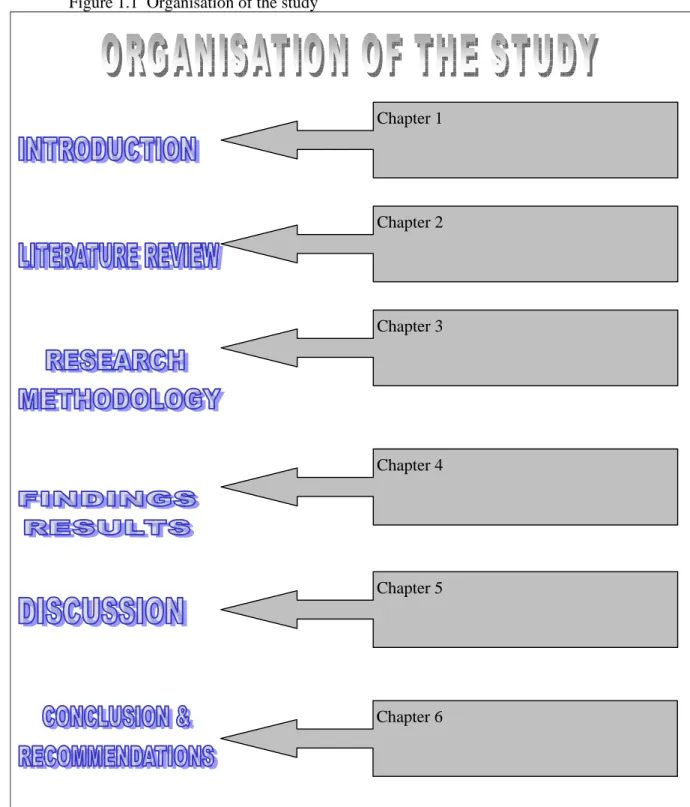
This can be summarised in the following diagram.
Figure 1.1 Organisation of the study
Source: Researcher’s own construction
Chapter 1
Chapter 2
Chapter 3
Chapter 4
Chapter 5
Chapter 6
Chapter 1 – Introduction
The chapter gives the introduction to the field of this research project. It mentions the background of the tourism industry in particular to Lesotho. Lastly, the chapter states the research problem and the objectives of this study.
Chapter 2 – Literature Review
The second chapter of this study discusses the literature that is relavant to the subject of this project. The chapter starts off by defining the important terms that are related to the subject, synthesises the broader theoretical framework in which tourism business thrive with inclination towards addressing the objectives of this study. and lastly, the chapter explores the approaches of other researchers on the same subject matter.
Chapter 3 – Research Methodology
This chapter described the tools and the way in which this research is going to be carried out, the instrumements and how this instruments were chosen, formulated and how they are going to be employed to address the objectives of the study. The chapter concludes by mentioning the types of interpreting aids that are used and justification of why they have been chosen.
Chapter 4 – Findings
The fourth chapter of this research lays out the results of the study as stipulated in the instruments that were employed as mentioned in the previous chapter.
Chapter 5 – Discussions
Interpretations of the results tabled out in the previous chapter is given in this chapter. The chapter further assesses these results according to the assessment criteria mentioned in chapter 2 (literature review).
Chapater 6 – Conclusion and Recommendations
This last chapter of this study gives the conclusions and the recommendations.
1.9 Conclusion
This study was conducted with the aim of establishing how media are used in Lesotho to promote tourism domestically. Being charged with the responsibility of promoting tourism in the country, the LTDC initiatives will be analysed on how the institution is using media to promote tourism in the country. A brief report of the LTDC’s overall strategy is made. Thirty specific tourist destinations in the country were approached to find out about tourism patterns between 2001 – 2006 and what can be done in order to attract more domestic tourists.
The main objective of this study was to identify appropriate media initiatives that could be used by LTDC to improve marketing of domestic tourism in Lesotho.
Through the use of research design and methodology, it was envisaged that problems affecting domestic tourism promotion would be determined through this research and the answers be proposed.
This study will investigate the LTDC media campaign in order to see if it could be improved and how. The next chapter will review the literature related to this research to elicit how similar problems were addressed.
CHAPTER 2: LITERATURE REVIEW
2.1 Introduction
Tourism has received a fair share of having been studied, as a result of research, tourism has an increasing amount of literarture. This chapter sets out to review literate that is germane to leisure tourism marketing, which is an area of focus in this study. It starts with definition and interrogation of tourism and related concepts in order to bring clarity on the subject matter under the study and to differentiate leisure tourism from other forms of tourism. In this study leisure tourism marketing is construed in a similar form whereby marketing is commonly undertaken for promotion of tangible goods or services offered by or from a specific place as a product that can be given to interested buyers at a given price.
In addition, this chapter synthesises the broader theoretical framework in which tourism business thrives with inclination towards addressing the objectives of this study. These theories provide for analytical approaches that enable to reveal developments/trents in leisure tourism marketing. The areas of focus in this theoretical framework are as follows:-
SWOT to assess the environment
Porter’s Five Forces to assess the company
Marketing to find out how tourism products are promoted
Human resources management to asses how good practice affects the performance of the industry.
Finance and accounting to determine success or failure in the industry.
Lastly, the chapter will explore the approaches of other researchers on the same subject matter.
2.2 Definition of Terms
Tourism involves movement of people to visit various places for different purposes/intents (Lickorish: 2006). These purposes/intents influence the orientation and type/form of tourism. As such, the study of tourism should set clarity and
limitation to a specific type or form of tourism that one attempts to investigate at any given study.
2.2.1 Tourism
According to Lubbe (2005) and Eagles, McCool and Haynes (2002), tourism is deemed to include any activity concerned with the temporary short-term movement of people to destinantions outside places they normally live and work, and their activities during the stay at the destinantions. World Tourism Organisation (1991) cited by Glaesser (2004) and Del Valle (2005), tourism comprises the activities of persons travelling to and staying in places outside their usual environment for not more than one consecutive year for leisure, business and other purposes.
Holloway (2002), Franklin (2003) and Bennet, Joaste and Strydom (2005) also agreed that tourism is a temporary short-term movement of people to destinations outside the places where they normally live and work, and activities during their stay at these destination; it includes movement for all purposes, as well as day visitors or excursions.
However, Veal (1997) argued that tourism is a leisure activity which involves normal place of residence but also as encompassing, in some cases such activities as business travel, attending conventions and visiting friends and relatives.
2.2.2 Leisure Tourism
Veal (1997) described a field of leisure and tourism as a large one, encompassing a wide range of individual and collective human activity.
Leisure is taken to encompass such activities as; recreation, play, games involvement in sport and arts, either as spectator or audience or as participant; the use of the electronic and printed media, live entertainment, hobbies, socializing, drinking, gambling, sightseeing, visiting parks, coast and countryside, do-it-yourself, arts and craft activity, home-based and non- home-based activity, commercial and non-commercially based activity and doing nothing in particular.
2.2.3 Domestic Tourism
Eagles et al., (2002) described domestic tourism as a kind of tourism that involves residents of the given country travelling only within that particular country. This is underscored by Lickorish (2006) who agreed with this view. He defined domestic tourism as involving a person travelling away from home for recreational or business purposes and is characterised by a trip within the frontiers of a country.
2.2.4 Tourist Destination
Holloway (2002) defined tourist destination as any facility whose success in attracting tourists depends upon the quality of three essential benefits that it offers the tourits; attractions, amenities (facilities) and accessibility.
2.2.5 Attraction
Middleton (1998) cited in Lubbe (2005) defined attraction as a designated, permanent resource that is controlled and managed. While Swarbrooke (1999) also cited in Lubbe (2005) defined attraction as a permanent establishment that draws tourists and day-visitors. Attractions tend to be single units, individuals sites or clearly defined small scale geographical areas that are accessible and motivate large numbers of people to travel some distance from their home, usually in their leisure time, to visit them for a short time, limited period.
Lubbe (2005) then offered what he called a more appropriate definition of attractions as follows;
“Attractions are those occurances or creations (such as scenery, climate, hot water springs, exceptional fauna or flora, buildings or other architectural work, scenes of historic importance, works of art, places of enjoyment and entertainment) or happenings (such as festivals, meetings, sport competitions etc.) in the natual or human-made environments, that motivate people to travel”.
He further classified two major types of attractions which are visitor attractions and tourist attraction.These two are defined as follows;
Tourist attractions – attractions that provide overnight accommodation. For example Gold Reef City in Johannesburg.
Day-visitor attractions – attractions that are without overnight accommodation. For example Ratanga Junction in Cape-Town.
It is to be noted that for the purpose of this research project, these two words, attraction and destination will be used interchangeably.
2.2.6 Media
Defined by Oxford dictionary as the main means of communicating with large numbers of people. Nel (2000) defines media as the plural of medium which is the mode of making and receivng messages.
Baran (2004) backed this point and further added that the medium is a technology that carries messages to a large number of people – newspapers carry out printed word and radio conveys the sound of music and news.
The various types of media includes books, magazines, radio, television, movies, compuer networks, sound recordings, banners, brochures, posters, flyers, catalogs, billborards, booklets, internet and newspapers (Fourie:
2005). Arens (2000) also confirmed that these media contained so much information to (potential) customers and therefore were very important to both selling and reinforcing prior sales decisions.
In Lesotho, television and radio are media that are commonly used by most businesses to reach their customers. However, according to the Lesotho News Agency (LENA: 2007), the LTV coverage is about eighty-five perecent which is mostly the urban and sub-urban areas of the country.
Nevertheless, the government is working on increasing this coverage to one hundred percent.
The Public Eye of June 27th, 2008 had an article about the availability of the newspapers in the country. It was stated that there were few local newspapers that had distribution centres in all the ten districts of the country. Other newspapers are only available in the seven districts (Maseru, Berea, Leribe, Butha-Buthe, Mafeteng, Mohales’ Hoek and Quthing).
2.2.7 Tourism Policy
It contains a government’s guiding principles and intentions with regards to dealing with tourism issues. The policy provides the means by which government prioritises problems which need to be addressed, sets objectives and allocates resources in order to for the set objectives to be achieved (South African Tourism: 2000) cited in Makhoba (2006).
The Lesotho Tourism Policy and the Tourism Act were read as part of the relevant literature to the study and it was discovered that these tow documents cover satisfactory ground for tourism promotion. The Lesotho Tourism Policy was drawn with the similar initiatives as shown above as well as complying with the World Tourism Organisation standards (About LTDC: 2003). The Lesotho Tourism Policy laid out the priorities and the objectives of the Lesotho government in addressing tourism issues.
In Lesotho tourism is developed and regulated within the legal framework.
Tourism Act of 2002 No. 18 provided for establishment of the LTDC. This body is mandated to be the main champion in tourism development in Lesotho. The functions of the LTDC were clearly stipulated in the Tourism Act of 2002 No. 18 as well as its organisational structure.
2.2.8 Background of LTDC
This was established in 2002 as an implementing agency of the Ministry of Tourism, Environment and Culture (MTEC) with a mandate to promote
tourism and facilitating private sector involvement in the tourism sector (Lesotho Tourism Act of 2002 and About LTDC: 2003).
VISION
LTDC will be a catalyst of the National Tourism direction to position Lesotho as a preferred adventure tourist destination, and a champion for development of a strong and vibrant tourism sector which contributes to sustainable economic growth, job creation, poverty alleviation and protection of the natural and cultural heritage.
MISSION
The LTDC promotes Lesotho as a preferred adventure tourist destination through strategic marketing and sustainable product and industry development in partnership with the private sector and the community.
“Promoting Responsible and Sustainable Economic Development through Tourism”.
FUNCTIONS OF THE LTDC
To promote and generate sustainable and profitable tourism projects which demonstrate a high absorptive capacity for labour.
Mobilization of requisite resources to meet the demand for financial and infrastructural requirements from the local and international donor/financial institutions and the private sector.
To market and promote Lesotho as a preferred destination for tourists (increased market share of global tourist traffic) in such a manner that will contribute to generation of additional foreign exchange, improved balance of payments and creation of employment.
To promote and increase the flow of domestic tourism by marketing internally the unique selling points of Lesotho with particular accent on appreciation of heritage, traditional and cultural endowments and responsible use of environment.
GOALS
To make and sustain a quantifiable contribution to poverty reduction through tourism and facilitation of employment creation and income generating projects.
To develop a tourism product that will contribute to sustainable GDP growth, job creation and redistribution of wealth
Position Lesotho as a preferred adventure tourist destination.
Facilitate long term sustainability of the Co-operation.
As it can be deduced from the main functions of the LTDC outlined above, in Lesotho development of tourism undertakings is a collaboration of both government and private sector role players. The LTDC as the main body mandated to champion tourism development by the government of Lesotho developed a tourism policy in the year 2000 as a basis for stategic direction for tourism development in the country.
Under the policy the vision is to develop Lesotho into a quality tourism destination and make the tourism industry the biggest employer by 2020.
The policy document has also identified key tourism attrations in the country that present Lesotho’s uniqueness. These include Historical and palaeontological features-caves with Sand painting in the region, dinasaur footprints, canoeing on rivers, bird watching, rock climbing fishing etc.
Organizational structure of the LTDC is as follows: The board of directors, the chief executive officer and six directors reporting to him from six key functional areas of the organization (research & development director, investment & promotions director, strategic marketing director, finance &
administration director, human resources director and corporate secretariat).
2.3 Theoritical Framework on the Objectives 2.3.1 Factors that Influence Tourism Patterns
There are various factors that influence tourism patterns. These are closely linked to specific tourist’s purpose/ intend to visit specific destination. As
Lubbe (2005) stated, individuals are driven by their particular needs and motivations to leave their place of origion and to experience another place or country. This, he described as an intergral part of demand side (heart of demand side) of tourism system. This enables tourism marketers to segment these individuals into target markets and to promote their destinations and tourist products and services more effectively.
Lickorish (2006) supported by Fleischer and Pizam (2001) mentioned that tourism demand is influenced by many factors such as financial, economic social and cultural factors. Special interests are particularly powerful motivators; however, essentially demand is a function of real discretionary income levels conditioned by motivating factors. The latter also believed that leisure tourism is directly influenced by individual income.
Lubbe (2000) believed that consumers in the leisure market are becoming less satisfied with traditional holiday packages. He further stated that nowadays, tourists are more experienced, more environmentally aware, more independent, more flexible, more quality conscious and harder to please than before.
2.3.2 The Impact that Media Can Have on These Factors
Crouch, Jackson and Thompson (2005) suggested that there were an over- arching and necessary interdependence between tourism and media. They also added that the media were heavily involved in promoting an emotional disposition, coupled with imagination and cognitive activity, which had the potential to be converted into tourist activity.
2.3.3 How Domestic Tourism is Promoted
Mancini (1999) emphasised the necessity of knowing all the relevant facts about a tourist attraction or destination if one is a travel agent/professional or a tourist promoter.
Inglis (2000) cited in Crouch et al., (2005) stated that Television is the source of the imagery with which we do our imagining of the future, and the holiday imagery now so omnipresent on the screen – in the soaps as well as the ads and in the travel programmes of all sorts – is one of the best places to find our fantacies of the free and fulfilled life.
One of South Africa’s initiatives in promoting tourism was the launching of
“Sho’t Left”. This is a television campaign developed from its marketing strategy aimed at promoting domestic tourism to incorporate black South Africans who were formerly excluded in the national government tourism policies before 1994 democratic transition (Rogerson and Lisa: 2007).
Rogerson and Visser (2006) further mentioned that in order to promote domestic tourism, reduced rates for the locals either in accommodation or visiting fees could be introduced.
Indaba is also another largest marketing event on the African calendar. It is held at the Durban International Convention Centre annually and showcases the widest variety of Southern Africa’s best tourism products and attracts international and media across the world. These products are marketed through flyers, brochures, magazines, stall displays, presentations etc. This event is owned by South African Tourism and it is aimed at attracting all types of tourits - domestic, regional and international (About Indaba: 2007) even though the focus of this study is only on domestic tourism.
In the same way, Lesotho is not excluded in to this kind of marketing.
Apart from taking part in the events like Indaba and Mangaung Cultural Festival (Macufe), the country has its own annual marketing event called Morija Arts and Cultural Festival. The intention of this event is to provide a showcase of Sesotho culture, reviving certain aspects of it which are waning, boost tourism and to encourage craftsellers and small scale manufacturers (Morija Festival: 2007).
Maswera, Dawson and Edwards (2006) carried out a study and identified e- commerce as another initiative that could be used to promote tourism. They
stated that in general, African tourism organisatins’ websites were found to be more informative as compared to their Western counterparts (USA and Western Europe) in embracing the e-commerce.
Holloway (2002) suggested tour operators as other marketing mediums that could be used to promote tourism. He stated that tour operators perform a distinct function in the tourism industry; they purchase separate elements of transport, accommodation and other services and combine them into a package which they sell directly or indirectly to the customers.
2.3.4 Problems that Media Tourism Promotions Face
Promotion of tourism has been identified as a key strategy that can lead to Economic upliftment, community development and poverty relief in the developing world (Binns and Nel:2002). However, Dieke (2003) held that tourism like any other industry is faced with problems. He pointed out that one of the problems facing tourism is, as the demand for tourism increases, it will not bring with it not only the opportunities for linkages with other sectors but also the consequences of social, cultural and environmental nature giving urban traffic congestions as an example of such consequences.
Despite this, Ghimire, (1997) cited in Rogerson and Lisa (2007) concluded that domestic tourism has been largely under-researched aspect of tourism economies in the developing world. Supporting this view was Keyser (2002) also cited in Rogerson and Lisa (2007) and he added that this lack of research is linked among other things, to the fact that domestic tourism is more difficult to track than international tourism as it occurs within the country of residence and thus does not involve the crossing of international borders at entry points into a country where visitors are counted.
2.3.5 How the Above Problems Can be Addressed
The importance of developing tourism in this continent cannot be over- emphasised (Dieke: 2003). It therefore depends on each country to ensure that all the necessary efforts are taken to increase the opportunities of tourism.
2.4 Criteria for Assessment 2.4.1 SWOT Analysis
Environmental analysis will be done using the SWOT analysis as described by Elhers and Lazenby (2006) and (Internet 3) as one of the best techinigues for doing an environmental analysis. It is an acronym for
“Strengths, Weaknesses, Opportunities and Threats”.
This approach will be used to analyse the business environment in which leisure trourism marketing in Lesotho is premised. The following model shows this technique.
Fig.2.1 SWOT Analysis Techinique
Determining the Determining the
S – strengths W – weaknesses O – opportunities T – threats Adapted from: Ehlers and Lazenby (2004)
SWOT Analysis
External Analysis Internal Analysis
Threats Opportunities Weaknesses
Strengths
Strength – Refers to a resource or capability that the organisationa has which is an advantage relative to what competitors have. It offers a distinctive competence that gives the organisation an competitive advantage.
Weakness – It is a lack of, or defiency in, a resource that represents a relative disadvantage to an organisation in comparison to what competitors have. This deficiency prevents the organisation from developing a competitve position in the market industry.
Opportunity – Refers to a favourable situation in the organisation’s external (market and macro) environment.
Threat – An unfavourable situation in the organization’s extenal environment.
2.4.3 Porter’s Five Forces
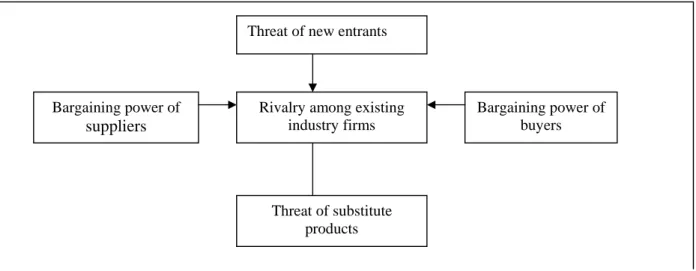
This is one of the better-known approaches to evaluating a company’s competitive position in light of the structre of its industry (Chase, Jacobs and Aquilano: 2006). As thus, Lesotho Tourism Development Co-
operation will be analysed with the use of this approach as also detailed in Mullins, Walker, Boyd and Larréché (2005).
The following diagram shows how this approach works as given by Mullins et al., (2005).
Fig. 2.2 Porters Five Forces
Adapted from: Chase, Jacobs and Aquilano (2006)
2.5 Other Factors used for Assessement 2.5.1 Marketing
Kotler (2001) cited in Lickorish (2006) wrote that “Marketing is the analysing, organizing, planning and controlling of the firm’s customer – impringing resources, policies and activities with a view to satisfying the needs and wants of chosen customer groups at a profit.”
Kerin, Hartley, Berkowitz and Rudelius, (2006) supported by Hollensen (2003) and Kotler and Armstrong (2002) identified the crucial aspect of marketing which is the marketing mix or the four P’s of marketing (product, price, place and promotion). They stated that it is important for a company to have/sell appropriate products at the correct price. It should also have enough/strong distribution channels to ensure that the products are at the correct place where the consumers would easily reach them. The company should ensure that these products are promoted suffiently so that the target market know about them.
Botha, Fairer-Wessels and Lubbe (2006) pointed that “The location of a business is extremely important – it can be the main reason why a business succeeds or fails.” They sub-divided “location” into three general functional categories and explained them as follows;
Threat of new entrants
Bargaining power of buyers Bargaining power of
suppliers
Rivalry among existing industry firms
Threat of substitute products
Site – Includes availability of land, basic utilities, amenities(quality of life) and nature and level of access to local transportation. These factors have important effect on the costs associated with location.
Accessibility – A number of opportuity factors related to a location, mainly labour(wages, availability, level of qualification), materials, energy, markets(local, regional and global) and accessibility of suppliers and customers.
Infrastructure – convenience to transportation and suppliers, reasonable requirements for parking, proximity to airports, rail and shipping centres.
Brennan (1997) mentioned that “If you don’t go after every customer with even more gusto and aggressiveness than your competition can muster, you’re going to be left in your competitor’s dust”. This statement really shows how difficult it is nowadays to do businesses as companies are fighting over the customers. He also mentioned “Recognition for change” which he defined as the process of uncovering the customer’s actual problem, moving beyond a need for change to the absolute understanding of the customers need for continuing actions. Uncovering the need for change motivates the customer to take action and make a commitment to correct the situation.
There is also a study that had been conducted by Kim, Crompton and Botha (1999) which was about the marketing of Sun/Lost City which is one of the biggest resorts in Africa. Although this study is old, the marketing techniques that have been used could still be applied in the current situation. The study stated that they had a selection of the segments of existing visitors on which the resort should focus its efforts to compensate for the anticipated erosion of its core gambling visitors, was perceived to be the central challenge because it influences, and in some instances will directly determine, all the subsequent marketing decisions that will be made regarding each thing such as type of services, entertainment and facilities offered;
pricing; and promotion. In short, the selection of these target markets is likely to dictate where the resort's future investments should be made.
In order to work out problems associated with marketing, a company can employ fishbone technique as shown in the following diagram as suggested by Perrault and McCarthy (2005).
Fig. 2.3 Fishbone Diagram
Adapted from: Perrault and McCarthy (2005)
The fishbone technique as shown in the above diagram depicts the following: At the spinal cord of the fish, there is a problem which should be identified. The fish ribs represent what might be a cause of the identified problem. The first rib shows company procedures associated with such a problem. The second one shows the company policy that governs such problems. Thirdly, there are people who are involved, their involvement into the whole system should be looked at. Lastly the physical environment of the business pertaining to the structure and the functionality of the building should be reviewed.
2.5.2 Economics
This is another fundamental factor that has to be carefully consindered if a firm is to succeed in business. Economics is about assessing the demand of the people or target market and what the firm can do to supply the or satisfy the customers’ demands. Mohr and Fourie (2004)
Problem
Physical Environment People
Policy Procedures
Lickorish (2006) stated that the major economic determinant of demand is the availability to the potential tourits of a sufficient level of real discretionaly income. Real income is a measure used to tract the purchasing power of income. Harrison (1995) stated that Botswana, Lesotho and Swaziland rely for their intake on the Republic of South Africa which in this case acts as their sending country while they themselves are receiving countries.
2.5.3 Strategy
This is a long time plan of an organisation which gives business objectives and goals for a period of not less than a year. It is therefore vital for each business or organisation not only to have good strategy but also to implement it in a way that will bring growth to the assets of the organisation (Jones and George: 2003). Each organisation has its own culture and structures that it chooses to follow based on the strategy that it wants to achieve. Most of the times, the structure that the organisation chooses is determined by the number of employees it has as well as its operations.
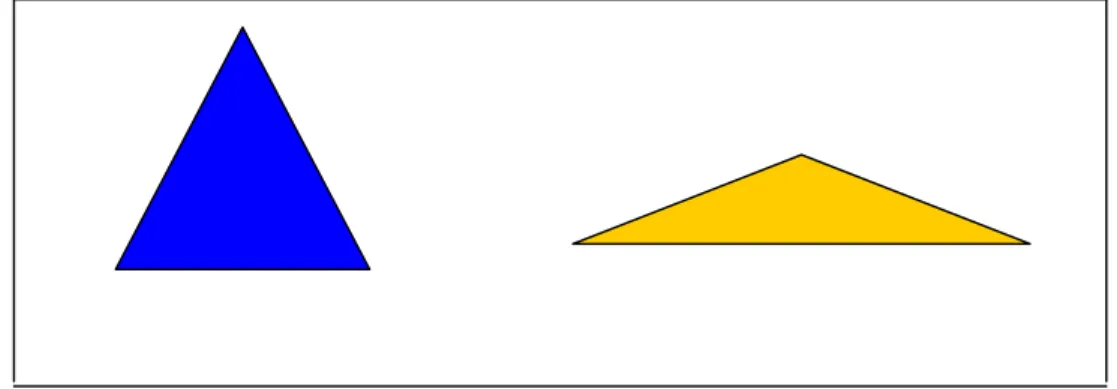
However, Ehlers and Lazenby suggested the following organisational reporting structures.
Fig. 2.4 Organisations Hierarchical Structures Adapted from: Ehlers and Lazenby (2004)
The above figure depicts possible reporting strucures of an organisation as suggested by the above authors. The first structure portrays symetrical hierarchicy and a narrow span of control and it was mostly used in the
1970s. This structure has many hierarchical layers. The second structures shows a flat hierarchical and a wide span of control. It has a few hierarchical layers as compared to the previous structure. This structure is encouraged and widely and currently used as it is time-saving when a quick decisions have to be made.
It is not always that an organisation’s strategy brings forth the expected positive results, sometimes instead of being successful, these strategies become failures and this could be caused by different reasons. Charan and Useem in Maidment (2004/2005) listed ten corporate sins that explain why companies fail and they include the following;
Softened by Success
This happens when a successful company ignores to make necessary plans for the future due to its success. The management thinking that that company will always be successful.
See no Evil
This is when a company fails to read its surrounding environment and is unable to confront the changing world around it. These kind of companies are slow to act or adjust if anything unordinary happens to their environment.
Fearing the Boss More Than the Competition
When the surbordinates are afraid to tell their bosses of the dangers that might be facing their company. They are afraid to tell the truth or withold the important information which the management needs to make informed decisions. It is said that in such environment, employees most of the time are concerned with internal affairs than worrying about the outside world or competitors.
The New-economy Death Spiral
This happens when a company losses its main assets – employees/people and ideas. For instance, high level of employees’ resignation, customers delay in placing new orders and more of them defect.
2.5.4 Management Information Systems and Supply Chain
Simchi-Levi, Kaminsky and Simchi-Levi (2003) mentioned internet technology as an important and useful force that the companies can use to drive their business in order to keep up with the ever-changing and vast- advancing business environment.
The mordern business should have appropriate equipment and use mordern technology to reach its stakeholders (through e-commerce, e-business etc.) and also to ensure that customers and other stakeholders are able to reach it through the internet, e-mail and so on.
2.5.5 Research Methods
Research is a vital part of the business decision-making process (Blumberg, Cooper and Schinder: 2005, Leedy and Ormrod: 2005 and, Searle: 2003). It is therefore, crucial that organisation engage themselves in this process not only to solve their organisational problems but also to make informative and correct decisions (Williamson: 2002).
In this area the focus is on how Lesotho Toursim Development Co- operation undertakes research to identify problems, find answerss and determine trends and identify inititives to improve the tourism industry in Lesotho.
2.6 Conclusion
Leisure tourism can have positive results in country’s economy. Lesotho as a small country, fully landlocked by the Republic of South Africa, still has a lot to do in order to improve this aspect of tourism domestically. The literature detailed in this chapter covered the objectives that had been set out earlier in this research.
In order to better understand the focus of this research, the first part of this chapter outlined the meaning of tourism as a whole. Then it narrowed down to mention some kinds of tourism with specific interest on domestic leisure tourism which is the main focus of this report. This kind of tourism is described as the movement of residents of a certain country travelling with the borders of that country for leisure purposes.
The second part explored the theories on this topic which are linked to the objectives of this research. This part also gave clarity of the type of media initiatives that are engaged to promote leisure tourism in other areas where those studies were carried out. In the light of this, it is anticipated that appropriate questions will be asked (when doing data collection) which will unearth the required information for best addressing the objectives of this research. This part is completed by giving some specific literature on Lesotho Tourism, the establishment of Lesotho Tourism Development Co-operation (which is the heart of this project).
The intension of this research project is to focus on the media initiatives that are engaged by the LTDC. As such, one cannot make proper judgement of an organisation without using appropriate method of assessement, both of that organisation as well as the industry on which the organisation is part of. The literature on how this is done is given as the last part of this chapter. This includes amongst other things the human resource management, the financial practices, strategy that an organisation can employ etc.
The following chapter will give the methodology of how this research was conducted to unearth the needed information about Lesotho’s domestic leisure tourism.
CHAPTER 3: RESEARCH METHODOLOGY
3.1 Introduction
This chapter sets out the methodology that was employed in this research. The research relied predominantly on the use of qualitative data even though a some quantitative data was employed. The researcher decided to use qualitative data because it gives better insight on this field (Blumberg et al.,: 2005). Qualitative research is also richer than quantitative research.
The material for this research was collected from electronic resources, journals, completed thesis and other publications that were relevant to the study.
Quantitative data was used because it gives a clear picture of the current situation and it was collected with the use of questionniare as well as unstructured interviews (Leedy and Ormrod: 2005).
3.2 Aim and Objectives of the Study
The main aim of this research was to identify appropriate media initiatives that could be engaged by the LTDC in order to promote domestic leisure tourism. The objectives were set out as follows;
To establish tourism patterns in Lesotho within the period 2001-2006 to see whether there has been an increase or decrease in this industry.
To establish factors that influence tourism patterns in Lesotho and identify what impact media can have on these factors.
To identify which media forms are used by the LTDC at the moment.
To identify appropriate media for domestic tourist markets.
To establish problems surrounding media tourism promotions and how they can be addressed.
3.3 Data Collection Strategies
“An advantage of using primary data is that the investigator/researcher knows where the data came from, the circumstances under which they were collected and any limitations or inadequencies in the data” (Searle:2003). As such, primary data was collected through unstructured interviews with eleven (11) employees of Lesotho Tourism Development Co-operation/Ministry of Tourism, Environment and Culture. Questionnaire was completed at identified thirty (30) tourist destinations. Furthermore, Searle (2003) stated the advantage of using secondary data as being cheaply available. Secondary data was therefore sought from publications from various destinations, LTDC, electronic resources (Google, Science Direct, Sabinet and Ebsco Host).
3.4 Sampling Technique
Given the nature of this study, the time consuming nature concerning the administration of questionniares, time and financial constraints and the number of tourist attractions that Lesotho has, sampling was inevitable. Williamson (2002), supported by Render et al., (2005) stated that sampling involves selecting a sample of items from a population as it is in most practical situations impossible to examine the whole population in a survey.
A sample of thirty (30) tourists attractions were targeted for the questionnaire. The sampled participating attractions were chosen on the basis that they represent their type of attractions as well as the region on which they were based. For instance, Lesotho Sun Hotel and Casino was chosen to represent hospitality industry and attractions in the urban areas of the country. Tšehlanyane was identified to represent the nature reserves and the sub-urban areas of the country while Bokong Pony Trekking represented the rural and the pony trekking attractions.
With the assistance of the LTDC public relations officer, a list of individuals (who were available) from different departments of the LTDC as well as the MTEC was made. Those individuals were believed to have relevance to the research project that why they were identified. The list was compiled and unstructured interviews were held with each one of them.
With the above facts, it was certain that not all role players in the industry were involved in this research as Huysame (1994) cited in Khumalo (2006) stated that “it is not practically and economically feasible to involve all members of the population in a research project”. The implication was that not all destinations/attractions in Lesotho were reflected in the study in the first instance while on the last instance, the implication was that not all the views of the staff of the LTDC were received.
3.4.1 Population
The LTDC had forty-five (45) employees (Lesotho Tourism Policy: 2003).
There are about 120 tourist attractions in Lesotho which include; hotels, pony trekkings, natural sceneries, natural parks, historical sights and man- made structures. These attractions are spread across the country (About LTDC: 2003).
3.4.2 Sample Size
The interviews were held with seven (7) of the most senior LTDC staff members and given their positions and experience their input was of value.
It was decided not to interview the LTDC employees as they would largely be unaware of policy and implementation issues. The other four (4) people that were interviewed were from the MTEC who were dealing directly with LTDC. Those were the director of tourism and three (3) tourism officers.
The questionnaire were distributed to thirty (30) tourist attractions. The attractions that were selected represented the urban areas, sub-urban areas and rural areas (Lesotho Review: 2007). In total, 37 people within the tourism industry were surveyed, due to the small size of the Tourism Industry in Lesotho, the research targeted people at senior, informed parties.
It was decided at the outset to focus on industry sources for this reasearch.
The reason being that the researcher wanted to determine an industry perspective of the situation as the resports and tour companies are the organisations that attract and convey tourists and as such they stand to lose
out financially if they fail to deliver. Their interaction with one another and of course with the LTDC thus being the core focus of this research.
3.4.3 Validity
Leedy and Ormrod (2005) supported by Blumberg et al., (2005) described the validity of measurement instrument as “the extent to which the instrument measures what it is supposed to measure. The question that validity asks is: Does such a test or instrument, in fact, measure what is intended to be measured or something else altogether?”
Searle (2003) adds that “validity is concerned with whether what one is measuring is what one really intends to measure. Something is valid if it really measures what it claims to mearsure”. Blumberg et al., (2005) further state that “validity of the data should be judged in terms of four qualities;
relevance, freedom from bias, reliability and availability. The questions that are asked are clear and relevant to the topic being researched”.
In view of the above theories, the instruments that were used in this research project seemed to be appropriate. They were constructed is such a way that they yielded the information which the researcher was looking for when conducting this study.
The principal purpose of this research was to find out whether or not media were used effectively to promote domestic leisure tourism. As it was the responsibility of LTDC to conduct effective marketing initiatave for the said tourist destinations, this study revealed LTDC’s marketing strategies.
The focus being on media promotions intended to promote domestic leisure tourism.
The effect of these initiatives will be disscused under the findings.
However, it was worth noting here that the media have an effect on tourism promotion (Lubbe: 2003) inspite of some prevelant limitations. Those limitations will also be discussed in the findings.
3.4.4 Reliability
“It referes to the consistency and dependability of the data. If the same study was done by a different researcher, or again by the same researcher at another time, the results are the same, then the data is said to be reliable”.
Searle (2003). Leedy and Ormrod (2005) agreed and further state that
“reliability is the consistency with which a measuring instrument yields a certain result when the entity being measured remains constant”.
The data collected in this study was reliable due to the fact that it came from respondents who dealt with issues relating to tourism marketing on regular basis. As their responses were premised on properly profiled information, it was possible that if another researcher could conduct a similar study, he/she will have the same findings that this study revealed.
Searle (2003) confirms that “something is reliable if you or other people can repeat your study and get the same results”.
For instance, quantitative data revealed in this study comes from records of affected specific organisations and as such if another researcher could conduct the similar study the same records would give similar outcome.
The respondents were given interview questions before hand in order to enable them to refer to documents containing relevant required information for the research. That eliminated chances of omissions that would result in responses which come off head - if the respondents were not given the lattitute to prepare through references to necessary documents - from both marketing and research divisions of the LTDC.
3.5 Research Design and Methodology 3.5.1 Description and Purpose
This research was both qualitative and quantitative in nature. According to Leedy and Ormrod (2005), qualitative research serves the following purposes;
Description – it reveals the nature of certain situations, settings, processes, relationships, systems or people. In the same way, this research revealed the nature of domestic leisure tourism and the responsibility of LTDC in promoting leisure tourism in the country.
Interpretation – It enable a researcher to:
Gain new insights about a particular phenomenon,
Develop new concepts or theoritical perspectives about the phenomenon, and/or
Discover the problems that exist within the phenomenon.
Similarly, this research enabled a researcher to
learn more about the type of media that are used in the country by the LTDC
acknowledge other forms of promotions that can be used to promote tourism
discover problems that are associated with using different types of media in promoting tourism.
Verification – It allows a researcher to test the validity of certain assumptions, claims, theories, or generalisations within real-world contexts.
In the same way, Through the fieldwork (interviews and questionnaire) the researcher was able to test the validity of assumptions and generalizations that she had before conducting this study. The researcher was also able to test the theories that were presented in chapter two of this research.
Evaluation – It provides a means through which a researacher can judge the effectiveness of particular policies, practices, or innovations. In the course of this research, the researcher was able to judge the effectiveness through the findings in comparison to the theories.
Searle (2003) supported this view and added that qualitative research usually involves only a few cases unlike the quantitative research which was precisley what the researcher did. It was also qualitative in that
secondary data was used not only to get the historical background of the domestic leisure tourism but also to familiarise the researcher with the field.
The research was to some extent quantitative in nature because primary data was collected in order to get new information or current status of the subject matter. The purpose of this research was to find out how domestic leisure tourism can be promoted in Lesotho, identifying problems that are facing domestic leisure tourism and how these problems can be addressed.
In addition, Searle (2003) supported by Blumberg et al., (2005) stated that amongst other things, quantitative research is based on numbers, statistics and examines general patterns in data. One of the objectives of this research was to examine the pattern in the data collected in the past five years so the previous statement supported the view that this research was also of the quantitative nature.
3.5.2 Construction Of Instruments
An interview schedule was drawn up to be used in the unstructured interviews. It should be noted that there were other types of instruments that could be used to collect the required information such as telephone interviews, postal questionnaire and e-mail. The chosen instruments (face- to-face interviews and questionniares) were considered to be the most appropriate instruments for this research because; they were more personal;
they were practical and; they provided first-hand information (Blumberg:
2005).
Furthermore, each instrument has the following advantages as stated by Williamson (2002).
Advantages of personal interviews;
- Standardised questions and ways of recording the responses mean that less skilled interviewers may be used, thereby reducing the cost of the survey.
- The questions can be given in a fixed order with a fixed wording and the answers can be recorded in a standard manner. This will reduce variability if there is more than one interviewer involved in the survey.
- The interviewers can ask, within narrow limits, for a respondent’s answer to be clarified.
- The interviewer is able to reduce respondent anxiety and allay potential embarrassment, thereby increasing the response rate and decreasing the potential error.
- Pictures, signs and objects can be used.
Advantages of questionnaire;
- The cost per person is likely to be less, so more people can be sampled.
- It is usually possible to ask more questions because the people completing the forms ( the respondents) can do so in the own time.
- All respondents are presented with questions in the same way.
There is no opportunity for an interviewer to influence responses (interviewer bias) or to misrecord them.
- It may be easier to ask personal or embarrassing questions in a questionnaire than in a personal interview.
- Respondents may need to look up information for the questionnaire.
This will be easier if the questionnaire is completed from either home or place of work.
The researcher decided to use unstructured interviews as opposed to the structured or semi-structured interviews because of the following advantages; the respondents were not asked to respond to a fixed set of questions; they provide guiding questions to the topical direction and coverage (which ensured that only the required information was offered);