1
CHAPTER I
INTRODUCTION
1.1 Background
The reduction of air pollution from combustion devices is an
increasingly serious concern worldwide due to the rise in fuel usage
especially for transport applications in urban areas. Spark-ignition (SI)
and diesel engines, widely used to power various types of vehicles,
have been shown to be a major source of air pollution in cities (Faiz A,
et al, 1996). The primary pollutants emitted from modern SI engines
are mainly oxides of nitrogen, (primarily nitric oxide, NO, with a small
amount of nitrogen dioxide, NO2, collectively known as NOx), carbon
monoxide (CO), organic compounds that are mainly unburned or
partially burned hydrocarbons (UHC), small amounts of oxides of
sulfur and particulates.
Overcome the problem of vehicle exhaust emissions, various
attempts were made many countries. One of them by applying modern
technology to produce automotive exhaust gas emissions at a
minimum level. To encourage technology development of
environmentally friendly vehicles by the automotive industry in the
world, introduced the Euro standard 1991 in European countries.
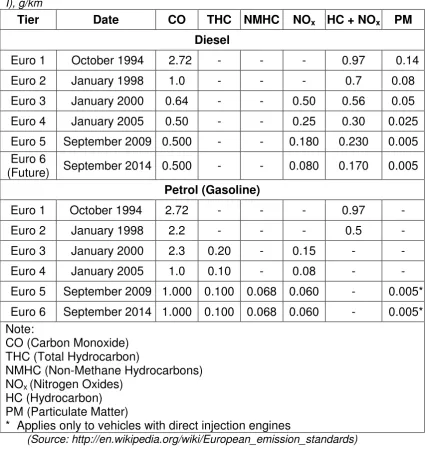
European emission standards or Euro Standard define the
2
member states. The emission standards are defined in a series of
European Union directives staging the progressive introduction of
[image:2.595.108.534.184.635.2]increasingly stringent standards.
Table 1.1 Euro Standard for Light Commercial Vehicles ≤1305 kg (Category N1 -I), g/km
Tier Date CO THC NMHC NOx HC + NOx PM
Diesel
Euro 1 October 1994 2.72 - - - 0.97 0.14
Euro 2 January 1998 1.0 - - - 0.7 0.08
Euro 3 January 2000 0.64 - - 0.50 0.56 0.05
Euro 4 January 2005 0.50 - - 0.25 0.30 0.025
Euro 5 September 2009 0.500 - - 0.180 0.230 0.005
Euro 6
(Future) September 2014 0.500 - - 0.080 0.170 0.005
Petrol (Gasoline)
Euro 1 October 1994 2.72 - - - 0.97 -
Euro 2 January 1998 2.2 - - - 0.5 -
Euro 3 January 2000 2.3 0.20 - 0.15 - -
Euro 4 January 2005 1.0 0.10 - 0.08 - -
Euro 5 September 2009 1.000 0.100 0.068 0.060 - 0.005*
Euro 6 September 2014 1.000 0.100 0.068 0.060 - 0.005*
Note:
CO (Carbon Monoxide) THC (Total Hydrocarbon)
NMHC (Non-Methane Hydrocarbons)
NOx (Nitrogen Oxides)
HC (Hydrocarbon) PM (Particulate Matter)
* Applies only to vehicles with direct injection engines
(Source: http://en.wikipedia.org/wiki/European_emission_standards)
Indonesia to address motor vehicle exhaust emissions have
been set on exhaust emission limits. For older vehicles or who already
operate on the road used The Decree of Environment Minister No.
3
for the new type vehicles and motor vehicles are being produced set
emission standards Euro. Currently, Indonesia has adopted the Euro II
standards as stated in Decree of Environment Minister No. 141/2003.1
Threshold of motor vehicle exhaust gas emission is a maximum
limit of substances or contaminants that may be issued directly from
the exhaust pipes of motor vehicles.2
Hydrogen has been widely acknowledged for a long time to be
a most promising fuel that can continue to meet the increasingly
stringent emission regulations without the production of greenhouse
gas emissions. However, CO, carbon dioxide (CO2) and UHC were
shown to be present in the exhaust gases of SI engines operated on
pure hydrogen (Furuhama S. and Hiruma M., 2004), albeit at very
small concentration levels. These carbon-bearing species inevitably
result from the complete and incomplete oxidation of the very small
amounts of lubricating oil. They can be considered conveniently as
natural tracers for indicating the levels of lubricating oil consumption
and can be measured readily by normal gas analysis equipment and
methods. There is an increasing interest in examining the engine oil
consumption mechanism and develop procedures for its further
reduction for economic and emissions control purposes.
The liquid hydrocarbon, typically gasoline, is not itself explosive;
rather, only the vapor derived from the liquid is explosive. Since the
vaporization process is exothermic, past efforts have been made to
1
[email protected], September 5th, 2005, explanation of Euro 2
4
warm the fuel charge before it is admitted to the combustion cylinders,
in order to hasten the vaporization.
A variety of heat exchangers which warm the charge with the
combustion exhaust products have been proposed as well as various
electric resistant heaters and from water radiator (Erfan Jauhari,
2005). In most modern carburetors a "hot spot" is provided which is
heated with the exhaust gas. Also, various forms of "atomizers" have
been proposed to subdivide the fuel into droplet form, thereby
increasing the surface area of a given fluid quantity to hasten its
vaporization.
The present invention of Hydrocarbon Treating System broadly
contemplates achieving the advantages provided by vaporized fuel
charge through use of a unique liquid fuel and a novel arrangement for
vaporizing that fuel to achieve a vapor fuel that may be provided
directly to the combustion chamber. This is not a fluid mist formed of
droplets as are the outputs of prior art devices but is in true gaseous
form. The inventor of this device stated that HTS can reduce the fuel
consumption up to 50 percent.
Through this research, the writer wants to analysis the effect of
HTS installation to the emission of engine and fuel consumption. The
result of this research will give us explanation whether this device
5 1.2 Objectives
1.2.1 How to know the effect of using Hydrocarbon Treating System
to CO emissions of four-stroke spark-ignition engine.
1.2.2 How to know the effect of using Hydrocarbon Treating System
to UHC emissions of four-stroke spark-ignition engine.
1.2.3 How to know the effect of using Hydrocarbon Treating System
to fuel consumption of spark-ignition four-stroke engine.
1.3 Outcomes
Two kinds of benefits which can be gained from the study are
as follows:
1. Theoretical Benefit
The study is expected to give additional information and
knowledge about effect of Hydrocarbon Treating System (HTS) on
exhaust emission of four-stroke engine.
2. Practical Benefit
The study is expected to enrich the knowledge of researcher
and reader about principles and mechanisms of bubbler system and
Hydrocarbon Treating System.
1.4 Problem Limitations
Problem limitation on the writing of this problem is used to
adjust the tools which available and also for issues to be discussed or
6 Limitations are as follows:
a. The fuel which used in the experiment is gasoline with octane
number 88.
b. Engine that used is Honda Revo version 2008 (Standard)
c. The discussion is about the emission before and after using of
Hydrocarbon Treating System.
d. The research will be done in three conditions which are low,
medium and high rotation.
e. The writer will not discuss about calculation of heat transfer that
occurs in the catalyst. The heat transfer process that occurs only