Indications of Climate Regime shifts in the Middle Adriatic Sea
Frano MATIĆ*, Branka GRBEC and Mira MOROVIĆ
Institute of Oceanography and Fisheries, P.O. Box 500, 21000 Split*Corresponding author, e-mail: [email protected]
INTRODUCTION
The Adriatic Sea, as adjacent sea of the greater Mediterranean Sea, is under direct influence of atmospheric processes and their variability. Cold deep water formed under strong winter outbursts of Bura wind in the Northern Adriatic plays crucial role in the overall Adriatic circulation. Interannual variability of temperature and salinity in the Adriatic Sea is firstly interplay of Northern Adriatic Dense water (NAdDW) formation and intrusions of Levantine Intermediate Water (LIW) (BULJAN, 1953; ZORE-ARMANDA, 1963; VILIBIĆ & ORLIĆ, 2001). The LIW continuously enters the Adriatic in the intermediate layer but with variable intensity depending on wider scale atmospheric conditions (ZORE-ARMANDA, 1972; GRBEC et al., 1998), which are of global character.
It is supposed that El Nino Southern Oscillation (ENSO) was one of the mechanisms
Applying sequential t-test analysis for regime shift detection on 52 years (period 1963-2004) of continuous summer thermohaline data at the three ocean stations in the Adriatic Sea, the two shifts in sea temperature were evidenced, around 1987 and 1998. These shifts separated three climate regimes, where the first climate regime is rather similar to the third one. The first climate regime (1963-1986) is characterized by moderate temperatures and rather high salinities. The first shift occurred in 1987, triggering the second climate regime, influenced by East Mediterranean Tran-sient (EMT). The temperature and salinity in the Adriatic in the second climate regime were lower for one standard deviation than in the previous regime. In the third regime, after second shift the temperatures and salinities abruptly increased. All these conditions were influenced by changes in wind field pattern over the Mediterranean.
that in 1977 have caused the change from one climate regime to another all over the world seas. The change was recorded in a number of abiotic and biotic oceanic parameters (MILLER et al., 1994; MANTUA et al., 1997; NEWMAN et al., 2003; HSIEH et al., 2005). The changes in the atmosphere
and ocean between 1977 and 1989 were so intense that hundreds of marine parameters (31 abiotic and 69 biotic) have shown synchronous shift (HARE & MANTUA, 2000). Climate shift was attributed to fluctuations of atmospheric and oceanographic structures like ENSO and Pacific Decadal Oscillation (PDO). In the period 1987-1988 strong El Niño phase switched very fast to a strong La Niña phase in the period 1988-1999 (SCHWING et al., 2002); this change was fastest in
the last 100 years. It is supposed that these fast changes triggered atmospheric and oceanic shift to a new climate state, after which the system did not return to a state before 1977 but shifted to a new regime (PETERSON & SCHWING, 2003).
Climate state in the Pacific Ocean oscillates between warm and cold phases. The PDO switched phases in 1925, 1945-1946, 1976-1977, 1988-1989 and 1997-1998 (MANTUA & HARE, 2002; OVERLAND et al., 2008). The change of
climate regimes of Pacific Ocean as the greatest ocean, influence the climate in the whole Earth, e.g. have global character. The evidences are found all over the world from the Pacific to other oceans and seas, the Northern Atlantic, Bering Sea and Baltic Sea as well as in the Mediterranean including the Adriatic Sea. For geographical reasons, the European seas are influenced by different climate impacts: from mid latitude and sub-tropical variability to sporadic intrusions of polar air mass. European climate variability is highly related to large scale pressure centres distribution, which also influence the Adriatic Sea atmospheric variability as well as variability of the marine ecosystem (biotic and abiotic) (GRBEC et al., 2007; GRBEC et al., 2009).
The most significant changes in the Adriatic Sea temperature occurred in 1980, 1987 and 1999 and are associated to cold winters. As already stated, cold winters are in favour of formation of NAdDW, which regulates LIW intrusions from the Mediterranean. In late eighties the East Mediterranean Transient (EMT; KLEIN et al., 1999)
occurred and the Adriatic water did not contribute much to a deep Eastern Mediterranean waters. Consequently the exchange of waters between the Adriatic and Mediterranean in deep layers slowed down. This resulted with colder South and Middle Adriatic deep waters in the areas where usually warmer and saltier LIW could be found (GRBEC et al., 2009). Normally, in the Ionian
Sea the circulation was cyclonic until that period, while in late eighties circulation switched to anti-cyclonic (BORZELLI et al., 2009; GAČIĆ et al.,
2010). Such conditions are consequences of large scale pressure distribution which changed winds and circulation in the surface and intermediate layers. The transient ended in mid-nineties when the circulation turned to normal, and stronger water exchange between the Adriatic and Mediterranean again took place.
Transient like conditions may trigger shifts in the ocean changing climate from one regime
to another. Generally the climate regime is characterized by a stable mean value and variance of parameters throughout a longer period. The fast change to another climate state is defined as climate shift.
In the last century atmospheric parameters changed its climate regimes several times. Atmospheric stresses resulted with stress in the coupled atmospheric-marine environment. Stress may change the climate state from one stable regime to another. In this paper in detail we defined regimes of temperature and salinity in the water column of the middle Adriatic and have also determined the timing of the shifts. Our intension was detecting of thermohaline climate regimes as such, without going to details of the atmospheric processes connected to climate indexes responsible for these shifts.
MATERIAL AND METHODS
Time series of monthly values of temperature and salinity in the Middle Adriatic (Fig. 1.) for ocean stations OS1, OS2 and OS3 were analysed. Although monthly measurements in this transect started in fifties only the series for the period 1963-2004 were used, consideringFig. 1. Adriatic Sea and geographical locations of ocea-nographic stations OS1 (43° 12.0’ N, 16° 19.0’E), OS2 (43° 0.0’ N, 16° 20.0’E) and OS3 (43° 36.0’ N, 16° 16.0’E)
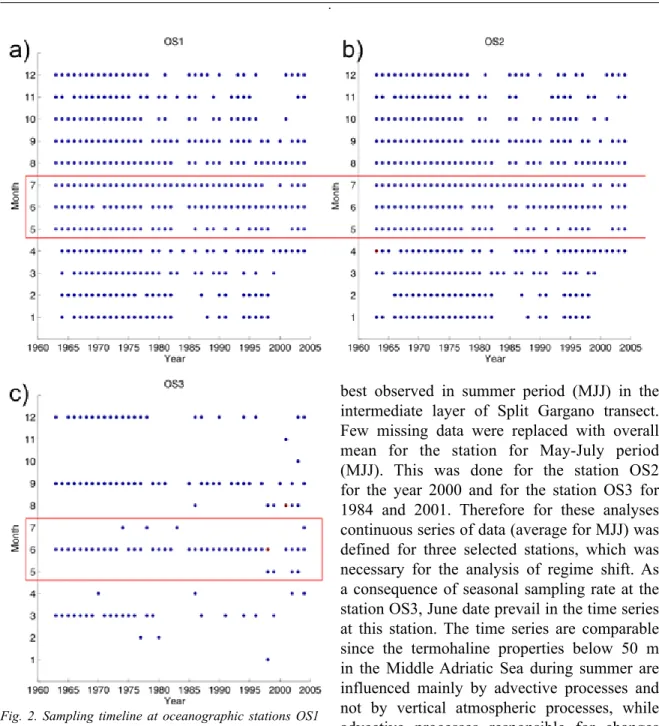
the best coverage frequency. Available data for all three stations (Fig. 2.) show that most of measurements were performed in the warm part of the year. The measurements were done with classical methods until 1998 and CTD probe Sea Bird SBE 25 was used in the latter period. Details about methodology and data can be found in earlier works (BULJAN & ZORE-ARMANDA, 1966, 1979; ZORE-ARMANDA et al., 1991).
Changes of thermohaline properties of intermediate layer caused by climate are
Fig. 2. Sampling timeline at oceanographic stations OS1 a), OS2 b) and OS3 c). Red squares denote the data that were used for analyses
best observed in summer period (MJJ) in the intermediate layer of Split Gargano transect. Few missing data were replaced with overall mean for the station for May-July period (MJJ). This was done for the station OS2 for the year 2000 and for the station OS3 for 1984 and 2001. Therefore for these analyses continuous series of data (average for MJJ) was defined for three selected stations, which was necessary for the analysis of regime shift. As a consequence of seasonal sampling rate at the station OS3, June date prevail in the time series at this station. The time series are comparable since the termohaline properties below 50 m in the Middle Adriatic Sea during summer are influenced mainly by advective processes and not by vertical atmospheric processes, while advective processes responsible for changes of temperature and salinity in the intermediate layer have low variability at seasonal scale (GRBEC, 1997).
The sequential t-test analysis for regime shift detection STARS method (RODIONOV, 2004) defines climate regimes as stable periods. This analysis is performed utilizing Student t-test which determines whether the next period in the investigated time series is significantly different from the previous period. If this is the case, the year in time series when it occurred is a start of a new regime. The hypothesis of existence of a new regime is tested based on subsequent
observations, using regime shift index (RSI). The
RSI represents cumulative sum of normalized deviation from the empirical mean for the new regime. The determination of the regime is strongly dependent on the cut-off length l, probability level p (RODIONOV & OVERLAND, 2005) and Huber parameter H (HUBER, 1964). In this paper cut-off length is selected to l=10 years, p0.05 and H=2 in order to give minor influence to the data which exceed 2 standard deviations. The sequential regime shift detection method is available at www.beringclimate.noaa.
gov/regime.
RESULTS AND DISCUSSION
We analysed the time series from 1963 to 2004 of temperature and salinity vertical profilesat stations OS1, OS2 and OS3 down to the deep layers (Fig. 3 and 4) and their anomalies standardized relative to the period 1963-1986 (Fig. 5 and 6).
In the period May to July the water profile is stratified at all the stations. We can see that going offshore (from OS1 to OS3) surface layer variability of temperature and salinity decreases while variability in deeper layers increases. Isotherm 15°C is a border between the layers influenced by atmospheric processes from the layer which is under stronger influence of advective processes (GRBEC, 1997).
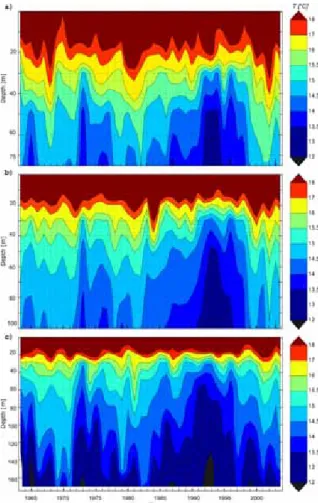
The range of temperature in the intermediate layer was between 12°C and 15°C with significant interannual variability (Fig. 3). Starting from mid eighties the presence of colder water pool in deep layers is evident at all the stations. In
Fig. 3. Time evolution of vertical profiles (Hovmöller dia-gram) of average MJJ sea temperature [°C] at sta-tions OS1 a), OS2 b) and OS3 c). Vertical scales differ between stations
Fig. 4. Time evolution of vertical profiles (Hovmöller dia-gram) of average MJJ salinity at stations OS1 a), OS2 b) and OS3 c). Vertical scales differ between stations
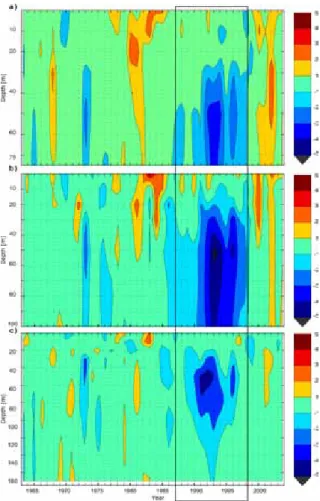
the first period, during 23 years there were not warmer or colder periods longer than two years. Temperature anomalies below 50 m depth until 1987 oscillated mainly within one standard deviation (Fig. 5) around the mean from the period 1963-1986. In the period 1987-1998, the temperature below 50 m was lower than average for more than two standard deviations. The highest deviation from the mean is observed at OS2 in 1993 and 1996, where it was higher than four standard deviations.
Relatively low temperatures were present below thermocline, but not at the surface, pointing that advective processes did not bring in the area warmer and more salty Mediterranean waters in the Adriatic. This indicates the shift in climate regime. After 1998, the temperature conditions of intermediate layer turned back to previous values.
As already pointed, due to the EMT, the exchange of waters between the Adriatic and Mediterranean decreased in the period 1987-1998, and this lower ventilation resulted with lower temperatures of the Middle Adriatic waters. Similar phenomenon is also observed in the deep South Adriatic Pit (VILIBIĆ & ORLIĆ, 2001).
Lower salinities in the surface layer are best expressed at the station OS1, which is most exposed to the river influence. The depth of relatively low salinity 38.2 varies much and in some years reached down to 50 meters.
Between strong interannual variability at all stations we can distinguish period characterized by lower salinity values at station OS2 from 1987-1998, although less visible in salinity anomaly, as salinity is more conservative variable than temperature. However, evidence that the Adriatic did exchange less water with the Mediterranean is observed in lower oxygen content (GRBEC et al., 2009) and lower nutrient
input (KUŠPILIĆ et al., 2004).
Positive anomalies are more frequent than negative, implying that most of the investigated period salinities were higher than the mean value for the 1963-1986. Salinity higher than 38.6 points to the years with higher intrusion of Mediterranean waters through the Otranto
known as Adriatic ingressions. Episodes of higher intermediate layer salinity were recorded in 1968, 1978, 1982, 1987 and 2003. High positive anomalies appeared in 2003 at all the stations, especially at OS2. Between the year 1987 and 2003, no positive salinity anomalies were recorded. Strong positive anomaly in 2003 was caused by two reasons, higher Mediterranean intrusions and the absence of precipitation from February-August (GRBEC et al., 2007), impacting also low Neretva river
runoff. This strong atmospheric anomaly was observed in the area of Northern Adriatic (LYONS
et al., 2006) as well as in the Southern (MOROVIĆ et al., 2006). The atmospheric conditions in this period have modified thermohaline circulation in the whole Adriatic (ORLIĆ et al., 2007).
Fig. 5. Time evolution of vertical profiles (Hovmöller dia-gram) of MJJ standardized temperature anomaly at stations OS1 a), OS2 b) and OS3 c). Vertical scales differ between stations
In the Fig. 7 the detected shifts for temperature a) and salinity b) in layers below 50 m are shown. In the period 1963-2004, the two shifts (according to Student’s t-test at significance level of p <10-4) were detected in
intermediate layer temperature data. The two shifts separated the three regimes. First shift occurred approximately around 1987 and second around 1998. After second shift the system turned back to a warmer regime, although the thermohaline circulation was similar in the first and the third regime, implying higher intrusions from the Mediterranean. For defined periods for all stations and different depth layers the average and standard deviation for temperature and salinity are given in the Table 1.
After the period of 24 years in which there were not significant changes in the intermediate
layer, the temperature shift occurred. Abrupt decrease of sea temperature in 1987 was the start of a different colder climate regime that lasted 12 years (Fig. 8). Temperature decrease was observed at all the three stations. In 1999, an abrupt increase of temperature occurred, e.g. the system turned to the third climate regime while its circulation probably turned to the state before the first shift.
It can be noted that at the station OS1 the temperature increased to a level higher than in the initial state, pointing that climate warming in the coastal sea might have taken place.
Figure 6
Fig. 6. Time evolution of vertical profiles (Hovmöller
dia-gram) of MJJ standardized salinity anomaly at sta-tions OS1 a), OS2 b) and OS3 c). Vertical scales differ between stations
Figure 7
Fig. 7. Regime shift index (RSI, RODIONOV, 2004) of tem-perature a) and salinity b) taking cut-off length l=10,
at significance level p=0.05 and Huber parameter H=2, applied to May-July average data at different depth at stations OS1, OS2 and OS3 in the period 1963-2004
Table 1. Means and standard deviations of average May-July sea temperature and salinity for station OS2 during different Adriatic Sea climate regimes
Figure 8
Fig. 8. Time series (black) and climate regimes (blue) for
average May-July sea temperatures at stations OS1 (a) at 75 m, OS2 (b) at 100 m and OS3 (c) at 100 m
Fig. 9. Time series (black) and climate regimes (blue) for average May-July sea salinity at stations OS1 (a) at 75 m, OS2 (b) at 100 m and OS3 (c) at 100 m
Figure 9 Temperature [ °C ] Depth [m] \ Period 1963 – 1986 1987 – 1998 1999 – 2004 0 20.99 ± 1.14 20.96 ± 1.04 21.94 ± 0.59 10 19.94 ± 0.96 19.59 ± 1.25 20.54 ± 1.19 20 17.24 ± 0.86 16.50 ± 0.72 18.15 ± 1.29 30 15.88 ± 0.50 15.03 ± 0.66 16.33 ± 0.71 50 15.02 ± 0.34 14.09 ± 0.43 15.26 ± 0.32 75 14.56 ± 0.30 13.72 ± 0.37 14.80 ± 0.31 100 14.30 ± 0.32 13.53 ± 0.34 14.60 ± 0.34 Salinity Depth [m] \ Period 1963 – 1986 1987 – 1998 1999 – 2004 0 37.92 ± 0.33 37.96 ± 0.42 38.16 ± 0.42 10 38.14 ± 0.25 38.13 ± 0.29 38.41 ± 0.23 20 38.38 ± 0.18 38.38 ± 0.23 38.58 ± 0.11 30 38.49 ± 0.16 38.46 ± 0.19 38.67 ± 0.12 50 38.57 ± 0.14 38.51 ± 0.15 38.71 ± 0.09 75 38.62 ± 0.11 38.60 ± 0.13 38.74 ± 0.08 100 38.66 ± 0.10 38.64 ± 0.10 38.75 ± 0.08
Regimes of salinity are not synchronous with the regimes of temperature. At all the stations the average salinity for May-July in the intermediate layer shifted to higher values in 1978, as a result of Mediterranean intrusions. In 1991 the third salinity regime initiated at stations closer to the Eastern coast (OS1 and OS2) and salinities suddenly decreased. Significant decrease of salinity however, was not recorded at the station OS3. This station is not influenced only by the NW current but also by reversed current from the west coast (VILIBIĆ et al., 2008). After 1999 salinity turned to the regime of higher salinities at OS1 and OS2. Although, considering the results of STARS method, the synchronicity of salinity and temperature was not obtained,
the drop of intermediate salinity was recorded in the period 1987-1998, accompanied with a drop of oxygen (GRBEC et al., 2009). The drop of
salinity, temperature and oxygen point to the presence of old water mass as a consequence of low ventilation of the Adriatic Sea in that period. The period of first climate regime (1963-1986) over wider Mediterranean area is characterized by a significantly different mean wind field than in the second climate regime (1987-1998) (Fig. 10). Over the Eastern Mediterranean the wind in the second period was much stronger than in the first period. In
Figure 10
the Ionian Sea wind direction changed from W to NW direction accompanied with increased speed. Changes in the wind field are also visible in the Otranto Strait where the wind was from SE direction and changed to North direction, e.g. the wind flows from the Adriatic Sea to the Ionian Sea. In the first climate regime the mean wind field for February over the Adriatic Sea shows characteristic wind field structure with NE wind over the Northern Adriatic and SE wind southward. In the second period, on contrary over the whole Adriatic wind was from NE direction. Although the wind didn’t change direction in the North Adriatic its speed considerably weakened in the second climate regime. This reduced its formation potential of cold water, which is important factor for circulation in the Adriatic Sea. The conditions in the wind field after 1987 have resulted with decrease for evaporation in the North Adriatic (GRBEC et al., 1998) while outbursts of polar air over the Aegean and Eastern Mediterranean caused significant evaporation increase that caused EMT (SAMUEL et al., 1999). All these
weakened the Adriatic ventilation and probably resulted with a second climate regime.
CONCLUSIONS
Analysis of May to July average temperature and salinity at the three stations along the transect Split-Gargano, revealed the three climate regimes (first until 1986, second from 1987 to 1998, third from 1999). All regimes are according to Student’s t-test significant at 0.01 level. Until 1986 the fluctuations of termohaline data of intermediate layer were within expected climate range. Mean temperature of intermediate layer in the second climate regime (13.72 ± 0.37 at OS2 at 75 m depth) was characterized with lower temperatures for more than two standard deviations in comparison with previous regime (14.56 ± 0.30 at OS2 at 75 m depth). Such thermohaline conditions took place until 1998, when the second shift occurred. After this shift the temperature abruptly increased e.g. turned to the values close to those before the first shift (14.80 ± 0.31 at OS2 at 75 m depth).
Although, considering the results of STARS method, the synchronicity of salinity and temperature was not obtained, the drop of intermediate salinity was recorded in the period 1987-1998, accompanied with a drop of oxygen (GRBEC et al., 1998). The drop of salinity,
temperature and oxygen point to the presence of old water mass as a consequence of low ventilation of the Adriatic Sea in that period.
These changes in the marine environment are consequences of atmospheric changes over the area wider than the Mediterranean. Differences in thermohaline regimes are probably caused by different wind field pattern. Periods before and after the two shifts are characterized by rather strong exchange through the Otranto strait, while in the period between the shifts the EMT was crucial for lower exchange between the Adriatic Sea and the Mediterranean, as a consequence of changed wind pattern in the Ionian Sea as well as over the Adriatic Sea.
ACKNOWLEDGEMENTS
The work in this paper is supported from the MINISTRY OF SCIENCE, EDUCATION AND SPORTS OF THE REPUBLIC OF CROATIA through the project: Cooscillations of atmosphere and the sea important for the Adriatic ecosystem. No 001-0013077-1118.
REFERENCES
BORZELLI, G.L.E., M. GAČIĆ, V. CARDIN & G. CIVITARESE. 2009. Eastern Mediterranean Transient and reversal of the Ionian Sea circulation. Geophys. Res. Lett., 36: L15108, doi:10.1029/2009GL039261.
BULJAN, M. 1953. Fluctuations of salinity in the Adriatic. Izv. rep. Rib. biol. Eksped. `Hvar’, 2(2): 1-64.
BULJAN, M. & M. ZORE-ARMANDA. 1966. Hydrographic data on the Adriatic Sea collected in the period from 1952 through 1964. Acta Adriat., 12: 1-438.
BULJAN, M. & M. ZORE-ARMANDA. 1979. Hydrographic properties of the Adriatic Sea
in the period from 1965 through 1970. Acta Adriat., 20: 1-368.
GAČIĆ, M., G.L. EUSEBI BORZELLI, G. CIVITARESE, V. CARDIN & S. YARI. 2010. Can internal processes sustain reversals of the ocean upper circulation? The Ionian Sea example. Geophys. Res. Lett., 37: L09608, doi:10.1029/2010GL043216.
GRBEC, B. 1997. Influence of climatic changes on oceanographic properties of the Adriatic Sea. Acta Adriat., 38(2): 3-29.
GRBEC, B., M. MOROVIĆ & M. ZORE-ARMANDA. 1998. Some new observations on the long-term salinity changes in the Adriatic Sea. Acta Adriat., 39: 3-12.
GRBEC, B., I. VILIBIĆ, A. BAJIĆ, M. MOROVIĆ, G. BEG-PAKLAR, F. MATIĆ & V. DADIĆ. 2007. Response of the Adriatic Sea to the atmospheric anomaly in 2003. Ann. Geophys., 25: 835-846.
GRBEC, B., M. MOROVIĆ, G. KUŠPILIĆ, S. MATIJEVIĆ, F. MATIĆ, G. BEG-PAKLAR & Ž. NINČEVIĆ. 2009. The relationship between the atmospheric variability and productivity in the Adriatic Sea area. J. Mar. Biol. Ass. U.K., 89(8): 1549-1558.
HARE, S.R. & N.J. MANTUA. 2000. Empirical evidence for North Pacific regime shifts in 1977 and 1989. Prog. Oceanogr., 27(2-4): 103 – 145.
HSIEH, C., S. GLASER, A. LUCAS & G. SUGIHARA. 2005. Distinguishing random environmental fluctuations from ecological catastrophes for the North Pacific Ocean Nature. 435(7040): 336–340.
HUBER, P. J. 1964. Robust Estimation of a Location Parameter. Ann. Math. Stat., 35: 73-101. KLEIN, B., W. ROETHER, B. MANCA, D. BREGANT,
V. BEITZEL, V. KOVACEVIĆ & A. LUCHETTA. 1999. The large deep water transient in the Eastern Mediterranean. Deep-Sea Res. Pt. I, 46: 371-414.
KUŠPILIĆ G., B. GRBEC, G. BEG-PAKLAR, M. MOROVIĆ & A. BARIĆ. 2004. Changes of oxygen saturation in the bottom layer of the middle-eastern Adriatic during the period 1972–2002. Rapp. Comm. int. Mer. Médit., 37: 216.
LYONS, D.M., I. JANEKOVIĆ, R. PRECALI & N. SUPIĆ. 2006. Northern Adriatic Sea hydrographic conditions from October 2002 – September 2003, including the climatic heating anomaly of summer 2003. Acta Adriat., 47: 81-96. MANTUA, N., S. HARE, Y. ZHANG, J. WALLACE
& R. FRANCIS. 1997. A Pacific interdecadal climate oscillation with impacts on salmon production. B. Am. Meteorol. Soc., 78: 1069-1079.
MANTUA, N. & S. HARE. 2002. The Pacific Decadal Oscillation. J. Oceanogr., 58(1): 35-44. MILLER, A.J., D.R. CAYAN, T.P. BARNETT, N.E.
GRAHAM & J.M. OBERHUBER. 1994. The 1976-77 climate shift of the Pacific Ocean. Oceanography, 7: 21-26.
NEWMAN, M., G.P. COMPO & M.A. MICHAEL. 2003. ENSO-Forced Variability of the Pacific Decadal Oscillation. J. Climate, 16(23): 3853–3857.
MOROVIĆ, M., F. MATIĆ, B. GRBEC, V. DADIĆ & D. IVANKOVIĆ. 2006. South Adriatic phenomena observable through VOS XBT and other ADRICOSM data. Acta Adrait., 47: 33-49. ORLIĆ, M., V. DADIĆ, B. GRBEC, N. LEDER, A.
MARKI, F. MATIĆ, H. MIHANOVIĆ, M. PASARIĆ, Z. PASARIĆ & I. VILIBIĆ. 2007. Wintertime buoyancy forcing, changing seawater properties, and two different circulation systems produced in the Adriatic. J. Geophys. Res., 112(C3): 1-21.
OVERLAND, J., S. RODIONOV, S. MINOBE & N. BOND. 2008. North Pacific regime shifts: Definitions, issues and recent transitions. Prog. Oceanogr., 77(2-3): 92-102.
PETERSON, W. & F. SCHWING. 2003. A new climate regime in northeast pacific ecosystems. Geophys. Res. Lett., 30(17): 1896-1900. RODIONOV, S.N. 2004. A sequential algorithm
for testing climate regime shifts. Geophys. Res. Lett., 31: L09204, doi:10.1029/2004GL019448.
RODIONOV, S.N. & J.E. OVERLAND. 2005. Application of a sequential regime shift detection method to the Bering Sea ecosystem. ICES J. Mar. Sci., 62(3): 328-332.
1999. Response of the Mediterranean Sea thermohaline circulation to observed changes in the winter wind stress field in the period 1980–1993. J. Geophys. Res., 104(C4): 7771–7784.
SCHWING, F.B., T. MURPHREE, L. deWITT & P.M. GREEN. 2002. The evolution of oceanic and atmospheric anomalies in the Northeast Pacific during the El Niño and La Niña events of 1995–2000. Prog. Oceanogr., 54: 459– 491.
VILIBIĆ, I. & M. ORLIĆ. 2001. Least-squares tracer analysis of water masses in the South Adriatic (1967-1990). Deep-Sea Res. Pt. I, 48: 2297-2330.
VILIBIĆ I., J.W. BOOK, G. BEG-PAKLAR, M. ORLIĆ, V. DADIĆ, M. TUDOR, P.J. MARTIN, M. PASARIĆ,
B. GRBEC, F. MATIĆ, H. MIHANOVIĆ & M. MOROVIĆ. 2008. West Adriatic coastal water excursions into the East Adriatic. J. Mar. Sys., 78: 132-156.
ZORE-ARMANDA, M. 1963. Les masses d’eau de la Mer Adriatique. Acta Adriat., 10(3): 1-93. ZORE-ARMANDA, M. 1972. Response of
the Mediterranean to oceanographic/ meteorogical conditions of the Northern Atlantic. Rapp. Comm. int. Mer. Médit., 21(4): 203-205.
ZORE-ARMANDA, M., M. BONE, V. DADIĆ, M. MOROVIĆ, D. RATKOVIĆ, L. STOJANOVSKI & I. VUKADIN. 1991. Hydrographic properties of the Adriatic Sea in the period from 1971 through 1983. Acta Adriat., 32(1): 1-547.
Received: 01 September 2011 Accepted: 26 October 2011
Indikacije klimatskih skokova u srednjem Jadranu
Frano MATIĆ*, Branka GRBEC i Mira MOROVIĆInstitute of Oceanography and Fisheries, P.O. Box 500, 21000 Split *Corresponding author, e-mail: [email protected]
SAŽETAK
Analizom dugodišnjih nizova (1963-2004) temperature i saliniteta u području srednjeg Jadrana, te primjenom sekvencijalnog t-testa (STARS) definirana su dva klimatska skoka, oko 1987. i 1998. godine. Ovi skokovi razdvajaju tri klimatska režima, te su prvi i treći sličnih osobina. Prvi je klimatski režim (1963-1986) karakteriziran umjerenim temperaturama i prilično visokim salinitetima. Prvi skok oko 1987.g. početak je drugog klimatskog režima, u kojem su termohaline osobine intermedijarnog sloja srednjeg Jadrana pod utjecajem istočno mediterananskog tranzijenta (EMT). Temperatura i salinitet Jadranskog mora u razdoblju drugog klimatskog režima bile su niže za jednu standardnu devijaciju nego u prethodnom razdoblju. Nakon drugog klimatskog skoka, što predstavlja početak trećeg klimatskog režima, temperatura i salinitet su se naglo povisili. Objašnjenje ovih promjena leži u činjenici da se u tom razdoblju promijenio sustav vjetrova nad Sredozemljem.