Jurnal Manajemen Pelayanan Kesehatan
MEASURING TRANSPARENCY TO IMPROVE GOOD GOVERNANCE OF
PHARMACEUTICALS IN INDONESIA
PENILAIAN TRANSPARANSI UNTUK MENINGKATKAN TATAKELOLA OBAT YANG BAIK DI INDONESIA
Sri Suryawati1
Centre for Clinical Pharmacology and Medicine Policy Studies Gadjah Mada University, Yogyakarta, Indonesia
ABSTRACT
A national survey has been conducted to assess the transparency in public pharmaceutical sector in Indonesia. The survey was conducted during 2007, and writer was appointed by the government as independent assessor. The assessment covered five functions of government in pharmaceutical sector, i.e., registration, control of promotion, inspection of production, selection of essential medicines, and central procurement of national buffer stock. Key informants were selected based on first-hand knowledge on each function, representing government, pharmaceutical company, academe/professionals, and NGOs, i.e. 10 informants for each registration, control of promotion, inspection of production, selection of essential medicines, and 20 informants for central procurement. Data were collected by means of in-depth interviews, using sets of questionnaires provided by the WHO. Findings were analyzed following a scoring system that ranging from zero to ten. The smaller the score indicates in-transparency, and therefore indicates the more vulnerability for corruption.
The results showed that the registration process scored 7.2, control of promotion scored 7.6, inspection of production scored 8.7, selection of essential medicines scored only 5.5, and the central procurement scored 7.0. In general, it is appreciated that the functions of registration, control of promotion, inspection, and procurement were well governed, but the selection of essential medicines obtained a low score. There has been remarkable lacking of written procedures that publicly available. In regard to the selection function, there is no written procedure in every process of selection, i.e., selection criteria of the revision committee member, written criteria for application, written criteria for addition, substitution and deletion, and written procedures of decision making. Declaration of interest is to some extents, lacking from most functions. It was recommended that the Government should establish written procedures of each function and make them publicly available, establish mechanism to minimize conflict of interest in each function i.e., by means of declaration of interest, and establish measures to fill up regulatory gaps. By the time of publication, corrective actions in all five functions have been made and at the time being the Government is ready for re-assessment.
Key words: transparency, pharmaceuticals, good governance, public sector, vulnerability for corruption
ABSTRAK
Suatu survey nasional telah dilakukan untuk menilai transparansi di sektor public pelayanan obat di Indonesia. Survei dilakukan tahun 2007, dan peneliti bertindak sebagai assessor independen yang ditunjuk pemerintah. Penilaian dilakukan terhadap lima fungsi pemerintah di sektor obat, yaitu registrasi, pengendalian promosi, inspeksi produksi, seleksi obat esensial, dan
pengadaan obat di tingkat pusat. Informan kunci dipilih berdasarkan penguasaan masalah yang terkait dalam setiap fungsi, mewakili pemerintah, produsen obat, institusi pendidikan dan profesi, dan lembaga masyarakat, meliputi masing-masing sepuluh informan untuk fungsi registrasi, pengendalian promosi, inspeksi produksi, seleksi obat esensial, dan 20 informan untuk fungsi pengadaan obat. Data dikumpulkan melalui wawancara mendalam dengan menggunakan pedoman interview yang telah dikembangkan oleh WHO. Informasi yang diperoleh dianalisis dan diberi nilai antara 0-10. Nilai kecil menunjukkan kecilnya transparansi, yang dapat menunjukkan besarnya kerawanan untuk terjadi korupsi.
Hasil penelitian menunjukkan bahwa fungsi registrasi mendapat nilai 7,2, pengendalian promosi 7,6, inspeksi produksi 8,7, seleksi obat esensial 5,5, dan pengadaan obat di tingkat pusat mendapat nilai 7,0. Secara umum dapat disimpulkan bahwa tatakelola untuk ke empat fungsi pemerintah relatif sangat baik, sedangkan nilai yang diperoleh untuk fungsi seleksi obat esensial kurang baik. Kelemahan utama di semua fungsi adalah tak tersedianya informasi tertulis tentang prosedur tatakelola yang dapat diakses publik. Rendahnya nilai untuk seleksi obat esensial disebabkan tidak adanya prosedur tertulis pada setiap langkah tatakelolanya, misalnya prosedur pemilihan anggota tim seleksi, kriteria pendaftaran, penambahan, penggantian atau penghapusan obat dari daftar obat esensial, dan prosedur tertulis untuk membuat keputusan. Belum dilembagakannya deklarasi kepentingan juga merupakan kelemahan di berbagai fungsi tatakelola obat. Kepada pemerintah telah disarankan untuk memastikan bahwa prosedur tertulis untuk setiap fungsi tatakelola tersedia di ranah publik, mengelola konflik kepentingan dengan lebih baik di setiap fungsi, dan menutup kesenjangan regulasi bila ada. Pada waktu hasil penelitian ini dipublikasi, berbagai langkah perbaikan telah dilakukan di kelima fungsi dan pemerintah menyatakan siap untuk di nilai ulang.
Kata kunci:
transparansi, obat, tatakelola pemerintahan yang baik, sektor publik, kerawanan untuk korupsi
BACKGROUND
Registration of medicines is a crucial government function that ensures the quality, efficacy, and safety standards of registered medicines in the country.1
It’s also one of the most important barriers to entry the pharmaceutical market. However, registration should be followed with adequate inspection of the production. Without control of pharmaceutical promotion, availability of pharmaceuticals will only end up with inappropriate use of medicines. Therefore,
VOLUME 13 No. 01 Maret 2010 Halaman 9 - 15
it is important that the regulation of pharmaceuticals, including registration, inspection of production, and promotion is transparent. In Indonesia, the National Agency for Drugs and Food is responsible for these three functions.
Besides the regulation function, selection of medicines also requires government to make decisions about what medicines are to be included in the National Essential Medicine List. The selection of medicines to be included in the List may be vulnerable to conflicts of interest if the process is not transparent. Another crucial function is procurement of medicines. Procurement not only requires accurate purchase quantification, but must also ensure that the right medicines are procured to meet the needs of the population. Transparency in procurement process is therefore a must, i.e., by following formal written procedures throughout the process and using explicit criteria to award contracts. In Indonesia, these two functions are among the responsibility of the Directorate General of Pharmaceutical Services of the Ministry of Health.
Promoting ethical practices in pharmaceutical sector is a part of the WHO Global Medicines Strategy 2004-2007.2 The World Health Organization
(WHO) provides technical and financial supports to countries which are willing to conduct activities to assess, and furthermore to improve transparency in the five government functions of pharmaceutical sector. Serial workshops have been conducted, guideline for assessment has been provided. Assessments of government function in pharmaceutical sector have been done in many countries, including Cambodia, Lao PDR, Malaysia, Mongolia, Papua New Guinea, Philippines, and Thailand,3 and many more countries in East
Mediterranean and African Regions4 later joined the
movement and work together in strengthening technical components in improving good governance in pharmaceuticals.
Objectives of the study
The objectives of the study were to identify the level of transparency in the five functions of pharmaceutical sector in Indonesia, i.e., registration, promotion, inspection, selection of essential medicines, and procurement of medicines. Results of this assessment were communicated to the Government for further use.
Methods
A national survey was conducted following the method recommended by World Health Organization.5 Key informants were selected based
on their first-hand knowledge about the subject and/ or their level of involvement in the pharmaceutical sector, representing government, pharmaceutical company, academe/professionals, and NGOs. The writer initially set the characteristics of each group of respondents and discussed them with the Government. Then the Government identified name(s) of potential candidate(s). When several names were identified, the writer randomly selected ones. The final number of the selected key informants included 10 for registration, 10 for control of promotion, 10 for inspection, 10 for selection issue, and 20 for procurement.
After the decentralization of pharmaceutical procurement in public sector, the national government is responsible for national buffer stock, social security for poor people (JPKM-Miskin), and drug procurement for vertical programs. Based on its biggest value of procurement compared to the others and considering its nation-wide distribution, the procurement of national buffer stock was selected as the object of the assessment.
Data were collected by in-depth interview. Indepth interviews were conducted by the writer and trained interviewers. The WHO interview guides were translated into Bahasa Indonesia and refined for easy use by interviewers. The translation version of the guides was pilot-tested before use. Interviews were noted and recorded, and verbatim of each interview was produced for further analysis.
Based on the notes and verbatim of each respondent, qualitative information of each score was processed by means of content analysis. Important points were tabulated according to the number of questions and translated back into English. Then the writer scored/rated them following the WHO method, as described below. Scores and qualitative findings were then triangulated
The WHO5 suggests four types of indicators to
determine the level of transparency. The first type of indicators required a binary answer (yes/no), aimed to minimize subjective for interpretation of the findings. interpretation of key informants’ responses. The second type included a series of sub-questions or criteria that also require a binary answer.
indicated that documents existed in the country, documents were classified as non existent if the writer was unable to access them, because it showed a lack of transparency in some procedures. Once all the interviews were completed and all indicators rated according to the criteria, an average score was calculated for each function and converted to a zero to 10 (0.0 to 10.0) scale to represent different degrees of vulnerability to corruption (Table 1).
Table 1. Ten-point rating scale as developed by WHO5
Extremely Vulnerable
Moderately vulnerable
Marginally vulnerable
Minimally vulnerable 0.0 – 2.0
Very vulnerable
2.1 – 4.0 4.1 – 6.0 6.1 – 8.0 8.1 – 10.0
The third type of questions involves subjective questions that probe the perceptions of the key informants. Informants were asked whether they strongly agreed, agreed, were undecided, disagreed, or strongly disagreed with a number of statements. Basic frequencies were used to present the results. The fourth type used open questions, allowing key informants to provide additional input on the function in general. This paper presents only on the first two types of data.
Results and discussions
Ten key informants were recruited for registration process, ten for control of promotion, ten for the inspection of production, ten for the selection of essential medicines, and 20 for the central procurement. The background of the key informants was described in Table 2, covering informants from the Government (central, provincial or district), pharmaceutical industry, academe/professionals, and non-governmental organizations.
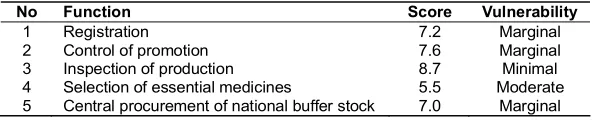
Table 3 describes the summary results of the
assessment. High scores were obtained in registration (7.2), control of promotion (7.6), inspection of production (8.7), and central procurement (7.0). Unfortunately, the score obtained from the assessment of selection of essential medicines is low (5.5).
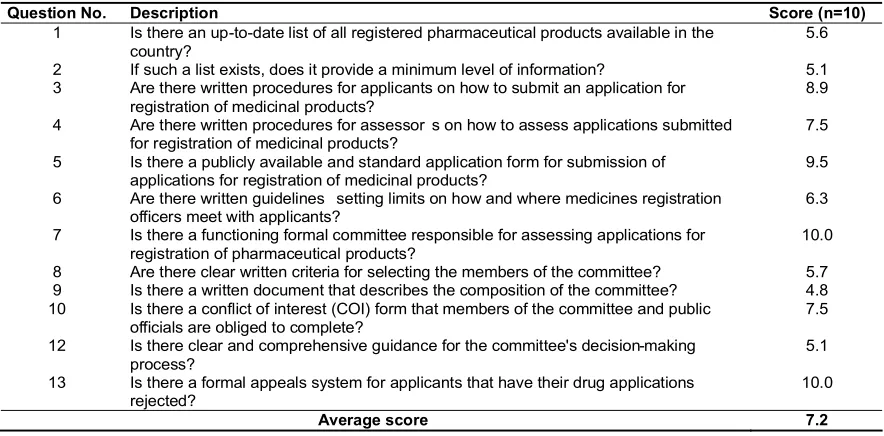
Details, as well as strengths and weaknesses of each function are described in Table 4 to 8. Those tables describe the scores of each question. Attention should be paid to questions that are scored low (i.e. less than 7.0), as these reflect weaknesses in governing the functions. In other words, questions with low scores indicate the components that need to be established or strengthened, in order to improve good governance in public pharmaceutical sector.
Registration
The registration process scored 7.2; and details are described in Table 4. From the answers to Question 1, it seems that the access to the updated list of registered pharmaceutical products was limited only to pharmaceutical company, although the list was available on the web (http://www.bpom.go.id) and in the registration area of the National Agency of Drug and Food Control, Building D, Jakarta. Responses to Question 2 confirmed however, that although updated list was available the information was very little.
Responses to Questions 3, 4, 5, 6, 7 confirmed that national guideline for new drug registration was publicly available, clear and comprehensive, as evidenced by the National Guideline which is publicly available.6 All respondents except NGO were positive
that the registration process was transparent and did not allow collusions, because it applied collective scientific decision process and involved independent
Table 2. Background of key informants
Group of key informants N Government Private/
pharm. industry
Academe/ professionals
NGO
Registration 10 4 central 4 1 1
Control of promotion 10 4 central 4 1 1
Inspection 10 4 central 4 1 1
Selection of essential medicines 10 4 central 2 2 2
Central procurement 20 4 central
2 provincial 6 district
3 3 2
Table 3. Summary table of the results of transparency assessment on registration, control of promotion, inspection, selection, and procurement
No Function Score Vulnerability
1 Registration 7.2 Marginal
2 Control of promotion 7.6 Marginal
3 Inspection of production 8.7 Minimal
4 Selection of essential medicines 5.5 Moderate
experts with high integrity. Unfortunately, the criteria for selecting the committee members and the composition of the committee are not known by the public. To this issue, the government respondents explained that the composition is kept disclosed from the public in order to avoid communication between members and drug applicants prior to decision making.
In the other hand, responses to Questions 8, 9, 10, and 12 indicated that both government and industry respondents expressed that some important measures to ensure transparency in the future were lacking, i.e., written criteria for members of drug evaluation committee, written declaration of interest by members of the drug evaluation committee and the written procedure of decision making.
Control of promotion
The control of promotion scored 7.6, and details are described in Table 5. Responses to Questions 17, 19, and 20 showed that all respondents able to explain Laws, Decrees, and regulations that control
promotion and protect consumers. Evidence shows that the WHO Guideline on Ethical Criteria for Medicinal Drug Promotion7 is well implemented in
the National Regulations. In addition, respondents from industry underlined IFPMA codes8 that had been
adopted by Indonesian Association. Industry respondents were positive that the control of promotion was well–respected while government respondents expressed their worries that the regulation was not well-respected by industry.
All respondents agreed that control of promotions had involved all relevant stake holders. However, responses to Question 21 and 22 expressed that most respondents concerned that implementation of the sanctions was inadequate and inconsistent.
Inspection of production
Inspection of manufacturers scored 8.7 and details are described in Table 6. Questions 29, 30, 31, 32, 35, and 36 scored very high. Key informants from both industry and government recognized the
Table 4. Results of assessment on registration process
Question No. Description Score (n=10)
1 Is there an up-to-date list of all registered pharmaceutical products available in the country?
5.6
2 If such a list exists, does it provide a minimum level of information? 5.1 3 Are there written procedures for applicants on how to submit an application for
registration of medicinal products?
8.9
4 Are there written procedures for assessor s on how to assess applications submitted for registration of medicinal products?
7.5
5 Is there a publicly available and standard application form for submission of applications for registration of medicinal products?
9.5
6 Are there written guidelines setting limits on how and where medicines registration officers meet with applicants?
6.3
7 Is there a functioning formal committee responsible for assessing applications for registration of pharmaceutical products?
10.0
8 Are there clear written criteria for selecting the members of the committee? 5.7 9 Is there a written document that describes the composition of the committee? 4.8 10 Is there a conflict of interest (COI) form that members of the committee and public
officials are obliged to complete?
7.5
12 Is there clear and comprehensive guidance for the committee's decision-making process?
5.1
13 Is there a formal appeals system for applicants that have their drug applications rejected?
10.0
Average score 7.2
Table 5. Results of assessment on control of promotion
Question No. Description Score (n=10)
17 Is there a provision in the medicines legislation/regulations covering drug promotion and advertising?
10.0
19 Are the provisions on drug promotion and advertising comprehensive? 8.3 20 Do the provisions foresee an enforcement mechanism on promotion and
advertisement of medicines?
8.5
21 Is there a service or committee responsible for monitoring and enforcing the provisions on drug promotion?
5.4
22 Are there written and publicly available Standard Operating Procedures (SOPs) guiding the services responsible for pre-approving or monitoring drug promotion and advertising?
5.8
Indonesian Good Manufacturing Practices (GMP)9
and Good Distribution Practices (GDP)10 as the
national guidelines. In addition, key informants from industry also mentioned their Company’s SOP for inspection. Industry and government respondents agreed that the national GMP and GDP were clear, detailed, and strict enough to ensure the transparent process of inspections.
However, responses to Questions 33 showed that both sides were aware that there was no “Declaration of Interest” as like the WHO form. Some informants mentioned that there was “Inspector’s Oath”. An NGO respondent expressed worries of the selection of inspectors as it was a high qualified position and she was not sure whether there were enough candidates to be recruited as inspectors. This issue was confirmed by the Government respondents, and they agree that more competent inspectors should be prepared in the near future.
Selection of essential medicines
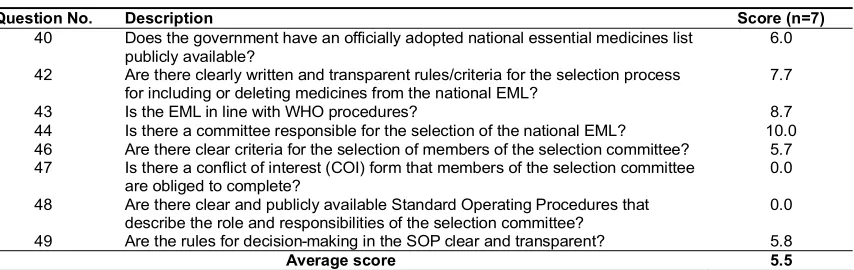
Selection of essential medicines scored 5.5; details are depicted in Table 7. All key informants mentioned that the National Essential Medicine List (NEML) was frequently updated, the last update was in 2005,11 and was available for health managers.
Government informants confirmed that the revision procedure followed the WHO guidelines.12
All informants acknowledged that the Committee of NEML Revision consisted of well-respected people with high credibility and integrity. Unfortunately, most of the procedures were not written or not available to public. Non-government informants said that the selection process had involved experts with high integrity, but they did not know if there were criteria for being committee members. Government respondents were aware that the most important measures to ensure transparency were lacking, i.e., written criteria for members of selection committee, written declaration of interest by members of the selection committee and the written procedure of revision that publicly available. On the other hand, the writer noted a strong evidence of high quality of National Medicine List,11 meaning
that the good works relied on the good people. For sustainability, however, written procedures and more appropriate management of conflict of interest should have been in place.
The result of this study was directly communicated with the Chair of the Committee of NEML Revision, which was by coincidence in the preparation of the 2008 revision of the List. Corrective
Table 6. Results of assessment on inspection of production
Question No. Description Score (n=10)
29 Is there a provision in the medicines legislation/regulation covering inspection of medicines manufacturers and distributors?
10.0
30 Is the provision comprehensive enough? 10.0
31 Are there written guidelines on classification of Good Manufacturing Practices (GMP) or Good Distribution Practices (GDP) non-compliance that describe the types of deficiencies and the corresponding measures to be taken by the MRA?
9.0
32 Are there written procedures/mechanisms to prevent capture between an inspector and the manufacturers or distributors that he/she inspects?
7.3
33 Are there written comprehensive guide lines detailing the situations regarded as conflict of interest (COI) with regard to inspection activities?
4.8
34 Are inspection findings and conclusions subject to an internal review? 8.9 35 Are there written procedures for inspectors on how to conduct inspections? 9.6 36 Are there written criteria for the selection and recruitment of inspectors? 10.0
Average score 8.7
Table 7. Results of assessment on selection of essential medicines
Question No. Description Score (n=7)
40 Does the government have an officially adopted national essential medicines list publicly available?
6.0
42 Are there clearly written and transparent rules/criteria for the selection process for including or deleting medicines from the national EML?
7.7
43 Is the EML in line with WHO procedures? 8.7
44 Is there a committee responsible for the selection of the national EML? 10.0 46 Are there clear criteria for the selection of members of the selection committee? 5.7 47 Is there a conflict of interest (COI) form that members of the selection committee
are obliged to complete?
0.0
48 Are there clear and publicly available Standard Operating Procedures that describe the role and responsibilities of the selection committee?
0.0
49 Are the rules for decision-making in the SOP clear and transparent? 5.8
actions had been made, and the Committee was then in full compliance with the international Guidelines and ensured its transparency and accountability.
Central procurement
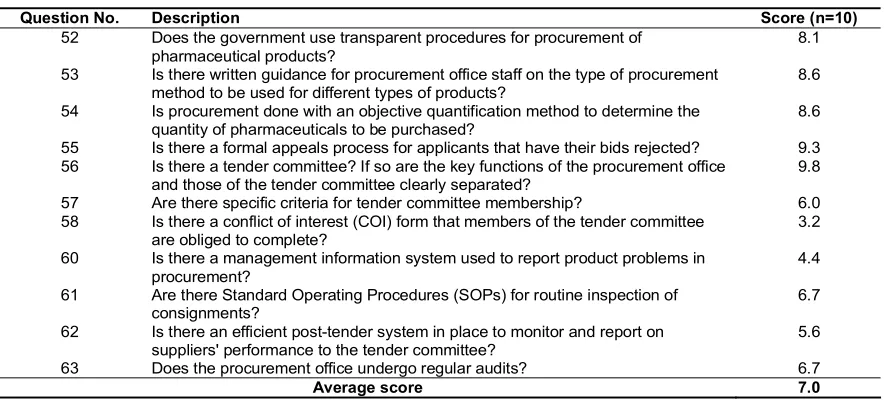
Central procurement of national buffer stock scored 7.0; details are described in Table 8. All informants were able to explain the Presidential Decree No. 80 (enacted in 2003)13 as the national
regulation for transparent procurement. The evidence shows that in majority, the Decree is concordance with the international guideline.14 The majority of
informants expressed that the Presidential Decree was comprehensive, clear, and strict enough to ensure transparent procurement. These opinions were indicated by their responses to Questions 52, 53, 54, 55, and 56.
Responses to Questions 58, 60, 61, 62, and 63 however, indicated that some informants raised the issue that there was no declaration of interest of the Tender Committee members. Respondents from district level expressed concerns that procurement procedure for medical devices was not as strict as medicines and therefore provided rooms for deviation. All government informants mentioned that integrated post-tender management information system was lacking. Monitoring was usually conducted manually and it usually took a long time to follow up complaints.
Strengths and weaknesses of the assessment method
The writer found the WHO questionnaires were easy to use. Questions were very detailed showing what everything should be. While conducting the
survey, the questionnaires themselves pointed out every strength and weakness of the system. In short the assessment tool can be used as an educational tool; as we survey we teach. The writer also found that the questions attracted key informants to explain lots of things when they knew the situation, or if they had complaints to related topics. Although all interviews were recorded, to make data collection much easier the writer recommended the questionnaires are developed into data collection booklets, providing enough rooms to write down information for each sub-question. For further analysis, the writer also developed worksheets that allowed her to compile summary of qualitative information and provided step-by-step calculation of scores. The step-by-step calculation allowed the writer to re-check and cross-check the scores.
However, the writer found a question which is contrary to the country’s regulations. The Indonesian Presidential Decree No. 8013 clearly stated that
involvement of senior government officials in the Tender Committee is prohibited because they were considered as funding users, and therefore their involvement in tender committee conflicted with their interests. However, the WHO questionnaire supports their involvements in tender committee. Some short-coming were identified, e.g., the number of indicators was not balanced as in promotion with only 5 scored indicators, as compared to twelve in registration, eight in inspection, eight in selection of essential medicines, and 11 in procurement. There was also inconsistency due to as some questions requiring proof of written documents, while others do not (Questions 30, 35, 36, 61).
Conclusions and recommendations
Table 8. Results of assessment on central procurement of national buffer stock
Question No. Description Score (n=10)
52 Does the government use transparent procedures for procurement of pharmaceutical products?
8.1
53 Is there written guidance for procurement office staff on the type of procurement method to be used for different types of products?
8.6
54 Is procurement done with an objective quantification method to determine the quantity of pharmaceuticals to be purchased?
8.6
55 Is there a formal appeals process for applicants that have their bids rejected? 9.3 56 Is there a tender committee? If so are the key functions of the procurement office
and those of the tender committee clearly separated?
9.8
57 Are there specific criteria for tender committee membership? 6.0
58 Is there a conflict of interest (COI) form that members of the tender committee are obliged to complete?
3.2
60 Is there a management information system used to report product problems in procurement?
4.4
61 Are there Standard Operating Procedures (SOPs) for routine inspection of consignments?
6.7
62 Is there an efficient post-tender system in place to monitor and report on suppliers' performance to the tender committee?
5.6
63 Does the procurement office undergo regular audits? 6.7
It is appreciated that the functions of registration, control of promotion, inspection, and procurement are well governed. However, there has been remarkable lacking of written procedures that publicly available. The score obtained from selection of essential medicines is quite low, mainly because there is no written procedure in every process of selection, i.e., selection criteria of the revision committee member, written criteria for application, written criteria for addition, substitution and deletion, and written procedures of decision making. Declaration of interest is to some extents, lacking from most functions.
It was recommended that the Government should establish written procedures of each function and make them publicly available, establish mechanism to minimize conflict of interest in each function and establish measures to fill up regulatory gaps. Feedbacks to respective authorities have been given right after the completion of the study. By the time of publication, corrective actions in all five functions have been in place and at the time being the Government express its readiness for re-assessment.
Acknowledgement
The writer thanks all key informants for their excellent participation. Data collection was made possible by great assistance of Rustamaji MD, M.Kes, Dra. Anita Lestari, MS, Drs. Bambang Saparyono, MPHA, dan Sri Hidayati, S.Ked. The study was jointly funded by the World Health Organization and the Centre for Clinical Pharmacology and Medicine Studies, Gadjah Mada University.
References
1. WHO, Policy Perspectives on Medicines: Effective medicines regulation: ensuring safety, efficacy and quality. Author, Geneva. 2003. 2. WHO, Medicine Strategy – Countries at the
Core – 2004-2007. Author, Geneva. 2004. 3. WHO, Measuring Transparency to Improve Good
Governance in the Public Pharmaceutical Sector, a comparative analysis of five country assessment studies: Bolivia, Cambodia, Indonesia, Mongolia, Papua New Guinea.
Author, Geneva. 2008.
4. WHO, Good Governance for Medicines Programme Progress Report - February 2009. Author, Geneva. 2009.
5. WHO, Measuring Transparency to Improve Good Governance in the Public Pharmaceutical Sector. Author, Geneva. 2006.
6. Indonesian National Agency for Drug and Food Control (Badan Pengawasan Obat dan Makanan RI), 2003, Decree No: HK.00.05.3.1950 ref. Criteria and Procedures of Drug Registration. (SKNo: HK.00.05.3.1950 tentang Kriteria dan Tatalaksana Registrasi Obat). Author, 2003. 7. WHO, Ethical criteria for medicinal drug
promotion. Author, Geneva.1988.
8. International Federation of Pharmaceutical Manufacturers & Associations (IFPMA), Code of Pharmaceutical Marketing Practices, 2006 Revision. Author, Geneva. 2006.
9. Indonesian National Agency for Drug and Food Control (Badan Pengawasan Obat dan Makanan RI), Guidelines on Good Manufacturing Practices (Pedoman Cara Pembuatan Obat yang Baik). Author, Jakarta. 2006.
10. Indonesian National Agency for Drug and Food Control (Badan Pengawasan Obat dan Makanan RI), Decree No HK 00.05.3.2522 ref. Implementation of Good Distribution Practices (Keputusan No HK 00.05.3.2522 tentang Penerapan Cara Distribusi Obat yang Baik). Author, Jakarta. 2003.
11. Ministry of Health, Daftar Obat Essensial Nasional (National Essential Medicine List). Author, Jakarta. 2005.
12. WHO, WHO Policy Perspectives on Medicines: The selection of essential medicines. Authors, Geneva. 2002.
13. President of Republic of Indonesia, Presidential Decree No. 80/2003 ref. Governmen Procurement Procedures of Kinds and Services (Keputusan Presiden No. 80/2003 tentang Pelaksanaan Pengadaan Barang dan Jasa Pemerintah). Author, Jakarta. 2003.