1 PREFACE
Praise and thanks us prays before the lord because of almighty god grace and his , thanks to the surplus we iccp committee ( international conference and call for paper and completes ) can construct proseding this . Proseding it contains a collection of paper which is accumulated in the event of a call for paper held unit for student activities uny research.
In drafting this proseding the committee got a lot of challenges and obstacles but with assistance from various parties challenges that can be handled . Because of the optimal itupantia say thank you to all parties , which has helped proseding in the preparation of this hopefully their assistance received an appropriate penalty of the lord almighty God.
2 CONTENTS
Page TITLE ... i PREFACE ... ii CONTENTS ... iii
Content
1. MOVING FORWARD WITH INNOVATION:
FACILITATING LANGUAGE LEARNING THROUGH
ON-LINE SOCIAL NETWORKS (SNSs) ... 1 2. The Drivers and Inhibitors of Technology
Adoption in Business Management: A Literature Review ... 9 3. Analysis of the multimedia learning based on
interactive videos towards the efficiency of time, level of boredom, and optimization receiving knowledge
in education especially of health branch. ... 18 4. INTELLIGENT WAREHOUSING USING AS/RS ... 27 5. Information and Communication Technology: Taking
Benefits to Improve Student Writing Skill... 36 6. Implementing Virtual University in indonesia ... 45 7. Application Software “SiapCerdas” To Identify
The Potential Of Intelligence And Learning Styles Of Students In Educational Institutions
To Enhance Students Achievement ... 54 8. The Use of Kompasiana as Media for Teaching Writing
Skill at School ... 63 9. The Future of Gold Education: How Social-Networking
and Digital- Gaming will Sharpening Your Mind with
3 Mathematical Learning Process in Differential
Equations Subject ... 90 12. ICT-assisted Oral English Instruction in Grade VII
Students of SMPN 5 Panggang, Guningkidul ... 98 13. CHEAPER AND CREATIVE LEARNING METHOD
BASED WIKIWIKIWEB
(WEB INFORMATION EXCHANGE). ... 107 14. Application of Adventure Game for Islamic Learning. ... 116 15.MULTIMEDIA IN BILINGUAL LEARNING: A CASE
OF PILOT PROJECT OF INTERNATIONAL
STANDARDIZED SCHOOL IN INDONESIA ... 125 16.A Block-Mapping Based Fragile Watermarking
Scheme for Optimized Tampering Localization ... 134 17.DESIGNING PROJECT BASED LEARNING
THROUGH 2.0 WEB APPLICATION FOR INDONESIAN ... 143 18.Learning Management System (LMS) as an Alternative
for Supporting Co-op ... 152 19.OPTIMISATION OF ICT FOR EDUCATION IN
REMOTE AREA ... 161 20.SUPPORTING TEACHING AND LEARNING
PROCESS USING CD INTERACTIVE IN ISLAMIC
JUNIOR HIGH SCHOOL ... 170 21.Developing an Online Collaborative Learning
System with Knowledge Construction Based ... 178 22.EXAMINEES RESPONSE TEST PATTERN
SIMULATION-BASED ADAPTIVE COMPUTER
USING FUZZY REASONING TSUKAMOTO ... 185 23.Making ICT based child society : ideas for
school leaders of Bangladesh ... 192 24.Information and Communication Technology in Education
4 of the Internet for Islamic Learning ... 201 25.Applications of Information Systems to Improving the
Competitiveness of Higher Education in Indonesia ... 210 26.BLOGMATIKA: MATHEMATICS LEARNING
INOVATION IN SCHOOL BASED ON ICT
(INFORMATION AND COMMUNICATION TECHNOLOGY) ... 218 27.The Effectiveness of Computer-assisted Multimedia
for Social Science Learning in Grade IV of Sekolah
Dasar Percobaan II Depok Sleman. ... 225 28.“KINECT” AS AN INNOVATION IN NUI-BASED
INTERACTIVE LEARNING DEVELOPMENT ... 234 29.Online System for Physic Learning Difficulties
Diagnostic Based on Social Networking and
Web Integration ... 243 30.Bugis linux Ubuntu (international conference
And call for paper) ... 251 31.Inteligent Learning Content Management System
Using Web Services Technology for E-learning
Performance ... 260 32.Global School Administration System (G-SAS) for Better
Education in The Future ... 269
33.Emerging ICTs and Their Potential in Revitalizing
Small Scale Agriculture in Central Sulawesi ... 275 34.Application of PDF Reader for Final Project/Thesis Reports in
Electrical Engineering Department Library Of
Yogyakarta State University ... 284 35. The Future of Gold Education: How Social-Networking
and Digital- Gaming will Sharpening Your Mind with
Fun-Learning ... 293 36.IMPLEMENTATION OF FIELD TRIP TECHNIQ
5 GAZEBO TO IMPROVE THE ECONOMIC QUALITY
FOR LAPINDO MUD VICTIMS IN PORONG SIDOARJO ... 302 37.Developing Instructional Multimedia for Science
at Elementary School ... 311 38.“Z80 Simulator” for Improving Student Competence
in Microprocessor Field of Subject ... 320 39.Application of PDF Reader for Final Project/Thesis Reports in
Electrical Engineering Department Library Of Yogyakarta State University 329
40.The Development of Discharge Planning Model through Family Empowerment in Nursing Care for Low Birth Weight Babies ... ... 334 41.Improving Learning Effectiveness and Flexibility through Hybrid
Learning Model ... 345
345 Improving Learning Effectiveness and Flexibility through Hybrid Learning Model
By: Hartoyo
Yogyakarta State University e-mail: [email protected]
Abstract
This study aimsto examine the effectiveness and flexibility of the hybrid learning model, namely the combination of face-to-face learning and web-based e-learningin Technique of Refrigeration and Air Coinditioning Course. This research is classroom action research. The subjects are students who take Technique of Refrigeration and Air Conditioning Course in the second half of the Year 2008/2009. Methods of data collection were questionnaire, observation, tests to find out the effectiveness and flexibility of learning. Data analysis was descriptive analysis.The results of this study were: (1) hybrid learning model can improve the effectiveness of learning both in learning process and output, make learning fun and challenging, able to increase enthusiasm, improve student involvement, provide a conducive learning athmosphere, and make learning more meaningful (with a mean score of 2.977 and 3.111 of a score range of 1-4 respectively for the cycle I and II). Achievement of learning increased. All students can achieve and exceed the minimum criteria (B-). Cycle I: The score of A = 3 people (18.75%), score A-= one person (6.25%), score B + = 4 people (25%), the score of B = 5 students (31.25%), and The B-= 3 people (18.75%). Cycle II: The score of A = 4 people (25%), score A-= 5 people (31.25%, the score of B + = 1 person (6.25%), and the score of B = 6 people (37.50%); (2) Hybrid learning has also been able to increase the flexibility of learning where learning materials can be accessed from anywhere and anytime, learning materials easily enriched and updated (average score of 3.542 and 3.625 in the range of scores 1-4 in succession to cycle I and II).
Key Words: Hybrid learning, E-learning, Learning Effectiveness and Fexibility, Refrigeration and Air Conditioning
1. Introduction
346 have not been used optimally. Technique of Refrigeration and Air Coinditioning Course has not been using web-based e-learning systems.
With such a reason then to improve the effectiveness of learning is necessary to develop and apply the hybrid learning model, a combination of conventional learning (face- to-face) with a learning system using e-learning. Effectiveness refers to the quality of the learning process and improved learning output. Flexibility means that learning materials can be accessed from anywhere and anytime, learning materials can be enriched with a variety of learning resources including multimedia and can be updated quickly. Although the study was developed using e-learning system, it does not mean that conventional learning (face-to-face) is to be abandoned. Learning face-to-face is still ongoing, and enriched by using e-learning systems. As we know, face-to-face learning is still important because the role of teachers/lecturers will be difficult to be replaced in the education process, although the use of technology and sophisticated instructional media. Thus, the problem can be formulated as follows: How is the effectiveness of hybrid learning model applied to theTechnique of Refrigeration and Air Coinditioning Course?
E-Learning is one form of distance education using electronic media as media delivery of content and communication between teachers with students. E-Learning is the latest term in the system of distance education and the term is reserved for electronics learning including computers and telecommunications media (web-based learning) (Alan et al, 2001; Goran et al, 1996; Rosenberg, 2001; Sohn, 2005).
347 The hybrid learning model combines the conventional model with learning by using e-learning systems (Herman Dwi Surjono, 2008). Thus, the learning still cultivated with face-to-face between lecturers and students optimally and are equipped with e-learning (web-based learning) where the syllabus, lesson plans, lecture materials, and assignments are provided on the web so that students can access it. At any given moment if the lecturer was unable to attend class, learning continues to take advantage of e-learning facilities that have been developed, students can access learning resources and tasks that can be accessed and uploaded in e-learning. E-learning also provides information relating to lectures and discussion facility via the “forum” if there are some things that need to be discussed whether in relation to lecture material, clarity of tasks, and so forth.
2. Method
The research is classroom action research. The research was conducted in March 2009 through June 2009 in the Electrical Education Study Program, College of Engineering, Yogyakarta State University (YSU). These study subjects were students of Electrical Education Study Program, College of Engineering YSU who are taking Technique of Refrigeration and Air Coinditioning Course in semester even 2008/2009 as many as 16 students. This classroom action research procedure covers: planning, implementation of the action (action), observation, and reflection.
Research instruments used for collecting data are as follows: a list of questions/ statements (questionnaire), observation sheet, and test questions and a list of tasks. Analysis of the data used is the analysis of descriptive data with averages and percentages. Each cycle will be obtained the effects of actions that serve as a reflection on the next cycle. Based on the results of the data obtained is then performed quantitative analysis of data with averages and percentages are then compared with indicators of success that has been set.
To determine whether the learning process good or not that takes place needs to be calculated in advance the average ideal (Mi) and the ideal standard deviations (SD) with the formula:
348 SD = 1/6 (maximum score of an ideal - an ideal minimum score) = 0.500
Furthermore, the category to determine whether the learning process good or not used norm as follows:
Good = (> Mi+1.5 SD) up = > 3.250 to 4.000 Good Enough = (> Mi to Mi+1.5 SD) = > 2.500 to 3.250 Poor = (> Mi-1.5 SD to Mi) = > 1.750 to 2.500 Not Good = (Mi-1.5 SD) down = 1.000 to 1.750
3. Findings and Discussion
In the study does not develop its own e-learning system, but using e-learning system that has been developed by the UNY Computer Center with the URL address http://besmart.uny.ac.id. UNY e-learning developed using the LMS (Learning Management System) open source Moodle. Advantages of using UNY e-learning was the integration and ease. E-learning of this course is included and become part of UNY e-learning. The steps undertaken in this activity are: log in, add courses in e-learning systems, editing and uploading learning materials, assignments, discussion forums and so on. As for viewing e-learning developed is as in the picture below.
349 Evaluation of the successful implementation of the action is seen from the effectiveness of learning. Effectiveness can be seen both in terms of learning process and student learning outputs. The quality of learning process can be seen from the student activity, the implementation of fun and meaningful learning, and learning flexibility. Students learning output or mastery of competencies can be seen from the score obtained by students.
[image:12.595.95.533.69.306.2]Evaluation results and reflections of students about the learning process can be seen in the following tables and figures.
Table 1
Results of Evaluation and Student Reflection on Learning Process in Cycle I and II
No. Indicators Mean Score
Cycle I Cycle II
1. Learning more enjoyable 2.833 3.167
2. Students are challenged to explore the material 2.833 3.000
3. Students are enthusiastic in learning 2.833 2.833
4. Increased student involvement in learning 2833 3.333
5. Allows students to learn faster 2.833 3.167
6. The learning atmosphere is comfortable and conducive 2.667 3.167 7. Achievement of learning objectives is guaranteed 2.833 3.000 8. It can foster the active participation of students 3.167 3.333 9. The use of learning time is more optimal 3.333 3.333
350 11. It can increase the learning frequency 2.833 3.167 12. It strengthen the memory of the learning material 3.000 2.833 13. Increase the professionalism of lecturers in teaching 3.000 3.000
14. It is more meaningful learning 3.167 3.000
15. Through a hybrid learning task completion is easier 3.167 3.167 16. Learning material can be accessed from anywhere 3.667 3.667 17. Learning material can be accessed anytime 3.667 3.667
18. Learning material easily to enrich 3.167 3.500
19. Learning material easily to update 3.667 3.667
[image:13.595.93.539.69.216.2]Total mean score 3.096 3.219
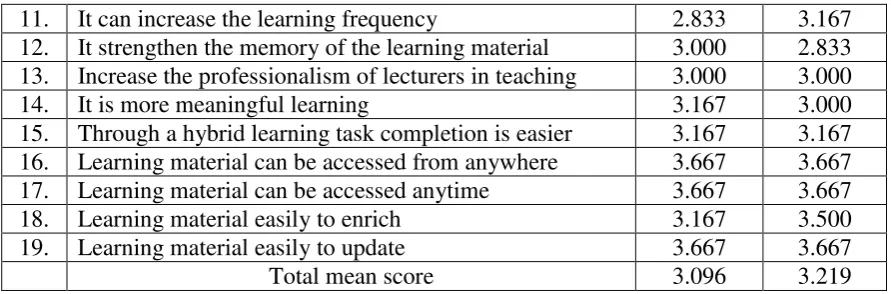
Table 1 above shows that for cycle I the lowest score is 2.667 and the highest is 3.667 and the average score was 3.096. Ideal minimum score is 1 and the ideal maximum score is 4. Based on the average score obtained for 3.096 and when seen from the above categories, then the learning process of hybrid learning that has taken place is good enough. When viewed on each indicator is obtained the lowest average score of 2.667 and the highest average score of 3.667 which means that all aspects are considered in the category good enough and good.
Suggestions and comments of students about the learning process that has taken place are as follows: (1) the implementation of learning that utilizes e-learning is good enough and continued; (2) e-learning material are added again in order to fully equipped; (3) students who do not use the forum discussion are still many and they are advised to use it; (4) e-learning need to be added with questions that can be answered directly so that the students can see the results and they can fix it; (5) It is necessary to do observation activity about the cooler machinesin Maintenance and Repair Workshop. Based on the data and the above description, when viewed from the learning process, then the application of hybrid learning model is quite effective in enhancing the learning process. Although the process of learning that has been going quite well, to further improve the quality of the learning process again, especially on those aspects of assessment that a score below 3.0 then the application of hybrid learning continued with some improvements in order to increase the quality of the learning process more optimal.
351 obtained is 3.219. It means that the learning process using hybrid learning is good enough. When viewed on each indicator is obtained the lowest score of 2.833 and the highest score of 3.667 which means that all aspects are considered in the category good enough and good.
When compared with cycle I, although the learning process cycle II is in the same category as cycle I that is good enough, but if the observed mean score on the cycles increased from 3.096 to 3.219. This means that the effectiveness of the learning process on the cycle II has increased compared with the cycle I. Thus one indicator of success in this research through hybrid learning can enhance the effectiveness of the learning process has been reached.
Increasing the effectiveness of the learning process on the second cycle based on the perceptions and opinions of students as listed in table 1 above, is also supported by researchers in a qualitative observation that the implementation of face-to-face learning is better than the cycle I. It is more conducive.Students are more active to ask question and give respond, give an idea,and do a presentation in the learning process. In addition, all students are also active in accessing learning materials, collect and uploadthe tasks assigned to the e-learning. Even,there are more students who have made use of existing “forums” on e-learning to inquire about the tasks given, ask for material that has not been understood, and as a means to channel the aspirations to convey suggestions or proposed improvement of learning process.
The application of hybrid learning also increase learning flexibility. It was based on the perceptions and opinions of students as listed in tabel 1 above on indicators number 16-19. According to students through web-based e-learning the learning and course materials can be done and accessed anywhere and anytime. Learning materials can be enriched and updated easily.
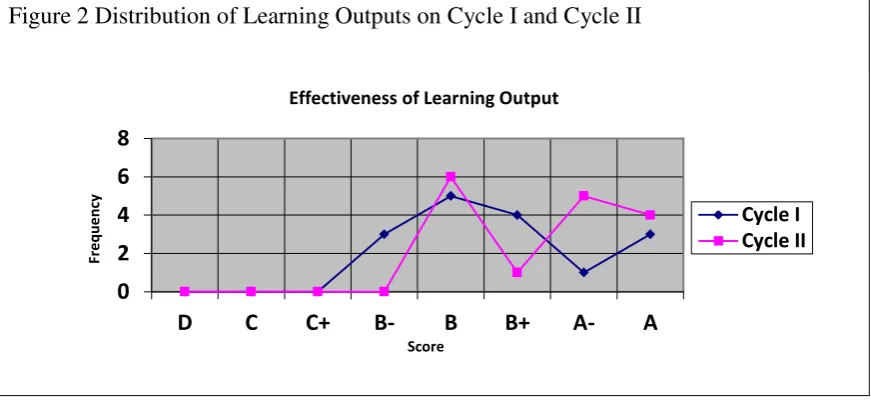
352 Student learning output in the form of the achievement of competence and mastery of the material between cycle I and cycle II can be seen in the picture below. Figure 2 Distribution of Learning Outputs on Cycle I and Cycle II
Figure 3 above shows that for the cycle I the lowest student score is a B-as many as three students (18.75%) and the highest score of A as many as three students (18.75%). No students who scored C+, C, and the score underneath. This shows that all students have met the minimum criteria a B- such as set at the beginning of the study. Thus, it can be said that when seen from the results of student learning that has been done with a hybrid learning model can be quite effective. However, to further improve student learning output again it was decided to continue the action while applying the hybrid learning on subsequent learning
For the second cycle of the lowest student learning outcomes is the score of B as many as 6 students (37.50%) and the highest score is the score of A by 4 students (25.00%). No students who received a B-, C+, C, and the score underneath. This shows that all students have exceeded the minimum criteria for B- scores as set at the beginning of the study. When compared grades of students between cycles I and II it seems clear that the students in second cycle had a marked improvement. The lowest score on the cycle I was a B-as many as three students (18.75%), in cycles II B-score is not there anymore. Score of B in cycle I were 5 students (31.25%), in cycles II rose to 6 students (37.50%). An A- on cycle I only 1 student (6.25%), the second cycle up to 5 students (31.25%). The A score in the cycle I counted 3 students (18.75%), the second cycle up to 4 students (25%). Thus, it can be said that when seen from the results of
0 2 4 6 8
D C C+ B- B B+ A- A
F
re
que
ncy
Score
Effectiveness of Learning Output
353 student learning, the learning that has been done with a hybrid learning model can be said to be effective in improving student learning outputs.
4. Conclusion
The application of hybrid learning model that combines face-to-face learning and e-learning on Techniques of Refrigeration and Air Conditioning Course is proved successful in increasing the effectiveness both in terms of learning process and output and flexibility of learning
The process of learning becomes more enjoyable and challenging, enhance the spirit of learning, increase the student activity and involvement, enhance a conducive and attractive learning environment, students more easily understand and master the required competencies, learning becomes more meaningful. This can be seen from the opinions of students about the learning process with a mean score of 3.096 and 3.219 (range of scores 1-4) in succession to cycle I and II that have a meaning that the learning process run quite well (good enough). Through hybrid learning, the learning process also become more flexible, learning material can be accessed from anywhere and anytime, and can be easily enriched and updated.
In terms of learning output, all students got score above or equal to the score of a minimum criterion (a B-). This is indicated by grades as follows. Cycle I: grade A as many as 3 students (18.75%), an A- as 1 student (6.25%), B+ by 4 students (25%), the grade B is 5 students (31.25%), and a B- as many as three students (18.75%), while the cycle II: grade A by 4 students (25%), A- as many as 5 students (3.25%), a B+ as 1 student (6.25%) , and the score of B as many as 6 students (37.50%). It also showed an increase in the score of students between cycles I and II.
References
354 Chu, Alan G; Thompson, Melody M; Hancock, Burton W. (1998). The Mc Graw-Hill
Handbook of Distance Learning. New York: McGraw-Hill
Herman Dwi Surjono. (2008). Pengantar e-learning dan penyiapan materi. Modul Pelatihan E-learning. UPT Puskom Universitas Negeri Yogyakarta 4-6 November 2008.
Rosenberg, M.J. (2001). E-learning: Strategies for delivering aspects of knowledge in the digital age. New York: Mc Graw-Hill.