Regional Free Trade Agreement as the form of ‘New
Regionalism’ in Asia Pacific: Politic and
Geo-Economic Aspect of ASEAN Centrality
Adiasri Putri
Dosen Hubungan Internasional FISIP UPN Veteran Jawa Timur
e-mail: [email protected]
ABSTRACT
While most of the theories of regionalism give more focus on the study of regional institutions (neo-liberal institutionalism approach), or on the identity aspect of regionalism (constructivist approach), regionalism can also be analyzed under the international political economy (IPE) framework. Kevin G Chai in his book, The Politics of Economic Regionalism, uses (IPE) theory to analyses the regional economic integration in East Asia. The increasing number of regional FTAs as the new form of regionalism is basically driven by strategic interest, such as economy and politics. This paper seeks to explain the ‘new regionalism’ in Asia Pacific (the noodle bowl of FTAs), by understanding the geo-political and geo-economic aspects of Association of Southeast Asian Nations (ASEAN). There are two main arguments here: 1) under the ‘new regionalism’, the driving force of this regional FTAs is not regional identity but geo-politic and geo-economic value of particular region; 2) The ASEAN Economic Community (AEC) can be viewed as the form of dependency to the geo-economy and geo-politics interests of the major economy powers in Asia Pacific region.The main section for this paper is divided into four parts. The first one is the history of new regionalism and the IPE theoretical approach. The second one is the dynamics of economic regionalism process in Asia Pacific region. The third one is the geo-political and geo-economic aspects of ASEAN for Asia Pacific Regionalism frameworks.
Keywords: New Regionalism, Economic Regionalism, Geo-political, Geo-economy
Mayoritas teori mengenai regionalism berfokus pada pendekatan neo-liberal institusionalisme, Ekonomi Politik Internasional (EPI), dan analisis menggunakan pendekatan konstitusionalisme. Kevin G Chai dalam bukunya The Politics of Economic Regionalism menggunakan teori EPI untuk menganalisa integrasi ekonomi di Asia Timur. Peningkatan jumlah integrasi ekonomi adalah bentuk baru dari regionalism dan pada dasarnya berdasarkan kepentingan strategis, seperti ekonomi dan politik. Artikel ini menjelaskan fenomena New Regionalism di Asia Pasifik dengan menjelaskan dari sisi Geo-ekonomi dan Geo-Politik pada region tertentu.
Kata-Kata Kunci: New Regionalism, Regionalisme Ekonomi, Geopolitik, Geoekonomi
The development of regionalism study has been through several stages. Starting from the old regionalism (functionalist and neo-functionalist perspectives), based on the case of European Union, to a newer form of regionalism that was based on the study of Free Trade Agreement (FTAs) in other regions. The ‘new regionalism’ is an open regionalism tightly related to the wave of globalization. After the 1997 Financial Crisis, more focuses are given to the economic interest, such as trade and foreign direct investment. Instead of an EU-style of institutionalism, the ‘new regionalism’ takes form in FTAs arrangements without any form of ‘supranational’ body.
According to Kelly (2007) there is no natural regions and region can be built as needed with political purpose. Region also can be viewed in a multidimensional way, including economic interactions such as trade blocs. This is where the ‘new regionalism’ takes form. While the old form of regionalism involving a well-functioning institutions, such as Europe with European Union or Southeast Asian with ASEAN, the framework of regional integration in Asia Pacific takes form of multilateral cooperation. Asia Pacific Economic Cooperation (APEC) forum, the ongoing process of Trans-Pacific Partnership (TPP), or the Regional Comprehensive Economic Partnership (RCEP) are three example of the regional economic integration arrangement in Asia Pacific. In this region, the economic integration schemes are basically seek to integrate the economy of Asia and America.
While most of the theories of regionalism give more focus on the study of regional institutions (neo-liberal institutionalism approach), or on the identity aspect of regionalism (constructivist approach), regionalism can also be analyzed under the international political economy (IPE) framework. Kevin G Chai (2010) in his book, The Politics of Economic Regionalism, uses (IPE) theory to analyses the regional economic integration in East Asia. The increasing number of regional FTAs as the new form of regionalism is basically driven by strategic interest, such as economy and politics.
This paper seeks to explain the ‘new regionalism’ in Asia Pacific (the noodle bowl of FTAs), by understanding the geo-political and geo-economic aspects of Association of Southeast Asian Nations (ASEAN). There are two main arguments here: 1) under the ‘new regionalism’, the driving force of this regional FTAs is not regional identity but geo-politic and geo-economic value of particular region; 2) The ASEAN Economic Community (AEC) can be viewed as the form of dependency to the geo-economy and geo-politics interests of the major economy powers in Asia Pacific region.
The main section for this paper is divided into four parts. The first one is the history of new regionalism and the IPE theoretical approach. The second one is the dynamics of economic regionalism process in Asia Pacific region. The third one is the geo-political and geo-economic aspects of ASEAN for Asia Pacific Regionalism frameworks.
New Regionalism: History and IPE Theoretical Approach
intersubjective understanding (36). Region can also considered as politically constructed while it still relates to certain geographical area (Katzenstein 2005 cited in Rathus 2011). As one region can be defined in various ways, there is no exact definition of regionalism as well. There are various forms of regionalism.
When it comes to regionalism, historically, the development of regionalism can be divided into two forms, old regionalism and new regionalism. Old regionalism refers to the development of European Union, which involves the spillover effect (functionalist) and the creation of a supra-national body (neo-functionalist). This ‘old regionalism’ began in the 1950s and stagnated in the 1970s before the ‘new regionalism’ started to be developed in the middle of 1980s (Sonderbaum 2002). This new form of regionalism was based from the study of regionalization process outside Europe and highly related to globalization.
In the 1990s, in other regions outside Europe, the study of regional integration then related to the development of various regional free trade agreements (FTAs). This new form of regionalism have different characteristics from the case of European Union, where regions were not taken place in the form of formal organizations. Regions are constructed and re-constructed in the process of global transformation (Farrell 2005: 8). The new regionalism is also can be seen as the way to reduce the dependence on the international economy and to secure ‘greater competitive access to global markets as opposed to securing regional autarchy’ (Breslin 2002: 7). The central issues in the new regionalism is economy and how to integrate the regional economy.
The main characteristic of this new regionalism, includes; 1) the change from bipolarity to a multipolar post-Cold War international system; 2) the decline of American hegemony and a more permissive attitude of US towards regionalism; 3) the globalization era, where state is not the only actor, and the growth of interdependence; and 4) the growing popularity of neo-liberal economic development and political system in developing countries including the post-communist countries (Sonderbaum 2002: 33).
According to Chai (2010), in terms of economic regionalism, the theory from international political economy provides many useful thoughts. The central issues in international political economy is the interaction between international politics and economy and thus this can be used to understand the development of regional economic integration frameworks. Chai proposes three perspectives from international political economy that can be used to understand the dynamics of economic regionalism, which includes Economic Nationalism perspectivei, Liberalism perspectiveii, and
Marxism perspective.
imperialism in a world order. The imperial system is basically a structure consist of a dominant core and dependent periphery. In a global economy, the South has the capitals but it’s the Western Europe and North America, as the core, that accumulate those capitals. Under this perspective, global capitalism is ‘a system of globalized relations of domination and dependency’ where the peripheral country is not just being undeveloped but ‘underdeveloped by core countries and supported by a wealthy comprador class of local elites to be poor, dependent, and exploited’ (Amawi 2013: 25).
Immanuel Wallerstein’s work on World System Theory can be used to understand the emergence of a global capitalist system. Wallerstein’s work mainly related on how in the global economic system, the South countries, which mostly are dependent underdevelopment states, will remain in that condition because it is the nature of the world system that structured to support the world capitalist economy. Market is the main force and the system is characterized by a competition between production units. While the system doesn’t have to be a global one, it has become global in scope (Wallerstein n.d. cited in Jones 2010). According to him, ‘world economy is an entity based around the capitalist mode of production’ (Wallerstein n.d. cited in Jones 2010: 23).
Wallerstein argues that the capitalist world economy has a global geographical dimension and has developed into three structural regions, includes the core, the periphery, and the semi-periphery. The core emerged from north-west Europe and it has been called the First World, which has been benefited from the surplus of value and labor from the periphery. The semi-periphery on the other hand is the balancer, for example Latin America and South Asia in the twentieth century (Wallerstein n.d. cited in Jones 2010: 24-25).
Regional Economic Cooperation in Asia Pacific: The Dynamics & Competition between Major Powers
Asia Pacific has been the most difficult region to conceptualize. Regions are politically constructed and most of the time they became a label for a certain geographical area (Katzenstein 2005 cited in Rathus 2011). Beeson (2009) writes that, geographically, Asia Pacific region includes four separate regions. Those regions are East Asia, Southeast Asia, Pacific Rim, and North and South America. These regions have different culture, political traditions, and economic system that makes it difficult to be treated as one.
Beeson (2009) writes that in many ways, Asia Pacific Economic Cooperation (APEC) forum is the definitive organization for the region (37). APEC was established in 1989 with 12 founding member countries, including, Australia, Brunei Darussalam, Canada, Indonesia, Japan, Korea, Malaysia, New Zealand, the Philippines, Singapore, Thailand and the United States. In 1998, APEC membership grew into 21 members. APEC is basically an economic forum that gathered the leaders around the world to discuss the strategic vision and cooperation in Asia Pacific region. In 2014, APEC leaders has been discussing about the realization of a Free Trade Area of the Asia Pacific for 2025 (apec.org 2014). This FTAAP is strongly supported by China (BBC News 2014).
After APEC, another economic regional framework in this region comes in the form of Trans-Pacific Partnership (TPP), which covers both sides if the Pacific. According to Chong (2013) can be considered as the continuation of APEC in the form of FTA. While the origin of TPP was from the initiative from Pacific-4 (Brunei Darussalam, Chile, New Zealand, and Singapore) in 2006, it is the US President Barack Obama’s ‘Pivot to Asia’ foreign policy that brings more attention to the agreement. The TPP itself has a geopolitical factor importance for the US to coping with the rise of People Republic of China (PRC) especially in East Asia region.
Other than TPP, there is another FTA framework in Asia Pacific region involving ASEAN as the central of the economic integration schemes. Regional Comprehensive Partnership Agreement (RCEP) is an ASEAN-led trade agreement for 16 Asia Pacific Countries. According to Das (2013), RCEP works to integrate five separates ASEAN+1 FTAs into one regional economy framework. The development of RCEP depends on the progress of AEC blueprint in 2015. RCEP was introduced in 2011 at the ASEAN Leaders Summit in Bali. If PRC is not involved in the US-led TPP, in RCEP there is no US involvement so far (Bower 2012).
Source: (UNESCAP 2014)
Based on the Asian Development Bank (ADB) website, along with the growing number of free trade agreement in Asia Pacific, this has led to one ‘noodle bowl’ of overlapping free trade agreements. In 2013, there are a total 257 FTAs in the region, in which 189 of those FTAs are bilateral and only 68 are multilateral. With RCEP, ASEAN and their 6 partners will create a market size of 3.4 bullion people which constitutes 30% or world GDP (ADB.org 2013).
ASEAN in Asia Pacific Economic Regionalism Frameworks: Geo-Politics & Geo-Economic aspects
History of ASEAN & ASEAN Economic Community
The Association of Southeast Asian Nations (ASEAN) is a regional organization in Southeast Asia region that consist of ten Southeast Asian member countries. ASEAN was established on 8 August 1967 in Bangkok, Thailand. The founder of ASEAN are Indonesia, Malaysia, Philippines, Singapore and Thailand. The other Southeast Asian countries joined ASEAN afterwards, such as, Brunei Darussalam in 1984, Vietnam in 1995, Lao PDR and Myanmar in 1997, and Cambodia in 1999. Based on Treaty of Amity and Cooperation in Southeast Asia (TAC) of 1976, ASEAN was built under several fundamental principles and one of the most important principle is the ‘non-interference’ principle (ASEAN.org 2014).
political and economic integration. The reason for this is because the member states are a newly independent states and are still struggling with their domestic issues, such as, domestic economy development, internal political struggle, and the problem of nation building. ASEAN was created to solve the tension between neighboring countries, such as Indonesia-Malaysia Confrontation and Indonesia-Malaysia-Philippine regional disputes on Sabah. Politics and security were the main issues during the establishment of ASEAN rather than economy.
As written by Lee Tsao Yuan (1994), ‘…in the 1970s and 1980s, the raison d’etre for ASEAN cooperation was political, a consensus began to develop that the new raison d’etre for ASEAN cooperation in 1990s and beyond had to be economic’ (319). ASEAN Free Trade Area (AFTA) was created in 1992 to increase ASEAN’s competitive advantage as a production based for the world market. AFTA created to promote trade liberalization with the elimination of trade barriers (both non-tariff and tariff barriers). AFTA were based on the Common Effective Preferential Tariff (CEPT) agreement that requires a 0 to 5 % tariff reductions for several products traded within the region (ASEAN.org 2014).
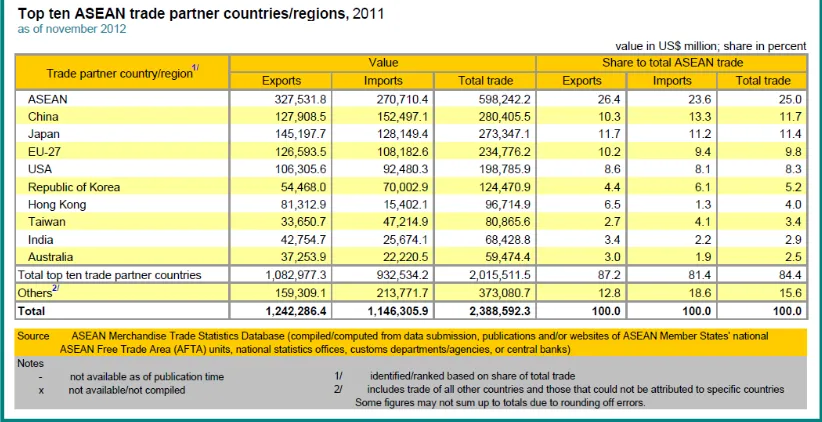
Table 1. ASEAN Trade by Partner
Source: (asean.org 2014)
In 2003, the heads of state/government met up at the 9th ASEAN Summit in
AEC blueprint signed in 2007 in Singapore by all of the member of ASEAN. With AEC, ASEAN will have a single market and production base. To create this, the core principles of AEC includes, 1) free flow of goods; 2) free flow of services; 3) free flow of investment; 4) free flow of capital; and 5) free flow of skilled labor. AEC is claimed to be ASEAN’s way to integrate into global economy. Under the framework of AEC, ASEAN has been involved with several free trade agreements, such as ASEAN-China Free Trade Agreement and also the ongoing negotiation process of Regional Comprehensive Economic Partnership (RCEP) between ASEAN and 6 FTA partners. RCEP have the potential to transform the region into an integrated market of about 3.4 billion people (AEC Key Messages Booklet 2014)
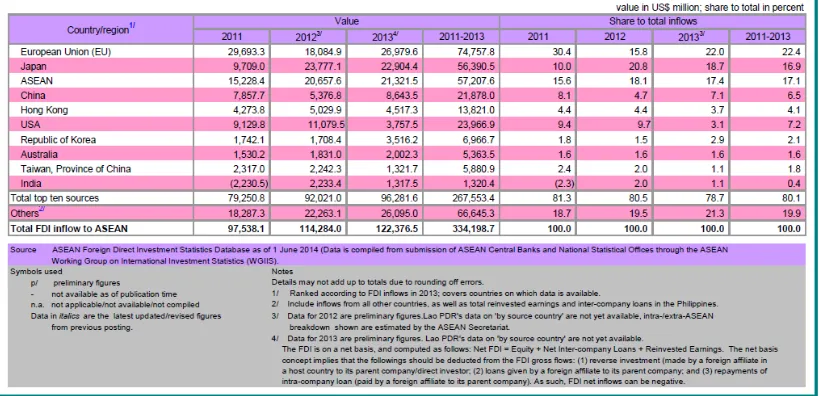
Table 2. Foreign Direct Investment Inflow to ASEAN
Source: (asean.org 2014)
Based on the trade and FDI data in ASEAN, major economies in Asia Pacific such as US, Japan, South Korea, Australia and China are important partners for ASEAN economically. Even the internal trade and FDI in ASEAN is not significantly higher than those external partners. Under the AEC’s main goal to create a single market and single production base, this will surely help ASEAN to enter the global market. However, at the same time the question is, AEC provides a stronger ASEAN economic power in Asia Pacific (more than just being the market or production base for big MNCs) or AEC provides the way for Asia Pacific countries to keep ASEAN countries as the periphery.
Geo-Politics and Geo-Economy of ASEAN for US & China
unrivaled dominance in the Asia Pacific before and now has to act strategically to hedge China’s growing influence in the region.
Graphic 2. ASEAN’s Geo-Politics & Geo-Economic in Asia Pacific ‘New Regionalism’
Under President Obama’s administration, ASEAN has been given special focus, especially related to the economic importance of Southeast Asian region for the US Vice President Joe Biden, before his visit to Singapore in July 2013, states that compared to China, the US has stronger investment power in Southeast Asia (Biden 2013 cited in Graham 2013). He also states that ASEAN represents ‘US$2 trillion economy of 600 million people’ and but yet the US relative market share of ASEAN’s trade in between 1998-2010 is decreased by half from 20 percent to 9 percent (Biden 2013 cited in Graham 2013: 308). In 2012, Hillary Clinton delivered a speech, in which she emphasized the importance of deepening US business partnership and creating ‘economic pivot’, at Singapore Management University (Graham 2013: 309).
Despite US lack of focus on Southeast Asia after the end of Cold War, the region holds a promising importance for US ‘Rebalance’ to Asia strategy. Based on the CSIS Publication, ‘The US-ASEAN Relationship in 2030’, the strategic importance of ASEAN can be seen from three perspectives. The first one is economic perspective, which includes trade and market; the second one is security perspective, which includes US long security presence in the region; and third, the ideas perspective, which includes people connections (Bower 2012).
Based on that CSIS Publication, written by Bower (2012) ASEAN is a big market and the fourth-largest trading partner for the US. The US has been investing more in ASEAN than China or India. In the future, ASEAN will be the core of ASEAN growth and currently has free trade agreement (FTA) with big economies in Asia Pacific region, such as Australia, China, Japan, South Korea, and New Zealand (Bower 2012). ASEAN, collectively, is the 5th
However, while the US is still trying to keep close economic relations with ASEAN, China-ASEAN relation is also continued to be deeper. ASEAN’s economic integration prospect has caught China’s attention and thus pursuing integration strategy under ASEAN +3. In 2005, China passing the US as ASEAN’s third largest trading partner (Cronin cited in Yuzawa 2010). The close relation between China and ASEAN is not only from the establishment of China-ASEAN Free Trade Area, but also with China’s support for Greater Mekong Subregion (GMS) cooperation (Chang 2007 cited in Yuzawa 2010). China has been involving in the region’s economic integration under the ASEAN +3 framework. China has been promoting Chinese standards and harmonization objectives (Bower 2012). China also created a multilateral bank called Asian Infrastructure Investment Bank (AIIB) in October 2014 and the main area of this bank is lending thrust for infrastructure building (Junio 2014).
China also has been pursuing security cooperation in the Southeast Asia region. President Xi proposed a Treaty of Good Neighborliness, Friendship, and Cooperation between China and ASEAN on October 2013 (Thayer Southeast Asia, and South Asia), or North America, Asia Pacific as a region is hard to define. The development of ‘new regionalism’ in this region has been growing, especially after the wave of globalization and the 1997 Financial Crisis. While APEC has been the main regional cooperation in this region, there are growing numbers of regional FTA frameworks in Asia Pacific, namely TPP, RCEP, and APEC FTAAP. Unlike the old wave of regionalism like European Union, this growing number of regional FTAs are not followed by any plan to create a supra-national body. These regional FTAs are mainly multilateral cooperation emphasizing on the ‘regions’, which is Asia Pacific region.
Then why ‘region’ is being emphasized here? This paper use ASEAN’s position as the case, especially the development of AEC. In Asia Pacific ‘noodle bowl’ of regional FTAs framework, two of the apparent reasons are the geo-politics and geo-economics values of one ‘region’. ASEAN has possess the geo-politics and geo-economics values to the big economic powers in Asia Pacific. Asia Pacific regionalism frameworks basically an integration that constitutes the Asia and Pacific, in particular as the door for US’s strategic presence in Asia. However, while after the Cold War, the international system was unipolar, with the US as the sole hegemony, the rising China’s economy puts this country into the big economy power position.
was importance for the spreading of ideology influence between US and USSR. For the US, the formation of ASEAN became a containment tool for the expansion of communism in the region. After the Cold War, with the wave of globalization and the changing issues from security to economy, ASEAN still holds a strategic position. Economically, ASEAN is the market for this big economies in Asia Pacific. Politically, ASEAN is importance for the US to contain the growing presence of China in the region.
REFERENSI
ADB, 2013. Asian Development Bank. [Online]
Available at: www.adb.org [Accessed 9 January 2015].
AEC Key Message Booklet, 2014. ASEAN.org. [Online] Available at: www.asean.org
Amawi, D. E. P. &. A., 2013. The Theoretical Evolution of International Political Economy. Thrid Edition ed. Oxford: Oxford University Press.
APEC.org, 2014. Asia Pacific Economic Cooperation. [Online] Available at: www.apec.org [Accessed 20 December 2014].
ASEAN.org, 2014. ASEAN. [Online] Available at: www.asean.org [Accessed 30 December 2014].
BBC News, 2014. Apec summit: Chinese trade pact plan backed by leaders.
[Online]
Available at: http://www.bbc.com/news/world-asia-29999782?
print=true [Accessed 20 December 2014].
Beeson, M., 2009. Institutions of the Asia Pacific : ASEAN, APEC and beyond. New York: Routledge.
Bower, E. Z., 2012. The U.S.-ASEAN Relationship in 2030. CSIS Publication, Issue May 11.
Breslin, S. e. a., 2002. New Regionalism in Global Political Economy.
London: Routledge.
Chai, K. G., 2010. The Politics of Economic Regionalism: Explaining Regional Economic Integration in Asia. London: Palgrave Macmillan.
Cheng-Chwee Kuik, N. A. I. a. A. R. M. N., 2012. The China Factor in the U.S. "Reengagement" With Southeast Asia: Drivers and Limits of Converged Hedging. Asian Politics & Policy, pp. 315-344.
Das, S. B., 2013. RCEP and TPP: Comparison and Concern. ISEAS Perspective.
Farrell, M. B. H. &. L. V. L., 2005. Global politics of regionalism : an introduction. London: Pluto Press.
Graham, E., 2014. Southeast Asia in the US Rebalance: Perceptions from a Devided Region. Contemporary Southeast Asia: A Journal of International and Strategic Affairs, 35(3 (December 2013)), pp. 305-332.
Jones, A., 2010. Globalization: Key Thinkers. Cambridge: Polity Press.
Available at:
http://thediplomat.com/2014/12/asian-infrastructure-investment-bank-an-idea-whose-time-has-come/ [Accessed 10 January
2015].
Kelly, R. E., 2007. Security Theory in the "New Regionalism". International Studies Review, Volume 9, pp. 197-229.
Kumar, N., 2011. Financial Crisis and Regional Economic Cooperation in Asia-Pacific:Towards an Asian Economic Community?, s.l.: UNESCAP.
Oba, M., 2014. ASEAN and the Creation of a Regional Community. Asia Pacific Review, Volume 21, pp. 63-78.
Rathus, J., 2011. Japan, China and Networked Regionalism in East Asia.
London: Palgrave Macmillan.
Söderbaum, B. H. &. F., 2002. Theorising the rise of Regioness. In: S. Breslin, ed. New Regionalisms in the Global Political Economy.
s.l.:s.n.
Solis, M., Cross Regional Trade: Understanding Permeated Regionalism in East Asia. 2008. Springer.
Thayer, C., 2013. China's New Regional Security Treaty (The Diplomat).
[Online]
Available at:
http://www.thediplomat.com/2013/10/chinas-new-regional-security-treaty-with [Accessed 20 December 2014].
UNESCAP, 2014. UNESCAP. [Online] Available at: www.unescap.org [Accessed 30 December 2014].
Yuan, L. T., 1994. The ASEAN Free Trade Area. Asia-Pacific Economic Literature, Volume 8, pp. 1-7.
Yuzawa, T., 2010. The United States and the ASEAN Community: Factors for Active US Engagement in ASEAN Community Buliding. In:
ASEAN Study Group Report. s.l.:The Japan Institute of International Affairs, pp. 126-137.
Zheng, X. W., 2012. China-ASEAN Security Cooperation in Perspective.
China Institure of Contemporary International Relations (CCIR).
pursue national economic interests through (1) shielding the national economy against outside influences and (2) aggressive and discriminatory policies against foreigners’ (Chai 2010: 11).
ii Based on the Liberalism perspective, free trade is based on comparative advantage and it is
believed to help rapid economic growth and creates a good distributions for nations therefore the trade restrictions is harmful (Chai 2010: 15). In the relations with hegemonic power, hegemonic leadership is ‘necessary but not sufficient condition’ (Chai 2010: 19). Basically in the liberal market system, the function of the hegemon is to maintain the liberal economic order. The example for this is the 19th century gold standard, Bretton Woods system, and