Resettlement Plan
March 2018
Indonesia: Neighborhood Upgrading and Shelter
Project – Phase 2
CURRENCY EQUIVALENTS (as of 15 March 2018) Currency unit – rupiah (Rp)
Rp1.00 = $0.0000725 $1.00 = Rp13,793.00
ABBREVIATIONS
ADB – Asian Development Bank
APBD – Anggaran Pendapatan and Belanja Daerah (Regional Budget Income and Expenditure)
DGHS – Directorate of Human Settlements
NOTE
(i) The fiscal year (FY) of the Government of Indonesia and its agencies ends on 31 December. “FY” before a calendar year denotes the year in which the fiscal year ends, e.g., FY2011 ends on 31 December 2011.
(ii) In this report, "$" refers to US dollars.
ii | P a g e
B. PROJECT DESCRIPTION AT KOTA PEKALONGAN ... 1
C. PROJECT IMPACT ... 2
D. RELOCATION OF AFFECTED RESIDENTS ... 4
CHAPTER II ... 5
RESETTLEMENT SCOPE ... 5
A. RESETTLEMENT ... 5
B. ACTIVITY IMPACT DESCRIPTION ... 5
CHAPTER III ... 7
INFORMATION AND PROFILE OF SOCIAL ECONOMY ... 7
A. THE AFFECTED PEOPLE ... 7
DISCLOSURE OF INFORMATION, CONSULTATION AND PARTICIPATION ... 10
A. SOCIALIZATION ... 10
B. ADVANCED CONSULTATION ... 11
C. DISCLOSURE ... 12
CHAPTER V ... 13
POLICY FRAMEWORK OF POPULATION RESETTLEMENT ... 13
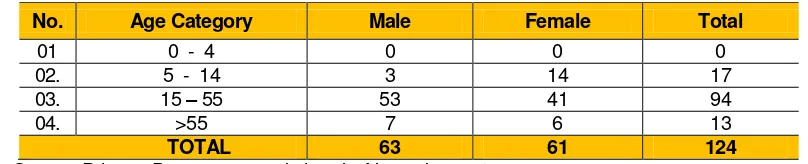
A. OBJECTIVE ... 13
B. BASIC LEGAL POLICY ... 13
C. BASIC PRINCIPLES OF PROJECT ... 14
D. MATRIX OF AFFECTED PEOPLE RIGHT ... 15
iii | P a g e
IMPACT AND COMPENSATION ... 17
A. REASONABLE REIMBURSEMENT VALUE ... 17
B. COMPENSATION ... 20
C. GAP ... 20
CHAPTER VII ... 23
RECOVERY OF INCOME AND OR LIVELIHOOD ... 23
A. PURPOSE ... 23
B. RECOVERY AND REHABILITATION PROGRAMS ... 23
CHAPTER VIII ... 26
INSTITUTIONAL ARRANGEMENTS ... 26
A. GENERAL ARRANGEMENTS ... 26
B. THE DIVISION OF ROLES ... 26
C. BUDGET ... 27
CHAPTER IX... 28
MONITORING DAN EVALUATION ... 28
A. PURPOSE ... 28
B. MONITORING DAN EVALUATION RESULT ... 28
C. RECOMENDATION ... 29
iv | P a g e
ABBREVIATIONS
ADB : Asian Development Bank
AP : Affected People
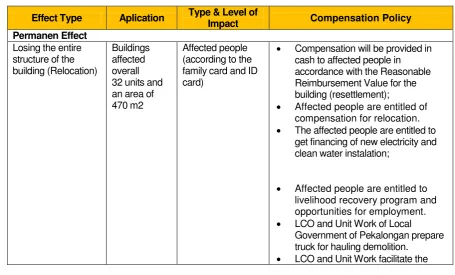
APBD : Local Budget
BSPS : Bantuan Stimulan Perumahan Swadaya
CIO : Community Implementing Organization
DDR : Due Diligence Report
DED : Detail Engineering Design
DGHP : Directorate General of Housing Provision
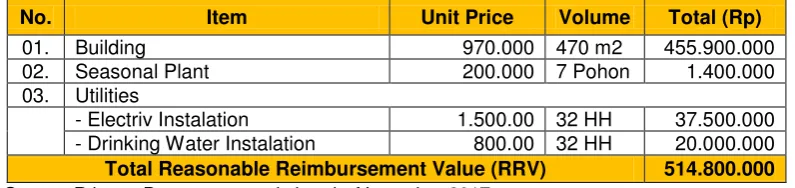
DGHS : Directorate General of Human Settlements
HHs : Households
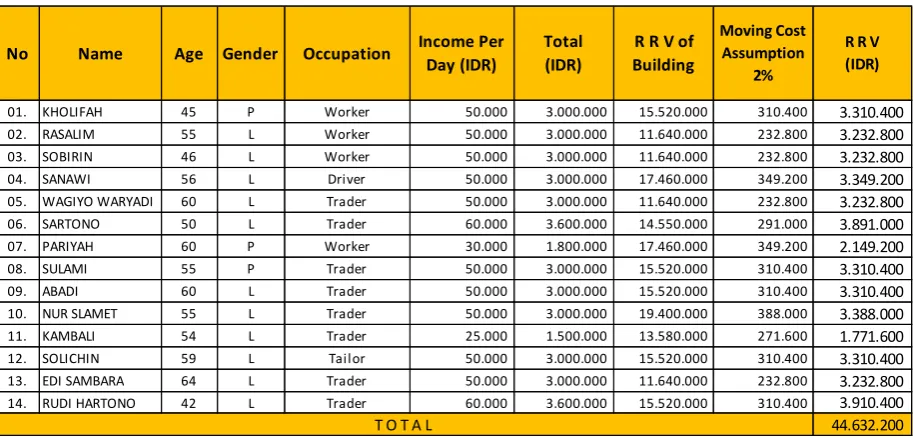
KIP : Indonesia Smart Card
KIS : Indonesia Health Card
LCO : Local Coordinating Office
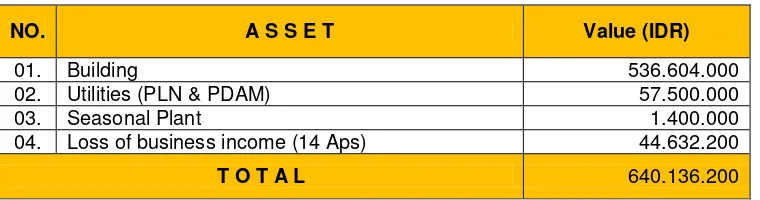
NMC : National Management Consultant
NPW : Reasonable Reimbursement Value
NUAP : Neighborhood Upgrading Action Plan
NUSP : Neighborhood Upgrading Shelter Project
PIU : Project Implementation Unit
PDAM : Local Government-owned Water Supply Company
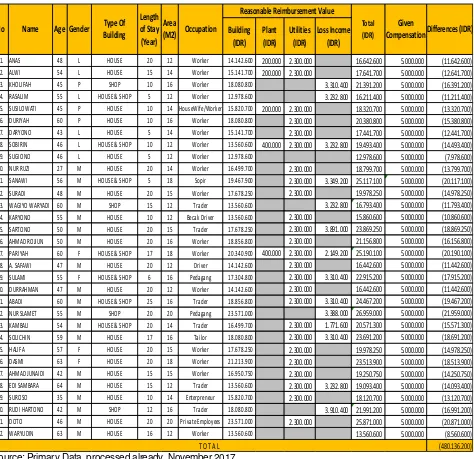
PMU : Project Management Unit
RMC : Regional Management Consultant
RTLH : Renovation of Inadequate House
SATKER : Local Project Working Unit
SIAP : Slum Improvement Action Plan
v | P a g e
LIST OF FIGURES
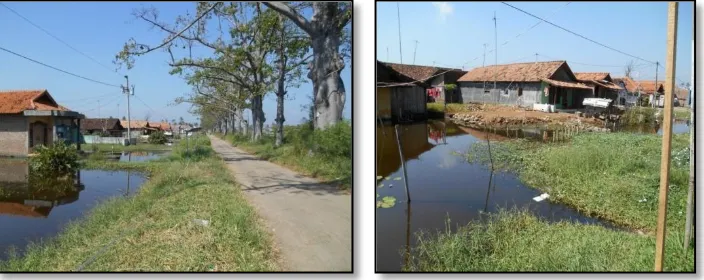
Figure 1 Puddle Water Condition in Kelurahan Pasir Kramat Kraton ... 2
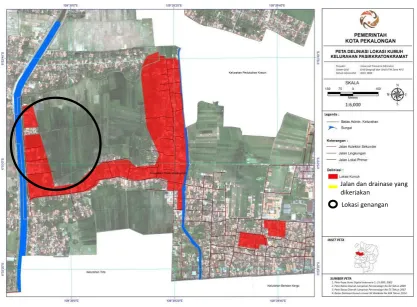
Figure 2 Scope of Handling Map ... 3
Figure 3 Affected Resident Houses That Classified As Inadequate. ... 28
vi | P a g e
LIST OF TABLES
Table 1 Female Household Profile ... 7
Table 2 Affected Residents Profile ... 7
Table 3 Affected Residents Occupation ... 8
Table 4 Average Income Affected Residents ... 8
Table 5 Data of vulnerable age households ... 9
Table 6 Entitlement Matrix ... 15
Table 7 Reasonable Reimbursement Value for House Building, Plant and AR Utilities ... 17
Table 8 Reasonable Reimbursement Value of Loss Income ... 18
Table 9 Solatium Criteria ... 18
Table 10 Calculation of Solatium Against Residential Building & RRV ... 19
Table 11 Total of Reasonable Reimbursement Value ... 19
Table 12 GAP value or deviation ... 21
Table 13 Program Type and Implementation of AR Recovery ... 24
Table 14 APs Name of Recovery Program Recipient ... 25
vii | P a g e
LIST OF APPENDICES
Appendix 1 List of NUSP-2 target cities / districts ... 31
Appendix 2 List of Pekalongan City Slum Area Location ... 32
Appendix 3 List of Directly Affected Resident ... 33
Appendix 4 Vulnerable Age and Poor of APs ... 35
Appendix 5 The Reasonable Reimbursement Value of 32 The affected Residents... 36
Appendix 6 Plant Reasonable Reimbursement Value ... 37
Appendix 7 Utilities Reasonable Reimbursement Value ... 38
Appendix 8 Relocation Cost/Kerohiman ... 39
Appendix 9 The Affected Residents Asset Value ... 40
Appendix 10 Project Struktur Organization ... 41
1 | P a g e sustainable manner in accordance with the mandate of Law No . 1 of 2011 about Housing and Settlement Area.
2. NUSP-2 will be implemented in 20 districts / cities to improve the quality of slum areas with facilitation of activities grouped in three main components, namely: 1). Improving the institutional capacity of local governments; 2). Improving the quality of slum infrastructure; 3). Provision of new settlements for low-income communities. One of target districts / cities of NUSP-2 are Local Government of Pekalongan. List of NUSP-2 targeted cities / districts can be seen in Appendix 1.
3. Improvement the quality of slum infrastructure (component 2) is carried out in two patterns: implemented by Community Implementing Organization (Badan Keswadayaan Masyarakat) by community empowerment for infrastructure on an environmental scale and implemented by contractors for complex activities on a regional scale.
4. NUSP-2 has been started since 2015, starting with the implementation of the environmental scale activities in 73 Kelurahan spread across 20 cities / districts. Implementation of area-scale activities began in 2016, including physical implementation in Kota Pekalongan.
B. PROJECT DESCRIPTION AT PEKALONGAN CITY
5. NUSP-2 in Pekalongan city was carried out in 7 slum Kelurahan of 17 slum Kelurahan determined by the Decree of Mayor of Pekalongan No 601/215 of 2014 as amendment to Decree of Mayor of Pekalongan No 601/132 Year 2014 About Determination of Urban Slum Area of Local Government of Pekalongan. List of Slum locations and target locations of NUSP-2 Local Government of Pekalongan can be seen in Appendix NUSP-2.
6. In 2016, Local Government of Pekalongan conducts physical activities consisting of infrastructure development environmental scale in 7 Kelurahan and 3 package of infrastructure development area scale. One of them is a package of road construction and drainage activities along 722 m wide 2 m along Randujajar road in Pasirsari Kelurahan Pasir Kraton Kramat.
7. In accordance with the slum profile of Kelurahan Pasir Kraton Kramat, for road conditions, there are 30% of areas not covered by road network and 46 areas with poor road surface quality. As for the drainage conditions, 31% of the area does not have drainage and 57% have drainage but in bad condition and not functioning optimally. The low level of infrastructure service in
Kelurahan Kraton Kramat Village is caused by almost all areas flooded by ROB1. Based on the
handling scenarios formulated in the SIAP document and referring to the drainage master plan of Local Government of Pekalongan, it is recommended that secondary drainage development with pumping system needed. The need for drainage handling is also a proposed community which is often proposed through the Sub District Development and Planning Consultation
1
2 | P a g e
(Musyawarah Perencanaan dan Pengembangan) and was proposed in Kelurahan meetings at the time of NUAP drafting in 2015.
8. DED for regional scale packages prepared by consultants recruited by Municipality of Kota Pekalongan with regional budget. The plan has been socialized to the community around the location of road and drainage development plans. The socialization was held on September 14, 2015 attended by the Community Implementing Organization, LPM, RW Chairman and community leaders, and resulted in an agreement to accept and support the community's rehabilitation / relocation plan.
9. Road and drainage development sites are located along Randujajar road in Kelurahan Pasir Kratamat. The land status for road construction and drainage is owned by Municipality of Local Government of Pekalongan. The existing condition of the road is damaged, while the drainage area of drainage is not working and there are 32 houses standing on it.
10. Displacement of 32 Households on top the drainage can not be avoided because that settlement interfere the drainage function and it is a landless settlement, no evidence and the rights of use / ownership of land. Randujajar Road is chosen as the location of drainage development because this location is adjacent to Bremi River, so the water puddle in the settlement will be pumped into the river.
11. This Due Diligence Report (DDR) is a social safeguard document for the Area Scale of Quality Improvement Package of Pasir Kraton Kramat, with road and drainage activities along 722 m and wide 2 m in Randujajar road in Pasirsari Kelurahan Pasir Kraton Kramat, Sub District West Pekalongan, Local Government of Pekalongan, Central Java Province. DDR contains policies, guidelines, resettlement processes and profiles of affected people, compensation and local government assistance programs.
C. PROJECT IMPACT
12. Quality Improvement of Slum Settlement work in Pasir Kraton Kramat area, in the form of road and drainage construction along Randujajar road, aims to improve community accessibility and reduce puddles. Most of the slum target NUSP-2 facing the same problem, which there is water puddle caused by the ROB. In Kelurahan Pasir Kraton Kramat this puddle reaches a height between 20-50 cm.
3 | P a g e
13. The economic development of the Kelurahan Pasir Kraton Kramat community has decreased because difficulty of community accessibility due to the inundation that occurred over the years. This drainage construction is expected to eliminate puddles and simplify community accessibility which ultimately will improve the economy of the community.
14. Kelurahan Pasir Kraton Kramat community strongly supports the road and drainage construction plan on Jl. Randujajar because that construction is expected to solve water puddle problem that has occurred for many years. In addition, the restoration of Randujajar road is expected to facilitate socio-cultural and economic accessibility of the community.
15. Slum area of Pasir Kraton Kramat with an area of 17.96 Ha and almost 70% of the area was
inundated due to ROB. The construction of drainage and installation of pumps are expected to reduce the puddle by 60%.
Figure 2 Scope of Handling Map
Jalan dan drainase yang dikerjakan
4 | P a g e
D. RELOCATION OF AFFECTED RESIDENTS
16. The construction of drainage along Randujajar road has had an impact on the destruction and replacement of 32 buildings located on the existing drainage channel along the road. The displacement of Kelurahan Pasir Kraton Kramat society that lived atop of the drainage can not be avoided because that settlement disrupts the drainage function and it is a non-licensed settlement as well as the land evidence and right of use / ownership.
17. 32 relocated buildings are semi-permanent buildings occupied by 32 Households. Most condition of the buildings to be relocated is in poor condition.
5 | P a g e
CHAPTER II
RESETTLEMENT SCOPE
A. RESETTLEMENT
19. Work of Quality Improvement of Slum Areas in Pasir Kraton Kramat area, in the form of road
and drainage construction along Randujajar Road has affected the replacement of 32 Households, with 124 souls.
20. From 32 Households, there are 6 families whose heads of households are female, and there
are 30 Households classified to vulnerable families (including female heads of household).
21. Road and drainage construction plan along Randujajar Road and replacement of 32
households have been agreed by the affected residents and Pasir Kramat Kraton residents through society meeting and consultation.. Based on resident forum, affected residents have agreed on the amount of relocation cost (cost of kerohiman) which is Rp. 5.000.000, - for the cost of destruction the building, transportation cost and rental cost of house for 1 year. The affected residents are planned to occupy a rental townhouse in Krapyak Lor.
22. The replacement of 32 Households affected the total demolition of 32 buildings and utilities
(electricity and clean water), trees, demolition of mosque wudhu place and the displacement of electric poles.
23. LCO, the Unit Work of Local Government og Pekalongan and consultant have identified the
affected objects, compiled the missing assets and prepared the assistance facilitation plan to ensure that the affected people are not encounter degradation in their quality of life.
B. ACTIVITY IMPACT DESCRIPTION
24. House Destructions. The 722 m drainage along Randujajar Road has impacted the destruction of 32 buildings located above drainage channels along Randujajar Road. 32 buildings are semi permanent buildings owned by 32 families. Most of the buildings are in poor condition, only 9 buildings are in good condition. Owner name and status of affected buildings can be seen in Appendix 3 and the photos of affected house can be seen in Appendix 11. The value of the affected assets as a result of the demolition of the house are:
House Building, calculated based on the type of construction used and valued based on
ReasonableReimbursement Value (FRV)).
Utilities, in the form of installation costs of clean water and electricity.
Land is not part of the affected assets, because the land is owned by Municipality of Kota
Pekalongan.
Plants, when including plants that have economic value. The number of trees were cut
down as much as 7 trees, where 6 trees are type of plant that has economic value, and 1 is not economically valuable tree.
6 | P a g e
experience a decrease in income, so within a certain period of time, support for their livelihood are needed.
7 | P a g e
CHAPTER III
INFORMATION AND PROFILE OF SOCIAL ECONOMY
A. THE AFFECTED PEOPLE
27. There are 32 buildings directly affected by the road and drainage construction activities, and
the function of the affected buildings can be grouped into 2 parts: 21 buildings as residence and 11 buildings as residence and business (store and shops).
28. 8 Households have 6 - 8 family members, while the other 24 Households have 2 - 5 family
members. From this data indicates that most Households have relatively medium and large family dependents.
29. Of the 32 Aps there are 6 households (15.6%) whose head of families are female. Female
households profile of affected are as follows :
Table 1 Female Household Profile
Source: Primary Data, processed already, November 2017
30. The number of affected people living in the 32 buildings are 124 peoples, consisting of 50.8% male (63 people) and 49.2% female (61 people). In terms of productive age, 75.8% (94 persons) were of productive age, while the remaining 24.2% were unproductive ages. In detail, the profile of affected residents in terms of age and sex can be seen in table 2 below.
Table 2 Affected Residents Profile
Source: Primary Data, processed already, November 2017
B. LIVELIHOOD AND INCOME
8 | P a g e 1.500.000, - (in 2016) and the remaining 16% (5 Households) already have income above Pekalongan Regional Minimum Wage. When viewed from the sex composition, female household (6 households) have income levels below Pekalongan Regional Minimum Wage.
Table 4 Average Income Affected Residents
No. Households Average Income Per Month
<Rp.1 Million Rp. 1 -1,5 Million 1,6-3 Million
01. Male 6 16 5
02. Female 3 2 0
Total 9 18 5
Source: Primary Data, processed already, November 2017
C. SOCIAL INFORMATION
33. Kelurahan Pasir Kraton Kramat community strongly supports the road and drainage
construction plan on Jl. Randujajar, because the construction can solve the problems of water puddle and accessibility of socio-cultural and economic communities, although they must be relocated. This is because the 32 affected residents have realized the mistake of build on a location that does not belong to them, that is above the drainage, thus disrupting the drainage function.
34. Affected people have close kinship relationships with the surrounding environment, since
most of them are from that region and many close relatives live nearby. Affected people have good social and cultural relation in work together and cooperation.This is proved by the many community activities that have been done regularly, such as, arisan, regular pengajian (praying together), community service, etc..
35. Affected people have easy access to health, education and market centers. They also have
easy access to clean water, sanitation and garbage services.
D. GENDER ISSUE
36. The problems faced by the Kelurahan Pasir Kraton Kramat community, including the
9 | P a g e
37. Of the 124 affected people, 61 persons (49.2%) were female, and 67% (41 persons) of them on productive age. Productive women are involved in the process of implementing NUSP-2, such as socialization and deliberation for planning, as well as the special consultation of affected residents, to decide building demolition agreement.
38. Affected people including women have agreed for decision to be relocated because women and all affected people are aware of their mistakes, occupying government-owned drainage land as their home location. This decision was agreed together with consideration of the great benefits to be gained by women (housewives), who have always had their house puddled by water.
E. VULNERABLE HOUSEHOLD
39. Affected residents if viewed from the age and female households, there are 30 households
who belong to vulnerable households. Details of residents data who classified as vulnerable can be seen in the table below.
Table 5 Data of vulnerable age households
10 | P a g e handling through NUSP-2, also discussed the area-scale management plan to solve flood problem in Kelurahan Pasir Kraton Kramat. Socialization participants strongly supporting drainage construction plan with pumping system in Pasir Kraton Kramat and Padukuhan Kraton area. Initial socialization was also conducted specifically for the affected residents to explain the drainage development plan on Jl. Randujajar which affects the relocation of 32 houses.
41. Socialization was also held to provide information of the demolition and destruction plan of
32 buildings. The socialization was carried out by a team consisting of: DPU, DPPKAD, BPMP2AKB, Bappeda, Satpol PP, Governance Div., Development Administration Div., Sub-district, Danramil, Kapolsek, Kasi Tramtib Kecamatan, Lurah, Babinsa and Babinsa kamtibmas.
42. The socialization was conducted to provide information on complaints handling related to the
displacement of 32 affected people. Complaints may be submitted either directly or in writing to the RT / RW or, if necessary, to the Kelurahan level even to the municipal level, with the following mechanism:
Kabupaten will conduct research complaint.
The result of the research or investigation will be informed to the Affected Residents no
later than 12 days to be deliberated by a decision that holds the principle of win-win solution.
The results of problem solving or handling of complaints are disseminated through
available public spaces such as notice boards in the project office, Government Office, Sub District Office and Kelurahan Office.
43. Coordination meeting discussed handling of Pasir Kraton Kramat slum area implemented on
August 20, 2015. This meeting was attended by the Regional Secretary of Local Government of Pekalongan, Ass. Governance and Administration Setda, Ass. Ekbang and Kesra Setda, Head of DPU, Head of DPKAD, Head of BPMP2AKB, Head of Government of Setda, Head of Administration of Setda Development, Head of Law of Setda, Head of Satpol PP, Head of West Pekalongan, West Pekalongan Danramil, West Pekalongan Police Head, Head of Cipta Karya DPU, Spatial DPU, Head of SDA DPU, Lurah Pasir Kraton Kramat, Kasi Trantib Kec. West Pekalongan, Babinsa Kel. Kramat Kramat Sand, Babinkamtibmas Kel. Kramat Sand Kramat, BKM Coordinator, LPM Coordinator, Head of RW VI and
community leaders. The results of the coordination meeting resulted in the following
11 | P a g e
1. To handle the Pasirsari slum area caused by water puddles, it is necessary to build drainage system through Randujajar channel
2. At the top of the channel, there are 32 units of illegal houses, with permanent building conditions (brick house) and some semi-permanent (board house).
3. To build a good drainage system, the illegal houses must be relocated immediately. 4. The relocation site provided by the government is Rumah Susun Sederhana Sewa
(Rusunawa) Krapyak Lor
5. The cost of relocation for affected residents is proposed in amount:
- Building Destruction Cost Rp. 1.000.000,-
- Moving Transport Cost Rp. 1.000.000,-
- Rusunawa Rental Cost 1 tahun Rp. 3.000.000,- +
- Total Rp. 5.000.000,-
44. The next coordination meeting was held on October 13, 2015 and was attended by the
Regional Secretary of Local Government of Pekalongan, Ass. Governance and Administration Setda, Ass. Ekbang and Kesra Setda, Head of DPU, Head of DPKAD, Head of BPMP2AKB, Head of Government of Setda, Head of Administration of Setda Development, Head of Law of Setda, Head of Satpol PP, Head of West Pekalongan, West Pekalongan Danramil, West Pekalongan Police Head, Head of Cipta Karya DPU, Spatial DPU, Head of SDA DPU, Lurah Pasir Kraton Kramat, Kasi Trantib Kec. West Pekalongan, Babinsa Kelurahan Pasir Kraton Kramat, Babinkamtibmas Kelurahan Pasir Kraton Kramat, Coordinator BKM, Koord.LPM, Chairman of RW VI and community leaders.
The result of the meeting stipulates the following matters:
1. South part of the mosque building, the priest's chamber, will not be demolished because the channel that will be normalizedis on the north side of Jl. Samanhudi. The northern mosque wudhu place in the irrigation channel border if exposed to channel normalization work will be re-built in that mosque.
2. Drinking water containers in the channel border will not be demolished before any substitute from DAK PSAB or HID / HIK activities.
3. Decent public toilet will soon be built through the 2017 - 2018 Local Budget.
4. Jalan RanduJajar located in the border area with the district (Tegaldowo) which is currently severely damaged condition will be repaired through NUSP regional scale work package.
5. The public road lighting (PJU) works in that region are prioritized on 2016 work.
45. During the construction of road and drainage activities carried out by LCO, Satker and
other relevant agencies, including on-site consultations with affected residents, community around construction and Community I Organization.
B. ADVANCED CONSULTATION
46. Coordination and monitoring meeting in post-resettlement evaluation framework was
12 | P a g e
1. Advanced survey to identify socio-economic data on 32 affected people;
2. Identification of local government programs that can be given as an effort to restore the lives of affected residents;
3. Acceleration preparation of DDR reports.
47. Coordination meeting in order to identify the local government's regular programs, the
meeting was attended by LCO, Unit Work of Local Government of Pekalongan, RMC, City Coordinator and CIO on Thursday, November 2, 2017. From the outcome of the consultation has been agreed on several recovery programs that are intended for affected residents of 32 households. The agreed recovery programs are as follows:
1. PAMSIMAS program, which will be implemented on FY. 2018 Quarter 1-4. Funds will be used to finance the program come from Local Budget (APBD).
2. Indonesia Health Card, will be implemented on FY. 2018 Quarter 1 - 4. Funds will be used to finance the program come from Local Budget (APBD).
3. Training process for agriculture and fishery product, tailor and otomotif, will be implemented on FY. 2018 Quarter 1. Funds will be use to finance the program come from Local Budget (APBD).
4. Renovation of Inadequate House, will be implemented on FY. 2018 Quarter 1 - 4. Funds will be use to finance the program come from BSPS.
5. Integrated Service Post of the Elderly, will be implemented on FY. 2018 Quarter 1 - 4. Funds will be use to finance the program come from Local Budget (APBD). 6. Construction of public toilet, will be implemented on FY. 2018 Quarter 1 - 4. Funds
will be use to finance the program come from Local Budget (APBD).
7. Keluarga Harapan Program, will be implemented on FY. 2018 Quarter 1 - 4. Funds will be use to finance the program come from Local Budget (APBD).
8. Indonesia Smart Card (KIP), will be implemented on FY. 2018 Quarter 2 and Quartal 4. Funds will be use to finance the program come from Local Budget (APBD).
48. LCO and Unit Work of Local Government of Pekalongan will carry out consultations
and coordination regularly with affected residents and various related parties. This consultation aims to monitoring how is far the purpose of resettlement have been achieved and to evaluate to ensure that the social and economic conditions of affected residents are not decreased, and also intended to monitor the implementation of assistance programs that have been planned. Monitoring and evaluation are expected to provide input to the government in formulating the future policies and programs.
C. DISCLOSURE
49. For public disclosure, this Due Diligence (DDR) report will be uploaded on the ADB and PWH
Ministry website, as well as on the local Satker’s website. Further, the information about DDR
13 | P a g e
CHAPTER V
POLICY FRAMEWORK OF POPULATION RESETTLEMENT
A. OBJECTIVE
50. The objective of resettlement and compensation is to ensure that the project provides
an opportunity for affected residents to get benefit so it does not become worse during and after the implementation.
B. BASIC LEGAL POLICY
51. Policy Framework. This RF has been prepared in compliance with ADBs Involuntary Resettlement Safeguards (SPS, 2009) and Operation Manual Section F1/BP, March 2010, and the Indonesian Government’s law and regulations related to land acquisition that include i) Law No. 2/2012 on Land Acquisition for Development in Public Interests; ii) Presidential Regulation no. 71/2012 on Implementation of Land Acquisition for the Development in Public Interest; iii) Regulation of BPN Head No. 5/2012 on the implementation guideline for Presidetail Regulation No. 71/2012. In addition, the Ministry of Finance Regulation No. 13/PMK 02/2013 and Ministry of Home Affair Regulation No. 72/2012 on the guidelines for Law 2/2012 implementation.
1. ADB’s Social Safeguard Policy Requirements
52. The ADB SPS, 2009 consolidated three safeguard policies, i.e. (i) involuntary
resettlement (IR), (ii) indigenous peoples (IP), and (iii) environment. Requirements of ADB’s 2009 SPS indicates the following principles: (i) involuntary resettlements must be avoided where feasible; (ii) minimize involuntary resettlements by exploring project and design alternatives; (iii) enhance the livelihoods of all displaced persons in real terms relative to pre-project levels; and (iv) improve the standards of living of the displaced poor or other vulnerable groups. The scope of the safeguards include physical replacement (relocation, loss of residential land, or loss of shelter) and economic displacement (loss of land, assets, access to assets, income sources, or means of livelihood as a result of (a) involuntary acquisition of land, or (b) involuntary restrictions on land use or on access to legally designated parks and protected areas. It also stipulates whether the losses and involuntary restrictions are full or partial, permanent or temporary. Annex 1 lists the 12 policy principles required to meet the resettlement objectives of ADB’s SPS. The project has been categorized as C for IP (no impact on IP), as no IP have been identified residing in the project locations. The policy on environment is discussed in a separate document.
2. Other ADB’s Crosscutting Policy Themes
14 | P a g e
associated with the implementation of its policies in all programs or projects it assists. Prescriptions from these crosscutting ADB’s policy themes shall be incorporated and defined in the appropriate sections of the LARPs.
3. Indonesia Government Regulation
54. In 2012, the Government issued Law no. 2 on the procurement of land for
development for Public Interest.The purpose of land acquisition is to provide land for the implementation of development in order to improve the welfare and prosperity of the nation, state and society with still maintaining legal interests of the Eligible Party. Some of the things regulated in this rule are:
The availability of land for development for public interest is guaranteed by the
state;
Land acquisition is conduct by the government;
Land acquisition must be done in accordance with spatial planning and other
The land acquisition process should involve all stakeholders.
4. Analysis Gap and Basic Principles Project
55. The gap was found between ADB's Social Safeguard Policy and Indonesian
Government regulations on land acquisition, such as:
The law provides managed stability between the interests of development and the
interests of the community, but has not yet specifically defined the alignments of the community (including indigenous peoples, vulnerable groups), and the socio-economic evaluation of affected communities.
Law has not regulating resettlement clearly, relocation of affected persons and
regulating the use of government land illegally.
C. BASIC PRINCIPLES OF PROJECT
56. Basic Principles The principles to be applied for the project are as follows:
a. Acquisition of land and other assets shall be avoided and minimized as much as possible by exploring project and design alternatives and appropriate social, economic, operational, and engineering solutions that have the least impact on populations in the project area.
b. All affected persons included in the cut-off date are eligible for compensation and rehabilitation assistance, irrespective of tenure status, social or economic standing, and any such factors that may discriminate against achieving the objectives outlined above. Neither lack of legal rights to the assets lost, or tenure status or social or economic status will not be a bar for the APs from entitlements to such compensation and rehabilitation measures.
15 | P a g e
d. APs shall be fully consulted and informed on the project, their entitlement and resettlement options. As well as the assistance measures. Ensure the APs participation in planning, implementation, and monitoring and evaluation of resettlements programs. Particular attention will be provided to the vulnerable groups and ensure their participation in consultations.
e. The project will not cause physical displacement of APs from housing and/or lose 10% or more of total land owned or productive income. If the proposed infrastructure indicates the need to relocate people, the proposed infrastructure will be dropped from project financing.
f. The living standards of the affected people are not expected to be reduced due to the small scale of the land acquisition. This will be ensured in the LARP.
g. There shall be an effective grievance redress mechanisms to receive and facilitate resolution of the affected persons’ concern during the preparation and implementation of LARPs.
h. Details of the LARPs, including documentation of the consultation process shall be disclosed to APs and any interested groups through public meetings and in the form of summary LARPs or information booklets and leaflets in a language that can be understood by the APs and in an accessible places (such as neighborhood notice board, project and commune offices).
i. Appropriate monitoring shall be carried out to assess land acquisition objectives and their impacts on the standard of living of the APs. The M& E, mechanisms shall be identified and set in place as part of the land acquisition management system. Monitoring reports should be disclosed.
j. Civil works will not be commenced until (a) payment has been fully provided to the APs and rehabilitation measures if any, are in place; (b) already-compensated APs have cleared the area in a timely manner; and (c) the area is free from any encumbrances.
D. MATRIX OF AFFECTED PEOPLE RIGHT
57. The matrix of affected people right in the table below summarizes the rights and
support received by affected residents.
Table 6 Entitlement Matrix
Effect Type Aplication Type & Level of
Impact Compensation Policy
The affected people are entitled to get financing of new electricity and
16 | P a g e
Effect Type Aplication Type & Level of
Impact Compensation Policy
transfer process to Rusunawa
LCO and Unit Work provide opportunities for the affected residents if they want to work on the project.
LCO and Unit Work will facilitate the development of public infrastructure and facilities such as public toilets, access roads, waste management and water supply channels.
Losing Business The affected people is entitled for
Reasonable Reimbursement Value
LCO and Unit Work provide FRV for rebuilding.
Affected People Affected people are entitled for compensation in accordance with FRV.
Right for Vulnerable Households
The 30 APs Vulnerable groups will get the economic recovery program
17 | P a g e
CHAPTER VI
IMPACT AND COMPENSATION
A. REASONABLE REIMBURSEMENT VALUE
58. Reasonable Reimbursement Value; is the value of ownership interest based on equality with Market Value of the Property, regarding to extraordinary elements of non-physical loss cause by the right acquisition of the Property (SPI 102 - 3.10. Reasonable Reimbursement Value (RRV) is defined the same as the value of compensation as stipulated in Law No. 2 Year 2012. RRV can be generated from a combination of physical and non-physical losses on an assessment object. This combination can be described as the sum of the Market Value indication on physical damages plus an indication of value on the non-physical losses.
59. Land. Land used by affected people belong to Local Government of Pekalongan Government, so there is no calculation of Reasonable Reimbursement Value (NPW) to the affected people land.
60. Residential Buildings. The affected house are 32 houses, with a total area of 470m2. All house structures are semi-permanent. House structure building is varied, some use roof tile and asbestos, building wall using brick and bamboo / board. Age of the building is estimated between 5-25 years, and most of the buildings have been damaged.
61. Plant. There are 7 affected plants, namely 6 mango trees and 1 banyan tree. Mango and banyan trees are 2-3 years old. RRV plant calculated based on the cost of seed and treatment. Assumed per plant is Rp. 200,000.
62. Utilities (PLN and PDAM). New installations of PLN and PDAM will be allocated for
32 affected people.Reasonable Reimbursement Value is awarded based on the new
instalation fee of PLN and PDAM 2017 that applicable in Pekalongan city.
63. The Reasonable Reimbursement value against the physical losses (buildings, plants
and utilities) affected is calculated as follows:
RRV for house building is calculated by using the unit price of building materials in
2017 set by the mayor. Calculation of unit price per m2 for semi-permanent building is Rp. 970.000, - details of unit price can be seen in appendix 9.
RRV for the plant is calculated based on the market value is Rp. 200.000, - / plant
RRV for utilities of PLN new installations based on 2017 price is Rp. 1.500.000, - /
house and Drinking Water new installations based on 2017price is Rp. 800.000, - / house
Table 7 Reasonable Reimbursement Value for House Building, Plant and AR Utilities
No. Item Unit Price Volume Total (Rp)
01. Building 970.000 470 m2 455.900.000
02. Seasonal Plant 200.000 7 Pohon 1.400.000
03. Utilities
- Electriv Instalation 1.500.00 32 HH 37.500.000
- Drinking Water Instalation 800.00 32 HH 20.000.000
Total Reasonable Reimbursement Value (RRV) 514.800.000
18 | P a g e
Total RRV for 32 affected residents covering buildings, plants and utilities amounted to Rp. 514.800.000, -. RRV details for each affected residents of buildings, plants and utilities can be found in appendix 5, 6 and 7.
64. Public Facilities. Public facilities that affected are the demolition and relocation of mosque ablution area of 6 m2 that located on the drainage field. Assumed the cost of reconstruction the ablution place is Rp. 2,000,000,-.
65. Loss of business income. Residents relocation will impact their business income, especially residents who have jobs as traders. From the 32 affected residents, there are 14 residents who work as traders and their business income was affected. Meanwhile, residents who work as laborers, drivers and employees, their revenues were not affected. The RRV for loss income (temporarily) is calculated by assuming that for 2 months the residents can not trade, so amount of residents monthly income becomes the unit price of loss income:
Table 8 Reasonable Reimbursement Value of Loss Income
Source: Primary Data, processed already, November 2017
66. Solatium. It is an intangible emotional loss associated with land acquisition used as residence of the owner. The solatium assessment object is only for residential buildings. The solatium calculation criteria is carry out by observing the period of stay
that is between 3 up to 30years. For more details criteria calculation solatium can be
seen in the table. 9 as follows:
19 | P a g e
67. Calculation of solatium to residential buildings. The calculation of solatium on residential building was conducted on 32 APs based on the length of stay and / or occupying the house. The calculation of solatium can be seen in the table. 10 below.
Table 10 Calculation of Solatium Against Residential Building & RRV
68. Total of Reasonable Reimbursement Value. Total of RRV for the 32 affected people assets are the sum of RRV for buildings, plants, public facilities and loss of income, as follows:
Table 11 Total of Reasonable Reimbursement Value
NO. A S S E T Value (IDR)
01. Building 536.604.000
02. Utilities (PLN & PDAM) 57.500.000
03. Seasonal Plant 1.400.000
04. Loss of business income (14 Aps) 44.632.200
T O T A L 640.136.200
Source: Primary Data, processed already, November 2017
Length
02. ALWI Worker 15 14 970.000 13.580.000 1.358.000 203.700 15.141.700
03. KHOLIFAH Worker 10 16 970.000 15.520.000 2.328.000 232.800 18.080.800
04. RASALIM Worker 5 12 970.000 11.640.000 1.164.000 174.600 12.978.600
05. SUSILOWATI HouseWi fe/Worker 10 14 970.000 13.580.000 2.037.000 203.700 15.820.700
06. DURIYAH Worker 10 16 970.000 15.520.000 2.328.000 232.800 18.080.800
07. DARYONO Worker 5 14 970.000 13.580.000 1.358.000 203.700 15.141.700
08. SOBIRIN Worker 10 12 970.000 11.640.000 1.746.000 174.600 13.560.600
09. SUGIONO Worker 5 12 970.000 11.640.000 1.164.000 174.600 12.978.600
10. NUR RUZI Worker 20 14 970.000 13.580.000 2.716.000 203.700 16.499.700
11. SANAWI Dri ver 5 18 970.000 17.460.000 1.746.000 261.900 19.467.900
12. SURADI Worker 20 15 970.000 14.550.000 2.910.000 218.250 17.678.250
13. WAGIYO WARYADI Trader 15 12 970.000 11.640.000 1.746.000 174.600 13.560.600
14. KARYONO Becak Dri ver 10 12 970.000 11.640.000 1.746.000 174.600 13.560.600
15. SARTONO Trader 20 15 970.000 14.550.000 2.910.000 218.250 17.678.250
16. AHMAD ROJIUN Worker 20 16 970.000 15.520.000 3.104.000 232.800 18.856.800
17. PARIYAH Worker 17 18 970.000 17.460.000 2.619.000 261.900 20.340.900
18. A. SAFAWI Dri ver 20 12 970.000 11.640.000 2.328.000 174.600 14.142.600
19. SULAMI Trader 6 16 970.000 15.520.000 1.552.000 232.800 17.304.800
20. DURRAHMAN Worker 20 12 970.000 11.640.000 2.328.000 174.600 14.142.600
21. ABADI Trader 25 16 970.000 15.520.000 3.104.000 232.800 18.856.800
22. NUR SLAMET Trader 20 20 970.000 19.400.000 3.880.000 291.000 23.571.000
23. KAMBALI Trader 20 14 970.000 13.580.000 2.716.000 203.700 16.499.700
24. SOLICHIN Tai l or 17 16 970.000 15.520.000 2.328.000 232.800 18.080.800
25. HALIFA Worker 20 15 970.000 14.550.000 2.910.000 218.250 17.678.250
26. DASMI Worker 20 18 970.000 17.460.000 3.492.000 261.900 21.213.900
27. AHMAD JUNAIDI Worker 15 15 970.000 14.550.000 2.182.500 218.250 16.950.750
28. EDI SAMBARA Trader 15 12 970.000 11.640.000 1.746.000 174.600 13.560.600
29. SUROSO Enterpreneur 10 14 970.000 13.580.000 2.037.000 203.700 15.820.700
30. RUDI HARTONO Trader 12 16 970.000 15.520.000 2.328.000 232.800 18.080.800
31. DOTO Pri vate Empl oyees 20 20 970.000 19.400.000 3.880.000 291.000 23.571.000
32. WARYUDIN Worker 16 12 970.000 11.640.000 1.746.000 174.600 13.560.600
20 | P a g e
B. COMPENSATION
69. Act. No. 2 of 2012 declares that compensation shall be appropriate and fair and
equitable compensation shall be granted to the rightful parties in return for the liberated land. The 10 principles of fairness in this Act emphasizes that land procurement guarantees benefits and compensation for eligible parties in order for them to get a chance for better life.
70. The relocation of 32 households was carried out because the implementation of the
drainage construction project is voluntarily. Deliberation and consultation have been conducted before the drainage construction begins. The whole affected community is strongly supportive of the implementation of the project because it will overcome the inundation problems that have occurred throughout the day for many years.
71. LCO and Unit Work of Pekalongan City provide guarantees to affected people and
other affected objects for assistance and compensation so as to ensure that ressttlement does not adversely affect the community.
72. Although 32 affected HHs were found to build unlicensed buildings on government
land (above drainage), but the Municipality of Pekalongan City has prepared a compensation fund whose amount has been agreed upon by affected people. Three discussion meetings have been held to determine the amount of compensation fund and the amount of compensation that had been agreed is Rp. 5.000.000, - per HH.
73. The total cost of the compensation that has been given by the Government amounted
Rp.160.000.000, - where each affected resident get Rp. 5.000.000, - for demolition costs, moving costs and rent for 1 year.
C. GAP
74. GAP; GAP is a measurement method to find out the gap value that occurs during RRV implementation. There is a relatively high gap compared to the compensation value provided with the reasonable reimbursement value of 32 APs. The gap is:
Reasonable Reimbursement Value = 640.136.200
,-Paid Compensation = 160.000.000,-
21 | P a g e
Table 12 GAP value or deviation
Source: Primary Data, processed already, November 2017
75. To finalize the GAP value of Rp. 480.136.200.- Pekalongan City Government will provide assistance in the form of development programs, social and health support and other assistance. That program will be implemented in 2017 and 2018 Quartal Quartal 4 1 - 4. The budget that will be used for the implementation of the program comes from BSPS funds and Pekalongan local budget (APBD).
23 | P a g e
CHAPTER VII
RECOVERY OF INCOME AND OR LIVELIHOOD
A. PURPOSE
76. LCO and Pekalongan City Unit Work guarantee that the affected residents do not
experience a decrease in the quality of livelihood and income by providing facilitation of income recovery and rehabilitation programs as needed.
B. RECOVERY AND REHABILITATION PROGRAMS
77. Recovery Income. LCO and the Pekalongan City Work Unit ensured that the displacement of the population would not lead to decrease of income or loss of jobs to affected people. Nevertheless, the government will continue to provide assistance to ensure that residents livelihoods are secured with house, food and clothing, and also continue to support other existing social and economic relief programs. Pekalongan City Government has planned to provide training for the affected people gradually and continuously, so that in a given year all the affected residents receive training assistance that can support the
profession and increase their income.
78. Several effort to increase the residents affected income is by providing several
programs as follows:
Sewing Training, will be implemented on TA. 2018 Quarter 2. Funds to be used to
finance the program come from local budget (APBD).
Training of Carpenter, will be implemented in TA. 2017 Quarter 4. Funds to be used
to finance the program come from NSUP (APBN).
The Health Card, will be implemented on TA. 2017 Quarter 4 and TA. 2018 Quarter
1 - 4. Funds to be used to finance the program come from local budget (APBD).
Integrated Service Post of the Elderly, will be implemented on TA. 2017 Quarter 4
and TA. 2018 Quarter 1 to Quarter 4. Funds to be used to finance the program
Funds to be used to finance the program come from local budget (APBD).
79. Rehabilitation. Due to the tendency of affected residents to move to their old house or build their own house, the Pekalongan City Government has prepared the program such as:
PAMSIMAS program, which will be implemented on TA. 2017 Quarter 4 and TA.
2018 Quarter 1 to Quarter 4. Funds to be used to finance the program come from local budget (APBD).
Construction of Public Lavatory, will be held on TA. 2017 Quarter 4 and TA. 2018
Quarter 1 to Quarter 4. Funds to be used to finance the program come from local budget (APBD).
Renovation of Inadequate House (RTLH), will be implemented on TA. 2018 Quarter
24 | P a g e
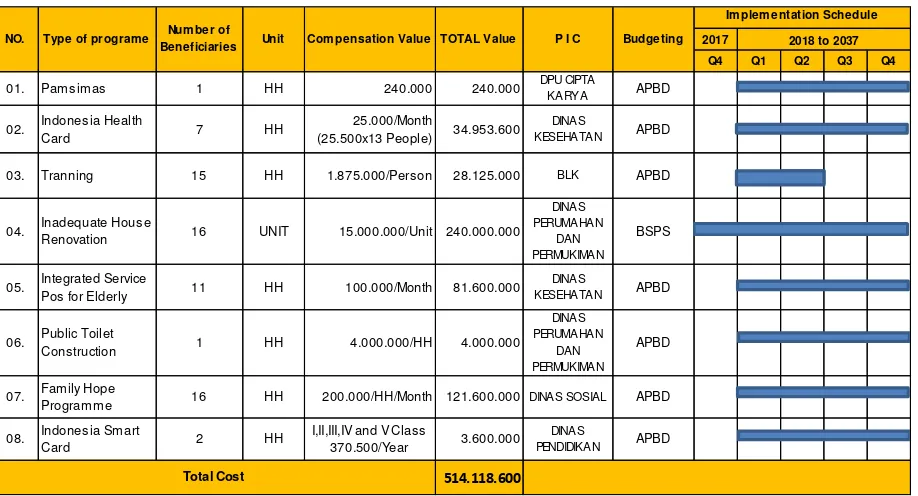
80. Conclusion. Economic recovery program for the 32 Affected People will be implemented by Pekalongan City Government to comply with the lack of compensation that has been given, based on the Fair Value Calculation that has been done. The Value Recovery Program which will be provided to cover the gap will be described below;
The Value Recovery Program = 514.118.600
,-Gap = 480.136.200
,-Difference (Excess Compensation) 33.982.400,-
Table 13 Program Type and Implementation of AR Recovery
Source: Primary Data, processed already, November 2017
2017
03. Tranning 15 HH 1.875.000/Person 28.125.000 BLK APBD
04. Inadequate House
Programme 16 HH 200.000/HH/Month 121.600.000 DINAS SOSIAL APBD
08. Indonesia Smart
Beneficiaries Unit Com pensation Value TOTAL Value P I C Budgeting
25 | P a g e
Table 14 APs Name of Recovery Program Recipient
Source: Primary Data, processed already, November 2017
Remarks :
01. ANAS 1.875.000 9.600.000 1.350.000 12.825.000 -11.642.600 1.182.400 2018-2021Musfiroh (istri)
02. ALWI 15.000.000 15.000.000 -12.641.700 2.358.300 2017-2018Desy alfiana (anak)
03. KHOLIPAH 1.875.000 15.093.600 16.968.600 -16.391.200 577.400 2018-2037 04. RASALIM 1.875.000 9.600.000 11.475.000 -11.211.400 263.600 2018-2025SYAMSUDIN
05. SUSILOWATI 1.875.000 2.400.000 5.560.800 4.000.000 13.835.800 -13.320.700 515.100 2018-2024 SUSILOWATI 06. DURIYAH 15.000.000 240.000 1.200.000 16.440.000 -15.380.800 1.059.200 2018
07. DARYONO 15.000.000 15.000.000 -12.441.700 2.558.300 2018 08. SOBIRIN 15.000.000 15.000.000 -14.493.400 506.600 2017 09. SUGIONO 1.875.000 4.800.000 1.588.800 8.263.800 -7.978.600 285.200 2018-2019 SUGIONO 10. NUR RUZI 15.000.000 15.000.000 -13.799.700 1.200.300 2018 11. SANAWI 1.875.000 14.400.000 3.972.000 20.247.000 -20.117.100 129.900 2018-2023MILATUN
12. SURADI 12.000.000 3.972.000 15.972.000 -14.978.250 993.750 2018-2022 13. WAGIYO WARYADI 6.000.000 6.000.000 12.000.000 -11.793.400 206.600 2018-2022 14. KARYONO 15.000.000 15.000.000 -10.860.600 4.139.400 2017
15. SARTONO 15.000.000 1.875.000 2.250.000 19.125.000 -18.869.250 255.750 2018-2022Siti muayanah (istri)
16. AHMAD ROJIUN 15.000.000 1.400.000 16.400.000 -16.156.800 243.200 2017-2018
17. PARIYAH 1.875.000 7.200.000 12.000.000 21.075.000 -20.190.100 884.900 2018-202 Slamet Prabowo (34), 18. A. SAFAWI 15.000.000 15.000.000 -11.442.600 3.557.400 2018
19. SULAMI 15.000.000 1.875.000 1.200.000 18.075.000 -17.915.200 159.800 2018 Ferry fajri (anak)
20. SUHARTI 15.000.000 15.000.000 -11.442.600 3.557.400 2018
21. ABADI 15.000.000 1.875.000 3.200.000 20.075.000 -19.467.200 607.800 2018-2019Khoiron (anak)
22. NUR SLAMET 1.875.000 20.400.000 22.275.000 -21.959.000 316.000 2018-2034 NUR SLAMET 23. SRIAH 15.000.000 1.875.000 16.875.000 -15.571.300 1.303.700 2018 SRIAH 24. SOLICHIN 1.875.000 6.000.000 12.000.000 19.875.000 -18.691.200 1.183.800 2018-2022 SOLICHIN 25. HALIFA 15.000.000 600.000 15.600.000 -14.978.250 621.750 2018-2019 26. DASMI 7.200.000 12.000.000 19.200.000 -18.513.900 686.100 2018-2023 27. AHMAD JUNAIDI 12.000.000 3.177.600 15.177.600 -14.250.750 926.850 2018-2022 28. EDI SAMBARA 4.800.000 9.600.000 14.400.000 (14.093.400) 306.600 2018-2021 29. SUROSO 15.000.000 15.000.000 -13.120.700 1.879.300 2018-2019 30. RUDI HARTONO 1.875.000 15.600.000 17.475.000 -16.991.200 483.800 2018-2030Juanah (istri)
31. DOTO 15.000.000 4.800.000 1.588.800 21.388.800 -20.871.000 517.800 2018-2019 32. WARYUDIN 1.875.000 2.400.000 4.800.000 9.075.000 -8.560.600 514.400 2018-2020SOFIA
26 | P a g e
CHAPTER VIII
INSTITUTIONAL ARRANGEMENTS
A. GENERAL ARRANGEMENTS
81. To support the implementation of NUSP-2, there is a project management organization that
includes government, community and consultants, from the central, district / city level, to neighbourhood and community level. The organizational structure of the project can be seen in appendix 11.
82. The Directorate General of Human Settlements is the Executing Agency of NUSP-2, at the
central level of EA assisted by the Project Management Unit (PMU) and the PKPBM Unit Work as a Project Implementation Unit (PIU) at the central level. While at the city level, there are Local Coordinating Office (LCO) Pekalongan City and Pekalongan City Work Unit as Project Implementation Unit at city level. Each unit is assisted by National Management Consultant (NMC) and Regional Management Consultant (RMC). The Directorate General of Human Settlements is responsible for the management of LARP compiled by the LCO and Work Unit with the assistance of TA. The safeguard in RMC with the implementing unit at the city level will continue monitoring and updating LARP.
B. THE DIVISION OF ROLES
83. PMU and Work Unit, representing DGHS to run the tasks are: 1). Establish planning and implementation policies program; 2). Coordinate all activities to all relevant agencies; 3). Conduct recruitment of consultants; 4). Coordinating project financial management; 5). Coordinating the procurement process of goods and services; 6). Coordinating intensively with the lender; 7). Consolidating physical and financial reports thoroughly; 8). supporting the tasks of the LCO and the City Work Unit in carrying out their duties including in implementing and updating LARP; 9). Conduct control, monitoring and evaluation of all project implementation.
84. LCO and Work Unit, representing the City Government to carry out the tasks are: 1). Preparing SIAP; 2). Coordinating all activities to all relevant agencies in the region; 3). Coordinating actors at the community level; 4). Coordinating NUAP drafting and civil work planning; 5). Conducting civil work auctions and coordinating procurement at the community level; 6). Coordinate intensively with PMU and Unit Work at the central level; 7). Consolidating physical and financial reports at city level; 8). Arranging safeguard reports including implementing and updating LARP; 9). Controlling, monitoring and evaluation of all project implementation at city level; 10). Deliver physical and financial reports to the PMU and the Central Work Unit on a regular basis.
27 | P a g e
environmental preliminary conditions, and reporting on initial project impact assessments; 11). Controlling, monitoring and evaluation of all project implementation at city level; 12). Deliver physical and financial reports to PMU, LCO and Work Unit on a regular basis.
86. Resstlement activity begins with initial socialization in 2015 and continued with other
coordination and consultation processes. Implementation of the displacement of affected people is carried out in early 2016, while the implementation of the drainage development project commences in mid-2016. The monitoring process of the affected people continues until now. The complete plan of LAP resstlement and implementation is as follows:
Table 15 Implementation Schedule
87. The allocation of asset replacement cost to 32 affected PEOPLE, with a total area of
28 | P a g e
CHAPTER IX
MONITORING DAN EVALUATION
A. PURPOSE
88. Monitoring and evaluation activities are conducted with the aim of monitoring the
implementation of land acquisition to the relocation of affected people to be carried out in accordance with the plan and get benefit for all parties involved. Monitoring was conducted by LCO and Pekalongan City PIP Work Unit, in collaboration with the identification team.
89. The monitoring and evaluation team has a duty; 1). Supervision of action plans (ActionPlan)
implementation starting from socialization, community consultation, land acquisition and relocation and implementation of efforts to restore the livelihoods of affected residents; 2) coordinate with relevant stakeholders in municipalities and affected communities; 3). compile a progress report on LARP implementation.
B. MONITORING DAN EVALUATION RESULT
90. Aps Residences. Affected people who originally planned to occupy Rusunawa Krapyak Lor, but they prefer to live in their original house or build houses around the origin site. This is because having a residence around the location, some old locations just as business place. Another reason is because the Rusunawa location is a bit far from the workplace, some state it is far away from the long-known neighbors and family, there is also a reason because they are not used to living in graded house, especially for the elderly. All affected residents now have a residence with the right status of land, only 1 household who claimed to stay at his son house.
Figure 3 Affected Resident Houses That Classified As Inadequate.
29 | P a g e
Figure 4 Houses of affected resident that experiencing economic improvement.
92. Social Condition. The social relations of the community in the new place have not changed from the previous place, because most of the residents moved not far from the original location so that social relations of society remain well established. In fact, they expressed a more comfortable feeling of staying in a place that was already their property. For citizens who move at a location farther away, the surrounding residents is well greeting.
C. RECOMENDATION
93. Recommendations were formulated based on the results of monitoring and evaluation:
Increasing socialization to the community so as not to build a building on the land
owned by the government.
Put up signs prohibiting build on land owned by the government.
Prioritize inadequate house renovation assistance for affected resident.
Providing easier accesso of capital for affected resident who run small businesses
Increase the socialization of PHBS and print transform agents that can socialize in
31 | P a g e
Appendix 1 List of NUSP-2 target cities / districts
No. Province District/City Budget Alocation
01. Sumatera Utara Tanjungbalai City USD 3,5 million
02. Kepulauan Riau Batam City USD 2,4 million
03. Jambi Tanjung Jabung Barat District USD 2,4 million
04. Bengkulu Bengkulu City USD 2,4 million
05. Sumatera Selatan Palembang City USD 4,5 million
06. Lampung Bandar Lampung City USD 3,5 million
07. Banten Serang City USD 3,5 million
08. Jawa Barat Sukabumi City USD 2,4 million
09. Jawa Tengah Semarang City USD 4,5 million
10. Jawa Tengah Pekalongan City USD 3,5 million
11. Jawa Timur Pasuruan City USD 2,4 million
12. Kalimantan Selatan Banjarmasin City USD 2,4 million
13. Kalimantan Tengah Kapuas District USD 2,4 million
14. Kalimantan Tengah Palangkaraya City USD 2,4 million
15. Sulawesi Selatan Makasar City USD 4,5 million
16. Sulawesi Selatan Bone District USD 2,4 million
17. Sulawesi Selatan Palopo City USD 2,4 million
18. Sulawesi Tenggara Kendari City USD 2,4 million
19. Nusa Tenggara Barat Bima City USD 2,4 million
32 | P a g e
Appendix 2 List of Pekalongan City Slum Area Location
NO SUB DISTRICT NEIGHBOURHOOD SLUM AREA
01. West Pekalongan 1. Pasir Kraton Kramat
03. North Pekalongan 1. Kandang Panjang
2. Panjang Baru
04. South Pekalongan 1. Banyuurip Ageng
2. Jenggot
6,78 ha
33 | P a g e
Appendix 3 List of Directly Affected Resident
34 | P a g e
No Name Address Status in
Family
Total Member
of Family
Livelihood Average
income per day
27 Ahmad Junaidi Rt 03 Rw VI Pasirsari HH 3 Worker Rp. 50,000.00
28 Edi Sambara Rt 03 Rw VI Pasirsari HH 4 Trader Rp. 50,000.00
29 Suroso Rt 03 Rw VI Pasirsari HH 4 Enterpreneur Rp. 100,000.00
30 Rudi Hartono Rt 03 Rw VI Pasirsari HH 2 Trader Rp. 60,000.00
31 Abadi Pasirsari HH 6 Worker Rp. 80,000.00
32 Waryudin Jl. Randusari No. 43 Pasirsari
HH 6 Worker Rp. 50,000.00
Total HH
35 | P a g e
Appendix 4 Vulnerable Age and Poor of APs
36 | P a g e
Appendix 5 The Reasonable Reimbursement Value of 32 The affected Residents
37 | P a g e
Appendix 6 Plant Reasonable Reimbursement Value
Type Of
Plant
Volume
Estimated
Plant
Price (IDR)
Total
(IDR)
01. ANAS Manggo 1 200.000 200.000 200.000
02. ALWI Banyan 1 200.000 200.000 200.000
03. SUSILOWATI Manggo 1 200.000 200.000 200.000
04. SOBIRIN Manggo 2 200.000 400.000 400.000
05. PARIYAH Manggo 2 200.000 400.000 400.000
1.400.000
R R V (IDR)
T O T A L
No
Name
38 | P a g e
10. NUR RUZI Worker 14 1.500.000 800.000 2.300.000
11. SANAWI Driver 18 1.500.000 800.000 2.300.000
12. SURADI Worker 15 1.500.000 800.000 2.300.000
13. WAGIYO WARYADI Trader 12
14. KARYONO Becak Driver 12 1.500.000 800.000 2.300.000
15. SARTONO Trader 15 1.500.000 800.000 2.300.000
16. AHMAD ROJIUN Worker 16 1.500.000 800.000 2.300.000
17. PARIYAH Worker 18 1.500.000 800.000 2.300.000
18. A. SAFAWI Driver 12 1.500.000 800.000 2.300.000
19. SULAMI Trader 16 1.500.000 800.000 2.300.000
27. AHMAD JUNAIDI Worker 15 1.500.000 800.000 2.300.000
28. EDI SAMBARA Trader 12 1.500.000 800.000 2.300.000
29. SUROSO Enterpreneur 14 1.500.000 800.000 2.300.000
30. RUDI HARTONO Trader 16
31. DOTO Private Employees 20 1.500.000 800.000 2.300.000
40 | P a g e
Appendix 9 The Affected Residents Asset Value
41 | P a g e
42 | P a g e
Appendix 11 Existing House Condition
1. Name : RASALIM
Address : Jl. Randujajar RT. 05 RW. VI
2. Name : SULAMI
Address : Jl. Randujajar RT. 05 RW. VI
3. Name : KHOLIFAH
43 | P a g e
4. Name : SARTONO
Address : Jl. Randujajar RT. 05 RW. VI
5. Name : PARIYAH
Address : Jl. Randujajar RT. 05 RW. VI
6. Name : KARYONO
44 | P a g e
7. Name : A. SAFAWI
Address : Jl. Randujajar RT. 05 RW. VI
8. Name : AMAT ROJIUN
Address : Jl. Randujajar RT. 04 RW. VI
9. Name : DOTO
45 | P a g e
10.Name : ANAS
Address : Jl. Randujajar RT. 04 RW. VI
11.Name : NUR SLAMET
Address : Jl. Randujajar RT. 04 RW. VI
12.Name : SURADI
46 | P a g e
13.Name : DURRAHMAN
Address : Jl. Randujajar RT. 04 RW. VI
14.Name : ALWI
Address : Jl. Randujajar RT. 04 RW. VI
15.Name : ABADI
47 | P a g e
16. Name : WAGIYO WARYADI
Address : Jl. Randujajar RT. 05 RW. VI
18.Name : SUSILOWATI
Address : Jl. Randujajar RT. 02 RW. V 17. Name : DURIYAH
48 | P a g e
21.Name : WARYUDIN
Address : Jl. Randujajar RT. 03 RW. VI 20.Name : AHMAD JUNAIDI
Address : Jl. Randujajar RT. 03 RW. VI 19.Name : EDI SAMBARA
49 | P a g e
24.Name : DASMI
Address : Jl. Randujajar RT. 03 RW. VI 23.Name : HALIFA
Address : Jl. Randujajar RT. 03 RW. VI 22.Name : SOLICHIN
50 | P a g e
27.Name : KAMBALI
Address : Jl. Randujajar RT. 03 RW. VI 26.Name : SANAWI
Address : Jl. Randujajar RT. 03 RW. VI 25.Name : DARYONO
51 | P a g e
30.Name : SUGIONO
Address : Jl. Randujajar RT. 06 RW. VI 29.Name : NUR RUZI
Address : Jl. Randujajar RT. 06 RW. VI 28.Name : SOBIRIN
52 | P a g e
32.Name : RUDI HARTONO
Address : Jl. Randujajar RT. 03 RW. VI 31.Name : SUROSO