INCREASING THE ECONOMIC VALUE OF RECLAIMED WOOD AND
WASTED WOOD THROUGH ENTREPRENEURSHIP AS
A REAL OF ETHICAL BUSSINESS
Lamidi, SE, MSi, Retno Susanti, SE, MM
Dosen Fakultas Ekonomi Universitas Slamet Riyadi Surakarta
Corresponding e-mail: [email protected]
Abstract: Kadipiro is a village in District Banjarsari, Surakarta. Along Solo-Purwodadi road is part of Kadipiro, along the road, there are more than fifty SMEs (Small and Medium Enterprises) that cultivate raw material of teak. Every day, a lot of wasted wood is generated from their production process. So far the wasted wood is just dumped into firewood for individuals or SMEs that need firewood such as tofu SMEs, crackers SMEs, etc. It is of course very unfortunate, moreover teak is a kind of wood with a very good quality. By looking at the environment and its resources, actually the wasted wood can become a commodity that has high competitiveness with people creativity and innovation. Jati Lawas Alto Solo SME is a creative SMEs that produce sills, doors, furniture, gazebo and wooden house with reclaimed wood of former house, former timber of ships as their raw materials. In terms of raw materials, this SME is environmentally friendly SME. Karang Taruna (Youth organization), MMIB, see self-employment opportunities of those much wasted wood. Those wasted woods are used as raw material for their production. However, the limitations of the equipment and management make the uptake of raw material from wasted wood that is utilized as a creative product is still low. Research and Implementation Team of Universitas Slamet Riyadi (UNISRI), Jati Lawas Alto Solo SME and Group Organization MMIB initiate the utilization of wasted wood into raw material resource for making creative products and make it more optimized. By the development of these entrepreneurs, there are several advantages obtained by the use of wasted wood into creative competitive product, which will increase the economic value of wasted wood, processing wasted wood will reduce the impact of the use of wood in which the supply of wood is decreasing due to rare of wood. Utilization of wasted wood as a raw material creates ethical business because trough this business we preserve the nature, not illegally taking natural resources that increasingly scarce and taking a long time to restore it. Another advantage is to expand employment opportunities and economy improvement will occur. The development of these entrepreneurs will produce a creative competitive product which would strongly support the creative economy development program promoted by the Government of Indonesia.
Keywords: Reclaimed Wood, Wasted Wood, Entrepreneur, Ethical Business
PRELIMINARY Kadipiro is a village in District
Solo-Purwodadi road is part of Kadipiro, along the road there are more than fifty SMEs (Small and Medium Enterprises) that cultivate raw material of teak. Every day, a lot of waste wood is generated from their production process. So far the waste wood is just dumped into firewood for individuals or SMEs that need firewood such as tofu SMEs, crackers SMEs, etc. It is of course very unfortunate, moreover teak is a kind of wood with a very good quality. By looking at the environment and its resources, actually the waste wood can become a commodity that has high competitiveness with people creativity and innovation.
Jati Lawas Alto Solo SME is a creative SME that produce sills, doors, furniture, gazebo and wooden house with waste wood of former house, former timber of ships (reclaimed wood) as raw materials, in terms of raw materials, this SME is environmentally friendly SMEs. Jati Lawas Alto Solo SME was founded in 2000 and now this SME is still running and surviving in the midst of a tight business competition. This SME still can survive because their products have particular characteristics and is made from special material those are waste wood of former house and former timber of ships.
For creativity section, youth organization (Karang Taruna) of Banyuagung in Kadipiro, MMIB, is focused in the utilization of numerous waste woods that is available in the neighborhood. Those waste woods are taken from several wood production SMEs in Kadipiro then processed again to be souvenir products such as wooden ladle, ashtrays, coasters and others.
In terms of sources of raw materials such as waste wood of former house and former timber of ships, then both of these SMEs are SMEs which seek to increase higher economic value from waste wood
that were simply discarded or utilized as firewood which is certainly less in economic value. Therefore both these SMEs are really SMEs that do ethical business.
Community Service Team of Universitas Slamet Riyadi (UNISRI), Jati Lawas Alto Solo SME and Youth Organization MMIB initiated utilization of waste wood into raw material resource for making creative products so that it will be more optimized.
IMPLEMENTATION METHOD
The method of implementation in community service activities are carried out in stages. The stages are as follows:
1. Socialization Program.
The implementation of community service begins with socialization activities for partners, there are Jati Lawas Alto Solo SME and Banyuagung Youth Organization in Kadipiro MMIB SME. Goal that wants to be achieved through this activity is to synchronize the agenda between both SMEs with community service team activities, so that the implementation of further activities can take place properly.
2. Training and Assistance Activity in Entrepreneurial Management Field
3. Training and Assistance Activity in Human Resources Division
This activity aims to equip entrepreneurs in human resource management division. The goal is to make entrepreneurs to be capable of preparing human resources that are reliable to adjust to changes, such as changes in the organizational structure, technology development, business process or human resources itself undergoing changes so that the organization or business will continue to exist in an environment that is always experiencing changes. (Gordon, 1991) 4. Training and Assistance Activity in
Production Management or Operations Field
This activity aims to equip entrepreneurs in operations management field. Operations management is an activity to organize/manage optimally or resources processing management in the process of transforming inputs into outputs. The goal of Operations Management is production efficiency and effectiveness. To achieve this goal it is necessary to direct the organization or company to generate output as expected by the market, produce output efficiently, generating more added value efficiently, being the winner in competition activities, produces output that favored more and more by customers. The function of the operations management (Yamit, 1996) is determining the layout of the production efficiently, maintenance in order to create continuity of production, minimizing defects or failure product, determining the design of the product, determining work schedule that is effective, evaluating the cost of additional hours of work, improving information systems with supplier.
5. Training and Assistance Activity in Creativity and Innovation
This activity aims to equip entrepreneurs with creativity in business, so
developing a new organization (West, Michael A, 2000).
6. Training and Assistance Activity in Marketing Management Field
This activity aims to equip entrepreneurs in marketing management field. Management is a series of activities that involve the entire marketing mix strategy to increase the value of the goods/services which will eventually provide satisfaction to the stakeholders (customers, employees, capital owners). The Importance of Marketing Mix includes: Product, Price, Promotion, Place (distribution), Probe (research). Beside the marketing mix, the important thing that has to be known by an entrepreneur is Principles of Marketing. Principles of marketing consist of: Customer Value & Equality Value, Competitive Advantage & Differentiation and Focus. In era of growing, marketing paradigm is also growing from Production Concept to Product Concept then developed to Sales Concepts and Marketing Concepts. Implementation of Marketing Concepts includes: consumer research is process and tool to study consumer behavior, segmentation is process of dividing the market into groups with the same needs and characteristics, targeting is a selection of one or more segments that will be the target market and positioning aims to develop specific product's image in the minds of consumers. If the marketing concepts are carried out, marketers can predict how consumers tend to react to the information they receive, so that marketers can develop suitable marketing strategies. By understanding consumer behavior, marketers will be able to influence consumer behavior that fit what marketers’ desire. (Mowen, John C, dan Minor, Michael, 2002).
7. Training and Assistance Activity in Financial Management and Accounting Field
This activity aims to equip entrepreneurs in Financial Management and Accounting field. Financial reports can be used to determine company's financial condition, determine company’s health, and know company’s development. Financial report is required by the company owner to determine the success of his company and to assess the performance of managers, required by managers or leader of the company to measure the cost of the company's activities and to measure the efficiency of each section as well as to measure the impact of each individual, for making policy and new procedures to achieve the best results. Financial Report is also required by the investors to know the level of benefits earned, to know the security of funds invested, also required by creditors to decide whether to accept or reject credit application, to measure the company's ability to pay, for the importance of security of funds lent. For the Government, of a company's financial reports are used for tax purposes and to determine the company's ability to pay wages. Financial reports obtained after doing accounting process, start from recording process or keeping journal, classification or posting, summarizing by making trial balance sheet and making the financial reports of the Income Reports, Balance Sheet and Capital changes reports. (Suwardjono, 2010).
RESULTS AND DISCUSSION
1. Overview of Entrepreneurial Using Waste and Used Wood as Raw Material
SME and Youth Organization MMIB mostly use the concept of partnership in running their business, but Youth Organization MMIB can also define their own raw materials resources and products sales. Jati Lawas Alto Solo SME is not binding on the business activities of Youth Group MMIB. Though still a simple management, Youth Group MMIB has been able to raise the local economy in Banyuagung, Kadipiro and surrounding areas. It is evident from the fact that this activity can reduce unemployment. Before this activity was carried out, SMEs Lawas Alto Solo SME only has 3 permanent employees but now the company has up to 6 employees and also some sub-contract workers with time of termination contract is limited, they are employed when order quantity increases. Likewise, the Youth Organization MMIB has ever faced an end in its business, but with management implementation, they initiated the business again and began to develop as new entrepreneurs who utilize waste wood into economically valuable products.
In running the business it is essentials to have capital. Capital is used for purchasing raw materials, funding operating costs and marketing. Therefore the concept of (family) kinship partnerships makes the basic needs of capital does not become an obstacle, especially using waste wood as the source of raw materials that is easily obtained. The waste wood are taken from Jati Lawas Alto Solo SME and made into products by Youth Organization MMIB until the waste wood is all produced, afterward when Youth Organization MMIB run out of raw materials, they take waste wood from Jati Lawas Alto Solo SME again as raw materials. For products marketing, there are some products produced by Youth Organization MMIB which is orders from Jati Lawas Alto Solo SME, this case makes Youth Organization MMIB easier in
marketing their products, so that marketing problems can be resolved. However, based on the evaluation results in the field, Jati Lawas Alto Solo SME does not bind to Youth Organization MMIB in obtaining their raw materials, production and marketing of its products. It is certainly very helpful for Youth Organization MMIB to more freely develop its business.
Advantage that were felt by Jati Lawas Alto Solo SME from the entrepreneurial activities of Youth Organization MMIB are 1) Waste wood which has been problem for Jati Lawas Alto Solo SME for disrupting the production site can be resolved because the waste wood was taken by Youth Organization MMIB as raw materials. 2) Jati Lawas Alto Solo SME can make Youth Organization MMIB as a business partner so that they can obtain ordered products from the Youth Organization MMIB at a price that can compete. 3) By Partnering with Youth Organization MMIB, Jati Lawas Alto Solo SME is helped in providing and completing products. 4) The economic benefit is obtained (value) with this partnership.
marketing, this is an excellent opportunity if carried out.
There are many kinds of souvenir products made by the Youth Organization MMIB with waste wood as the raw material such as wooden ladle, ashtrays, coasters and others. The demand for souvenir products is a lot, especially during celebration season, a lot of product is needed as souvenir for celebration. But not all demand for these products fulfilled, it is because the amount of production is still very limited. This entrepreneurship is run by four people, Bagas Ichsan as chairman of the Youth Organization MMIB he works as the entrepreneurship manager with the task of finding consumers, looking for raw materials, organizing and managing production, while there are only three people working on the product and they even use very simple tools, such as manual saws, manual chisel tool to make circle or oval shape, and manual sandpaper.
2. Raw Material Uptake Analysis and Production Capacity
In terms of availability of raw materials that is waste wood, the use of waste wood as raw materials that is processed into product is relatively very little, this is because the tools that are used is still manual tools, so that with limited manpower produce a number of products that are limited too.
Table 1. Percentage of Uptake Use of Material from Raw Material Supply
Source : processed primary data
When production tools are adequate such as chain saw machines, planer tool machines, lathe tool machines and sandpaper machines. Based on interviews, calculation of projection of waste wood as raw material uptake after use of production tool in the form of machines, as the table below
Tabel 2. Percentage of Uptake Use of Material from Raw Material Supply after using machines
By using machine tools for production, the uptake of waste wood as raw material increased by 1000%, it also means increasing production capacity and makes this entrepreneurship has competitiveness in the market.
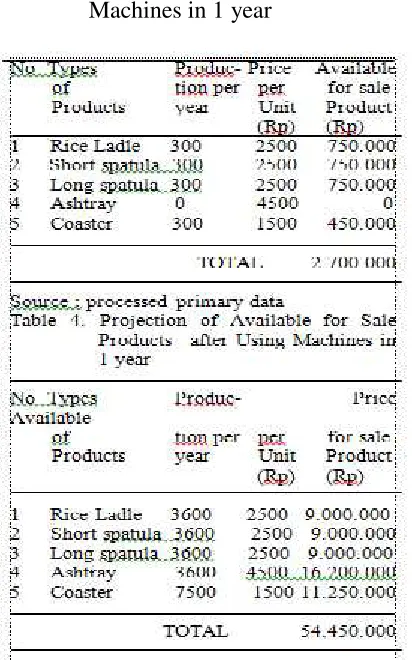
3. Analysis of Available for Sale Products
Relation between production capacity and selling price per unit will become available for sale products (Al Haryono Yusuf, 1999).
Table 3. Available for Sale Products Capacity before Using Machines in 1 year
Source : processed primary data
It is seen that there is a very significant increase of products available for sale, with thousands of percent-fold rise.
CONCLUSIONS
Jati Lawas Alto Solo SME is a creative SME that produce sills, doors, furniture, gazebo and wooden house with waste wood of former house, former timber of ships (reclaimed wood) as raw materials, in terms of raw materials, this SME is environmentally friendly SMEs. Youth Organization of Banyuagung in Kadipiro, MMIB, is a SME that utilize waste wood that numerously available in the neighborhood. The waste wood that will be utilized as raw material are taken from several wood production SMEs in Kadipiro then processed again to be souvenir products such as wooden ladle, ashtrays, coasters and others.
In terms of sources of raw materials such as waste wood of former house and former timber of ships, then both of these SMEs are SMEs which seek to increase higher economic value from waste wood that were simply discarded or utilized as firewood which is certainly less in economic value. Therefore both these SMEs are really SMEs that do ethical business, because with the wisdom of entrepreneurship, they utilize waste wood into economically valuable products so that we are not wasting natural resources such as wood that takes a very long time to grow from planting tree seedlings until become wood that can be cut down.
the results is the uptake of waste wood as raw material increased by 1000%, it also means increasing production capacity and makes this entrepreneurship has competitiveness in the market.
Relation between production capacity and selling price per unit will become available for sale products. After using machinery tools for production, the production capacity increase and the available for sale products also experience a very significant increase.
SUGGESTIONS
With creativity and innovation also with an adequate technology, waste wood can be processed to be product that provide high economic value and can be used as a business opportunity that has a great chance to compete.
REFERENCES
Basu Swastha Dh, 2002, Manajemen Pemasaran Modern, Edisi Kedua, Liberty, Yogyakarta
Evans, James R., 1994 Berfikir Kreatif dalam Pengambilan Keputusan dan Manajemen. Jakarta : Bumi Aksara. Fandy Tjiptono, 1997, Strategi Pemasaran,
edisi kedua, Liberty, Yogyakarta Heflin Frinces, 2004, Kewirausahaan dan Inovasi Bisnis, Darussalam Offset, Yogyakarta.
Jakarta.
Hubeis, M. 1997, Manajemen Industri Kecil Profesional di Era Globalisasi Melalui Pemberdayaan Manajemen Industri, Orasi Ilmiah. Institut Pertanian Bogor.
Kasmir, 2007. Kewirausahaan. Jakarta, PT Raja Grafindo Persda.
Kotler, Philip, 2000, Manajemen Pemasaran, Analisis, Perencanaan, Implementasi dan Kontrol, Jilid I dan Jilid II, Alih bahasa Imam Nurmawan, Edisi Ketiga, PT. Prehalindo, Jakarta.
Longenecker,J.G., More, J.W. Petty, 2001, Small Business Management, An Entrepreneurial Enphasis, South Western Publishing Company, Cincinati.
M Suyanto, 2004. Smart in Entrepreneur (Belajar dari Kesuksesan Pengusaha Top Dunia). Yogyakarta, Andi Offset. Masykur Wiratmo, 2007, Pengantar
Kewiraswastaan, BPFE UGM, Yogyakarta.
Meredith, Geoffrey G.et al, 2005, The practice of Entrepreneurship, International Labour Organization, Geneva.
Michael Leboeuf, 2006, Kiat-Kiat Menjadi Entrepreneur Sukses, Alih Bahasa: Suyanto, Prestasi Pustakaraya, Jakarta.
Moh. As’Ad, 2003, Psikologi Industri, Yogyakarta, Penerbit Liberty
Mowen, John C, dan Minor, Michael, 2002, Perilaku Konsumen, Alih Bahasa Dwi Kartini Yahya, Erlangga, Jakarta.
Sukanto Reksohadiprdjo, 1999, Organisasi Perusahaan :Teori, Struktur dan Proses, BPFE, Yogyakarta.
Thobymutis, 2010, Kewirausahaan Yang Berpotensi, Gramedia Widia Sarana Indonesia.
West, Michael A, 2000, Mengembangkan Kreatifitas Dalam Organisasi, Yogyakarta
Penerbit Kanisius.
Winardi. 2003, Entrepreneur dan Entrepreneurship, Prenada Media. Jakarta