IAB Discussion Paper
Articles on labour market issues
9/2011
Manfred Antoni
Lifelong learning inequality?
Lifelong learning inequality? The relevance of
family background for on-the-job training
Manfred Antoni (IAB)
Mit der Reihe „IAB-Discussion Paper“ will das Forschungsinstitut der Bundesagentur für Arbeit den Dialog mit der externen Wissenschaft intensivieren. Durch die rasche Verbreitung von
Forschungs-ergebnissen über das Internet soll noch vor Drucklegung Kritik angeregt und Qualität gesichert werden.
The “IAB Discussion Paper” is published by the research institute of the German Federal Employment
Contents
Abstract . . . 4
Zusammenfassung . . . 4
1 Introduction . . . 5
2 Theory and hypotheses . . . 7
3 Data and descriptives . . . 10
3.1 Independent variables . . . 10
3.2 Dependent variable . . . 12
4 Econometric strategy . . . 14
5 Results . . . 16
6 Predictions and sensitivity analysis . . . 21
6.1 Simulation of training participation by family background . . . 21
6.2 Sensitivity analysis . . . 22
7 Summary and conclusions . . . 25
References . . . 27
Abstract
Despite ample evidence on intergenerational persistence of formal education as well as on the determinants of non-formal training, these issues have not yet been analysed jointly. The question remains whether people from low-qualified family backgrounds make up for their relatively sparse own formal education by means of non-formal training during adulthood. Hypotheses based on economic theory and findings from various other disciplines suggest otherwise. I use the German ALWA survey to estimate the influence of family background on non-formal training participation. Count data analyses show that a low-qualified family background is negatively related to both likelihood and frequency of on-the-job training. This result holds when controlling for education, ability and personality as well as job and firm characteristics.
Zusammenfassung
Trotz zahlreicher Befunde zur intergenerationalen Vererbung formaler Bildung sowie zu den Einflussfaktoren nicht-formaler Bildungsbeteiligung sind diese beiden Aspekte bisher nie gemeinsam ökonometrisch untersucht worden. Daher ist unklar, ob Personen mit einem bildungsfernen familiären Hintergrund ihre häufig geringe eigene formale Bildung durch die Teilnahme an nicht-formaler Bildung im Erwachsenenalter kompensieren können. Hypothesen auf Basis ökonomischer Theorien sowie von Befunden anderer Disziplinen lassen dies als zweifelhaft erscheinen. Mit Daten der ALWA-Befragung untersuche ich den Einfluss des familiären Hintergrunds auf die Beteiligung an nicht-formaler Weiterbildung in Deutschland. Die Resultate auf Basis von Zähldatenmodellen zeigen, dass Personen mit einem bildungsfernen familiären Hintergrund sowohl eine geringe Wahrscheinlichkeit als auch eine geringe Häufigkeit der Teilnahme an beruflicher Weiterbildung aufweisen. Dies gilt unter Kontrolle von individueller Bildung, Fähigkeiten und Persönlichkeitsmerkmalen sowie von Tätigkeits- und Betriebscharakteristika.
JEL classification: C25, I21, J24, J62
Keywords: on-the-job training, human capital, intergenerational transmission, per-sonality traits, cognitive skills, zero-inflated negative binomial regression
1
Introduction
Intergenerational transmission of educational chances and success is documented by a number of studies. The educational achievements of children, youths and even adoles-cents correlate heavily with the success of their parents in this field. Children of better educated parents achieve higher schooling certificates and attempt as well as attain formal occupational training or higher education more often than children from less educated family backgrounds. That holds for various countries and has been a stable phenomenon for decades (e.g. Chevalier/Denny/McMahon, 2009; Heineck/Riphahn, 2009; Hertz et al., 2007).
This relationship is not restricted to general schooling.1 Early decisions on the attainment of formal training sustain an intergenerational relationship of educational levels, even when parents no longer have direct influence on subsequent decisions. Part of this can be explained by path dependency between general schooling and formal occupational or higher training (cf. Pallas, 2004). Unequal chances in schooling attainment lead to even more unequal opportunities when it comes to education that is directly relevant for labour market success. This is of particular relevance for countries in which the majority of occupational or academic educational activities strictly require certain schooling certificates prior to admission. Thus, unequal chances in early education have a lasting influence on educational success during the whole life course.
Education—or a lack thereof—heavily influences several aspects of life, including labour market success (cf. Trostel/Walker/Woolley, 2002) and a wealth of non-monetary outcomes (cf. Grossman, 2006). Policymakers therefore strive to minimise inequality in educational chances. Among others, non-formal training, henceforth referred to as on-the-job training interchangeably, is regarded as a means to compensate for lacking formal educational achievements. Formal and non-formal training2are highly dissimilar in terms of, for instance, the amount of time or money they exact, the extent of knowledge and signalling value they offer, or the entry barriers they present. Nevertheless, non-formal training has proven to increase wages, lower the risk of unemployment and facilitate career advancement (e.g., Asplund, 2005; Büchel/Pannenberg, 2004; Dieckhoff, 2007). This compensates for lower chances of access to formal education to some extent. People from less educated family backgrounds might catch up in terms of educational and subsequently in labour market chances if they only participated enough in non-formal training. However, for this catching-up to happen they would have to participate in on-the-job training more often or more intensely than people from better educated family backgrounds. Otherwise the gap widens even more due to the path dependency of formal education.
When we turn our attention to adults’ participation in on-the-job training, the empirical
1 Different types of learning activities are termed according to their labour market relevance. General education
is termed as schooling, labour market oriented education as training. The term education includes both categories.
2 Formal training henceforth denotes activities at institutions that provide access to recognised occupational
knowledge appears to be sound. For Germany, for instance, results based on a variety of data sets show that participants mainly do not have an immigrant background, are better educated, middle-aged and gainfully employed (see e.g., Büchel/Pannenberg, 2004; Schömann/Leschke, 2008). Despite ostensibly ample evidence, it is startling that the relation of parental education and an adult’s own non-formal training participation has never been analysed explicitly. The literature on intergenerational transmission of education concentrates on formal education and thus provides no insights into the question at hand.
There are only few studies that even remotely touch this issue. Those who do so measure family background poorly or include it in the analysis without interpreting it or motivating it theoretically. Pannenberg (2001) examines returns to on-the-job training in Germany. In a first step of estimating the selection into training he includes the educational level of the father. This is positively related to the offspring’s training participation. Buchmann et al. (1999) include the qualification and labour market status of the father in their analysis of determinants of non-formal training in Switzerland. They find that the father’s labour market status plays no role, regardless of the type of training. A lack of a vocational certificate on behalf of the father, though, lessens the probability of his offspring’s further training. The measurement of family background in both studies is so undifferentiated that a thorough analysis of the relationship of parental formal education and the offspring’s non-formal training participation is not feasible.
Instead of examining a mono-causal link between parental education and the offspring’s non-formal education, the present study shows that on-the-job training during adulthood is determined by a wealth of factors, many of which are related to parental education. Family background taken by itself plays a significant role for on-the-job training. Factors like cognitive skills, personality traits, cultural capital and the detailed formal educational history allow a distinction between the influence of the parental education and other inheritable characteristics.
By means of count data models, the analysis differentiates between what determines non-participation and what is important for the rate of on-the-job training non-participation over the course of employment spells. The results show that not all relevant factors determine both measures in the same way. Data from the German ALWA survey with a strong focus on formal and non-formal education as well as a wealth of social background information on respondents make this analysis possible.
Although the results presented here stem from Germany, they are informative from an international perspective for two reasons. First, Germany shares the phenomenon of low intergenerational mobility with a multitude of countries. Lessons on the long-term consequences of this phenomenon should be relevant to educational and labour market policy in just as many countries. Second, the institutional barriers inherent in the German vocational training system3 also exist in countries with similar systems such as Austria, France, Switzerland and a growing number of Asian countries. They may benefit from these results to evaluate their educational systems’ capabilities to increase intergenerational
educational mobility.
This paper develops in the following way. Section 2 shows the theoretical foundation and derives some hypotheses. Section 3 introduces the data set and shows descriptive results. The econometric strategy is described in Section 4. This is followed by a presentation of the results in Section 5. Section 6 adds predictions and results from sensitivity analyses. Section 7 concludes.
2
Theory and hypotheses
Since there is no unified theory on how the family background might influence a person’s educational decisions in adulthood, one has to draw on theories on different aspects of the proposed relationship. Indeed, there are some theories that provide the basis for hypotheses, as they border at the topic or concentrate on some aspects of it. The framework for the hypotheses will be provided by human capital theory (e.g., Becker, 1962). Additional assumptions based on theories and results from disciplines such as psychology and genetics are implemented below.
According to Becker (1962), human capital denotes a bundle of skills that determine a person’s labour market productivity. In the standard model this productivity can be observed accurately by both the person holding it and potential employers at no cost. Human capital can be augmented by training, which in turn increases future income prospects, as a person is assumed to achieve a wage according to her marginal productivity. Investment in human capital should take place as long as the expected present value of wage gains at least equals the present value of direct and opportunity costs. Another assumption is that the costs of training are negatively related to the innate abilities of the learner. More able people thus invest more in their human capital.
Becker/Tomes (1979, 1986) bring the family into the theoretical framework by developing a model that allows for utility maximisation over time on the family level. Rather than treating people as isolated beings, they are assumed to be members of families that consist of several generations. The utility of future generations inside a family is considered in consumption and investment decisions of each actual family member. Parents strive to maximise the utility of the family by creating inheritable wealth but also by investing in the human capital of their offspring. Models in a similar fashion or developments thereof have been proposed by Becker/Chiswick (1966), Solon (2004) and Checchi (2006).
Bowles/Gintis (2002) stress that parents do not only provide the financial means for the education of their offspring. They also hand on important endowments to their children. Surveying decades of research, Plomin et al. (2008) show that both cognitive ability and per-sonality traits are genetically inheritable to some extent.4 After birth the development of the offspring’s abilities and personality is affected by a wealth of factors including the parents’ ed-ucation or parenting skills (see e.g., Cunha/Heckman, 2008; Feinstein/Duckworth/Sabates, 2004). In terms of the model of Becker/Tomes (1986) it is not relevant which part or how much of the inherited endowment is due to genetic inheritance or due to imitating and learning from parents. Both channels are equally included in their model.
Ability and personality on the other hand are related to the propensity of attaining educa-tion. The survey by Colquitt/LePine/Noe (2000) on personality traits that influence training participation reveals that locus of control (cf. Rotter, 1966), anxiety (cf. McCrae/John, 1992) and self-efficacy (cf. Bandura, 1994) are the most predictive traits. Moreover, Fouarge/Schils/de Grip (2010) empirically find several personality traits that strongly influ-ence the willingness to participate in on-the-job training. Cawley/Heckman/Vytlacil (2001) and Heckman/Stixrud/Urzua (2006) give an overview of studies that show the strong pos-itive relationship between cognpos-itive ability and educational attainment. Cognpos-itive skills and personality traits also positively influence wages (e.g., Green/Riddell, 2003; Heineck, forthcoming; Heineck/Anger, 2010). By reducing liquidity constraints, these endowments also foster human capital investments indirectly.
Moreover, ability and personality are interrelated. Results on the relationship between cognition and temporal discounting indicate that the higher one’s abilities, the lower one’s discount rate (Dohmen et al., 2010; Frederick, 2005; Kirby/Winston/Santiesteban, 2005). Applying this to human capital theory, which states that the higher the discount rate the lower the probability of investment in human capital, it follows that the higher a person’s ability, the lower her discount rate, the more likely will she participate in education.
To sum up, family background influences the incidence of non-formal training both indirectly and directly. Smarter parents are better educated and thus have higher incomes. They are able to invest more in their offspring’s formal education. This in turn puts children on a path of continued education in later life. It follows that they have more access to non-formal training in later life just by having enjoyed better initial conditions than people from a less educated family background. Apart from this indirect effect, ability and favourable personality traits inherited from parents directly increase educational attainment. These endowments lead to higher training motivation, a higher willingness to finance training and more learning success.
However, the decision whether someone is trained and, if she is, how this is financed is not entirely up to the potential learner herself. In contrast to human capital theory, theories of segmented labour markets (see e.g., Leontaridi, 1998; Taubman/Wachter, 1986) stress the influence of job characteristics. They argue that training participation mainly depends on the job, or more specifically, the labour market segment someone is employed in. Jobs in some
segments mostly provide well-paid and stable employment with good career prospects as well as training opportunities. Other segments comprise of badly-paid jobs which lack stability or career chances. Due to the short expected duration of these employment relationships, time to cash-in returns on investments in human capital would be too short. Anticipating this, employers are not willing to finance such investments. Furthermore, as people in secondary segment jobs earn less, their financial means to invest in their human capital are smaller, making training even more unlikely for them. Along the lines of these theories I argue that a strong influence of job and firm characteristics is to be expected. The hypotheses and implications are summarised below.
H1: The better educated and the more economically successful the family back-ground, the more likely is on-the-job training participation (intergenerational persis-tence hypothesis).
According to the model of Becker/Tomes (1986) better educated and wealthier parents are more able to support their offspring financially. This support has two implications. First, the theory allows for continued financial support even after the end of formal education or after the offspring has moved out of the parents’ household. Second, early financial transfers in wealthy families may lead to higher accumulated wealth on the part of the offspring. This in turn facilitates the own financing of on-the-job training in the long run. As financial support of that kind or the offspring’s wealth are not observed in the data set at hand, their impact can not be distinguished from that of parental education.
H2: Cognitive skills and favourable personality traits positively influence training participation (endowment hypothesis).
The smarter a person, the higher her probability to invest in any kind of education. Cognitive skills and on-the-job training should thus be positively related. The likelihood also depends on personality traits. A high value on, for instance, an external locus of control signifies the belief that events in life or their outcomes are determined by external factors such as luck rather than by own decisions, actions or effort. This belief should lead to a low expected return to education and thus to fewer investment in on-the-job training. Finally, the higher the cultural capital measured as the participation in high-cultural activities and the number of books in the household, the more likely will on-the-job training be.
H3: The higher the formal education the higher the probability of on-the-job training (path dependency hypothesis).
The individual wage depends on one’s productivity which in turn depends on the training one has received. Therefore, the higher one’s schooling and training the higher are the financial means to invest in further education. The investment decisions claimed by human capital theory can be realised as they are not impeded by liquidity constraints.
As proposed by theories of segmented labour markets, the job one is employed at strongly determines training participation. In particular, the probability of on-the-job training should rise with weekly working time, job requirements as well as firm size. All of those charac-teristics are seen as proxy variables for stable employment in a favourable labour market segment or the presence of an internal labour market in the firm. This in turn increases the probability of positive returns to human capital investments and makes on-the-job training more likely.
3
Data and descriptives
I use retrospective survey data of the German study “Work and Learning in a Changing World” (ALWA)5which provides monthly longitudinal information on educational and labour market histories. The representative sample consists of 10,177 German citizens aged 18 through 50. Aided recall techniques were used during the interviews (Drasch/Matthes, forthcoming) to reduce recall error. In the longitudinal part of the survey, a wealth of information on educational activities has been gathered. This includes the levels of schooling and training achieved over time as well as their timing in the life course. Non-formal training is measured by its frequency during spells of employment, unemployment and other situations.
3.1
Independent variables
Standard socio-demographic characteristics include age-classes, sex and the presence of an immigrant background. This is supplemented by a dummy variable for being employed in East Germany and the unemployment rate in Eastern or Western Germany respectively. Education is measured by dummy variables for schooling and training levels. Full-time equivalent employment experience and its square are included as an additional measure for human capital. They are measured as cumulated work experience over all jobs before the beginning of the spell under consideration.
Family background is measured by schooling and training levels of the parent of the same sex as the respondent as well as this parent’s employment status during the youth of the survey respondent. Along the lines of the sex-role model (cf. Sinnott, 1994), the parent of the own sex is likely to have a stronger influence on educational or career decisions of the offspring than the parent with the opposite sex. To examine whether this decision has an influence on the results, Section 6 presents results based on the highest training level of any of the parents.
To test the endowment hypothesis, several self-reported measures of cognitive skills, person-ality traits and cultural capital are included in the analysis. These have been computed by principal component analyses (cf. Jolliffe, 2002) using several 5-point items for each score. Cognition is measured by scores in the three domains prose literacy, document literacy and numeracy. These have been calculated based on the self-reported success in the school
5 See Antoni et al. (2010) for more detailed information on the data set. Technical documentation and
subjects mathematics and German as well as on several items on self-assessed literacy and numeracy. Information on personality traits include scores on an external versus an internal locus of control. Personality is also measured by a score of employment-related self-confidence. Finally, scores on the importance of life domains such as work and occupation on the one hand and family and friends on the other hand are included. I argue that these scores represent proxy variables for time preference as they relate to the trade-off between work and leisure time. The more value one assigns to the family or friends, the higher the time preference and the lower the likelihood to invest in work-related training. A proxy variable on cultural capital is constructed as a principal component score based on items on the participation in high-cultural activities and the number of books in the household.
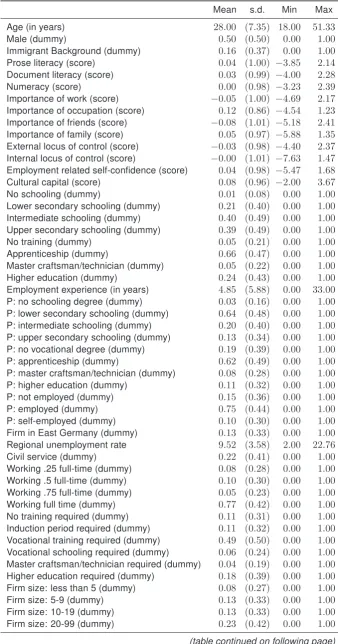
As only spells of dependent employment will be considered, firm and job characteristics control for the employer’s influence on human capital investments. The data provide information on the working time in four categories, the qualification level required for the job, the firm size and whether the worker is employed in the civil service sector. Sample statistics for all independent variables are given in Table A.1 in the appendix.
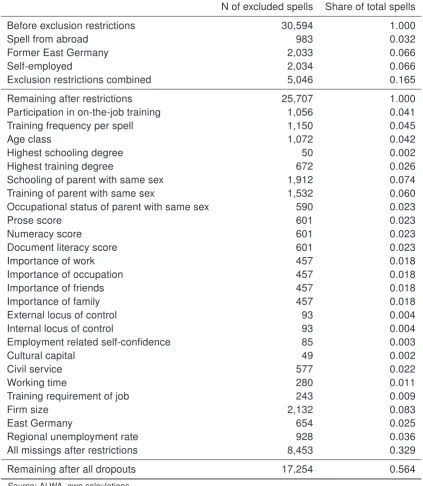
The analysis sample considered in Table A.1 is a result of the following restrictions: Spells that originate from outside Germany are excluded; spells that originate from East Germany starting before reunification are excluded as training decisions in that context did not neces-sarily follow the cost-benefit considerations laid down by human capital theory. Although the same could apply to public sector workers, they are not excluded from the sample. The implications of this decision are presented in Section 6. Finally, self-employment spells are excluded as the notion of co-financing of training by the employer cannot be examined for them. The number of observations lost due to each of these exclusions and to missing values is given in Table A.2 in the appendix.
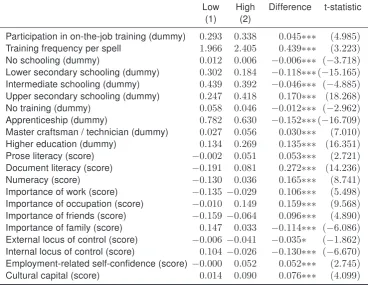
Although descriptive in nature, Table 1 provides a first empirical indication of whether individual characteristics are associated with family background variables as stated in Section 2. The table reports on t-tests that compare the means of important individual characteristics of low qualified and highly qualified family backgrounds. The offspring of parents without formal schooling or training is described in the column denoted by “Low”, whereas the offspring of parents that have both formal schooling and formal training are described by the column denoted by “High”. The table is based on spells rather than individuals because some independent variables may vary between different spells of a given person in the sample.
The first striking difference between columns 1 and 2 is related to the probability of partici-pation in and frequency of on-the-job training per spell. The offspring from more educated family backgrounds is significantly more likely to participate in on-the-job training. On average, they also experience on-the-job training more often per employment spell than the offspring from less educated backgrounds, with a frequency of 2.41 compared to 1.97.
Table 1: On-the-job training, education and endowments by dichotomous family background (measured as educational level of parent of the same sex as respondent), t-test of difference
Low High Difference t-statistic
Employment-related self-confidence (score) −0.000 0.052 0.052∗∗∗ (2.745)
Cultural capital (score) 0.014 0.090 0.076∗∗∗ (4.099)
Notes:ALWA, own unweighted calculations; 17254 observations; ***,**,* denote a significant difference at 1%, 5%, 10%;Lowdenotes a lack of parental formal schooling or training degree (n=3,307);Highdenotes parental formal schooling as well as training (n=13,947).
parents is better educated itself. This is demonstrated by, for instance, the significantly lower share of observations without formal schooling or training in the second column. Higher cognitive skills, higher employment-related self-confidence and a higher cultural capital in column 2 also corroborate the assumption of inheritability of cognition and personality. All in all, the offspring of better educated parents seem to be better equipped with endowments and skills relevant for the labour market. Based on the assumptions stated in Section 2, these differences should make them more likely to participate in on-the-job training.
3.2
Dependent variable
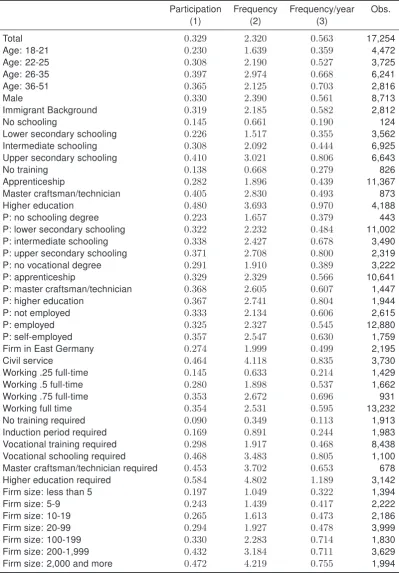
Table 2: Probability and frequency of on-the-job training by individual, parental and job characterstics (only dummy variables)
Participation Frequency Frequency/year Obs.
Lower secondary schooling 0.226 1.517 0.355 3,562
Intermediate schooling 0.308 2.092 0.444 6,925
Upper secondary schooling 0.410 3.021 0.806 6,643
No training 0.138 0.668 0.279 826
Apprenticeship 0.282 1.896 0.439 11,367
Master craftsman/technician 0.405 2.830 0.493 873
Higher education 0.480 3.693 0.970 4,188
P: master craftsman/technician 0.368 2.605 0.607 1,447
P: higher education 0.367 2.741 0.804 1,944
Induction period required 0.169 0.891 0.244 1,983
Vocational training required 0.298 1.917 0.468 8,438
Vocational schooling required 0.468 3.483 0.805 1,100
Master craftsman/technician required 0.453 3.702 0.653 678
Higher education required 0.584 4.802 1.189 3,142
Firm size: less than 5 0.197 1.049 0.322 1,394
Notes:ALWA, own unweighted calculations; 17254 observations.
influence of individual, parental and job characteristics on on-the-job training.
First, the better educated a person, the higher is the likelihood of on-the-job training as well as its frequency. This applies for formal schooling and formal training levels. Second, on-the-job training probability and frequency are associated with parental schooling and training. The better educated the family background the more likely and frequent is own on-the-job training. While, for instance, a parental background without formal schooling is associated with a probability of on-the-job training of 22.3%, a parental upper secondary schooling degree is associated with a training probability of 37.1%.
The amount of on-the-job training is also related to job and firm characteristics. The higher the weekly working time, the job requirement or the number of employees in the firm, the more likely and frequent is on-the-job training. Thus, the descriptive results corroborate the hypotheses given in Section 2.
4
Econometric strategy
The dependent variable is the number of on-the-job training activities during a given employ-ment spell, denoted asy. Since the underlying random variable is a non-negative integer
with a strongly right-skewed distribution, a count data model (cf. Cameron/Trivedi, 1998) is the usual approach for this analysis. They allow inference about the influence of explanatory variables on the number of events during a measurable amount of time.
The most basic variant of count data models assumes a probability distribution for the number of events based on the Poisson distribution. The Poisson regression model can only be justified if the properties of the underlying Poisson distribution are fulfilled, most notably the assumption of equality of conditional mean and conditional variance:
V ar(yi|xi) =E(yi|xi) =µi (1) If this assumption of equidispersion is violated the single-parameter Poisson distribution may be too inflexible to account for the real-life data at hand. As a result, biased standard errors make statements on the significance of regressors unfeasible. A glance at the distribution of the count variable in the estimation sample indeed reveals significant overdispersion in the data. Its variance of 49.56 is more than 20 times as high as its mean of 2.32.
A common remedy is a generalisation by using a model based on the negative binomial distribution (e.g., Cameron/Trivedi, 1986; Hilbe, 2008). This allows for more flexibility due to an additional distributional parameter (Cameron/Trivedi, 1998). The variance function from Equation 1 therefore turns into
V ar(yi|xi) =µi+αµki. (2)
unobserved heterogeneity as a mixture distribution. The dispersion parameterαcan be estimated from the data. The two most common variants of the negative binomial model are often called Negbin I (k= 1) and Negbin II (k= 2). Both are better suited to deal with overdispersed data than the Poisson model but the decision for either of them depends on the data at hand. Information criteria are suitable to provide information for this decision.
Since Poisson and negative binomial models are nested, different tests can be used to determine whether the null hypothesis ofαbeing equal to zero has to be rejected.Highly
significant test statistics of both the Pearson’sχ2goodness-of-fit test (199229.8, df=17,206)
and the likelihood ratio test (86089.4, df=17,206) reject the null hypothesis and reveal that the Poisson regression model is not appropriate for the data at hand. Information criteria show that the Negbin II model (BIC=49338.49, AIC=48958.45) is superior to the Negbin I variant (BIC=49840.55, AIC=49460.52) for the analysis at hand. Due to this result the Poisson and Negbin I regression models will no longer be considered throughout the text.
Both Poisson and negative binomial models produce biased results when the share of zero-counts in the data is much higher than predicted by the underlying probability distribution (Hardin/Hilbe, 2007). The most common solutions in econometrics are the hurdle model (Mullahy, 1986) and the zero-inflated model (Heilbron, 1994; Lambert, 1992). Both models are flexible enough to allow for a substantive amount of non-participants in the sample and can be based either on the Poisson or the negative binomial distribution. Thus, the issues of missing equidispersion and an excess of zeros can both be tackled with these models.
The models’ interpretations of what drives the amount of zero-counts differ. The hurdle model assumes that counts below a given hurdle—in our case zero-counts—and counts above the threshold stem from different data generating processes. They are potentially driven by different explanatory factors. The hurdle model thus is a two-part model with one part modeling the probability to encounter an event at all and a second part considering positive counts of events. The interpretation would be that of a two-staged decision process. Empirical applications of this model to on-the-job training include Arulampalam/Booth (2001) and Pannenberg (1998).
The zero-inflated model enables us to distinguish between a subgroup that is not subject to the risk of any event and a subgroup that can experience any number of events, including zero-counts. Covariates that describe the first group explain the so-called inflation of the number of zero-counts. The covariate vector describing the group that experiences any number of events including zeros may differ from the former. Empirical evidence provides support for this method in the current context. Backes-Gellner/Mure/Tuor (2007) show that some people persistently refrain from on-the-job training as contrasted to those who merely participate less frequently than others. They identify characteristics that make it more likely to belong to the group of chronic non-participants. This is more in line with the interpretation of the zero-inflated model than that of the hurdle model.
and Bayesian information criteria to compare the two non-nested models, the hurdle model is rejected in favour of the zero-inflated model. The test based on the work of Vuong (1989) confirms that the data indeed show an excess of zeros as the zero-inflated negative binomial model is preferred over the negative binomial model. Therefore, all results presented in Sections 5 and 6 are based on the zero-inflated negative binomial model and maximum likelihood estimation.6 For an application of this method see Gerner/Stegmaier (2009) who examine the provision of on-the-job training by firms in Germany on the basis of firm data.
The longer an employment spell the more occasions may arise in which on-the-job training is necessary or profitable. Thus, a given count may represent different rates of training per period of time. The natural logarithm of the spell duration in months is included in the model to indicate the amount of time during which a person is exposed to the possibility of participating on-the-job training. Its coefficient is constraint to 1.
Some of the individuals under consideration experience more than one employment spell dur-ing the observation period. These observations are correlated due to common unobserved characteristics (Moulton, 1990). This usually leads to an underestimation of standard errors. To achieve robust standard errors clustered on the person-level the variance-covariance matrix is estimated by the modified, cluster-robust version of the sandwich estimator based on Huber (1967) and White (1980).
5
Results
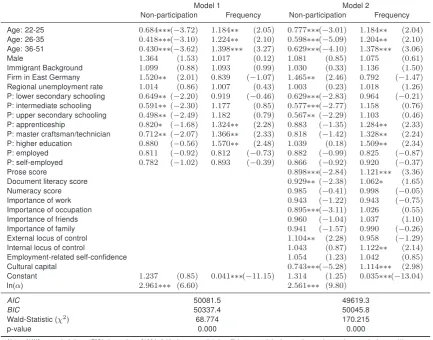
The estimation results given in Tables 3 and 4 are structured according to the hypotheses given in Section 2. In every model specification, the column “Non-participation” represents the probability never to participate in on-the-job training during a given spell, whereas the column “Frequency” is related to the number of training events per spell. Results are presented as exponentiated coefficients, so that values larger than 1 indicate a lack of on-the-job training (columns 1 and 3) but a higher number of on-the-job training activities (columns 2 and 4) per spell respectively. The covariates common to all specifications include age-class, sex, the presence of an immigrant background, employment in East Germany and the unemployment rate in East or West Germany at the beginning of the spell.
Model 1 presents the most parsimonious specification. It only includes parental char-acteristics and those socio-demographic covariates that serve as control variables in all specifications. Model 1 corroborates the descriptive results on the relationship between family background and training participation. A better educated family background is related to a decreased likelihood of totally refraining from on-the-job training as indicated by ex-ponentiated coefficients below 1. This relationship is driven by parental schooling as well as their training level. For the number of training events per spell this finding no longer holds. Only the dummy variables representing parental training levels show significant
Table 3: Determinants of non-participation in training and of the number of courses respec-tively, zero-inflated negative binomial regression, Probit inflation
Model 1 Model 2
Non-participation Frequency Non-participation Frequency
Age: 22-25 0.684∗∗∗(−3.72) 1.184∗∗ (2.05) 0.777∗∗∗(−3.01) 1.184∗∗ (2.04)
Age: 26-35 0.418∗∗∗(−3.10) 1.224∗∗ (2.10) 0.598∗∗∗(−5.09) 1.204∗∗ (2.10)
Age: 36-51 0.430∗∗∗(−3.62) 1.398∗∗∗ (3.27) 0.629∗∗∗(−4.10) 1.378∗∗∗ (3.06)
Male 1.364 (1.53) 1.017 (0.12) 1.081 (0.85) 1.075 (0.61)
Immigrant Background 1.099 (0.88) 1.093 (0.99) 1.030 (0.33) 1.136 (1.50)
Firm in East Germany 1.520∗∗ (2.01) 0.839 (−1.07) 1.465∗∗ (2.46) 0.792 (−1.47)
Regional unemployment rate 1.014 (0.86) 1.007 (0.43) 1.003 (0.23) 1.018 (1.26)
P: lower secondary schooling 0.649∗∗(−2.20) 0.919 (−0.46) 0.629∗∗∗(−2.83) 0.964 (−0.21) P: intermediate schooling 0.591∗∗(−2.30) 1.177 (0.85) 0.577∗∗∗(−2.77) 1.158 (0.76)
P: upper secondary schooling 0.498∗∗(−2.49) 1.182 (0.79) 0.567∗∗(−2.29) 1.103 (0.46)
P: apprenticeship 0.820∗ (−1.68) 1.324∗∗ (2.28) 0.883 (−1.35) 1.284∗∗ (2.33)
P: master craftsman/technician 0.712∗∗(−2.07) 1.366∗∗ (2.33) 0.818 (−1.42) 1.328∗∗ (2.24)
P: higher education 0.880 (−0.56) 1.570∗∗ (2.48) 1.039 (0.18) 1.509∗∗ (2.34)
P: employed 0.811 (−0.92) 0.812 (−0.73) 0.882 (−0.99) 0.825 (−0.87)
P: self-employed 0.782 (−1.02) 0.893 (−0.39) 0.866 (−0.92) 0.920 (−0.37)
Prose score 0.898∗∗∗(−2.84) 1.121∗∗∗ (3.36)
Document literacy score 0.929∗∗(−2.38) 1.062∗ (1.65)
Numeracy score 0.985 (−0.41) 0.998 (−0.05)
Importance of work 0.943 (−1.22) 0.943 (−0.75)
Importance of occupation 0.895∗∗∗(−3.11) 1.026 (0.55)
Importance of friends 0.960 (−1.04) 1.037 (1.10)
Importance of family 0.941 (−1.57) 0.990 (−0.26)
External locus of control 1.104∗∗ (2.28) 0.958 (−1.29)
Internal locus of control 1.043 (0.87) 1.122∗∗ (2.14)
Employment-related self-confidence 1.054 (1.23) 1.042 (0.85)
Cultural capital 0.743∗∗∗(−5.28) 1.114∗∗∗ (2.98)
Constant 1.237 (0.85) 0.041∗∗∗(−11.15) 1.314 (1.25) 0.035∗∗∗(−13.04)
ln(α) 2.961∗∗∗ (6.60) 2.561∗∗∗ (9.80)
AIC 50081.5 49619.3
BIC 50337.4 50045.8
Wald-Statistic (χ2) 68.774 170.215
p-value 0.000 0.000
positive influence on the own training frequency. The parental labour market status bears no relevance in either of the two equations. Nevertheless, a Wald test on joint significance of the background variables shows a significant influence of these variables (χ2(16)=106.13, p-value=0.00). So far, the intergenerational persistence hypothesis cannot be rejected.
Model 2 extends the specification by including indices based on self-reported measures of cognitive skills, personality traits and cultural capital. In line with the endowment hypothesis, literacy skills as well as cultural capital are positively related to both the occurrence and the number of training activities. Self-reported personality traits are only weakly related to on-the-job training. The importance of the own occupation decreases the likelihood of never participating in on-the-job training whereas this likelihood increases with external locus of control. As expected, the stronger the internal locus of control the higher the frequency of on-the-job training. The respective Wald tests show joint significance of the endowment as well as the family background variables (χ2(22)=190.79, p-value=0.00 andχ2(16)=68.22,
p-value=0.00, respectively). Both the intergenerational persistence hypothesis and the endowment hypothesis can be maintained.
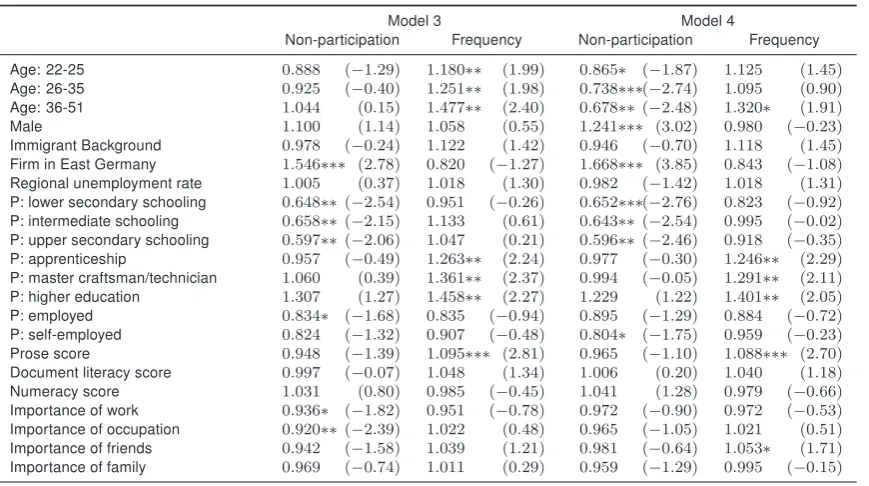
Additional covariates on educational level and full-time equivalent employment experience prior to the actual spell are included in Model 3 in Table 4. The results support the path dependency hypothesis. Having achieved at least intermediate schooling and any level of vocational degree makes non-formal training abstinence less likely. There is no influence of training levels on the frequency of on-the-job training. A Wald test does not reject the joint significance of own formal educational levels on on-the-job training (χ2(12)=94.78,
p-value=0.00). The employment experience on the other hand influences the number of training events per spell and hints at a U-shaped relationship. This could be explained by growing opportunity costs due to increasing wages over the life course.
Table 4: Determinants of non-participation in training and of the number of courses respectively, zero-inflated negative binomial regression, Probit inflation
Model 3 Model 4
Notes:ALWA, own calculations; 17254 observations; 6490 individuals; exponentiated coefficients; z-statistics in parentheses; cluster-robust standard errors; ***, **, * denote significance at 1%, 5%, 10%; additional controls: age-class, sex, immigrant background, East Germany and regional unemployment rate; reference category: parent of own sex without formal schooling or training and not employed, no own formal schooling or training, working≤25% of full-time, no training required, firm size: 1-19 employees.
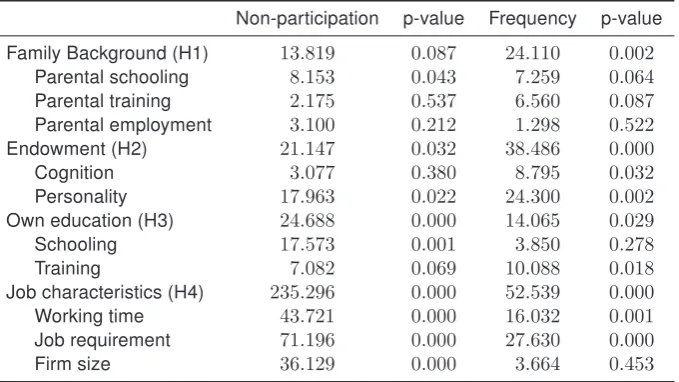
Finally, Model 4 also includes job and firm characteristics of the employment spell at hand. As expected, they exhibit a strong influence on both the probability never to participate in on-the-job training and the number of training events per spell. Civil service employees are less likely to experience training abstinence and they participate in courses more often than employees in private firms. The higher the working time or the job requirement, the more likely and frequent is on-the-job training. Finally, on-the-job training is more likely in firms with more than 200 employees than in smaller firms. Given these results, it is not surprising that the results of Wald tests depicted on Table 5 indicate joint significance of job characteristics. Although the job segment hypothesis is corroborated by these results in general, the firm size only influences training probability, but not its frequency. Being employed in a small firm might therefore be an obstacle to getting on-the-job training at all. As soon as a firm is able and determined to provide training at all, the number of training activities might no longer depend on its size.
Table 5: Wald tests of variable groups based on hypotheses and estimation results from
Notes:ALWA, own calculations; the columns showχ2-statistics and significance levels, respectively.
influence. Whereas formal schooling achievements on behalf of the parents is associated with both a lower likelihood of on-the-job training abstinence and a higher frequency of training activities, parental training levels are only positively related to their offspring’s frequency of on-the-job training. The latter might be due to networks of parents, continued financial assistance or a higher cumulated wealth among the offspring of better educated and wealthier parents. The schooling of parents, on the other hand, might be better suited as an indicator to isolate wealth-related aspects from inherited cultural capital or intrinsic learning motivation. These different channels, however, cannot be investigated in more detail due to a lack of data.
Although not strongly significant, Wald tests on cognition and personality generally support the endowment hypothesis. Endowments are less relevant for a lack of on-the-job training than for the frequency of training. While cognitive skills are significantly related to the frequency of training, they are not relevant for abstinence from training. Cognitive skills are therefore neither a prerequisite for receiving training in the first place, nor do they significantly foster participation when there is some other obstacle that leads to a lack of training. For those who receive training at all, prose literacy skills in particular contribute to a higher number of training activities, which is in line with human capital theory and the endowment hypothesis. Personality traits are jointly significant for both equations. This is mainly driven by the the fact that a high score in cultural capital increases both the likelihood and frequency of participation in on-the-job training. Having a strong internal locus of control leads to a higher frequency of on-the-job training activities per spell.
This counterintuitive result can be explained by the assumptions given in Section 2. If training participation depends on the financial means of a person, higher human capital measured by educational certificates leads to more training because liquidity constraints are less likely to be relevant. If, on the other hand, the wage is strongly related to the job segment one is employed in—as claimed by the theories of segmented labour markets—job characteristics would be more important for wages than education. In that case, the training level as a proxy for the unobserved wage gets less important. If the job segment is controlled for, a complementary explanation gets relevant: A better educated and thus more productive worker has higher opportunity costs of training. This influences his investment decision towards less on-the-job training. Finally, human capital theory also offers an explanation of the negative relationship between formal training level and the number of on-the-job training activities per spell. A person that has already achieved a high level of human capital is more likely to refrain from additional investments, because she might already have achieved the optimal level of human capital. Investing more would yield less future returns than the actual costs.
6
Predictions and sensitivity analysis
6.1
Simulation of training participation by family background
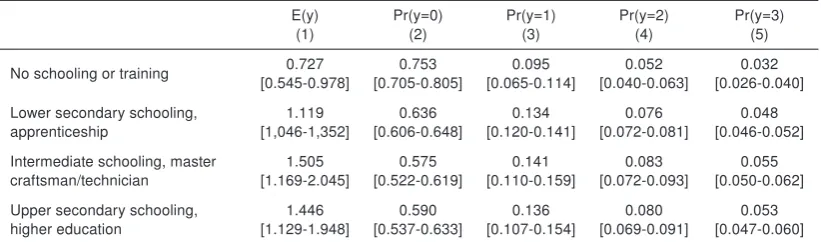
To infer the economic relevance of the results, Table 6 shows predicted frequencies of on-the-job training per spell—denoted byy—by parental educational level as well as the
probabilities of realising certain values fory. The predictions are computed based on the
results from Model 4; the rows represent different parental educational levels. The column denoted byE(y)represents the expected frequency of on-the-job training activities per spell, whereas the remaining columns show the probability to experienceytraining courses during
a spell withyranging from 0 to 3. Predictions for higher values ofyare not shown due to their small share in the estimation sample. The confidence intervals in square brackets are estimated by bootstrapping with 1,000 replications.
Table 6: Predicted frequency of training per spell (y) and probabilities of counts, respectively, by selected parental educational levels
E(y) Pr(y=0) Pr(y=1) Pr(y=2) Pr(y=3)
(1) (2) (3) (4) (5)
No schooling or training [0.545-0.978]0.727 [0.705-0.805]0.753 [0.065-0.114]0.095 [0.040-0.063]0.052 [0.026-0.040]0.032
Lower secondary schooling,
Notes:ALWA, own calculations; predictions based on Model 4; remaining covariates fixed at their mean; 95% confidence intervals in square brackets calculated by bootstrapping with 1000 replications.
family background (rows 3 and 4) compared to people from a family background without any formal education (row 1). However, the expected numbers of training activities per spell do not significantly differ between the three formally educated groups (rows 2 to 4), as shown by the overlapping confidence intervals.
The same applies when considering the rest of the predicted values. Column 2 shows the predicted probability of experiencing no on-the-job training based on both equations of the zero-inflated negative binomial model. The result can be interpreted as the probability of experiencing no on-the-job training either because of a lack of opportunity or because of not using or having been offered on-the-job training although the opportunity would have existed. The predicted probability of a lack of on-the-job training for people from a family background without formal education is 75%. The same fate is less likely by 16 percentage points for people from, for instance, an academic family background. Thus, when comparing the different parental educational levels, the conclusions are similar to those from column 1. The same applies for the remaining columns 3 to 5, albeit with smaller absolute differences between the educational levels.
This shows that family background plays an important role for on-the-job training, but this applies mainly to the lowest end of the parental educational distribution. A total lack of parental education is associated with low probabilities and frequencies of on-the-job training. Variation in parental education beyond that threshold is no major explanatory factor for non-formal training.
6.2
Sensitivity analysis
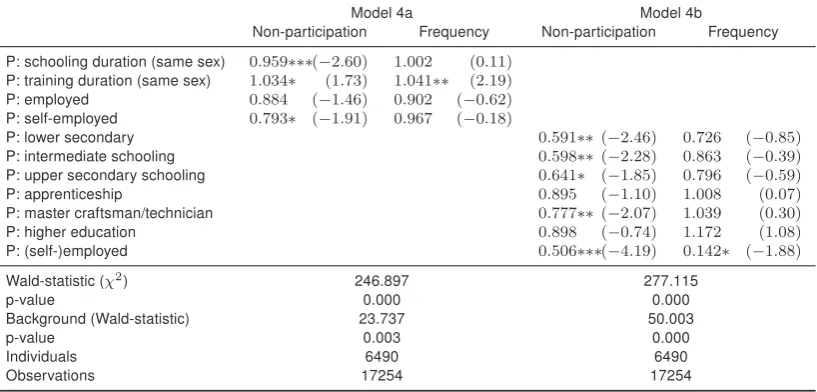
To check the robustness of the results, alternative specifications are tested. The remaining control variables from Model 4 are included in the estimations but not shown in the tables hereafter. Depending on the groups and variables included in the respective models, the number of observations vary. First, Model 4 is re-estimated using alternative specifications of the family background to infer whether the results depend on assumptions regarding the measurement of these variables. Model 4a includes schooling and training of the parent of the same sex as the respondent as cumulated durations of educational activities instead of categorical educational levels. Model 4b includes the highest schooling and training levels achieved by any of the parents.
Table 7 shows the results of Model 4a. These durations are computed based on mean durations per educational level that have been tested empirically for Germany (cf. Helberger, 1988). Other empirical applications can be found in Black/Devereux/Salvanes (2005) and Plug (2004).
Table 7: Determinants of non-participation in training and of the number of courses respec-tively, comparing different measures of parental education, zero-inflated negative binomial regression, Probit inflation
Notes: ALWA, own calculations; exponentiated coefficients; z-statistics in parentheses; cluster-robust standard errors; ***, **, * denote significance at 1%, 5%, 10%; omitted control variables similar to Model 4; Model 4a: parental schooling and training durations instead of categories; Model 4b: highest parental educational levels instead of that of the same sex as the respondent; reference categories: parent of own sex not employed (Model 4a), no parent formally educated or employed (Model 4b).
in training. This could be interpreted as an inversely U-shaped relationship between parental schooling duration and non-participation in on-the-job training. Alternatively, it could be due to the fact that the variable representing parental cumulated training duration has only five different values. That is why the influence of this variable thus can hardly be interpreted as linear. The Wald test on the overall relevance of the family background, nevertheless, still corroborates the intergenerational persistence hypothesis.
Whereas all parental characteristics so far have been based on information on the parent of the same sex as the respondent, Model 4b replicates Model 4 but uses the highest parental schooling and training levels given in the family as well as a dummy variable that indicates whether at least one parent had been employed or self-employed when the respondent was 15 years old. Parental schooling and to a lesser extent also parental training make non-participation in training less likely, but none of these regressors are significantly associated with the frequency of on-the-job training. Having had at least one parent that was employed or self-employed, on the other hand, is negatively related to the number of training events. This counterintuitive finding was already present in the previous specifications, although never statistically significant. Except for this result, the intergenerational persistence hypothesis can be sustained, and there is no indication that this specification should be preferred over the specification based on the sex-role model in Model 4.
remain statistically significant taken by themselves. It is not discernible whether this is due to the fact that the relationship described before may in fact differ between the two age groups or due to the reduced number of observations. The intergenerational persistence hypothesis receives support by a Wald test that does not reject the joint significance of the family background variables.
A closer look reveals that this result is mainly driven by parental schooling rather than parental training. The influence of socialisation by the parents regarding the learning orientation seems to be more strongly and more persistently explained by parental schooling. It is also to be expected that the parental training level is more strongly related to unobserved wealth of the family. Since it is likely that financial support from parents decreases over the life course of the offspring, the result from Model 4c also reflects a decreasing influence of unobserved wealth of the family on on-the-job training over time. The offspring gets more independent from its parents, and that also applies to the financing of human capital investments.
Table 8: Determinants of non-participation in training and of the number of courses re-spectively, excluding spells starting below the age of 26 or civil service spells rere-spectively, zero-inflated negative binomial regression, Probit inflation
Notes:ALWA, own calculations; exponentiated coefficients; z-statistics in parentheses; cluster-robust standard errors; ***, **, * denote significance at 1%, 5%, 10%; omitted control variables and reference categories similar to Model 4; Model 4c: exclusion of all spells beginning before the age of 26; Model 4d: exclusion of employment spells in the civil service.
be related primarily to parental schooling, gains importance; parental training and labour market status, as proxy variables for unobserved parental wealth, are less important.
These sensitivity analyses brought about more differentiated results, but did not contradict the general conclusions. On-the-job training participation is related to both formal parental schooling and training. Whereas parental schooling is mainly associated with the general likelihood of training, parental training is particularly relevant for the number of training activities per spell. Both relationships diminish over the life course of the offspring.
7
Summary and conclusions
The aim of this study was to examine whether people from low-qualified family backgrounds make up for any inherited lack of formal education by means of non-formal training. If this is not the case, one would have to conclude that a lack of intergenerational mobility in educational attainment is persistent over the life course. The high relevance of education for both labour market success and social participation makes this a key issue for economic research and from a policy perspective.
The results confirm that educational inequality is a lifelong phenomenon. In accordance with the intergenerational persistence hypothesis, family background is associated with a person’s human capital investments over the whole life. Growing up in a poorly educated household impedes one’s prospects of formal and non-formal educational attainment even during adulthood. The often cited blessings of lifelong learning are misleading as long as non-formal training does not contribute to the catching-up of people from low-qualified family backgrounds. They lack formal education themselves, and as they do not attain non-formal training often or intensively enough, the gap in human capital becomes even wider.
However, the story is not as simple as that. It is not only the education of parents that influences someone’s adult educational achievement. The endowment hypothesis stated that also personality traits and cognitive skills, which are in part inheritable, can explain a substantive part of differences in on-the-job training participation between people from different family backgrounds. The analyses corroborate this hypothesis. One channel of intergenerational persistence therefore works through the inheritance of endowments that make educational attainment more likely.
Finally, the job segment hypothesis stated that employment in a favourable labour market segment leads to more on-the-job training. This is corroborated by the finding that both the likelihood and the frequency of training rise with working time and with job requirements. Firm size is only positively related to a higher likelihood of on-the-job training.
This study makes two contributions to the literature. First, it shows that there are some factors that contribute to a lack of non-formal training—i.e. they constitute an obstacle to training, whereas other factors are associated with both the likelihood and frequency of training. The negative-binomial regression model has proven itself useful for more differentiated analyses than what would have been possible with the standard Poisson regression model. Second, and more importantly, the present article has been the first to bring together the issue of intergenerational educational persistence with an analysis of the determinants of non-formal training. In doing so, intergenerational mobility—or a lack thereof—could be analysed more comprehensively.
These results allow several policy implications. In the short run, human capital deficits could be reduced in part by incentives to participate in non-formal training and information on its benefits aimed at low-qualified people. Although these short-run remedies might be small steps towards more equal educational chances, a more advantageous cost-benefit ratio may be achieved by investments in human capital earlier in the life course. Findings reviewed, for instance, by Cunha/Heckman (2010) stress how profitable early investments in human capital are. It is therefore not surprising that the following long-term policy implications resemble those from the literature on intergenerational persistence in formal education.
Family policy can play a major role in fostering intergenerational mobility. Possible measures include compulsory and cost-free kindergarten attendance or subsidised childcare facilities. Both foster the labour supply of parents of young children who would otherwise be unable to finance daycare for their children. The resulting increase in income would diminish financial constraints and allow additional investments in the human capital of the offspring. Moreover, daycare facilities with well-educated staff offer favourable role-models and learning-oriented peer-groups. Both may foster the development of children’s skills that are important for future educational attainment and economic success (e.g., Heckman et al., 2010).
Educational policy has an equally important role to play. The comprehensive survey by Björklund/Salvanes (forthcoming) identifies key obstacles in educational systems that lead to a lack of educational mobility. For one thing, the duration of compulsory school attendance proves to be negatively related to the influence of the family background on educational attainment. The longer children are obligated by law to learn independently from parental decisions, the more human capital will be attained even after the period of compulsory school attendance. For another thing, the system of school tracking is important. The longer all pupils learn together before being separated into different tracks, the lower the influence of the family background on early educational decisions.
the present study for other countries. By comparing the results for countries with educational systems similar to that of Germany with countries that show a higher intergenerational educational mobility, research on the influence of the institutional background could be conducted. Moreover, as the data set includes only cross-sectional measures of cognition and personality, the assumption of their time-invariability is crucial for the analysis. To overcome this, repeated measurements of these dimensions would be necessary.
References
Anger, Silke; Heineck, Guido (2010): Do smart parents raise smart children? The intergen-erational transmission of cognitive abilities. In: Journal of Population Economics, Vol. 23, No. 3, p. 1105–1132.
Antoni, Manfred; Drasch, Katrin; Kleinert, Corinna; Matthes, Britta; Ruland, Michael; Trahms, Annette (2010): Working and Learning in a Changing World. Part I: Overview of the study. FDZ Methodenreport 05/2010 (en).
Arulampalam, Wiji; Booth, Alison L. (2001): Learning and Earning: Do Multiple Training Events Pay? A Decade of Evidence from a Cohort of Young British Men. In: Economica, Vol. 68, No. 271, p. 379–400.
Asplund, Rita (2005): The Provision and Effects of Company Training: A Brief Review of the Literature. In: Nordic Journal of Political Economy, Vol. 31, p. 47–73.
Backes-Gellner, Uschi; Mure, Johannes; Tuor, Simone N. (2007): The Puzzle of Participation in Continuing Training - An Empirical Study of Chronic vs. Temporary Non-Participation. In: Zeitschrift für Arbeitsmarktforschung, Vol. 40, No. 2/3, p. 295–311.
Bandura, Albert (1994): Self-Efficacy. In: Ramachandran, Vilayanur Subramanian (Ed.) Encyclopedia of Human Behavior, Vol. 4, San Diego et al.: Academic Press, p. 71–81.
Becker, Gary S. (1962): Investment in Human Capital: a Theoretical Analysis. In: Journal of Political Economy, Vol. 70, No. S5, p. 9–49.
Becker, Gary S.; Chiswick, Barry R. (1966): Education and the Distribution of Earnings. In: American Economic Review, Vol. 56, No. 1/2, p. 358–369.
Becker, Gary S.; Tomes, Nigel (1986): Human Capital and the Rise and Fall of Families. In: Journal of Labor Economics, Vol. 4, No. 3, p. S1–S39.
Becker, Gary S.; Tomes, Nigel (1979): An Equilibrium Theory of the Distribution of Income and Intergenerational Mobility. In: Journal of Political Economy, Vol. 87, No. 6, p. 1153–1189.
Black, Sandra E.; Devereux, Paul J.; Salvanes, Kjell G. (2005): Why the Apple Doesn’t Fall Far: Understanding Intergenerational Transmission of Human Capital. In: American Economic Review, Vol. 95, No. 1, p. 437–449.
Bowles, Samuel; Gintis, Herbert (2002): The Inheritance of Inequality. In: Journal of Economic Perspectives, Vol. 16, No. 3, p. 3–30.
Büchel, Felix; Pannenberg, Markus (2004): Berufliche Weiterbildung in West- und Ost-deutschland. Teilnehmer, Struktur und individueller Ertrag. In: Zeitschrift für Arbeitsmarkt-forschung, Vol. 37, No. 2, p. 73–126.
Buchmann, Marlis; König, Markus; Jiang Hong, Li; Sacchi, Stefan (1999): Weiterbildung und Beschäftigungschancen. Chur et al.: Rüegger.
Cameron, Adrian C.; Trivedi, Pravin K. (1986): Econometric Models Based on Count Data: Comparisons and Applications of Some Estimators and Tests. In: Journal of Applied Econometrics, Vol. 1, No. 1, p. 29–53.
Cameron, Adrian Colin; Trivedi, Pravin K. (1998): Regression Analysis of Count Data. Cambridge: Cambridge University Press.
Cawley, John; Heckman, James; Vytlacil, Edward (2001): Three observations on wages and measured cognitive ability. In: Labour Economics, Vol. 8, No. 4, p. 419–442.
Checchi, Daniele (2006): The Economics of Education. Human Capital, Family Background and Inequality. Cambridge et al.: Cambridge University Press.
Chevalier, Arnaud; Denny, Kevin; McMahon, Dorren (2009): A Multi-country Study of Intergenerational Educational Mobility. In: Dolton, Peter; Asplund, Rita; Barth, Erling (Eds.) Education and Inequality Across Europe, Cheltenham et al.: Edward Elgar, p. 260–281.
Colquitt, Jason A.; LePine, Jeffrey A.; Noe, Raymond A. (2000): Toward an Integrative Theory of Training Motivation: A Meta-Analytic Path Analysis of 20 Years of Research. In: Journal of Applied Psychology, Vol. 85, No. 5, p. 678–707.
Cunha, Flavio; Heckman, James J. (2010): Investing in Our Young People. NBER Working Paper 16201, URL❤tt♣✿✴✴✇✇✇✳♥❜❡r✳♦r❣✴♣❛♣❡rs✴✇✶✻✷✵✶✳♣❞❢.
Cunha, Flavio; Heckman, James J. (2008): Formulating, Identifying and Estimating the Technology of Cognitive and Noncognitive Skill Formation. In: Journal of Human Resources, Vol. 43, No. 4, p. 738–782.
Dieckhoff, Martina (2007): Does it Work? The Effect of Continuing Training on Labour Market Outcomes: A Comparative Study of Germany, Denmark, and the United Kingdom. In: European Sociological Review, Vol. 23, No. 3, p. 295–308.
Drasch, Katrin; Matthes, Britta (forthcoming): Improving retrospective life course data by combining modularized self-reports and event history calendars. Experiences from a large scale survey. In: Quality & Quantity.
European Commission (2000): A Memorandum on Lifelong Learning. SEC(2000) 1832, URL❤tt♣✿✴✴✇✇✇✳❜♦❧♦❣♥❛✲❜❡r❧✐♥✷✵✵✸✳❞❡✴♣❞❢✴▼❡♠♦r❛♥❞✉♠❊♥❣✳♣❞❢.
Feinstein, Leon; Duckworth, Angela Lee; Sabates, Ricardo (2004): A Model of the Inter-generational Transmission of Educational Success. Wider Benefits of Learning Research Report No. 10, URL ❤tt♣✿✴✴✇✇✇✳❧❡❛r♥✐♥❣❜❡♥❡❢✐ts✳♥❡t✴P✉❜❧✐❝❛t✐♦♥s✴ ❘❡s❘❡♣s✴❘❡s❘❡♣✶✵✳♣❞❢.
Fouarge, Didier; Schils, Trudie; de Grip, Andries (2010): Why Do Low-Educated Workers Invest Less in Further Training? IZA Discussion Paper No. 5180, URL❤tt♣✿✴✴❢t♣✳✐③❛✳
♦r❣✴❞♣✺✶✽✵✳♣❞❢.
Frederick, Shane (2005): Cognitive Reflection and Decision Making. In: Journal of Economic Perspectives, Vol. 19, No. 4, p. 25–42.
Frick, Joachim R.; Grabka, Markus M.; Groh-Samberg, Olaf (2007): Economic Gains from Publicly Provided Education in Germany. IZA Discussion Paper No. 2911, URL❤tt♣✿ ✴✴❢t♣✳✐③❛✳♦r❣✴❞♣✷✾✶✶✳♣❞❢.
Gerner, Hans-Dieter; Stegmaier, Jens (2009): Unsicherheit und betriebliche Weiterbil-dung. Eine empirische Analyse der Weiterbildungsaktivität unter Unsicherheit in KMU und Großbetrieben. In: Zeitschrift für Betriebswirtschaft, Vol. Special Issue 6/2009, p. 135–163.
Green, David A.; Riddell, W.C. (2003): Literacy and earnings: an investigation of the interaction of cognitive and unobserved skills in earnings generation. In: Labour Economics, Vol. 10, No. 2, p. 165–184.
Grossman, Michael (2006): Education and nonmarket outcomes. In: Hanushek, Eric A.; Welch, Finis (Eds.) Handbook of the Economics of Education, Vol. 1, Amsterdam et al.: North-Holland, p. 577–633.
Hardin, James W.; Hilbe, Joseph M. (2007): Generalized Linear Models and Extensions. College Station: Stata Press, 2 ed..
Heckman, James J.; Moon, Seong Hyeok; Pinto, Rodrigo; Savelyev, Peter A.; Yavitz, Adam (2010): The rate of return to the HighScope Perry Preschool Program. In: Journal of Public Economics, Vol. 94, No. 1-2, p. 114–128.
Heckman, James J.; Stixrud, Jora; Urzua, Sergio (2006): The Effects of Cognitive and Noncognitive Abilities on Labor Market Outcomes and Social Behavior. In: Journal of Labor Economics, Vol. 23, No. 3, p. 411–482.
Heineck, Guido (forthcoming): Does It Pay To Be Nice? Personality And Earnings In The UK. In: Industrial and Labor Relations Review.
Heineck, Guido; Anger, Silke (2010): The returns to cognitive abilities and personality traits in Germany. In: Labour Economics, Vol. 17, No. 3, p. 535–546.
Heineck, Guido; Riphahn, Regina T. (2009): Intergenerational Transmission of Educational Attainment in Germany - The Last Five Decades. In: Jahrbücher für Nationalökonomie und Statistik, Vol. 229, No. 1, p. 36–60.
Helberger, Christof (1988): Eine Überprüfung der Linearitätsannahme der Humankapitalthe-orie. In: Albach, Horst; Bodenhöfer, Hans-Joachim (Eds.) Bildung, Beruf, Arbeitsmarkt, Berlin: Duncker & Humblot, p. 151–170.
Hertz, Tom; Jayasundera, Tamara; Piraino, Patrizio; Selcuk, Sibel; Smith, Nicole; Ve-rashchagina, Alina (2007): The Inheritance of Educational Inequality: International Compar-isons and Fifty-Year Trends. In: B.E. Journal of Economic Analysis & Policy, Vol. 7, No. 2, article 10.
Hilbe, Joseph M. (2008): Negative Binomial Regression. Cambridge: Cambridge University Press.
Huber, Peter J. (1967): The behavior of maximum likelihood estimates under nonstandard conditions. In: Le Cam, Lucien M.; Neyman, Jerzy (Eds.) Proceedings of the Fifth Berkeley Symposium on Mathematical Statistics and Probability, Vol. 1, Berkeley: University of California Press, p. 221–233.
Jolliffe, Ian T. (2002): Principal Component Analysis. New York: Springer.
Kirby, Kris N.; Winston, Gordon C.; Santiesteban, Mariana (2005): Impatience and grades: Delay-discount rates correlate negatively with college GPA. In: Learning and Individual Differences, Vol. 15, No. 3, p. 213–222.
Lambert, Diane (1992): Zero-Inflated Poisson Regression, with an Application to Defects in Manufacturing. In: Technometrics, Vol. 34, No. 1, p. 1–14.
Leontaridi, Marianthi (1998): Segmented Labour Markets: Theory and Evidence. In: Journal of Economic Surveys, Vol. 12, No. 1, p. 63–101.
McCrae, Robert R.; John, Oliver P. (1992): An Introduction to the Five-Factor Model and its Applications. In: Journal of Personality, Vol. 60, No. 2, p. 175–215.
Moulton, Brent R. (1990): An Illustration of a Pitfall in Estimating the Effects of Aggregate Variables on Micro Units. In: Review of Economics and Statistics, Vol. 72, No. 2, p. 334–338.
Mullahy, John (1986): Specification and testing of some modified count data models. In: Journal of Econometrics, Vol. 33, No. 3, p. 341–365.
Pannenberg, Markus (2001): Schützt Weiterbildung on-the-job vor Arbeitslosigkeit? In: von Weizsäcker, Robert K. (Ed.) Bildung und Beschäftigung, Schriften des Vereins für Socialpolitik, Berlin: Duncker & Humblot, p. 275–291.
Pannenberg, Markus (1998): Weiterbildung, Betriebszugehörigkeit und Löhne: ökonomische Effekte des "timings" von Investitionen in die berufliche Weiterbildung. In: Pfeiffer, Friedhelm; Pohlmeier, Winfried (Eds.) Qualifikation, Weiterbildung und Arbeitsmarkterfolg, No. 31 in ZEW Wirtschaftsanalysen, Baden-Baden: Nomos, p. 257–278.
Plomin, Robert; DeFries, John C.; McClearn, Gerald E.; McGuffin, Peter (2008): Behavioral genetics. New York: Worth, 5 ed..
Plug, Erik (2004): Estimating the Effect of Mother’s Schooling on Children’s Schooling Using a Sample of Adoptees. In: American Economic Review, Vol. 94, No. 1, p. 358–368.
Rotter, Julian B. (1966): Generalized expectancies for internal versus external control of reinforcement. In: Psychological Monographs, Vol. 80, No. 1, p. 1–28.
Schömann, Klaus; Leschke, Janine (2008): Lebenslanges Lernen und soziale Inklusion -der Markt alleine wird’s nicht richten. In: Becker, Rolf; Lauterbach, Wolfgang (Eds.) Bildung als Privileg - Erklärung und Befunde zu den Ursachen der Bildungsungleichheit, Wiesbaden: VS Verlag für Sozialwissenschaften, 3 ed., p. 347–383.
Sinnott, Jan D. (1994): Sex Roles. In: Ramachandran, Vilayanur Subramanian (Ed.) Encyclopedia of Human Behavior, Vol. 4, San Diego et al.: Academic Press, p. 151–159.
Solon, Gary (2004): A model of intergenerational mobility variation over time and place. In: Corak, Miles (Ed.) Generational income mobility in North America and Europe, Cambridge: Cambridge University Press, p. 38–47.
Taubman, Paul J.; Wachter, Michael L. (1986): Segmented labor markets. In: Ashenfelter, Orley (Ed.) Handbook of Labor Economics, Vol. 2, Amsterdam et al.: North-Holland, p. 1183–1217.
Trostel, Philip; Walker, Ian; Woolley, Paul (2002): Estimates of the economic return to schooling for 28 countries. In: Labour Economics, Vol. 9, No. 1, p. 1–16.
Vuong, Quang H. (1989): Likelihood Ratio Tests for Model Selection and Non-Nested Hypotheses. In: Econometrica, Vol. 57, No. 2, p. 307–333.
A
Appendix
Table A.1: Sample statistics of independent variables
Mean s.d. Min Max
Master craftsman/technician required (dummy) 0.04 (0.19) 0.00 1.00