i
FACTORS THAT INFLUENCE JUNIOR HIGH
SCHOOL STUDENTS IN SEMARANG PREFER
TO USE
BAHASA INDONESIA
THAN THE
JAVANESE LANGUAGE
A THESIS
In Partial Fulfillment of the Requirements for
The Sarjana Degree Majoring Linguistics in English Department Faculty of Humanities Diponegoro University
Submitted by: SITI NURDJANAH NIM: 13020111130086
FACULTY OF HUMANITIES DIPONEGORO UNIVERSITY
ii
PRONOUNCEMENT
The writer honestly confirms that she compiles this thesis by herself and
without taking any result from other researches in S-1, S-2, S-3 and in diploma
degree of any university. The writer ascertains also that she does not quote any
material from other publications or someone’s paper except from the references
mentioned.
Semarang, 23 September 2015
iii
MOTTO AND DEDICATION
MOTTO
“.... For indeed, with hardship [will be] ease. Indeed, with hardship [will be] ease. So, when you have finished [your duties], then stand up [for worship], and to your lord direct [your] longing.” (Ash-Sharh: 5-8)
“Good communication comes from people to people, but great communication
comes from people to Allah.” (Anonym)
This paper is dedicated to
God, mother, father, sister, brother, and
to everyone who helped me accomplished this paper
iv
APPROVAL
Approved by, Thesis Advisor
v
VALIDATION
Approved by
Strata 1 Thesis Examination Committee Faculty of Humanities Diponegoro University
on 23 of September 2015
Chair Person
Dr. Agus Subiyanto, M.A. NIP. 19640814 199001 1 001
First Member
Dr. Deli Nirmala, M.Hum. NIP. 19611109 198703 2 001
Second Member
Prihantoro, S.S., M.A. NIP. 19830629 200604 1 002
Third Member
vi
ACKNOWLEDGEMENT
Praise be to God Almighty, who has given strength and true spirit so this
research on “Factors That Influence Junior High School Students in Semarang
Prefer to Use Bahasa Indonesia than the Javanese Language” came to a completion.
In this occasion, I would like to thank all those who have supported and
contributed to the completion of this thesis. Additionally, I also would like to extend
my deepest gratitude and appreciation to the following people:
1. Dr. Redyanto Noor, M. Hum., the Dean of the Faculty of Humanities,
Diponegoro University.
2. Sukarni Suryaningsih, S.S., M.Hum., as the Head of the English
Department, Faculty of Humanities, Diponegoro University.
3. Dwi Wulandari, S.S., M.A., as my thesis advisor who had given me
continuous guidance, helpful correction, moral support, patience,
advice, and suggestion for this final paper. Without those, it is doubtful
that this final paper came into completion.
4. Dr. Agus Subiyanto, M. A., as Head of Linguistics Major of the English
Department Faculty of Humanities, Diponegoro University.
5. All the lecturers in the Faculty of Humanities, especially English
Department who had shared and given their knowledge, experience, and
dedications to me.
6. My dearly beloved mother and father (Mr. And Mrs. Kholil) for the
vii
everything. I am proud to be your daughter and I feel truly fortunate to
have had your support.
7. My beloved older brothers and sisters (Mas zal, mas Dul, Mba Nung,
and Mba Kung). (I hope you all become the great people).
8. Eko Suwanto, S.Pd., as the head master of SMP N 27 Semarang who
has allowed me to find the data there.
9. Mr. Kun as the English teacher in SMP N 27 Semarang, my partner
“Eva”, and all respondents for help and cooperation in collecting the
data.
10.The nicest family in “Gayamsari 13 Girls”, (Citra, Opi, Nisa, Tari,
Nurul, and Diena) for sharing about everything together. Thanks for
coloring my life with laughter, tears, fun, advice, and every crazy time
we have shared together.
11.My new familes, in this great way, who always give me strength when
I am down (Mba Maya, Mba Astna, Mba Dwi, Mba Halimah, Mba
Mudah, Firas, Septi, Yulis, Puji, Gomeng, and Fera). Because of you, I
know what the true meaning of “Ukhuwah”. I love you guys.
12.My beloved best friends in English Department (Tika, Suci, Nia) who
shared our moments together, both in happiness and sadness. Thank you
so much for being such a great companion during our togetherness at
campus.
13.My first research partner (Bu Ti, and Bu Cha). Thanks you so much for
viii
14.The big family of Kharisma FIB and Insani Undip 2015 especially
Litbang, you are so amazing. I am really proud have you all as my
partner.
15.All 2011 English Department students (especially Sasing C, and
linguistic class). Nice to know you.
16.All of my best friends in Indonesian Department, faculty of Humanity,
(Sintya, Nesya, Izza, Sitta, Caca, and Septi) thank you so much you have
accompanied me in my hard time. Meet you in a campus library is a kind
of fortune.
17.Everyone who helped me to grow and always accompanied me in every
moment. Sorry, I cannot mention all of you one by one.
I realize that this final paper is still far from perfection. Therefore, I
will be glad to receive any constructive critics and recommendations to
make this final paper better.
Finally, I expects that this final paper will be useful to the readers
who want to learn the language use and language attitude phenomenon.
Semarang, 23 September 2015
ix
TABLE OF CONTENTS
TITLE... i
PRONOUNCEMENT... ii
MOTTO AND DEDICATION... iii
APPROVAL... iv
VALIDATION... v
ACKNOWLEDGMENT... vi
TABLE OF CONTENT... ix
LIST OF TABLES... xii
LIST OF FIGURES... xiii
APPENDIX LIST... xiv
ABSTRACT... xv
CHAPTER I INTRODUCTION... 1
1.1. Background of the Study... 1
1.2. Research Problems... 4
1.3. Purposes of the Study... 5
1.4. Previous Study... 5
1.5. Organization of the Writing... 7
CHAPTER II REVIEW OF THE LITERATURE... 9
2.1. Language Shift... 9
x
2.3. The Factors Influencing Language Shift... 11
2.4. Language Attitude... 13
2.5. Sentimental and Instrumental Attachment on the Language... 14
HAPTER III RESEARCH METHOD... 16
3.1. Type of Research... 16
3.2. Data, Population. Sample, and Technique Sampling... 17
3.3. Method of Collecting Data... 17
3.4. Method of Analyzing Data... 18
CHAPTER IV DATA ANALYSIS... 20
4.1. Background of the Respondents... 20
4.2. The Language Used by the Respondents... 22
2.2.1. Language Used Based on The Parents’ Educational Background... 22
4.2.2. Language Used Based on Their Origin... 26
4.2.3. Language Used Based on Their Parents’ Job... 27
4.2.4. Language Used by the Respondents Based on Their Gender... 31
4.2.5. The Language Used by the Respondents Based on the Duration Their Stay in Semarang... 34
xi
4.3. Their Language Attitude toward Javanese... 41
4.3.1. Cognitive Aspect... 45
4.3.2. Affective Aspect... 48
4.3.3. Conative Aspect... 49
4.4. The Relationship between Their Language Attitude and Language Shift …... 51
CHAPTER V CONCLUSION... 53
REFERENCES...
APPENDIX... 56
xii
LIST OF TABLES
Table 1. Table of the distribution of language used in daily life by
teenagers in Semarang based on their parent’s education... 23 Table 2. Table of the distribution of language used by Javanese teenagers
based on their origin (place they were born)... 26 Table 3. Table of the distribution of language used by Javanese teenagers
based on their father’s job... 28 Table 4. Table of the distribution of language used by the Javanese
teenagers based on their mother’s job... 29 Table 5. Table of the distribution of language used by the children by
their gender... 32 Table 6. Table of the distribution of language used by the children based
on the duration of their stay in Semarang... 34 Table 7. Table of the distribution of language used in daily life by
teenagers in Semarang based on the situation and the
interlocutors…... 36 Table 8. Table of response percentages: attitudes toward bahasa
xiii
LIST OF FIGURES
xiv
APPENDIX LIST
1. Questionnaire
2. The result of Questionnaire Survey 3. Documentation
4. Permit
xv
ABSTRAK
Sebagai bahasa nasional Indonesia, bahasa Indonesia kini tidak hanya digunakan dalam situasi formal bahkan dalam situasi non formal pun orang telah menggunakannnya, terutama para remaja sebagai generasi muda. Bahasa Indonesia mulai menggeser penggunaan bahasa daerah tak terkecuali penggunaan bahasa Jawa. Oleh karena itu, penulis tertarik untuk menganalis fenomena pergeseran penggunaan bahasa Jawa ke dalam bahasa Indonesia, terutama yang dilakukan oleh para remaja sebagai generasi muda. Hal yang menjadi fokus dalam penelitian ini adalah faktor apa saja yang mempengaruhi para remaja di daerah Jawa lebih memilih menggunakan bahasa Indonesia dari pada bahasa Jawa dalam berkomunikasi sehari-hari. Penulis juga melihat sikap berbahasa dari mereka untuk melihat kaitannya dengan penggunaan bahasa mereka. Dalam hal ini, penulis mengamati aspek kognitif, afektif, dan konatif pada sikap berbahasa mereka. Untuk mengetahui hal ini penulis menggunakan teory language shift. Partisipan dalam penelitian ini adalah murid SMP N 27 Semarang kelas 1A, 2A, dan 2E. Data yang digunakan adalah jawaban dari close dan open kuesioner serta pengamatan langsung. Metode yang digunakan dalam pengambilan sampel adalah purposive
sampling untuk menentukan responden. Sedangkan metode yang digunakan untuk
menganalisis data yang telah diperoleh adalah metode kuantitatif dan kualitatif. Hasil penelitian menunjukan bahwa faktor yang paling memengaruhi remaja di Semarang lebih memilih menggunakan bahasa Indonesia daripada bahasa Jawa dalam komunikasi sehari-hari adalah latar belakang keluarga seperti pendidikan orang tua dan pekerjaan orang tua, asal, jenis kelamin, sikap bahasa, dan lawan bicara. Selain itu hasil analisis juga menunjukan sikap bahasa mereka terhadap bahasa Jawa yang positif terhadap aspek kognitif dan afektif, namun dalam aspek konatif bahasa mereka menunjukan sikap yang negatif.
1
CHAPTER 1
INTRODUCTION
1.1Background of The Study
Indonesia is a large nation in terms of geography, population, and great linguistic
diversity. It is the fourth most populous nation in the word after China, India, and
United States (United Nations, World Population Prospect, 2012). Based on the
Central Agency on Statistic of Indonesia or BPS, Indonesia is extending some 1.760
kilometers from North to South and more than 5.120 kilometers from East to West.
The country comprised 17.508 islands, and inhabited by 350 ethnic groups speaking
750 native languages and dialects that are commonly used at home and within the
local community (Muljana, 1959:11). The major of ethnic groups are Javanese
47.02%, Sundanese 14.53%, Madurese 7.5%, Coastal Malay 7.5%, and others are
26% (Muljana, 1959:12).
Bahasa Indonesia has 23 million native speakers and 140 million second
language speakers (Muljana, 1959:5). It is used extensively as the first language by
people who live in urban areas, and as the second language by those who live in
rural parts of Indoneisa. Muljana (1959:10) said that it is a standardized version or
dialect of Malay language to unite the Islands, which is called “bahasa Indonesia”.
Malay has been used as lingua franca in Indonesia and spoken widely by
most people in Indonesia in 7th century (Alek, 2011:10-12). It is marked by the use
2
(Indonesian archipelago) to communicate in trades and business. According to
Indonesian law, bahasa Indonesia is proclaimed as the unifying language during
Sumpah Pemuda on 28 October 1928. Since then bahasa Indonesia become a
national language in Indonesia.
Since its conception in 1928 and official recognition in 1945, bahasa
Indonesia has been loaded with a nationalist political purpose to unify Indonesia
(Musgrave, 2007:4). This status made bahasa Indonesia relatively open to
accommodate influences from other Indonesian ethnic languages, such as Javanese
as the majority ethnic group in Indonesia, and Dutch as the previous colonizer.
Based on the census data from 1980 and 1990, Steinhauer (1994; 768)
indicates that the number of youth reporting “daily use of Javanese” dropped 16.3
% during the period, whereas the number reporting “daily use of bahasa Indonesia”
increased by 38.9 %.
At the beginning, not all of Indonesian people tend to use bahasa Indonesia.
Many people think that they do not really need that language. A long with the
development of the civilization or in the globalization era, and government’s policy
like migration or transmigration, Indonesian people try to use bahasa Indonesia in
their daily communication rather than to use their mother language.
Government also supported bahasa Indonesia as the national language in
Indonesia. All of government’s businesses like legislation, administration, justice,
defense, education, national development and so on are conducted wholly in bahasa
3
educational setting. Government tries to introduce bahasa Indonesia to Indonesian
children in formal education. It is one of many Government’s ways to make children
as a young generation learn bahasa Indonesia as a national identity.
Using language as media of communication can happen in formal and
informal situation. In formal situation, such as in office, during study activities, in
meeting, or in seminar, people usually use bahasa Indonesia to communicate.
Bahasa Indonesia as an official language in Indonesia is also used in all public
areas, such as education, mass media (magazine, printed and broadcast mass
media), transaction and trade documentation, the development of national culture,
science, and technology.
Meanwhile, in informal situation, such as in daily activities, people usually
use mother language that will make the speakers closer to each other. When they
get communication with their neighbor or family they seldom use bahasa
Indonesia. This is quite interesting to see, because in 30 years earlier, it was mother
language or Javanese language which was used in both types of communication.
Javanese family, especialy in Semarang try to change their vernacular
language into bahasa Indoneisa. An interesting finding of the observation is that
the family appear to be changing language choices across generational lines. They
have to use that language because it is the only means of communications. Their
mother languages are not missing completely, they still use it in some
communications or sometimes they will mix their vernacular languages and bahasa
4
Indonesia to help their chidren educationally, since, as the official language in
Indonesia, bahasa Indonesia is also a school subject.
Language use patterns are important indicates of on going societal changes
and community attitudes. Consequently. A large number of studies have focused
on the issue of language choice and shift (Fishman, 1991:45).
Based on this condition, I decided to take language use as the topic of the
study. I will focus on the factors that influence teenagers in Semarang tend to use
bahasa Indonesia than Javanese language. The data were taken in one of Junior
High Schools in Semarang, namely SMP N 27 Semarang, Central Java. Thus, based
on the background above, the research is entitled “Factors That Influence Junior
High School Students in Semarang Tend to Use Bahasa Indonesia than Javanese
Language”.
1.2Research Problems
In other to make easier analysis, I limit the discussion of this research that is only
on factors that influencing teenagers in Semarang tend to use bahasa Indonesia,
Central Java. Therefore, I focus only on the following problems related to the study,
namely:
1. Do the teenagers in Semarang tend to use bahasa Indonesia than Javanese
5
2. What factors influence the use of bahasa Indonesia by Junior High School
Students in Semarang, Central Java?
1.3Purposes of the Study
By answering the questions, there are some purposes related in this research,
namely:
1. To provide an overview of Junior High School students in Semarang,
Central Java in using bahasa Indonesia.
2. To describe the factors that influence Junior High School students in
Semarang to use bahasa Indonesia in their daily communication.
1.4Previous Study
Language use and language shift is one of interesting topics in conversational
interaction by people. Many studies about this topic used teenager’s language. I
used three previous studies as references related to the topic of my research, namely
(1) “Peer-Oriented Intervention: A Social Factor of Language Shift in Elementary
School Students” by Ihda Rosdiana in 2014, (2) “Pergeseran Bahasa Jawa dalam
Ranah Keluarga Pada Masyarakat Multibahasa di Wilayah Kabupaten Brebes” by
Hari Bakti Mardikantoro in 2007, and (3) “Influenced factors Towards the
Language Shift Phenomenon of Wotunese” by Masrudin in 2014.
The first study was written by Rosdiana in 2014. She focused on the
6
tried to find out the social factor causing the shifting of Bahasa Jawa Ngoko into
bahasa Indonesia. The data were collected through observation and interview. She
used the respondents’ utterances and the context of the conversation as her data.
She found that there is peer oriented intervention (Mug et al, 2001) functions as a
social factor of language shift. However, this Javanese shift did not occur in the
fifth grade students because they come from same speech community. To analyze
the data she just took data from two grades, namely third and five grade in one of
elementary schools in Tegal.
The second study was conducted by Mardikantoro in 2007 about the pattern
of Javanese shift in Brebes and the socio-cultural factor of language shift. He
conducted his research in Brebes, Central Java. He used theory of language shift by
Fishman and descriptive qualitative method to analyze his study. He found several
factors that influence Javanese people in Brebes shift their language into bahasa
Indonesia, there are; the speaking situation, the ethnic background, the ability of
family members language, the consanguinity relation, and the topic of discussion.
Nevertheless, the sample of total population did not represent the whole population
of Brebes society. Although Brebes has 17 sub-districts, he only focused on Losary
sub-district, the border between Brebes and Cirebon. Meanwhile, the differences
between this research and his research is in the method to find the data. He used
utterances as his main data and not found another data like questionnaire to support
his analysis.
The third study was conducted by Masrudin in 2014. The aim of his study
7
was carried out in two villages namely Lampenai Village and Bawalipu village,
Wotu District, east Lawu Regency. The method used was field survey by
distributing questionnaire, interviewing, and direct observation. He used theory of
language shift by Fishman. He used quantitative data and descriptive qualitative
method to conduct his research. The result of his study shows that the determinant
factors influence significantly on language shift of Wotunese are age, mobilization,
bilingualism, and language attitude.
1.5 Organization of the Writing
Research should be easy to be understood by the readers. Thus, it should be in a
good arrangement and also well organized. To make it easy to be understood, this
research is organized into five chapters as below:
CHAPTER I : INTRODUCTION
It consists of background of the study, research problem, purposes
of the study, previous study, and writing organization.
CHAPTER II : REVIEW OF LITERATURE
It contains the underlying theory.
CHAPTER III : METHODOLOGY
It discusses the type of research, the method of collecting data, the
samples and population, and also the technique for collecting and
8
CHAPTER IV : ANALYSIS
It comprises the analysis of the collected data. It describes the
background of the respondents, their language use to find out the
factors that influence them tend to use bahasa Indonesia than
Javanese language, their language attitude, and the relationship
between their language attitude and their language use.
CHAPTER V : CONCLUSION
9
CHAPTER II
REVIEW OF LITERATURE
In this chapter, I will present some theories which are used in this research. First, it
will cover about language use. I used it as the foundation of the study. Second it
will discuss the language shift. The third is the description of language shift, by
focusing on how the description of the language shift uttered by teenagers. The last
is sentimental and instrumental attachment on language, and language attitude, to
find the correlation between language use, and attitude toward language.
2.1Language Use
The study of language use has been the focus of many language maintenance and
language shift. Fasold (1984:183) stated that domains are institutional context “in
which one language variety is more likely to be appropiate than another. Domains
are taken to be constellations of factors such as location, topic, and participants.
Domains analysis is related diglosia.” Example of different types of domains
include family, frienship, neighbourhood, market, school, work, government, and
religion.
A number of studies using the consept of domain in language choice have been
10
language choice. She concluded in her study that “widespread variation in language
use reflected a language shift in progress.
Fase, Jaspert, and Kroon (1992) state that shift in language use patterns occuring in
inter-ethnic communication, or out-group domains, does not lead to total language
shift.
As long as we are dealing with a group, there is also communication within the group, and the norms that develop for interethnic communication do not need to have any impact on intragroup communication. If only interethnic shift occurs, thye language situation within the community will evolve towards a form of stable bilingualism: in its most extreme form, it would ceate a situation in which the minority group language is used for communication within the group, and the dominant group’s language is used in all other instances (1992:6).
2.2Language Shift
Language shift is one of the subjects in sociolinguistic study. Weinrich (1953:68)
says that shift is the change of habitual use of one language to another language. It
means that the language users change their daily use of language to the new one.
However, their main language still exists.
Language shift has been studied in many parts of the world. There are many
communities that have different languages, so they must change their language to
make communication to each other. Sometimes language shift happens by small
weak languages, or the languages of marginalized group come into contact with
large powerful language. Language shift also happens toward language used by less
member of community. It also can happen toward language which is less respected
11
Another definition is stated by Fasold (1990:213):
“Language shift simply means that a community gives up a language
completely in favor of another one. The members of the community have
collectively chosen a new language where an old one used to be used.”
Furthermore, language shift is found mostly in the young generations.
Junior high school students as the young generation have big role in using different
languages in their communication. They must face more challenges of language
shift as a consequence of globalization.
2.3Description of Language Shift
Language shift is kind of sociolinguistic phenomena caused by language contact.
Sometimes language shift happens in a place that has better economic condition
(Chaer, 1995:190). In some bilingual communities we can find many people try to
change their languages. It is caused by many factors depending on the situations
they face like the topic changes in their communications.
Jendra (2012:141) stated that “Language shift is a form of full amount
language change. The concept refers to a situation where a speech community begins to entirely use a new language, or in other words, discontinues the use of their former language for their communication
needs.”
Thomson (1988) cited in Masruddin (2014) stated that language shift shows
a gradual and progressive transition from one language to another, and a shift may
occur over several generations. Language shift mostly happen in teenagers or
younger generations. In some areas especially in big cities there are many young
people who do not use their vernaculars. (Snedon:2003) stated that in south
12
it was commonly used before that. Language shift phenomena also can be seen in
young generation in East Timor that has been probably shifting from bahasa
Indonesia to use Portuguese since its independence in 1999.
Language shift also mostly happens in immigrant groups. Jendra (2012:142)
stated that the shifting towards a new language in immigrant groups will follow
some stages. First, immigrants only use their native languages in a new place. Then,
when they get married and have a family they will start to borrow the local language
or may begin to be a bilingual. They will use the local language when speaking with
the local residents, but they will use their native language when speaking with their
families. It will continue for long times. By the growing of the second generation,
the immigrants become fully bilingual speakers. At this point, the next generation
may begin to consider it to let their children speak local language and do not teach
their native language. At this result, the third or fourth generation only has a
competence to speak the local language. This becomes the point how language shift
happens.
Fishman (1972:85-86) showed that there is a language shift in immigrant
community in USA. The third or fourth generation of the immigrants have not
spoken or known their mother languages. They begin to be a monolingual and speak
only in English Language. Chaer (2010: 144) gives a simple descript’ion show in
13
*ML: Mother Language
EL: English Language
From the description above we can conclude that language shift happens
when there is a full amount of language change in someone’s utterances. As we can
see in the graphic above, immigrants will speak with full English language at the
fifth step, thus language shift happens in that stage.
2.4Language Attitude
Language atitude refers to people’s feelings and preferences towards their own
language abd other speech varieties around them., and what value they place on
those language. Attitude may be defined as the sum total of person’s psychological
construct towards certain objects, institution, person, ideas, etc. It play crucial role
in the social behavior of an individual as it defines and promotes certain behavior.
Then, language attitudes may be positive or negative, as well as neutral
feeling attached to a particular language situation (Lukman, 2000:1). In relation to
this phenomenon, Garvin and Mathiot (1972: 373) stated that there are three
characteristics of language, namely; (1) Cognitive aspect or language loyalty, which Monolingual
(ML)
Bilingual Setara
(ML-EL)
Bilingual bawahan
(ML-EL)
Monolingual (EL)
Bilingual bawahan
14
motivate a society of language speakers maintain their language, and if it is needed,
they will protect their language from other languages’ influences. In short attitude
cognitive tend to have a cognitive component. This could involve beliefs or
perceptions about the objects or situations related to the attitude, (2) Affective
aspect or Language pride, which motivate someone to develop their language to be
identity symbol and unity of society. Affective aspect has evaluative components.
This means that the objects or situations related to the attitude may generate like or
dislike and (3) conative aspect or awareness of the norm, which motives the speaker
to use the language carefully and politely and this is the biggest factor which
contribute to the activity of using the language. Conative aspect has a behavioral
component, i.e. certain attitudes tend to prompt learners to adopt particular learning
behaviors. In addition, Crystal (1992) defines language attitudes as the feelings
people have their own language or the languages of others.
2.5Sentimental and Instrumental Attachment on the Language
The idea of attachment in general is an important one in the study of the formation
of both ethnic groups and nations.
The primordialist argues that every person carries with him through life
“attachment” derived from place to birth, kinship relationship, religion, language, and social practices that are “natural” for him “spiritual” in
character, and that provide a basis for an easy “affinity” with other people from same background. (Bass 1997 in Eastman, 1941: 34).
Primordial attachment is a strong form of sentimental attachment, because
they will represent more than themselves (Eastman, 1941: 34). So that, Eastman
15
major symbolic means of forming such an attachment by bridging immediate
loyalties (the need to be one nation or state) with transcendent ones (the need for
unique linguistic and cultural heritage). One group with a sentimental attachment
to a language will lack access to a dominant other languages and will experience
discrimination at the instrumental level “because its language is not given due
recognition” (Kelman, 1971 in Eastman, 1941: 35).
Thus, in instrumental attachment people become upset when they cannot get
what everyone else can because the lack ability to use the language that is the key
to get good life (Eastman, 1941: 34). So, at the instrumental level, where it is useful
for specific ends, a national language allows political, economic, and social
16
CHAPTER III
RESEARCH METHOD
A research method is designed as steps taken by researcher to solve the research
problem. In this chapter I will describe the type of research, the source of the data,
population and sampling technique, method of collecting data, and method to
analyze the data of the study.
3.1Type of Research
According to the purposes of the research, which are to provide an overview of
Junior High School students in Semarang in using bahasa Indonesia and to describe
the factors that influence them to use that language, this research is categorized into
descriptive with qualitative and quantitative analysis. Descriptive research aims at
describing the object of the research. In this case, it is quantitative because the main
source of data were gathered by using questionnaire through a survey which was
compiled in a table numerically. From the data taken, I analyzed them by using
qualitative and quantitative methods, so that I got the description of the factors that
17
3.2Data, Population, Sample and Technique Sampling
The data used in this research were taken from questionnaire and direct observation
of teenagers in Semarang. It was obtained from first and second grade students of
Junior High Schools in Tembalang, namely SMP N 27 Semarang during three
months observation. I took 3 classes that consist of first and second grades as the
respondents. In every class, there are 31-32 students, so the total of the respondents
are 95 students.
Sampling technique used in this study is purposive sampling. I used it to
choose the students. I choosed the students of SMP N 27 Semarang as the object of
my study because it has a rule for students to speak Javanese in certain day in a
week. Furthermore, I choose class 1 A, 2 A, and 2 E as the sample of the study
because in that class there are more students disobeying the rule to use Javanese
language.
3.3Method of Collecting Data
In conducting the research, I used two instruments of collecting data, namely,
questionnaire and direct observation. The first instrument is questionnaire methods.
I used close and open questionnaire to find the background of the respondents and
the reasons why they prefer to use bahasa Indonesia or Javanese language in their
communication. The questionnaire was composed of three parts. The first part
18
background. The second part of the questionnaire consists of questions related to
the language used by teenagers in Semarang including the language that they use in
their daily life in various settings and with some different interlocutors. The third
part of the questionnaire consists of questions about their attitude toward Javanese
and bahasa Indonesia. It includes language loyalty, belief about language, etc. The
questionnaires are distributed in three classes, namely 1 A, 2 A, and 2 E.
The second instrument is observation. Observation was also conducted to
validate the survey result and to deepen the understanding of respondents’ language
shift and attitude. The observation is conducted in the class that I used as the sample,
I focused on the using of bahasa Indonesia by the respondents both in class and
outside the class to find the supporting data. The using of bahasa Indonesia and
Javanese language will be seen in the various situations and contexts of the
conversations. Observation was done for three months at school. The process of
observation is done together with the process of Simak Libat Cakap and Simak
Bebas Libat Cakap technique.
3.4Method of Analyzing Data
The data that I got are from questionnaire, and direct observation. To answer the
question of the research, the data of the research were analyzed quantitatively and
qualitatively.
The data that I got from close questions will be analyzed using quantitative
method by looking at the percentages of their answer. I use three steps to process
19
the data. The second step is coding. In this step I will classify the answer of
respondents by giving symbols in every question. The third step is tabulation. In
this step I will input the data into standard table and start to count the percentage of
every question. I use tables to make it easier to understand. So, it will be easy to
conclude what is the most influencing factor of language used by teenagers in
Semarang. Furthermore, to analyze the answer of open questions and direct
observation, I use qualitative method. I use the analysis to find their language
attitude and the factors that influence them tend to use bahasa Indonesia than
20
CHAPTER IV
DATA ANALYSIS
In this chapter, I analyze the data in order to find the result of the study. I analyzed
the questionnaire to find respondents’ background, the language used by them, their
language attitude toward Javanese, and the relationship between their language
attitude and language used by them.
4.1 Background of the Respondents
In this research I took the respondents from SMP N 27 Semarang, because in that
school there is a day in a week that has a rule for the students to use Javanese
language to communicate to each other, but most of them disobey the rule. When
they get communication at school, in class or outside the class, most of them tend
to use bahasa Indonesia even at that day they must use Javanese language.
Based on my observation and the data I got, their parents prefer to use
bahasa Indonesia to communicate with their children since the children were born,
so most of them feel more comfortable to speak in bahasa Indonesia or mix
language between bahasa Indonesia and Javanese language.
In this research, there are 95 respondents, consisting of 36 males and 59
21
of the respondents come from Java area or the cities that use Javanese language for
daily conversation like Semarang, Pati, Wonosobo, Solo, etc. Only 3 % of the
respondents come from some areas which do not use Javanese language for
communication like Jakarta, Bandung, Cirebon, and Tasik. Most of the
respondent’s parents were also born in Java area, 88 fathers and 89 mothers are
native Javanese language.
From this fact, the respondents are assumed to know Javanese language
clearly, because they were born and raised in Java area in which most of the people
use Javanese language. Moreover, based on the data, most of the respondents live
in Java area for more than 10 years (81 respondents). There are only 9 respondents
who live in Semarang for about 1-5 years, and only 5 respondents who live in
Semarang for about 6-10 years (see appendix page 8). Based on the age of the
respondents who are approximately between 13-15 years old, we can assume that
the respondents who life in Semarang more than 10 years means they have lived in
Semarang throughout their life or since they were born.
From the data, I found that most of the students come from family which
has good or higher educational background, about 8.4 % of parents were graduated
from elementary school, 6.3 % from Junior High School, 31.5 % from Senior High
School, 2 % from Academy and 36.6 % graduated from University (See appendix;
page 10). Most of their parents also have a good job like civil servant, entrepreneur
or business, and employee. So, we can conclude that most of the respondents come
from high level of family background or having good economy background. As we
22
Fishman (1991: 67) said that family background has a big role as the central driving
force in children language socialization within the context of both minority and
majority languages. Nowadays, many Javanese teenagers especially in Semarang
ignore standard Javanese language.
4.2 The Language Used by the Respondents
In this research, language used will be seen based on their family backgrounds,
gender, origin, the duration of their stay in Semarang, and the context of the
conversation.
4.2.1 Language Used Based on the Parents’ Educational Background
Education is one of the indicators of social class that can cause language used by
the children. Daucet (1991) and Harres (1989) cited in Schwartz (2008) found that
the higher education levels of the parents are, the greater their shift from one
language into another language are. In this case, I find that education level of the
parents will influence the language use of children.
In Semarang, many teenagers who come from family which has good
educational background tend to use bahasa Indonesia to communicate. It is proven
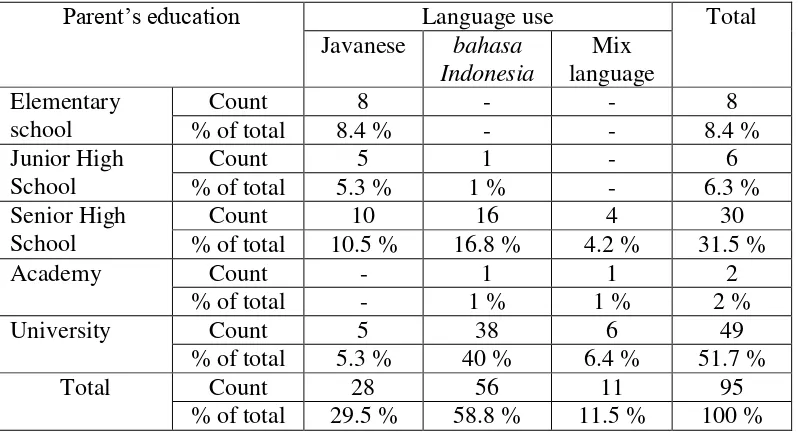
by the finding listed in table 1. It shows the description of language used by
23
language used by teenagers whose parents graduated from Senior High School or
University.
Table 1. The distribution of language used in daily life by teenagers in Semarang
based on their parent’s education
Parent’s education Language use Total
Javanese bahasa
Semarang who are growing up in family which has better educational background
to use bahasa Indonesia. To analyze the data, I took the higher educational level
from their mother or father to see how big influence given by better educational
family background to the children language use.
Table 1 above shows that there are differences of language use. From this
table, it shows that the number of children whose parents graduated from
Elementary School are 8. All of them do not use bahasa Indonesia. It means 100 %
of children whose father graduated from elementary school tend to use Javanese
24
Furthermore, almost all of the children whose parents graduated from Junior High
School also prefer to use Javanese language to communicate. About 5 from 6
children use Javanese language, and only 1 person use bahasa Indonesia.
However, about 38 from 49 respondents whose parents graduated from
university tend to use bahasa Indonesia in their daily communication. Based on this
finding we can see that family educational background will influence children tend
to use bahasa Indonesia than Javanese language.
Meanwhile, children whose parents graduated from Senior High School
show the similarities to use both Javanese language and bahasa Indonesia. There is
no significant change from it. About 50 % of them use bahasa Indonesia and almost
50 % of them use Javanese language.
In some cases, some of the children who come from parents’ higher
educational background and still use Javanese language stated that they use high
level of Javanese language namely bahasa krama. Whereas children who come
from lower parents’ educational background who use Javanese language stated that
they use low level of Javanese language namely bahasa ngoko. It is showed from
the questionnaire (open question) that some of the respondents who grow up in good
family educational background and use Javanese language as their daily language
stated that they use bahasa krama to communicate with their family at home. So,
from this finding, we can see that family who uses Javanese language even they
25
happens because bahasa krama has higher prestige and more polite than bahasa
ngoko.
In the perspective of parental educational background, we can state that the
children who come from family which has better educational background use
bahasa Indonesia dominantly. Relied on these data the educational background of
the parents can be assumed as the one of the determinant factors of language used.
These finding is also strengthened by the respondents’ answer about their
first language taught. Most of the children stated that their parents prefer to use
bahasa Indonesia than Javanese language in the way they speak with them, so the
respondents sometimes mix their languages between bahasa Indonesia and
Javanese language when they communicate with their friends and neighbors. (See
appendix; page 16).
Family educational background, especially parental education level also
leads the children become a bilingual, so it makes them easy to use another
language. This study also supports the previous study by King and Fogle (2006)
about the language used by the family member, they found that a high level of
education relative to the total population among American families will support the
26
4.2.2 Language used based on their Origin
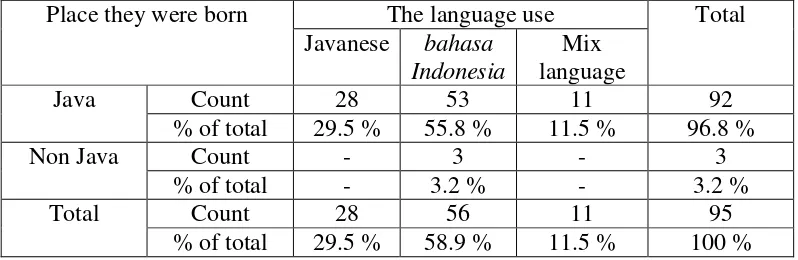
Table 2. The distribution of language used by Javanese teenagers based on their
origin (place they were born)
Place they were born The language use Total
Javanese bahasa Indonesia
Mix language
Java Count 28 53 11 92
% of total 29.5 % 55.8 % 11.5 % 96.8 %
Non Java Count - 3 - 3
% of total - 3.2 % - 3.2 %
Total Count 28 56 11 95
% of total 29.5 % 58.9 % 11.5 % 100 %
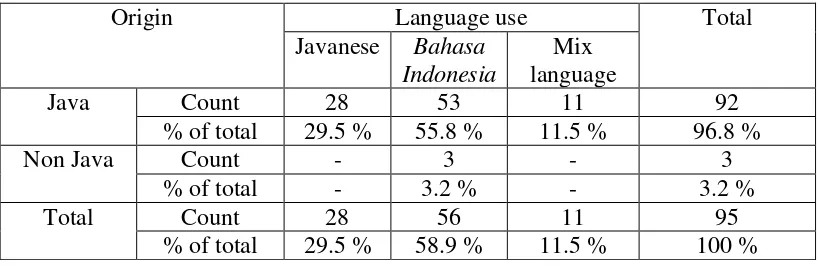
From table 2 above, it can be seen that 92 respondents or 96.8% of them
were born in Java area (East and Central Java), area whose inhabitants still use
Javanese language. From all of the students who were born in Java area, there are
53 students or 55.8 % use bahasa Indonesia as their native language. If we see from
the data, the children actually have to use Javanese language to communicate with
others because they come from Java area, but in the reality, most of them prefer to
use bahasa Indonesia. As we know that Javanese children whose mother tongue is
Javanese will normally acquire low Javanese first (Geert, 1960; Keeler, 1984;
Siegel, 1986) cited in Kurniasih (2006: 5). By the time they start school, they start
to acquire bahasa Indonesia for educational purposes. Parents, grandparents, and
other adult members of family are the children’s main sources for learning and
acquiring Javanese, while they learn bahasa Indonesia at school, but in this case,
most of the parents does not play the role again. So, I think this phenomenon is
27
This finding is also supported by the data of where the parents were born.
Most of the parents were born in Java area, it is for about 88 fathers and 89 mothers
from 95 respondents. So, from this finding, we can conclude that their origin or
from where they come from is not really influence the teenagers to use Javanese
language. Even they were born in Java area, it is not become a must for them to use
Javanese language as their first language. So, we can state that language shift start
to happen in Java area, especially by younger generations. This study also supports
the previous study by Masruddin (2014), he found that in Wotu area, even the
people live in Lampenai where it is the center of Wotunese, most of them still tend
to use bahasa Indonesia. He stated that their origin or their area to stay is not really
influence their language use. As same as people in Semarang, most of Wotunese
also think that bahasa Indonesia is considered as prestigious language and they can
get many benefits include economic benefit when they interact with the other
people using bahasa Indonesia.
4.2.3 Language Used Based on Their Parents’ Job
Job of the parents or we can say economical background of the family will influence
language used of the children. Based on the study by Nadratunnaim (2005) cited in
Masruddin (2014) found that language shift from Banjari is taking place in the
Malaysian Banjarese community was influence by the gender, level of profession,
28
Based on the direct observation and the data from questionnaire, in Java
area, especially Semarang as the central city of Central Java, there are differences
among the kind of jobs of Javanese in using bahasa Indonesia. From questionnaire
we can see that language which used by the parents who have good work will prefer
to use bahasa Indonesia to communicate with their children, so it will influence
language used by their children as the younger generations.
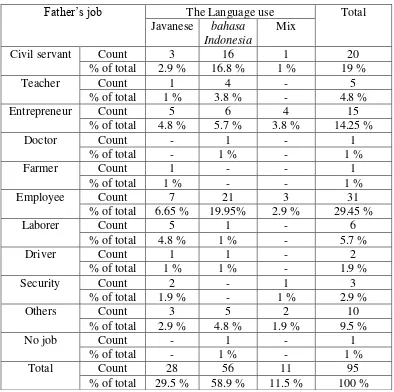
Table 3. The distribution of language used by Javanese teenagers based on their
father’s job
Father’s job The Language use Total
29
Based on table 3 above, we can see that 56 respondents use bahasa
Indonesia. 16 from 20 respondents whose fathers work as a civil servant, 4 from 5
whose father work as teacher and 21 from 31 whose father work as employee prefer
to use bahasa Indonesia. Whereas almost all of the teenagers whose father work as
a farmer, laborer, driver, and security tend to use Javanese language. In other cases,
teenagers whose parents work as entrepreneur have no any significant change of
language use. From this finding we can see that father’s job give influence to their
children’s language use, but it will different when we see from the language used
by the children based on their mother’s job below.
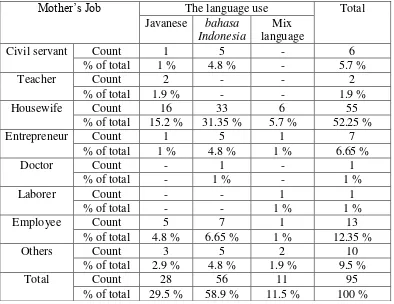
Table 4. The distribution of language used by Javanese teenagers based on their
mother’s job
Mother’s Job The language use Total
30
Based on table 4 above, it can be seen that most of the respondents’ mothers
stay at home as a housewife. There are 55 mothers who stay at home and 33 of their
children speak in bahasa Indonesia. It shows different language use when we
compared with father’s job. Most of the children who speak in bahasa Indonesia
have father who work as civil servants, employee, and teacher, but most of children
whose mothers are unemployed or stay at home as a housewife have tendency to
use bahasa Indonesia. While, The respondents whose mother’s job as employee
prefer to use Javanese language. So, mother who has much time to stay at home
will lead the children to shift their mother language into bahasa Indonesia. They
who stay at home all day will have more opportunity to teach their children’s
language. In this case bahasa Indonesia. This situation is not in line with
sociolinguistics theory that home domain is a place to heritage the local language.
Parents, especially mother actually have a big role to teach their local language to
their children.
Furthermore, we also can see that the pattern of language used by children
more influenced by father’s job (see appendix page 12). As we know, in Java area,
father has bigger role in the family than mother. When we see from the data also
there are no significant differences of job between mother and father. Both of
parents have similarities of job, whether it is white-collar worker (person who
performs professional, managerial, or administrative work) or blue-collar worker (person who performs manual labor).
This finding is different with the study by Masruddin (2014) found that there
31
groups of worker, such as civil servant and fisherman, both of these group of job
tend to have the same characteristics to change Wotu language into bahasa
Indonesia.
Parents who have good work also will concern with preparing their
children’s future life. They encourage children to learn some languages and it will
be influenced by their perceptions of what language skills are required to face the
globalization era. Their parents feel afraid if their children have accent too Javanese,
it make them difficult to speak in bahasa Indonesia or other languages properly, so
it will make their children difficult to find better job in the future.
Meanwhile, the indigenous language has often been esteemed as the
language of heritage, even while being replaced by the national language, in this
case Javanese language and bahasa Indonesia. Bahasa Indonesia as the language
that used in all of parts in Indonesia, may be used simply because it is needed for
functioning in the workplace to earn living. Even they prefer to use bahasa
Indonesia in their daily communication, it does not mean that they are really forget
about the language. They still have a hope that Javanese language will still exist as
an inheritance of their culture.
4.2.4 Language Used by the Respondents Based on Their Gender
Gender of the respondents also will support teenagers in Semarang tend to use
bahasa Indonesia than Javanese language. The American high school in sub urban
32
(1998) cited in Smith-Hefner (2009) found young working class woman to be the
innovators in regional (nonstandard) vowel shift.
Table 5. The distribution of language used by children based on their gender.
The duration of their stay in Semarang
Based on the data above we can see that more than half of the respondents
speak in bahasa Indonesia. The percentage shows that gender have correlation or
influence on language use, even the influence is not significance.
As can be seen in table 5 above, there are differences of language use based
on gender. From the percentages, it shows that the number of male Javanese who
use Javanese language are 20 from 36 or 55. 5 % of the total male respondents.
Only 33 % of the respondents use bahasa Indonesia, and about 11 % use mix
language between bahasa Indonesia and Javanese language. In contrast, there are
44 or 76.6 % of the total female respondents use bahasa Indonesia, and only 10.6
% use Javanese language.
Based on this quantitative data, it shows that there are differences of
33
bahasa Indonesia rather than men. This study is in the line with the previous study
conducted by Milroy in Belfast (1990) cited in Errington (1998) she stated that
women are the catalysts in linguistic change. In other hands, this study is not in line
with the study by Masruddin (2014), he stated that there are no differences of
language use based on gender group in Wotu. It happens because based on his
observation, he found that in Wotu area, in the Wotunese family, when they have
decided something, both of the parents, mother and father have the same right to
give opinions related to the problem. Then, both of woman and man have to decide
together all the problems in the family. This condition seems really different with
the condition in Java area. In java area, especially Central Java, we can see that man
and woman have different position in family life. Man has bigger power and higher
position in the family, so man has more right to give opinions and to choose
something.
Relied with the quantitative data above, based on my direct observation also
shows that most of the male respondents who gather in a class or outside the class
prefer to use Javanese language or mix language between Javanese language and
bahasa Indonesia. They also use Javanese language to curse their friends and to
make a joke. This phenomenon is really different in female groups who prefer to
34
4.2.5 The Language Used by the Respondents Based on the Duration Their Stay in Semarang
Language used by the people is also influenced by the duration their stay in one
place whose majority groups speak their own languages. Semarang, as the central
city of Central Java has many residents who come from other places. Jendra
(2012:145) stated that when people’s lives are surrounded by speakers of different
languages can influence a speech community to change their languages. Because of
many differences of language use, so it will make people in that place to use national
language to communicate. In this case of study, based on my direct observation,
many people in Semarang who come from many places have tendency to use
bahasa Indonesia when they speak with others. This finding is also supported by
the questionnaire data below.
Table 6. The distribution of language used by the children based on the duration of their stay in Semarang.
The duration of
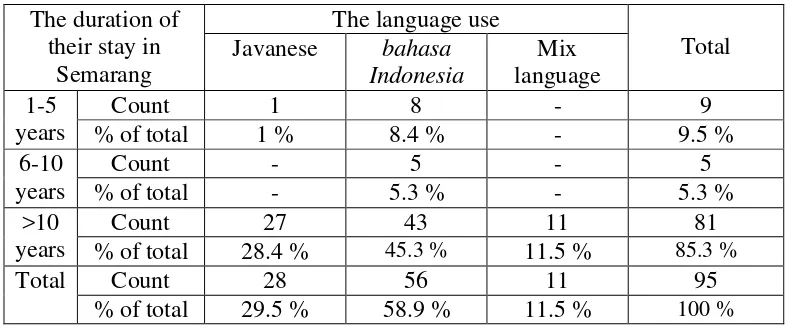
From table 6 above, it can be seen that there are 81 respondents who live in
Semarang for more than 10 years. Only 27 or 28.4 % of the respondents who speak
35
Indonesia. Whereas, almost all of the respondents who live in Semarang less than
5 years tend to use bahasa Indonesia. 8 from 9 respondents who live in Semarang
for about 1-5 years use bahasa Indonesia. Based on these finding, it can be said that
teenagers in Semarang tend to use bahasa Indonesia to get communication even
most of them live in Semarang since they were born.
Based on this finding, we can conclude that how long people live in
Semarang give effect of them to use bahasa Indonesia to communicate with others.
The longer they stay in Semarang, the bigger probability of them to use Javanese
language.
4.2.6 Language Used by the Respondents Based on the Context of Conversation
and the Interlocutors
Context and the interlocutor will influence people’s language use. People will tend
to use bahasa Indonesia if they communicate in a formal or in a new place with
new people, but based on my observation, nowadays people use bahasa Indonesia
not only in formal situation, but also in informal situation. This finding is supported
36
Table 7. The distribution of language used in daily life by teenagers in Semarang based on the situation and the interlocutors.
37
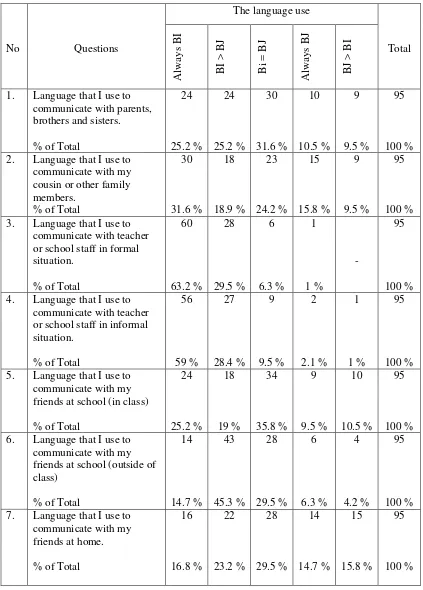
Table 7 above shows that the majority of the respondents tend to use
bahasa Indonesia in all contexts of the conversation. Questions number 1 and 2
shows that there is a general trend of teenagers to communicate with family
members in bahasa Indonesia. We can see that about 24-30 respondents tend to use
No Questions
message, BBM, WA, line, etc.
38
only bahasa Indonesia when they speak with their family members like parents,
brothers and sisters, or other family members. Whereas only 9 respondents or 9.5
% of them tend to use only Javanese language. Respondents stated that they use
bahasa Indonesia when they speak with family members at home because their
parents tend to use bahasa Indonesia and seldom use Javanese language when they
speak with them. It seems that parents or family members do not have any desire or
willingness to teach Javanese language to their children at home. So, we can predict
that Javanese language fades away with the next generation. Fisman (1991: 5) stated
that family at home has a basic role to maintain or shift an ethnic language. If
parents do not use Javanese language at home, it really influences the children to
lose their ability to speak their vernacular language, in this case Javanese language.
With the regard to their teacher, and as shows in questions 3 and 4, most of
the respondents tend to use bahasa Indonesia to communicate with their teacher
whether in formal or informal situations. From table 6 above, it can be seen that
there are 60 or 63 % of the respondents who use bahasa Indonesia when they
communicate with their teacher in formal situation, whereas none of them use
Javanese language. Moreover there are 56 or 59 % of them tend to use bahasa
Indonesia when they communicate with their teacher in informal situation, and
almost none of them (1%) tend to use only Javanese language. If we can argue that
the use of bahasa Indonesia in question number 3 and 4 is due to the fact that they
must honor their teacher, so they tend to use bahasa Indonesia to make a polite
39
know low level of Javanese style which should not be used when they communicate
with older people in Java.
The question number 5, 6 and 7 shows the language use of the respondents
to communicate with their friends whether at school (outside or in class) and at
home. From the table above we can see that 24 or 25.2 % of the respondents tend
to use only bahasa Indonesia when they communicate with their friends at school
in class. Whereas, for about 14 of the respondents use bahasa Indonesia to
communicate outside the class. Most of the respondents prefer to use mix language
between Javanese language and bahasa Indonesia when they communicate with
their friends whether in class or outside the class. Based on my observation the
respondents use bahasa Indonesia when they communicate with their friends in
serious conversation like discussion, but they will use Javanese language when they
want to make a joke or when they are in daily conversations.
Neighbors at home also have a role in language use of the children. Based
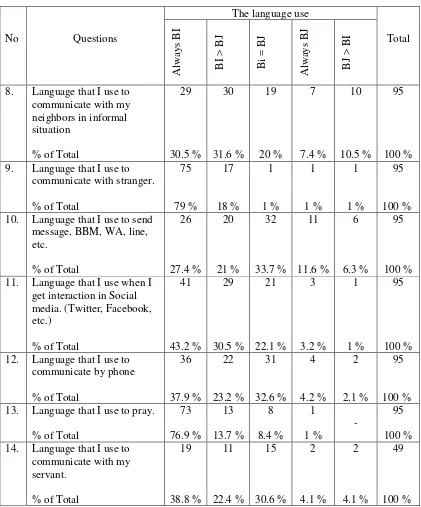
on the finding above, from the question number 8, it can be seen that 29 of the
respondents tend to use only bahasa Indonesia when they communicate with their
neighbors. From this finding, we can state that most of the people who live in
Semarang start to use bahasa Indonesia that will make the children also use bahasa
Indonesia when they communicate with them.
With the regards to the community or someone stranger, the respondents
tend to use bahasa Indonesia to get communication. As indicated in question
40
Indonesia when they communicate with previously un known people, 26 % of the
respondents use bahasa Indonesia when they send message using BBM, Line or
WhatsApp, and 43.2 % when they get interaction in social media like twitter or
Facebook. From this finding, we can argue that the use of bahasa Indonesia in
question 9, 10, and 11 is to fulfill social needs that are to communicate effectively
and be better understood by other people. Moreover, bahasa Indonesia is a
prestigious language, so children will prefer to use it to get interaction in social
media. As Mugaddam (2006:129) cited in Tawalbeh, Dagamseh, and Al-Matrafi
(2013: 193) people who have their vernacular language tend to not use their own
languages publicly in the host environment, in order to avoid the stigma associated
with these languages.
The result also indicates in question number 12, about 37.9 % of the
respondents use bahasa Indonesia to communicate with people by phone. Only 2.1
% of the respondents use only Javanese language. The respondents tend to use
bahasa Indonesia to communicate by phone because sometimes they do not know
who’s speaking there, so they prefer to use bahasa Indonesia.
Finally, as seen in question number 13 and 14, the respondents also tend to
use bahasa Indonesia to pray and communicate with their servant. There are 73 or
76.9 % of the respondents who tend to use bahasa Indonesia when praying, and no
one of them use Javanese. It is really interesting that they are as Javanese teenagers
tend to use bahasa Indonesia to communicate even if it is just in their heart like
praying or worship. So, we can conclude that all of the respondents somehow have
41
Indonesia when they communicate with their servant at home. It shows that there
are for about 38.8 % of the respondents use only bahasa Indonesia and 2.1 % use
only Javanese language. As we know, servant have lower status, they sometimes
come from lower educational and family background. Usually servants use
Javanese language to communicate with their community, but in this case, teenagers
prefer to use bahasa Indonesia with them. It may be due to the fact that the
teenagers want to show their prestige and their status at home.
4.3 Language Used by the Teenagers Basen on Their Language Attitude toward
Javanese
Language attitude is one of the important aspects in language used. This aspect has
been proven in many studies to have big contribution towards the language change
phenomenon in societies to societies. Baker (1992: 12) stated that language attitude
has been defined as a feeling, reaction or emotion disposition towards an idea,
concept or phenomenon. So, language shift and death are very linked to language
attitude.
The finding from the students’ language use survey were supported by the
result of their answer in the questionnaires. Some important points that can be made
are the use of bahasa Indonesia was reinforced by the parents who have good
42
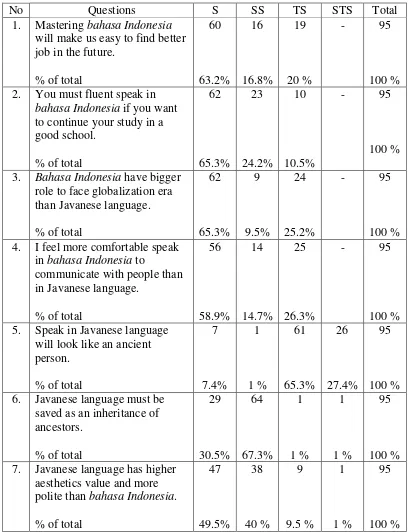
attitudes toward Javanese language. Their language attitude toward Javanese
language and bahasa Indonesia will show in table 8 below.
Table 8. Response percentages: attitudes toward bahasa Indonesia and Javanese language
No Questions S SS TS STS Total
1. Mastering bahasa Indonesia
will make us easy to find better job in the future.
bahasa Indonesia if you want to continue your study in a good school.
3. Bahasa Indonesia have bigger role to face globalization era than Javanese language. 4. I feel more comfortable speak
in bahasa Indonesia to
communicate with people than in Javanese language. 5. Speak in Javanese language
will look like an ancient person. 6. Javanese language must be
saved as an inheritance of ancestors. 7. Javanese language has higher
aesthetics value and more polite than bahasa Indonesia.
43
speak in Javanese language with me.
Javanese language as a Muatan Lokal. 11 Vocabularies of Javanese
language must have
improvement to make it exist in globalization era.
Javanese language than bahasa Indonesia. 13. I only use Javanese language
when get interaction in social media,