USING STEREO VISION TO SUPPORT THE AUTOMATED ANALYSIS OF
SURVEILLANCE VIDEOS
Moritz Menze and Daniel Muhle
Institute of Photogrammetry and GeoInformation Leibniz Universit¨at Hannover
Nienburger Straße 1, 30167 Hannover, Germany [email protected], [email protected]
http://www.ipi.uni-hannover.de
Commission III/1
KEY WORDS:Image Sequences, Stereoscopic Vision, Image Matching
ABSTRACT:
Video surveillance systems are no longer a collection of independent cameras, manually controlled by human operators. Instead, smart sensor networks are developed, able to fulfil certain tasks on their own and thus supporting security personnel by automated analyses. One well-known task is the derivation of people’s positions on a given ground plane from monocular video footage. An improved accuracy for the ground position as well as a more detailed representation of single salient people can be expected from a stereoscopic processing of overlapping views. Related work mostly relies on dedicated stereo devices or camera pairs with a small baseline. While this set-up is helpful for the essential step of image matching, the high accuracy potential of a wide baseline and the according good intersection geometry is not utilised. In this paper we present a stereoscopic approach, working on overlapping views of standard pan-tilt-zoom cameras which can easily be generated for arbitrary points of interest by an appropriate reconfiguration of parts of a sensor network. Experiments are conducted on realistic surveillance footage to show the potential of the suggested approach and to investigate the influence of different baselines on the quality of the derived surface model. Promising estimations of people’s position and height are retrieved. Although standard matching approaches show helpful results, future work will incorporate temporal dependencies available from image sequences in order to reduce computational effort and improve the derived level of detail.
1 INTRODUCTION
The increasing number of surveillance cameras and the corre-sponding amount of videos to be checked establish a need for automated analysis of such footage. Due to the amount of video material on the one hand and limitations in financial and techni-cal resources on the other, human operators are not able to de-tect salient behaviour on-line for wider areas nor can they handle a manual reconfiguration of large sensor networks to achieve a good coverage. The completion of these tasks based on reason-able resources w.r.t the number of cameras and security personnel is one major focus of research on video surveillance systems. Impressive progress has been made in terms of people detection and tracking, mostly relying on monocular views of the scene. Stereoscopic analysis is shown to be very helpful for detection and tracking, especially in more complex scenes or in presence of occlusions. Furthermore, dense image matching can be used to reconstruct the visible surface of people. This leads to a more ro-bust estimation of the person’s position in the scene as well as to a hint regarding it’s posture enabling additional reasoning about people’s actions and interactions in three-dimensional space. Up to now, stereoscopic analysis is mostly carried out using special and more expensive stereo devices or network set-ups.
Recent work on reconfigurable smart camera networks aims at self-organising structures capable of automated reconfiguration with respect to maximum coverage or focus on individual sub-jects. This paper investigates the employment of stereo vision algorithms using pairs of standard pan-tilt-zoom (PTZ) cameras of a reconfigurable sensor network. The presented approach and does not require special stereo devices or dedicated and possibly redundant configuration of the camera network.
The remainder of this paper is organised in four sections. It gives a brief insight into related work in section 2, presents the
pro-posed approach in section 3, describes its experimental valida-tion in secvalida-tion 4 and ends with secvalida-tion 5 drawing conclusions and giving an outlook to future work.
2 RELATED WORK
Using stereo vision approaches in video surveillance is a notion that regularly appears in the literature. A lot of publications make use of stereo vision devices like Konolige’s Small Vision Sys-tem (Konolige, 1997) which consists of mechanically aligned cameras and dedicated stereo algorithms. It is integrated into a combined detection and tracking algorithm for one static stereo camera in (Haritaoglu et al., 1998). In that publication, the dispar-ity map is combined with an intensdispar-ity based model to implement background subtraction. Removal of background is an important step in this paper as well but it will rely on colour information to extract foreground regions which are then processed by dense image matching.
(Zhao et al., 2005) employ a network of stereo cameras with overlapping fields of view which yields reliable tracking results even in complex environments but also makes excessive use of resources. Less resource-intensive is the approach presented by (Zhou et al., 2010). A pair of PTZ cameras is installed with a short baseline and utilised to generate high-resolution images of detected people as well as three-dimensional information from stereo vision. In contrast to these approaches, the presented work investigates the application of stereo vision in almost arbitrary PTZ camera networks allowing its use in existing video surveil-lance systems.
Dependencies
orientation camera network
Figure 1: Core algorithm and external dependencies.
al., 2009), classification of observed people into either salient or unremarkable and dynamical reconfiguration of the camera net-work (J¨anen et al., 2011). All of these components are investi-gated in the joint research project CamInSens1.
3 METHOD
Spatially and temporally aligned image pairs are the prerequi-site input to standard image matching approaches. While tech-nical details of the reconfiguration of our sensor-network are de-scribed in (J¨anen et al., 2011), the major steps of our approach are presented in this section. After a comparison of monocu-lar and stereoscopic approaches to the analysis of surveillance videos, the four major steps of our method are described, i.e. pre-processing of the individual image sequences, background sub-traction, dense stereo matching and post-processing of matching results. The section ends with the estimation of measuring uncer-tainties. An overview of the core algorithm as well as external dependencies is given in figure 1.
3.1 Comparison of monocular and stereoscopic analyses
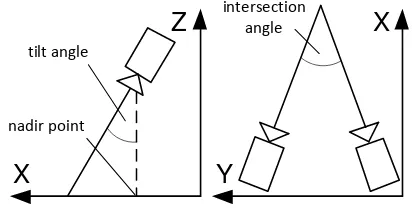
Given the exterior orientation of the camera, objects’ positions on a known ground plane can be inferred from monocular images. Resulting positioning accuracy heavily depends on the measur-ing uncertainty in the image and on the tilt angle between camera and ground plane. The positioning uncertainty decreases with the imaging direction approaching the nadir point, i.e. a birds-eye view of the scene (cf. figure 2). Together with the tilt angle, geometrical positioning uncertainty decreases as well as the in-formation content of the images since people in the scene usually cannot be identified from views of their head-tops and shoulders. Because recognition of people is a major task in the manual and automated analysis of surveillance videos, the most commonly used camera set-up is a heavily tilted one. Adapting the imaging geometry to improve recognition inevitably increases positioning uncertainty. Furthermore, tilted views of the scene can lead to partial occlusion of the targets which does not necessarily inter-fere with identification, since heads will remain visible, but can hinder the direct measurement of people’s point of contact to the ground. Stereoscopic analysis of the scene can overcome these problems inferring people’s position from a huge number of mea-surements on the visible surface. Its positioning accuracy mainly depends on the distance-to-base ratio and the resulting intersec-tion angle as depicted in figure 2.
3.2 Pre-processing
Since we are using standard PTZ network cameras one of the most important preprocessing steps is to select appropriate stereo pairs from the live-streams. Given moving people, a temporal
1www.caminsens.org
Figure 2: Imaging geometry in monocular and stereoscopic case.
offset between the images would lead to different poses of the person in the left and right frame hindering image matching or leading to errors in depth calculation. To retrieve corresponding images, their timestamps, written to the image header on the cam-era when the image is actually captured, are compared and only nearest neighbours are selected as candidate pairs. The cameras’ clocks are synchronised with the same NTP server to avoid off-sets. Moreover, the difference between adjacent timestamps has to fall short of a threshold of one frame, i.e.0.06sgiven a frame rate of15f ps. As a result of this synchronisation procedure only a subset of images is actually processed which reduces the ac-tual frame rate and leads to variable offsets between subsequent images.
For the investigations in this paper we fix the interior orientation of the cameras and apply a constant set of calibration parameters. All cameras in our network are calibrated off-line using standard methods and a calibration pattern. The exterior orientation is de-rived based on image features with known object coordinates. In our dataset there is a significant pattern on the floor simplifying the estimation of the exterior orientation. Since the cameras did not move while capturing images the control points’ image coor-dinates could be measured manually. Spatial resection based on this data yields reliable results for the exterior orientation param-eters.
In order to make use of parallel epipolar lines with identicaly co-ordinates, the images are rectified to the normal case. Given this standard geometry, image matching is reduced to a one dimen-sional search for correspondences along the epipolar line. This set-up simplifies the selection of matching image rows and the calculation local of matching costs.
3.3 Background Subtraction
Given the application of video surveillance, the analyses as well as the input data to image matching can be reduced to people, i.e. foreground objects, in the scene. Subtracting a static background heavily reduces the amount of data to be processed and eliminates an important source of errors.
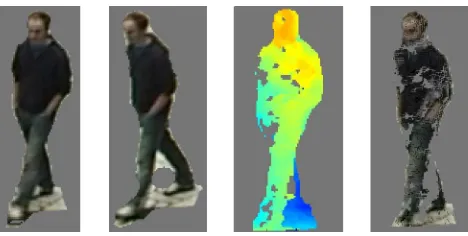
Background subtraction has been investigated intensively in cent years and elaborate methods have been proposed, giving re-liable foreground regions at high frame rates. In this paper, we apply the approach described in (KaewTraKulPong and Bowden, 2001), followed by morphological closing in order to retrieve consistent foreground regions. Dense image matching is applied to the foreground regions, exemplarily shown in the two leftmost images of figure 3.
3.4 Dense Image Matching
Figure 3: Input to dense matching (left), colour-coded disparity map (center) and coloured point cloud (right).
salient. The basic idea is to have a closer look at these people over a limited stretch of time. To derive as many points as pos-sible on the person’s surface dense image matching is applied to the foreground regions of the rectified image pair. A consistent disparity map can be used to derive a point-wise reconstruction of the person in three dimensional object space.
To reduce computational effort and to exclude potential mismatches, image matching is performed on small parts of the images. Input to the matching algorithm are the foreground pixels inside the bounding box from a preceding people detection step. For the investigations in this paper, we make use of manually labelled bounding boxes simulating error-free output of a people detector. This region of interest in the left image is matched to the corre-sponding rows in the right image using a semiglobal optimisation approach (Hirschm¨uller, 2008). The algorithm calculates local matching costs based on the sum of absolute differences (SAD) of three-channel colour images and optimises the resulting disparity image by minimising an energy function along 16 paths ending in the current pixel. Changes of disparity in neighbouring pixels are penalised by penalty terms for small differences or larger ones re-spectively. Additionally, a left-right disparity check is performed eliminating implausible matches. Application of this algorithm leads to a smooth disparity map of the visible surface.
An exemplary result is shown in the center of figure 3. The dis-parity map is given with larger disparities coloured orange and smaller ones coloured blue. Since the cameras are mounted ap-proximately3moverhead and the viewing direction is slanted towards the ground plane, the disparities change slightly along the body’s major axis.
3.5 Post-processing
After the calculation of the disparity map, object coordinates of the matched image points are retrieved by re-projecting valid dis-parity measures to the model coordinate frame of the stereo pair. Afterwards, model coordinates are transformed to the common reference frame using the left cameras’ exterior orientation pa-rameters.
The median of the resulting X- and Y-coordinates is calculated as a robust approximate value of the position belonging to the person that mainly occupies the bounding box. Partial occlusions in the image due to objects between the focussed person and one of the cameras can be handled by the presented approach based on the use of 3D information clearly separating people in object space. To exclude points on additional objects that lie within the bounding box in the image, a square buffer of40cmside length around the median coordinates is applied to the point cloud in object space. The final position of the person is derived from the mean X- and Y-coordinates of all points inside the buffer. An estimation of the person’s body height is calculated as the mean Z-value of the five topmost object points inside the buffer.
Figure 4: Exemplary point clouds of the same person in different imaging distances.
3.6 Uncertainty Estimation
To assess the derived results it is necessary to evaluate a measure of uncertainty in object space. Error propagation delivers estima-tions of uncertainty (cf. equation (1)) in imaging directionsZand perpendicular to itsX(McGlone, 2004), neglecting the influence of the orientation parameters’ uncertainties.
sX=
Z
c ·sx′, sZ= Z2
b·c·spx (1)
Zis the calculated depth of the object point andcis the principal distance, the ratio of both is the scale number. sx′ denotes the
uncertainty of image coordinates and is set to 1 pixel
Equation 1 gives uncertainties in the model coordinate frame cen-tred in the left camera’s optical centre. The variance-covariance matrix has to be transformed to the common reference frame with the same rotation as applied to the coordinates.
The limits of feasible imaging configurations are determined con-sidering the resulting uncertainties. In this case, the relative un-certainty, i.e. the ratio between uncertainty and calculated dis-tance, is an appropriate measure of quality. Given a fixed stereo baseline, a maximum distance can be found yielding a relative accuracy below a threshold of 0.001. For the dataset discussed in section 4 this yields a maximum distance of13.5mbetween object and cameras. This consideration can be reversed to select appropriate cameras to observe a certain target.
4 RESULTS AND DISCUSSION
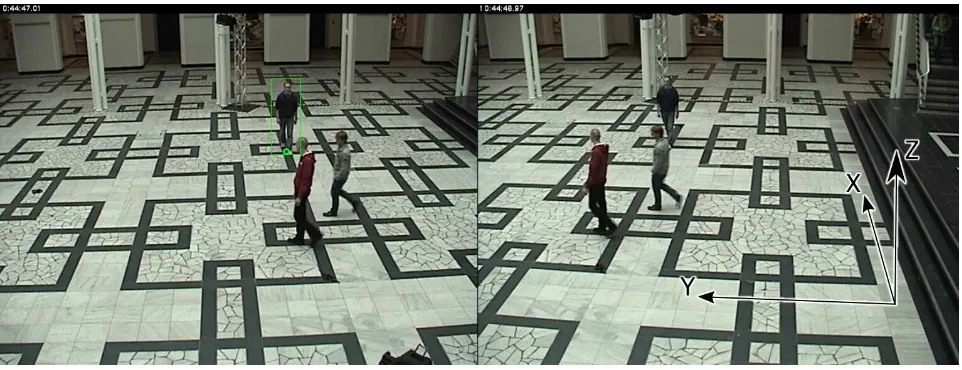
Figure 5: Stereo image pair from test sequence. The coordinate system is translated into the image to show the directions of the axes. In the left image a bounding box is depicted as well as the position derived from our approach (green circle).
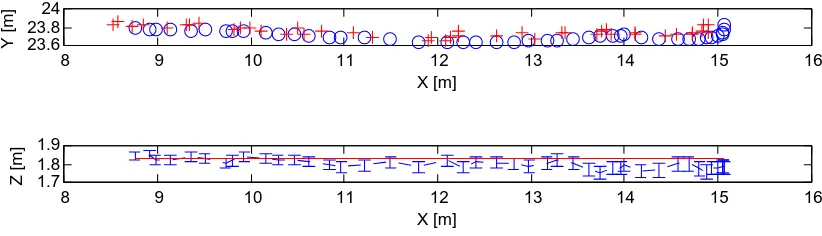
In our approach, people’s position on the ground plane is calcu-lated as the mean X- and Y-coordinate of the reconstructed point cloud. A monoscopic approach is to re-project the center of the bounding box’s lower boundary on the ground plane. For this pur-pose we use manually labelled bounding boxes. Figure 6 shows the results for the person marked in figure 5 which approaches the cameras on a straight line. The upper graph shows the person’s position on the ground plane, derived from the point cloud, as blue circles and reference data as red crosses. The X-coordinate corresponds to the distance between object and camera. There is an offset between both trajectories resulting from the shape of the bounding boxes. Since they enclose the limbs of the person, the monoscopic projection is biased. In the left image of figure 5 our result is projected to the image plane as a green circle and shown together with the bounding box. Note the offset between the results due to the person’s foot.
The lower graph of figure 6 gives the height estimates and their individual uncertainties (blue bars) plotted against the true body height (red line). With decreasing distance to the cameras, mea-suring uncertainty decreases as well as the deviation from the true height. One can clearly identify the periodical movement of the head indicating a high relative measurement accuracy. (Hirasaki et al., 1999) show that the vertical translation of the head varies between1cmand3cmdepending on walking velocity which corresponds to our results.
Person 1 Person 2 Person 3 mean estimated height [m] 1.80 1.82 1.93
standard deviation [m] 0.02 0.04 0.03 true body height [m] 1.83 1.83 1.93
Table 1: Mean estimated body height and ground truth for differ-ent people in the scene.
To show the accuracy potential of the approach given the de-scribed dataset the mean body height derived from our measure-ments is compared to ground truth for three people in table 1. The standard deviation of the height estimation, calculated over all epochs, varies between0.02and0.04cm, the biggest devi-ation results for person 1. It’s trajectory, as shown in figure 6, partially exceeds the maximum measuring distance of13.5m discussed in section 3. Note that the offset between height esti-mation and ground truth increases significantly on the other side of this threshold. For Person 3 the results are identical to ground truth, the person crosses the scene perpendicular to the viewing direction at a relatively short distance of8.5m.
In absence of reference measurements the quality of the result-ing surface models is evaluated by visual inspection. Figure 4 gives point clouds of the same person in maximum and minimum imaging distance. The total number of points is 1890 and 5936 respectively. While the left point cloud still consists of enough points to retrieve a robust estimation of the person’s position the determination of the body height suffers from the heavily reduced number of points on the head.
During our investigations another dataset of the same scene was processed to assess the influence of even wider stereo baselines. Due to a different camera set-up and a reduced scale and resolu-tion in object space the resulting point clouds are significantly smaller. Only 330 points are reconstructed on a person at an imaging distance of20m. Thus a reliable height estimation is no longer feasible but robust positioning results are retrieved for a baseline of11.6m. This shows the principal applicability of the approach to a wide range of camera set-ups.
5 CONCLUSIONS AND FUTURE WORK
The application of stereo vision to surveillance videos produces more robust results compared to monocular analysis. Estimates of people’s positions in the scene and of their body height can be derived from the point cloud reconstructed on the visible sur-face. Both measures can be obtained from low resolution im-agery. However, processing of higher resolution material would enable a more detailed representation of people in terms of an articulated body model as well as a more sophisticated approach to height estimation, e.g. by fitting a geometric primitive to the head’s point cloud.
Common challenges in monocular analysis can be tackled with stereoscopic approaches. However, stereo vision is resource in-tensive and therefore reduced to single salient people in this work. Further reduction of the computational load could be achieved by incorporating knowledge about the expectable disparity range from matching results of directly preceding epochs.
8 9 10 11 12 13 14 15 16 23.6
23.8 24
X [m]
Y [m]
8 9 10 11 12 13 14 15 16
1.7 1.8 1.9
X [m]
Z [m]
Figure 6: Results for a person approaching the cameras. Reference data is shown in red, our results in blue.
The presented work will be the basis of further investigations on the optimisation of matching costs and the analysis of the derived point cloud.
ACKNOWLEDGEMENTS
This research was funded by the German Federal Ministry of Ed-ucation and Research (BMBF), 13N10809 - 13N10814.
REFERENCES
Haritaoglu, I., Harwood, D. and Davis, L., 1998. W4S: A real-time system for detecting and tracking people in 2 1/2D. In: ECCV’98, LNCS, Vol. 1406, pp. 877–892.
Hirasaki, E., Moore, S. T., Raphan, T. and Cohen, B., 1999. Ef-fects of walking velocity on vertical head and body movements during locomotion. Experimental Brain Research 127, pp. 117– 130.
Hirschm¨uller, H., 2008. Stereo processing by semiglobal match-ing and mutual information. IEEE Transactions on Pattern Anal-ysis and Machine Intelligence 30(2), pp. 328 –341.
J¨anen, U., Huy, M., Grenz, C., H¨ahner, J. and Hoffmann, M., 2011. Distributed three-dimensional camera alignment in highly-dynamical prioritized observation areas. In: Fifth ACM/IEEE In-ternational Conference on Distributed Smart Cameras (ICDSC).
KaewTraKulPong, P. and Bowden, R., 2001. An improved adaptive background mixture model for real-time tracking with shadow detection. In: Proc. 2nd European Workshop on Ad-vanced Video Based Surveillance Systems.
Konolige, K., 1997. Small vision systems: Hardware and imple-mentation. In: Proc. of 8th International Symposium on Robotics Research.
McGlone, J. C. (ed.), 2004. Manual of Photogrammetry. 5 edn, American Society for Photogrammetry and Remote Sensing.
Monari, E., Maerker, J. and Kroschel, K., 2009. A robust and efficient approach for human tracking in multi-camera systems. In: Proc. of Sixth IEEE International Conference on Advanced Video and Signal Based Surveillance, 2009. AVSS ’09, pp. 134 –139.
Zhao, T., Aggarwal, M., Kumar, R. and Sawhney, H., 2005. Real-time wide area multi-camera stereo tracking. In: IEEE Computer Society Conference on Computer Vision and Pattern Recogni-tion, 2005, Vol. 1, pp. 976–983.