Kindergarten as a Protective
Factor in the Development of
Preschool Children from Risk
Groups: Perception of Preschool
Teachers’ Capacities
Sanja Tatalović Vorkapić1, Ivana Mihić2 and Martina Matovina31University of Rijeka, Faculty of Teacher Education
2University of Novi Sad, Faculty of Philosophy, Department of Psychology 3Kindergarten Rijeka
Abstract
The study included 161 preschool teachers from different kindergartens in Primorje-Gorski Kotar County. The Scale for assessing the risk conditions for children and capacity of kindergartens to work with families at risk was applied. It consists of two subscales that measure the level of risk conditions and preschool teachers’ competences to work with children from risk groups (children: with disabilities, members of the Roma minority, safeguarded by the Social Services, the ones who come from families which provide a low level of stimulation, from families with chronically ill member(s), with divorced/divorcing parents, and whose mother suffers from depression).
The higher levels of risk of particular conditions of preschool children and expected difficulties in their development were determined. Preschool teachers evaluated that they have moderate possibilities for work with children from families at risk, and estimated there is a higher level of benefit that children can have from being in kindergarten. The significant positive correlations between the levels of risk, the expected difficulties and the benefit that children could have from being in kindergarten, but only for some of the explored types of risk, were determined. The contribution of this study lies in the significant implications for improving educational practices in the direction of articulating the needs for further education of preschool teachers in the context of different developmental risk.
Key words:competences; early and preschool care and education; educational work with risk groups; risk conditions; preschool children; preschool teachers.
Vol.20; Sp.Ed.No.3/2018, pages: 217-242 Preliminary communication Paper submitted: 20th December 2017
Paper accepted: 13th November 2018
Introduction
Different risk factors for vulnerability have been described in research so far. Some of them may include different characteristics of the family or context a child lives in (Bradley et al., 2001; Gaynor, 2015; Pettit et al., 1997) like poverty (Blair & Raver, 2016; Chaudry & Wimer, 2016; Kalil, 2009; Letourneau et al., 2013), number of siblings, overcrowding and similar housing arrangements (Leventhal & Newman, 2010), conflict, divorce, abuse and violence in family relations (Cummings et al., 2009; Holmes, 2013; Howell et al., 2016), or living in non-parental family care (Goemans et al., 2016; Lipscomb et al., 2013; Waterman et al., 2013) or residential care (Oliveira et al., 2015). Others may include child characteristics such as premature birth, low birth weight (Cassiano, Gaspardo, & Linhares, 2016), disability or chronic illness, etc. Most of them are related to (or coexist with) low parenting care quality (Linver, Brooks-Gunn, & Kohen, 2002; Pettit, Bates, & Dodge, 1997) described as low stimulation, low sensitivity and responsiveness to child’s needs, harsh discipline, low acceptance of the child, etc., or issues related to parents’ physical (chronic illness) and mental health (prolonged or chronic stress, depression or mental health problems, alcohol or substance abuse, etc.). Research indicates that exposure to single risk factor may have small effects on child development. Multiple risk factors, however, make a difference in developmental outcomes of children from families at risk compared to other children (Fergusson & Horwood, 2003).
There are different theories that describe the pathway from risky environment to developmental delays, problems or pathology (Wenar, 2002). In order to relate the initial context of development with possible outcomes, Sroufe (1997), for example, lays out four possible paths: path A which is recognized in continuity of maladaptation which culminates in disorder; path B which presents the continuous positive adaptation; path C in which initial maladaptation is followed by positive change (resilience); and path D that is described by initial positive adaptation followed by a negative change toward pathology. Many theories stress the importance of quality of childcare as a buffer that may protect a child from risky environment. Nurturing care is thought to be protective of the so-called toxic stress (Garner, 2013) originating in aforementioned risk factors and creating lifelong effect of health, mental health, educational outcomes and social relations (Evans et al., 2010). Good quality childcare is related to felt security, creating positive bases for developing secure attachment that is also protective for developmental outcomes of children at risk (Berlin, Zeanah, & Lieberman, 2008).
However, most of the time, even a single risk factor is joint with other factors influencing the quality of childcare. This is why most of the vulnerable early life experiences may be described predominantly by risk for low sensitivity and quality of care. At the same time, this calls for the early interventions to include family support as well (Britto et al., 2017).
Inclusion of children at risk in quality early education and care system (ECEC) has been widely recognized as beneficial for all children from vulnerable groups (Biddle et al., 2017; Burchinal et al., 2010; Lonigan et al., 2015). Since data indicate that as the number of persisting risk factors increases, the probability for a child to attend preschool decreases (Biddle, Crawford, & Seth-Purdie, 2017), many efforts have been made so far in order to develop accessible high quality early childhood education programs, which include a strong component of support for the family. Such efforts are being currently made in the region as well (Mihić & Branković, 2017; Pavlović-Breneselović & Krnjaja, 2017; Vandekerckhove et al., 2013).
Positive effects of high quality ECEC programs are found in several areas of child’s development, such as emotional regulation and social participation and functioning, and academic achievement (Belsky et al., 2007; Burchinal et al., 2002; Camili et al., 2010; Magnuson et al., 2004). Some intensive early childhood intervention programs combined with early education (such as programs within Head start initiative, HIPPY, Incredible years, Abecedarian project or High Scope Perry Preschool) have been continuously evaluated and cited as evidence of long-lasting effects of good quality early childhood support for the families at risk that were based, among else, on early inclusion in ECEC (Axberg & Broberg, 2012; Azavedo et al., 2013; Baker et al., 1996, 1998; Bradley & Gilkey, 2002; Campbel et al., 2008, 2012; Hommem et al., 2015; Muenning et al., 2011). Although current research of the effects of programs of such a kind raise questions of different effects in rural and urban areas (McCoy et al., 2016), or are related to child’s gender or program service model, for example, whether it includes home visitation component or not (Miller, Farkas, & Duncan, 2014), most of the data firmly underlines that exposure to quality programs may be important for children from families at risk, i.e. children in non-parental care, from low income families (Magnuson & Shager, 2010), minority children (Duncan & Sojourner, 2013; Stahmer & Carter, 2005), children with disabilities (Blackmore, Alyward, & Grace, 2016), and that effects may extend beyond child developmental outcomes (cognition, communication, social and emotional skills, autonomy) to better family and childcare outcomes (Johnson et al., 2012; Nievar et al., 2011). Research has also revealed the meaning of good quality ECEC programs not only related to structural and process quality, but also to naming the key elements, such as culturally sensitive practice when it comes to children from minority groups (Felfe & Huber, 2017) or integrated early intervention for children with developmental delays or disability (Odom, Buysse, & Soukakou, 2011). Despite the proven effects of early inclusion in ECEC, working with children from different vulnerable groups may cause professional stress and burnout in early childhood teachers (Brunsting, Sreckovic, & Lane, 2014), as well as low perceived competence and high demand for assistance.
Development of inclusive early childhood education is a strategic goal of Croatia, but also other countries in the region. This leads to the necessity of constant monitoring of the quality of opportunities to learn, socialize, explore and participate, that are offered
to children with childhood adversities. Although the external evaluation is in place as the way of official monitoring, process quality is assessed by constant reflexive practice and self-evaluation (NKRPOO, 2014). When it comes to research, it mostly deals with the issues of attitudes towards inclusion, and mostly with inclusion of children with disabilities. The results of these studies in Croatia indicate that the attitudes of the educators related to the importance of inclusion are positive. At the same time, however, perceived competence to work in inclusive setting is still quite low and significantly related to the assessment of the (low) available support, or quality and availability of continuous professional development courses on the topic of inclusion (Skočić Mihić, 2011). Compared with teachers in schools, preschool teachers show greater motivation, but also higher sensitivity in relation to children with disabilities and readiness for professional development in this field. They assess their work with children with disabilities to be high in quality, based on continuous reflexive practice (Kudek Mirošević & Jurčević Lozančić, 2014). In the region, research indicates ambivalence to negative attitudes of early childhood education teachers (Klemenović, 2014; Kovačević, 2015; Stančić & Stanisavljević-Petrović, 2013), assessment that working conditions, adult-child ratio and number of children in the group are not adequate for inclusive practice (Stanisavljević-Petrović & Stančić, 2010), low perceived competence to work in inclusive setting, as well as the availability of assistance in the process (Rajović & Jovanović, 2010; Stanisavljević-Petrović & Stančić, 2010; Stanković-Đorđević, 2007; Vujačić, 2009), experiences of fear and worries related to the ability to respond to the needs of a targeted child, but also to respond to the needs of both that child and other children in the group (Tomić & Milić, 2014). The issues of the quality of initial education and professional development (Klemenović, 2014), the quality of documenting and practice assessment (Pavlović Breneselović, Krnjaja, & Matović, 2012), and the need for developing mentoring system (Miškeljin, 2016) are introduced in the research as well.
There is no available research data on inclusion of children from other vulnerable groups in the context of early and preschool care and education in Croatia. Therefore, this research aims to explore perception of capacities of early childhood education teachers in Croatia on risk factors that are influencing the development of children from different groups, expected problems they may have, assessment of working conditions, and competence and ability to work with them in the inclusive preschool setting.
Research Aim, Problems, Hypotheses
Taking into account the importance of protective factors in the development of children growing up in different families at risk, this research aimed to analyze the capacities of preschool teachers to competently work with children from the vulnerable groups. Those groups are: children with disabilities; children who are members of the Roma minority; children from the social welfare system - foster
families and residential institutions; children from families that provide a low level of stimulation; children from families with chronically ill member(s); children with divorced/divorcing parents; and children whose mothers suffer from depression.
This aim encompasses two major research problems:
a) to descriptively analyze perception of preschool teachers’ capacities in regard to development of children from the vulnerable groups including: negative factors that contribute to risky conditions for the child; expected problems children may have in the context of early education due to risk factors; benefits of inclusion in early education for the children and assessment of working conditions necessary for the quality work with children from vulnerable families;
b) to analyze the relationship between risk assessment of different conditions and a kindergarten as a protective factor for each vulnerable group respectively. The kindergarten as a protective factor has been defined by self-evaluated professional characteristics (rated work characteristics, working experience and professional development) of preschool teachers in their work with children from vulnerable families.
Even though there is a lack of similar studies in Croatia, based on theoretical background, it was expected that preschool teachers will perceive kindergarten as a protective factor for children from vulnerable families. However, it is also expected they will perceive the lack of needed competences, but in different levels regarding each specific group of children at risk.
Method
Subjects
The study included the convenience sample of 161 preschool teachers from different early childhood and preschool institutions in Primorje-Gorski Kotar County: 41 (25.47%) from Matulji; 17 (10.56%) from Čavle; 15 (9.32%) from Kastav; 14 (8.70%) from Kostrena; 12 (7.45%) from Opatija, Bakar and Viškovo, each; 11 (6.83%) from Kraljevica; 8 (4.97%) from Novi Vinodolski; 7 (4.35%) from Crikvenica, and 6 (3.73%) teachers from Čabar and the same number from Delnice. These kindergartens were chosen due to their geographical proximity within the same county. The average working experience of all preschool teachers who participated in this study was M = 14.3 years (SD = 10.83), ranging from 6 months to 41 years.
Measures and Procedure
The research is a part of a wider ongoing initiative/project (running since 2009) - Kindergarten as the secure base, that had been organized by the Department of Psychology, University of Novi Sad in cooperation with many preschool facilities from Serbia and professional associations of nurses, associates (psychologists, pedagogues, social workers, defectologists) and early education teachers. Faculty of Teacher Education, University of Rijeka (Croatia) participated in earlier phases of the project
as well. The main objective of the project in general is to develop evidence-based and research-informed practices in improving quality of child care in ECEC, especially focusing on teacher sensitivity in relations with children from vulnerable groups. Due to the very nature of the project, the entire research carried out within the project (including the one presented in this paper), is based on the mixed-method approach, and participatory design (with the advisory board of ECEC practitioners participating in developing research methodology, and reflecting on results and procedures that are to be piloted afterwards based on the research data).
The same methodology was used within this research. The key steps in the study were:
1. organizing advisory board (representatives of ECEC practitioners);
2. conducting focus group discussions (4 focus group discussions with a total of 46 ECEC practitioners) with the early education practitioners. The key topic was “who are the children at risk that provide early educators with most challenges in work and why”. Based on the data from the focus group discussion, 8 stories were developed for 8 groups of children that were named to be most challenging for the teachers (more precise information is given in the text below);
3. developing instrument for the purpose of the research - Scale for assessing the risk conditions of children and capacity of kindergartens to work with children from vulnerable groups - also based on the data from the focus group discussion. The data indicated four key factors influencing the perceived challenges in work with children from vulnerable groups: 1) The level and source of risk in early development perceived by teacher; 2) Expected problems the child may have; 3) Teacher and working conditions (assessed by teachers) and 4) The perceived benefits of the inclusion of the child in early education system;
4. conducting the research in Serbian and Croatian preschool facilities;
5. discussion on the results with ECEC practitioners from the advisory board – giving recommendations for future steps.
The Scale for assessing the risk conditions of children and capacity of kindergartens to work with children from vulnerable groups that was created for the purposes of this studywas applied. This measure consists of four subscales that were made in 8 equivalent forms, reflecting 8 different groups of children at risk. So, four groups of preschool teachers (which were randomly distributed) filled out the scale for the two groups combined. All assessments were based on imaginary stories (the names of the children are fictitious and culturally adapted). This allowed the teachers with no actual experience in working with the child from each group to also think about the child and the possibilities and benefits of his/her inclusion in early education.
The first group of preschool teachers (N = 47) rated the kindergarten’s capacities for Ana (children from families which provide a low level of stimulation: “Ana is a 5-year-old girl. Her parents are low educated, unemployed and they live in a small town”) and Jan stories (children who are members of the Roma minority: “Jan is 6 years old and lives
in a big family, belonging to the Roma minority. He has five brothers and he is the youngest one. His mom is a housekeeper and his dad works occasionally, as a manual worker. None of his brothers, including him, go to the kindergarten”). Both of these children live in families at risk of low stimulation, discrimination and social isolation (so parents may have difficulties in finding support for good quality child care).
The second group of preschool teachers (N = 37) filled out the scale for the stories of Meri (children whose mothers suffer from depression: “Meri is 4 years old. Her mom suffers from depression”)and Vesna(children with divorced/divorcing parents: “Vesna is 6 years old and she lives with her mother. Her parents have been divorced for a year because her dad was beating her mother, which Vesna saw. Vesna and her dad see each other during supervised visits at the Center for Social Services”). Both of these children live in families where the quality of parental care and responsiveness to the child’s needs is compromised.
The third group of preschool teachers (N = 32) rated Vedran (children with disabilities: “Vedran is 5 years old and has difficulties from the autism spectrum”) and Katarina stories (children from families with chronically ill member(s): “Katarina is 5 years old. Her younger sister has been diagnosed with rare chronic illness”). Both of these children live in families who struggle with the issues of acceptance and resolution to the diagnosis, and overcoming challenges of taking care of a child who develops differently.
Finally, the fourth group of preschool teachers (N = 45) filled out the scale for the stories of Zlatko (children from the social welfare system: “Zlatko is a boy who lives in residential care. He has been living there since he was two years old. Zlatko is 5 years old now. He is being taken care of by two youth workers (in shifts)”) and Tamara (children from the social welfare system: “Tamara is 3 years old and lives in a foster family. Once a week, her foster parents take her to the Children’s Safe House where she can see her mother”). Both of these children have early traumas related to the poor quality of care in biological families.
For each group teachers assessed (four subscales):
a) Risk factors - low quality of child care for the child, traumatic experiences of the child, low education of the parent/caretaker, health conditions of the parents/ caretakers, difficulty or/and disability of the child (if (s)he has one), financial status of the family, affiliation to a discriminated group, low competences of the experts who care about the development of the child;
b) Expected problems the child may have - in the areas of establishing contacts with peers and social interaction, being able to rely on support and care of preschool teacher, cognitive development and learning, emotional reactions and regulation, being cared for and thought of by the teacher, speech development and communication;
c) Teacher and working conditions domain (in regard to the child at risk) - motivation, perceived competence, overall working conditions, the number of children per group;
d) Benefits of the inclusion in early education - compensatory experience of good quality care; new knowledge, opportunity to learn, availability of stimulating materials for play; peer relations, the involvement in the group; routine, rules and boundaries that could be defined for the child.
The scale showed satisfactory levels of Cronbach’s alpha values for each story and for each subscale: Ana’s story (from α = .83 to .95); Jan’s story (from α = .83 to .97); Meri’s story (from α = .70 to .91); Vesna’s story (from α = .67 to .93); Vedran’s story (from α = .76 to .91); Katarina’s story (from α = .84 to .95); Zlatko’s story (from α = .60 to .90) and Tamara’s story (from α = .75 to .89).
After obtaining the formal permission to enter the kindergartens (which were willing to participate in this study), preschool teachers were asked to fill out the questionnaires. The main aim of the study was described, the anonymity and confidentiality of the gathered data were assured, and only the group’s results were analyzed.
Results
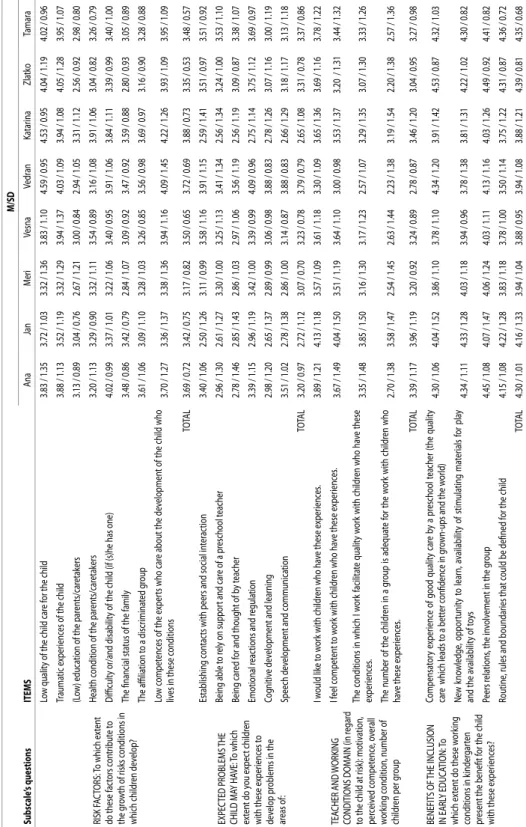
Having the aim of this study and two major research problems in mind, descriptive and correlational analyses were run. Therefore, Table 1 presents the basic descriptive parameters of means and standard deviations for the four subscales and each item of the Scale for assessing the risk conditions of children and capacity of kindergartens to work with children from vulnerable groups for each group.
The Risk factors. Analyzing the first subscale Risk factors and its items (N = 8), it could be seen that preschool teachers rated the factor of (low) quality of the parental child care as the one that contributes the most to the overall risk experiences of a child. In addition, they have rated this factor as the one related with the highest risk for the most of the children described: (belonging to the ethnic minority (Jan); disability (Vedran); chronically ill family member (Katarina); and both risks of living in the social care (Zlatko and Tamara).
In the situations of divorced/divorcing parents (Vesna) and living in the childcare facility (Zlatko), preschool teachers have rated the traumatic experiences as those that contribute the most to the vulnerability of a child. When it comes to Ana’s story (children from families that provide a low level of stimulation), the difficulty or/and disability of the child (if (s)he has one) was assessed as the factor that contributes the most to the overall risk for the child. Finally, preschool teachers have rated the experts’ (low) competences as the factor that contributes the most when it comes to Meri (children whose mothers suffer from depression) and Vesna (children with divorced/ divorcing parents). Regardless of the key risk factor presented in the story, preschool teachers have rated low education of parents as the one being the least influential on vulnerability of a child. The comparison of the risk factors’ ratings among different stories indicates that living in a family with chronically ill member was described as the riskiest early experience for a child, whereas living with a parent who is depressed is the least risky environment.
Table 1 Descriptiv e par amet ers (Means and Standar d D eviations) of the four subsc ales and each item of the Sc ale for assessing the risk conditions of childr en and capacit y of kinder gar tens t o w
ork with childr
en fr om vulner able gr oups , for each st or y or risk f ac tor r espec tiv ely Subsc ale ’s questions ITEMS M/SD Ana Jan M er i Vesna Vedr an Ka tar ina Zla tko Tamar a RISK F AC TORS: To which ex ten t do these fac tors c on tribut e t o the g ro wth of r isks c onditions in which childr en dev elop? Lo w qualit
y of the child car
e f or the child 3.83 / 1.35 3.72 / 1.03 3.32 / 1.36 3.83 / 1.10 4.59 / 0.95 4.53 / 0.95 4.04 / 1.19 4.02 / 0.96 Tr auma tic exper ienc es of the child 3.88 / 1.13 3.52 / 1.19 3.32 / 1.29 3.94 / 1.37 4.03 / 1.09 3.94 / 1.08 4.05 / 1.28 3.95 / 1.07 (L ow) educa
tion of the par
en ts/car etakers 3.13 / 0.89 3.04 / 0.76 2.67 / 1.21 3.00 / 0.84 2.94 / 1.05 3.31 / 1.12 2.56 / 0.92 2.98 / 0.80 Health c
ondition of the par
en ts/car etakers 3.20 / 1.13 3.29 / 0.90 3.32 / 1.11 3.54 / 0.89 3.16 / 1.08 3.91 / 1.06 3.04 / 0.82 3.26 / 0.79 Difficult y or/and disabilit
y of the child (if (s)he has one)
4.02 / 0.99 3.37 / 1.01 3.22 / 1.06 3.40 / 0.95 3.91 / 1.06 3.84 / 1.11 3.39 / 0.99 3.40 / 1.00
The financial sta
tus of the family
3.48 / 0.86 3.42 / 0.79 2.84 / 1.07 3.09 / 0.92 3.47 / 0.92 3.59 / 0.88 2.80 / 0.93 3.05 / 0.89 The affilia tion t o a discr imina ted g roup 3.61 / 1.06 3.09 / 1.10 3.28 / 1.03 3.26 / 0.85 3.56 / 0.98 3.69 / 0.97 3.16 / 0.90 3.28 / 0.88 Lo w c ompet enc es of the exper ts who car
e about the dev
elopmen
t of the child who
liv es in these c onditions 3.70 / 1.27 3.36 / 1.37 3.38 / 1.36 3.94 / 1.16 4.09 / 1.45 4.22 / 1.26 3.93 / 1.09 3.95 / 1.09 TO TA L 3.69 / 0.72 3.42 / 0.75 3.17 / 0.82 3.50 / 0.65 3.72 / 0.69 3.88 / 0.73 3.35 / 0.53 3.48 / 0.57 EXPEC TED PROBLEMS THE CHILD M AY HA VE: To which ex ten t do y ou expec t childr en
with these exper
ienc es t o dev elop pr oblems in the ar eas of : Establishing c on tac
ts with peers and social in
ter ac tion 3.40 / 1.06 2.50 / 1.26 3.11 / 0.99 3.58 / 1.16 3.91 / 1.15 2.59 / 1.41 3.51 / 0.97 3.51 / 0.92 Being able t o r ely on suppor t and car e of a pr eschool t eacher 2.96 / 1.30 2.61 / 1.27 3.30 / 1.00 3.25 / 1.13 3.41 / 1.34 2.56 / 1.34 3.24 / 1.00 3.53 / 1.10 Being car ed f or and though t of b y t eacher 2.78 / 1.46 2.85 / 1.43 2.86 / 1.03 2.97 / 1.06 3.56 / 1.19 2.56 / 1.19 3.09 / 0.87 3.38 / 1.07 Emotional r eac tions and r egula tion 3.39 / 1.15 2.96 / 1.19 3.42 / 1.00 3.39 / 0.99 4.09 / 0.96 2.75 / 1.14 3.75 / 1.12 3.69 / 0.97 Cog nitiv e dev elopmen t and lear ning 2.98 / 1.20 2.65 / 1.37 2.89 / 0.99 3.06 / 0.98 3.88 / 0.83 2.78 / 1.26 3.07 / 1.16 3.00 / 1.19 Speech dev elopmen t and c ommunica tion 3.51 / 1.02 2.78 / 1.38 2.86 / 1.00 3.14 / 0.87 3.88 / 0.83 2.66 / 1.29 3.18 / 1.17 3.13 / 1.18 TO TA L 3.20 / 0.97 2.72 / 1.12 3.07 / 0.70 3.23 / 0.78 3.79 / 0.79 2.65 / 1.08 3.31 / 0.78 3.37 / 0.86 TEA CHER AND WORKING CONDITIONS DOM AIN (in r egar d to the child a t r isk): motiv ation, per ceiv ed c ompet enc e, o ver all w or king c ondition, number of childr en per g roup I w ould like t o w or k with childr en who ha ve these exper ienc es . 3.89 / 1.21 4.13 / 1.18 3.57 / 1.09 3.61 / 1.18 3.30 / 1.09 3.65 / 1.36 3.69 / 1.16 3.78 / 1.22 I f eel c ompet en t t o w or k with childr en who ha ve these exper ienc es . 3.67 / 1.49 4.04 / 1.50 3.51 / 1.19 3.64 / 1.10 3.00 / 0.98 3.53 / 1.37 3.20 / 1.31 3.44 / 1.32 The c onditions in which I w or k facilita te qualit y w or k with childr en who ha ve these exper ienc es . 3.35 / 1.48 3.85 / 1.50 3.16 / 1.30 3.17 / 1.23 2.57 / 1.07 3.29 / 1.35 3.07 / 1.30 3.33 / 1.26
The number of the childr
en in a g roup is adequa te f or the w or k with childr en who ha ve these exper ienc es . 2.70 / 1.38 3.58 / 1.47 2.54 / 1.45 2.63 / 1.44 2.23 / 1.38 3.19 / 1.54 2.20 / 1.38 2.57 / 1.36 TO TA L 3.39 / 1.17 3.96 / 1.19 3.20 / 0.92 3.24 / 0.89 2.78 / 0.87 3.46 / 1.20 3.04 / 0.95 3.27 / 0.98 BENEFIT S OF THE INCL USION IN EARL Y EDUC ATION: To which ex ten t do these w or king conditions in k inder gar ten pr esen t the benefit f or the child
with these exper
ienc es? Compensa tor y exper ienc e of good qualit y car e b y a pr eschool t
eacher (the qualit
y car e which leads t o a bett er c onfidenc e in g ro
wn-ups and the w
or ld) 4.30 / 1.06 4.04 / 1.52 3.86 / 1.10 3.78 / 1.10 4.34 / 1.20 3.91 / 1.42 4.53 / 0.87 4.32 / 1.03 New k no wledge , oppor tunit y t o lear n, a vailabilit y of stimula ting ma ter ials f or pla y and the a vailabilit y of t oy s 4.34 / 1.11 4.33 / 1.28 4.03 / 1.18 3.94 / 0.96 3.78 / 1.38 3.81 / 1.31 4.22 / 1.02 4.30 / 0.82 Peers r ela tions , the in volv emen t in the g roup 4.45 / 1.08 4.07 / 1.47 4.06 / 1.24 4.03 / 1.11 4.13 / 1.16 4.03 / 1.26 4.49 / 0.92 4.41 / 0.82 Routine
, rules and boundar
ies tha t c ould be defined f or the child 4.15 / 1.08 4.22 / 1.28 3.83 / 1.18 3.78 / 1.00 3.50 / 1.14 3.75 / 1.22 4.31 / 0.87 4.36 / 0.72 TO TAL 4.30 / 1.01 4.16 / 1.33 3.94 / 1.04 3.88 / 0.95 3.94 / 1.08 3.88 / 1.21 4.39 / 0.81 4.35 / 0.68
Expected problems the child may have within the early education classroom. The second subscale dealt with the issues of problems the teachers expect a child might have when it comes to developing social interaction and involvement, learning and emotional regulation and wellbeing. The results indicate that the greatest level of expected problems were related to children’s emotional reactions and regulation. This finding was present in the stories of Jan, Meri, Vedran, Zlatko and Tamara. According to the preschool teachers’ ratings, children would have most challenges in speech and communication development if they live in family which provides a low level of stimulation. If children live with divorced/divorcing parents, they have the most chance to develop problems in establishing contacts with peers and in social interaction. On the other hand, if they live in a family with chronically ill member, they face the greatest prospect of developing problems in their cognitive development and learning opportunities. In total, preschool teachers have rated that children with disabilities would develop the highest level of problems listed in this subscale.
Teacher and working conditions domain. The results indicate that regardless of the child described, the number of children in a group was described as not adequate for the quality of work. Comparing the stories, the highest ratings were given to the story of Jan. This means that preschool teachers in this study felt most competent to work with children from the Roma minority group. In the case of Vesna (a child with divorced parents), preschool teachers gave the highest rating to the item: “I feel competent to work with children who have these experiences”. Teachers feel to be the least competent to work with children from welfare system (especially with children from residential care), and a child with disability.
Benefits of inclusion in early education. Finally, having analyzed the assessed benefits for children, the following could be observed: the children who come from families which provide a low level of stimulation, children whose mothers suffer from depression, children with divorced/divorcing parents, children from families with chronically ill members and children living in foster families are perceived to have the most benefits from inclusion in early education, mostly due to peer relations and from the involvement in the kindergarten group. According to the preschool teachers’ ratings, children who are members of the Roma minority have the greatest benefit in the new knowledge and opportunities to learn, availability of stimulating materials for play. Children with disabilities and those who live in the residential homes are expected to benefit from the compensatory experience of good quality care provided by a preschool teacher. Teachers from the sample believe that children from the social welfare system would benefit the most from the early inclusion in quality early education.
The findings presented in Table 2 indicate that teachers had few opportunities to work with children from different vulnerable groups, and mostly with children with disabilities. Least frequently they worked with children from families dealing with domestic violence. They perceive that their basic education and programs of
professional development have prepared them best for the work with the children with disabilities, and least for working with the children from discriminated groups (such as children who are members of the Roma minority) and the children from families with chronically ill member(s). Overall, they assess that they are not well prepared during basic education and through current programs of professional development. Table 2
Descriptive parameters (Means, Standard Deviations and Ranges) of preschool teachers’ characteristics regarding their work with children from risk groups
QUESTIONS ITEMS M SD RANGE
Rate the possibility (you have had so far) to work with some children from the following risk groups within your entire working experience?
Children from discriminated groups (children who are members of the Roma minority)
1.57 0.81 1-3 Children from the social welfare system 1.55 0.77 1-3 Children from families with domestic
violence 1.43 0.71 1-3
Children from families which provide a
low level of stimulation 2.10 0.89 1-3 Children with disabilities 2.43 0.77 1-3 Children from families with chronically
ill member(s) 1.49 0.77 1-3
According to your opinion, to which extent did your basic education prepare you for the work with the children from these risk groups?
Children from discriminated groups (children who are members of the
Roma minority) 2.12 1.21 1-5
Children from the social welfare system 2.32 1.17 1-5 Children from families with domestic
violence 2.33 1.18 1-5
Children from families which provide a
low level of stimulation 2.54 1.20 1-5 Children with disabilities 3.13 1.17 1-5 Children from families with chronically
ill member(s) 2.13 1.14 1-5
To what extent have programs of professional development helped you to feel competent to work with children from these risk groups?
Children from discriminated groups (children who are members of the Roma minority)
2.00 1.13 1-5 Children from the social welfare system 2.26 1.14 1-5 Children from families with domestic
violence 2.44 1.26 1-5
Children from families which provide a
low level of stimulation 2.35 1.13 1-5 Children with disabilities 3.74 1.02 1-5 Children from families with chronically
Table 3
Correlations between rated risk factors, expected problems the child may have, teachers’ working conditions domain and benefits of the inclusion in early education for children from families which provide a low level of stimulation and who are members of the Roma minority, and preschool teachers’ working experience and professional development
Children from families which provide a low level of stimulation: Ana is a 5-year old girl. Her parents are low educated, unemployed and they live in a small town. (above diagonal)
Children who are members of the Roma minority: Jan is 6 years old and lives in a big family. He has five brothers and he is the youngest one. His mom is a housekeeper and his dad works occasionally as a manual worker. None of his brothers, including him, go to the kindergarten. (below diagonal)
Negative factors Problems of children Preschool teachers’ work Benefits from kindergarten Working experience -.094 .042 -.048 -.068 -.018 -.013 -.281 -.067 Seminars (1=yes, 2=no) -.126 -.047 -.132 -.054 -.231 -.353* -.025 -.338* Negative factors 1.000 .414** .612** .225 .129 .171 .275 Problems of children 1.000 .059 .024 .140 .276 Preschool teachers’ work 1.000 .504** .616** *p < 0.05; **p < 0.01
The second research problem aimed to analyze the relationship between risk assessment and a kindergarten as a protective factor for each risk condition respectively. Having in mind a relatively small number of participants in each analysis and dichotomous variables, Spearman coefficients of correlation were calculated. The following four tables (Table 3 to Table 6) present correlation coefficients and their significance between the rated risk factors, expected problems, work and teacher domain assessments and benefits of kindergarten for children in two risk groups and preschool teachers’ working experience and professional development.
Table 3 presents the results of correlation analysis related to the children from families which provide a low level of stimulation and those who are members of the Roma minority. In both cases, preschool teachers perceive that higher risk factors are significantly related to more problems children are expected to have. In addition, they have rated that greater preschool teachers’ competences and experience present greater benefit children could have from going to the kindergarten. Seminars within professional development programs were seen as significantly useful for preschool
teachers’ work and the benefit that children could have from the kindergarten, but only in the case of working with the children who are members of the Roma minority. Table 4
Correlations between rated risk factors, expected problems the child may have, teachers’ working conditions domain and benefits of the inclusion in early education for children whose mothers suffer from depression and who are living with the divorced/divorcing parents, and preschool teachers’ working experience and professional development
Children whose mother suffers from depression: Meri is 4 years old. Her mom suffers from depression. (above diagonal)
Children with divorced(ing) parents: Vesna is 6 years old and she lives with her mother. Her parents have been divorced for a year because her dad was beating her mother, which Vesna saw. Vesna and her dad see each other during supervised visits in the Center for Social Services. (below diagonal)
Negative factors Problems of children Preschool teachers’ work Benefits from kindergarten Working experience -.177 .062 -.112 -.012 -.054 -.230 .009 .079
Seminars (1=yes, 2=no)
.042 .091 .012 .333* -.228 .277 .014 -.166 Negative factors 1.000 .585** .591** -.125 .031 .051 .205 Problems of children 1.000 .084 -.117 .190 -.375*
Preschool teachers’ work 1.000
.306 .225
*p < 0.05; **p < 0.01
Table 4. presents the results of correlation analysis on the preschool teachers’ ratings regarding the children whose mothers suffer from depression and those who live with divorced/divorcing parents. Preschool teachers perceive that if the risk factors are higher, the problems children may have are also higher. On the other hand, if practitioners are educated through the seminars within the programs of professional development, they expect less problems in children living with divorced/divorcing parents. Also, in that same group, the higher perceived benefit from the kindergarten is related to the fewer expected problems a child may have.
The results of correlation analysis between risk factors, expected problems, work and teacher domain variables and benefits from kindergarten for children with disabilities and children who live in the family with chronically ill member and preschool teachers’ working experience and professional development, could be observed in Table 5. Higher preschool teachers’ competences and experience is significantly related to
perceived grater benefits for children with disabilities. On the other hand, problems children from families with chronically ill member(s) may have, are assessed as lower by teachers who have been educated through seminars, teachers with greater work experience and those who perceive themselves as more competent.
Table 5
Correlations between rated risk factors, expected problems the child may have, teachers’ working conditions domain and benefits of the inclusion in early education for children with disabilities and who are living in the family with chronically ill member, and preschool teachers’ working experience and professional development
Children with disabilities: Vedran is 5 years old and has difficulties from the autism spectrum. (above diagonal)
Children from families with chronically ill member(s): Katarina is 5 years old. Her younger sister has been diagnosed with rare chronic illness. (below diagonal)
Negative
factors Problems of children teachers’ workPreschool Benefits from kindergarten Working experience -.123 -.190 .042 .009 -.155 .116 .127 .221
Seminars (1=yes, 2=no)
-.313 -.272 -.288 .353* -.055 -.204 .137 -.290 Negative factors 1.000 .220 -.028 -.202 .020 .159 .196 Problems of children 1.000 -.256 .478** .018 .328
Preschool teachers’ work 1.000
.410* .209
*p < 0.05; **p < 0.01
Finally, correlation analysis between rated risk factors, expected problems, work and teachers’ domain variables, and benefits from kindergarten for children from the social welfare (residential care and foster family) and preschool teachers’ working experience and professional development has been introduced in Table 6. There is significant positive correlation between assessed risk factors and working experience and problems children may have in both children from residential care and children in foster care. In other words, preschool teachers who have greater working experience assessed that risk factors are more noticeable and expect greater problems in children from this vulnerable group. Preschool teachers, who have been educated through seminars, perceive greater risk factors only in the group of children who live in a foster family, whereas the risks for a child living in the residential care are assessed the same, regardless of teachers’ further professional education.
Table 6
Correlations between rated risk factors, expected problems the child may have, teachers’ working conditions domain and benefits of the inclusion in early education for children from the social care (childcare facility and foster family), and preschool teachers’ working experience and professional development
Children from the social care: Zlatko is the boy who lives in the Child Care Facility. He has been living there since he was two years old. Zlatko is 5 years old now. He is being taken care of by two youth workers (in shifts). (above diagonal)
Children from the social care: Tamara is 3 years old and lives in a foster family. Once a week, her foster parents take her to the Children’s Safe House where she can see her mother. (below diagonal)
Negative factors Problems of children Preschool teachers’ work Benefits from kindergarten Working experience .379* .379* .364* .406* .040 .115 .108 -.098
Seminars (1=yes, 2=no)
-.180 -.344* -.147 .212 -.163 -.220 .062 .140 Negative factors 1.000 .541** .341* .019 .130 .271 .265 Problems of children 1.000 .101 .065 .178 .018
Preschool teachers’ work 1,000
-.062 .186
*p < 0.05; **p < 0.01
Discussion
The descriptive analysis of preschool teachers’ capacities to work competently with children from risk groups includes: negative factors that contribute to risk conditions; expected children’s problems due to risk factors; teachers’ working conditions domain; benefits of the inclusion in early education for the children and related correlation analyses of the relationship between risk assessment of these different conditions and a kindergarten as a protective factor for each risk condition respectively. It resulted in expected findings.
First of all, the higher levels of riskiness of particular conditions of preschool children and expected difficulties in their development were determined. Even though preschool teachers have recognized all negative factors which moderately contribute to the expansion of risk conditions in which children live, the most frequent and the highest rating was given to the (non)quality of the family care for the child. This finding is definitely expected, since science of developmental psychology (Berk, 2015),
claims that family plays the crucial role in children’s lives (Bradley et al., 2001; Gaynor, 2015; Linver, Brooks-Gunn, & Kohen, 2002; Pettit et al., 1997). On the other hand, the least threatening factor was low education level of parents.
It is interesting to discuss the findings regarding the low competences of experts who care about the development of children living in certain risk conditions. These low competences were rated as highest in the lives of children whose mothers suffer from depression and who live with divorced/divorcing parents. These are very valuable findings since preschool teachers clearly recognized the need for specialized education in the field of helping children who come from the families where mothers suffer from depression or where the parents are either splitting up or they live with only one, divorced parent. This has confirmed prior findings about a recognized need for basic and specialized education for working with children from vulnerable groups (Klemenović, 2014; Miškeljin, 2016; Pavlović Breneselović, Krnjaja, & Matović, 2012). Therefore, this should be taken into account when study programs or lifelong learning programs for preschool teachers are created.
Besides this need, the highest rating regarding their low competences has been given to work with a child from the family with a chronically ill member. In addition, this risk has been given the highest rating regarding all negative factors, which should be taken into serious consideration. Within the basic administrative work in kindergarten, this is not the information that is usually collected by the kindergarten during the admission process. Very often, if preschool teachers create open, sincere and continuous communication with preschool children’s parents, they find out by chance about this particular family situation. In addition, many families are trying to hide this kind of information due to possible stigma, depending on the type of the chronic illness. However, this information should be provided during kindergarten admission, or should be communicated if chronic illness is discovered during kindergarten years. In addition, even though the elective course Developmental Psychopathology at the Faculty of Teacher Education in Rijeka covers the theoretical and practical approach in working with children from families with chronically ill member(s), what preservice teachers actually can recognize (Tatalović Vorkapić, Vlah, & Vujičić, 2012) is only a portion. In addition, some other study programs do not cover this very important field of preschool teachers’ competences.
Regarding the expected children’s problems that result from their living in risk conditions, preschool teachers recognized the emotional development of these children as the most vulnerable one. Therefore, emotional development of preschool children should be specially nurtured during kindergarten time using workshops, toys, plays and materials for stimulating the development of emotional intelligence and regulation (Masten & Reed, 2002). Among all risks, the highest level of possible children’s problems in all developmental aspects was given to children with certain disabilities. Therefore, preschool teachers have perceived this risk as the strongest one according to development of all other children’s problems.
Analyzing rated working conditions of preschool teachers participating in this study, regardless of the specific story (risk condition), preschool teachers highly articulated that they would like to work with children who have experiences described in the presented stories. Therefore, the sensitivity and availability of preschool teachers has been detected, as previous studies have determined, too (Kudek Mirošević & Jurčević Lozančić, 2014). However, on the other hand, they are unanimous in claiming that the number of children in a kindergarten group is not adequate to work with children who have the experiences presented in each of the stories. Again, as many times before (Tatalović Vorkapić, Čargonja-Pregelj, & Mihić, 2015), the number of children in one kindergarten group (20-25 children) with two preschool teachers proved to be a strong organizational problem in Croatian kindergartens. It was revealed in other studies, too (Stanisavljević-Petrović & Stančić, 2010).
Comparing working conditions among all presented risk conditions, preschool teachers rated that they are most competent to work with children who are members of the Roma minority. Now, this finding could be related to the opinion of preschool teachers on their working experience and preparation for work with specific risk groups of children (Table 2). They claimed that they were the lowest level of basic education and that they had professional development to work with children from the Roma minority. On the other hand, these results could be easily explained, since the greatest competence for working with other minorities is in tolerating and accepting other cultures and getting to know them very fast. However, maybe the Roma minority is not a very good example of minorities in general, since there is no language barrier between children, their parents and preschool teachers. Therefore, in the future studies it will be wise to use a story about children who are members of some ethnic minority that has a rather different language than Croatian. In addition, the greatest working experience and preparation was expressed for working with children with disabilities, which is in accordance with the study programs and professional development programs that are at disposal in our country.
Finally, even though preschool teachers evaluated they have moderate possibilities for working with children from families at risk, they believe that children could have a higher level of benefit from the inclusion in early education setting. The greatest benefit was found for children from the social welfare system, which was expected. Among all benefits, the consistent highest ratings were given to the peer relations, the involvement in the group or social development. The socialization effect presents the strongest positive effect of kindergarten in general, and in the case of children from risk groups. In addition, compensatory effect and the effect of the kindergarten environment as “an additional preschool teacher” could not be neglected, since they were strongly recognized by preschool teachers. Therefore, it is recommended to develop preschool teachers’ competences in nurturing compensatory effect and in using toys and materials in the most stimulating and adequate way when working with preschool children.
Summarizing the findings from all correlation analyses, it could be seen that they have resulted in significant positive correlations between the levels of risks and the expected problems that children may have with all the examined risks (not only in the situation of disability and the life with chronically ill family member). As it could be supposed, education through seminars has a diminishing effect on problems of children regarding risk conditions in which they live. Therefore, lifelong learning and professional development programs should be very carefully planned and should be based on objective empirical research studies, such as this one. The benefits of the inclusion in early education are significantly positively correlated with preschool teachers’ working conditions domain (competences and affiliation to work with children from vulnerable groups), but only in the groups of children who come from families which provide a low level of stimulation, children who are members of the Roma minority and children with disabilities (autism). Therefore, the findings clearly implicated that there is significant free space for offering new study programs and other educational programs for developing preschool competences to work with children from various risk groups. Additionally, the possibilities of inclusion should be equal for all children from vulnerable groups, regardless of the type of risk, which should be taken into account when planning new study programs for preschool teachers.
Conclusion
The aim of this paper was to analyze the capacities of childcare and childcare facilities which provide education for children that live and grow in risk conditions (children with special needs, children belonging to the Roma national minority, children from the social welfare system, children who come from families which provide a low level of stimulation, children from families with a chronically ill family member, children whose parents are divorcing/divorced and children whose mothers suffer from depression).
The data obtained through this research showed an increased level of risks regarding the analyzed living conditions and expected children’s problems. On the other hand, moderate to decreased preschool teachers’ competences in work with children from vulnerable groups were determined. The results revealed that preschool teachers have experience in working with children from vulnerable groups. However, basic study programs and training seminars provided them with insufficient level of competences to work efficiently with: children who belong to the Roma national minority, children from the social welfare system, children with special needs, children who come from families which provide a low level of stimulation, children from families with chronically ill members, children from families of divorced/divorcing parents and children from families in which mother suffers from depression. In addition, it was established that those preschool teachers who have a higher level of competences and experience in dealing with children from vulnerable groups and whose self-rating confirmed their better competences for the same work, estimated the risk related to
living conditions, expected developmental problems and benefits from the inclusion in the institutions of early and preschool care and education for the children from vulnerable groups as significantly higher.
Starting from the fact that, in their work, preschool teachers meet children who grow up and live in some risk conditions on a daily basis, this paper has opened new themes for further reflection and exploration of this area in the context of working with children of early childhood and preschool age. The preschool teachers are required to have many relevant competences and various skills and abilities needed to work with the children from various vulnerable groups. Given the dynamics and complexity of this area, preservice teachers should be able to develop capacities for working with children whose development is influenced by environmental or genetic risk during their basic education. Having in mind these research findings, it may be suggested that early and preschool education programs should enrich their content with more courses to address this complex issue. The results implied that preschool teachers have high sensitivity and readiness to work with children from all kinds of vulnerable groups, but low levels of competences. This could be definitely improved by research-based and improved study programs. Additionally, it is worth mentioning the importance of professional training seminars so that preschool teachers, who did not come across these topics during their basic education, could have an opportunity to gain new knowledge and keep up to date with innovations in this area. For those preschool teachers who already have basic knowledge and skills to work with children at risk, this kind of training will create an opportunity for further learning and upgrading the existing competences and skills.
Therefore, the main contribution of this study lies in the significant implications for improving educational practices and in articulating the needs for further training and education of preschool teachers in the context of different developmental risks of preschool children. So, the research findings could serve as some solid guidelines for creating study programs and professional development programs.
References
Axberg, U., & Broberg, A. (2012). Evaluation of ‘The Incredible Years’ in Sweden: The transferability of an American parent-training program to Sweden. Scandinavian Journal of Psychology, 53, 224-232. https://doi.org/10.1111/j.1467-9450.2012.00955.x
Azevedo, A., Seabra-Santos, M., Gaspar, M., & Homem, T. (2013). The Incredible Years Basic Parent Training for Portuguese Preschoolers with AD/HD Behaviors: Does it Make a Difference? Child Youth Care Forum 42, 403-424. https://doi.org/10.1007/s10566-013-9207-0
Baker, A., & Piotrkowski, C. (1996). Parents and Children through the School Years: The Effects of the Home Instruction Program for Preschool Youngster. New York: National Council of Jewish Women, Center for the Child.
Baker, A. J. L., Piotrkowski, C. S., & Brooks-Gunn, J. (1998). The effects of the Home Instruction Program for Preschool Youngsters (HIPPY) on children’s school performance at the end of the program and one year later. Early Childhood Research Quarterly, 13(4), 571-588. https://doi.org/10.1016/S0885-2006(99)80061-1
Belsky, J., Burchinal, M., McCartney, K., Vandell, D. L., Clarke-Stewart, K. A., & Owen, M. T. (2007). Are there long-term effects of early child care? Child Development, 78, 681–701.
https://doi.org/10.1111/j.1467-8624.2007.01021.x
Berlin, L., Zeanah, C., & Lieberman, A. (2008). Prevention and intervention programs for supporting early attachment security. In J. Cassidy, & P. Shaver (Eds.), Handbook of attachment - theory, research and clinical applications (pp. 745-762). New York, London: The Guilford Press.
Biddle, N., Crawford, H., & Seth-Purdie, R. (2017). Risk burden, participation in early childhood education and care, and child outcomes. Australasian Journal of Early Childhood, 42(1), 49-59. https://doi.org/10.23965/AJEC.42.1.06
Blackmore, R., Aylward, E., & Grace, R. (2016). ‘One of the kids’: Parent perceptions of the developmental advantages arising from inclusion in mainstream early childhood education services. Australasian Journal of Early Childhood, 41(2), 13-17. https://doi. org/10.1177/183693911604100203
Blair, C., & Raver, C. (2016). Poverty, Stress, and Brain Development: New Directions for Prevention and Intervention. Academic Pediatrics,16(3), 30-36. https://doi.org/10.1016/j. acap.2016.01.010
Bradley, R. H., & Gilkey, B. (2002). The impact of the Home Instructional Program for Preschool Youngsters (HIPPY) on school performance in 3rd and 6th Grades. Early Education and Development, 13(3), 301-311. https://doi.org/10.1207/s15566935eed1303_4
Bradley, R. H., Corwyn, R. F., Burchinal, M., McAdoo, H. P., & Garcia Coll, C. (2001). The home environments of children in the United States part II: Relations with behavioral development through age thirteen. Child Development, 72(6), 1868-1886. https://doi. org/10.1111/1467-8624.t01-1-00383
Britto, P., Lye, S., Proulx, K., Yousfazai, A. K., Matthews, S. G., Vaivada, T., Perez-Escamilla, R., Rao, N., Ip, P., Fernald, L. C. H., MacMillan, H., Hanson, M., Wachs, T. D., Yao, H., Yoshikawa H., Cerezo, A., Leckman, J. F., & Bhutta, Z. A. (2017). Nurturing care: promoting early childhood development. UNICEF. https://doi.org/10.1016/S0140-6736(16)31390-3
Brunsting, N. C., Sreckovic, M. A., & Lane, K. L. (2014). Special education teacher burnout: A synthesis of research from 1979 to 2013. Education and treatment of children, 37(4), 681-711.
https://doi.org/10.1353/etc.2014.0032
Burchinal, M. R., Peisner-Feinberg, E., Pianta, R., & Howes, C. (2002). Development of academic skills from preschool through second grade: Family and classroom predictors of developmental trajectories. Journal of School Psychology, 40, 415–436. https://doi. org/10.1016/S0022-4405(02)00107-3
Burchinal, M., Vandergrift, N., Pianta, R., & Mashburn, A. (2010). Threshold analysis of association between child care quality and child outcomes for low-income children in pre-kindergarten programs. Early Childhood Research Quarterly, 25, 166–176. https://doi. org/10.1016/j.ecresq.2009.10.004
Camilli, G., Vargas, S., Ryan, S., & Barnett, W. S. (2010). Meta-analysis of the effects of early education interventions on cognitive and social development. Teachers College Record, 112, 579–620.
Campbell, F., Pungello, E., Burchinal, M., Kainz, K., Pan, Y., Wasic, B., Barbarino, O., Sparling, J., & Ramey, C. (2012). Adult outcomes as a function of an early childhood education program: An Abecedarian project follow up. Developmental Psychology, 48 (4), 1033-1043.
https://doi.org/10.1037/a0026644
Campbell, F., Wasic, B., Pungello, E., Burchinal, M., Barbarian, O., Kainz, K., Sparling, J., & Ramey, C. (2008). Young adult outcomes of the Abecedarian and CARE early educational intervention. Early Childhood Research Quarterly, 23(4), 452-466. https://doi.org/10.1016/j. ecresq.2008.03.003
Cassiano, R., Gaspardo, C., & Linhares, M. (2016). Prematurity, neonatal health status and later child behavioral/emotional problems: a systematic review. Infant Mental Health Journal,37(3), 274-288. https://doi.org/10.1002/imhj.21563
Chaudry, A., & Wimer C. (2016). Poverty is Not Just an Indicator: The Relationship Between Income, Poverty, and Child Well-Being. Academic Pediatrics, 16 (3 Suppl), 23-29. https:// doi.org/10.1016/j.acap.2015.12.010
Cummings, M., El-Sheikh, M., Kouros, C., & Buckhalt, J. (2009). Children and Violence: The Role of Children’s Regulation in the Marital Aggression - Child Adjustment Link. Clinical Child and Family Psychology Review, 12(1), 3-15. https://doi.org/10.1007/s10567-009-0042-7
Duncan, G., & Soujourner, A. (2013). Can Intensive Early Childhood Intervention Programs Eliminate Income-Based Cognitive and Achievement Gaps. The Journal of Human Resources, 48(4), 945-968. https://doi.org/10.3368/jhr.48.4.945
Evans, G., Ricciuti, H., Hope, S., Schoon, I., Bradley, R., Coewyn, R., & Hazan, C. (2010). Crowding and Cognitive Development: The Mediating Role of Maternal Responsiveness among 36-Month-Old Children. Environment and Behavior, 42(1), 135-148. https://doi. org/10.1177/0013916509333509
Felfe, C., & Huber, M. (2017). Does preschool boost the development of minority children: The case of Roma children. Journal of the Royal Statistical Society SeriesA, 180(2), 475-502. https://doi.org/10.1111/rssa.12207
Ferguson, D., & Horwood, J. (2003). Resilience to childhood adversity: Results of a 21 years long study. In S. Luthar (Ed.), Resilience and vulnerability: adaptation in the context of childhood adversities (pp. 130-155). Cambridge, USA: Cambridge University Press. https:// doi.org/10.1017/CBO9780511615788.008
Garner, A. (2013). Home Visiting and the Biology of Toxic Stress: Opportunities to Address Early Childhood Adversity. Pediatrics, 2, S65-S73. https://doi.org/10.1542/peds.2013-1021D
Gaynor, A. (2015). Development toward School Readiness: A Holistic Model. Journal of Education,195(3), 27-40. https://doi.org/10.1177/002205741519500304
Goemans, A., van Geel, M., van Beem, M., & Vedder P. (2016). Developmental Outcomes of Foster Children. Child Maltreatment,21(3), 198-217. https://doi. org/10.1177/1077559516657637
Holmes, M. (2013). The Sleeper Effect of Intimate Partner Violence Exposure: Long-Term Consequences on Young Children’s Aggressive Behavior. Journal of Child Psychology and Psychiatry, 54(9), 986-995. https://doi.org/10.1111/jcpp.12071
Homem, T., Gaspar, M., Santos, M., Azevedo, A., & Canavarro, M. (2015). Incredible Years Parent Training: Does it Improve Positive Relationships in Portuguese Families of Preschoolers with Oppositional/Defiant Symptoms? Journal of Child and Family Studies, 24(7), 1861-1875. https://doi.org/10.1007/s10826-014-9988-2
Howel, K., Barnes, S., Miller, L., & Graham-Bermann, S. (2016). Developmental variations in the impact of intimate partner violence exposure during childhood. Journal of Injury
& Violence Research, 8(1), 43-57.
Johnson, U., Martinez-Cantu, V., Jacobson, A., & Weir, C. (2012). The Home instruction for parents of preschool youngsters program’s relationship with mother and school outcomes. Early Education and Development, 23(5), 713-727. https://doi.org/10.1080/10409289.201 1.596002
Kalil, A. (2009). Joblessness, family relations and children’s development. Family Matters, 83, 15–22.
Klemenović, J. (2014). Spremnost za školu u inkluzivnom kontekstu. Novi Sad: Filozofski fakultet u Novom Sadu.
Kovačević, N. (2015). Spremnost vaspitača za rad u inkluzivnom obrazovnom kontekstu. Paper presented at 6. Međunarodna naučna konferencija „Inkluzija u predškolskoj ustanovi i osnovnoj školi“ [The Sixth International Scientific Conference “Inclusion in preschool and primary school institutions”], Sremska Mitrovica, Srbija.
Kudek Mirošević, J., & Jurčević Lozančić, A. (2014). Stavovi odgojitelja i učitelja o provedbi inkluzije u redovitim predškolskim ustanovama i osnovnim školama. Hrvatska revija za rehabilitacijska istraživanja, 50(2), 17-29.
Letourneau, N., Duffett-Leger, L., Levac L., Watson, B., & Young-Morris, C. (2013). Socioeconomic Status and Child Development: A Meta-Analysis. Journal of Emotional and Behavioral Disorders, 21(3), 211-224. https://doi.org/10.1177/1063426611421007
Leventhal, T., & Newman, S. (2010). Housing and child development: Meeting Children’s Basic Needs. Children and Youth Services Review, 32(9), 1165-1174. https://doi. org/10.1016/j.childyouth.2010.03.008
Linver, M. R., Brooks-Gunn, J., & Kohen, D. E. (2002). Family processes as pathways from income to young children’s development. Developmental Psychology, 38(5), 719–734.
https://doi.org/10.1037/0012-1649.38.5.719
Lipscomb, S., Pratt, M., Schmitt, S., Pears, K., & Kim, H. (2013). School readiness in children living in non-parental care: impact of Head Start. Journal of Applied Developmental Psychology,34, 28-37. https://doi.org/10.1016/j.appdev.2012.09.001
Lonigan, C., Phillips, B., Clancy, J., Landry, S., Swank, P. R., Assel, M., Taylor, H. B., Starkey, P., Klein, A., Domitrovich, C. E., Eisenberg, N., de Villiers, J., de Villiers, P., Barnes, M., & the School Readiness Consortium (2015). Impact of a comprehensive school readiness curriculum for preschool children at risk for educational difficulties. Child Development, 86(6), 1773-1793. https://doi.org/10.1111/cdev.12460
Magnuson, K., & Shager, H. (2010). Early education: Progress and promise for children from low-income families. Children and Youth Services Review,32, 1186–1198. https:// doi.org/10.1016/j.childyouth.2010.03.006
Masten, A. S., & Reed, M. G. (2002). Resilience in development. In C. R. Snyder, & S. J. Lopez (Eds.), The handbook of positive psychology (pp. 74-88). New York: Oxford University Press. Magnuson, K. A., Meyers, M. K., Ruhm, C. J., & Waldfogel, J. (2004). Inequality in preschool education and school readiness. American Educational Research Journal,41, 115–157.
https://doi.org/10.3102/00028312041001115
McCoy, D., Morris, P., Connors, M., Gomez, C., & Yoshikawa, H. (2016). Differential effectiveness of Head Start in urban and rural communities. Journal of Applied Developmental Psychology,43, 29-42. https://doi.org/10.1016/j.appdev.2015.12.007
Mihić, I., & Branković, J. (2017). “Posetite nas”- specijalizovani program kućnih poseta namenjen obuhvatu dece iz rizičnih grupa. Beograd: Udruženje stručnih saradnika i saradnika PU Srbije.
Miller, E., Farkas, G., & Duncan, G. (2016). Quarterly. Does Head Start differentially benefit children with risks targeted by the program’s service model? Early Chidlhood Research Quaterly,34, 1-12 https://doi.org/10.1016/j.ecresq.2015.08.001
Miškeljin, L. (2016). Mentorstvo kao kolaboracija praktičara - perspektiva mentora. Nastava i vaspitanje, 65(2), 395-410. https://doi.org/10.5937/nasvas1602395m
Muennig, P., Robertson, D., Johnson, G., Campbell, F., Pungello, E., & Neidell, M. (2011). The effect of an early education program on adult health: The Carolina Abecedarian Project randomized controlled trial. American Journal of Public Health, 101(3), 512-516. https:// doi.org/10.2105/AJPH.2010.200063
NKRPOO (2014). Nacionalni kurikulum za rani i predškolski odgoj i obrazovanje. Republika Hrvatska, Ministarstvo znanosti, obrazovanja i sporta. Retrieved from http://www. azoo.hr/images/strucni2015/Nacionalni-kurikulum-za-rani-i-predskolski-odgoj-i-obrazovanje.pdf
Nievar, M. A., Jacobson, A., Chen, Q., Johnson, U., & Dier, S. (2011). Impact of HIPPY on home learning environments of Latino families. Early Childhood Research Quarterly, 26(3), 268-277. https://doi.org/10.1016/j.ecresq.2011.01.002
Odom, S., Buysse, V., & Soukakou, E. (2011). Inclusion of young children with disabilities: a quarter century of research perspectives. Journal of Early Intervention,33(4), 344-356.
https://doi.org/10.1177/1053815111430094
Oliveira, P., Fearon P., Belsky, J., Fachada, I., & Soares, I. (2015). Quality of Institutional Care and Early Childhood Development. International Journal of Behavioral Development,39(2), 161-170. https://doi.org/10.1177/0165025414552302
Pavlović Breneselović, D., Krnjaja, Ž., & Matović, N. (2012). Pedagoška dokumentacija: perspektiva vaspitača. Zbornik instituta za pedagoška istraživanja,44(2), 349-367.https:// doi.org/10.2298/ZIPI1202349P
Pavlović Breneselović, D., & Krnjaja, Ž. (2017). Kaleidoskop: osnove diversifikovanih programa. Beograd: IPA.