1
Materi
Materi
Patient Safety
Patient Safety
dalam
dalam
Pendidikan
Pendidikan
& Training
& Training
Tenaga
Tenaga
Dokter
Dokter
di
di
Indonesia
Indonesia
Dr.dr.Sutoto
Dr.dr.Sutoto, , MKesMKes Ketua
2
Bahasan
Bahasan
:
:
1.
1.
Patient safety
Patient safety
–
–
apa
apa
,
,
mengapa
mengapa
dan
dan
seberapa
seberapa
besar
besar
problemnya
problemnya
2.
2.
Taxonomy Patient safety
Taxonomy Patient safety
3.
3.
Penyebab
Penyebab
umum
umum
dari
dari
medical error
medical error
4.
4.
Patient safety: Education & Training
Patient safety: Education & Training
5.
5.
Materi
Materi
Patient Safety
Patient Safety
untuk
untuk
pendidikan
pendidikan
dokter
dokter
, training
, training
untuk
untuk
dokter
dokter
RS
RS
dan
dan
Manager RS
4
(Patient safety: What)
Keselamatan Pasien
Suatu sistem dimana rumah sakit membuat asuhan pasien lebih aman.
Hal ini termasuk:
• asesmen risiko,
• identifikasi dan pengelolaan hal yang berhubungan
dengan risiko pasien,
• pelaporan dan analisis insiden,
• kemampuan belajar dari insiden dan tindak lanjutnya
serta
• implementasi solusi untuk meminimalkan timbulnya
risiko.
Sistem ini mencegah terjadinya cedera yang disebabkan oleh kesalahan akibat melaksanakan suatu tindakan atau tidak
5
Berbagai Upaya RS untuk meningkatkan mutu
pelayanannya dengan berbagai cara: Quality
Assurance. Total Quality Management,
Continous Quality Improvement, Akreditasi RS,
ISO, Malcom Baldrigde Award, Benchmarking,
Good Clinical Governance etc
Tetapi : masih terjadi terus Medical Error
(Patient safety: Why)
6
(Patient safety: Who Big is the
Problem )
IO
M (Institute of Medicine) di Amerika Serikat
Tahun 2000 membuat laporan berjudul : To
ERR IS HUMAN yang berhasil merebut
perhatian dunia kedokteran : Extrapolasi
kematian karena medical error per tahun
mencapai 44.000-98.000 orang pertahun jauh
lebih besar daripada kematian karena Kec
lalulintas (43.458) Cancer (42.297)
7
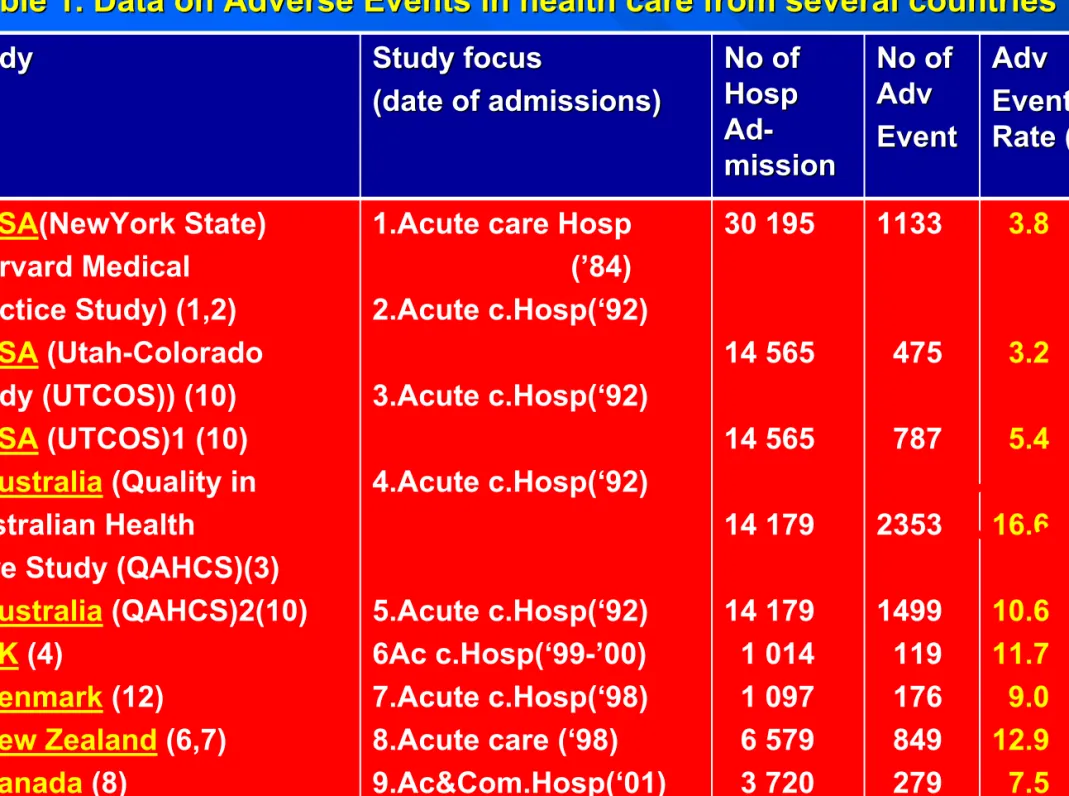
(WHO : World Alliance for Patient Safety, Forward Programme, 2004)
Study
Study Study focusStudy focus
(date of admissions) (date of admissions) No of No of Hosp Hosp Ad Ad- -mission mission No of No of Adv Adv Event Event Adv Adv Event Event Rate (%) Rate (%) 1.USA(NewYork State)
(Harvard Medical Practice Study) (1,2) 2.USA (Utah-Colorado Study (UTCOS)) (10) 3.USA (UTCOS)1 (10) 4.Australia (Quality in Australian Health
Care Study (QAHCS)(3) 5.Australia (QAHCS)2(10) 6.UK (4)
7.Denmark (12)
8.New Zealand (6,7) 9.Canada (8)
1.Acute care Hosp (’84) 2.Acute c.Hosp(‘92) 3.Acute c.Hosp(‘92) 4.Acute c.Hosp(‘92) 5.Acute c.Hosp(‘92) 6Ac c.Hosp(‘99-’00) 7.Acute c.Hosp(‘98) 8.Acute care (‘98) 9.Ac&Com.Hosp(‘01) 30 195 14 565 14 565 14 179 14 179 1 014 1 097 6 579 3 720 1133 475 787 2353 1499 119 176 849 279 3.8 3.2 5.4 16.6 10.6 11.7 9.0 12.9 7.5 Table 1. Data on Adverse Events in health care from several coun
8
(Schellekens, W : Patient Safety Conference,
9
KTD / Adverse Event
KNC / Near Miss tidak cederaPasien
Pasien cedera Medical Error Medical Error Proses of Care (Non Error) •Kesalahan proses •Dpt dicegah
•Pelaks Plan action
tdk komplit
•Pakai Plan action yg
salah
•Krn berbuat : commission •Krn tdk berbuat: omission
Kejadian Tidak Diharapkan = Suatu kejadian yg mengakibatkan cedera yg tdk diharapkan pada pasien karena suatu tindakan (“commission”) atau krn tdk bertindak (“omission”), ketimbang krn “underlying disease” atau kondisi pasien.
(KKP-RS)
Kejadian Nyaris Cedera =
1. Dpt obat “c.i.”, tdk timbul (chance) 2. Plan, diket, dibatalkan (prevention) 3. Dpt obat “c.i.”, diket, beri anti-nya
(mitigation) (Unpreventable) (Unpreventable) (Preventable) (Preventable) KKP-RS
10
Medical
Medical
Error
Error
Adverse Event
Adverse Event
AE / KTD
AE / KTD
Near
Near
Miss
Miss
((KejadianKejadian NyarisNyaris Celaka Celaka)) Preventable Preventable
AE
AE
KTD
KTD
Un Un- -preventable preventableAE
AE
KTD
KTD
(Non Error) (Non Error)1. Stuart Emslie :International Perspectives on Patient Safety,National Audit Office, England, 2005 2. Studdert DM, Mello MM, Gawande AA, Gandhi TK, Kachalia A, Yoon C, Puopolo AL, & Brennan TA. Claims. Errors, and Compensation Payments in Medical Malpractice Litigation. N Engl J Med 354;19 www.nejm.org May 11, 2006
62
11
Most Common Root Causes of Medical Errors
Most Common Root Causes of Medical Errors
(AHRQ Publication No. 04-RG005, December 2003. )-Agency for Healthcare Research and
Quality-1.
1.
Communication problems
Communication problems
2.
2.
Inadequate information flow
Inadequate information flow
3.
3.
Human problems
Human problems
4.
4.
Patient
Patient
-
-
related issues
related issues
5.
5.
Organizational transfer of knowledge
Organizational transfer of knowledge
6.
6.
Staffing patterns/work flow
Staffing patterns/work flow
7.
7.
Technical failures
Technical failures
8.
12
Dimana kesalahan dibuat ? (Type of Errors)
• Diagnostic
1. Kesalahan atau keterlambatan Diagnosis
2. Tidak menerapkan Tes yg sebenarnya diindikasi 3. Mengunakan Tes / Terapi yg sdh tdk dipakai
4. Tidak bertindak atas hasil monitoring atau hasil tes
• Treatment
1. Kesalahan pada Operasi, Prosedur atau Tes 2. Kesalahan pada pelaksanaan Terapi
3. Kesalahan metode pengunaan suatu obat
4. Keterlambatan dlm pengobatan atau merespon thd hasil tes yg 5. abnormal
6. Asuhan yg tidak layak / diindikasi
• Preventive
1. Tidak memberikan terapi profilaktik
2. Monitoring atau follow up yg tidak adekuat pd suatu pengobatan
• Other
1. Gagal melakukan komunikasi
2. Kegagalan Alat
3. Kegagalan sistem lain
(Leape, Lucian; Lawthers, Ann G.; Brennan, Troyen A., et al. Preventing Medical Injury. Qual Rev Bull. 19(5):144–149, 1993.)
13
Patient Safety Education for Medical Students: Report of 3 Years of a Curriculum at New York Medical College
Presenters: Joseph L. Halbach, M.D., M.P.H.
Institution: Department of Family Medicine; New York Medical College, Valhalla, New York Co-Author: Laurie Sullivan, Ph.D., C.S.W.
Association of Medical Colleges
Patient Safety and Graduate Medical
Education
February 2003
A Report and Anotated Bibliography by the Joint Committee of the Group of Resident Affairs and Organization of Resident Representatives
Patient Safety Education and Training
Patient Safety CME Curriculum
Patient Safety: The Other Side of the Quality Equation
Under Grant from
The Agency for Health Care Research and Quality Principal Investigator
14
Administering
Failure points where medication errors occur
Transcribing Prescribing Dispensing
39%
12%
11%
38%
JAMA 1995 Jul 5,274(1):29 -3415
Curicullum
Curicullum
Patient Safety for
Patient Safety for
Medical Student
Medical Student
Background: Increasing recommendations to
Background: Increasing recommendations to
educate physicians
educate physicians
–
–
in training about safety
in training about safety
Goals: are introduce student to:
Goals: are introduce student to:
–
– The prevalence and origins of medical errorsThe prevalence and origins of medical errors –
– The PhysicianThe Physician’’s responsibility and role in prevention of s responsibility and role in prevention of error
error
–
– Avenues for communicating an error to a patientAvenues for communicating an error to a patient
Curricullum
Curricullum
Methods:
Methods:
–
– DidacticDidactic –
– Required readingRequired reading –
16
A. Didactic
A. Didactic
–
– Discussion of medical error and non errorDiscussion of medical error and non error –
– Read aloud excerpt from one real medical errorRead aloud excerpt from one real medical error –
– Family Physician & Medical errorFamily Physician & Medical error –
– BrieftBrieft review of definition, epidemiology, non error and review of definition, epidemiology, non error and systems
systems vsvs individualsindividuals
B. Required Readings
B. Required Readings
C. Videotape/Simulation
C. Videotape/Simulation
–
– 44--6 student per 3 hours session6 student per 3 hours session –
– Preparation Preparation ½½ hourshours –
– Each student is videotaped with actor for 10Each student is videotaped with actor for 10--15 minutes15 minutes –
17
Curriculum Patient Safety for
Curriculum Patient Safety for
Medical Staff
Medical Staff
Introduction to patient safety
Introduction to patient safety
Seven Steps to Patient Safety
Seven Steps to Patient Safety
Patient Safety Standard
Patient Safety Standard
Simple investigation
Simple investigation
Risk assessment and redesign process
Risk assessment and redesign process
Root Cause Analysis (RCA)
Root Cause Analysis (RCA)
Failure Mode Effect analysis (FMEA)
Failure Mode Effect analysis (FMEA)
Effective Communication and Communicating
Effective Communication and Communicating
Bad News
Bad News
18
Curicullum
Curicullum
Patient Safety for
Patient Safety for
Hospital Manager
Hospital Manager
Introduction to patient safetyIntroduction to patient safety
Patient Safety StandardPatient Safety Standard
Effective Communication and Communicating Bad NewsEffective Communication and Communicating Bad News
How to build a safety culture How to build a safety culture thasthas is open and fairis open and fair
How to lead and support staff in patient safetyHow to lead and support staff in patient safety
How to integrate risk management activityHow to integrate risk management activity
How to promote reporting systemHow to promote reporting system
How to involve patients and the public in patient safety How to involve patients and the public in patient safety
program
program
How to learn and share safety lessonHow to learn and share safety lesson
19
Kesimpulan
Kesimpulan
Patient Safety adalah isu terkini, besar, penting, relatif
baru dimulai sejak th 2000an
Gerakan Keselamatan Pasien Rumah Sakit telah
dicanangkan oleh Menteri Kesehatan pada Seminar
Nasional PERSI tgl 21 Agustus 2005, di JCC
Rekomendasi untuk memasukan Patient Safety dalam
kurikulum Fakultas Kedokteran makin meningkat
Pengalaman pendidikan dan training patient safety di
beberapa negara dapat dijadikan masukan bagi
pengembangan kurikulum dan training patient safety di Indonesia
20
Sekian
Sekian