ACADEMIC MOTIVATION, PARENTAL EDUCATION AND WRITING ACHIEVEMENT OF ENGLISH STUDY PROGRAM STUDENTS, SRIWIJAYA
STATE POLYTECHNIC
Sri Endah Kusmartini
English Department, Sriwijaya State Polytechnic Email: [email protected]
Abstract: This study examined the correlation of academic motivation and parental education towards writing achievement of English Study Program students, Sriwijaya State Polytechnic in academic year 2012/2013. The Study also examined whether there was a significant difference in terms of gender towards writing achievement of the students. It was quantitative correlational research. The sample consisted of 45 students of English Study Program, Sriwijaya State Polytechnic. Academic Motivation Scale (AMS) by Vallerand et al. (1992) with some modification conducted by researcher was used as a measure to find out the academic motivation of the students and demographic questionnaire was used to find out name, class, gender and parental education of the students. Meanwhile, the data about writing achievement of the students were taken from the archive in English Study Program, Sriwijaya State Polytechnic. The results showed that academic motivation added to parental education correlated significantly towards writing achievement of the students (R=0.837); and there was no significant difference in terms of gender towards writing achievement of the students. Hopefully, future studies will investigate why and how academic motivation added to parental education influenced and gave contribution to writing achievement of the students.
Keywords: motivation, parental education, writing achievement
INTRODUCTION
ne of the ultimate goals of learning process in English Study Program of Sriwijaya State Polytechnic is the students are able to communicate in English oral and written (Politeknik Negeri Sriwijaya, 2009). Therefore, oral and written achievement of the students should be the main priority. Before a report is presented, it should be well prepared in written carefully. For that purpose, the students should have good English writing skill. Daniels and Bright (1996) states that writing is the representation of language in a textual medium through the use of a set of signs or symbols which is known as a writing system.
Unfortunately, learning process does not always run smoothly. Many factors are believed to contribute to the success or even the failure of a learning process.Teachers often get the fact that students obtain poor grades. In this case, the effectiveness of teachers is considered as the main cause of student failure in obtaining the expected value, but the study conducted by Kusmartini (2012) proved that teacher effectiveness as perceived by the teachers themselves added to teacher effectiveness as perceived by their students contributed only 36% to the academic achievement of the students. Moreover, she also reported that there was 64% of the variance in students’ academic achievement which was attributed to non teacher effects. This means that there are many other factors that also contribute to the achievement of the students.
A research conducted by Shah, Mahmud, Din, Yusof, and Pardi (2011) showed that there was a positive correlation between self-efficacy and writing performance of Malaysian ESL learners (r=0.563, ρ = 0.000). Kusmartini (2012) reported that effectiveness of the teacher as perceived by the teachers themselves added to teacher effectiveness as perceived by their students and self-efficacy as perceived by their students simultaneously contributed 48.2% towards students’ academic achievement. She also reported that there was 51.8% of the variance in students’ academic achievement which was attributed to non teacher and
students’ self efficacy effects. The question which might appear was what other factors that may contribute to students’ achievement.
The researcher understood that the students of English Study Program, Sriwijaya State Polytechnic should have good English writing skill. The question that might arise was what the teacher should do to facilitate this students’ need. Facts showed that teacher effectiveness and students’ self-efficacy were not the only factors that might contribute to students’ achievement. Mitchell (1992) and Gardner (1985) believe that motivation has a very important role towards the students’ success in studying.
Pintrich and Zusho (2002) mention the term motivation as academic motivation, the internal processes that initiate and maintain activities aimed at achieving specific academic goals. Based on Self-Determination Theory, academic motivation can be divided into Intrinsic Motivation, Extrinsic Motivation and A-motivation (Decy & Ryan, 2002). It is called Intrinsic Motivation if someone performs something based on his/her own will and he/she feels happy with his/her involvement (Decy & Ryan, 2002). Vallerand et al. (1992) mention that if a student goes to school because he/she feels that it is exciting to learn, it means that he/she has intrinsic motivation. It is called Extrinsic Motivation if someone performs or conducts something influenced by something or someone outside of himself (Deci and Ryan, 2002). It is called a-motivated when a student does not see the emergencies between outcome and his own action (Deci and Ryan, 2002). Choosri and Intharaksa (2011) reported that there was a significant relationship between motivation and English learning achievement of the second year vocational certificate level Hatyai Technical College students. Therefore, the researcher tried to find out whether motivation especially academic motivation also has significant correlation to writing achievement of the students of English Study Program Sriwijaya State Polytechnic. Research concerning with academic motivation is needed in order that the teacher understands what to do, whether they have to motivate the students or not in order to improve the writing achievement of the students.
Davis-Kean, (2005) conducted a research to children ages 8 to 12 and reported that socioeconomic factors were related indirectly to children’s academic achievement through parents’ beliefs and behaviors. Parents with moderate to high income and educational background have ability to predict their children’s academic achievement better than those with low income and educational background (Alexander, Entwisle, and Bedinger, 1994). Finally, Corwyn and Bradley (2002) reported that parental education especially educational background of a mother had significant influence towards children’s academic achievement. Studies conducted by Davis-Kean (2005), Alexander, Entwisle, and Bedinger (1994), and Corwyn and Bradley (2002) led to the emergence of the question of whether it also applies to higher school students since most of their time are spent away from their parents. The question that might appear was whether parental education as one of socioeconomic factors had significant correlation with writing achievement of the students in English Study Program, Sriwijaya State Polytechnic. This research was also needed in order that the teacher understands what to do, whether to involve students’ parents in teaching and learning process or not in order to improve writing achievement of the students. Next, the researcher also wanted to find out whether academic motivation added to parental education of the students contributed significantly to the writing achievement of the students. If there was a significant correlation, then, the researcher wanted to find out their influence and contribution towards writing achievement of the students.
Finally, the researcher also wanted to find out whether there was a difference in terms of gender towards writing achievement of the students. This research is needed in order that the teacher understands what to do when dealing with different gender of the students.
Based on the above explanation, the hypotheses were described as follows: Ho1)
the students; Ha1) There is significant correlation between academic motivation and writing
achievement of the students; Ho2) There is no correlation between parental education and
writing achievement of the students; Ha2) There is significant correlation between parental
education and writing achievement of the students; Ho3) Academic motivation added to
parental education does not influence writing achievement of the student; Ha3) Academic
motivation added to parental education influences writing achievement of the students significantly; Ho4) There is no significant difference in terms of gender towards writing
achievement of the students; and Ha4) There is significant difference in terms of gender
towards writing achievement of the students.
METHODOLOGY
The design is a quantitative correlational design. There were four variables used in this research—three independent variable (academic motivation of the students, parental education of the students, and gender of the students) and one dependent variable (writing achievement of the students).
The population of this research was all students of English Study Program, Sriwijaya State Polytechnic in academic year of 2012/2013. The number of the sample was 45 which were taken randomly.
To get the data, the researcher asked each respondent to write his/her name, gender, class, and parental education. The researcher used a measure of Academic Motivation Scale (AMS) by Vallerand et al. (1992) with some modification conducted by the researcher to measure the academic motivation of the students by circling one of the points which ranges from 1 (does not correspond at all) to 7 (correspond exactly) which shows the reasons why the respondents go to school. The number of the items was 28. The lowest possible score was 28 and the highest possible score was 196. Writing scores of the respondents were taken from the cumulative of their scores before conversed into grade (A, B, C, D or E). Those data were taken from the archive of English Study Program, Sriwijaya State Polytechnic.
ANALYSES AND INTERPRETATION
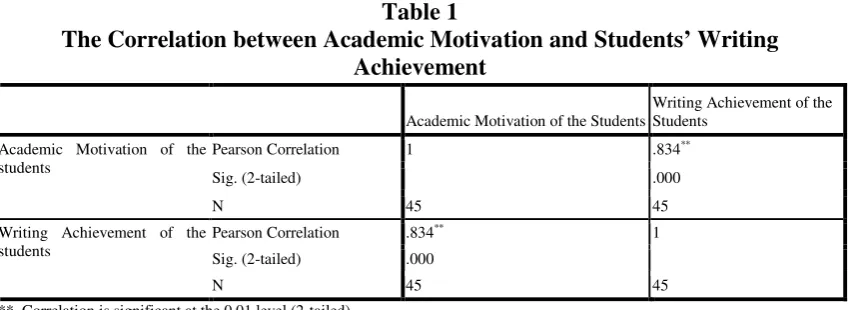
The following was the description about the correlation between academic motivation and writing achievement of the students.
Table 1
The Correlation between Academic Motivation and Students’ Writing Achievement
Academic Motivation of the Students
Writing Achievement of the Students
Academic Motivation of the students
Pearson Correlation 1 .834**
Sig. (2-tailed) .000
N 45 45
Writing Achievement of the students
Pearson Correlation .834** 1
Sig. (2-tailed) .000
N 45 45
**. Correlation is significant at the 0.01 level (2-tailed).
concluded that there was a significant correlation between students’ Academic Motivation and students’ writing achievement.
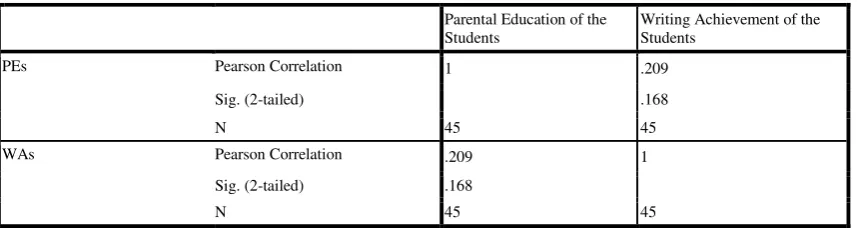
Table 2
The Correlation between Parental Education and Students’ Writing Achievement
Parental Education of the
The correlation between Parental Education of the students and Writing Achievement of the Students was 0.209 with probability value 0.168 which was higher than the alpha level (0.168 > 0.05). Therefore, Ho2 was accepted and Ha2 was rejected. It can be concluded that
there was no significant correlation between Parental Education of the students and writing achievement of the students.
The following were the description about the correlation, the influence and contribution of academic motivation and parental education towards writing achievement of the students.
Table 3
The Influence and Contribution of AMS added to PES towards WAS
Model R R Square Adjusted R Square
1 .837a .700 .686
a. Predictors: (Constant), parental education of the students, academic motivation of the students b. Dependent variable: writing achievement of the students
ANOVAb
The correlation of academic motivation of the students (AMS) added to parental
education of the students (PES) towards writing achievement of the students (WAS) was
0.837. It showed that the correlation of AMS added to PES towards WAS was very strong
although in partial, the correlation between PES and WAS was not significant. R square (R2)
of AMS added to PES towards WAS was 0.700. It showed that the contribution of AMS added
to PES towards WAS was 70%. In this case, unexplained factor was 30%.
accepted. It can be concluded that academic motivation of the students added to parental education of the students influenced writing achievement of the students significantly.
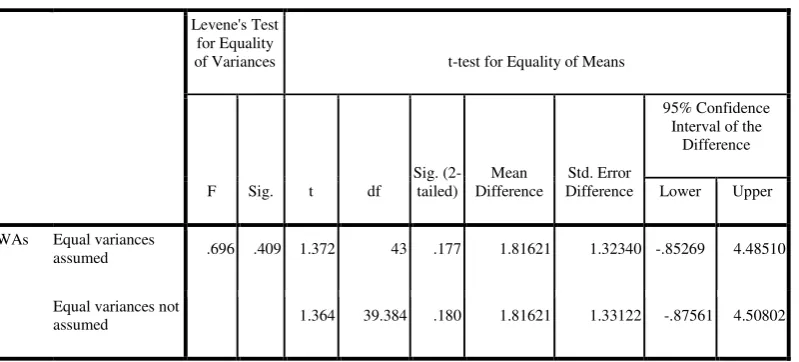
The following was the description about mean difference of writing achievement of the students based on gender.
Table 4
Mean Difference of Writing Achievement of the Students based on Gender
gender N Mean Std. Deviation Std. Error Mean
writing achievement of the students 1 22 75.7727 4.99459 1.06485
2 23 73.9565 3.83143 .79891
Independent Samples Test
Levene's Test for Equality
of Variances t-test for Equality of Means
F Sig. t df
Sig. (2-tailed)
Mean Difference
Std. Error Difference
95% Confidence Interval of the
Difference
Lower Upper
WAs Equal variances
assumed .696 .409 1.372 43 .177 1.81621 1.32340 -.85269 4.48510
Equal variances not
assumed 1.364 39.384 .180 1.81621 1.33122 -.87561 4.50802
The mean score of writing achievement of male studentswas 75.7727, whereas the mean score of academic achievement of female students was 73.9565. The mean difference was 1.81621, t-obtain was 1.372 < t-table (df =43) 2.016692 and the significance was 0.409 > α 0.05. Therefore, Ho5 was accepted and Ha5 was rejected. It can be concluded that there was
no significant difference in terms of gender towards writing achievement of the students. The positive significant correlation between academic motivation and writing achievement of English Study Program students, Sriwijaya State Polytechnic suggests that the more the students have academic motivation, the better their writing achievement.
Although there was not significant correlation between parental education and writing achievement of the students, there was significant correlation between academic motivation added to parental education towards writing achievement of the students. It suggests that in order to improve writing achievement of the students, it is necessary to involve those factors.
The contribution of 70% of academic motivation of the students added to parental education of the students towards writing achievement of the students suggests that 30% of the variance in students’ writing achievement were contributed by unexplained factors.
CONCLUSIONS AND SUGGESTIONS
Academic motivation of the students correlated positively and significantly to writing achievement of the students (R=0.834). It means that the more the students have academic motivation, the better their writing achievement. Therefore, in order to improve writing achievement of the students, it is important to improve their academic motivation.
Although, the influence of parental education of the students towards writing achievement of the students was not significant, but when academic motivation of the students added to parental education of the students, both influenced writing achievement of the students significantly with the contribution of 70%.
Finding showed that there was no significant difference in terms of gender towards academic achievement of the students. It means that both genders have the same potency to improve their writing achievement.
In general, quantitative research cannot answer the question why and how. Therefore, it is suggested that future studies will investigate why and how academic motivation of the students added to parental education of the students influenced and gave contribution to writing achievement of the students by using qualitative correlational design.
REFERENCES
Alexander, K. L., Entwisle, D. R., & Bedinger, S. D. (1994). When expectations work: Race and socioeconomic differences in school performance. Social Psychology Quarterly, 57, 283–299.
Choosri, C., and Intharaksa, U. (2011). Relationship between motivation and students’ English learning achievement: A study of the second – year vocational certificate level Hatyai Technical College Students. The 3rd International Conference on Humanities and Social Sciences, April 2, 2011 Faculty of Liberal Arts, Prince of Songkla University.
Corwyn, R. F., & Bradley, R. F. (2002). Family process mediators of the relation between SES and child outcomes. Unpublished manuscript, University of Arkansas at Little Rock.
Daniels, P.T. & Bright, W. (1996). The study of writing systems. In The world’s writing systems. Oxford University Press, Inc.
Davis-Kean, P.E. (2005). The influence of parent education and family income on child achievement: The indirect role of parental expectations and the home environment. Journal of Family Psychology, 19(2), 294-304.
Deci, E. L., & Ryan, R. M. (2002). Overview of self-determination theory: An organismic dialectical perspective. In E. L. Deci & R. M. Ryan (Eds.), Handbook of self-determination research (pp. 3–33). Rochester, NY: University of Rochester Press. Gardner, R. C. (1985). Social psychology and second language learning: The role of attitudes
and motivation. London: Edward Arnold.
Kusmartini, S.E. (2012). The relationships among teacher effectiveness, self-efficacy and academic achievement of English education study program students in three universities in Palembang. Unpublished Thesis. Magister Program of Language Education Faculty of Teacher Training and Education Sriwijaya University.
Shah, P.M., Wan Mahmud, W.H., Din, R., Yusof, A., and Pardi, K. M. (2011). Self-efficacy in the writing of Malaysian ESL learners. World Applied Sciences Journal (Innovation and Pedagogy for Lifelong Learning) 15, 8-11.
Pintrich, P. R., & Zusho, A. (2002). The development of academic self-regulation: the role of cognitive and motivational factors. In A. Wigfield & J. S. Eccles (Eds.), Development of achievement motivation (pp. 249–284). San Diego, CA: Academic Press.
Politeknik Negeri Sriwijaya. (2009). Buku Pedoman Politeknik Negeri Sriwijaya. Palembang: Politeknik Negeri Sriwijaya