QUALITATIVE CIRCULATION SPACE APPLICATION AT
THE TUNJUNGAN PLAZA SHOPPING MALL IN SURABAYA
Sriti Mayang Sari, M. Dwi Marianto*, Suastiwi* Interior Design Departement, Petra Christian University
*Indonesia Institute of The Arts, Yogyakarta
Abstract
The public circulation space is the element that organizes and joins together the different parts of a shopping mall. As such the circulation space is partly defined by the different accommodation of shops, anchor stores, catering and leisure facilities. In considering the organizational framework to be established by the public circulation space the objectives can be separately identified into functional and qualitative requirements. The functional requirements are essential primary planning considerations and the qualitative requirements are recommended secondary planning and more detailed design considerations. The goal of this research is to identify the qualitative circulation requirements at Tunjungan Plaza, Surabaya, as one of the biggest shopping mall in East Java. As a result of the field identification will create some recommendations for the qualitative circulation requirement that suitable for the shopping mall visitor.
Keywords:
Qualitative, Circulation Space, Shopping Mall
Introduction
1. Circulation Space of Shopping Mall
In general, mall is a closed multiflour building with eye catching window shopping and interior, arrangement good air circulation so the visitor can do their activities comfortably. Mall filled by a variety of retail or shops in one solid structure, independent vendor or branded stores melting pot. Between one store with others connected by circulation’s line with the aim of facilitating the visitors to walk from one shops to others [1].
The function of space circulation in shopping mall is to connect interior and exterior spaces together on building. The pathways of this public circulation is an element that organizing and combining different parts in shopping mall. Public circulation path is determined by different accommodation facilities, such as stores, anchor tenant, catering, foodcourt, and entertainment facilities. Thus space or circulation path is forming the planning structure and layout in shopping mall. Vertical and horizontal circulation is applied in a shopping mall to help visitor reach stores and others facilities easly.
Corridor, bridge and atrium are modes of horizontal circulation generally applied in a shopping centre (mall). Their main function is to cater and distribute consumers to all parts of the shopping centre (mall) and to shops and stores there). Type of corridor that is commonly applied in a shopping centre (mall) is single loaded corridor of 3 metres wide or even more. Its provided to ease consumers’ circulation so that they are able to enjoy the shop frontages, undisturbed by those who are just passing by) [2]. Escalator, lift is a vertical circulation that are commonly used in shopping mall. The presence of the building. Many important functional consideration to be aware, such as the widespread of circulation space
influence over the visitors’ qualitative memories of the place. This qualitative aspect is especially important in an age when providing customers with memorable experiences is all-important [3].
2. Functional and Qualitative Requirements
According Coleman [3] In considering the organizational framework to be established by the public circulation space the objectives can be separately identified into functional and qualitative requirements. The functional requirements are essential primary planning considerations and the qualitative requirements are recommended (nice to have) secondary planning and more detailed design considerations. The functional requirements represent the basic and well-established general rules of shopping center planning. They are essential considerations common to all shopping formats and were referred to earlier. The qualitative requirements tend towards the consideration of the use of the center from the viewpoint of the customer and are recommended considerations that can make the difference between one center and another.
The qualitative requirement of the circulation of public space will be discussed in this research. Because of the qualitative considerations which generally give character in space and help make the facility more memorable and enjoyable.
The following summary of the qualitative consideration of Coleman that used as parameter to examine the public space circulation at TP mall, Surabaya. The qualitative considerations which generally give character to a place and help make the facility more memorable and enjoyable.
Public circulation space qualitative requirements: secondary-planning considerations (recommended): Consider giving different areas or individual lengths of
circulation space a separate recognizable identity. Establish a clear hierarchy between the different
circulation spaces which correspond to the relative importance of the function of the space.
Provide protection from the weather.
improvement on the external ambient temperature. Provide a chilled environment in summer.
Provide a heated environment in winter.
Establish a sense of well-being from a well made and maintained environment.
Provide a positive memorable experience (combining functional and qualitative considerations):
general quality and proportion of space. form the space to facilitate the occurrence of
informal social and civic uses to include: identifiable meeting places
space for seating to allow visitors to enjoy the place and watch the activity
space for occasional gatherings, events, performances and Christmas displays. spontaneous overspill space for tables and
chairs to allow street cafés and dining. generally encourage the visitor to dwell and
experience the place:
by inclusion of the above informal spaces. provide a quality of detailing, finishes and
general workmanship which can withstand scrutiny.
incorporate aspects of craftsmanship integrated into the finishes (decorative plaques, motifs, decoration)
incorporate elements of artwork (stand alone and integrated pieces)
provide civic elements (clocks, water sculptures and other features).
All the above facilities, if well considered, will encourage the visitor to engage with the place, enhance their experience and encourage the use of the shopping facility in preference to another.
Aims
The goal of this research is to identify the qualitative circulation requirements at Tunjungan Plaza, Surabaya, as one of the biggest shopping mall in East Java. As a result of the field identification will create some recommendations for the qualitative circulation requirement that suitable for the shopping mall visitor.
Methodology
This research employs qualitative approach to analyze problems. Methods and research procedures are adopted from some literatures including Marshall and Rossman (4), Maxwell (5), Creswell (6). These procedures are: - Literature study including journals, books and
documents related to shopping mall circulation. - Qualitative observation, a researcher’s observation to
the Tunjungan Plaza Mall, Surabaya, to observe shopping mall circulation and visitors activities. The results are noted and documented in photographic recordings.
- Interview with visitors to collect their opinions about circulation in a shopping mall.
- Analyses and data interpretation. The collected data is analyzed with a prescribed parameter, and then the researcher draws up recommendations on qualitative circulation requirements that is suitable with visitors. Object of this research is Tunjungan Plaza Shopping Mall, Surabaya, with a consideration that this mall is in the downtown, popular, and the biggest in east region of Indonesia.
Results and Discussion
The emergence of modern shopping mall in Surabaya was begun by Tunjungan Plaza (TP) which is established in 1986 and until today is still a favorite. Before TP, some other malls have been established in Surabaya such as Delta Plaza and Surabaya Mall. However, these malls is not as modern and big as TP. After TP, the establishment of some newer shopping malls raises. There are more (TP East, Center, and West). TP is strategically located in the city center of Surabaya. As part of Tunjungan City superblock which consists of not only a shopping center, but also a condominium, 5-star hotel and office tower, Tunjungan Plaza has become the largest shopping center in East Indonesia and the landmark of Surabaya.
There are some factors to succeed TP as a shopping mall like its location, brand name, and the timing of establishment. TP is located in the center of Surabaya, TP’s brand name is so popular in East Java society, and TP is established when the trend of modern shopping malls began in US and Asia [7].
Tunjungan Plaza was established in 1986. At that time it was the first modern shopping center in Surabaya which operated for 12 hours every day. Nowadays it has the total area of 125,000 M2. It is the favourite shopping destination and leisure place for both locals and foreigners in Surabaya. It has also become an icon that tourists and visitors should come and see. Supported by anchor tenants such as SOGO, Matahari Department Store, Gramedia, Tunjungan 21, Cinema XXI, Ace Hardware, Informa, Hero Supermarket, Amazone and Celebrity Fitness, hundreds of local brand and famous international brand tenants, a huge Convention Center and two main atriums, Tunjungan Plaza has become a complete shopping destination and has offered an ultimate shopping excitement to its visitors [8].
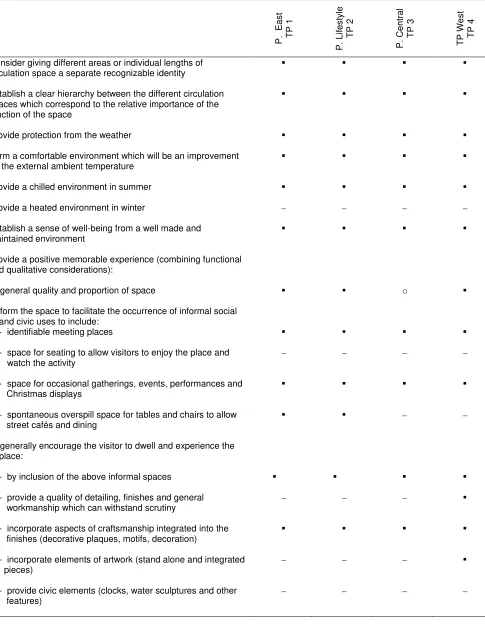
To improve the objectivity of this research, researcher put herself as a visitor while exploring and observing facilities related to circulation in TP. The results are pictures of circulation facilities, interview data, and ‘public circulation space qualitative requirements’ checklist (see: table 1)
Table 1. Parameter forpublic circulation space qualitative requirements: secondary planning considerations (recommended)
P.
Ea
s
t
TP
1
P.
L
ife
s
ty
le
TP
2
P.
Cen
tra
l
TP
3
TP
We
s
t
TP
4
Consider giving different areas or individual lengths of circulation space a separate recognizable identity
Establish a clear hierarchy between the different circulation spaces which correspond to the relative importance of the function of the space
Provide protection from the weather
Form a comfortable environment which will be an improvement on the external ambient temperature
Provide a chilled environment in summer
Provide a heated environment in winter
Establish a sense of well-being from a well made and maintained environment
Provide a positive memorable experience (combining functional and qualitative considerations):
general quality and proportion of space
o
form the space to facilitate the occurrence of informal social and civic uses to include:
- identifiable meeting places
- space for seating to allow visitors to enjoy the place and watch the activity
- space for occasional gatherings, events, performances and Christmas displays
- spontaneous overspill space for tables and chairs to allow street cafés and dining
generally encourage the visitor to dwell and experience the place:
- by inclusion of the above informal spaces
- provide a quality of detailing, finishes and general workmanship which can withstand scrutiny
- incorporate aspects of craftsmanship integrated into the finishes (decorative plaques, motifs, decoration)
- incorporate elements of artwork (stand alone and integrated pieces)
- provide civic elements (clocks, water sculptures and other features)
Notes:
: applied the parameter
o : applied, but not the same as the parameter : not applied
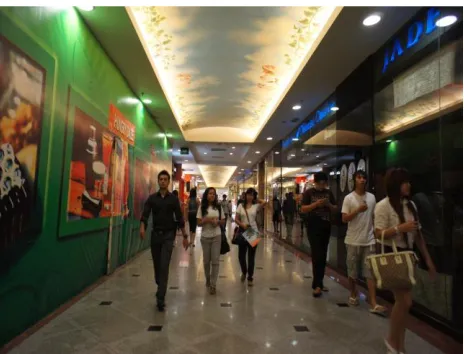
Figure 1 Shopping Mall ‘Tunjungan Plaza’ [9]
Based on the parameter check list in table 1, it is obtained that no area from East Plaza (TP1) to West Plaza (TP4) apply those parameter aspect completely. Thus, discussion will be focused on the implementation of aspects which are not suitable with the parameter and not apply those aspects in TP.
Not all parameters can be applied in TP shopping mall. For example: Shopping mall should provide a heated environment in winter. It is not necessary to be implemented in TP because there is no winter in Indonesia. TP uses air conditioning for all areas, and this is one of the aspects that make visitors enjoy staying in this mall.
There are some important qualitative requirements aspect which can give a positive memorable experience, but it is not applied or applied but not maximal. Circulation space quality and proportion aspect shows that there are crowd in central Plaza (TP3) in its prime times (weekend, holidays or special events) that minimize visitors comfort in enjoying the mall atmosphere (see: figure 2). TP 3 is the most crowded because its position which is flanked by TP1 and TP4. Moreover, it is also functioned as circulation path to Sheraton Hotel.
Figure 2.Visitor crowd
Another aspect which is also important and it is not available in all other TP areas are the availability to enjoy shopping mall atmosphere and visitor activities. Since the absence of sitting rooms, there are many visitors sitting on the breezeway in circulation path. It disturbs visitors who need to pass because the circulation path becomes
narrow and create a visitor crowd (see: figure 3). It happens especially in TP 1 and 3, while it doesn’t happen
in TP 2 nor TP 4. It doesn’t happen in TP 2 because this
plaza is destined for lifestyle plaza only where cafés and restaurants located. It also doesn’t happen in TP 4 because it is destined for high-end segment where its interior atmosphere makes non concerned visitors unwilling to come. Related to the availability of sitting room in TP4, based on the interview, it is known that the visitors need a free charge sitting facility.
Figure 3 Visitors sitting in circulation path
Parametrical aspects which give visitors new experiences and they need to stay longer in shopping mall relates to decorations, artworks, and other elements. Interior finishing aspect which is related to art work is only implemented in TP4, as a painting at the ceiling along the corridor in restaurant areas and void (see: figure 4 and 5). While on the floor, as a circulation area, there is flooring patterns creating circulation path. For decorative aspect, TP management doesn’t decorate permanently its shopping mall because automatically it has been created by the existence of many kind of window display at shop-front. Temporary decoration is usually created by TP management with special themes relevant to on going events.
Figure 5 Artwork at the ceiling of Plaza west/TP 4
Conclusion and Recomendation
Conclusion of this research is that TP has implemented public circulation space qualitative requirements, even though not all parametrical aspects has not been implemented. Aspects which is related to artworks, sculptures, and permanent decoration can be ignored, because the spatial atmosphere has been created by the existence of window display in the shop-fronts. Besides, the existence of temporary decorations has supported the atmosphere of shopping mall which is always change dynamically. Recommendation for public circulation space qualitative requirements which should be considered is the availability of public sitting facility in circulation areas so it can make visitor enjoy the atmosphere of shopping mall.
Recommendation for the next research is to follow up
the research on circulation in TP shopping mall with phenomenological approach. By this approach, it can be gained visitor’s new experience in interactions with space, and this experiences will be useful for designing shopping mall based on visitor needs. The same parameter can be applied in the other shopping malls the big cities in Indonesia, so that it can be found reliable shopping mall parameter.
References
[1] Sari, Sriti M. 2010, “Sejarah Evolusi Shopping Mall” dalam Dimensi Interior, Jurnal Desain Interior, 8/02, Jurusan Desain Interior, Fakultas Seni dan Desain, Universitas Kristen Petra, Surabaya.
[2] Yuli, A. S., Aditya, F., Suharnoko, W. 2006, Indonesia Shopping Center, PT. Griya Asri Prima, Jakarta.
[3] Coleman, Peter. 2006, Shopping Environments Evolution, Planning and Design. Architectural Press, Burlington.
[4] Marshall, C., Rossman, G.B. 2006, Designing Qualitative Research (4th ed.). Sage, Thousand Oaks, CA.
[5] Maxwell, J.A. 2005, Qualitative Research Design: An Interactive Approach (2nd ed.). Sage, Thousand Oaks, CA [6] Creswell, J.W. 2009, Research Design: Qualitative, Quantitative, and Mixed Methods Approaches (3 th ed.). Sage, Thousand Oaks California.
[7] Ishananto, O. 2010, Mal Surga Tanpa Tuhan Ruang Tanpa Waktu. Jaring Pena, Surabaya.
![Figure 1 Shopping Mall ‘Tunjungan Plaza’ [9]](https://thumb-ap.123doks.com/thumbv2/123dok/1559969.2049570/4.595.64.294.496.705/figure-shopping-mall-tunjungan-plaza.webp)