TRIAL OF
sub sp.
IN GUNUNGKIDUL
YOGYAKARTA
Melaleuca cajuputi
cajuputi
Liliana Baskorowati , Mudji Susanto , Prasetyono , Noor Kartikawati and Anto Rimbawanto
Received : 16 March 2012, Accepted : 26 October 2012
Family variation of capsule production and the seed viability in the Paliyan full-sib trial of
subsp. , at Gunungkidul, Yogyakarta, were observed. The full-sib trial was designed as
Incomplete Block Design, consisting of 39 families; six individual as tree plot and replicated in eight blocks. Height and diameter at breast height were assessed to identify the correlation between capsule category and growth performance. The capsule production was assessed visually to one of the capsule categories: “0” for none; “1” for light; “2” for medium and “3” for heavy. Results showed that each
family of sub sp. c equally contributed to the seed production. Progeny analysis
showed that the seed productions were not strongly under genetic control = 0.12. This study also
found positive correlation between the flowering strength (the flower production levels) and the number of capsule (R =0.279). However, there were no significant differences between the flowering
levels and the viability of sub sp. . Mean seed viability was 31%, there were no
significantly differences of capsules production between trees having high flowering intensity and low flowering intensity. Low seed viability was assumed due to the unsynchronicity of flowering, leading to the low levels of outcrossing rate. Therefore, selection of families with synchronicity of flowering was recommended to establish a seed orchard.
Keywords: Seed production, seed viability, , genetic control, flowering
1,2 1 1
1 1
2
ABSTRACT
Melaleuca cajuputi cajuputi
M. cajuputi ajuputi
M. cajuputi cajuputi
Melaleuca cajuputi
(h i)2
I. INTRODUCTION
sub sp. commonly
known as ' ', represented by three sub
species, is the most widespread species, extending from northern Australia to parts of Papua New Guinea, Indonesia, Malaysia, Thailand, Cambodia and Vietnam (Craven, 1999). In Indonesia this species occurs in Maluku, Seram and Buru islands
(Gunn 1997). sub sp.
plantations are the main source of cajuput oil industry in Indonesia. Cajuput oil industry is part of forestry activities in Indonesia aimed at producing non-timber forest products as well as a
Melaleuca cajuputi cajuputi, kayuputih
et al., M.cajuputi cajuputi
useful prosperity approach for people living around the forest area. Total plantation area of
sub sp. is in the order of 24 000
ha concentrated in Java Island with annual production of leaves biomass of 300t/y that are managed by Perum Perhutani. Outside Java, cajuput farmers especially in Buru, Seram, Ambon and Aru islands run their home oil industry by collecting the biomass from natural
plantations of sub sp.
(Rimbawanto 2009).
In response to demand for good seed, Common wealth Scientific and Industrial Research Organization (CSIRO) and Forestry Research and Development Agency (FORDA) have initiated a
selection and breeding program for sub
sp. since 1995 (Doran ., 1998). To date,
several seedling seed orchards and clonal seed
M. cajuputi cajuputi ,
M. cajuputi cajuputi
et al.,
M. cajuputi
cajuputi et al
1 2
orchards had been established in Java based on selection; aimed to improve the 1,8-cineole content and improve oil yield. However, more detailed study of seed yield is required to improve seeds collected from seedling seed orchards. Seed production areas and seed orchards exist to produce the greatest possible yield of well-filled viable seed. Their successful management depends on a thorough knowledge of the genetics and physiology of flowering as well as seed production, and it is therefore necessary to investigate the current state of knowledge on these aspects.
Estimating and understanding the amount of seed production of a seed orchard is important. Since the information on the individual and family variation in seed yield is important towards increasing the improved seed, the target may be limited by mating among a few families. It is likely that a lot of seeds will be produced from a few families when the individual and family variation
is high in terms of seed production (Yamada ,
2001).
This study therefore was conducted aimed to evaluate the family variation in capsule production and the subsequentseed viability in Paliyan
Full-sib of sub sp. Seedling
Seed Orchard, Yogyakarta, Indonesia.
sub sp. Full-sib
seedling seed orchard was established on December 2004, comprising 39 full sib families, six tree plots with eight replicates and was designed following incomplete block design. First flowering of this plantation occurs in 2006, and the observation of family variation in capsule production was carried out during peak capsule period in September 2009. Meanwhile, the observation of seed germination to determine the seed viability was carried out from November to December 2009.
Assessment of the traits was conducted on all individual trees in this plot (the number of trees
et al.
Melaleuca cajuputi cajuputi
Melaleuca cajuputi cajuputi II. MATERIAL AND METHOD A. Material
B. Methods
were only two quantitative traits included in the assessment to identify the correlation between capsule category and growth performance.
referred to the total tree height, measured to
the nearest 0.1 m. was defined as the
stem diameter taken at 1.3 m from ground level and was measured to the nearest 0.1 cm
(Pinyopusarerk ., 2004).
Classification and scoring techniques were applied to characteristics which could not be
measured quantitatively (Pinyopusarerk .,
2004). The capsule production was assessed visually to one of the capsule categories (based on
flowering categories by Griffin 1992). The
scores are: “0” for none; “1” for light; “2” for medium and “3” for heavy.
Twenty four representative trees were randomly selected from each capsule category one, two and three. The total capsules produced from each of sampled trees were harvested. All capsules were then cleaned from the debris by sieving using one mm siever, to leave a mixture of seed and chaff; and weighed to record the actual weight of capsules produced by each category. Turnbull and Doran (1987) noted that the majority of myrtaceous species, such as species of
and have very small seeds of irregular
shape, which make it difficult to precisely separate
pure seed and chaff. In sub sp.
because of the small size of the seeds and because the seed and chaff are the same colour, it was found impossible to reliably separate seed from the chaff even under the microscope, so the entire mixture had to be sown for germination testing.
The seed and chaff of each sample (the content of three capsules each sample) were sprinkled on moist Whatman filter paper over 30 ml of a-grade vermiculite in a 90 mm glass petridish, to which 28 ml of gel-filtrated water was added. Dishes totalled 120 (12 trees x 10, 3-capsule samples). These were placed in a germination cabinet set at a constant temperature of 25 C with 12 h of light per day. Germination counts in any dish commenced when the first cotyledons emerged, usually on day four. Healthy germinated seedlings were recorded on a daily basis up to 42 days. Seed viability of each sample was tested by counting the number of germinated seed.
The individual trait related data were analyzed using the ANOVA procedure in Genstat Version
Height
M. cajuputi cajuputi
(Payne 1987). Analyses on the data were based on the following linear model:.
where:
= the overall mean;
R = the effect of the replicate F = the effect of the Family
e = the residual error with a mean of zero. Y = the plot mean of the family, the replicate
The mean family variance components were used to estimate mean covering individual tree heritability (denoted as h ) separately for each trait as follows:
where:
h = individual tree heritability r = coefficient of relationship
= variance between families-within-provenance groups
= phenotypic variance
= (s +s +s ) = variance between plots = variance between trees within plots
The coefficient of relationship among offsprings used in computation of the individual tree heritability was assumed to 0.4 based on the assumption that likes many species of eucalyptus and other members of the family Myrtaceae (Moran, 1992). Genetic correlations (denoted r ) were calculated according methodologies
described by Williams ., (2002) based on the
following formula:
Cov (X,Y) = covariance of the two traits at the family level
(x) = family- level variance components
of trait (x)
(y) = family- level variance components
of trait (y)
r = genetic correlations
f
III. RESULT AND DISCUSSION
A. Family Variation, Heritability and Genetic Correlation
Significant capsules production was found in full-sib seedling seed orchard in which 76.07 % of the total trees contributed to produce capsules during the 2009 fruiting season. Capsule production varied significantly between families (df=38; MS=2.293; Pr=<.0001), replications, replication and family interactions (see Table 1). Figure 1, illustrated the ability for each family
(based on male parent) of in this
population to produce capsules, during 2009 fruiting season. This figure showed that several families of male parent no 19, 25 and 2a produced more capsules compared to families of male parent number 02, 10 and 18. This variation analysis showed that genotype influenced the ability to produce capsules.
Variation of seed production may occur within and between species (Kramer and Kozlowski, 1960; Matthews, 1963; Jackson and Sweet, 1972). They mentioned that environmental factors i.e. whether conditions, nutrition, and genetic factors i.e. synchronycity of flowering and degree of self-incompatibility of a species in one population have been important attributes to of flower initiation and the production of seed in forest trees. The synchronyous flowering may attract various insects or animal as pollinator to visit and to transfer pollen from one to other trees. This also may increase the pollen transfer between trees leading to increased cross pollination.
Previous study of flowering and fruiting of
sub sp. in a seedling seed
orchard showed that variation of flowering intensity between provenances occurs in
population (Baskorowati 2008). Another
study of sub sp. in a seedling
seed orchard in Yogyakarta, found that in general this species has a high level of self-incompatibilty (0.05), although some individual trees were completely self-incompatible (Kartikawati, 2005). These compatibility may result in inbreeding, leading to the reduction of viable seed or vigour of the seed. In this study, there were found variations of seed production between families suggesting that each full-sib family equally
M. cajuputi
M. cajuputi cajuputi
et al., M. cajuputi cajuputi
Y = + R + F + eij i j ij
h = – x2 1
r ss2
2
contributed to the seed production. Grouped seed production based on male parent, revealed that seed production varied significantly between male parents; means that the ability of pollen from different mother tress may vary or the degree of self-incompatibility may occurs in this family.
However, the individual heritability of seed
production in this study site was medium =
0.12; meaning the seed productions were not strongly under genetic control. According to
Williams (2002), the medium individual
heritability found in this study indicates more environment effect control than that of genetic effect. In general, the seed production is likely to be plastically influenced by internal and environmental condition, pollination, damage by
disease and insect pest (Yamada , 2001).
Moreover, flowering and fruiting of tropical tree species generally were also influenced by season, which not very clear every year.
At this study site, the replication treatment greatly influenced the capsule production; trees
(h i)2
et al.
et al.
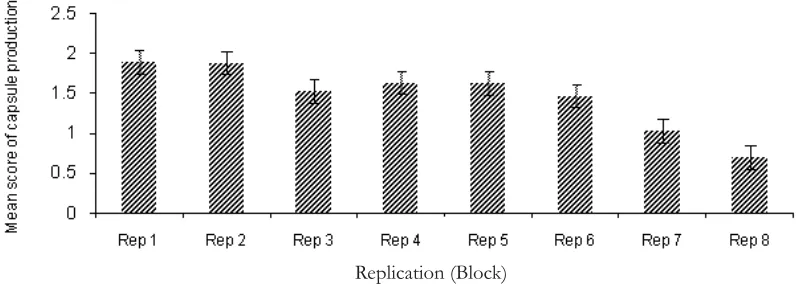
more capsules than those in other replications (Figure 2). The significant differences in the capability to produce capsules, which influenced by the flower production between replications were probably influenced by the amount of sunlight (radiation) received by individual trees in this population. In this site, replications one and two are located in the edges of the population, therefore probability of individual trees in these plots receiving sunlight more than other plots.
Estimation of genetic and phenotypic correlation between traits in the full-sib seedling
seed orchards of sub sp. are
presented in Table 2.
Negative correlations were found between capsule production and growth parameters. Genetic correlation between capsule production vs. height and vs. diameter are r = -0.87 and r =-0 25 respectively. Negative correlation in this parameter indicates that they are not possible to simultaneously achieve genetic gain in terms of growth traits and capsule productions.
M. cajuputi cajuputi
g g
.
Table 1. ANOVA and heritability of capsule production, height and diameter of sub sp
at full-sib seedling seed orchard Paliyan, in Gunungkidul, Yogyakarta
M. cajuputi cajuputi
.
Capsule production (score) Height (m) Diameter (cm)
Source db MS Prob MS Prob MS Prob
Rep 7 26.825 <.0001 46.38 <.0001 26.59 <.0001
Fam 38 2.293 <.0001 5.21 <.0001 3.81 <.0001
Rep*Fam 181 1.346 <.0001 2.09 <.0001 2.22 <.0001
Heritability (h2i) 0.12 0.14 0.11
Figure 1. Mean number of capsule production of sub sp grouped by male parent of
families
B. Relationship Between Flowering Strength and Actual Number of Capsules
Results showed that positive correlation between the flowering strength (the flower production) and the number of capsule (R =0.279) were observed. In general, seed production depends upon supply of quality pollen, which will be reduced with lower mating partner density and lower frequency of mate's relatives to other species (Kunin, 1997; Bosh and Waser, 1999; Cunningham, 2000; Duncan 2004). Therefore, increasing of flower production will lead to the capsule production. Even though pollinator behavior may further affect pollen supply in a population.
Furthermore, plant breeding systems were also characterized as factor affecting seed production. Generally outcrossing plants are likely to be impacted more than those of self-compatible
plants. generally is preferentially
out-crossing; for example , and
2
et al.
Melaleuca
M. alternifolia M. cajuputi
,
,
,
sub sp. (Butcher 1992; Rosseto
1999; Doran and Moran, 2002; Kartikawati, 2005;
Baskorowati 2010). A study of
sub sp. found that in general has a high
level of self-incompatibility (0.05) (Kartikawati, 2005). Generally self-pollination usually results in a reduction in fruit and/or seed production, or reduced seedling vigor (House, 1997; Baskorowati
2010).
The seed viability of sub sp.
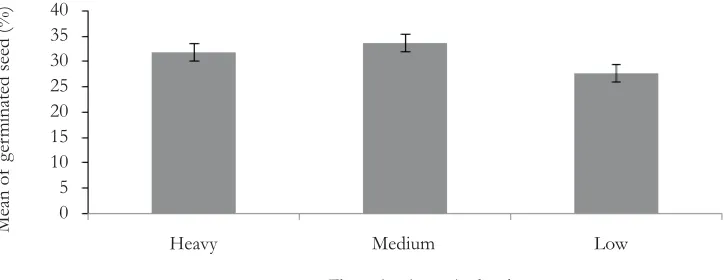
was not significantly different between flowering intensity levels (df = 2; MS = 1.49; Pr = 0.67) and/or among families sample (df = 31; MS = 5.414; Pr = 0.088). Mean seed viability was 31%; in which capsules produced from trees of high flowering intensity did not differ significantly with capsules produced from trees of low flowering intensity (see Figure 4).
cajuputi et al. et al
et al. M. cajuputi
cajuputi
et al.
M. cajuputi cajuputi
, .,
,
,
,
C. Seed Viability
Figure 2. Variation in mean capsule production and associated standard error of sub sp.
between replications/blocks
M. cajuputi cajuputi
Table 2. Estimation of genetic and phenotypic correlation (r ) between capsule production and growth traits (height and diameter). Genetic correlations were shown above the diagonal and phenotypic correlations were shown below the diagonal
g
Trait
Genetic correlation (rg)
Capsule production (score) Height (m) Diameter (cm)
Capsule production * -0.87 (0.41) -0.25 (0.45)
Height 0.4 * 0.89 (0.62)
Diameter 0.09 0.6 *
This study therefore indicated that the viability
of sub sp. from the full-sib trial
at Gunungkidul, Yogyakarta population was low, at only 31%. Previous study of reproductive success of this species found that the
reproductive success of sub sp.
of open pollinated seed is 32% - 36% (Hendrati
2002; Baskorowati 2008). Weins
(1987) in Owen (1991) informs that in
general outcrossing species have a low reproductive success often below 30%, whereas inbreeding species has a high reproductive success.
Low viability has been found in other population of this species and other species of
. Baskorowati (2008), for example,
reported viability rates of 6 to 32% for various
M. cajuputi cajuputi
M. cajuputi cajuputi et
al et al. et al
et al
Melaleuca et al.
., , .,
.,
provenances of sub sp. at a
seedling seed orchard. Meskimen (1962) found rates of between 3% and 28% viability for
in Northern NSW and Southern Queensland.
Low genetic diversity of the parent populations is widely recognized as a major contributing factor to low viability (Young
1996; Cunningham, 2000). Environmental factors also are hypothesized to significantly influence the ability of seed to germinate by initiating or inhibiting (delaying) germination. If environmental factors such as temperature, salinity, or sediment composition are the main influence on the ability of a seed to germinate, then one logical reason for seeds to not germinate under the optimal conditions would be a lack of viability.
M. cajuputi cajuputi
M. quiquenervia
et al.,
Figure 3. Effect of flowering intensity on the capsule production
Figure 4. Mean percentage and associated standard errors of germinated seed per flowering intensity levels
Number
of
capsules
60000 50000 40000 30000 20000 10000 0
Flowering strength
0 0.5 1 1,5 2 2,5 3 3,5
Flowering intensity levels
Heavy Medium Low
40 35 30 25 20 15 10 5 0
Mean
of
ger
minated
seed
IV. CONCLUSION
ACKNOWLEDGEMENT
REFERENCES
This study revealed that each family of
sub sp in full-sib seedling trial at
Gunungkidul, Yogyakarta equally contributed to the seed production. However in this study site, the seed productions are not strongly under
genetic control = 0.12. This study found
positive correlation between the flowering strength (the flower production levels) and the number of capsule (R =0.279); however, there were no significant differences between the
flowering levels and viability of sub sp.
.
This research was funded by Australian Centre for International Agricultural Research, Canberra, Australia through John All Wright Returnee Award Program 2009 awarded to the author. Technical support was provided by Forest Biotechnology and Tree Improvement Research Institute, Jogjakarta, Indonesia. The author is very grateful to Mrs. Alin Maryanti and Mr. Sukidjan for the field assistance.
Baskorowati L., R. Umiyati, N.K. Kartikawati, A. Rimbawanto and M. Susanto. 2008. Pembungaan dan pembuahan
sub sp. Powell. di kebun
benih semai Paliyan, Gunungkidul, Yogyakarta.
2 (2): 189-202.
Baskorowati L., M.W. Moncur, S.A. Cunningham, J.C. Doran and P.J. Kanowski. 2010. Reproductive biolog y of
(Myrtaceae): 2 incompatibility and pollen transfer in relation to the breeding system
58(5): 384-391.
Bosch, M. and N.M. Waser. 1999. Effect of local density on pollination and reproduction in
and (Ranunculaceae).
86(6): 871-879.
M. cajuputi . cajuputi
M. cajuputi cajuputi
Melaleuca cajuputi cajuputi
Jurnal Pemuliaan Tanaman Hutan
Melaleuca alternifolia
Australian Journal of Botany
Delphinium nuttalianum Aconitum
columbianum American
Journal of Botany (h i)2
2
Butcher, P.A., J.C. Bell, and G.F. Moran. 1992. Patterns of genetic diversity and nature of the breeding system in
(Myrtaceae). 40:
365 - 375.
Craven, L.A., 1999. Behind the names: the botany
of tea tree, cajuput and niaouli. :
Southwell I. and R. Lowe. (Eds.)
, Harwood Academic Publishers, Australia, pp. 11 - 28.
Cunningham, S.A., 2000. What determines the number of seed produced in a flowering event? A case study of
(Arecaceae). 48: 659-665.
Doran, J.C. and G.F. Moran. 2002. Development of DNA markers for breeding of tea tree. A report for the Rural Industries Research and Development Corporation. CSIRO, Canberra, 45 pp.
Doran, J.C., A. Rimbawanto, B.V. Gunn and A. Nirsatmanto. 1998. Breeding plan for
sub sp. in Indonesia.
Technical Report No. 98/178, CSIRO Forestry and Forest Products, Canberra, Australia, 60 pp.
Duncan, D.H., A.B. Nicotra and S.A.
Cunningham. 2004. High self-pollen
transfer and low fruit set in buzz-pollinated (Phormiaceae).
52: 185-193.
Gunn B.V., M.W. McDonald, D. Lea, B. Leksono, and J. Nahusana. 1997. Ecology, seed and leaf collections of Cajuput (
) from Indonesia and Australia.
112: 36-43.
Griffin, A.R., C.Y. Wong, R. Wickneswari and E. Chia. 1992. Mass production of hybrid seed
of x
inbiclonal seed orchards. L. T. Carron
and K. M. Aken.
(Eds.) ACIAR Canberra, pp. 70-75.
Hendrati, R.L., L. Baskorowati and N. Kartikawati. 2002. Reproductive biology of
sub sp. . : A.
Rimbawanto and M. Susanto. (eds.)
Melaleuca alternifolia Australian Journal of Botany
In Tea Tree the Genus Melaleuca
Calyptrogyneghies breghtiana Australian Journal of Botany
Melaluca cajuputi cajuputi
Dianella revolute Australian Journal of Botany
Melaleuca cajuputi
IPGRI Plant Genetic Resources Newsletter
Acacia mangium Acacia auriculiformis In:
Breeding technologies for tropical acacias
Proceedings International Seminar 'Advances in Genetic Improvement of Tropical Tree Species'
eucalypts In
Eucalypt Ecolog y
Horticultural Abstracts
Melaleuca cajuputi cajuputi Jurnal Penelitian Hutan Tanaman
Physiology of trees
Brassia kaber. The Journal of Ecology
Forestry Abstracts
Melaleuca quinquenervia
New Forests
, Centre for Forest Biotechnology and Tree Improvement, Jogjakarta, Indonesia, pp. 139 -143.
House, S.M., 1997. Reproductive biology of
. : J. E. Williams and J. C. Z.
Woinarski. (Eds.) ,
Cambridge University Press, Cambridge, pp. 30-50
Jackson, D.I. and Sweet, G.B., 1972. Flower initiation in temperate woody plants.
42: 9 - 24.
Kartikawati, N. K., 2005. Tingkat inkompatibilitas bersilang sendiri pada tanaman kayu putih (The level of self-incompatibility of
sub sp. ).
, 2: 141 - 147. Kramer, P.J. and T.T. Kozlowski. 1960.
. Mc Grow Hill Book Company, New York, 624 pp.
Kunin, W.E., 1997. Population size and density effects in pollination: Pollinator foraging and plant reproductive success in experimental arrays of
85: 225 -234.
Mathews, J. D., 1963. Factors effecting the production of seed by forest trees.
24: i-xiii.
Meskimen, G.F., 1962. A silvical study of the tree in South Florida. Gainesville, Florida: University of Florida. 177 pp.
Moran, G.F., 1992. Patterns of genetic diversity in
Australia tree species. 6: 49 - 66.
Owen, J. N., P. Sornsathapornkul and S. Tangmitcharoen. 1991. Manual Studying Flowering and Seed Ontogeny in Tropical Forest Trees, ASEAN-Canada, Forest Tree Seed Centre Project, Muak Lek Saraburi, Thailand, 134 pp.
Payne, R.W., P.W. Lane, A.E. Ainsley, K.E. Bicknell, P.G.N. Digby, S.A. Harding, P.K. Leech, H.R. Simpson, A.D. Tood, P.J. Verrier, R.P. White, J.C. Gower, and G.
Tunnicliffe-Wilcon. 1987.
. Oxford University Press, New York, 749pp.
Pinyopusarerk, K., A. Kalinganire, E.R. Williams, and K.M. Aken. 2004. Evaluation of International Provenance Trials of
.
No. 58e, Canberra, 106 pp.
Rimbawanto A., N.K. K ar tikawati, L. Baskorowati, M. Susanto and Prastyono. 2009. Status terkini pemuliaan
Prosiding ekspose hasil-hasil p e n e l i t i a n B a l a i B e s a r Pe n e l i t i a n Bioteknologi dan Pemuliaan Tanaman Hutan, 1 Oktober, pp. 148-157.
Robinson, R. W., P.I. Boon and P. Bailey. 2006. Germination characteristics of
Sm. (swamp paper bark) and their implications for the rehabilitation of coastal
wetlands. 57:
703-711.
Rosseto, M., R.W. Slade, P.R. Baverstock, R.J. Henry, and L.S.Slee. 1999. Microsatelite variation and assessment of genetic
structure in tea tree (
-Myrtaceae). 8: 633 -643.
Turnbull, J. and J. Doran. 1987. Seed development
and germination in the Myrtaceae. P.
Langkamp. P. (Eds.)
. Inkata Press, Melbourne, pp. 46 - 57.
Williams, E.R., A.C. Matheson and C.E. Hardwood. 2002.
Second edition, CSIRO Publishing, Australia, 214 pp. Yamada, H., P. Tambunan, F. Mangkuwibowo,
R.L. Hendrati and C. Osamu. 2001. Study on the prediction of seed production in seedling seed orchards of
and . FTIP-P2-No.28, JICA
and FORDA, 65 pp.
Young, A., T. Boyle and T. Brown. 1996. The population genetic consequences of habitat fragmentation for plants.
11 (10): 413-418.
Genstat 5 Refference Manual
Casuarina sequisetifolia ACIAR Technical Reports
Melaleuca cajuputi.
Melaleuca ericifolia
Marine and Freshwater Research
Melaleuca alternifolia Molecular Ecology
In: Germination of Australian Native Plant Seed
Experimental Design and Analysisfor Tree Improvement.
Acacia mangium Eucalyptus pellita