How to cite:
Putri WU, Qayim I, Qadir A (2017)Soil Seed Bank of Two Karst Ecosystems in Bogor, Indonesia: Similarity with the Above-ground Vegetation and its Restoration Potential. J. Trop. Life. Science 7 (3): 224 – 236.
*Corresponding author: Winda Utami Putri
Department of Biology, Faculty of Mathematics and Natural Sciences, Bogor Agricultural University
Dramaga, Bogor, Indonesia 16680 E mail: [email protected]
VOL. 7, NO. 3, pp. 224 – 236, September 2017 Submitted October 2016; Revised April 2017; Accepted June 2017
Soil Seed Bank of Two Karst Ecosystems in Bogor, Indonesia: Similarity with the Aboveground
Vegetation and Its Restoration Potential
Winda Utami Putri 1*, Ibnul Qayim 1, Abdul Qadir 2
1 Department of Biology, Faculty of Mathematics and Natural Sciences, Bogor Agricultural University, Bogor, Indonesia 2 Department of Agronomy and Horticulture, Faculty of Agriculture, Bogor Agricultural University, Bogor, Indonesia
ABSTRACT
Karst ecosystem in Bogor is currently threatened by mining activities. Restoration of the disturbed karst areas is urgently required. Seed banks are considered as an important potential seed sources for restoration. This study was conducted to quantify the composition and species diversity of the aboveground vegetation and the seed bank. The study determined the correspondence between the seed bank with the aboveground vegetation in relation with ecosystem restoration. Twenty 6 m × 6 m vegetation plots were established. A total of sixty soil samples were taken from the study sites. The seed bank was studied using germination experiment. All plant species in the vegetation plots and seedlings growing from all soil samples were identified and the number was counted to determine the composition, index of diversity, and index of similarity. There were 80 species from 41 families found in the seed bank in Mt. Nyungcung, dominated by Clidemia hirta (Melastomataceae), whereas 50 species from 29 families found in Mt. Kapur with Cecropia peltata (Urticaceae) dominated the site. Diversity index of Mt. Nyungcung and Mt. Kapur seed banks were 2.09 ± 0.21 and 1.78 ± 0.47 respectively. The similarity index between seed bank and the aboveground vegetation in the two study sites were 32.86% and 27.66% respectively. Mt. Nyungcung seed bank was more diverse than Mt. Kapur. The similarity between the seed bank with the aboveground vegetation in the two study sites were low. Further assessment is needed to determine the role of the seed bank of Mt. Nyungcung and Mt. Kapur in the restoration of the ecosystems.
Keywords: Diversity, germination, karst, soil seed bank, vegetation INTRODUCTION
Karst area is natural landscape of sedimentary rock that consists primarily of calcium carbonate. Tectonic movements lifted the karst above sea level after they were formed million years ago by calcium secreted ma-rine organism. The total of karst area in Indonesia is 145,000 km2, 15% of which are protected [1]. Karst area
possesses high ecological values especially in term of species endemicities. Karst vegetation has important role in securing water supply for the surrounding environ-ment by absorbing and supplying water. The vegetation also supports the existence of other components of the ecosystem such as wild animals.
Soil seed bank (hereafter referred as seed bank) is a
reservation of viable and ungerminated seeds either in the above or belowground of a habitat [2]. Ecologically, seed banks acts as seeds reservation that will prevent fur-ther extinctions of vulnerable local species [3]. The seed bank has also become an important part in plant regen-eration process after disturbance [4].
study was conducted to quantify the composition and species diversity of the standing vegetation and the seed bank. The study determined the correspondence be-tween the seed bank and the aboveground vegetation in relation with ecosystem restoration.
MATERIALS AND METHODS
This study was conducted on September 2015 until August 2016. Data were gathered from karst ecosystem
in Mount (Mt.) Nyungcung (06°27’15.3” S and 106°38’45.8” E) and Mt. Kapur (06°32’59.8” S and
106°41’16.1” E), both are in Bogor Regency. Both sites
were mined from around nineteen eighties. Mining ac-tivity in Mt. Nyungcung was ended around 2005 while in Mt. Kapur is still operating.
Vegetation data and soil sample collection
Twenty plots were established to collect data on veg-etation composition. The size of each plot was 6 m × 6 m, which was determined by preliminary investigation on the species number plotted in a graph from previous study conducted by [5]. All plant species in the plot were identified directly in the field based on their morpholog-ical characteristics. Herbarium voucher of unidentified plants was collected for further identification at Kebun Raya Bogor. Vegetation data were used to compare the composition of the vegetation with the composition of the seed bank. A total of sixty soil samples were taken from twenty vegetation plots. The size of each plot was 1 m × 1 m with 5 – 10 cm depth. Vegetation and soil plots was placed using purposive sampling technique. The plots in Mt. Nyungcung were placed at 193 – 218 m above sea level (asl) and in Mt. Kapur at 258 – 310 m asl.
Germination experiment
Seed bank testing was conducted using the germi-nation experiment. All soil samples from the same site were composited. The composited soil was placed in 44 cm × 35 cm × 10 cm germination plastic trays which are filled with 5 – 7 cm depth of sterilized sand. Germina-tion experiment started by covering all the germinaGermina-tion trays using clear plastic cover for the first two months to maintain the temperature and humidity in favorable condition for the seeds to germinate. The germination trays were then transferred to the glass house after the seeds germinated to allow them to grow into seedlings for identification purposes. Seedling identification were visually done by observing specific morphological char-acters of a plant.
Data analysis
Shannon’s diversity index (H’) [6] was determine
using the following formula:
𝐻′= − ∑ 𝑝𝑖 𝐿𝑛 𝑝𝑖 𝑛
𝑖=1
Note:
pi: proportion of individuals belonging to the ith species
Margalef species richness index (R) [7] was obtain by formula:
𝑅 =𝐿𝑛(𝑁)𝑆 − 1
Note:
S: Number of species
N: Total number of individual plant
Shannon’s evenness index (E) [8] was calculated
us-ing formula:
𝐸 =𝑙𝑛(𝑆)𝐻′
Note:
H’: Shannon’s diversity index
S: Number of species
The similarity of species composition in the seed bank and the aboveground vegetation on each location were analyzed using Sorensen Index of Similarity [9] formula:
𝐼𝑆 =𝑎 + 𝑏 × 100%2𝐽 Note:
J: Number of the same species in a and b a: Number of Species in a
b: Number of species in b
Independent sample t-test were performed on the diversity, evenness, and species richness index. Data analysis were conducted using Microsoft Excel and SPSS 22 software.
RESULTS AND DISCUSSION
Composition of the aboveground vegetation and its di-versity
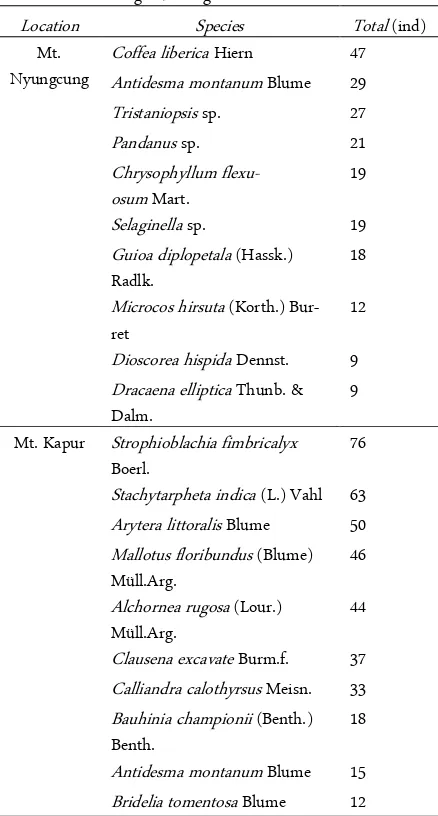
The field study found 354 plants belonging to 60 plant species from 40 families in the aboveground vege-tation of Mt. Nyungcung. Coffea liberica (Rubiaceae) dominated the site followed by Antidesma montanum
Table 1. List of top ten most abundant plant species composing the aboveground vegetation
Location Species Total (ind)
Mt. Nyungcung
Coffea liberica Hiern 47 Antidesma montanum Blume 29
Tristaniopsis sp. 27
Pandanus sp. 21
Chrysophyllum flexu-osum Mart.
19
Selaginella sp. 19
Guioa diplopetala (Hassk.) Dioscorea hispida Dennst. 9 Dracaena elliptica Thunb. & Dalm.
9 Mt. Kapur Strophioblachia fimbricalyx
Boerl.
76 Stachytarpheta indica (L.) Vahl 63 Arytera littoralis Blume 50 Mallotus floribundus (Blume) Clausena excavate Burm.f. 37 Calliandra calothyrsus Meisn. 33 Bauhinia championii (Benth.) Benth.
18 Antidesma montanum Blume 15 Bridelia tomentosa Blume 12
more plant number but fewer number of plant species compare to that of Mt. Nyungcung. There were 528 plants belonging to 46 species from 23 families, in the site. The most abundant species were Strophioblachia
fimbricalyx (Euphorbiaceae) followed by Stachytarpheta
indica (Verbenaceae). In Mt. Kapur, the plants mostly
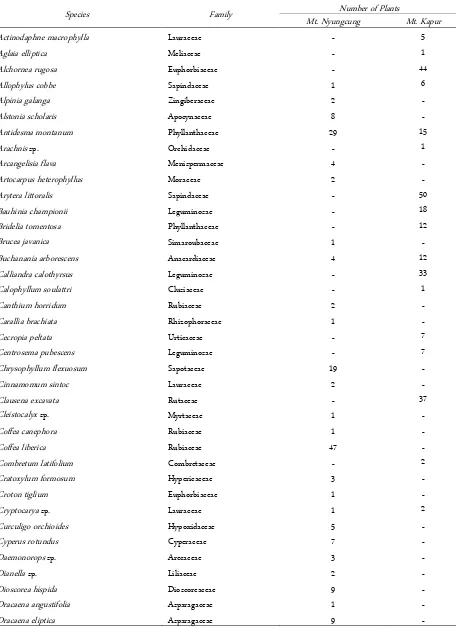
belong to Anacardiaceae, Euphorbiaceae, Leguminosae, Rutaceae, Sapindaceae and Verbenaceae. The complete list of the species is given as Appendix 1.
Pioneer species such as Macaranga rhizinoides and Macaranga tanarius both Euphorbiaceae were recorded in the aboveground vegetation of the two sites indicated early successional stage of the karst ecosystem. These species can withstand hostile environment of the karst area including high light intensity, thin solum and drought. The relatively open area of karst and the high
light intensity that were varied between 417 – 484 × 10 lux in Mt. Nyungcung and 1,816 – 1,823 ×10 lux in Mt. Kapur supported the growth of several species such as
Cecropia peltata (Urticaceae) and Melastoma
malabath-ricum (Melastomataceae).
The presence of several invasive species such as
Coffea liberica (Rubiaceae) and Piper aduncum
(Pipe-raceae) were also recorded in the aboveground vegeta-tion of Mt. Nyungcung and Mt. Kapur. The invasive species may have been colonizing the two study sites af-ter disturbance and considered to negatively impact the natural environment by replacing indigenous species [10]. Their presence at a site may be part of the condi-tion leading to assessment that restoracondi-tion is needed [11].
Diversity index of Mt. Nyungcung was higher com-pare to that of Mt. Kapur. The aboveground vegetation of Mt. Nyungcung had 2.65 ± 0.54 of diversity index, while Mt. Kapur had 2.51 ± 0.71. Higher value of Mt. Nyungcung diversity index showed by higher species number and more even species distribution which was indicated by higher species richness and evenness index. Value of species richness and evenness index in Mt. Nyungcung were 4.56 ± 1.21 and 0.95 ± 0.15 respec-tively, while in Mt. Kapur were 2.46 ± 0.84 and 1.07 ± 0.25. The species richness in the two study sites were significantly different (t = 4.515, df = 18, P = 0.00).
Seed bank characteristics: composition and species di-versity
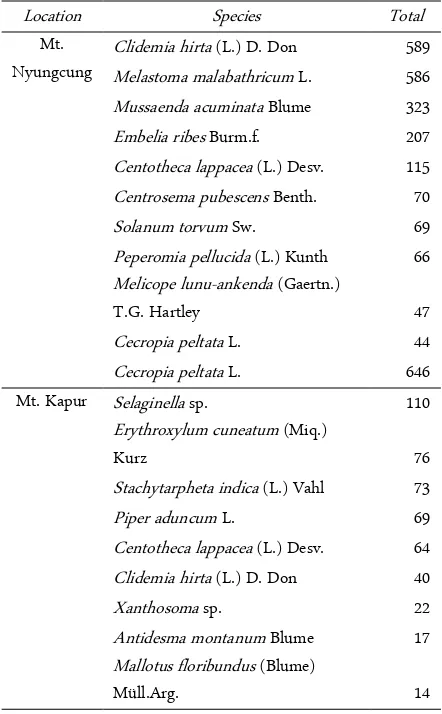
Mount Nyungcung seed bank comprised of 2602 seedlings belonging to 80 plant species from 41 families. The most abundant species were Clidemia hirta followed
by M. malabathricum both Melastomataceae (Table 2).
The largest family composing Mt. Nyungcung seed bank were Melastomataceae, subsequently followed by Rubi-aceae, PrimulRubi-aceae, Poaceae and Solanaceae.
The total number of plant species in the seed bank of Mt. Nyungcung were higher compare to that of Mt. Kapur. In Mt. Kapur seed bank, 1280 seedlings belong-ing to 50 plant species from 29 families were recorded.
C. peltata (Urticaceae) was the most abundant species
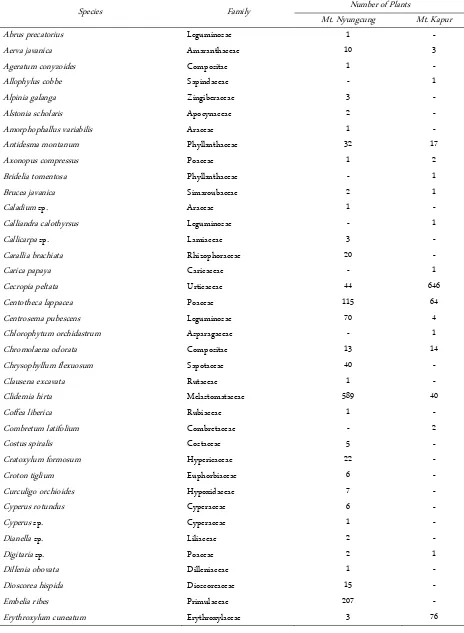
in Mt. Kapur. Urticaceae was the largest family compos-ing Mt. Kapur seed bank followed by Selaginellaceae, Poaceae, Erythroxylaceae and Verbenaceae. The com-plete list of the species is given as Appendix 2.
Nyungcung and Mt. kapur were dominated by shrubs and herbs. The tree species in both study sites were rel-atively low but in Mt. Kapur the numbers were slightly higher. Forests in Karst area have relatively smaller number of tree species compared to forests with thick solum [12]. Field observation showed that the Mt. Ka-pur solum was a little bit thicker by approximately 5-10 cm than Mt. Nyungcung. Therefore, trees in Mt. Kapur have bigger chances to survive and store their seeds in the soil.
The studied seed bank was dominated by small-seeded species while the standing vegetation was domi-nated by large-seeded species. Annual species such as
Laportea aestuans (Urticaceae), Solanum americanum
(Solanaceae), and Momordica charantia (Cucurbitaceae) were recorded present in the seed bank. Short-lived an-nual species maintains its existence by relying their re-generation on seeds, therefore accumulates their seeds in the seed bank.
The study also recorded the presence of few long-lived dominant trees species that has seeds accumulation prevention self-mechanism which was largely due to trade-offs between seed size and seed production and be-tween seed size and persistence. Large seeds typically produced in lower numbers than small seeds and gener-ally accumulating in the seed bank more ineffectively [13, 14].
The seed bank had been classified into transient and persistent, depending on the seeds persistence in the soil whether less or more than a year [15]. The length of the germination experiment suggested that the studied seed banks were mostly transient. However, we also con-firmed the presence of persistent seed bank. In the stud-ied site where invasion process occurred, the seed bank had become dominated by seeds of weedy species, which typically possess large, persistent seed banks [16]. Pio-neer species which were present after disturbance in the two studied sites had also formed the persistent seed bank by producing persistent seeds that remain in the seed bank [17].
The presence of invasive species such as C. peltata
(Urticaceae) and Piper aduncum (Piperaceae) in the seed bank showed that the seed bank had been invaded.
C. peltata which dominated Mt. Kapur seed bank
pro-duces large amounts of seeds which can remain fertile for years until germination occur [18]. Seed germination of the invasive species may potentially cause the rapid dominance of the species in the aboveground vegetation [19] that can lead to species loss and habitat degrada-tion.
Species diversity index of Mt. Nyungcung seed bank were significantly different from those of Mt. Kapur (t = 3.117, df = 57, P = 0.04). Mt. Nyungcung had 2.09 ± 0.21 of diversity index, while Mt. Kapur had 1.78 ± 0.47. Species diversity in Mt. Nyungcung was higher than that of Mt. Kapur. The species diversity of the seed bank has positive correlation with the species diversity of the aboveground vegetation [20]. Value of the species rich-ness index in Mt. Nyungcung and Mt. kapur were 3.97 ± 0.53 and 2.82 ± 0.64 respectively. Species richness in-dex of Mt. Nyungcung seed bank were significantly dif-ferent from those of Mt. Kapur (t = 7.490, df = 57, P = 0.00). Evenness index in Mt. Nyungcung and Mt. Ka-pur were 0.72 ± 0.09 and 0.76 ± 0.19 respectively. Num-ber of plant species in Mt. Nyungcung seed bank was higher and more evenly distributed between the species. The species diversity of the two seed banks were in the same level with the aboveground vegetation. The species diversity was moderate based on [21] classification but the species composition was different. In the coming pe-
Table 2. List of top ten most abundant plant species compos-ing the seed banks
Location Species Total
Mt. Nyungcung
Clidemia hirta (L.) D. Don 589 Melastoma malabathricum L. 586 Mussaenda acuminata Blume 323
Embelia ribes Burm.f. 207
Centotheca lappacea (L.) Desv. 115 Centrosema pubescens Benth. 70
Solanum torvum Sw. 69
Peperomia pellucida (L.) Kunth 66 Melicope lunu-ankenda (Gaertn.)
T.G. Hartley 47
Cecropia peltata L. 44
Cecropia peltata L. 646
Mt. Kapur Selaginella sp. 110
Erythroxylum cuneatum (Miq.)
Kurz 76
Stachytarpheta indica (L.) Vahl 73
Piper aduncum L. 69
Centotheca lappacea (L.) Desv. 64 Clidemia hirta (L.) D. Don 40
Xanthosoma sp. 22
Antidesma montanum Blume 17
Mallotus floribundus (Blume)
riod, the seed bank will probably increase the species diversity of the standing vegetation by adding the num-ber of species present in vegetation.
Similarity between seed bank and the aboveground veg-etation
Result of germination experiment showed that there were 118 and 84 plant species in the seed bank and the aboveground vegetation of Mt. Nyungcung and Mt. Ka-pur. From that numbers, 49.15% were present in the seed bank but absent in the aboveground vegetation, 31.36% occurring the aboveground vegetation but ab-sent from the seed bank of Mt. Nyungcung. In Mt. Ka-pur 45.24% of the species were present in the seed bank but absent in the aboveground vegetation, 39.29% pre-sent in the aboveground vegetation but abpre-sent from the seed bank. These findings were in agreement with few other studies on seed bank which showed that there were plant species recorded in the seed bank but were not part of the current standing vegetation [22,23].
The similarity index between the seed bank and the aboveground vegetation of Mt. Nyungcung was 32.86% while in Mt. Kapur was 27.66%. The species similarity was low, as found in most studies comparing the com-position of established vegetation and seed bank [24]. The seed banks were poor predictors of the aboveground vegetation of Mt. Nyungcung and Mt. Kapur. Many of the plant species found in the seed bank were absent in the aboveground vegetation. Result of germination ex-periment was in agreement with [25, 26] finding which showed that there was no strong relationship between species composition of the seed bank with the species composition of its aboveground vegetation.
There were two factors that might explain the low similarity between the seed bank and the aboveground vegetation in the study site. The first factor was the el nino occurrence in Indonesia when the study was con-ducted (reported by The Indonesian Agency for Mete-orology, Climatology, and Geophysics). El nino caused several plant species in the two study sites unable to sur-vive, but may had stored seeds in the seed bank prior to their deaths. Second, the presence of invasive species in the aboveground vegetation may cause another plant species to disappear because of a range of mechanisms associated with an invasion [27], but their seeds might still be present in the seed bank. Thus, several plant spe-cies recorded in the seed bank were not present in the aboveground vegetation. The similarity between the seed bank and the aboveground vegetation is low at heavily invaded or long term invaded sites [28] just like
Mt. Nyungcung and Mt Kapur.
Seed bank and ecosystem restoration
Seed banks play important roles in conservation of plant species. Components of species diversity in the form of seed bank are readily available to support the ecosystem restoration after disturbances. Seed banks of the two studied sites have low similarity with the above-ground vegetation, thereby affecting its ability in sup-porting the ecosystem restoration.
There are two possibilities that explain the low sim-ilarity between seed bank and aboveground vegetation, each has different consequences for the ecosystem resto-ration (if we exclude the seeds of the invasive species in the seed bank). First, the seed bank stored seeds from trees that were previously occupied the aboveground vegetation but no longer existed. The consequence of this possibility is that even if the similarity was low, the seed bank can still support the ecosystem recovery and allows natural restoration to occur. Second, the seed bank stored seeds that were carried by dispersal agents such as animals and humans from outside the ecosys-tem. They bring different consequences to that of the first possibility. The seed bank will have limitation in supporting the ecosystem recovery of the area. There-fore, a man managed restoration is needed. Further anal-ysis of the aboveground vegetation composition prior to the mining activity needed to be done to determine the capacity of the current seed bank in supporting the eco-system recovery.
The presence of invasive species in the studied seed banks may indicate a constraint in ecosystem restora-tion. Invasion process may change the composition of the native species seed bank, thereby affecting its resto-ration potential. Information on the origin of the seeds in the seed bank are required to develop an effective res-toration strategy. The resres-toration potential of the seed bank as the total biodiversity reservoir in the site is likely to be restored if the invasive species could be controlled or eliminated.
CONCLUSION
Mt. Nyungcung vegetation and seed bank was more diverse than Mt. Kapur. The similarity between the seed bank with the aboveground vegetation in the two sites were low. The seed banks were poor predictors of the aboveground vegetation.
from the analysis can determine the capacity of the cur-rent seed bank in supporting the ecosystem recovery of Mt. Nyungcung and Mt. Kapur.
ACKNOWLEDGMENT
This study was funded by the Indonesia Endow-ment Fund for Education, Ministry of Finance of The Republic of Indonesia. We are thankful for all the sup-ports especially research facilities from Bogor Agricul-tural University and Kebun Raya Bogor.
REFERENCES
1. Clements R, Sodhi NS, Schilthuizen M, Ng PKL (2006) Limestone karst of Southeast Asia: imperiled arks of biodi-versity. BioScience 56 (9): 733 – 742. doi: 10.1641/0006-3568(2006)56[733:LKOSAI]2.0.CO;2.
2. Baskin CC, Baskin JM (2001) Seeds: Ecology, biogeography, and evolution of dormancy and germination. San Diego, Ac-ademic Press.
3. Aparicio A, Guisande R (1997) Replenishment of the endan-gered Echinospartum algibicum (Genisteae, Fabaceae) from the soil seed bank. Biological Conservation 81 (3): 267 – 273. doi:10.1016/S0006-3207(96)00154-1.
4. Hyatt LA, Casper BB (2000) Seed bank formation during early secondary succession in a temperate deciduous forest. J Ecol. 88: 516-527. doi: 10.1046/j.1365-2745.2000.00465.x. 5. Satyanti A, Kusuma YWC (2010) Ecological study in two
quarried limestone karst hills in Bogor West Java: vegetation structure and floristic composition. Biotropia 17 (2): 115 – 129.
6. Dice LR (1945) Measures of the amount of ecologic associa-tion between species. Ecology 26 (3): 297–302. doi:10.2307/1932409 .
7. Clifford HT, Stephenson W (1975) An introduction to nu-merical classification. London, Academic Express. 8. Ludwig JA, Reynolds JF (1988) Statistical ecology a primer
on methods and computing. New York, John Wiley and Sons, Inc.
9. Shannon CE, Weaver, W (1949) The mathematical theory of communication. Urbana, University of Illinois Press. 10. Rogers HM, Hartemink AE (2000) Soil seed bank and
growth rates of an invasive species, Piper aduncum, in the lowlands of Papua New Guinea. Journal of Tropical Ecology 16 (2): 243 – 251.
11. D’Antonio CD, Meyerson LA (2002) Exotic plant species as problems and solutions in ecological restoration: A synthe-sis. Restoration Ecology 10 (4): 703 – 713. doi: 10.1046/j.1526-100X.2002.01051.x.
12. Crowther J (1982) Ecological observations in a tropical karst terrain, West Malaysia. I. Variations in topography, soils and vegetation. Journal of Biogeography 11 (1): 65 – 78. doi: 10.2307/2844731.
13. Fenner M, Thompson K (2005) The ecology of seeds, 2nd ed. Cambridge, Cambridge University Press.
14. Thompson K, Bakker JP, Bekker RM, Hodgson J (1998) Eco-logical correlates of seed persistence in soil in the north-west European flora. Journal of Ecology 86 (1): 163 – 169. doi: 10.1046/j.1365-2745.1998.00240.x.
15. Thompson K, Band SR, Hodgson JG (1993) Seed size and shape predict persistence in soil. Functional Ecology 7 (2): 236 – 241. doi: 10.2307/2389893.
16. Gioria M, Osborne BA (2009) Assessing the impact of plant invasions on soil seed bank communities: Use of univariate and multivariate statistical approaches. Journal of Vegetation Science 20 (3): 547 – 556. doi: 10.1111/j.1654-1103.2009.01054.x .
17. Hopfensberger KN (2007) A review of similarity between seed bank and standing vegetation across ecosystems. Oikos 116 (9): 1438 – 1448. doi: 10.1111/j.0030-1299.2007.15818.x. 18. Sheil D, Padmanaba M (2011) Innocent invaders? A
prelim-inary assessment of Cecropia, an American tree, in Java. Plant Ecology and Diversity 4 (2 – 3): 279 – 288. doi: 10.1080/17550874.2011.610371.
19. Gioria M, Osborne BA (2010) Similarities in the impact of three large invasive plant species on soil seed bank commu-nities. Biological Invasions 12 (6): 1671 – 1683. doi: 10.1007/s10530-009-9580-7.
20. Leckie S, Vellend M, Bell G et al. (2000) The seed bank in an old-growth, temperate deciduous forest. Canadian Jour-nal of Botany 78 (2): 181 – 192. doi: 10.1139/b99-176. 21. Magurran AE (1988) Ecological diversity and its
measure-ment. New York, Chapman and Hall. doi: 10.1007/978-94-015-7358-0.
22. Bossuyt B, Hermy H (2001) Influence of land use history on seed banks in European temperate forest ecosystems: A re-view. Ecography 24 (2): 225 – 238. doi: 10.1034/j.1600-0587.2001.240213.x.
23. Decocq G, Valentin B, Toussaint B et al. (2004) Soil seed bank composition and diversity in a managed temperate de-ciduous forest. Biodiversity and Conservation 13 (13): 2485
– 2509. doi:10.1023/B:BIOC.0000048454.08438.c6. 24. Díaz-Villa MD, Marañón T, Arroyo J, Garrido B (2003) Soil
seed bank and floristic diversity in a forest-grassland mosaic in southern Spain. Journal of Vegetation Science 14 (5): 701
25. Godefroid S, Phartyal SS, Koedam N (2006) Depth distribu-tion and composidistribu-tion of seed banks under different tree lay-ers in a managed temperate forest ecosystem. Acta Oecolog-ica 29 (3): 283-292. doi:10.1016/j.actao.2005.11.005. 26. Chaideftou E, Thanos CA, Bergmeier E et al. (2009) Seed
bank composition and above-ground vegetation in response to grazing in sub-Mediterranean oak forests (NW Greece). Forest Ecology 201: 255 – 265. doi: 10.1007/s11258-008-9548-1.
27. Gioria M, Jarošík V, Pyšek P (2014) Impact of invasive alien plants on the soil seed bank: Emerging patterns. Perspectives in Plant Ecology, Evolution and Systematics 16 (3): 132 – 142. doi: 10.1016/j.ppees.2014.03.003.
Appendix 1
Table 3. List of plant species composing the aboveground vegetation of Mt. Nyungcung and Mt. Kapur
Species Family Number of Plants
Mt. Nyungcung Mt. Kapur
Actinodaphne macrophylla Lauraceae - 5
Aglaia elliptica Meliaceae - 1
Alchornea rugosa Euphorbiaceae - 44
Allophylus cobbe Sapindaceae 1 6
Alpinia galanga Zingiberaceae 2 -
Alstonia scholaris Apocynaceae 8 -
Antidesma montanum Phyllanthaceae 29 15
Arachnis sp. Orchidaceae - 1
Arcangelisia flava Menispermaceae 4 -
Artocarpus heterophyllus Moraceae 2 -
Arytera littoralis Sapindaceae - 50
Bauhinia championii Leguminosae - 18
Bridelia tomentosa Phyllanthaceae - 12
Brucea javanica Simaroubaceae 1 -
Buchanania arborescens Anacardiaceae 4 12
Calliandra calothyrsus Leguminosae - 33
Calophyllum soulattri Clusiaceae - 1
Canthium horridum Rubiaceae 2 -
Carallia brachiata Rhizophoraceae 1 -
Cecropia peltata Urticaceae - 7
Centrosema pubescens Leguminosae - 7
Chrysophyllum flexuosum Sapotaceae 19 -
Cinnamomum sintoc Lauraceae 2 -
Clausena excavata Rutaceae - 37
Cleistocalyx sp. Myrtaceae 1 -
Coffea canephora Rubiaceae 1 -
Coffea liberica Rubiaceae 47 -
Combretum latifolium Combretaceae - 2
Cratoxylum formosum Hypericaceae 3 -
Croton tiglium Euphorbiaceae 1 -
Cryptocarya sp. Lauraceae 1 2
Curculigo orchioides Hypoxidaceae 5 -
Cyperus rotundus Cyperaceae 7 -
Daemonorops sp. Arecaceae 3 -
Dianella sp. Liliaceae 2 -
Dioscorea hispida Dioscoreaceae 9 -
Dracaena angustifolia Asparagaceae 1 -
Species Family Number of Plants
Mt. Nyungcung Mt. Kapur
Dracaena surculosa Asparagaceae 1 -
Elaeocarpus floribundus Elaeocarpaceae 3 -
Erythroxylum cuneatum Erythroxylaceae 4 -
Ficus fistulosa Moraceae - 6
Ficus geocarpa Moraceae - 5
Ficus hirta Moraceae 1 -
Ficus montana Moraceae 1 -
Ficus septica Moraceae - 5
Flacourtia rukam Salicaceae 1 -
Flagellaria indica Flagellariaceae 1 -
Garcinia celebica Clusiaceae 9 -
Garcinia parviflora Clusiaceae 2 -
Glochidion macrocarpum Phyllanthaceae - 1
Glochidion philippicum Phyllanthaceae - 2
Glochidion rubrum Phyllanthaceae - 1
Glycosmis pentaphylla Rutaceae - 1
Gnetum cuspidatum Gnetaceae 3 -
Gnetum gnemon Gnetaceae 2 -
Guioa diplopetala Sapindaceae 18 -
Hiptage benghalensis Malpighiaceae - 4
Ixora javanica Rubiaceae 9 12
Lantana camara Verbenaceae 1 -
Lepisanthes rubiginosa Sapindaceae - 2
Litsea glutinosa Lauraceae - 1
Litsea umbellata Lauraceae - 2
Macaranga rhizinoides Euphorbiaceae 3 8
Macaranga tanarius Euphorbiaceae 2 -
Mallotus floribundus Euphorbiaceae 1 46
Melastoma malabthricum Melastomataceae 2 -
Melicope lunu-ankenda Rutaceae - 1
Microcos hirsuta Malvaceae 12 -
Mucuna sp. Leguminosae 1 -
Nauclea sp. Rubiaceae - 2
Pandanus sp. Pandanaceae 21 -
Parameria laevigata Apocynaceae - 1
Piper aduncum Piperaceae - 3
Polyscias diversifolia Araliaceae 7 -
Pothos junghuhnii Araceae 1 -
Pterospermum javanicum Malvaceae - 1
Species Family Number of Plants
Mt. Nyungcung Mt. Kapur
Rothmannia longiflora Rubiaceae - 12
Sauropus androgynus Phyllanthaceae - 5
Selaginella sp. Selaginellaceae 19 -
Smilax leucophylla Smilacaceae 9 -
Stachytarpheta indica Verbenaceae - 63
Strophioblachia fimbricalyx Euphorbiaceae - 76
Syzygium acuminatissimum Myrtaceae 9 -
Syzygium lineatum Myrtaceae 2 2
Syzygium pycnanthum Myrtaceae 2 -
Syzygium racemosum Myrtaceae 2 3
Tetracera scandens Dilleniaceae 2 1
Tristaniopsis sp. Myrtaceae 27 -
Uncaria gambir Rubiaceae 2 -
Uvaria concava Annonaceae 1 2
Vitex pinnata Lamiaceae 2 -
Voacanga grandifolia Apocynaceae - 5
Appendix 2
Table 4. List of plant species in the seed bank of Mt. Nyungcung and Mt. Kapur
Species Family Number of Plants
Mt. Nyungcung Mt. Kapur
Abrus precatorius Leguminosae 1 -
Aerva javanica Amaranthaceae 10 3
Ageratum conyzoides Compositae 1 -
Allophylus cobbe Sapindaceae - 1
Alpinia galanga Zingiberaceae 3 -
Alstonia scholaris Apocynaceae 2 -
Amorphophallus variabilis Araceae 1 -
Antidesma montanum Phyllanthaceae 32 17
Axonopus compressus Poaceae 1 2
Bridelia tomentosa Phyllanthaceae - 1
Brucea javanica Simaroubaceae 2 1
Caladium sp. Araceae 1 -
Calliandra calothyrsus Leguminosae - 1
Callicarpa sp. Lamiaceae 3 -
Carallia brachiata Rhizophoraceae 20 -
Carica papaya Caricaceae - 1
Cecropia peltata Urticaceae 44 646
Centotheca lappacea Poaceae 115 64
Centrosema pubescens Leguminosae 70 4
Chlorophytum orchidastrum Asparagaceae - 1
Chromolaena odorata Compositae 13 14
Chrysophyllum flexuosum Sapotaceae 40 -
Clausena excavata Rutaceae 1 -
Clidemia hirta Melastomataceae 589 40
Coffea liberica Rubiaceae 1 -
Combretum latifolium Combretaceae - 2
Costus spiralis Costaceae 5 -
Cratoxylum formosum Hypericaceae 22 -
Croton tiglium Euphorbiaceae 6 -
Curculigo orchioides Hypoxidaceae 7 -
Cyperus rotundus Cyperaceae 6 -
Cyperus sp. Cyperaceae 1 -
Dianella sp. Liliaceae 2 -
Digitaria sp. Poaceae 2 1
Dillenia obovata Dilleniaceae 1 -
Dioscorea hispida Dioscoreaceae 15 -
Embelia ribes Primulaceae 207 -
Species Family Number of Plants
Mt. Nyungcung Mt. Kapur
Ficus annulata Moraceae 5 -
Ficus coronata Moraceae 1 -
Ficus deltoidea Moraceae 4 -
Ficus hirta Moraceae 3 -
Ficus palmata Moraceae 1 2
Ficus sagitata Moraceae 2 -
Ficus septica Moraceae - 1
Ficus sp. Moraceae 1 -
Ficus uncinata Moraceae - 1
Galinsoga parviflora Compositae 28 2
Gmelina arborea Lamiaceae 2 -
Hibiscus calyphyllus Malvaceae - 1
Hibiscus macrophyllus Malvaceae 11 9
Hiptage benghalensis Malpighiaceae 1 9
Ischaemum timorense Poaceae 11 12
Lantana camara Verbenaceae 5
Laportea aestuans Urticaceae 4 6
Lepidaploa obtusifolia Compositae 2 -
Leucaena leucocephala Leguminosae - 7
Macaranga rhizinoides Euphorbiaceae 23 9
Macaranga tanarius Euphorbiaceae 27 13
Mallotus floribundus Euphorbiaceae 11 14
Melastoma malabathricum Melastomataceae 586 -
Melicope lunu-ankenda Rutaceae 47 -
Mikania micrantha Compositae 7 6
Momordica charantia Cucurbitaceae 1 -
Mussaenda acuminata Rubiaceae 323 1
Oxalis barrelieri Oxalidaceae - 2
Oxalis corniculata Oxalidaceae 2 2
Oxalis sp. Oxalidaceae - 1
Passiflora foetida Passifloraceae 1 1
Peperomia pellucida Piperaceae 66 3
Physalis minima Solanaceae - 3
Piper aduncum Piperaceae 3 69
Rhynchospora colorata Cyperaceae 2 -
Rostellularia sundana Acanthaceae 2 1
Rotheca serrata Lamiaceae 2 2
Rubus pubescens Rosaceae 10 -
Sauropus androgynus Phyllanthaceae 1 -
Species Family Number of Plants
Mt. Nyungcung Mt. Kapur
Scleria Sumatrensis Cyperaceae 2 2
Selaginella sp. Selaginella 29 110
Sida rhombifolia Malvaceae 1 -
Solanum americanum Solanaceae 16 6
Solanum diphyllum Solanaceae - 1
Solanum torvum Solanaceae 69 6
Spermacoce laevis Rubiaceae 13 2
Spigelia anthelmia Loganiaceae 2 6
Stachytarpheta indica Verbenaceae 2 73
Tetracera scandens Dilleniaceae 2 -
Torenia violacea Linderniaceae 10 -
Trema orientalis Cannabaceae 19 -
Uraria lagopodoides Leguminosae 1 -
Urochloa glumaris Poaceae 1 -
Vitex pinnata Lamiaceae 5 -