The Effect Of Trust Toward The Intention Of Using The Internet Banking System
Herni Setyanti Hadri Kusuma
International Program, Faculty of Economics, Universitas Islam Indonesia
Abstract
Purpose – This research aims to investigate and extend the technology acceptance model to an internet banking system setting by adding trust as a new variable.
Design/approach– The paper shows that in testing whether trust might be related to intention to use of the internet banking system, this research sampled 184 bank customers’ responses via a cross-sectional survey in Yogyakarta, Indonesia.
Findings– The finding in the paper indicates that trust has a significant positive relationship the intention of use of an internet banking system.
Practical implications – The paper shows that, from the managerial perspective, it is necessary for bank management and policy makers to know the relationship between trust and the behavior intention of use by customers because it influences on the actual use of information technology system. The findings of this study suggest that, in order to develop trust on the banking system, it is not going to be enough to make the system easy and useful. It is of paramount importance for banks to develop trust the systems that are safe, trustworthy, and interactive for their users. This may lead to better customer loyalty towards the system.
Originality – The paper finds that trust as an additional factor in a technology acceptance model has not been examined before. Thus, researchers should include trust in online relationship banking models along with ease of use and useful effects. Bank management and policy makers need to develop trust among the customers to make them more committed to using internet banking system for their daily banking transactions.
Keywords-Trust, ease of use, usefulness, internet banking system and intention to use.
Introduction
Information Technology (IT), as the term, is used in the report, means the collection, storage, processing, dissemination and use of information. One of the developments of the IT on recent days is the development of internet services. Internet is a vast computer network linking computer networks worldwide. The reasons why an internet system becomes important are that the internet connectivity has a broad reach, can reduce the cost of communication, lowers transaction costs, it is interactive, flexible and easy, and has the ability to quickly distribute the information (Laudon and Laudon, 2000).
The internet has become a daily life for both customer and bank industries. Several banks start to apply the internet as the system to integrate their activities for increasing the customer satisfaction and improving their productivity. This online banking has been introduced as a channel in which customer can do financial activities electronically through bank website. By using this service, the customer can do several banking activities without many movements from one place to another place. Customer can do the non cash transaction anytime easily by having access using the computer system (internet network). Transaction cost using internet banking is much cheaper than the other banking system services (Allen and Hamilton, 2002).
a new technology, including its system, two factors are considered: perceived of usefulness and perceived ease of use. This is the limitation of this model and therefore it opens for new additional variables.
Trust in the internet banking transaction becomes a very important thing to be considered. Trust is crucial in many such transactional, buyer-seller relationships, especially those containing an element of risk, including interacting with an-e-vendor (Reichheld and Scheffer, 2000). Trust is the central factor in many online transactions because human needs to know a lot about the social surroundings to identify what, when, why, and how others behave. Basically, bank should make the customers feel comfortable in the form of security and ease to use the internet banking because by this way, the trust from the customer to the bank will increase as well. Thus, trust is also mentioned as one of the important factors of successful e-banking (Suh and Han, 2002; Pikkaraninen, 2004; and Kannabiran and Narayan, 2005). In the Sathye’s (1999) research, it was also stated that security became the most important.
This research extends TAM by adding the variable trust to existing variables: perceived of usefulness and ease of use. Thus, this research focuses on the influence of customer trust toward the intention use of internet banking system. Because of that reason, the object was only the customers who had already used the internet banking system.
Review Of Related Literature Information Technology
Technology is a tool that is used by people for completing their tasks. It can be like computer system (hardware, software, and data) which is provided to help people in doing their tasks (Goodhue & Thompson, 1995 in Rahardjo, 2001). It is used to save and analyze the information then help people in accessing and getting the information easier.
There are so many activities which are done by people by using the technology. In our daily life, the example is when we do our task or assignment by using the computer. We have to input the data that we want to do in the computer, we save the data, and then we will get the output in the form of file that we have already done. When we talk about technology, we will consider on the information technology which exists around us. According to Eska Almuntaha (2008), information technology (IT) is defined as a technology that is used for data processing, include obtaining, arranging, saving, and manipulating the data in many ways to obtain the qualified information in which it should be relevant, accurate, and timeliness which can be used for private matters, business, and government. It is also as a strategic information for decision making.
Internet is one of the network systems which is operated to integrate between a system to the others. This network usually is used by several banks to make a service that can help the customers access their transaction easily. The example of service that implements the internet service is online banking system. Based on Polatoglu and Ekin (2001) statement, banks like offering their financial services over the internet to accelerate the adoption process. However, if the cost of using this online banking system is expensive, the banks will still enhance their opportunity to use this network because of its efficiency and effectiveness. The most obvious examples are products in internet banking, electronic payments, security investments, information exchanges, and so on (Berger, 2003).
Internet Banking
Based on the development of information technology (IT) which is the implementation of the internet network, banks try to innovate their services by some ways. There is a transaction or activity that is conducted based on internet service which is called internet banking system. Internet banking is defined as financial services which are provided via internet network. On the other words, internet banking can only be accessed if there is any connection to the internet. The transactions usually are in the term of non cash activities that is conducted everywhere and every time. It contains of checking the account balance in bank, transferring payments, and so on.
way (DeYoung, 2005). Internet banking system which contains fulfillment of the customers’ needs will increase the customer satisfaction of the bank services. If the internet banking relates to the system effectiveness, the useless system that is considered by the customer will not be effective. Because of that, it is important to identify the reason whether the customer will use the new system or not. Understanding the determinant of internet banking adoption will help the banks in controlling the customers’ behavior, then their willingness in using the internet banking will be consistent and finally will be the loyal customer (Kusuma, 2007)
Besides in increasing the customer satisfaction, internet banking system is implemented to reduce the cost improvement of the banks development. It means that the banks can develop the infrastructure rather than the expansion of Automated Teller Machine (ATM) outlet (Sutadi, 2001). The cost will only focus on how to develop the system without making the increasing cost of ATM outlet expansion.
Technology Acceptance Model (TAM)
Technology Acceptance Model (TAM) is a model that is used to identify the adoption and application of the new information technology (IT). TAM firstly is defined by Fred D. Davis in the 1986. TAM is indentified by using two antecedents which are perceived of usefulness and perceived ease of use in the application of new IT (Davis, 1989). Perceived of usefulness has a direct impact on the objective of new IT implementation, whether the perceived ease of use has both of direct and indirect relationship with the objective of adoption through perceived of usefulness. These two factors have high determinants and validity which have already been proved by the empirical research (Chau, 1996; Davis, 1989; in Jantan, 2001). In this research, those two antecedents which are perceived of usefulness and perceived ease of use will integrate with two variables which are trust for identifying how the customers implement the internet banking system.
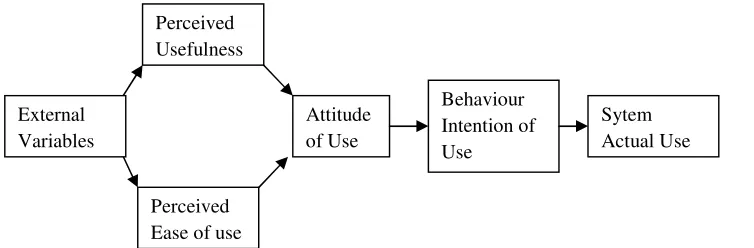
The main objective of TAM gives the basis on the effect of external factor toward trust, attitude, and the user objective. There are three variables to predict the intention of using the technology which are attitude toward using of the internet banking system, perceived of usefulness, and perceived ease of use. In this research, those two antecedents which are perceived of usefulness and perceived ease of use will integrate with two variables which are trust for identifying how the customers implement the internet banking system. The relationship between those variables will be shown by this figure:
Figure 1: Technology Acceptance Model by Davis (1983 and 1989) Hypothesis Development
Trust is a certain feeling which leads a person or people to believe in any information that exists or is given by the other party. According to Soesianto (2000), trust is related to belief or willingness to convince that a person can rely on people’s kindness and ability as a seller and buyer. The same diversity in trust conceptualizations is also implemented in e-commerce contexts. Trust has been defined as a general belief in an e-vendor that results in behavioral intentions (Gefen, 2000).
Because of the absence of proven guarantees that the e-vendor will not engage in harmful opportunistic behaviors, trust is also a critical aspect o e-commerce (Gefen, 2000; Kollock, 1999). Banks always have to consider in increasing their customer trust because trust has a big influence on the intention of using the internet banking system. Trust as the expression of belief between the parties which make them to take a risk by the other’s behavior (Akelrod and French, 2000 in dinar, 2006). By the explanation, it means that trust will indicate the intention of
Perceived Ease of use
Perceived Usefulness
Attitude of Use
Behaviour Intention of Use
Sytem Actual Use External
using the internet banking system. If there is an existence of belief equality between bank and the internet banking user, there will be a strong relationship that can motivate the existence of trust and intention of using internet banking. When the customers put their trust on the technology, they will use the technology with no doubt and continuously. Hypothesis tested is:
H1: Trust is positively related to the intention of using internet banking system
The users of online banking system also consider about the usefulness of the bank’s web. In such cases, trust determines the very nature of the utility expected (Fukuyama, 1995). Not surprisingly, the benefits of a customer trusting relationship, even online ones, are often willing to pay a higher price for the products which are bought from a vendor through its web site (Reichheld and Schefter 2000). The other thing that will be considered is the security of the system.
The important of security and privacy in the usage of internet banking has already been discussed in the previous research (Sathye, 1999; Tan dan Teo, 2000). If the customers get the benefits when using the internet banking system such as the easiness when doing their works, they will trust to continue using the technology. The hypothesis tested is:
H2: Perceived usefulness is positively related to the trust of using internet banking system
Perceived usefulness is the prospective of user’s subjective probability that uses a specific application system which will increase his or her job performance within an organizational context (Davis, 1989). It s a motivation that occurs because of the perception that technology is an instrument to increase the different value in the outcomes which is achieved from the specific activity.
According to Chin and Todd (1995), there are two categories of usefulness. First, usefulness with one estimation factor, and second is usefulness with two estimation factors which are usefulness and effectiveness. The function of usefulness with one factor estimation is to make the task easier and beneficial, to increase the productivity, to increase the effectiveness, and to develop the job performance. On the other hand, usefulness with two factors is divided to two categories which are usefulness and effectiveness. There are three factors to measure the usefulness of a technology. First, the technology adoption can improve the productivity of the user. Second, the technology will increase the user’s performance. Third, the technology develops efficiency process that is conducted by the user. It means that people will use the internet banking system when they are assured that the system will give any usefulness for them. The hypothesis tested is:
H3: Perceived usefulness is positively related to the intention of use the internet banking system
Control Variables
Perceived ease of use is defined as the degree in which the prospective users expect the target system to be free of effort (Davis, 1989). It occurs when there is an existence of main need of the activity. The internet banking system is designed by banks to help people do their job easier and not to give any difficulties to the customer.
Someone who adopts a system will make his or her job easier rather than someone who does not use the system. For example, when people tend to send a letter or transfer money by post, they will get any difficulties such as the longer time to assure that the letter or money has been received by the recipient. If they use internet as the other way to send a letter or transfer the money, they will get assurance for the receipt of those things faster. The easiness of internet banking usage indicates that the system is easily understood and implemented by the customer. The hypothesis tested is:
H4: Perceived ease of use is positively related to the intention of use internet banking system
H5: Perceived ease of use is positively related to the trust of using the internet banking system
Perceived ease of use is used to measure the perceived easy of use and easy of learning from the information technology user (Grefen and Straub, 2000). Positive behavior of a person in adopting the information technology is based on the belief that internet can help his or her job, then he or she will continue to adopt the technology. Then, if the customers think that using the internet banking is easy, the internet banking service will also give usefulness for them. Hypothesis tested is:
H6: Perceived ease of use is positively related to the perceived usefulness of internet banking system
Research Method Population and Sample
Population is all individuals who become the research object (Mustafa, 1998). Based on the definition, the population of this research were the customers of the banks who apply the internet banking service in Yogyakarta. Because of the usage of Simultaneous Equation Model (SEM), the total of questionnaire that has to be spread is at least for 100 (Hair et al, 2006). This research used convenience sampling as the technique of the data collection. The writers distribute questionnaires to the bank customers who have already used or still use the internet banking system especially without any involvement on the private identity of the banks customer to keep the security of the customer’s important data.
Validity and Reliability Testing Test of Validity
Validity is the measurement to assure the level of instrument legality. A certain instrument becomes valid if it has a high legality or validity, and it will give more assurance. If the validity is low or weak, the instrument is less of validity. Test of validity is conducted for all of the questions in every research variable. To measure the item of the questions, the researcher uses Confirmatory Factor Analysis (CFA) and uses an approach of Partial Least Square (PLS). PLS approach is often used because in PLS there is no sample charged and included as free distribution. Otherwise, the test is conducted by looking at the value of Average Variance Extracted (AVE). The formula of AVE is:
According to Formel and Larcker, AVE value must be greater than 0,5 (Ghozali, 2006 : 25).
Test of Reliability
i = component loading
var (i) = 1 -i
Data Analysis Method
Data analysis of this research uses the statistical test approach as an analysis of simultaneous equation of Structural Equation Model (SEM), and it is supported by software SmartPLS. The analysis of Partial Least Square regression has an objective to produce a model transforming a set of correlated explanatory variables (Tenenhaus, 1998). Parameter coefficient of PLS regression is obtained from direct correlation between variable predictor and criterion. Path analysis model of all latent variables in PLS consists of three relationships, those are:
1. Inner Model, which specifies the relationship between latent variables (structural model).
2. Outer Model, which specifies the relationship between latent variables and the indicator or manifest variables (measurement model).
3. Weight Relation in which the case value from latent variables can be estimated.
Test of Hypotheses
This is the equation which reflects the hypothesis testing, and it is conducted to test the intention of use internet banking system with trust, religiosity, perceived of usefulness, and perceived ease of use.
IU =1+1T +2RG +4PU +5PEU +1 1
T =2+3PU +6PEU +2 2
PU =3+7PEU +3 3
Where:
IU = Intention of use the internet banking T = Trust
RG = Religiosity
PU = Perceived of usefulness PEU = Perceived ease of use 1-4 = Error
Data Analysis and Discussion.
The discussion in this section is divided into six parts. The first part is the result of data collection which explains about the total data that were analyzed. The second part discusses about the description of the respondents who participate in the data collection such as the age, gender, and their educational level. The third part explains about the result of data testing which is related to the validity test. The fourth part discloses about the result of data testing which is related to the reliability test. The fifth part of the discussion explains the result of data testing which is related to the model. The last part discusses about the result of the research which is related to the hypothesis test.
Data Collection Result
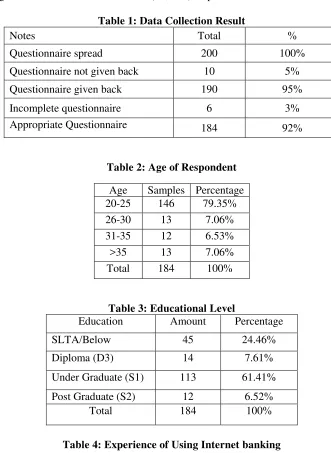
The data collection method which is used for this research is the questionnaire which has already been explained in the previous section. Sampling method that is used for the research is the convenience sampling. In this case, the writers choose customers who use internet banking in Yogyakarta. The result of appropriate data collected is shown in the table 1.
From the table 1, it can be concluded that from 200 questioners distributed, there are 190 (95%) of the questionnaires were already filled and given back, and the rest of 10 (5%) were not given back to the researcher. From the 190 questionnaires given back, there were 6 (3%) of those numbers filled incomplete. The completed questionnaires which are filled were 184 (92%).
The respondents who become the research target will be classified based on age, gender, education, and length time of using the internet banking system. The classifications of those criteria are in the table 2-4.
From the table 2, it can be concluded that the biggest number of internet banking systems’ users come from the range between 20 until 25 years old. As table 3 shown, the majority of internet banking users came from the undergraduate (S1) background with 113 (61,41%) respondents. Finally, the majority of the respondents who use the internet banking are below 12 months that is 125 (67,93%) respondents.
Table 1: Data Collection Result
Notes Total %
Questionnaire spread 200 100%
Questionnaire not given back 10 5%
Questionnaire given back 190 95%
Incomplete questionnaire 6 3%
Appropriate Questionnaire 184 92%
Table 2: Age of Respondent Age Samples Percentage 20-25 146 79.35%
26-30 13 7.06%
31-35 12 6.53%
>35 13 7.06%
Total 184 100%
Table 3: Educational Level
Education Amount Percentage
SLTA/Below 45 24.46%
Diploma (D3) 14 7.61%
Under Graduate (S1) 113 61.41%
Post Graduate (S2) 12 6.52%
Total 184 100%
Table 4: Experience of Using Internet banking
Length Time Amount Percentage
<12 Month 125 67.93%
12-24 Month 43 23.37%
25-36 Month 7 3.81%
>36 Month 9 4.89%
Validity Test Using The Outer Model Value
Validity test by using the outer model is used for testing whether indicator of the construct has appropriate discriminant validity or not by comparing indicator correlation of a construct with the other construct correlation. If the construct indicator correlation has higher value than its indicator correlation toward the other construct, we can conclude that the construct has a high validity value. Based on table in Appendix 1 (outer loadings), factor loadings of each indicator significantly reach 0.05 level significancy. It is shown by the T-statistic value above 1.64. Based on the outer loading, all factor loadings have fulfilled the convergent validity.
The validity of construct was also tested by comparing the square root of Average Variance Extracted (AVE) for each construct with the correlation between a construct and the other construct in a model. The model has enough discriminant validity if the square root of AVE for each construct is greater than correlation between a construct.
Table 5 shows that the square root of AVE for the construct of perceived of usefulness (PU) at0.817is higher than the correlation between construct of perceived of usefulness (PU) and trust (T) at 0.463. The square root of construct of perceived ease of use (PEU) at0.812is higher than the correlation between construct of perceived ease of use (PEU) and perceived of usefulness (PU) at0.482.From the result above, we can conclude that all variables have high discriminant validity.
Table 5: AVE and Square Root of AVE AVE Square Root of AVE
T 0.675 0.821
PU 0.668 0.817
PEU 0.660 0.812
IU 0.565 0.752
Reliability Testing
For testing the reliability of the construct, we employ composite reliability values. If a construct has a value that is more than 0.70, it means that the construct is reliable. Table 6 shows that the output result of Composite Reliability for each variable is very reliable because all of them exceed 0.70.
Table 6: Composite Reliability Variables Composite Reliability
T 0.892
PU 0.886
PEU 0.885
IU 0.838
Hypothesis Testing Results
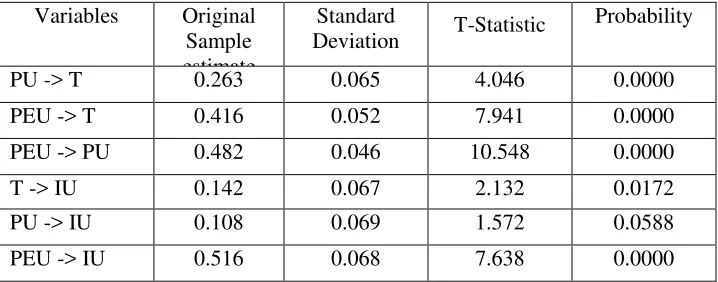
Evaluating the inner model means that it evaluates the relationship among latent constructs or variables, as hypothesized in this research. They correlate to the intention of using the internet banking system. This is the estimation of the inner model from the PLS data processing. Table 7 shows the result of hypothesis tests,
Variables Original Sample estimate
Standard
Deviation T-Statistic
Probability
PU -> T 0.263 0.065 4.046 0.0000
PEU -> T 0.416 0.052 7.941 0.0000
PEU -> PU 0.482 0.046 10.548 0.0000
T -> IU 0.142 0.067 2.132 0.0172
PU -> IU 0.108 0.069 1.572 0.0588
PEU -> IU 0.516 0.068 7.638 0.0000
Table 7 shows that the variable of trust has coefficient value of 0.142 and it is significant at 5% level. It implies that trust has significant correlation to the intention of using internet banking and the positive coefficient value (original sample estimate) is 0.142 indicating a positive correlation. Therefore hypothesis one (H1) which states that trust is
positively related to the intention of using internet banking is supported by the data. Consequently, if the customers’ trust to the internet banking system is high, their intention of using the system will be high as well. Here, users may concern about their loyalty which is reflected by their trust toward the intention of using internet banking system because when they put their trust on a system, they will tend to use the system continuously. This result supports the research result of Mayer, Davis, Schooman (1995) which stated that trust has significant influence on the intention of using internet banking system.
Hypothesis 2 (H2) which states that perceived usefulness is positively related to the trust in the internet banking is
also supported by the data. A positive coefficient value (original sample estimate) is 0.263 which shows that perceived usefulness has a positive correlation to the trust of using the internet banking system. Perceived usefulness has a t-statistic value of 4.046 and it is significant at 1% level. Therefore the result implies that when users feel much usefulness of the internet banking system, they will put more their trust with this system and they will keep their loyalty toward this kind system. In other words when customers have already got their benefits through internet banking transactions, they will continuously trust to use the system as well.
The result in the table 7 also shows that perceived usefulness has t-statistic value of 1.572 and significant at 10% level. It means that perceived usefulness has a significant correlation to the intention of using internet banking system. A positive coefficient value is 0.108 which shows that there is a positive relationship. Overall result is that the hypothesis (H3) which states that perceived of usefulness is positively related to the intention of using internet
banking system is supported by the data. It can be interpreted from the result that bank customers will use the internet banking system continuously if the system gives much benefit to them. This result supports the research by Chau and Lai (2003) who states that perceived usefulness has a significant influence on the intention of using internet banking system.
Other results
Table 7 shows that the rest hypotheses (hypothesis 4-6) are supported by the data. Perceived ease of use has t-statistic value of 7.638 and significant at 1% level. It means that perceived ease of use is positively related to the intention of using internet banking. Bank’s customers will use the internet banking system continuously when they get the ease of using the system as well. Using the internet banking system is easy, and then they will no doubt to use it over and over again. This is consistent with the study by Chau and Lai (2003)
Perceived ease of use is also a positively significant correlation to the trust in internet banking system. A coefficient value (original sample estimate) is 0.416 and is significant at 1% level. Therefore bank customers tend to put their trust on internet banking service when the system gives assurance of its ease and assure that the system is free of too many efforts. The users also will not consider about the detriment of the system anymore. This result supports the research result of Gefen, Karahanna, and Straub (2003) which states that perceived ease of use has a significant correlation to the customer trust in the internet banking system.
perceived ease of use is positively related to the perceived usefulness in the internet banking is supported by the data. When the internet banking system gives more eases, customers of banks people will get more benefits or usefulness as they transact using the internet banking system. This supports the research result of Chau and Lai (2003).
Conclusion and Recommendation
This research has an objective to test whether the customer trust is related to the intention of using internet banking system or not. This variable is an important factor in information technology system acceptance. Because of this reason, the researcher develops a new model in technology acceptance by integrating the trust variable with the Technology Acceptance Model (TAM). This research is objected to 184 respondents who used the internet banking system in Yogyakarta. Based on the result of the data processing, the researcher concludes that trust has a relation to the intention of using the internet banking system. It is also known that perceived usefulness has a positive relationship to the intention of using the internet banking system and trust.
The rest result is that perceived ease of use also has a positive relationship with the intention of using internet banking, trust, and the perceived of usefulness. It supported the theory of Technology Acceptance Model (TAM) which states that perceived usefulness and perceived ease of use have an influence to the adaption of the information technology.
The above result implies banks can improve their service to their customers especially through the internet banking service. Then, the customers will put more their trust on keep doing the transaction in the internet banking, and banks will not loose their customer’s loyalty. Moreover, bank that already provided internet banking services should improve the customer trust and commitment effectively toward improving the intention of using the internet banking technology. Customer trust is the important value to be achieved, and it is very important to be kept by bank party to increase the customer satisfaction. Banks should give more benefits and eases of using the internet banking service which help the customers to do their online transaction because it will give them assurance that this service will not harm them for any loss or detriment.
References
Almuntaha Eska, (2008), "Faktor-Faktor yang Mempengaruhi pengadopsiaan internet banking oleh Nasabah di Indonesia”, Skripsi FE UII, Yogyakarta
Berger, A. N. (2003), “The economic effects of technological progress: evidence from the banking industry”,
Journal of Money, Credit, Banking, 35 (2), 141-176
Campbell, H. (2005b), “Spiritualizing the Internet: Uncovering discourses and narratives of religious Internet use”.
Online-Heidelberg Journal of Religions on the Internet, 1 (1). Retrieved March 8, 2007 from http://archiv.ub.uni-heidelberg.de/volltextserver/volltexte/2005/5824/pdf/Campbell4a.pdf
Charles, Robia (2009), “Religiosity and Trust in Religious Institutions: tales from the South Caucasus”, University of California, Berkeley.
Davis, F. D. (1986), “A Technology Acceptance Model for Empirically Testing New End-User Information Systems: Theory and Results”. Doctoral Dissertation, Sloan School of Management, Massachusetts Institute of Technology,
Davis, F. D. (1989), “Perceived usefulness, perceived ease of use, and user acceptance of information technology”,
MIS Quarterly, 13 (3), p.319
Davis, F.D, R.P (1989), Bagozzi, dan PR. Warshaw, “User Acceptance of Computer Technology: A Comparison of Two Theoretical Models”,Management Science, 35 (8), pp. 982-1003
DeYoung R. (2005) “The performance of internet-based business models: evidence from the banking industry”,
Doherty, William O (1986), “Information Technology and Accounting”, Journal of Accountancy (pre-1986); Apr 1972; 133, 000004; ABI/INFORM Global pg. 31
Fukuyama, F (1995), “Trust: The Social Virtues and The Creation of Prosperity”, The Free Press, New York.
Gefen, D (2000), “E-Commerce: The Role of Familiarity and Trust.” Omega (28:6). Pp. 725-737.
Gefen, David; Karahanna, Elena; Straub, Detmar W (2003), “Trust and TAM in Online Shopping: An Integrated Model”, MIS Quarterly, 27, 1; ABI/INFORM Global pg. 51.
Ghozali, Imam. (2006),Structural Equation Modeling Metode Alternatif dengan Partial Least Square, Semarang: Universitas Diponegoro
Guriting, Petrus and Ndubisi, Nelson Oly (2006), “Borneo Online Banking: evaluating customer perceptions and behavioral intention”, Management Research News; 29, ½; ABI/INFORM Global pg.6.
Ho, Shirley J and Mallick, Sushanta K (2006), “The Impact of Information Technology on the Banking Industry: Theory and Empirics”, National Chengchi University, Taiwan; Queen Mary University, UK.
Kollock, P (1999), “The Production of Trust in Online Markets.” Advances in Group Processes (16). Pp. 99-123.
Kusuma, Hadri dan Dwi Susilowati (2007), “Determinan Pengadopsian Layanan Internet Banking: Perspektif konsumen Perbankan Daerah Istimewa Yogyakarta”,Jurnal Auditing dan Akuntansi Indonesia. V.12 (1).
Muafi (2003), “Pengaruh Motivasi Spiritual Karyawan Terhadap Kinerja Religius: Studi Empiris di Kawasan Industri Rungkut Surabaya (SIER)”, Jurnal Siasat Bisnis. Hal 1-18.
Najati, Muhammad Ustman (2001), “Al Qur’an wa Ilman Nafs”, Darus Syuruq: Kairo, Jiwa Manusia dalam Sorotan Al Qur’an, Cendekia: Jakarta.
Polatoglu, Vichuda N. and Ekin, Serap. (2001), “An empirical investigation of the
Turkish consumers’ acceptance of internet banking services”, The International Journal of Bank Marketing, vol. 19, no. 4/5, pp. 156 – 165.
Reichheld, F. F., and Schefter, P (2000), “Eloyalty: Your secret Weapon on the web.” Harvard Business Review (78:4). Pp. 105-113.
Sathye, M. (1999), “Adoption of Internet banking by Australian consumers: an empirical investigation”, International Journal of Bank Marketing 17(7), 324-34.
Setiawati, Trias; Fauzan (2005). “Pengaruh Religiusitas terhadap Prestasi Kerja Pegawai Negeri Sipil (PNS) Alumni dan Bukan Alumni Pesantren di Kantor Depag Kota Malang.” Jurnal Sinergi. Hal 1-18.
Susanto, Eko. Dapatkah melihat Agama dari Balik Internet?.
http://www.waena.org/index.php?option=com_content&task=view&id=1521&Itemid=44. (26 Mei 2008)
APPENDIX
Result of Outer Loading
original sample estimate
mean of subsamples
Standard
deviation Z-Statistic
T
T1 0.278 0.278 0.024 11.616
T2 0.311 0.309 0.027 11.671
T3 0.311 0.313 0.030 10.461
T4 0.7318 0.316 0.028 11.357
PU
PU1 0.311 0.307 0.024 13.085
PU2 0.315 0.312 0.018 17.077
PU3 0.387 0.385 0.034 11.236
PU4 0.181 0.180 0.051 3.519
PEU
PEU1 0.337 0.337 0.024 13.906
PEU2 0.326 0.326 0.023 14.312
PEU3 0.322 0.323 0.025 12.787
PEU4 0.237 0.230 0.043 5.498
IU
IU1 0.243 0.242 0.041 6.010
IU2 0.348 0.348 0.031 11.351
IU3 0.399 0.397 0.035 11.483