172
FIRST CYCLE DEVELOPING TEACHING MATERIALS FOR INTEGERS IN
GRADE FOUR WITH REALISTIC MATHEMATICS EDUCATION
Hongki Julie1, St. Suwarsono2, Dwi Juniati3
Sanata Dharma University12, Surabaya State University3
[email protected], [email protected]
Abstract
There are four questions that will try to answer in this paper, namely (1) what is the context which can be used to introduce negative integers?, (2) how to use the context to make the students construct an understanding of negative integers? (3) how to use context to make the students can also construct about (a) to compare two integers, (b) to order some integers, and (c) to add and subtract two integers, and (4) what are the impacts of the teaching material which designed by the researcher? Learning approach which is used by researcher in this design is realistic approach. The designs which were made by researcher are for fourth grade students. There are three main principles of realistic mathematics approach. This type of research that is used by researcher in this research is the design research. According Akker, Gravemeijer, McKeney, and Nieveen (in Akker, Gravemeijer, McKeney, and Nieveen, 2006), the characteristics of development research are (1) an interventionist, (2) an iterative, (3) a process-oriented, (4) an usability oriented and (5) a theory oriented. According Gravemeijer and Cobb (in Akker, Gravemeijer, McKeney, and Nieveen, 2006) there are three phases in the development of research, namely (1) the preparation of the trial design, (2) the trial design, and (3) a retrospective analysis. The results presented in this paper are the results obtained by the researcher on the first cycle of 2 cycles planned by the researchers.
Keywords:integer, realistic mathematics education, and design research
INTRODUCTION
When the researcher gets the opportunity to make an observation in 2012 in grade four, a teacher who observed by the researcher asked whether it was possible to teach negative integers using a realistic mathematics approach? According to the teacher, the difficulty which is found by the teacher is to find a context for introducing negative integers. The teacher said that, in general, when a teacher would introduce a negative integer, then the context that is used is about the temperature. But if the teacher uses the temperature to introduce negative integers, then the student is rather difficult to construct what is a negative integer. The difficulty of the construction process in Indonesia is because students do not have the condition in sub-zero temperatures, so they can not understand what is meant by temperatures below zero degrees.
The teacher’s question is to motivate researcher to create a context that can help students recognize integers. Researcher began looking roughly what context that would be used to introduce negative integers. The researcher remembers childhood passed by investigators, at that time, researchers often playing ular tangga games.
173 This game gives an inspiration for the researcher to develop a game which is used to introduce the negative integers. The Researcher gives the name of the game is permainan lempar dadu . The modifications of ular tangga game are made by the researcher are:
2. The number of each player throws the dice
)n the game of ular tangga , each player throws the dice before the player runs his/her pawn in the board game. )n the game of permainan lempar dadu , every player gets a chance to throw the dice twice. The result of the first roll of the dice pawn stated many steps to the right, while the result of the second roll of the dice pawn stated many steps to the left. The goal of this rule is to create a condition so that students feel the need for a number less than zero. This condition will be created, if at the time of the first round of students throwing dice, students get the second dice is more than the first dice or if the accumulation of the result of the second throw of the dice is more than the result of the first roll of the dice.
According to the researcher, context of permainan lempar dadu can be used by the teacher to introduce negative integers. Because by playing this game, students can imagine what means of negative integers. For example: students can imagine what it meant - 2 in this game, i.e., for the first round, the student got 1 on the first throw and 3 on the second throw, or 2 on the first roll, and 4 on the second throw, or 3 on the first pitch and 5 on the second toss, or 4 on the first roll and 6 on the second throw.
The next question that arises in the mind of the researcher is whether the context, students can also learn about how to order the integers, in particular negative integers and perform operations of addition and subtraction involving negative integers. According to the researcher, this game can be used also to teach how to order negative integers in particular, because the teacher can create questions that ask students to determine who won the game in each round. To answer these questions, students must rank position of each player so that students know who won the game. This game can motivate the students to learn about addition and subtraction on integers, but not every case of addition and subtraction of integers can be taught by the teacher using this context. For addition, the cases can be learned by the student with this game are (1) if the number is added up and the enumerator equally positive, and (2) if the number add up is a negative integer, and the enumerator is a positive number. For the substraction, the cases that can be taught by the teacher with this game are (1) if the number being subtracted and the substrahend are equally positive, and (2) if the number to be subtracted is a negative integer, and the substrahend is a positive integer.
Research approach is that used by researcher in this research is design research which will do at two cycles. For first cycle, the researcher did at grade four with 44 students in private school and for the second cycle, the researcher did at grade four with 29 students in the private school.
174 2. Try out the design.
The researcher will analysis base on the videos that are recorded by the researcher for whole lessons and the evaluation that is done by the student at the end of the series of the lessons.
REALISTIC MATHEMATICS EDUCATION (RME)
According Gravemeijer 994 , RME takes root from Freudenthal’s point of view that mathematics as a human activity. The starting point of Freudenthal’s view is the activity of mathematicians, both pure mathematicians and applied mathematicians. Freudenthal characterize the activity of mathematics as a problem-solving activity, looking for problems, and organize a mathematical subject from reality. The main activity in the mathematical activity, according to Freudenthal (Gravemeijer, 1994, and Steefland, 1991), is to organize or mathematization. According Gravemeijer (1994), when mathematization is the goal in the mathematics education, it may involve mathematization in math (the so-called vertical mathematization by Traffers, 1987 in Gravemeijer, 1994, and Steefland, 1991) or in reality (the so-called horizontal mathematization by Traffers, 1987 in Gravemeijer, 1994). According Gravemeijer (1994 , Freudenthal’s concept of mathematics as human activity is largely associated with the individual, but also in the RME social interactions are not overlooked.
There are three main principles in the RME (Gravemeijer, 1994), namely: 1. Guided reinvention and progressive mathematizing;
According to the principle of guided reinvention, students are given the opportunity to undergo a process similar to the process experienced by mathematicians when they found the concept to be rediscovered by students. The principle of the guided reinvention can also be inspired by the return procedures in an informal settlement. Informal strategies created by students may also be used as a step to produce formal procedures. Mathematization of procedures similar settlement creates an opportunity to reinvent the process. In general, we need to find the contextual issues that can awake with a settlement procedures vary, preferably those procedures, taken together, indicate a possible learning routes traversed by a process of progressive mathematization (Gravemeijer, 1994 ).
The realistic approach emphasizes mathematization. Mathematics is seen as an activity, a way to work. Learning mathematics is defined as doing the math. A necessary part of doing mathematics is to solve the dayly problems. If we choose to teach mathematics as an activity, then the problems become a center on the teaching learning process, which means that the problem is the real purpose of learning more than just the students were able to use a device that relates to math.
2. Phenomenology didactic (didactical phenomenology);
175 the situation, and the outcome of the investigation may be generalized to generate settlement procedures, resulting in a process mathematization vertically.
According to Van den Heuvel-Panhuizen (in Wijaya, 2012), the meaning of the context in realistic approach can be seen widely. In a broad sense, referring to the context of everyday phenomena, fiction or fantasy, or it could be a mathematical problem directly. According to Wijaya (2012), the context on RME is intended to establish or re-invent a mathematical concept through mathematization. So, the the contextual problem in RME is everyday phenomena, fiction or fantasy, or mathematical problems that can be directly used by students to build or re-invent a concept or procedure in mathematics through mathematization. knowledge. In the RME, the models are constructed by the students themselves. This means that students need to build models as they solve realistic problems. At first, a model is a model of a situation that is familiar / known by students. By a process of generalization and formalization, the model finally becomes a truly existed in him/her. It is a process of transition from a model of the to the model for which is similar to the reconstruction of the theoretical origins of mathematical knowledge subjectively by Ernest (1991 in Gravemeijer, 1994).
Following the principles of reinvention, bottom-up approach was followed. The idea is as follows students construct a model for himself / herself. Later, models are used as a basis for developing a formal mathematical knowledge. More detailed explanation is as follows: first, a model is a model of the specific context of a situation. Then, the model generalized over many similar situations (model-for). As a result, changes in the characteristics of the model. The model becomes something truly lies within the building model. This is a new form, the model can be used as a basis for reaching a formal knowledge of mathematics.
This means when the students learn the concept in mathematics through contextual problems, students need to develop their own models. The models are intended as a vehicle to develop students' thinking processes, of the thought process of the most well known by the students, which is informal, in the direction of a more formal process of thinking.
DESIGN RESEARCH
According Akker, Gravemeijer, McKeney, and Nieveen (in Akker, Gravemeijer, McKeney, and Nieveen, 2006), design research can be characterized as:
1. Interventionist: the research leading to the design of an intervention in the real world.
2. Iterative: the research incorporates a cyclic approach to the design, evaluation, and revision.
176 4. Oriented to usability: the benefits of design is measured by looking at the
practicality of the design for the user in reality.
5. Oriented to the theory: design (at least partially) made by theories that already exist, and field testing of the design contribute to the development of the theory. According Gravemeijer and Cobb (in Akker, Gravemeijer, McKeney, and Nieveen, 2006) there are three phases in the design research, namely
1. The first phase: preparation of trial design 2. Second phase: trial design
3. The third phase: a retrospective analysis
THE FIRST PHASE OF FIRST CYCLE
The objectives of the design which are made by researcher are (1) introducing negative integers, (2) if there are two different integers, then the students can determine which integer larger or smaller, (3) order some numbers round of the smallest or the largest, (4) determine the sum of two integers if (a) the integer which is add up and the enumerator are a positive integer, (b) the integer which is add up is negative integer and the enumerator is a positive integer, and (5) determine the outcome of the substraction of two integers if (a) the integer is substracted is positive integer and the substrahend is positive integers, (b) the integer is substracted is negative integer and the substrahend is positive.
Before students experiencing learning process designed by the researcher, the students had to learn about the natural numbers, compare two natural numbers, order the natural numbers, and adding and subtracting two natural numbers. Natural numbers studied by previous students are natural numbers up to 100,000.
THE SECOND PHASE OF FIRST CYCLE
In outline, the designs which are experienced by the student and designed by the researcher are as follows:
1. Throw dice game.
On this occasion, students play a game of throwing dice in groups of 4 students. Supplies throwing dice game:
a. The board of throw dice game (can be seen in figure 1).
Figure 1. dice throwing game board. b. Four pawns.
c. One dice.
Throw dice game rules:
a. Students determine the order with hom pim pa or throwing dice.
177 c. The winner of the game is the player who achieves the position of ten in the number line for the first time after a student threw dice 2 times in every opportunity. The players lose in this game if the students achieve position – 10 in the number line.
d. If no player reached the 10 or - 10, the game was stopped after 15 rounds. The order of the winner is determined by the last pawn position.
2. Noting the results of throw dice game.
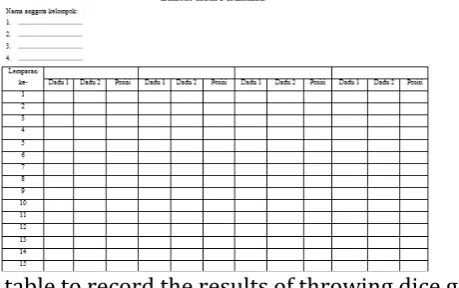
After each group finished playing the game, students are asked to play throw dice game again. On this second occasion, students were asked to record all the results roll of the dice every player in the following table:
Figure 2 table to record the results of throwing dice game.
After all the groups completed the table, the teacher asked one or two groups to tell the game is going on, and displays the results. If there is a mistake made by the students, the teacher can discuss the mistake.
3. Determine the outcome of the game for one round.
Students are asked to complete 10 questions related to the game of throw dice. On this occasion, students are asked to determine and draw the position and the movement of the pawn on the number line if we known starting position, and the results of the first and second roll of the dice. Here is the sample of the question which is completed by student:
Figure 3. Example of problems throwing dice determine the outcome of the game for one round
After all students completed the tenth question, the teacher asked 10 students one by one to write the answers on the board, then the teacher discuss the answers of these students. After that, the teacher asks the students to write a math sentence for each problem. After students complete, the teacher asked 10 students one by one to write the answers on the board, then the teacher discuss the answers of these students.
4. Determine the outcome of throw dice game for two rounds.
178 the position of the pawn on the number line if we known starting position, the results of the first and second roll of the dice in the first and second round. Here is the sample of the question which is completed by student:
Figure 4 example problems throwing dice determine the outcome of the game for two rounds
After all students completing the eighth question, the teacher asks 8 students one by one to write the answers on the board, the the teacher discuss the answers of these students. After that, the teacher asks the students to write a math sentence for each problem. After students complete, the teacher asked 8 students one by one to write the answers on the board, then the teacher discuss the answers of these students.
5. Determine the outcome of the throw dice game for 15 rounds.
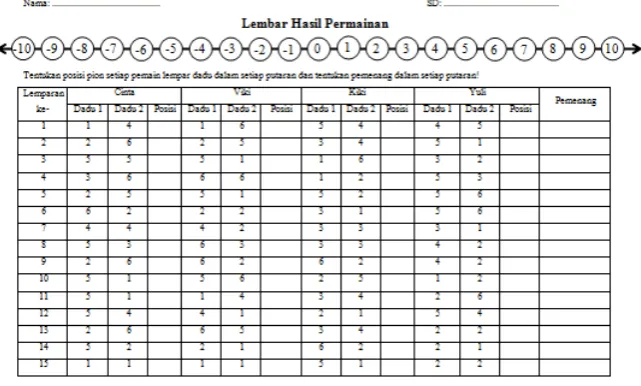
Students are asked to complete 15 questions related to the game of throwing dice. On this occasion, students are asked to determine the position of a pawn and the winner of the game for each round if we known results of the first and second roll of the dice for 15 rounds with 4 players. Here are the complete questions which are completed by students:
Figure 5. Throwing dice to determine the results of the game for 15 rounds.
After all students completed the questions, the teacher asked 15 students one one by one to write the answers on the board, the the teacher discuss the answers of these students.
6. Determine the sum and subtraction of two integers using a number line.
179 adding and substractinfg process on the number line. Here is the sample of the question which is completed by student:
Figure 6. Determining the result of addition and subtraction using a number line.
After all students complete ten questions, then the teacher asked 10 students one by one to write the answers on the board, then the teacher discuss the answers of these students.
7. Determining outcomes addition and substraction in integers.
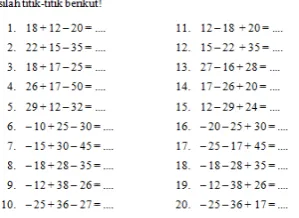
Students are asked to complete 20 addition and subtraction problems. Here are the complete questions which are completed by students:
Figure 7. Questions to determine the results of addition and subtraction
After all students completed the twenty questions, then the teacher asked 20 students one by one to write the answers on the board, then the teacher discuss the answers of these students.
8. Evaluation
After all the above circuit the learning process, the researcher conducted an evaluation to see the development of students' knowledge. This evaluation consists of five parts, namely:
a. Students compare two integers, and filled with the signs <,>, or =. The first part consists of 5 questions.
b. Students order some integers. The second part consists of 5 questions.
c. Students draw the results of throw dice game for 5 rounds of 2 players. After that, students are asked to determine the position of the pawn and the results for the 5 rounds of 2 players.
d. Students determine the results of addition and subtraction with used the number line. The fourth part consists of 5 questions.
e. Students determine the results of addition and subtraction. The fifth part consists of 5 questions.
THIRD PHASE FIRST CYCLE
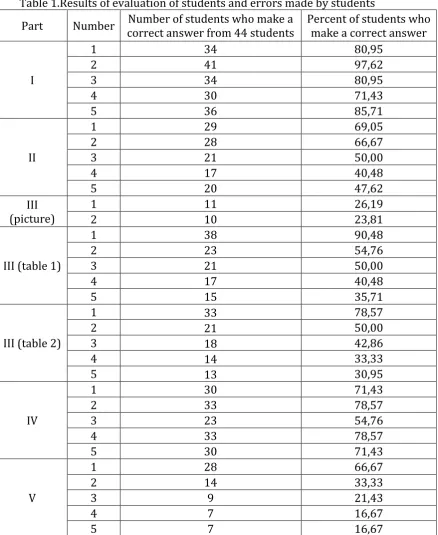
180 Table 1.Results of evaluation of students and errors made by students
Part Number Number of students who make a correct answer from 44 students
Tabel 2. Errors that mostly made by the students in evaluation problems.
Part Errors are still many made by students
I Many students still make mistakes when it comes to comparing two negative integers. Students still think that the way to compare two negative numbers together as a way to compare two positive integers. For example: when students are asked to compare 15 and 10. Some students think that 15 is greater than -10 because 15 is greater than -10.
181 negative integers. When they order the positive integers, they start from the smallest, but when ordering negative integers, they order them from largest. For example: order the following numbers from the smallest: 23, 29, 34, 27, 13, -22, -16, 31. Of the students' answers were wrong, so many students who answered -16, -22, -23, -29, 13, 27, 31, 34.
IV In this section, students are asked to calculate the results of addition and subtraction of two integers using a number line to help them. Many mistakes made by the students in this section are disorientation in drawing the steps on the number line when they want to find the sum or subtraction two integers. For example: count – 2 – 8 + 13. The mistake that many students do is start moving from position -2 on the number line, then stepped 8 steps to the right and stepped 13 steps to the left, so the answer obtained is -7.
V Many students still make mistakes when it comes to calculating the sum or subtraction involving negative integers. Many mistakes made by students are to treat negative integers as positive integers. For example: count - 17-7 + 15. Many mistakes done by the students are at current count - 17- 7. Many students count - 17- 7 = 17 - 7 = 10 or - 17-7 = - (17-7) = - 10.
CONCLUSIONS
There are some conclusions that can be derived from the results of students:
1. Students still have problems when they come to determining which one is teacher can make some questions about determining which one is greater or less between two negative integers, and to order some negative integers that is resulted by throwing dice .
182 REFERENCES
Akker, Jan Van Den, Gravemeijer K., McKenney S., dan Nieveen N.. 2006. Educational Design Research. New York: Taylor and Francis Group.
Ariyadi Wijaya. 2012. Pendidikan Matematika Realistik: Suatu Alternatif Pendekatan Pembelajaran Matematika. Yogyakarta: Graha Ilmu.
Gravemeijer, K.P.G. (1994). Developing Realistic Mathematics Education. Utrecht: Freudenthal Institute.
Steefland, L. (editor). 1991. Realistic Mathematics Education in Primary School. Utrecht: CD-β Press.
This paper can be cited as Zulkardi(2013). Proceeding The First South East Asia Design/Development Research (SEA-DR) International