• Tidak ada hasil yang ditemukan

Throughput and Delay Analysis of AODV DS

N/A
N/A
Protected

Academic year: 2018

Membagikan "Throughput and Delay Analysis of AODV DS"

Copied!
7
0
0

Teks penuh

(1)

REVIEW ARTICLE

Throughput and Delay Analysis of AODV, DSDV

and DSR Routing Protocols in Mobile Ad Hoc

Networks

Saima Zafar

Department of Electrical Engineering, National University of Computer & Emerging Sciences, Lahore, Pakistan

Hina Tariq

Department of Electrical Engineering, National University of Computer & Emerging Sciences, Lahore, Pakistan

Kanza Manzoor

Department of Electrical Engineering, National University of Computer & Emerging Sciences, Lahore, Pakistan

Abstract – Mobile ad hoc networks are envisaged to play a vital role in ubiquitous networking owing to their mobility support without relying on infrastructure-based design. Conversely, the same feature makes routing in these networks challenging as compared to the typical wired networks. As a result typical routing protocols designed for wired networks are not appropriate for these networks. A number of routing protocols have emerged over the last few years which can be generally classified as proactive and reactive routing protocols. In this research, we analyze and compare three most important routing protocols from both categories in terms of throughput, end to end delay and packet delivery fraction. This comparison is useful in understanding the requirements and challenges for routing protocols in mobile and ad hoc setting and forms the basis of designing a new routing protocol which we plan to present in future. Our simulation results based on simulations carried out using Network Simulator (NS2) show that Dynamic Source Routing (DSR) protocol gives best performance as compared to Ad-hoc On-demand Distance Vector (AODV) and Destination Sequenced Distance Vector (DSDV) routing protocols when network size is large and node mobility is high.

Index Terms – Wireless networks, infrastructure-less, AODV, DSR, DSDV, throughput, delay

1. INTRODUCTION

During the last few decades, wireless networks have experience immense growth and popularity due to mobility support, wireless connectivity and ubiquitous access. Wireless networks can be broadly classified into two types, the

‘Infrastructure networks’ such as the cellular networks which rely on fixed base stations which connect wirelessly with the end users providing them connectivity with the back end wired network. The other type is ‘Infrastructure-less or ad hoc

networks’ that comprise of a collection of end systems called nodes that are self-configurable and communicate with each other without relying on a fixed base station. Although these networks offer high user mobility and on demand networking,

a key challenge in these ad hoc networks is frequent changes in network topology due to high mobility [1], [2].

The routing protocols are mainly designed for computing the best routes from source to destination. The standard routing protocols which are used in wired networks like the Internet are not suitable for mobile ad hoc networks, essentially due to their wireless ad hoc nature and high mobility. Hence there is a need for design changes in standard routing approaches or designing new protocols which are adapted to the frequent topology changes and wireless link dynamics of the ad hoc networks. A number of routing protocols have been proposed fitting various requirements of ad hoc networks, these routing protocols are broadly classified into three types, proactive (table driven), reactive (on demand) and hybrid (mixture of both proactive and reactive protocols) [3]. Each type has its own merits and demerits and is considered suitable for certain network conditions.

In this research, first of all we highlight the typical features of the most important routing protocols for mobile ad hoc networks and identify their strengths and shortcomings. Next we compare their performance in terms of throughput and delay. We have selected one routing protocol from each category, we have selected Ad hoc On-demand Distance Vector (AODV), Dynamic Source Routing (DSR) and Destination Sequence Distance Vector (DSDV) routing protocols and analyzed their performance [4] – [6]. AODV and DSR are reactive protocols whereas DSDV is proactive. We have used Network Simulator (NS2.35) for simulations and the performance metrics for evaluation are end-to-end delay, throughput and packet delivery fraction.

(2)

REVIEW ARTICLE

performance evaluation metrics, in section 5 we present and discuss the results and finally section 6 concludes the paper.

2. RELATED WORK

Since routing protocols for ad hoc networks pose significant design challenges, a number of research efforts have been directed towards developing as well comparing notable routing protocols, some of which are worth discussing. H. Ehsan and Z.A. Uzmi [1] compared the ad hoc routing protocols namely AODV, DSR, DSDV and TORA. Their findings show that DSR outperforms other routing protocols because of its ability to utilize caching effectively and supporting multiple routes to the destination. TORA has high routing overloads and AODV has to go through adverse end to end delays. They also conclude that in DSDV packet delivery fraction is low for high mobility simulation scenario. J. Broch et al. [7] carried out performance analysis of four routing protocols for ad hoc networks. They carried out simulations in Network Simulator version 2 (NS2), their work is focused on medium sized networks comprising of around 50 nodes, 10 to 30 traffic sources and seven different pause times. Their results show that in medium sized networks, DSR protocol gives best performance at different mobility rates. In [8] D. Johnson et al. have analyzed throughput, delay and routing load for some of the major routing protocols. They simulated a 50 node network in NS2 and compare the performance of routing protocols for various workloads. Their results depict that DSR is more effective at low network load whereas AODV works better at higher network load.

N Vetrivelan and A V Reddy [9] evaluate average delay, packet delivery fraction and routing load for AODV, DSDV and TORA. They varied number of nodes and from 10 to 25 and kept simulation time up to 100sec. Their findings show that as far as average delay is concerned AODV outperforms the other two routing protocols but in terms of packet delivery fraction, TORA gives better performance and DSDV performs best in less stressful situations. For normalized routing load DSDV is better in stressful conditions followed by TORA. In [10] Kumar compared AODV and DSR in terms of various performance metrics. He varied simulation time from 10sec, 15sec and 20sec. He observed that initially packet loss is less in case of AODV but as simulation time increases packet loss increases whereas, in case of DSR packet loss is high initially but it decreases with increasing simulation time.

3. ROUTING PROTOCOLS FOR MANETS

Our work primarily concerns the three most important protocols from each category of the routing protocols for mobile ad hoc networks. In this section, we briefly describe the main design philosophy and key features of each of these protocols.

3.1. Ad-hoc On-demand Distance Vector (AODV) Protocol

The AODV protocol was developed as a joint contribution and it primarily focused on mobile and wireless ad hoc networks including ZigBee [4]. It supports unicast and multicast routing. The AODV protocol is based on the source-initiated algorithm which implies that the routing path from source to destination is discovered on demand from the source only. The protocol operates as follows: In the routing table, the recently used routes are maintained and each time a packet has to be forwarded, there is no need to the network to find routes and burden the network by sending route request (RREQ) messages. Path detection method of AODV comprises of RREQ, route reply (RREP) and route error (RERR). For route discovery, a node sends RREQ messages to all of its neighboring nodes. This RREQ message contains the sequence number of the destination. This guarantees route validity and eliminates routing loops. On receiving RREQ each neighboring node checks destination id and when path is tracked RREP is sent back to the requesting node. If path tracking fails, the neighboring nodes forward the request further to their neighboring nodes. In case of a broken link the RERR message is sent to the requesting node. The salient features of this protocol can be summarized as follows:

 The nodes maintain route information for the required routes only.

 Broadcasting is minimized.

 Reduced duplications result in reduced memory requirements.

 The protocol response is swift in case of link breakage in active routes.

 The protocol is highly scalable and suitable for large networks.

3.2. Dynamic Source Routing (DSR) Protocol

(3)

REVIEW ARTICLE

reaches the final destination and RREQ information is copied into the RREP message.

Typical features of DSR protocol are as follows:

 There is a limitation on bandwidth consumption by the control packets.

 There is no need for periodic beacon transmissions as it operates in beacon-less mode.

 The protocol’s reactive approach prevents flooding

in the network.

 The initial delay for connection setup is large.  DSR performs poorly when mobility is high.  The routing overhead is a function of path length and

is more for longer paths.

3.3. Destination Sequenced Distance Vector (DSDV)

Protocol

The DSDV routing protocol is a variation of Routing Information Protocol (RIP). It is a table driven routing scheme designed for mobile ad hoc networks [6]. The primary focus for DSDV protocol was to solve the routing loop problem in other routing protocols. In this problem the routing algorithm error results in a loop in the path to destination. In DSDV, new routes are differentiated from the outdated routes by adding sequence number to the routing table. The nodes update their routing tables by sharing information. The updates are of two types: time-driven and table-driven. The time-driven updates are periodic while table-driven updates are triggered by major changes. Overhead is caused when there is some modification and the routing updates are shared among all nodes. In case of increment changes, entry updates are required while full topology change results in complete updates where entire routing tables of all the nodes are updated [8]. Some of the typical features of DSDV protocol are as follows:

 As paths reside within the network nodes, the path setup process is quite fast.

 Due to ease of connectivity, and few changes required, this protocol is ideally suited for the interconnection of wired and wireless networks.

 The regular and periodic update of routing tables results in fast battery depletion and high bandwidth consumption even when the network is idle.

 This protocol is not suitable for highly dynamic networks where route changes are frequent and routing updates are invoked whenever there is a

change in the network.

4. NETWORK MODEL AND PERFORMANCE

METRICS

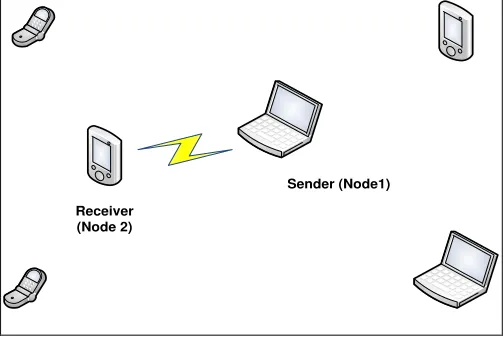
In an ad hoc network a group of mobile hosts called nodes with wireless interfaces can form a temporary network without any centralized infrastructure. These nodes communicate with each other without a central base station therefore in node discovery and routing, each node acts as a host and a router. This network configuration is quite different from wired networks where end systems or hosts are not involved in routing and specific devices called routers are meant for this purpose. Figure 1 illustrates the network topology that we have used in our simulations. It shows an ad hoc network formed by multiple devices located in close vicinity of each other or within each other’s communication range. The communication link is shown between a single sender and receiver although all hosts shown in figure 1 can form up communication links between each other in order to exchange information. Node 1 is indicated as the Sender and Node 2 is indicated as the Receiver. This is only for one instance. During simulations all nodes can send and receive routing information and data depending upon the focus of the simulation. All nodes can connect wirelessly with other nodes as soon as they are in communication range. It shows only a few nodes, our simulations extend to a large number of nodes, as required.

We test the performance of AODV, DSR and DSDV routing protocols for route formation between nodes in the network. The performance evaluation metrics for analysis of these routing protocols are throughput, end-to-end delay and packet delivery fraction.

Receiver (Node 2)

Sender (Node1)

Figure 1 Network Model (Mobile Ad hoc Network)

These performance metrics are defined as follows:

4.1. Throughput

(4)

REVIEW ARTICLE

ratio of the data packets sent to the data packets received [7]. It is also defined as the rate of successful message transmission over a communication channel. Measuring network throughput involves sending a medium sized file over communication channel and measuring the time taken for transmitting it. Dividing the file size by the transmission time gives a measure of network throughput. The practical throughput is lower than the maximum achievable theoretical throughput due to channel impairments. We select throughput as a performance metric for comparing the performance of the three routing protocols in ad hoc networks. The effectiveness of a routing protocol is measured through the throughput measurement which is the number of packets received by the receiver within certain time interval.

4.2. End-to-End Delay which is the time taken by the packets to reach from one end of the link to the other end, queuing delay which is the delay experienced by packets during waiting in router buffer before being served or transmitted and the processing delay which is the delay experienced by the packet during its processing at the router that is when routing consults its routing tables to determine where to forward the packet. The transmission delay is affected by the link bandwidth, the propagation delay depends on link speed and the queuing delay is flexible and varies significantly from one packet to the other, thus measured as average queuing delay. This is because the first packet in the queue faces minor delay while the last packet experiences substantial delay. Finally the processing delay depends on router processing capability and router load. It also includes the retransmission delay between intermediate nodes. For average end-to-end delays each delay is added for successively packet and is divided by the number of successively received packet. A lower value of end-to-end delay in a routing protocol represents efficient routing protocol, quick routes convergence and packets traversing the best routes. The end-to-end delays are significant for video and voice data transmissions [3], [8]. The formula for end-to-end delay is as follows: N = Number of data packets received

4.3. Packet Delivery Fraction

The packet delivery ratio or packet delivery fraction is the ratio of successfully delivered packets at the destination to the packets sent by the source. It represents the success rate of packets transmission that is in a given interval of time, how many packets are able to reach the destination out of the total packets which were transmitted. It is a function of packet drops or lost packets due to router congestion, queuing delays at the routers and routing algorithm efficiency. An efficient routing protocol with ensure a high packet delivery fraction. It describes the success rate of the protocol from source to destination and is given by the formula:

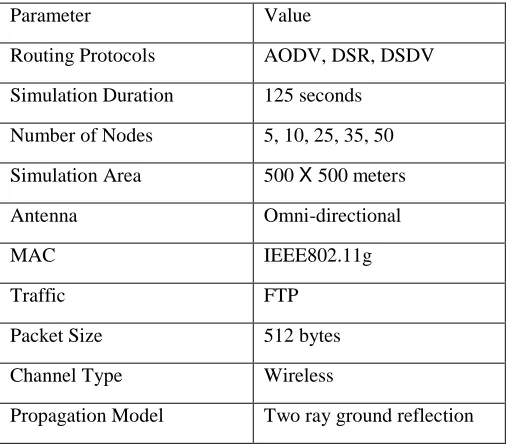
(2) � =� . �� � � compared the performance of reactive and proactive routing protocols, AODV, DSR and DSDV in ad hoc wireless networks in terms of throughput, end-to-end delay and packet delivery fraction while varying the network size and mobility. We selected IEEE802.11g at the MAC layer because it closely matches MAC layer of ad hoc networks and two-ray ground reflection model [13], [14]. The simulation parameters such as simulation time, simulation area, antenna, etc. are

Propagation Model Two ray ground reflection

Table 1 Simulation Parameters for Scenario 1

(5)

REVIEW ARTICLE

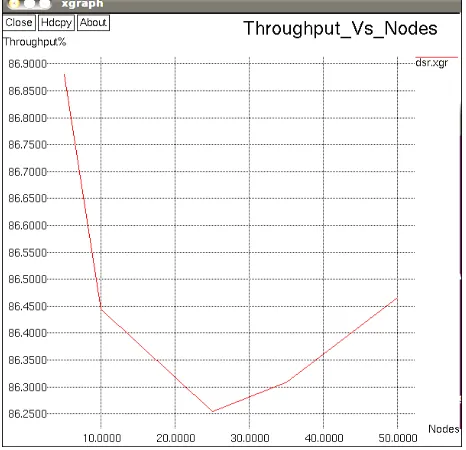
to observe the impact of network size on the performance of routing protocols we increased the number of nodes from 5 to 50 in increments and observed throughput, delay and calculated PDF. Figures 2, 3 and 4 show the impact of network size on throughput in case of AODV, DSR and DSDV routing protocols respectively and the impact on PDF is shown in Table 2. It is apparent from these results that there is minimal effect on throughput in DSR protocol as number of nodes in the network change. Throughput in AODV decreases moderately as number of nodes increase, but the worst impact is observed in DSDV where throughput declines appreciably as network size increases. We conclude that DSR outperforms the other two routing protocols when network size is large therefore it is most suitable for large networks while for small networks AODV is suitable.

Table 2 shows that the packet delivery fraction of DSDV declines when number of nodes is increased but in case of DSR it remains stable. Although AODV gives best performance in terms of PDF but if we observe the combined effect of network size, on throughput and PDF, DSR gives optimal performance and it is the best choice for large networks.

The simulation parameters for simulation of end-to-end delay versus mobility of nodes (speed) are given in Table 3.

Figure 2 AODV Throughput versus network size

Figure 3 DSR Throughput versus network size

Figure 4 DSDV Throughput versus network size

No. of Nodes

AODV PDF %

DSDV PDF %

DSR PDF %

5 99.9038 99.4929 99.90

10 99.9037 98.6879 99.8913

25 99.9037 96.8312 99.8914

35 99.9037 96.8107 99.6922

(6)

REVIEW ARTICLE

Table 2 Packet Delivery Fractions vs. Number of Nodes

Parameter Value

Routing Protocols AODV, DSR, DSDV

Simulation Duration 125 seconds

Number of Nodes 5

Simulation Area 500 X 500 meters

Antenna Omni-directional

MAC IEEE802.11g

Traffic FTP

Packet Size 512 bytes

Channel Type Wireless

Propagation Model Two ray ground reflection

Speed 2, 4, 6, 8, 10 m/s

Table 3 Simulation Parameters for Scenario 2

In mobile ad hoc networks, due to ad hoc nature of network and the type of applications, there is a high chance for node mobility. In some applications where node deployment is not fixed, node mobility can be high due to small sized nodes scattered in field for example, node deployment for monitoring seismic activities or environmental monitoring in far off places. The impact of node mobility is an important consideration for ad hoc networks routing protocols and we observe this impact.

Figure 5 AODV end-to-end delay variations with speed

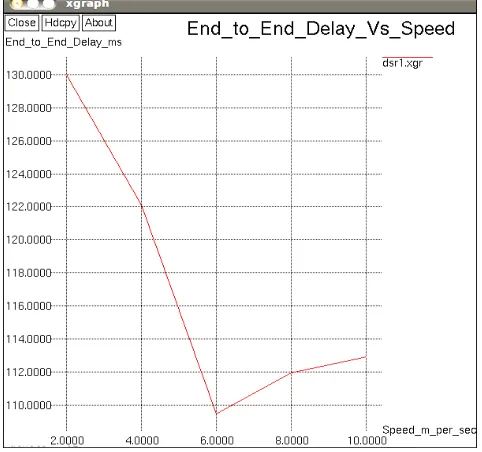
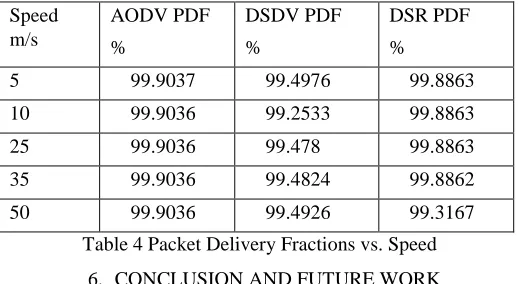
We keep the other parameters like network size constant and we vary node mobility. The application of interest is file transfer and we increase node mobility and observe end-to-end delay and PDF for the three routing protocols. The results are presented in Figures 5, 6 and 7 and Table 4. We find that in DSDV node mobility has little effect on end to end delay but in case of DSR end to end delay increases with node mobility.

Figure 6 DSR end-to-end delay variations with speed

(7)

REVIEW ARTICLE

AODV gives the best performance in this case therefore AODV is suitable for applications where end to end delay is an important consideration. Table 4 shows fairly stable behavior for PDF for all the three protocols AODV, DSR and DSDV. We conclude that node mobility impacts end to end delay but has little impact on PDF. We conclude that DSR outperforms when mobility is high, AODV comes next while DSDV gives worst performance. DSR is the best routing

Table 4 Packet Delivery Fractions vs. Speed

6. CONCLUSION AND FUTURE WORK

Ad hoc wireless networks are expected to play an important role in future networking. Due to typical properties in terms of link characteristics, mobility of nodes and variable network size, routing in these networks is more challenging as compared to wired networks. We have selected three protocols from the reactive and proactive categories of routing protocols and tested their performance in ad hoc wireless stands second while DSDV gives worst performance.

We plan to extend our simulations for more challenging scenarios including a number of other routing protocols from the two categories. We also plan to present a new routing protocol for mobile ad hoc networks in a future work based on the idea of assimilation of AODV and DSDV protocols.

REFERENCES

[1] H. Ehsan and Z. A. Uzmi, “Performance comparison of ad hoc wireless

network routing protocols,” Proc. of the 8th International Multitopic

Conference (INMIC 2004), Pakistan, Dec 2004, pp. 457-465.

[2] R. G. Sandhya, N. P. Santosh, “Mitigation of energy depletion in wireless ad-hoc sensor networks through path optimization,” International Journal of Computer and Network Applications, Jan-Feb 2015, vol. 2, issue 1, pp. 1-11.

[3] S. A. Zada, “Ad Hoc Networks: Performance evaluation of proactive,

reactive and hybrid routing protocols in NS2” M.S. thesis, Dept.

Economics and IT, West University, Sweden, 2010.

[4] C. Perkins, E. Belding-Royer, S. Das, “Ad hoc On-Demand Distance Vector (AODV) Routing. IETF”. RFC 3561. https://tools.ietf.org/html/rfc3561. Retrieved 2010-06-18, July 2003. [5] D. B. Johnson, “Routing in ad Hoc networks of mobile hosts,” Proc. of

the Workshop on Mobile Computing Systems and Applications, pp. 158–163, IEEE Computer Society, Santa Cruz, CA, December 1994. [6] C. E. Perkins and P. Bhagwat, “Highly dynamic Destination-Sequenced

Distance-Vector Routing (DSDV) for mobile computers,” Proc. Conference on communications architectures, protocols and applications (SIGCOMM 94) pp. 234-244 October 1994.

[7] J. Broch, D. A. Maltz, D. B. Johnson, Y. C. Hu, and J. Jetcheva, “A performance comparison of multi-hop wireless network routing

protocols,” Proc. of the Fourth Annual ACM/IEEE International Conference on Mobile Computing and Networking (MobiCom’98), USA, Oct 1998, pp. 25-30.

[8] D. Johnson, D. Maltz, Y. Hu, and J. Jetcheva, “The Dynamic Source

Routing protocol for Mobile Ad Hoc Networks” Internet draft, draft-ietf-manet-dsr-07.txt, Feb 2002.

[9] N. Vetrivelan, and A. V. Reddy, “Performance analysis of three routing

protocols for varying MANET size,” Proceeding of the International

Multi Conference of Engineers and Computer Scientists Vol. II,

(IMECS ‘08), Hong Kong, March 2008, pp. 19-21.

[10] V. Kumar, “Simulation and comparison of routing protocols AODV and

DSR in MANETs” M.S. thesis, Thapar University, Patiala, India, 2009.

[11] G. Adam, C. Bouras, A. Gkamas, V. Kapoulas, G. Kioumourtzis, N.

Tavoularis, “Performance evaluation of routing protocols for

multimedia transmission over mobile ad hoc networks,” Proc. of 4th Joint IFIP Wireless and Mobile Networking Conference, (WMNC ‘11)

France, Oct 2011, pp. 1-6.

[12] Available: http://mohittahiliani.blogspot.com.

[13] P. Meeneghan, D. Delaney, “An Introduction to NS, Nam and OTcl

scripting” NUIM-CS-TR-2004-05.

[14] S. Vancin, E. Erdem, “Design and simulation of wireless sensor

network topologies using the ZigBee standard,” International Journal of

Gambar

Figure 1 Network Model (Mobile Ad hoc Network)
Table 1 Simulation Parameters for Scenario 1
Figure 3 DSR Throughput versus network size
Figure 6 DSR end-to-end delay variations with speed
+2

Referensi

Dokumen terkait

Permasalahan professional terjadi ketika profesi tidak lagi menjalankan perannya berpedoman pada Standar Profesional yang berlaku. Hasilnya peran yang

Penerapan pembelajaran kooperatif tipe make a match memberikan pemahaman mengenai lagu daerah, meningkatkan keaktifan peserta didik dalam proses pembelajaran,

[r]

strengthened health systems based on primary health care Selected major approaches: support the formulation of legal and regulatory frameworks to move towards universal health

Beranjak dari kenyataan tersebut, maka pengembangan kurikulum sekolah harus mengakomodasi unsur-unsur lingkungan yang menjadi dasar dalam menetapkan materi

[r]

Pelapisan hot dipped galvanizing adalah suatu proses pelapisan dimana logam pelapisnya yaitu zinc dileburkan terlebih dahulu didalam bak galvanis ataupun dapur peleburan

Pembelajaran adalah proses interaksi antarpeserta didik,antara peserta didik dan pendidik, dan antara peserta dan sumber belajar lainnya pada suatu lingkungan belajar