DASAR TRANSFORMASI
LAPLACE
Bahasan
•
Transformasi Laplace
•
Transformasi Laplace Invers
•
Tabel Transformasi Laplace
•
Transformasi Lplace dari Suatu Turunan
•
Dua Sifat Transformasi Laplace
•
Membuat Transformasi Baru
•
Transformasi Laplace dari Turunan yang
Bahasan
•
Transformasi Laplace
•
Transformasi Laplace Invers
•
Tabel Transformasi Laplace
•
Transformasi Lplace dari Suatu Turunan
•
Dua Sifat Transformasi Laplace
•
Membuat Transformasi Baru
•
Transformasi Laplace dari Turunan yang
Transformasi Laplace
•
A differential equation involving an unknown
function
f
(
t
) and its derivatives is said to be
initial-valued
if the values
f
(
t
) and its derivatives are
given for
t
= 0. these initial values are used to
evaluate the integration constants that appear in
the solution to the differential equation.
•
The Laplace transform is employed to solve
certain initial-valued differential equations. The
Introduction to Laplace transforms
The Laplace transform
Given a function f (t) defined for values of the variable t > 0 then the Laplace transform of f (t), denoted by:
is defined to be:
Where s is a variable whose values are chosen so as to ensure that the semi-infinite integral converges.
( )L f t
0
( ) st ( )
t
L f t e f t dt
Introduction to Laplace transforms
The Laplace transform
Bahasan
•
Transformasi Laplace
•
Transformasi Laplace Invers
•
Tabel Transformasi Laplace
•
Transformasi Lplace dari Suatu Turunan
•
Dua Sifat Transformasi Laplace
•
Membuat Transformasi Baru
•
Transformasi Laplace dari Turunan yang
Introduction to Laplace transforms
The inverse Laplace transform
The Laplace transform is an expression involving variable s and can be denoted as such by F (s). That is:
It is said that f (t) and F (s) form a transform pair.
This means that if F (s) is the Laplace transform of f (t) then f (t) is the inverse Laplace transform of F (s).
That is:
( ) ( ) F s L f t
1
Introduction to Laplace transforms
The inverse Laplace transform
For example, if f (t) = 4 then:
So, if:
Then the inverse Laplace transform of F (s) is: 4
( )
F s
s
1
( ) ( ) 4 L F s f t
4 ( )
F s
s
Bahasan
•
Transformasi Laplace
•
Transformasi Laplace Invers
•
Tabel Transformasi Laplace
•
Transformasi Lplace dari Suatu Turunan
•
Dua Sifat Transformasi Laplace
•
Membuat Transformasi Baru
•
Transformasi Laplace dari Turunan yang
Introduction to Laplace transforms
Table of Laplace transforms
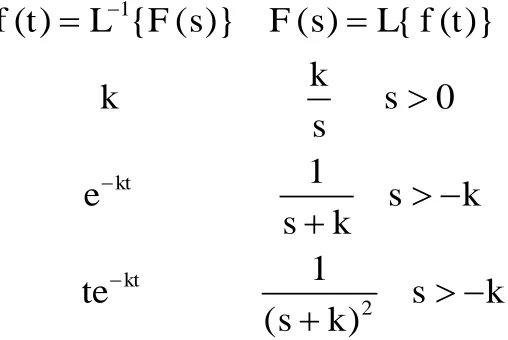
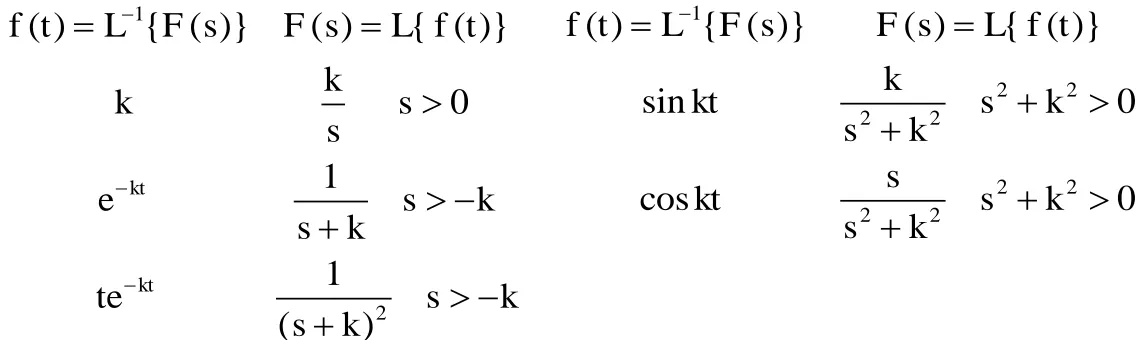
To assist in the process of finding Laplace transforms and their inverses a table is used. For example:
Bahasan
•
Transformasi Laplace
•
Transformasi Laplace Invers
•
Tabel Transformasi Laplace
•
Transformasi Laplace dari Suatu Turunan
•
Dua Sifat Transformasi Laplace
•
Membuat Transformasi Baru
•
Transformasi Laplace dari Turunan yang
Introduction to Laplace transforms
Laplace transform of a derivative
Bahasan
•
Transformasi Laplace
•
Transformasi Laplace Invers
•
Tabel Transformasi Laplace
•
Transformasi Laplace dari Suatu Turunan
•
Dua Sifat Transformasi Laplace
•
Membuat Transformasi Baru
•
Transformasi Laplace dari Turunan yang
Introduction to Laplace transforms
Two properties of Laplace transforms
The Laplace transform and its inverse are linear transforms. That is: (1) The transform of a sum (or difference) of expressions is the sum (or
difference) of the transforms. That is:
(2) The transform of an expression that is multiplied by a constant is the constant multiplied by the transform. That is:
1 1 1
( ) ( ) ( ) ( )
( ) ( ) ( ) ( )
L f t g t L f t L g t L F s G s L F s L G s
Introduction to Laplace transforms
Two properties of Laplace transforms
For example, to solve the differential equation:
take the Laplace transform of both sides of the differential equation to yield:
That is:
Resulting in:
( ) ( ) 1 where (0) 0 f t f t f
( ) ( )
1 so that
( )} { ( )
1L f t f t L L f t L f t L
1 1( ) (0) ( ) which means that ( 1) ( )
sF s f F s s F s
s s
1 ( )
Introduction to Laplace transforms
Two properties of Laplace transforms
Given that:
The right-hand side can be separated into its partial fractions to give:
From the table of transforms it is then seen that:
Introduction to Laplace transforms
Two properties of Laplace transforms
Thus, using the Laplace transform and its properties it is found that the solution to the differential equation:
is:
( ) 1 t
f t e
Bahasan
•
Transformasi Laplace
•
Transformasi Laplace Invers
•
Tabel Transformasi Laplace
•
Transformasi Lplace dari Suatu Turunan
•
Dua Sifat Transformasi Laplace
•
Membuat Transformasi Baru
•
Transformasi Laplace dari Turunan yang
Introduction to Laplace transforms
Generating new transforms
Deriving the Laplace transform of f (t) often requires integration by parts. However, this process can sometimes be avoided if the transform of the derivative is known:
For example, if f (t ) = t then f ′(t ) = 1 and f (0) = 0 so that, since:
That is:
( )
{ ( )} (0) then {1} { } 0 L f t sL f t f L sL t 2
1 1
{ } therefore { }
sL t L t
Bahasan
•
Transformasi Laplace
•
Transformasi Laplace Invers
•
Tabel Transformasi Laplace
•
Transformasi Lplace dari Suatu Turunan
•
Dua Sifat Transformasi Laplace
•
Membuat Transformasi Baru
•
Transformasi Laplace dari Turunan yang
Introduction to Laplace transforms
Laplace transforms of higher derivatives
It has already been established that if: then:
Now let so that:
Therefore:
( ) { ( )} and ( ) { ( )} F s L f t G s L g t
( ) ( ) so (0) (0) and ( ) ( ) (0) g t f t g f G s sF s f
{ ( )} { ( )} ( ) (0) ( ) (0) (0) L g t L f t sG s g
s sF s f f
Introduction to Laplace transforms
Laplace transforms of higher derivatives
For example, if: then:
and
Similarly:
( ) { ( )} F s L f t
2
{ ( )} ( ) (0) (0)
L f t s F s sf f
3 2
{ ( )} ( ) (0) (0) (0)
L f t s F s s f sf f
Introduction to Laplace transforms
Laplace transforms of higher derivatives
Therefore if:
Then substituting in:
yields
So:
2
( ) sin so that ( ) cos and ( ) sin
f t kt f t k kt f t k kt
2
{ ( )} ( ) (0) (0)
L f t s F s sf f
2 2 2
{ sin } {sin } {sin } .0
L k kt k L kt s L kt s k
Introduction to Laplace transforms
Table of Laplace transforms
In this way the table of Laplace transforms grows:
Learning outcomes
Derive the Laplace transform of an expression by using the integral definition
Obtain inverse Laplace transforms with the help of a table of Laplace transforms
Derive the Laplace transform of the derivative of an expression
Solve linear, first-order, constant coefficient, inhomogeneous differential equations using the Laplace transform
Derive further Laplace transforms from known transforms
Use the Laplace transform to obtain the solution to linear, constant-coefficient,