Context-aware Process Support through automatic Discovery and Invocation of
Semantic Web Services
Stefan Dietze, Alessio Gugliotta and John Domingue
Knowledge Media Institute
Open University
Milton Keynes, MK7 6AA, UK
E-Mail: {s.dietze, a.gugliotta, j.b.domingue}@open.ac.uk
Abstract
Current technologies aimed at supporting processes – whether it is a business process or a learning process – are usually based on using a dedicated set of metadata to describe a process which refers to some specific data, used in the process. Process metadata is usually specific to a standard specification – like the Business Process Modeling Notation (BPMN) or the IMS Learning Design Standard – while used process data is specific to a specific process context. These facts limit the re-usability of a process model across different standards and contexts. To overcome these issues, this paper describes an innovative semantic web service-oriented architecture aimed at changing this data- and metadata-based paradigm to a highly dynamic service-oriented approach following the idea of a semantic abstraction from process metadata as well as process data. This approach enables a dynamic adaptation to specific actor needs and objectives and supports the development of abstract semantic process models which are re-usable across different contexts and standards. To illustrate the application of our approach, we describe a prototypical application to the domain of E-Learning.
1.
Introduction
Organizational processes are currently supported by a variety of dedicated information systems. These are primarily based on using a dedicated set of metadata to describe a – business or learning – process that makes use of specific process resources. The process metadata is usually based on proprietary or standard-specific specifications, such as the Business Process Modelling
Notation (BPMN) [14] or the IMS Learning Design
standard [9]. Furthermore, the resources are sets of data or services useful in a specific process context.
For instance, in the domain of E-Learning the current state of the art to support learning processes is based on composite learning content packages – i.e. learning objects (LO). Each package contains the physical learning resources as well as a learning process model based on
specific metadata. The latter specifies the sequence to be followed by the learner for accessing the physical data or services. Due to this approach, a new learning package has to be developed for every different learning context. For example, a learning package suiting the needs of a learner with specific preferences – e. g. his native language, maximum costs or technological platform - cannot be reused across different learning contexts.
Several general limitations and issues are observable across different process domains:
L1. Limited reusability of process applications (models)
across different process contexts and metadata standards.
L2. Limited appropriateness and dynamic adaptability to
actual process contexts.
L3. High development costs
To overcome these limitations, we propose a highly dynamic service-oriented approach based on semantic Web services (SWS) technology. Our approach enables the automatic allocation of resources – services as well as data – at runtime of a process. In our vision, processes are described in terms of user objectives (goals) and abstract from any specific data and metadata standard. Goals are accomplished by automatically selected functionalities fitting the actual user needs and process contexts. To actualize this vision, we adopt a layered approach: Web services provide the base layer of executable functionalities; a SWS broker and ontologies support the selection, composition, and invocation of services appropriate to a given process goal as well as context. Finally, semantic mappings link our process descriptions to existing metadata standards.
independence lead to a reduction of the development costs.
The following section of the paper provides brief background information about SWS, whereas section three explains our vision and approach of using a SWS oriented architecture to support processes. Sections four and five explain an application of our approach to the domain of E-Learning as well as an initial prototype application based on the described principles. In the last section we discuss our contributions and finally, provide an outlook to future work related to our approach.
2.
Semantic Web Services: IRS-III and
WSMO
Semantic Web services (SWS) technology aims to automate the development of Web services (WS) based applications through the Semantic Web technology. By providing formal descriptions with well defined semantics, it facilitates the machine interpretation of WS descriptions. The key areas of concern are automatic discovery, mediation, and composition of Web services.
IRS-III [3], the Internet Reasoning Service, IRS-III is a broker based platform that provides a powerful execution environment. It enables semantic descriptions to be associated to a deployed Web service and used during discovery, mediation, composition and invocation activities. By definition, a broker is an entity which mediates between two parties and IRS-III mediates between a service requester and one or more service providers
At the heart of IRS-III there is a SWS Library, where
semantic descriptions of WS, and the reference Domain Ontologies and Knowledge bases (instances) are stored using OCML representation language [5]. IRS-III adopts the Web Service Modelling Ontology (WSMO) [18] as reference ontology model for WS descriptions. WSMO is a formal ontology for describing the various aspects of services in order to enable the automation of WS discovery, composition, mediation and invocation. The meta-model of WSMO defines four top level elements:
• Ontologies provide the foundation for describing
domains semantically. They are used by the three other WSMO elements.
• Goals define the tasks that a service requester
expects a Web service to fulfil. In this sense they express the requester’s intent.
• Web Service descriptions represent the functional
behavior of an existing deployed web service. The description also outlines how web services communicate (choreography) and how they are composed (orchestration).
• Mediators handle data and process interoperability
issues that arise when handling heterogeneous systems.
One of the main characterizing features of WSMO is the linking of ontologies, goals and web services by mediators which map between different ontological concepts within specific WSMO entity descriptions. In order to facilitate appropriate mapping mechanisms, four classes of mediators are considered within WSMO. For example, an OO-mediator may specify an ontology mapping between two ontologies whereas a GG-mediator may specify a process or data transformation between two goals.
3.
Analysis of Current Issues
Current technologies and approaches aimed at supporting organizational processes are mainly based on the following practices:
• Widely use of data and metadata standards for
delivering appropriate resources - either data or services - to support a specific process objective.
• Resources are manually associated with specific
process objectives based on the limited knowledge and subjective decisions of a specific individual.
• Resources are allocated at design-time of a process -
i.e. when the specific process metadata is described.
Due to these facts, the following limitations have been identified (cf. [2], [11], [4], [12]):
L1. Limited reusability across different process contexts and metadata standards. A package suiting the context and the preferences of specific user – e. g. his/her objectives, native language, technological platform – cannot be used by other users having distinct situations and preferences. Moreover, a package developed using a specific standard might not be used in information systems adopting different specifications. As a result, distinct packages have to be developed to meet multiple scenarios or user needs.
L3. High development costs. Since process data is allocated manually at designtime (L1 and L2) high development costs have to be taken into account to create applications appropriate for different contexts and processes.
4.
A Semantic Web Service oriented
Architecture: Vision and Approach
This section describes our vision as well as the approach to support E-Learning based on semantic web services.
4.1.
Vision: Context-Adaptation through
automatic Service Discovery
To overcome the limitations described above, we consider the automatic allocation and invocation of functionalities at run-time. Processes are described in terms of composition of user objectives (goals) and abstracts from any specific data and metadata standard. In principle, several available functionalities can fulfill a generic goal. The most adequate functionality is selected and invoked dynamically regarding the demands and requirements of the actual (specific) context. This enables a highly dynamic adaptation to different contexts and actor needs. This vision is radically distinctive to the current state of the art in this area (Section 3). Moreover, using adequate mappings, our process models can be translated into existing process metadata standards and languages. Therefore, it can be reused within multiple run-time environments.
Addressing the limitations L1 and L2 identified in Section 1, we consequently reduce the efforts of creating process models (L3): one unique process model can adapt dynamically to different process contexts and can be translated into different process metadata standards.
4.2.
Approach: Semantic Abstraction from
Process Metadata, Functionalities and Data
Our approach is fundamentally based on utilizing Semantic Web technologies to realize the following principles:
1. Abstraction from data and functionalities: based on
SWS technology
2. Abstraction from process metadata standards:
based on semantic process model descriptions
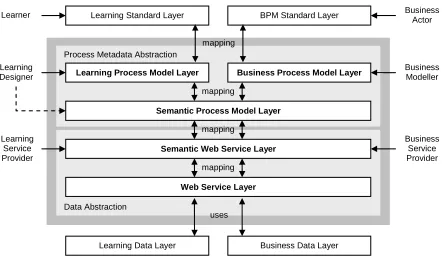
To support these principles, we adopt a layered approach as well as mapping in order to achieve a gradual
abstraction; Figure 1 depicts an example for business and learning processes.
Data Abstraction Process Metadata Abstraction
Semantic Process Model Layer Learning Process Model Layer
Learning Standard Layer
mapping Learning
Designer Learner
Learning Data Layer
Semantic Web Service Layer
uses mapping
Learning Service Provider
Business Process Model Layer
Business Data Layer BPM Standard Layer
mapping
Business Actor
Business Modeller
Business Service Provider
Web Service Layer
mapping
Fig. 1. Semantic Layers and Mappings applied to learning and business processes
Abstraction from Data and Functionalities. To abstract
from existing process data and content we consider a Web Service Layer. It operates on top of the data layer and exposes the functionalities appropriate to fulfill specific objectives. This first step enables a dynamic supply of appropriate data and contents, on the basis of a given context. Note that each service exposed at this level may make use of the semantic descriptions of available process data.
In order to abstract from Web service functionalities, we introduce an additional layer: Semantic Web Service Layer. The latter enables the dynamic selection, composition and invocation of appropriate Web services. This is achieved on the basis of formal semantic descriptions, which enable the dynamic matching of service capabilities to specific user goals.
Abstraction from Process Metadata. A first layer is
concerned with the abstraction from the current process metadata standards: Semantic Process Domain Model Layer. It allows the description of processes within a specific process domain – business and learning processes in Figure 1 - in terms of domain-specific concepts. This layer is mapped to existing semantic representations of process metadata standards. For instance, Semantic Learning Process Model Layer is aimed at semantically representing the higher-level concepts of a learning process such as learning goal, learner, and learning context.
To achieve a further abstraction from domain-specific process models, we consider an upper level process
model: Semantic Process Model Layer. For instance, the
concepts introduced in the Learning Process Model Layer can be mapped to business processes as described within the semantic Business Process Model Layer.
layers. This particularly includes the dynamic selection and invocation of a Web service (Web Service Layer) from, for instance, a standard-compliant learning application (Learning Application Standard Layer). This can be supported by using a mapping between a specific learning objective within a specific learning situation and a WSMO goal (Section 2). This enables the dynamic selection and invocation of services appropriate to achieve a specific learning objective. As a result, a dynamic adaptation to the individual demands of the learner within a specific learning context is achieved by using existing standard-compliant learning applications.
5.
A context-aware Prototype Application for
the E-Learning Domain
In order to validate the technical feasibility of our approach, a prototype application has been implemented realizing the introduced principles in the domain of E-Learning. The application implements an initial use case by utilizing the semantic layers and fundamental concepts introduced in the previous section.
5.1.
Use Case Scenario
We consider a scenario, where learning resources are allocated at runtime of a process based on a mapping between learning contexts, SWS (WSMO) as well as two different metadata standards - IMS Learning Design [9] and ADL SCORM [1]. In the use case scenario, several learners request to learn three different languages: English, German and Italian. This introduces three
possible learning objectives. Moreover, it is assumed that
each learner has one unique preference associated with
his/her native language. Objective and native language represents the two parameters that define the actual
learning context. For instance, if a learner is authenticated
as a person with the native language “English” and wants to learn the language “German”, the learner expects to be provided with an English-based online learning unit aimed at teaching the German language.
Following the current approaches, for every individual learner, learning objective as well as metadata standard, a specific learning content package would have to be created (Section 1). Conversely, our approach will enable all learners to use the same learning content process description – compliant with the metadata standards IMS LD and ADL SCORM. The standard-compliant package dynamically meets the multiple learner-specific requirements. Furthermore, used resources – services as well as data - will not be allocated at design-time, but retrieved at run-time selecting among several distributed repositories.
We are aware that the considered scenario is very simple. However, since the general principle and approach - stated in Section 3 - is implemented, the scenario could be easily extended in the future to achieve a dynamic adaptation to more complex learning contexts.
5.2.
Staged Ontological Mapping
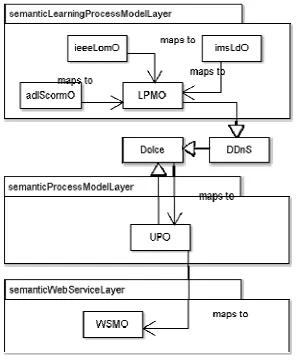
To actualize our vision (Section 3) and approach, we implemented different ontologies aimed at providing abstract semantic descriptions of learning data, processes and contexts. Figure 2 gives an overview of the main ontological representations considered in our approach as well as the mappings between them.
Fig. 2. Conceptual overview of proposed ontological framework
The Learning Process Modelling Ontology (LPMO)
implements the Semantic Learning Process Model Layer and is mapped to ontological representations of standard learning process models. Currently, representations of the following metadata standards are partially implemented:
ADL SCORM 2004 [1] (adlScormO), IMS Learning
Design [9] (imsLdO) and IEEE Learning Object Metadata [6] (ieeeLomO).
The general process ontology that implements the
Semantic Process Model Layer is named Upper Process
Ontology (UPO) and is currently being developed as part
of the SUPER project [17]. SUPER is concerned with
module (DDns) [7] of DOLCE. Finally, the UPO is mapped to the WSMO standard (Section 2). As a result, the ontologies introduced above allow us to realise a gradual mapping between a standard E-Learning process representation and WSMO descriptions.
It is important to note that our ontological architecture enables the mapping not only between multiple semantic layers but also within a specific semantic layer. For instance the LPMO concepts can be mapped to existing semantic descriptions of learning related concepts.
5.3.
SWS-oriented Architecture
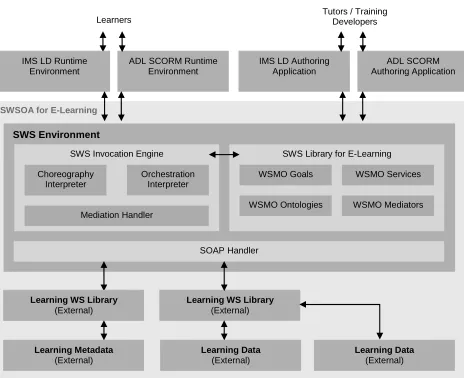
Our current implementation makes use of standard runtime environments: IRS III [3] is used as SWS broker as well as development environment for WSMO descriptions; the Reload software suite [16] is used for editing and runtime processing of IMS LD and ADL SCORM content. Several distributed Web service and data repositories provide the functionalities to achieve learning goals. Figure 3 outlines the Semantic Web Service Oriented Architecture (SWSOA) used in the current prototype. The defined architecture realizes all of the principles described in Section 4.
SWS Environment
SWS Library for E-Learning WSMO Goals WSMO Services WSMO Ontologies WSMO Mediators
SOAP Handler SWS Invocation Engine
Mediation Handler Choreography
Interpreter
Orchestration Interpreter
Learning WS Library
(External)
Learning WS Library
(External)
Learning Metadata
(External)
Learning Data
(External)
Learning Data
(External) Learners
Tutors / Training Developers
IMS LD Runtime Environment
ADL SCORM Runtime Environment
IMS LD Authoring Application
ADL SCORM Authoring Application
SWSOA for E-Learning
Fig. 3. SWS-based software architecture as utilized in the prototype application
To support the scenario described in Section 5.1, the following elements had to be provided within the general architecture presented above:
1. Learning Web services libraries. Web services were provided to support the authentication of the learner, the retrieval of semantic learner profiles, learning metadata and learning contents. Web services utilized
in this demonstrator were partly developed within the LUISA project [13].
2. WSMO Ontologies. To implement the Semantic Learning Process Model Layer, initial semantic representations of ADL SCORM, IMS LD, the LPMO and content objects provided by the Open Learn Project [15] have been created. To support individual learner preferences, we particularly consider semantic learner profiles, describing the native language of every learner. All ontologies have been developed by using OCML [5] as ontology language.
3. Mappings between semantic layers as well as metadata standards. We created mappings between the initial implementations of semantic representations of metadata standards (IMS LD, ADL SCORM) and the LPMO as well as WSMO. For instance, we defined a
mapping between the lpmo:Objective and the objective
description used within the IMS LD metadata (imsld:Objective). Moreover, semantic learning object descriptions based on the LPMO were mapped to
OpenLearn content units (ol:Content Unit), whereas
the language of a content unit (ol:Language) was
mapped to the native language of a learner (lpmo:Language). Since the UPO is not currently supported by any run- time environment, the LPMO objective is directly mapped to a WSMO goal. Figure 4 depicts the main ontological mappings as defined in our prototype. The defined mappings are performed at runtime as specific functionalities. These functionalities are exposed as Web services, which are part of an external learning Web services Library.
4. WSMO Goal, Web Service, and Mediator descriptions
of the available Web services, based on the concepts defined in the WSMO ontologies.
OpenLearn Ontology
LPMO WSMO IMS Learning Design Ontology
imsld:Activity
Fig. 4. Ontological mappings implemented and utilized in the prototype application
6.
Dynamic Context-Adaptation at Runtime
At runtime, an end-user (learner) accesses a standard-compliant player and loads the content packages compliant with IMS LD and ADL SCORM as defined in bullet 5 of the previous section. The learning application then sequentially presents all of the learning activities that would have to be performed. An initial activity first authenticates the learner and retrieves the semantic learner profile description. The WSMO goal associated with such an activity is invoked, and the SWS broker dynamically selects and invokes the WSMO Web service showing the appropriate capabilities to achieve the specified goal. At this point, the learner preferences are set within the player environment.
In the same way, when the learner selects an individual objective within the standard content package, our infrastructure dynamically selects and invokes semantic Web services according to his/her preferences and stated objectives. For instance, if a learner is authenticated as an English-speaking person (lpmo:Language=English) and uses an ADL SCORM-based package to learn the language German, a scorm:Item with the imss:Objective=Learn German is mapped to a WSMO Learn-German-Goal.
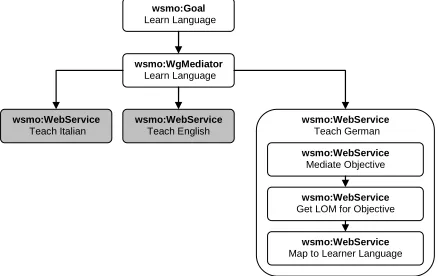
The accomplishment of such a goal involves the selection, orchestration and invocation of different Web services, which perform the described mappings and retrieve appropriate learning content. Therefore, a mapping between a WSMO goal and WSMO Web services was implemented based on the WSMO framework. Usually, different services are able to achieve a given goal. This means, several Web services are linked to a specific WSMO goal by using a dedicated WSMO mediator (WSMO WG Mediator).
wsmo:WgMediator
Learn Language
wsmo:Goal
Learn Language
wsmo:WebService
Teach Italian
wsmo:WebService
Teach English
wsmo:WebService
Teach German
Fig. 5. Linking of WSMO goals, mediators and Web services
Based on semantic capability descriptions of available services, the most appropriate service can be selected to suit a given goal. Listing 1 shows a portion of OCML code of a WSMO capability description of a Web service able to provide learning content to teach the language German.
(DEF-CLASS ACHIEVE-OBJECTIVE-GERMAN-WS-CAPABILITY (CAPABILITY)
?CAPABILITY
((USED-MEDIATOR :VALUE ACHIEVE OBJECTIVE-GERMAN-MED)
(HAS-ASSUMPTION :VALUE (KAPPA
(SERVICE) (= (WSMO-ROLE-VALUE ?WEB-SERVICE 'HAS-IMSS-OBJECTIVE)"Learn German")))
Listing 1. Portion of source code of a Web service capability description
In Listing 1, a WSMO description defines the assumption of a Web service that the objective provided by the ADL SCORM content package is valued by “Learn German”. The WSMO service used in our prototype application to achieve this objective requires an orchestration of several services to support this learning objective. Therefore, the goal achievement triggers a sequence of services needed to get information about the actual learner, to retrieve content appropriate to his specific objective as well as to select content appropriate for his specific requirements.
wsmo:WebService
Teach German
wsmo:WebService
Mediate Objective
wsmo:WebService
Get LOM for Objective
wsmo:WebService
Map to Learner Language
wsmo:WgMediator
Learn Language
wsmo:Goal
Learn Language
wsmo:WebService
Teach Italian
wsmo:WebService
Teach English
For instance, if a learner is authenticated as an
English-speaking person (lpmo:Language=English) and
uses an ADL SCORM-based package to learn the
language German, an imssIitem with the
imss:Objective=Learn German is mapped to a specific WSMO-Goal. The accomplishment of such a goal involves the selection, orchestration and invocation of different Web services, which perform the described mappings and retrieve appropriate learning content: (i) the imss:Objective is mapped to the lpmo:Objective
concept; (ii) the lpmo:Objective is used to retrieve the
semantic learning object metadata (LOM) of an appropriate learning object; (iii) the retrieved LOM is used to obtain an Open Learn learning unit appropriate to the individual language of the learner and its current objective. Each of these goals is accomplished by a distinct Web service dynamically selected at runtime.
The retrieved learning object is finally presented in the ADL SCORM runtime environment.
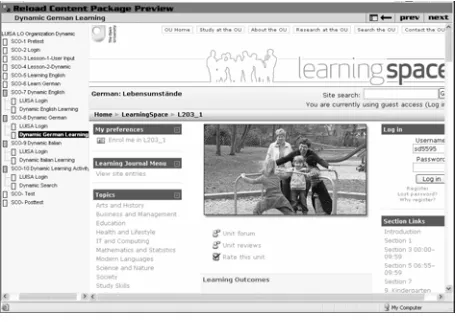
Fig. 7. Reload ADL SCORM Design Player while dynamically invoking SWS for E-Learning
Figure 7 depicts a screenshot of the Reload ADL SCORM 2004 Package Viewer while presenting a standard-compliant ADL SCORM 2004 content package and dynamically invoking SWS appropriate to fulfill the given learning objective “Learn German”. Besides several limitations, our current prototype implements the basic approach of a standard-compliant SWSOA for E-Learning as described here.
7.
Conclusion and Future Work
In this paper, we introduced an innovative approach to support process models based on a dynamic run-time invocation of Web services. This approach is radically distinctive to the current state of the art in this area, which is based on the manual allocation of process resources (data or services) at design-time. Adopting Semantic Web
technologies – in particular Semantic Web Services - we overcome current limitations (Section 1) and support a high level of standard-compliancy and re-usability. To summarize, the following contributions should be taken into account:
• Dynamic adaptation to specific process contexts at
runtime;
• Automatic allocation of distributed resources based
on comprehensive semantics;
• High reusability across process contexts;
• Metadata standard-independence as well as
compliancy;
• Reuse and integration of distributed process
resources;
• Decrease of development costs.
Furthermore, our approach can lead to contributions for developing domain-specific SWS applications in general, since we consider mappings between the WSMO standard and higher-level process modeling as well as domain specific process modeling standards. This enables the development of complex SWS-based applications and therefore several benefits are envisaged:
• Re-usability of SWS-based applications based on
semantic mappings with existing process metadata standards;
• Utilization of established standard-compliant process
metadata runtime environments to implement complex SWS- based architectures.
To prove the benefits of the proposed approach, we described an initial prototype application. The current prototype implements the basic approach of a standard-compliant SWSOA for E-Learning and will be extended in the future in order to address existing limitations and cover more comprehensive use cases.
8.
References
[1] Advanced Distributed Learning (ADL) SCORM 2004
Specification (http://www.adlnet.org).
[2] Amorim, R. R., Lama, M., Sánchez, E., Riera, A., & Vila,
X. A. (2006). A Learning Design Ontology based on the IMS Specification. Journal of Educational Technology & Society, 9 (1), 38-57.
[3] Cabral, L., Domingue, J., Galizia, S., Gugliotta, A.,
Norton, B., Tanasescu, V., Pedrinaci, C.: IRS-III: A Broker for Semantic Web Services based Applications. In proceedings of
the 5th International Semantic Web Conference (ISWC 2006),
Athens, USA (2006).
[4] Collis, B. and Strijker, A. (2004). Technology and Human
Issues in Reusing Learning Objects. Journal of Interactive Media in Education, 2004 (4). Special Issue on the Educational Semantic Web [www- jime.open.ac.uk/2004/4].
[5] J. Domingue, E. Motta and O. Corcho Garcia (1999).
Knowledge Modelling in WebOnto and OCML: A User Guide,
available from: http://kmi.open.ac.uk/projects/webonto/user_guide.2.4.pdf.
[6] Duval, E. (2002). 1484.12.1 IEEE Standard for learning
Object Metadata, IEEE Learning Technology Standards Committee, http://ltsc.ieee.org/wg12/.
[7] Gangemi, A., and Mika, P. Understanding the Semantic
Web through Descriptions and Situations. In Meersman, R.; Tari, Z.; and et al., D. S., eds., Proceedings of the On The Move Federated Conferences (OTM’03), LNCS. Springer Verlag.
[8] Gangemi, A., Guarino, N., Masolo, C., Oltramari, A.,
Schneider, L.: Sweetening Ontologies with DOLCE. In: A. Gómez-Pérez , V. Richard Benjamins (Eds.) Knowledge Engineering and Knowledge Management. Ontologies and the Semantic Web: 13th International Conference, EKAW 2002, Siguenza, Spain, October 1-4, 2002.
[9] IMS Learning Design Specification
(http://www.imsglobal.org).
[10]IMS Simple Sequencing Specification
(http://www.imsglobal.org).
[11]Knight, C., Gašević, D., & Richards, G. (2006). An
Ontology-Based Framework for Bridging Learning Design and Learning Content. Journal of Educational Technology & Society, 9 (1), 23-37.
[12]Koper, R. (2004). Use of the Semantic Web to Solve Some
Basic Problems in Education: Increase Flexible, Distributed Lifelong Learning, Decrease Teacher's Workload. Journal of Interactive Media in Education, 2004 (6). Special Issue on the Educational Semantic Web. ISSN:1365-893X [www-jime.open.ac.uk/2004/6].
[13]LUISA Project - Learning Content Management System
Using Innovative Semantic Web Services Architecture (http://www.luisa-project.eu/www/).
[14]Object Management Group: Business Process Modelling
Notation Specification (http://www.omg.org/docs/dtc/06-02-01.pdf).
[15]Open Learn Project: Online Educational Resources
(http://openlearn.open.ac.uk/).
[16]Reload Project (http://www.reload.ac.uk/).
[17]SUPER – Semantics Utilized for Process Management
within and between Enterprises (http://www.ip-super.org/).
[18]WSMO Working Group, D2v1.0: Web Service Modeling