AN ANALYSIS THE SECOND YEAR STUDENT’S ABILITY IN USE HOLTICULTURE TERMINOLOGY AT SMKN PERTANIAN TERPADU
PROVINSI RIAU
* Susilawati, **Khulaifiyah,**Sri Yuliani ** Dosen FKIP Universitas Islam Riau * Mahasiswa FKIP Universitas Islam Riau
Abstract
The objective of this research was to find out to find out how good is students’s mastery in English vocabulary of Holticulture Terminology, and What are the most difficulties student’s holticulture terminology at SMKN Pertanian terpadu provinsi Riau. This research was descriptive quantitative. There was one variable in this research. The location of this research was in SMKN Pertanian Terpadu Provinsi Riau consisted 127 students as population in this research and the researcher choose the sample using cluster ramdom sampling, the sample were 40 students from two classes of the second year at SMKN Pertanian Terpadu Provinsi Riau. There was one instrument in this research. The result of students’ability in using Holticulture terminology based on holticulture classification; the students was “Excellent” 96,66% in using holticulture classification by use, The students “Poor” in using Classification by climatic because the percentages was 51,66. The students was Fair in using Classification by Ecological Adaptations because the percentages was 60%, the students was “Fair” in using Classifiation by Stem and Leaf Texture because the percentages was 61,66%, the students was “Poor” in using Classification by Growth Habit because the percentages was 51,33 %, the students was “Fairly good” in using Classification by Life Span because the percentages is 73,66 %. There were two holticulture classifications still difficult for students at SMKN Pertanian terpadu provinsi Riau was in using Holticulture classification by climatic because the percentages was 51,66, and the students was “Poor” in using Classification by Growth Habit because the percentages is 51,33 %.
Keyword: Mastery of Holticulture Terminology
Introduction
Usually, it is believed that people need to work to live. However, work alone cannot provide us with all that we want. Instead, we want a balance between work and other life functions. Students should be advised to prioritize work according to their unique individual, family, work, and community needs and values.
Vocational school planning should value pluralism. As a nation with ethnic, racial, religious, and geographic diversity, we need an educational system that promotes an understanding of differences. Expatriates and foreign business circles in Indonesia should have an informed awareness of the sense of spirituality. It will strengthen the employees’ commitment to their work. Fourth, vocational planning should manage personal transitions and organizational changes. The most salient characteristic of globalization is change. Employees should be knowledgeable about the potential organizational change at the workplace.
They should also be taught how to manage the process. Different companies develop their own company culture so that students should be made familiar with cultures. It will help them prepare themselves to successfully learn before work. Therefore the student must learn their specific subject in their school but the real fact some student that writer asked about their specific especially in SMKN PERTANIAN TERPADU PROVINSI RIAU about English lesson, it is not specific to agricultural terminologies.
They said that they knew about English holticultural terminologies usefully, but they studied these terminologies in general form only. Some of students unfamiliar with agriculture words. It was caused by the students seldom reading and identify the difficult word that they found and some of the students cannot make ashort messages, instruction and list in term of selected words, spellings and correct grammars. It means that the students made sentences or messages use agriculture word list because were they seldom to write by using agriculture word, and they did not understand about that words. Therefore, the researcher wanted to teach English at vocational high school with specific needs.
Most of students considered that English in agricultural terminologies was not important for their field. They did not know that English agricultural terminology needed work in foreign company. Because they were of lack vocabulary about holticulture terminology.
Methodology
Participants
The participants of this research was all of second year students at SMKN PERTANIAN TERPADU PROVINSI RIAU, there were nine classes of the second year at SMKN TERPADU PROVINSI RIAU. The total number of the population was 253. But the participant in this research were 126 students because 127 students doing practice field. The population of this research was assumed to have the level of prophecy and the same material in teaching and learning process.
Instruments
The instrument was used multiple choice tests to know students’ability understand vocabulary in the test. The students chose the correct answer(A,B,C,D) The researcher asked them finding the meaning of vocabulary in holticultural texts. The researcher used these instruments of the students’ doing to fill the test based on resource that they had learned by their teacher.The total of test was 30 items.
Data Collection Procedure
The data collection technique used in this research collected by the researcher was 30 multiple choice items to the students. In this items included of students vocabulary comprehension in answering the test.
The procedures to conduct the data were as in the following :
a) The researcher asked the student to read instruction on the paper test carefully and instructed the to write their names.
b) The researcher reminded them about holticultural terminology, mentioned glossary about holticultural term in English.
c) The researcher asked to complete the blank sentences and translated the word of holticulture terminologies.
d) The researcher gave time about 90 minutes for students to do the test. e) The researcher asked to collect the students test.
f) The researcher checked the students test and then signed the student’s mistakes.
Results and Discussion
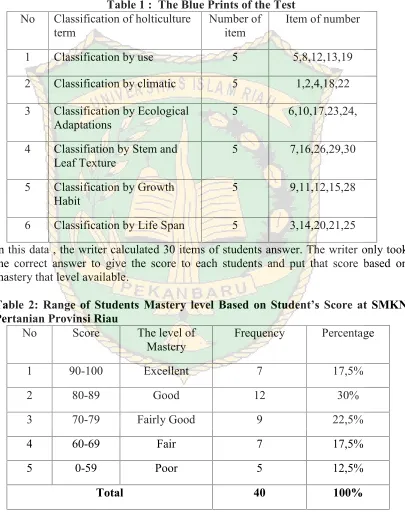
In this test the writer measured students’ mastery in answering the agriculture vocabulary in holticulture term. After the writer collected the data in SMKN Pertanian Terpadu Provinsi Riau. The writer classified and analyzed the data based on all of indicators that have been taken by the writer. Here are the blue prints of the test:
Table 1 : The Blue Prints of the Test No Classification of holticulture
term
Number of item
Item of number
1 Classification by use 5 5,8,12,13,19
2 Classification by climatic 5 1,2,4,18,22
3 Classification by Ecological Adaptations
5 6,10,17,23,24,
4 Classifiation by Stem and Leaf Texture
5 7,16,26,29,30
5 Classification by Growth Habit
5 9,11,12,15,28
6 Classification by Life Span 5 3,14,20,21,25
In this data , the writer calculated 30 items of students answer. The writer only took the correct answer to give the score to each students and put that score based on mastery that level available.
Table 2: Range of Students Mastery level Based on Student’s Score at SMKN Pertanian Provinsi Riau
No Score The level of
Mastery
Frequency Percentage
1 90-100 Excellent 7 17,5%
2 80-89 Good 12 30%
3 70-79 Fairly Good 9 22,5%
4 60-69 Fair 7 17,5%
5 0-59 Poor 5 12,5%
After calculating the result from holticulture test, the writer got the mastery level as follow; 5 students can categorized into Poor with range 0-59. , 7 students can be categorized into Fair with range 60-69, 9 students can be categorized into Fairly good with range 70-79, 12 students can be categorized into Good with range 80-89 and 7 students can be categorized into Excellent with range 90-100.
Table 3: The students Percentages in Answering the Holticulture Terminologies Based On All of Indicators at SMKN Pertanian Terpadu Provinsi Riau
N
51,66, and the students was Poor in using Classification by Growth Habit because the percentages was 51,33 %.
Conclusion
The result of this research showed from 40 samples in this research, there were 30 items of the test from of six holticulture classification which 5 test items each of holticulture classification. There were two of holticulture classifications student’s holticulture terminology was still difficult for students at SMKN Pertanian terpadu provinsi Riau was in using Holticulture classification by climatic because the percentages was 51,66, and the students was Poor in using Classification by Growth Habit because the percentages is 51,33 %.
The students was”Poor” in using Holticulture Terminology from two classification of holticulture terminology were classification by climatic requirement and classification by growth habit because the students seldom found the term in their subject.
References
Asmida, Mimi.(2012); A study on Students’ English Agriculture Terminologies of Third year at SMKN Pertanian Terpadu Provinsi Riau.Pekanbaru. UIR Press.
Brown, JD. (1991). Understanding Research in Second language Learning. Cambridge University Press. Cambridge.
Hatch, and Farhady, (1982). Research Design and Statistic for Applied linguists. Los Angeles : University of California.
Huaxiao Zhu.(2012). Discussion about Vocational English Teaching Reform. International Conference on Education Technology and Management Engineering.Lecture Notes in Information Technology, Vols.16-17. China: Tourism Department of Chongqing Educational College.
Heton,J.B.(1991). Writing English language test : A practical Guide for Teaching English as a second language or Foreign language. London : Longman Group limited.
Krisyani, Yiyis.(2005). English for Vocational School. Yogyakarta: LP2IP Gajah mada.
HolticultureClassification.http://www.seiofbluemountain.com/upload/product/201209 /1346822688rc3oosc.pdf. retrieve on September 2012.
Oxford University.(2000). Oxford Learners’ Pocket Dictionary. Oxford University Press. New York.
Sutinah, Entin.(2006).Get Along With English. Erlangga.