FUNDAMENTALS OF
COMPUTER
ORGANIZATION AND
ARCHITECTURE
Mostafa Abd-El-Barr
King Fahd University of Petroleum & Minerals (KFUPM)
Hesham El-Rewini
Southern Methodist University
FUNDAMENTALS OF
WILEY SERIES ON PARALLEL AND DISTRIBUTED COMPUTING SERIES EDITOR: Albert Y. Zomaya
Parallel & Distributed Simulation Systems/Richard Fujimoto
Surviving the Design of Microprocessor and Multimicroprocessor Systems: Lessons Learned/Veljko Milutinovic
Mobile Processing in Distributed and Open Environments/Peter Sapaty Introduction to Parallel Algorithms/C. Xavier and S.S. Iyengar
Solutions to Parallel and Distributed Computing Problems: Lessons from Biological Sciences/Albert Y. Zomaya, Fikret Ercal, and Stephan Olariu (Editors) New Parallel Algorithms for Direct Solution of Linear Equations/
C. Siva Ram Murthy, K.N. Balasubramanya Murthy, and Srinivas Aluru Practical PRAM Programming/Joerg Keller, Christoph Kessler, and Jesper Larsson Traeff
Computational Collective Intelligence/Tadeusz M. Szuba
Parallel & Distributed Computing: A Survey of Models, Paradigms, and Approaches/Claudia Leopold
Fundamentals of Distributed Object Systems: A CORBA Perspective/ Zahir Tari and Omran Bukhres
Pipelined Processor Farms: Structured Design for Embedded Parallel Systems/Martin Fleury and Andrew Downton
Handbook of Wireless Networks and Mobile Computing/Ivan Stojmenoviic (Editor)
Internet-Based Workflow Management: Toward a Semantic Web/ Dan C. Marinescu
Parallel Computing on Heterogeneous Networks/Alexey L. Lastovetsky Tools and Environments for Parallel and Distributed Computing Tools/ Salim Hariri and Manish Parashar
Distributed Computing: Fundamentals, Simulations and Advanced Topics, Second Edition/Hagit Attiya and Jennifer Welch
Smart Environments: Technology, Protocols and Applications/ Diane J. Cook and Sajal K. Das (Editors)
FUNDAMENTALS OF
COMPUTER
ORGANIZATION AND
ARCHITECTURE
Mostafa Abd-El-Barr
King Fahd University of Petroleum & Minerals (KFUPM)
Hesham El-Rewini
Southern Methodist University
This book is printed on acid-free paper.1
Copyright#2005 by John Wiley & Sons, Inc. All rights reserved. Published by John Wiley & Sons, Inc., Hoboken, New Jersey. Published simultaneously in Canada.
No part of this publication may be reproduced, stored in a retrieval system, or transmitted in any form or by any means, electronic, mechanical, photocopying, recording, scanning, or otherwise, except as permitted under Section 107 or 108 of the 1976 United States Copyright Act, without either the prior written permission of the Publisher, or authorization through payment of the appropriate per-copy fee to the Copyright Clearance Center, Inc., 222 Rosewood Drive, Danvers, MA 01923,
for permission should be addressed to the Permissions Department, John Wiley & Sons, Inc., 111 River Street, Hoboken, NJ 07030; (201) 748-6011, fax (201) 748-6008.
Limit of Liability/Disclaimer of Warranty: While the publisher and author have used their best efforts in preparing this book, they make no representations or warranties with respect to the accuracy or completeness of the contents of this book and specifically disclaim any implied warranties of merchantability or fitness for a particular purpose. No warranty may be created or extended by sales representatives or written sales materials. The advice and strategies contained herein may not be suitable for your situation. You should consult with a professional where appropriate. Neither the publisher nor author shall be liable for any loss of profit or any other commercial damages, including but not limited to special, incidental, consequential, or other damages.
For general information on our other products and services please contact our Customer Care Department within the U.S. at 877-762-2974, outside the U.S. at 317-572-3993 or fax 317-572-4002.
Wiley also publishes its books in a variety of electronic formats. Some content that appears in print, however, may not be available in electronic format.
Library of Congress Cataloging-in-Publication Data: Abd-El-Barr, Mostafa.
Fundamentals of computer organization and architecture/Mostafa Abd-El-Barr, Hesham El-Rewini p. cm. — (Wiley series on parallel and distributed computing)
Includes bibliographical references and index.
ISBN 0-471-46741-3 (cloth volume 1) — ISBN 0-471-46740-5 (cloth volume 2)
1. Computer architecture. 2. Parallel processing (Electronic computers) I. Abd-El-Barr, Mostafa, 1950– II. Title. III. Series.
QA76.9.A73E47 2004 004.202—dc22
2004014372
Printed in the United States of America
10 9 8 7 6 5 4 3 2 1
To my family members (Ebtesam, Muhammad, Abd-El-Rahman, Ibrahim, and Mai) for their support and love
—Mostafa Abd-El-Barr
To my students, for a better tomorrow
&
CONTENTS
Preface xi
1. Introduction to Computer Systems 1
1.1. Historical Background 2
1.2. Architectural Development and Styles 4
1.3. Technological Development 5
1.4. Performance Measures 6
1.5. Summary 11
Exercises 12
References and Further Reading 14
2. Instruction Set Architecture and Design 15
2.1. Memory Locations and Operations 15
2.2. Addressing Modes 18
2.3. Instruction Types 26
2.4. Programming Examples 31
2.5. Summary 33
Exercises 34
References and Further Reading 35
3. Assembly Language Programming 37
3.1. A Simple Machine 38
3.2. Instructions Mnemonics and Syntax 40
3.3. Assembler Directives and Commands 43
3.4. Assembly and Execution of Programs 44
3.5. Example: TheX86Family 47
3.6. Summary 55
Exercises 56
References and Further Reading 57
4. Computer Arithmetic 59
4.1. Number Systems 59
4.2. Integer Arithmetic 63
4.3 Floating-Point Arithmetic 74
4.4 Summary 79
Exercises 79
References and Further Reading 81
5. Processing Unit Design 83
5.1. CPU Basics 83
5.2. Register Set 85
5.3. Datapath 89
5.4. CPU Instruction Cycle 91
5.5. Control Unit 95
5.6. Summary 104
Exercises 104
References 106
6. Memory System Design I 107
6.1. Basic Concepts 107
6.2. Cache Memory 109
6.3. Summary 130
Exercises 131
References and Further Reading 133
7. Memory System Design II 135
7.1. Main Memory 135
7.2. Virtual Memory 142
7.3. Read-Only Memory 156
7.4. Summary 158
Exercises 158
References and Further Reading 160
8. Input – Output Design and Organization 161
8.1. Basic Concepts 162
8.2. Programmed I/O 164
8.3. Interrupt-Driven I/O 167
8.4. Direct Memory Access (DMA) 175
8.5. Buses 177
8.6. Input – Output Interfaces 181
8.7. Summary 182
Exercises 183
References and Further Reading 183
9 Pipelining Design Techniques 185
9.1. General Concepts 185
9.2. Instruction Pipeline 187
9.3. Example Pipeline Processors 201
9.4. Instruction-Level Parallelism 207
9.5. Arithmetic Pipeline 209
9.6. Summary 213
Exercises 213
References and Further Reading 215
10 Reduced Instruction Set Computers (RISCs) 215
10.1. RISC/CISC Evolution Cycle 217
10.2. RISCs Design Principles 218
10.3. Overlapped Register Windows 220
10.4. RISCs Versus CISCs 221
10.5. Pioneer (University) RISC Machines 223
10.6. Example of Advanced RISC Machines 227
10.7. Summary 232
Exercises 233
References and Further Reading 233
11 Introduction to Multiprocessors 235
11.1. Introduction 235
11.2. Classification of Computer Architectures 236
11.3. SIMD Schemes 244
11.4. MIMD Schemes 246
11.5. Interconnection Networks 252
11.6. Analysis and Performance Metrics 254
11.7. Summary 254
Exercises 255
References and Further Reading 256
Index 259
&
PREFACE
This book is intended for students in computer engineering, computer science, and electrical engineering. The material covered in the book is suitable for a semester course on “Computer Organization & Assembly Language” and a one-semester course on “Computer Architecture.” The book assumes that students studying computer organization and/or computer architecture must have had exposure to a basic course on digital logic design and an introductory course on high-level computer language.
This book reflects the authors’ experience in teaching courses on computer organ-ization and computer architecture for more than fifteen years. Most of the material used in the book has been used in our undergraduate classes. The coverage in the book takes basically two viewpoints of computers. The first is the programmer’s viewpoint and the second is the overall structure and function of a computer. The first viewpoint covers what is normally taught in a junior level course on Computer Organization and Assembly Language while the second viewpoint covers what is normally taught in a senior level course on Computer Architecture. In what follows, we provide a chapter-by-chapter review of the material covered in the book. In doing so, we aim at providing course instructors, students, and practicing engineers/ scien-tists with enough information that can help them select the appropriate chapter or sequences of chapters to cover/review.
development and styles are covered in Chapter 1. We devote the last part of our cov-erage in this chapter to a discussion on the different CPU performance measures used.
The sequence consisting of Chapters 2 and 3 introduces the basic issues related to instruction set architecture and assembly language programming. Chapter 2 covers the basic principles involved in instruction set architecture and design. We start by addressing the issue of storing and retrieving information into and from memory, followed by a discussion on a number of different addressing modes. We also explain instruction execution and sequencing in some detail. We show the appli-cation of the presented addressing modes and instruction characteristics in writing sample segment codes for performing a number of simple programming tasks. Building on the material presented in Chapter 2, Chapter 3 considers the issues related to assembly language programming. We introduce a programmer’s view of a hypothetical machine. The mnemonics and syntax used in representing the different instructions for the machine model are then introduced. We follow that with a discussion on the execution of assembly programs and an assembly language example of theX86 Intel CISC family.
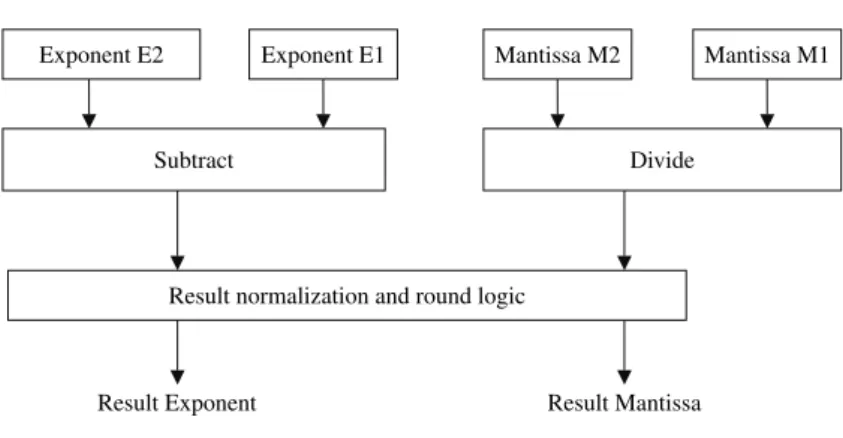
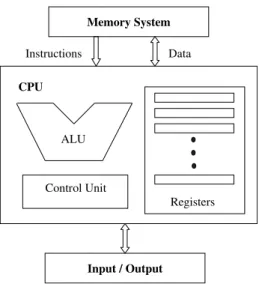
The sequence of chapters 4 and 5 covers the design and analysis of arithmetic cir-cuits and the design of the Central Processing Unit (CPU). Chapter 4 introduces the reader to the fundamental issues related to the arithmetic operations and circuits used to support computation in computers. We first introduce issues such as number representations, base conversion, and integer arithmetic. In particular, we introduce a number of algorithms together with hardware schemes that are used in performing integer addition, subtraction, multiplication, and division. As far as floating-point arith-metic, we introduce issues such as floating-point representation, floating-point oper-ations, and floating-point hardware schemes. Chapter 5 covers the main issues related to the organization and design of the CPU. The primary function of the CPU is to execute a set of instructions stored in the computer’s memory. A simple CPU con-sists of a set of registers, Arithmetic Logic Unit (ALU), and Control Unit (CU). The basic principles needed for the understanding of the instruction fetch-execution cycle, and CPU register set design are first introduced. The use of these basic principles in the design of real machines such as the 8086 and the MIPS are shown. A detailed discussion on a typical CPU data path and control unit design is also provided.
Chapters 6 and 7 combined are dedicated to Memory System Design. A typical memory hierarchy starts with a small, expensive, and relatively fast unit, called the cache. The cache is followed in the hierarchy by a larger, less expensive, and rela-tively slowmain memoryunit. Cache and main memory are built using solid-state semiconductor material. They are followed in the hierarchy by a far larger, less expensive, and much slower magnetic memories that consist typically of the (hard) disk and the tape. We start our discussion in Chapter 6 by analyzing the fac-tors influencing the success of a memory hierarchy of a computer. The remaining part of Chapter 6 is devoted to the design and analysis of cache memories. The issues related to the design and analysis of the main and the virtual memory are covered in Chapter 7. A brief coverage of the different read-only memory (ROM) implementations is also provided in Chapter 7.
I/O plays a crucial role in any modern computer system. A clear understanding and appreciation of the fundamentals of I/O operations, devices, and interfaces are of great importance. The focus of Chapter 8 is a study on input – output (I/O) design and organization. We cover the basic issues related to programmed and Interrupt-driven I/O. The interrupt architecture in real machines such as 8086 and MC9328MX1/MXL AITC are explained. This is followed by a detailed discussion on Direct Memory Access (DMA), busses (synchronous and asynchronous), and arbitration schemes. Our coverage in Chapter 8 concludes with a discussion on I/O interfaces.
There exists two basic techniques to increase the instruction execution rate of a processor. These are: to increase the clock rate, thus decreasing the instruction execution time, or alternatively to increase the number of instructions that can be executed simultaneously. Pipelining and instruction-level parallelism are examples of the latter technique. Pipelining is the focus of the discussion provided in Chapter 9. The idea is to have more than one instruction being processed by the processor at the same time. This can be achieved by dividing the execution of an instruction among a number of sub-units (stages), each performing part of the required oper-ations, i.e., instruction fetch, instruction decode, operand fetch, instruction execution, and store of results. Performance measures of a pipeline processor are introduced. The main issues contributing to instruction pipeline hazards are dis-cussed and some possible solutions are introduced. In addition, we present the con-cept of arithmetic pipelining together with the problems involved in designing such pipeline. Our coverage concludes with a review of two pipeline processors, i.e., the ARM 1026EJ-S and the UltraSPARC-III.
Chapter 10 is dedicated to a study of Reduced Instruction Set Computers (RISCs). These machines represent a noticeable shift in computer architecture paradigm. The RISC paradigm emphasizes the enhancement of computer architectures with the resources needed to make the execution of the most frequent and the most time-consuming operations most efficient. RISC-based machines are characterized by a number of common features, such as, simple and reduced instruction set, fixed instruction format, one instruction per machine cycle, pipeline instruction fetch/ exe-cute units, ample number of general purpose registers (or alternatively optimized compiler code generation), Load/Store memory operations, and hardwired control unit design. Our coverage in this chapter starts with a discussion on the evolution of RISC architectures and the studies that led to their introduction. Overlapped Reg-ister Windows, an essential concept in the RISC development, is also discussed. We show the application of the basic RISC principles in machines such as the Berkeley RISC, the Stanford MIPS, the Compaq Alpha, and the SUN UltraSparc.
single uniprocessors is expected to be more cost effective than building a high-performance single processor. We present a number of different topologies used for interconnecting multiple processors, different classification schemes, and a topology-based taxonomy for interconnection networks. Two memory-organization schemes for MIMD (multiple instruction multiple data) multiprocessors, i.e., Shared Memory and Message Passing, are also introduced. Our coverage in this chapter ends with a touch on the analysis and performance metrics for multiprocessors. Interested readers are referred to more elaborate discussions on multiprocessors in our book entitled Advanced Computer Architectures and Parallel Processing, John Wiley and Sons, Inc., 2005.
From the above chapter-by-chapter review of the topics covered in the book, it should be clear that the chapters of the book are, to a great extent, self-contained and inclusive. We believe that such an approach should help course instructors to selectively choose the set of chapters suitable for the targeted curriculum. However, our experience indicates that the group of chapters consisting of Chapters 1 to 5 and 8 is typically suitable for a junior level course on Computer Organization and Assembly Language for Computer Science, Computer Engineering, and Electrical Engineering students. The group of chapters consisting of Chapters 1, 6, 7, 9 – 11 is typically suitable for a senior level course on Computer Architecture. Practicing engineers and scientists will find it feasible to selectively consult the material cov-ered in individual chapters and/or groups of chapters as indicated in the chapter-by-chapter review. For example, to find more about memory system design, interested readers may consult the sequence consisting of Chapters 6 and 7.
ACKNOWLEDGMENTS
We would like to express our thanks and appreciation to a number of people who have helped in the preparation of this book. Students in our Computer Organization and Computer Architecture courses at the University of Saskatchewan (UofS), SMU, KFUPM, and Kuwait University have used drafts of different chapters and provided us with useful feedback and comments that led to the improvement of the presentation of the material in the book; to them we are thankful. Our colleagues Donald Evan, Fatih Kocan, Peter Seidel, Mitch Thornton, A. Naseer, Habib Ammari, and Hakki Cankaya offered constructive comments and excellent sugges-tions that led to noticeable improvement in the style and presentation of the book material. We are indebted to the anonymous reviewers arranged by John Wiley for their suggestions and corrections. Special thanks to Albert Y. Zomaya, the series editor and to Val Moliere, Kirsten Rohstedt, and Christine Punzo of John Wiley for their help in making this book a reality. Of course, responsibility for errors and inconsistencies rests with us. Finally, and most of all, we want to thank our families for their patience and support during the writing of this book.
&
CHAPTER 1
Introduction to Computer Systems
The technological advances witnessed in the computer industry are the result of a long chain of immense and successful efforts made by two major forces. These are the academia, represented by university research centers, and the industry, represented by computer companies. It is, however, fair to say that the current tech-nological advances in the computer industry owe their inception to university research centers. In order to appreciate the current technological advances in the computer industry, one has to trace back through the history of computers and their development. The objective of such historical review is to understand the factors affecting computing as we know it today and hopefully to forecast the future of computation. A great majority of the computers of our daily use are known as general purpose machines. These are machines that are built with no specific application in mind, but rather are capable of performing computation needed by a diversity of applications. These machines are to be distinguished from those built to serve (tailored to) specific applications. The latter are known asspecial purposemachines. A brief historical background is given in Section 1.1. Computer systems have conventionally been defined through their interfaces at a number of layered abstraction levels, each providing functional support to its pre-decessor. Included among the levels are the application programs, the high-level languages, and the set of machine instructions. Based on the interface between different levels of the system, a number of computer architectures can be defined. The interface between the application programs and a high-level language is referred to as alanguage architecture.Theinstruction set architecture defines the interface between the basic machine instruction set and theruntimeandI/O control. A different definition of computer architecture is built on four basic viewpoints. These are the structure, the organization, the implementation, and the performance. In this definition, the structure defines the interconnection of various hardware com-ponents, the organization defines the dynamic interplay and management of the various components, the implementation defines the detailed design of hardware components, and the performance specifies the behavior of the computer system. Architectural development and styles are covered in Section 1.2.
A number of technological developments are presented in Section 1.3. Our discus-sion in this chapter concludes with a detailed coverage of CPU performance measures.
1.1. HISTORICAL BACKGROUND
In this section, we would like to provide a historical background on the evolution of cornerstone ideas in the computing industry. We should emphasize at the outset that the effort to build computers has not originated at one single place. There is every reason for us to believe that attempts to build the first computer existed in different geographically distributed places. We also firmly believe that building a computer requires teamwork. Therefore, when some people attribute a machine to the name of a single researcher, what they actually mean is that such researcher may have led the team who introduced the machine. We, therefore, see it more appropriate to mention the machine and the place it was first introduced without linking that to a specific name. We believe that such an approach is fair and should eliminate any controversy about researchers and their names.
It is probably fair to say that the first program-controlled (mechanical) computer ever build was the Z1 (1938). This was followed in 1939 by the Z2 as the first oper-ational program-controlled computer with fixed-point arithmetic. However, the first recorded university-based attempt to build a computer originated on Iowa State University campus in the early 1940s. Researchers on that campus were able to build a small-scale special-purpose electronic computer. However, that computer was never completely operational. Just about the same time a complete design of a fully functional programmable special-purpose machine, the Z3, was reported in Germany in 1941. It appears that the lack of funding prevented such design from being implemented. History recorded that while these two attempts were in progress, researchers from different parts of the world had opportunities to gain first-hand experience through their visits to the laboratories and institutes carrying out the work. It is assumed that such first-hand visits and interchange of ideas enabled the visitors to embark on similar projects in their own laboratories back home.
As far as general-purpose machines are concerned, the University of Pennsylvania is recorded to have hosted the building of the Electronic Numerical Integrator and Calculator (ENIAC) machine in 1944. It was the first operational general-purpose machine built using vacuum tubes. The machine was primarily built to help compute artillery firing tables during World War II. It was programmable through manual set-ting of switches and plugging of cables. The machine was slow by today’s standard, with a limited amount of storage and primitive programmability. An improved version of the ENIAC was proposed on the same campus. The improved version of the ENIAC, called the Electronic Discrete Variable Automatic Computer (EDVAC), was an attempt to improve the way programs are entered and explore the concept of stored programs. It was not until 1952 that the EDVAC project was completed. Inspired by the ideas implemented in the ENIAC, researchers at the Institute for Advanced Study (IAS) at Princeton built (in 1946) the IAS machine, which was about 10 times faster than the ENIAC.
In 1946 and while the EDVAC project was in progress, a similar project was initiated at Cambridge University. The project was to build a stored-program com-puter, known as the Electronic Delay Storage Automatic Calculator (EDSAC). It was in 1949 that the EDSAC became the world’s first full-scale, stored-program, fully operational computer. A spin-off of the EDSAC resulted in a series of machines introduced at Harvard. The series consisted of MARK I, II, III, and IV. The latter two machines introduced the concept of separate memories for instructions and data. The termHarvard Architecture was given to such machines to indicate the use of separate memories. It should be noted that the term Harvard Architecture is used today to describe machines with separate cache for instructions and data.
The first general-purpose commercial computer, the UNIVersal Automatic Computer (UNIVAC I), was on the market by the middle of 1951. It represented an improvement over the BINAC, which was built in 1949. IBM announced its first com-puter, the IBM701, in 1952. The early 1950s witnessed a slowdown in the computer industry. In 1964 IBM announced a line of products under the name IBM 360 series. The series included a number of models that varied in price and performance. This led Digital Equipment Corporation (DEC) to introduce the firstminicomputer, the PDP-8. It was considered a remarkably low-cost machine. Intel introduced the first micropro-cessor, the Intel 4004, in 1971. The world witnessed the birth of the first personal computer(PC) in 1977 when Apple computer series were first introduced. In 1977 the world also witnessed the introduction of the VAX-11/780 by DEC. Intel followed suit by introducing the first of the most popular microprocessor, the 8086 series.
Personal computers, which were introduced in 1977 by Altair, Processor Technology, North Star, Tandy, Commodore, Apple, and many others, enhanced the productivity of end-users in numerous departments. Personal computers from Compaq, Apple, IBM, Dell, and many others, soon became pervasive, and changed the face of computing.
In parallel with small-scale machines, supercomputers were coming into play. The first such supercomputer, the CDC 6600, was introduced in 1961 by Control Data Corporation. Cray Research Corporation introduced the best cost/performance supercomputer, the Cray-1, in 1976.
The 1980s and 1990s witnessed the introduction of many commercial parallel computers with multiple processors. They can generally be classified into two main categories: (1) shared memory and (2) distributed memory systems. The number of processors in a single machine ranged from several in a shared memory computer to hundreds of thousands in a massively parallel system. Examples of parallel computers during this era include Sequent Symmetry, Intel iPSC, nCUBE, Intel Paragon, Thinking Machines (CM-2, CM-5), MsPar (MP), Fujitsu (VPP500), and others.
One of the clear trends in computing is the substitution of centralized servers by networks of computers. These networks connect inexpensive, powerful desktop machines to form unequaled computing power. Local area networks (LAN) of powerful personal computers and workstations began to replace mainframes and minis by 1990. These individual desktop computers were soon to be connected into larger complexes of computing by wide area networks (WAN).
The pervasiveness of the Internet created interest in network computing and more recently in grid computing. Grids are geographically distributed platforms of com-putation. They should provide dependable, consistent, pervasive, and inexpensive access to high-end computational facilities.
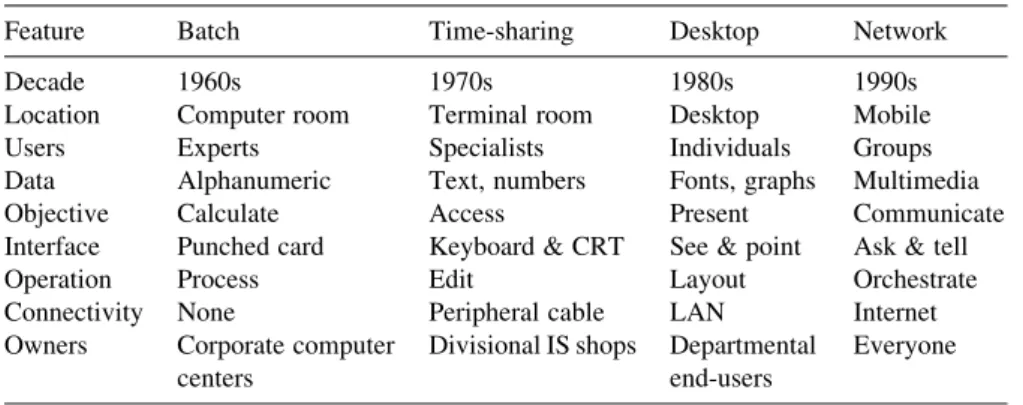
Table 1.1 is modified from a table proposed by Lawrence Tesler (1995). In this table, major characteristics of the different computing paradigms are associated with each decade of computing, starting from 1960.
1.2. ARCHITECTURAL DEVELOPMENT AND STYLES
Computer architects have always been striving to increase the performance of their architectures. This has taken a number of forms. Among these is the philosophy that by doing more in a single instruction, one can use a smaller number of instructions to perform the same job. The immediate consequence of this is the need for fewer memory read/write operations and an eventual speedup of operations. It was also argued that increasing the complexity of instructions and the number of addressing modes has the theoretical advantage of reducing the “semantic gap” between the instructions in a high-level language and those in the low-level (machine) language. A single (machine) instruction to convert several binary coded decimal (BCD) numbers to binary is an example for how complex some instructions were intended to be. The huge number of addressing modes considered (more than 20 in the VAX machine) further adds to the complexity of instructions. Machines following this philosophy have been referred to as complex instructions set computers (CISCs). Examples of CISC machines include the Intel PentiumTM, the Motorola MC68000TM, and the IBM & Macintosh PowerPCTM.
It should be noted that as more capabilities were added to their processors, manufacturers realized that it was increasingly difficult to support higher clock rates that would have been possible otherwise. This is because of the increased TABLE 1.1 Four Decades of Computing
Feature Batch Time-sharing Desktop Network
Decade 1960s 1970s 1980s 1990s
Location Computer room Terminal room Desktop Mobile
Users Experts Specialists Individuals Groups
Data Alphanumeric Text, numbers Fonts, graphs Multimedia
Objective Calculate Access Present Communicate
Interface Punched card Keyboard & CRT See & point Ask & tell
Operation Process Edit Layout Orchestrate
Connectivity None Peripheral cable LAN Internet
Owners Corporate computer
centers
Divisional IS shops Departmental end-users
Everyone
complexity of computations within a single clock period. A number of studies from the mid-1970s and early-1980s also identified that in typical programs more than 80% of the instructions executed are those using assignment statements, conditional branching and procedure calls. It was also surprising to find out that simple assign-ment stateassign-ments constitute almost 50% of those operations. These findings caused a different philosophy to emerge. This philosophy promotes the optimization of architectures by speeding up those operations that are most frequently used while reducing the instruction complexities and the number of addressing modes. Machines following this philosophy have been referred to asreduced instructions set computers (RISCs). Examples of RISCs include the Sun SPARCTM and MIPSTMmachines.
The above two philosophies in architecture design have led to the unresolved controversy as to which architecture style is “best.” It should, however, be men-tioned that studies have indicated that RISC architectures would indeed lead to faster execution of programs. The majority of contemporary microprocessor chips seems to follow the RISC paradigm. In this book we will present the salient features and examples for both CISC and RISC machines.
1.3. TECHNOLOGICAL DEVELOPMENT
Computer technology has shown an unprecedented rate of improvement. This includes the development of processors and memories. Indeed, it is the advances in technology that have fueled the computer industry. The integration of numbers of transistors (a transistor is a controlled on/off switch) into a single chip has increased from a few hundred to millions. This impressive increase has been made possible by the advances in the fabrication technology of transistors.
The scale of integration has grown from small-scale (SSI) to medium-scale (MSI) to large-scale (LSI) to very large-scale integration (VLSI), and currently to wafer-scale integration (WSI). Table 1.2 shows the typical numbers of devices per chip in each of these technologies.
It should be mentioned that the continuous decrease in the minimum devices feature size has led to a continuous increase in the number of devices per chip,
TABLE 1.2 Numbers of Devices per Chip
Integration Technology Typical number of devices Typical functions
SSI Bipolar 10 – 20 Gates and flip-flops
MSI Bipolar & MOS 50 – 100 Adders & counters
LSI Bipolar & MOS 100 – 10,000 ROM & RAM
VLSI CMOS (mostly) 10,000 – 5,000,000 Processors
WSI CMOS .5,000,000 DSP & special purposes
SSI, small-scale integration; MSI, medium-scale integration; LSI, large-scale integration; VLSI, very large-scale integration; WSI, wafer-scale integration.
which in turn has led to a number of developments. Among these is the increase in the number of devices in RAM memories, which in turn helps designers to trade off memory size for speed. The improvement in the feature size provides golden oppor-tunities for introducing improved design styles.
1.4. PERFORMANCE MEASURES
In this section, we consider the important issue of assessing the performance of a computer. In particular, we focus our discussion on a number of performance measures that are used to assess computers. Let us admit at the outset that there are various facets to the performance of a computer. For example, a user of a computer measures its performance based on the time taken to execute a given job (program). On the other hand, a laboratory engineer measures the performance of his system by the total amount of work done in a given time. While the user considers the program execution time a measure for performance, the laboratory engineer considers the throughput a more important measure for performance. A metric for assessing the performance of a computer helps comparing alternative designs.
Performance analysis should help answering questions such as how fast can a program be executed using a given computer? In order to answer such a question, we need to determine the time taken by a computer to execute a given job. We define the clock cycle time as the time between two consecutive rising (trailing) edges of a periodic clock signal (Fig. 1.1). Clock cycles allow counting unit compu-tations, because the storage of computation results is synchronized with rising (trail-ing) clock edges. The time required to execute a job by a computer is often expressed in terms of clock cycles.
We denote the number of CPU clock cycles for executing a job to be the cycle count (CC), the cycle time by CT, and the clock frequency by f¼1/CT. The time taken by the CPU to execute a job can be expressed as
CPU time¼CCCT¼CC=f
It may be easier to count the number of instructions executed in a given program as compared to counting the number of CPU clock cycles needed for executing that
program. Therefore, the average number of clock cycles per instruction (CPI) has been used as an alternate performance measure. The following equation shows how to compute the CPI.
CPI¼CPU clock cycles for the program Instruction count
CPU time¼Instruction countCPIClock cycle time
¼Instruction countCPI Clock rate
It is known that the instruction set of a given machine consists of a number of instruction categories: ALU (simple assignment and arithmetic and logic instruc-tions),load,store,branch, and so on. In the case that the CPI for each instruction category is known, the overall CPI can be computed as
CPI¼ Pn
i¼1CPIiIi Instruction count
whereIiis the number of times an instruction of typeiis executed in the program and
CPIiis the average number of clock cycles needed to execute such instruction.
Example Consider computing the overall CPI for a machine A for which the following performance measures were recorded when executing a set of benchmark programs. Assume that the clock rate of the CPU is 200 MHz.
Instruction category
Percentage of occurrence
No. of cycles per instruction
ALU 38 1
Load & store 15 3
Branch 42 4
Others 5 5
Assuming the execution of 100 instructions, the overall CPI can be computed as
CPIa¼ Pn
i¼1CPIiIi Instruction count¼
381þ153þ424þ55
100 ¼2:76
CPI and the instruction count are considered in assessing the merits of a given computer or equivalently in comparing the performance of two machines.
A different performance measure that has been given a lot of attention in recent years is MIPS (million instructions-per-second (the rate of instruction execution per unit time)), which is defined as
MIPS¼ Instruction count Execution time106¼
Clock rate CPI106
Example Suppose that the same set of benchmark programs considered above were executed on another machine, call it machine B, for which the following measures were recorded.
Load & store 30 2
Branch 15 3
Others 20 5
What is the MIPS rating for the machine considered in the previous example (machine A) and machine B assuming a clock rate of 200 MHz?
CPIa¼
It is interesting to note here that althoughMIPShas been used as a performance measure for machines, one has to be careful in using it to compare machines having different instruction sets. This is because MIPS does not track execution time. Consider, for example, the following measurement made on two different machines running a given set of benchmark programs.
Instruction
Instruction countCPIa
Clock rate ¼
Instruction countCPIa
Clock rate ¼
201062:1
200106 ¼0:21 s
MIPSb.MIPSa and CPUb.CPUa
The example shows that although machine B has a higher MIPS compared to machine A, it requires longer CPU time to execute the same set of benchmark programs.
Million floating-point instructions per second, MFLOP (rate of floating-point instruction execution per unit time) has also been used as a measure for machines’ performance. It is defined as
MFLOPS¼Number of floating-point operations in a program Execution time106
While MIPS measures the rate of average instructions, MFLOPS is only defined for the subset of floating-point instructions. An argument against MFLOPS is the fact that the set of floating-point operations may not be consistent across machines and therefore the actual floating-point operations will vary from machine to machine. Yet another argument is the fact that the performance of a machine for a given program as measured by MFLOPS cannot be generalized to provide a single performance metric for that machine.
The performance of a machine regarding one particular program might not be interesting to a broad audience. The use of arithmetic and geometric means are the most popular ways to summarize performance regarding larger sets of programs (e.g., benchmark suites). These are defined below.
Arithmetic mean¼1
whereexecution timeiis the execution time for theith program andnis the total number of programs in the set of benchmarks.
The following table shows an example for computing these metrics.
Item
We conclude our coverage in this section with a discussion on what is known as the Amdahl’s law for speedup (SUo) due to enhancement. In this case, we consider
speedup as a measure of how a machine performs after some enhancement relative to its original performance. The following relationship formulates Amdahl’s law.
SUo¼
Performance after enhancement Performance before enhancement
Speedup¼Execution time before enhancement Execution time after enhancement
Consider, for example, a possible enhancement to a machine that will reduce the execution time for some benchmarks from 25 s to 15 s. We say that the speedup resulting from such reduction isSUo¼25=15¼1:67.
In its given form, Amdahl’s law accounts for cases whereby improvement can be applied to the instruction execution time. However, sometimes it may be possible to achieve performance enhancement for only a fraction of time,D. In this case a new formula has to be developed in order to relate the speedup,SUDdue to an enhance-ment for a fraction of timeDto the speedup due to an overall enhancement,SUo.
This relationship can be expressed as
SUo¼
1
(1D)þ(D=SUD)
It should be noted that whenD¼1, that is, when enhancement is possible at all
times, thenSUo ¼SUD, as expected.
Consider, for example, a machine for which a speedup of 30 is possible after applying an enhancement. If under certain conditions the enhancement was only possible for 30% of the time, what is the speedup due to this partial application of the enhancement?
SUo¼
1
(1D)þ(D=SUD)
¼ 1
(10:3)þ0:3 30
¼ 1
0:7þ0:01¼1:4
It is interesting to note that the above formula can be generalized as shown below to account for the case whereby a number of different independent enhancements can be applied separately and for different fractions of the time,D1,D2,. . .,Dn, thus leading respectively to the speedup enhancementsSUD1,SUD2,. . .,SUDn.
SUo¼
1 ½1(D1þD2þ þDn) þ
(D1þD2þ þDn) (SUD1þSUD2þ þSUDn)
1.5. SUMMARY
ways of evaluating the speedup for given partial or general improvement measure-ments of a machine were discussed at the end of this Chapter.
EXERCISES
1. What has been the trend in computing from the following points of view? (a) Cost of hardware
(b) Size of memory (c) Speed of hardware
(d) Number of processing elements
(e) Geographical locations of system components
2. Given the trend in computing in the last 20 years, what are your predictions for the future of computing?
3. Find the meaning of the following: (a) Cluster computing
(b) Grid computing (c) Quantum computing (d) Nanotechnology
4. Assume that a switching component such as a transistor can switch in zero time. We propose to construct a disk-shaped computer chip with such a com-ponent. The only limitation is the time it takes to send electronic signals from one edge of the chip to the other. Make the simplifying assumption that elec-tronic signals can travel at 300,000 kilometers per second. What is the limit-ation on the diameter of a round chip so that any computlimit-ation result can by used anywhere on the chip at a clock rate of 1 GHz? What are the diameter restrictions if the whole chip should operate at 1 THz¼1012Hz? Is such a
chip feasible?
5. Compare uniprocessor systems with multiprocessor systems in the following aspects:
(a) Ease of programming (b) The need for synchronization (c) Performance evaluation (d) Run time system
6. Consider having a program that runs in 50 s on computer A, which has a 500 MHz clock. We would like to run the same program on another machine, B, in 20 s. If machine B requires 2.5 times as many clock cycles as machine A for the same program, what clock rate must machine B have in MHz? 7. Suppose that we have two implementations of the same instruction set
archi-tecture. Machine A has a clock cycle time of 50 ns and a CPI of 4.0 for some program, and machine B has a clock cycle of 65 ns and a CPI of 2.5 for the same program. Which machine is faster and by how much?
8. A compiler designer is trying to decide between two code sequences for a particular machine. The hardware designers have supplied the following facts:
Instruction class
CPI of the instruction class
A 1
B 3
C 4
For a particular high-level language, the compiler writer is considering two sequences that require the following instruction counts:
Code sequence
Instruction counts (in millions)
A B C
1 2 1 2
2 4 3 1
What is the CPI for each sequence? Which code sequence is faster? By how much?
9. Consider a machine with three instruction classes and CPI measurements as follows:
Instruction class
CPI of the instruction class
A 2
B 5
C 7
Suppose that we measured the code for a given program in two different compilers and obtained the following data:
Code sequence
Instruction counts (in millions)
A B C
Compiler 1 15 5 3
Compiler 2 25 2 2
Assume that the machine’s clock rate is 500 MHz. Which code sequence will execute faster according to MIPS? And according to execution time? 10. Three enhancements with the following speedups are proposed for a new
machine: Speedup(a)¼30, Speedup(b)¼20, and Speedup(c)¼15.
Assume that for some set of programs, the fraction of use is 25% for enhancement (a), 30% for enhancement (b), and 45% for enhancement (c). If only one enhancement can be implemented, which should be chosen to maximize the speedup? If two enhancements can be implemented, which should be chosen, to maximize the speedup?
REFERENCES AND FURTHER READING
J.-L. Baer, Computer architecture,IEEE Comput., 17(10), 77 –87, (1984).
S. Dasgupta,Computer Architecture: A Modern Synthesis, John Wiley, New York, 1989. M. Flynn,Some computer organization and their effectiveness,IEEE Trans Comput., C-21,
948 – 960 (1972).
D. Gajski, V. Milutinovic, H. Siegel, and B. Furht, Computer Architecture: A Tutorial, Computer Society Press, Los Alamitos, Calif, 1987.
W. Giloi, Towards a taxonomy of computer architecture based on the machine data type view, Proceedings of the 10th International Symposium on Computer Architecture, 6 – 15, (1983).
W. Handler, The impact of classification schemes on computer architecture, Proceedings of the 1977 International Conference on Parallel Processing, 7 – 15, (1977).
J. Hennessy and D. Patterson,Computer Architecture: A Quantitative Approach, 2nd ed., Morgan Kaufmann, San Francisco, 1996.
K. Hwang and F. Briggs, Computer Architecture and Parallel Processing, 2nd ed., McGraw-Hill, New York, 1996.
D. J. Kuck,The Structure of Computers and Computations, John Wiley, New York, 1978. G. J. Myers,Advances in Computer Architecture, John Wiley, New York, 1982.
L. Tesler, Networked computing in the 1990s, reprinted from the Sept. 1991 Scientific American, The Computer in the 21st Century, 10 –21, (1995).
P. Treleaven, Control-driven data-driven and demand-driven computer architecture (abstract),
Parallel Comput., 2, (1985).
P. Treleaven, D. Brownbridge, and R. Hopkins, Data drive and demand driven computer architecture,ACM Comput. Surv., 14(1), 95 – 143, (1982).
Websites
&
CHAPTER 2
Instruction Set Architecture
and Design
In this chapter, we consider the basic principles involved in instruction set architecture and design. Our discussion starts with a consideration of memory locations and addresses. We present an abstract model of the main memory in which it is considered as a sequence of cells each capable of storingnbits. We then address the issue of stor-ing and retrievstor-ing information into and from the memory. The information stored and/or retrieved from the memory needs to be addressed. A discussion on a number of different ways to address memory locations (addressing modes) is the next topic to be discussed in the chapter. A program consists of a number of instruc-tions that have to be accessed in a certain order. That motivates us to explain the issue of instruction execution and sequencing in some detail. We then show the application of the presented addressing modes and instruction characteristics in writing sample segment codes for performing a number of simple programming tasks.
A unique characteristic of computer memory is that it should be organized in a hier-archy. In such hierarchy, larger and slower memories are used to supplement smaller and faster ones. A typical memory hierarchy starts with a small, expensive, and rela-tively fast module, called thecache. The cache is followed in the hierarchy by a larger, less expensive, and relatively slowmain memorypart. Cache and main memory are built using semiconductor material. They are followed in the hierarchy by larger, less expensive, and far slower magnetic memories that consist of the (hard) disk and the tape. The characteristics and factors influencing the success of the memory hierarchy of a computer are discussed in detail in Chapters 6 and 7. Our concentration in this chapter is on the (main) memory from the programmer’s point of view. In par-ticular, we focus on the way information is stored in and retrieved out of the memory.
2.1. MEMORY LOCATIONS AND OPERATIONS
The (main) memory can be modeled as an array of millions of adjacent cells, each capable of storing a binary digit (bit), having value of 1 or 0. These cells are
organized in the form of groups of fixed number, sayn, of cells that can be dealt with as an atomic entity. An entity consisting of 8 bits is called a byte. In many systems, the entity consisting ofnbits that can be stored and retrieved in and out of the memory using one basic memory operation is called aword (the smallest addressable entity). Typical size of a word ranges from 16 to 64 bits. It is, however, customary to express the size of the memory in terms of bytes. For example, the size of a typical memory of a personal computer is 256 Mbytes, that is, 256220 ¼228bytes.
In order to be able to move a word in and out of the memory, a distinct address has to be assigned to each word. This address will be used to determine the location in the memory in which a given word is to be stored. This is called a memorywrite operation. Similarly, the address will be used to determine the memory location from which a word is to be retrieved from the memory. This is called a memory readoperation.
The number of bits,l, needed to distinctly addressMwords in a memory is given byl¼log2M. For example, if the size of the memory is 64M(read as 64 mega-words), then the number of bits in the address is log2(64220)¼log
2(226)¼ 26 bits. Alternatively, if the number of bits in the address isl, then the maximum memory size (in terms of the number of words that can be addressed using these l bits) is M ¼2l. Figure 2.1 illustrates the concept of memory words and word address as explained above.
As mentioned above, there are two basic memory operations. These are the memory writeand memory read operations. During a memory write operation a word is stored into a memory location whose address is specified. During a memory read operation a word is read from a memory location whose address is specified. Typically, memory read and memory write operations are performed by thecentral processing unit(CPU).
Three basic steps are needed in order for the CPU to perform a write operation into a specified memory location:
1. The word to be stored into the memory location is first loaded by the CPU into a specified register, called thememory data register(MDR).
2. The address of the location into which the word is to be stored is loaded by the CPU into a specified register, called thememory address register(MAR). 3. A signal, calledwrite, is issued by the CPU indicating that the word stored in the MDR is to be stored in the memory location whose address in loaded in the MAR.
Figure 2.2 illustrates the operation of writing the word given by 7E (in hex) into the memory location whose address is 2005. Partaof the figure shows the status of the reg-isters and memory locations involved in the write operation before the execution of the operation. Partbof the figure shows the status after the execution of the operation.
It is worth mentioning that theMDRand theMARare registers used exclusively by the CPU and are not accessible to the programmer.
Similar to the write operation, three basic steps are needed in order to perform a memory read operation:
1. The address of the location from which the word is to be read is loaded into the MAR.
2. A signal, calledread, is issued by the CPU indicating that the word whose address is in the MAR is to be read into the MDR.
3. After some time, corresponding to the memory delay in reading the specified word, the required word will be loaded by the memory into the MDR ready for use by the CPU.
Before execution After execution
Figure 2.2 Illustration of the memory write operation
Figure 2.3 illustrates the operation of reading the word stored in the memory location whose address is 2010. Partaof the figure shows the status of the registers and memory locations involved in the read operation before the execution of the operation. Partbof the figure shows the status after the read operation.
2.2. ADDRESSING MODES
Information involved in any operation performed by the CPU needs to be addressed. In computer terminology, such information is called the operand. Therefore, any instruction issued by the processor must carry at least two types of information. These are the operation to be performed, encoded in what is called the op-code field, and the address information of the operand on which the operation is to be performed, encoded in what is called theaddressfield.
Instructions can be classified based on the number of operands as:three-address, two-address, one-and-half-address, one-address, and zero-address. We explain these classes together with simple examples in the following paragraphs. It should be noted that in presenting these examples, we would use the conventionoperation, source, destinationto express any instruction. In that convention, operation rep-resents the operation to be performed, for example, add,subtract,write, orread. The source field represents the source operand(s). The source operand can be a con-stant, a value stored in a register, or a value stored in the memory. The destination field represents the place where the result of the operation is to be stored, for example, a register or a memory location.
A three-address instruction takes the formoperation add-1,add-2,add-3. In this form, each ofadd-1,add-2, andadd-3refers to a register or to a memory location. Consider, for example, the instructionADD R1,R2,R3. This instruction indicates that
the operation to be performed isaddition. It also indicates that the values to be added are those stored in registersR1andR2that the results should be stored in registerR3.
An example of a three-address instruction that refers to memory locations may take the formADD A,B,C. The instruction adds the contents of memory locationAto the contents of memory locationBand stores the result in memory locationC.
A two-address instruction takes the formoperation add-1,add-2. In this form, each of add-1 andadd-2 refers to a register or to a memory location. Consider, for example, the instructionADD R1,R2. This instruction adds the contents of regis-terR1to the contents of registerR2and stores the results in registerR2. The original contents of registerR2 are lost due to this operation while the original contents of registerR1remain intact. This instruction is equivalent to a three-address instruction of the formADD R1,R2,R2. A similar instruction that uses memory locations instead of registers can take the formADD A,B. In this case, the contents of memory location Aare added to the contents of memory locationBand the result is used to override the original contents of memory locationB.
The operation performed by the three-address instructionADD A,B,Ccan be per-formed by the two two-address instructions MOVE B,C and ADD A,C. This is because the first instruction moves the contents of location Binto locationCand the second instruction adds the contents of locationAto those of locationC(the con-tents of locationB) and stores the result in locationC.
A one-address instruction takes the form ADD R1. In this case the instruction implicitly refers to a register, called theAccumulator Racc, such that the contents of the accumulator is added to the contents of the registerR1 and the results are stored back into the accumulatorRacc. If a memory location is used instead of a reg-ister then an instruction of the form ADD Bis used. In this case, the instruction adds the content of the accumulatorRaccto the content of memory locationBand stores the result back into the accumulatorRacc. The instructionADD R1is equival-ent to the three-address instructionADD R1,Racc,Raccor to the two-address instruc-tionADD R1,Racc.
Between the two- and the one-address instruction, there can be a one-and-half address instruction. Consider, for example, the instructionADD B,R1. In this case, the instruction adds the contents of registerR1 to the contents of memory location B and stores the result in register R1. Owing to the fact that the instruction uses two types of addressing, that is, a register and a memory location, it is called a one-and-half-address instruction. This is because register addressing needs a smaller number of bits than those needed by memory addressing.
It is interesting to indicate that there exist zero-address instructions. These are the instructions that usestack operation. A stack is a data organization mechanism in which the last data item stored is the first data item retrieved. Two specific oper-ations can be performed on a stack. These are thepush and thepop operations. Figure 2.4 illustrates these two operations.
incremented to indicate to location 1024. In the stack pop operation, the SP is first decremented to become 1021. The value stored at this location (DD in this case) is retrieved (popped out) and stored in the shown register.
Different operations can be performed using the stack structure. Consider, for example, an instruction such asADD(SP)þ, (SP). The instruction adds the contents of the stack location pointed to by the SP to those pointed to by the SPþ1 and stores the result on the stack in the location pointed to by the current value of the SP. Figure 2.5 illustrates such an addition operation. Table 2.1 summarizes the instruc-tion classificainstruc-tion discussed above.
The different ways in which operands can be addressed are called theaddressing modes. Addressing modes differ in the way the address information of operands is specified. The simplest addressing mode is to include the operand itself in the instruction, that is, no address information is needed. This is called immediate addressing. A more involved addressing mode is to compute the address of the operand by adding a constant value to the content of a register. This is calledindexed addressing. Between these two addressing modes there exist a number of other addressing modes including absolute addressing, direct addressing, and indirect addressing. A number of different addressing modes are explained below.
Figure 2.4 The stack push and pop operations
-52
39 1050
-13
39 1050
SP 1000
1001 1002
1000
1001 1002 SP
2.2.1. Immediate Mode
According to this addressing mode, the value of the operand is (immediately) avail-able in the instruction itself. Consider, for example, the case of loading the decimal value 1000 into a registerRi. This operation can be performed using an instruction such as the following:LOAD#1000,Ri. In this instruction, the operation to be per-formed is to load a value into a register. The source operand is (immediately) given as 1000, and the destination is the registerRi. It should be noted that in order to indi-cate that the value 1000 mentioned in the instruction is the operand itself and not its address (immediate mode), it is customary to prefix the operand by the special character (#). As can be seen the use of the immediate addressing mode is simple. The use of immediate addressing leads to poor programming practice. This is because a change in the value of an operand requires a change in every instruction that uses the immediate value of such an operand. A more flexible addressing mode is explained below.
2.2.2. Direct (Absolute) Mode
According to this addressing mode, the address of the memory location that holds the operand is included in the instruction. Consider, for example, the case of loading the value of the operand stored in memory location 1000 into registerRi. This oper-ation can be performed using an instruction such asLOAD1000,Ri. In this instruc-tion, the source operand is the value stored in the memory location whose address is 1000, and the destination is the registerRi. Note that the value 1000 is not prefixed with any special characters, indicating that it is the (direct or absolute) address of the source operand. Figure 2.6 shows an illustration of the direct addressing mode. For
TABLE 2.1 Instruction Classification
Instruction class Example
Three-address ADD R1,R2,R3
ADD A,B,C
Two-address ADD R1,R2
ADD A,B
One-and-half-address ADD B,R1
One-address ADD R1
Zero-address ADD(SP)þ, (SP)
Memory
Operand
Operation Address
Figure 2.6 Illustration of the direct addressing mode
example, if the content of the memory location whose address is 1000 was (2345) at the time when the instructionLOAD1000,Riis executed, then the result of execut-ing such instruction is to load the value (2345) into registerRi.
Direct (absolute) addressing mode provides more flexibility compared to the immediate mode. However, it requires the explicit inclusion of the operand address in the instruction. A more flexible addressing mechanism is provided through the use of the indirect addressing mode. This is explained below.
2.2.3. Indirect Mode
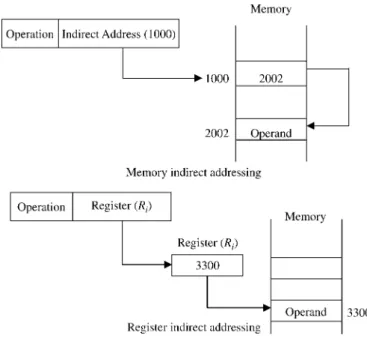
In the indirect mode, what is included in the instruction is not the address of the operand, but rather a name of a register or a memory location that holds the (effec-tive) address of the operand. In order to indicate the use of indirection in the instruc-tion, it is customary to include the name of the register or the memory location in parentheses. Consider, for example, the instructionLOAD(1000),Ri. This instruc-tion has the memory locainstruc-tion 1000 enclosed in parentheses, thus indicating indirec-tion. The meaning of this instruction is to load registerRiwith the contents of the memory location whose address is stored at memory address 1000. Because indirec-tion can be made through either a register or a memory locaindirec-tion, therefore, we can identify two types of indirect addressing. These areregister indirect addressing, if a register is used to hold the address of the operand, andmemory indirect addressing, if a memory location is used to hold the address of the operand. The two types are illustrated in Figure 2.7.
2.2.4. Indexed Mode
In this addressing mode, the address of the operand is obtained by adding a con-stant to the content of a register, called theindex register. Consider, for example, the instructionLOAD X(Rind),Ri. This instruction loads registerRiwith the contents of the memory location whose address is the sum of the contents of register Rind and the valueX. Index addressing is indicated in the instruction by including the name of the index register in parentheses and using the symbol Xto indicate the constant to be added. Figure 2.8 illustrates indexed addressing. As can be seen, indexing requires an additional level of complexity over register indirect addressing.
2.2.5. Other Modes
The addressing modes presented above represent the most commonly used modes in most processors. They provide the programmer with sufficient means to handle most general programming tasks. However, a number of other addressing modes have been used in a number of processors to facilitate execution of specific programming tasks. These additional addressing modes are more involved as compared to those presented above. Among these addressing modes therelative,autoincrement, and theautodecrementmodes represent the most well-known ones. These are explained below.
Relative Mode Recall that in indexed addressing, an index register,Rind, is used. Relative addressing is the same as indexed addressing except that the program counter (PC) replaces the index register. For example, the instructionLOAD X(PC), Ri loads register Ri with the contents of the memory location whose address is the sum of the contents of the program counter (PC) and the valueX. Figure 2.9 illustrates the relative addressing mode.
Autoincrement Mode This addressing mode is similar to the register indirect addressing mode in the sense that the effective address of the operand is the content of a register, call it theautoincrement register, that is included in the instruction.
Memory
+
Operation Value X
operand Index Register (Rind)
Figure 2.8 Illustration of the indexed addressing mode
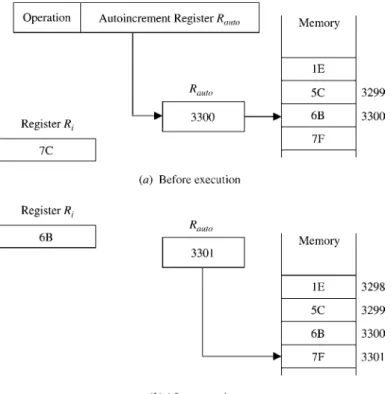
However, with autoincrement, the content of the autoincrement register is automati-cally incremented after accessing the operand. As before, indirection is indicated by including the autoincrement register in parentheses. The automatic increment of the register’s content after accessing the operand is indicated by including a (þ) after the parentheses. Consider, for example, the instruction LOAD(Rauto)þ,Ri. This instruction loads registerRiwith the operand whose address is the content of register Rauto. After loading the operand into register Ri, the content of register Rauto is incremented, pointing for example to the next item in a list of items. Figure 2.10 illustrates the autoincrement addressing mode.
Memory
+
Operation Value X
operand Program Counter (PC)
Figure 2.9 Illustration of relative addressing mode
Autodecrement Mode Similar to the autoincrement, the autodecrement mode uses a register to hold the address of the operand. However, in this case the content of the autodecrement register is first decremented and the new content is used as the effective address of the operand. In order to reflect the fact that the content of the autodecrement register is decremented before accessing the operand, a (2) is included before the indirection parentheses. Consider, for example, the instruction LOAD (Rauto),Ri. This instruction decrements the content of the registerRautoand then uses the new content as the effective address of the operand that is to be loaded into registerRi. Figure 2.11 illustrates the autodecrement addres-sing mode.
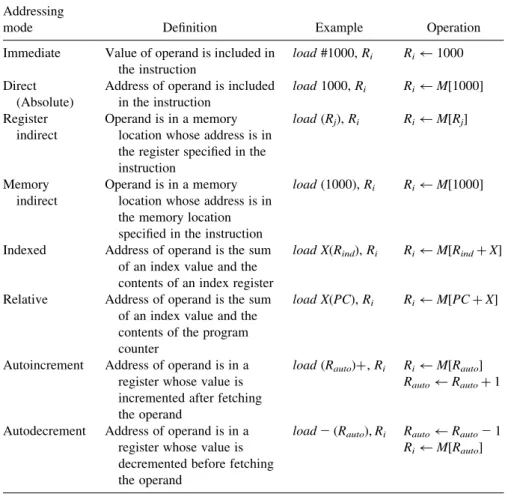
The seven addressing modes presented above are summarized in Table 2.2. In each case, the table shows the name of the addressing mode, its definition, and a gen-eric example illustrating the use of such mode.
In presenting the different addressing modes we have used theloadinstruction for illustration. However, it should be understood that there are other types of instructions in a given machine. In the following section we elaborate on the differ-ent types of instructions that typically constitute the instruction set of a given machine.
Figure 2.11 Illustration of the autodecrement addressing mode
2.3. INSTRUCTION TYPES
The type of instructions forming the instruction set of a machine is an indication of the power of the underlying architecture of the machine. Instructions can in general be classified as in the following Subsections 2.3.1 to 2.3.4.
2.3.1. Data Movement Instructions
Data movement instructions are used to move data among the different units of the machine. Most notably among these are instructions that are used to move data among the different registers in the CPU. A simple register to register movement of data can be made through the instruction
MOVE Ri,Rj TABLE 2.2 Summary of Addressing Modes Addressing
mode Definition Example Operation
Immediate Value of operand is included in the instruction
load#1000,Ri Ri 1000
Direct (Absolute)
Address of operand is included in the instruction
load1000,Ri Ri M[1000]
Register indirect
Operand is in a memory location whose address is in the register specified in the instruction
load(Rj),Ri Ri M[Rj]
Memory indirect
Operand is in a memory location whose address is in the memory location specified in the instruction
load(1000),Ri Ri M[1000]
Indexed Address of operand is the sum of an index value and the contents of an index register
load X(Rind),Ri Ri M[RindþX]
Relative Address of operand is the sum of an index value and the contents of the program counter
load X(PC),Ri Ri M[PCþX]
Autoincrement Address of operand is in a register whose value is incremented after fetching the operand
load(Rauto)þ,Ri Ri M[Rauto]
Rauto Rautoþ1
Autodecrement Address of operand is in a register whose value is decremented before fetching the operand
load2(Rauto),Ri Rauto Rauto21
Ri M[Rauto]
This instruction moves the content of registerRito registerRj. The effect of the instruc-tion is to override the contents of the (destinainstruc-tion) registerRjwithout changing the con-tents of the (source) registerRi. Data movement instructions include those used to move data to (from) registers from (to) memory. These instructions are usually referred to as theloadandstoreinstructions, respectively. Examples of the two instructions are
LOAD 25838,Rj STORE Ri,1024
The first instruction loads the content of the memory location whose address is 25838 into the destination registerRj. The content of the memory location is unchanged by executing the LOAD instruction. TheSTORE instruction stores the content of the source registerRiinto the memory location 1024. The content of the source register is unchanged by executing theSTORE instruction. Table 2.3 shows some common data transfer operations and their meanings.
2.3.2. Arithmetic and Logical Instructions
Arithmetic and logical instructions are those used to perform arithmetic and logical manipulation of registers and memory contents. Examples of arithmetic instructions include theADDandSUBTRACTinstructions. These are
ADD R1,R2,R0 SUBTRACT R1,R2,R0
The first instruction adds the contents of source registersR1andR2and stores the
result in destination register R0. The second instruction subtracts the contents of the source registersR1andR2and stores the result in the destination registerR0.
The contents of the source registers are unchanged by theADDand theSUBTRACT instructions. In addition to theADDandSUBTRACTinstructions, some machines have MULTIPLY and DIVIDEinstructions. These two instructions are expensive to implement and could be substituted by the use of repeated addition or repeated subtraction. Therefore, most modern architectures do not have MULTIPLY or
TABLE 2.3 Some Common Data Movement Operations Data movement
operation Meaning
MOVE Move data (a word or a block) from a given source (a register or a memory) to a given destination
LOAD Load data from memory to a register
STORE Store data into memory from a register
PUSH Store data from a register to stack
POP Retrieve data from stack into a register