vii ABSTRACT
Yulianita, Nadia Gitya. 2015. Compound Nouns in the Articles of The Jakarta Post Online Edition Used by National and International Writers. Yogyakarta: Sanata Dharma University.
In English, one lexical item can consist of two or more simpler lexemes. The linguists call this phenomenon compound. Compound can act as a noun, adjective, verb, and also preposition. If it acts as a noun in a sentence, it is called as compound noun. The examples of compound nouns are school boy, newspaper, and push button. This study of compound nouns was done to analyze the occurrence of compound nouns in The Jakarta Post in the period the of late 2014 until early 2015. Since The Jakarta Post online edition contains many articles from many writers, the researcher decided to compare the compound nouns used by national and international writers.
This study was done in order to answer the research problems: 1) What types of compound nouns can be found in the selected articles of The Jakarta Post online edition in the period of late 2014 until early 2015 used by national and international writers? 2) What is the frequency of compound nouns found in the selected articles of The Jakarta Post online edition in the period of late 2014 until early 2015 used by national and international writers?
Based on those research questions, the researcher used content analysis in this study. Besides, she used the theory of corpus linguistics to conduct this study. The compound nouns were collected and divided into the ones used by national writers and the ones used by international writers. Then, the data were analyzed based on the types of the compound nouns. After that, the frequency of occurrence of those compound nouns could be required.
Based on the results, the researcher noted the findings. First, the most common compound noun is endocentric with 70 compounds out of 4.659 words used by national writers and 84 compounds out of 8537 words used by international writers. Meanwhile, the number of exocentric and verbal compounds used by national writers are eleven and seven. The international writers also used 12 exocentric compounds and 24 verbal compounds.
viii ABSTRAK
Yulianita, Nadia Gitya. 2015. Compound Nouns in The Articles of The Jakarta Post Online Edition Used by National and International Writers. Yogyakarta: Universitas Sanata Dharma.
Dalam Bahasa Inggris, satu kata dapat terdiri dari dua kata atau lebih. Para ahli bahasa menyebut fenomena ini sebagai compound. Compound dapat berperan sebagai kata benda, kata sifat, kata kerja, dan preposisi. Jika compound berperan sebagai kata benda, maka disebut compound noun. Contoh-contoh dari compound noun adalah school boy, newspaper, dan push button. Penelitian mengenai compound noun ini dilakukan untuk menganalisis kemunculan dari compound noun itu sendiri dalam The Jakarta Post periode akhir 2014 hingga awal 2015. Dikarenakan edisi online dari The Jakarta Post berisi banyak artikel dari berbagai penulis, peneliti memutuskan untuk membandingkan compound noun yang ditulis oleh penulis nasional dan penulis internasional.
Penelitian ini dilakukan untuk menjawab dua rumusan masalah, yaitu: 1) Apa saja tipe compound nouns yang bisa ditemukan di artikel The Jakarta Post edisi online periode akhir 2014 hingga awal 2015? 2) Berapa frekuensi kemunculan compound nouns yang bisa ditemukan di artikel The Jakarta Post edisi online periode akhir 2014 hingga awal 2015?
Berdasarkan dua rumusan masalah tersebut, peneliti menggunakan konten analisis dalam penelitian ini. Selain itu, ia juga menggunakan teori mengenai corpus linguistics. Peneliti mengumpulkan compound nouns lalu membagi menjadi bagian yang ditulis oleh penulis nasional sedangkan yang satunya ditulis oleh penulis internasional. Kemudian, ia menganalisis dan membandingkan tipe dari compound nouns tersebut. Setelah itu, ia menghitung frekuensi kemunculan dari compound noun itu.
Berdasarkan hasil dari penelitian ini, peneliti mencatat beberapa penemuan. Pertama, compound noun yang paling sering muncul dalam artikel-artikel tersebut adalah endocentric compound dengan 70 compound dari 4.659 kata ditulis oleh penulis nasional dan 84 compound dari 8.537 kata ditulis oleh penulis internasional. Sementara itu, jumlah exocentric compound dan verbal compound yang ditulis oleh penulis nasional adalah 11 dan 7. Penulis internasional juga menulis 12 exocentric compound dan 24 verbal compound.
COMPOUND NOUNS IN THE ARTICLES OF THE JAKARTA
POST ONLINE EDITION USED BY NATIONAL AND
INTERNATIONAL WRITERS
A SARJANA PENDIDIKAN THESIS
Presented as Partial Fulfillment of the Requirements to Obtain the Sarjana Pendidikan Degree in
English Language Education
By
Nadia Gitya Yulianita Student Number: 111214119
ENGLISH LANGUAGE EDUCATION STUDY PROGRAM DEPARTMENT OF LANGUAGE AND ARTS EDUCATION FACULTY OF TEACHERS TRAINING AND EDUCATION
SANATA DHARMA UNIVERSITY YOGYAKARTA
i
COMPOUND NOUNS IN THE ARTICLES OF THE JAKARTA
POST ONLINE EDITION USED BY NATIONAL AND
INTERNATIONAL WRITERS
A SARJANA PENDIDIKAN THESIS
Presented as Partial Fulfillment of the Requirements to Obtain the Sarjana Pendidikan Degree in
English Language Education
By
Nadia Gitya Yulianita Student Number: 111214119
ENGLISH LANGUAGE EDUCATION STUDY PROGRAM DEPARTMENT OF LANGUAGE AND ARTS EDUCATION FACULTY OF TEACHERS TRAINING AND EDUCATION
SANATA DHARMA UNIVERSITY YOGYAKARTA
iv
DEDICATION PAGE
“Life is a climb, but the view is great”
This thesis is dedicated to:
my parents
vii ABSTRACT
Yulianita, Nadia Gitya. 2015. Compound Nouns in the Articles of The Jakarta Post Online Edition Used by National and International Writers. Yogyakarta: Sanata Dharma University.
In English, one lexical item can consist of two or more simpler lexemes. The linguists call this phenomenon compound. Compound can act as a noun, adjective, verb, and also preposition. If it acts as a noun in a sentence, it is called as compound noun. The examples of compound nouns are school boy, newspaper, and push button. This study of compound nouns was done to analyze the occurrence of compound nouns in The Jakarta Post in the period the of late 2014 until early 2015. Since The Jakarta Post online edition contains many articles from many writers, the researcher decided to compare the compound nouns used by national and international writers.
This study was done in order to answer the research problems: 1) What types of compound nouns can be found in the selected articles of The Jakarta Post online edition in the period of late 2014 until early 2015 used by national and international writers? 2) What is the frequency of compound nouns found in the selected articles of The Jakarta Post online edition in the period of late 2014 until early 2015 used by national and international writers?
Based on those research questions, the researcher used content analysis in this study. Besides, she used the theory of corpus linguistics to conduct this study. The compound nouns were collected and divided into the ones used by national writers and the ones used by international writers. Then, the data were analyzed based on the types of the compound nouns. After that, the frequency of occurrence of those compound nouns could be required.
Based on the results, the researcher noted the findings. First, the most common compound noun is endocentric with 70 compounds out of 4.659 words used by national writers and 84 compounds out of 8537 words used by international writers. Meanwhile, the number of exocentric and verbal compounds used by national writers are eleven and seven. The international writers also used 12 exocentric compounds and 24 verbal compounds.
viii ABSTRAK
Yulianita, Nadia Gitya. 2015. Compound Nouns in The Articles of The Jakarta Post Online Edition Used by National and International Writers. Yogyakarta: Universitas Sanata Dharma.
Dalam Bahasa Inggris, satu kata dapat terdiri dari dua kata atau lebih. Para ahli bahasa menyebut fenomena ini sebagai compound. Compound dapat berperan sebagai kata benda, kata sifat, kata kerja, dan preposisi. Jika compound berperan sebagai kata benda, maka disebut compound noun. Contoh-contoh dari compound noun adalah school boy, newspaper, dan push button. Penelitian mengenai compound noun ini dilakukan untuk menganalisis kemunculan dari compound noun itu sendiri dalam The Jakarta Post periode akhir 2014 hingga awal 2015. Dikarenakan edisi online dari The Jakarta Post berisi banyak artikel dari berbagai penulis, peneliti memutuskan untuk membandingkan compound noun yang ditulis oleh penulis nasional dan penulis internasional.
Penelitian ini dilakukan untuk menjawab dua rumusan masalah, yaitu: 1) Apa saja tipe compound nouns yang bisa ditemukan di artikel The Jakarta Post edisi online periode akhir 2014 hingga awal 2015? 2) Berapa frekuensi kemunculan compound nouns yang bisa ditemukan di artikel The Jakarta Post edisi online periode akhir 2014 hingga awal 2015?
Berdasarkan dua rumusan masalah tersebut, peneliti menggunakan konten analisis dalam penelitian ini. Selain itu, ia juga menggunakan teori mengenai corpus linguistics. Peneliti mengumpulkan compound nouns lalu membagi menjadi bagian yang ditulis oleh penulis nasional sedangkan yang satunya ditulis oleh penulis internasional. Kemudian, ia menganalisis dan membandingkan tipe dari compound nouns tersebut. Setelah itu, ia menghitung frekuensi kemunculan dari compound noun itu.
Berdasarkan hasil dari penelitian ini, peneliti mencatat beberapa penemuan. Pertama, compound noun yang paling sering muncul dalam artikel-artikel tersebut adalah endocentric compound dengan 70 compound dari 4.659 kata ditulis oleh penulis nasional dan 84 compound dari 8.537 kata ditulis oleh penulis internasional. Sementara itu, jumlah exocentric compound dan verbal compound yang ditulis oleh penulis nasional adalah 11 dan 7. Penulis internasional juga menulis 12 exocentric compound dan 24 verbal compound.
ix
ACKNOWLEDGEMENTS
First of all, I would like to thank Allah SWT. Because of His blessing, I
could finish this thesis on time. Besides, He gave me health and strength so that I
managed to work on my thesis.
Next, I would also like to show my deepest gratitude for my thesis advisor
Paulus Kuswandono, Ph.D. His guidance, support, patience, and suggestion about my thesis helped me a lot when I was working on my thesis. Without him, I
would not have finished my thesis on time. I also want to give my biggest thanks
to Drs. Barli Bram, M.Ed. Ph.D. for his corrections and also suggestions on my thesis. Besides, I want to give my deepest gratitude to my academic advisor
Yuseva Ariyani Iswandari, S.Pd. M.Ed., who always supports and guides me during my study. I also do not forget to give my gratitude to the lecturers in the
English Language Education Study Program of Sanata Dharma University. They
had lectured and given me all of the things that I need to know since I joined the
university. I got a lot of knowledge and experiences that can be applied in my life.
My special gratitude also goes to my family, especially for my parents,
Giyarso and Tumiyem. They always give me support and courage to finish my thesis on time. They also put all of their faith in me. Because of that, I want to
make them proud of having a daughter like me. They are also the reason for me to
work hard on my thesis. I also want to thank my sister, Ana, for her love, support and prayers for me. Even though we are not very close, I know that she always
x
I would not forget to give my gratitude to all of my best friends: Rita, Tusita, Priska, and Arum. They always give me support, advice, and happiness with their own way. Their jokes always help me to escape for a while from my
problems and their support makes me be ready to face my problem. I would also
like to thank my friends who fill my days with joys and laughter: Ludina, Dita,
and Hanung. Even though I rarely meet them in person, they always make me happy when I talk to them through whatsapp or bbm.
Then, I also want to give my biggest gratitude to all of my friends in batch
2011. They have motivated and supported me to finish my thesis. Their
companionship also helped me to fight my laziness and to start writing. Lastly, I
would also like to say many thanks to all of the people whose names cannot be
mentioned here. For those who supported and helped me finish my thesis, I really
would like to thank them.
Yogyakarta, May 22, 2015
xi
TABLE OF CONTENTS
TITLE PAGE ... i
APPROVAL PAGES ... ii
DEDICATION PAGE ... iv
STATEMENT OF WORK’S ORIGINALITY ... v
PERNYATAAN PERSETUJUAN PUBLIKASI ... vi
ABSTRACT ... vii
ABSTRAK ... viii
ACKNOWLWDGEMENTS ... ix
TABLE OF CONTENTS ... xi
LIST OF TABLES ... xiii
LIST OF APPENDICES ... xiv
CHAPTER I. INTRODUCTION A. Research Background ... 1
B. Research Problems ... 4
C. Problem Limitation ... 4
D. Research Objectives ... 6
E. Research Benefits ... 6
F. Definition of Terms ... 7
CHAPTER II. REVIEW OF RELATED LITERATURE A. Theoretical Description ... 10
1. Morphology ... 10
2. Compound ... 11
3. Noun ... 13
4. Compound Noun ... 15
5. Compounds VS Phrases ... 18
6. Corpus Linguistics ... 22
xii
B. Theoretical Framework ... 24
CHAPTER III. RESEARCH METHODOLOGY A. Research Method ... 26
B. Sources of Data ... 27
C. Research Instruments ... 27
D. Data Gathering Technique ... 28
E. Data Analysis Technique ... 29
F. Research Procedure ... 34
CHAPTER IV. RESEARCH RESULTS AND DISCUSSION A. Types of Compound Nouns in Selected Articles ... 38
B. Frequency of Compound Nouns in Selected Articles ... 45
CHAPTER V. CONCLUSIONS AND RECOMMENDATIONS A. Conclusions ... 56
B. Recommendations ... 59
REFERENCES ... 61
xiii
LIST OF TABLES
Table 2.1: Derivational Nouns ... 14
Table 2.2: Lexical Items Which Form Compound Nouns ... 15
Table 2.3: Endocentric Compounds ... 16
Table 2.4: Exocentric Compounds ... 17
Table 2.5: Verbal Compounds ... 18
Table 2.6: Examples of Compounds ... 21
Table 2.7: Examples of Phrases ... 22
Table 3.1: Forms of Compound Nouns Used by National Writers ... 29
Table 3.2: Types of Compound Nouns Used by National Writers ... 30
Table 3.3: Forms of Compound Nouns Used by International Writers ... 30
Table 3.4: Types of Compound Nouns Used by International Writers ... 31
Table 3.5: Frequency of Forms Used by National Writers ... 32
Table 3.6: Frequency of Types Used by National Writers... 32
Table 3.7: Frequency of Forms Used by International Writers ... 33
Table 3.8: Frequency of Types Used by International Writers ... 33
Table 3.9: Percentage of Types Used by National and International Writers ... 33
Table 4.1: Forms of Compound Nouns Used by National Writers ... 39
Table 4.2: Types of Compound Nouns Used by National Writers ... 40
Table 4.3: Forms of Compound Nouns Used by International Writers ... 41
Table 4.4: Types of Compound Nouns Used by International Writers ... 43
Table 4.5: Left-headed Compounds ... 44
Table 4.6: Frequency of Forms Used by National Writers ... 46
Table 4.7: Frequency of Types Used by National Writers... 48
Table 4.8: Frequency of Forms Used by International Writers ... 49
Table 4.9: Frequency of Types Used by International Writers ... 51
xiv
LIST OF APPENDICES
Appendix A
Forms of Compound Nouns Used by National Writers ... 64
Appendix B
Forms of Compound Nouns Used by International Writers ... 67
Appendix C
Types of Compound Nouns Used by National Writers ... 70
Appendix D
Types of Compound Nouns Used by International Writers ... 72
Appendix E
A Sample of Article Written by National Writers ... 75
Appendix F
1
CHAPTER I
INTRODUCTION
This chapter discusses the background information and rationale of the
research. There are six parts in this chapter. They are the research background, the
research problems, the problem limitation, the research objectives, the research
benefits, and the definition of terms.
A. Research Background
A newspaper is one of the mass-media that gives people a lot of
information in the world. Usually, people read the printed newspaper to enrich the
knowledge about the situation in their environment or even in other countries.
However, nowadays, people tend to read the online news because of the
development of technology. Besides, it is mostly free of charge and people can
read anytime and anywhere as long as there is an internet connection. People can
find the latest news or even the old news without searching in the pile of old
newspapers.
One of the largest newspaper companies in Indonesia that uses English as
the language is The Jakarta Post. In fact, the printed edition of this newspaper
was already well-known for both local and international readers. However, this
newspaper also has had the online edition since June 1994. The online edition also
information about Indonesia. It also includes news in the printed edition and more
other news. Moreover, this online edition is well-known for students in PBI
Sanata Dharma. It is because based on my personal experience, the lecturers use
The Jakarta Post as sources to teach English, for instance in Interpreting class.
Besides, the lecturers who are the alumni of PBI Sanata Dharma write articles in
this newspaper. It proves that the alumni of PBI Sanata Dharma might be the
writers of The Jakarta Post online edition. That is why the researcher chose this
newspaper since it is related to PBI students.
In the newspaper, there are a lot of articles that can be read to improve
people‟s knowledge. Since the newspaper uses English as the language,
sometimes, the local readers find it difficult to know the meaning about some
words in the articles. One of the sources of difficulty is understanding the
compounds. Meanwhile, understanding compounds is crucial because it will help
the readers to improve their reading comprehension. In order to understand the
main point of the articles, the readers should interpret the meaning of the words
precisely. Based on my personal experience, I found complex words making me
confused whether a particular word is a compound or a phrase. A compound word
is formed by two words which act as a lexical item. However, the words of a
compound can also occur as independent words (Katamba, 1993). Meanwhile,
phrase is the combination of two words which does not act as a single lexical
item. One word acts as the dependent (attributive), while the other acts as the
be seen in the word green house. For compound, green house means a house
made of glass to grow plants. If it is a phrase, green house means a house which is
green.
Differentiating between a compound and a phrase is important because it
will make the readers know about the meaning of the words. If the readers do not
know the meaning or misunderstand it, the information from the articles cannot be
absorbed clearly. As a result, the readers will be confused when reading the
newspaper. Because of that, this study is going to discuss compound nouns in the
articles of The Jakarta Post online edition in the period of late 2014 until early
2015. Moreover, Frank (1972) states that a noun has a function of head in every
sentence. It means that a noun has an important role to determine the meaning of a
sentence. Therefore, compound nouns are more common than other types of
compounds.
In The Jakarta Post online edition, there are a lot of articles written by
many writers. Those writers might be Indonesian writers or foreign writers.
Because of that, the researcher tried to compare the articles written by national
writers (Indonesian writers) and international writers (foreign writers). This
comparison is done to find out what types compound nouns which are usually
used by national and international writers. By knowing the types of compound
nouns used by those writers, the readers can study more about those types so that
they know about typical compound nouns that are commonly used by national and
most common compound nouns which occur in the articles, the readers will not
find difficulties in understanding the articles.
B. Research Problems
The research problems in the study are:
1. What types of compound nouns can be found in the selected articles of The
Jakarta Post online edition in the period of late 2014 until early 2015 used
by national and international writers?
2. What is the frequency of compound nouns found in the selected articles of
The Jakarta Post online edition in the period of late 2014 until early 2015
used by national and international writers?
C. Problem Limitation
The researcher decided to analyze only compound nouns. It is because this
compound is the most common compound (Katamba, 1993). Moreover, it is
difficult to explore other compounds (compound verbs, compound adjectives) in
the articles of a newspaper. In addition, the researcher only analyzes the
compound nouns which have two lexemes even though compounds can consist of
more than two lexemes. It is because the researcher wants to discuss the most
basic compound in English.
The researcher used The Jakarta Post online edition as the reference to
Indonesia. It is considered as large because it has more than 40.000 articles. While
there is also a printed edition of the same newspaper (The Jakarta Post), for the
sake of practicality and accessibility to analyze the data, the researcher only used
the online one.
In fact, there are other English mass media which are available in
Indonesia, for instance, Reader’s Digest and TIME. Nevertheless, The Jakarta
Post is the most frequently read among others. It can be proven by the award that
The Jakarta Post received in 2014. It also ranked second as Indonesian‟s most
popular newspaper. In addition, the biggest benefit of this online edition is it is
free of charge. Still, the internet connection is needed to access it. However,
nowadays, there are places which become the hot spot area as many more people
have smartphones to access internet anywhere and anytime.
Even though the researcher decided to explore the articles of The Jakarta
Post online edition, not all of those articles are included. This study only discusses
the articles which have many compound nouns. The selected articles are found in
The Jakarta Post online edition in Sci-Tech and Digital Life columns in the
period of late 2014 until early 2015. The researcher chose these columns based on
Swastikasari‟s (2009) research that most compounds are found in the scientific
articles. Since the scientific articles in The Jakarta Post are attached to
technology‟s articles, the researcher also searched in the Digital Life column to
D. Research Objectives
Based on the previous research problems, there are two objectives that this
study aims to achieve:
1. To identify the types of compound nouns found in the selected article of
The Jakarta Post online edition in the period of late 2014 until early 2015
used by national and international writers.
2. To give information to the readers about the frequency of compound nouns
found in the selected article of The Jakarta Post online edition in the
period of late 2014 until early 2015 used by national and international
writers.
E. Research Benefits
This study can be beneficial for all readers, especially English Language
Education Study Program students, lecturers, and future researchers. For the
students, they can learn more about morphology, especially compound nouns.
Besides, they will get new knowledge about types of compound nouns which
usually appear in The Jakarta Post online edition. Sometimes, there are
assignments which involve English articles from a newspaper as the reference.
Usually, students will choose The Jakarta Post online edition as the reference
because it is accessible and free. By knowing the types of compounds, they can
understanding the articles. In other words, it helps them to improve their reading
comprehension.
For the lecturers, this study also gives information about the types of
compound nouns which can be found in the articles of The Jakarta Post online
edition. These compound nouns can help students to understand the types of
compound nouns. Therefore, the lecturers can explain about compound nouns to
the students better because the lecturers have the authentic teaching material.
As for future researchers, the study about compound nouns can give clear
information about the types of compound nouns. This analysis of compound
nouns in the articles of The Jakarta Post online edition probably can be a
reference for the researchers to conduct deeper research about a similar topic.
Future researchers may also conduct other compounds, for instance, compound
adjectives and compound verbs.
F. Definition of Terms
In order to avoid ambiguity or misunderstanding, the researcher defines
the terms that will be used in the study:
1. Compound Noun
Compound noun is formed by two bases which act as a single lexical item.
O‟Grady et al (1997: 152) state that a compound noun may be formed from a
and a noun. The examples of compound nouns are fire truck, high court,
undergraduate, and jump suit.
There are two types of compound nouns as put forward by O‟Grady et al
(1997). They are endocentric and exocentric. Endocentric means the rightmost
morpheme of a compound determine the meaning of the compound itself.
Since the rightmost morpheme of a compound noun is a noun, the meaning of
the compound will also be a noun. Besides, the meaning will be related to the
rightmost morpheme itself. The examples of endocentric compound are
steamboat which is a kind of boat powered by steam and dog food which is
food for dog. From those examples, it can be seen that the meaning of those
compounds are the same as the rightmost morpheme.
Meanwhile, exocentric means that the rightmost morpheme of a compound
is not related to the meaning of the compound itself (O‟Grady et al, 1997). In
other words, exocentric is the opposite of endocentric. The common examples
of exocentric compounds are Greenhouse, Bigfoot, and Broadway.
In addition, there is one more type of compound noun which occur in the
articles. That type is verbal compound. It is a part of endocentric compound.
According to Spencer (1991: 309), the heads of these compounds are derived
by affixation from a verb. The example of this type of compound is
matchmaker. This compound has the head „maker‟ which is derived from the
verb „make‟ and followed by an affix –er. This compound is also called
2. The Jakarta Post Online Edition
The Jakarta Post is one of the largest English newspapers in Indonesia. It
is considered as large because this newspaper has more than 40.000 articles.
Moreover, it has two editions (printed and online). The online edition can be
accessed easily by many people both local and international.
3. Frequency
Frequency here means the occurrences of words. According to Bennet
(2010), frequency list “displays the words occurring in a corpus along with the
number of times each word appears” (p.5). In this study, the frequency list will
display compound nouns found in the articles.
In short, this introduction in chapter one will give the readers a description
about this study. After the researcher gives explanations about what she is going
to analyze in the research, there will be theories in the next chapter. In the chapter
II, the researcher provides theories related to compound nouns. The researcher
10
CHAPTER II
REVIEW OF RELATED LITERATURE
This chapter describes the theories used in the thesis about compound
nouns in The Jakarta Post. This chapter consists of two parts. Those parts are the
theoretical description and the theoretical framework. The first part explains the
theories which are relevant to the study. The next one talks about the theories
which are used to answer the research problems.
A. Theoretical Description
This section contains relevant theories of the study. The researcher
provides seven topics which are related to this research. The topics are
morphology, compound, noun, compound noun, compounds vs phrases, corpus
linguistics, and previous research.
1. Morphology
Since compound is a part of Morphology study, it is better for the readers
to understand about Morphology before discussing compound. Morphology is a
part of linguistics that focuses on words. According to Bauer (2003), morphology
is “the study of words and their structure” (p.3). Bauer also adds that morphology
is a study about the changes of words. Precisely, it focuses on the shapes of the
There are a lot of things that can be learned from morphology. They are
morpheme, affixation, inflection, derivation, and word-formation. Morpheme is
the single basic unit of meaning (O‟ Graddy, 1997). Meanwhile, affixation is the
adding of prefix, suffix, or infix in a morpheme. This affixation can cause an
inflection which produces the word forms of given lexeme but still in the same
lexical, for instance fly becomes flies. Meanwhile, derivation produces the
different forms of a lexeme in a different lexical. The example of derivation is
lexeme write which is a verb becomes writer which is a noun.
As for the word-formation, there are many kinds of word-formation.
They are compound, blend, conversion, and many more. Since this study is related
to compound, the word-formation that would be discussed is compound. The
further explanation about compound can be seen in the next topic.
2. Compound
Compound or compounding can be defined as the combination of two or
more words which acts as a single lexical item. Katamba (1993) argues that a
compound word consists of at least two bases which are words, or root
morphemes. He also adds that the bases which form the compound word can
occur anywhere as independent words. In another book, Matthews (2009) states
that compound is formed by two or simpler lexemes. He chooses the lexeme
instead of word or base. It is because he differentiates the word-formation and
compounding. In word-formation, a complex lexeme is directly related to a
simple(r) lexeme. On the other hand, the larger unit in compounding is related to
The terms word and lexeme are different. According to O‟Graddy (1997),
words are the free forms found in language. Meanwhile, Katamba (1993) declares
that the definition of word is not always clear. Therefore, he categorizes word into
three categories based on the variety of senses that the word has.
The first category is lexeme. Katamba (1993) mentions that lexemes are
the vocabulary items which exist in the dictionary. The example is when there is a
word cried, the readers will not try to find the word cried in the dictionary but
they will try to find the word cry. In this sense, the word cry is a lexeme.
Although it also has many forms, for instance, cries, crying, and cried, it is still
considered as one lexeme (cry) because they have the same meaning.
The second category is word-form. “The term word refers to physical
realisation of that lexeme in speech or writing” (Katamba, 1993, p.18). Therefore,
cry, cries, crying, and cried can be considered as four words.
The last category is the grammatical word (Katamba, 1993). In this sense,
the word is seen as a representation of a lexeme which is associated with
syntactic properties. Noun, adjective, verb, tense, and gender are parts of
morpho-syntactic properties. For instance, I cut the bread in the table every morning is
compared to I cut the bread yesterday. Those two sentences have the same
word-form cut and they belong to the lexeme CUT. However, they represent two
different grammatical words. The first cut represents the present tense and the
second one represents the past tense.
In addition, Frank (1972) confirms that compound is “a group of words
part of speech” (p.7). Besides, Curme (1947) declares that a compound noun is “a
group of two or more nouns that often forms a unit, a compound” (p.12). In spite
of the different opinions between those experts, the core meaning of compound is
the same. They agree that compound is a single lexical item which is formed by at
least two or more lexical categories (noun, adjective, verb, and preposition). After
discussing compound, this thesis is going to talk about noun.
3. Noun
One of the lexical items in English is Noun. It is considered as the most
important part of speech because it can be used in almost every sentence and also
called the main word of a sentence. It is the same like what Frank (1972) states
that “... it may function as the chief or „head‟ word in many structures of
modification” (p.6).
Moreover, there are four main classifications of nouns based on Frank‟s
and Curme‟s theories. Those classifications are inflectional, plural inflectional,
possessive inflectional, and derivational nouns. The researcher decided to discuss
these forms of nouns because the last form of nouns is related to compounds. The
following are the forms of nouns:
a.Inflectional
Frank (1972) argues that the forms of nouns can be changed because of
certain grammar properties. The examples of inflectional nouns may
determine the gender, for example actor and actress. Besides, it can explain a
case, for instance Ann sleeps and I sleep. Moreover, inflectional nouns can
b. Plural Inflectional
The plural of English nouns can be shown by adding –s or –es to the
singular form of noun (Frank, 1972). The examples are boy becomes boys
and box becomes boxes.
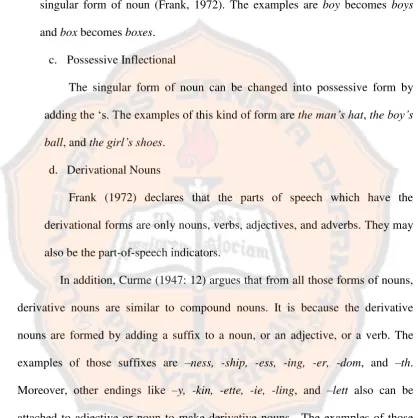
c. Possessive Inflectional
The singular form of noun can be changed into possessive form by
adding the „s. The examples of this kind of form are the man’s hat, the boy’s
ball, and the girl’s shoes.
d. Derivational Nouns
Frank (1972) declares that the parts of speech which have the
derivational forms are only nouns, verbs, adjectives, and adverbs. They may
also be the part-of-speech indicators.
In addition, Curme (1947: 12) argues that from all those forms of nouns,
derivative nouns are similar to compound nouns. It is because the derivative
nouns are formed by adding a suffix to a noun, or an adjective, or a verb. The
examples of those suffixes are –ness, -ship, -ess, -ing, -er, -dom, and –th.
Moreover, other endings like –y, -kin, -ette, -ie, -ling, and –lett also can be
attached to adjective or noun to make derivative nouns. The examples of those
kinds of nouns can be seen in the table below.
Table 2.1: Derivational Nouns
NO EXAMPLES 1 Skinship
From the table, we can see that the suffixes make the noun, verb, and
adjective become a noun. The examples from a noun to become a noun are heiress
and skinship. Other example is boredom which is from the verb bore. Meanwhile,
warmth and awareness are examples of nouns which are derived from adjectives
warm and aware.
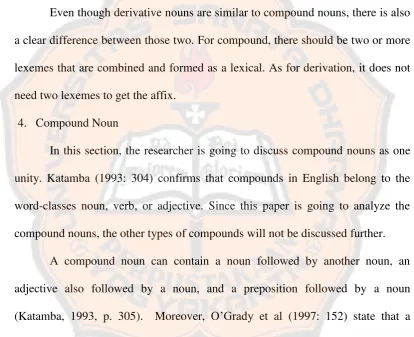
Even though derivative nouns are similar to compound nouns, there is also
a clear difference between those two. For compound, there should be two or more
lexemes that are combined and formed as a lexical. As for derivation, it does not
need two lexemes to get the affix.
4. Compound Noun
In this section, the researcher is going to discuss compound nouns as one
unity. Katamba (1993: 304) confirms that compounds in English belong to the
word-classes noun, verb, or adjective. Since this paper is going to analyze the
compound nouns, the other types of compounds will not be discussed further.
A compound noun can contain a noun followed by another noun, an
adjective also followed by a noun, and a preposition followed by a noun
(Katamba, 1993, p. 305). Moreover, O‟Grady et al (1997: 152) state that a
compound noun may be formed from a noun and a noun, an adjective and a noun,
a preposition and a noun, and a verb and a noun. The explanation of a compound
noun from those two experts can be seen in the following table.
Table 2.2:Lexical Items Which Form Compound Nouns
Lexical Items Which Form Compound Nouns
Example 1 Example 2
Preposition and Noun Undergraduate after thought Verb and Noun Push button jump suit
From the table, it can be seen that the lexical items (noun, adjective,
preposition, and verb) are followed by a noun. In most compounds, the rightmost
morpheme will determine the category of the entire word. That is why the
rightmost component in a compound noun is also a noun.
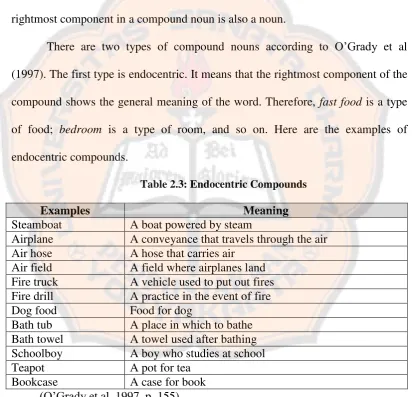
There are two types of compound nouns according to O‟Grady et al
(1997). The first type is endocentric. It means that the rightmost component of the
compound shows the general meaning of the word. Therefore, fast food is a type
of food; bedroom is a type of room, and so on. Here are the examples of
endocentric compounds.
Table 2.3: Endocentric Compounds
Examples Meaning
Steamboat A boat powered by steam
Airplane A conveyance that travels through the air Air hose A hose that carries air
Air field A field where airplanes land Fire truck A vehicle used to put out fires Fire drill A practice in the event of fire Dog food Food for dog
Bath tub A place in which to bathe Bath towel A towel used after bathing Schoolboy A boy who studies at school Teapot A pot for tea
Bookcase A case for book
(O‟Grady et al, 1997, p. 155)
The table shows that the meanings of the compounds are related to the
meanings of the rightmost morphemes. For example a teapot is a kind of pot and
compounds in English (Bauer, 1983; Katamba, 1993; Plag, 2003; Quirk et al,
1985).
However, there are also compounds, the meanings of which do not follow
the meanings of their parts like the endocentric compounds do. For instance,
green bottle is not the type of bottle which is green but it is a fly of the genus
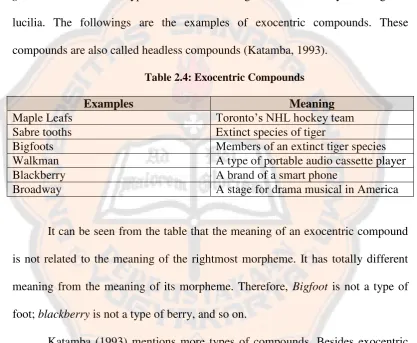
lucilia. The followings are the examples of exocentric compounds. These
compounds are also called headless compounds (Katamba, 1993).
Table 2.4: Exocentric Compounds
Examples Meaning
Maple Leafs Toronto‟s NHL hockey team Sabre tooths Extinct species of tiger
Bigfoots Members of an extinct tiger species Walkman A type of portable audio cassette player Blackberry A brand of a smart phone
Broadway A stage for drama musical in America
It can be seen from the table that the meaning of an exocentric compound
is not related to the meaning of the rightmost morpheme. It has totally different
meaning from the meaning of its morpheme. Therefore, Bigfoot is not a type of
foot; blackberry is not a type of berry, and so on.
Katamba (1993) mentions more types of compounds. Besides exocentric
and endocentric compound, there is a verbal compound. It is a part of endocentric
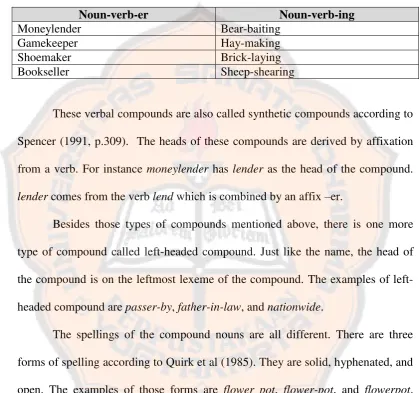
compounds. The following are the characteristics of a verbal compound:
a. A complex head adjective or noun, which is derived from a verb;
b. The nonhead constituent is interpreted as a syntactic argument of the deverbal noun or adjective head;
c. The 0-role of the nonhead is that of agent and patient; d. The meaning of the compound is transparent.
The followings are the examples of verbal compounds which act as a
noun:
Table 2.5: Verbal Compounds
Noun-verb-er Noun-verb-ing
Moneylender Bear-baiting Gamekeeper Hay-making Shoemaker Brick-laying Bookseller Sheep-shearing
These verbal compounds are also called synthetic compounds according to
Spencer (1991, p.309). The heads of these compounds are derived by affixation
from a verb. For instance moneylender has lender as the head of the compound.
lender comes from the verb lend which is combined by an affix –er.
Besides those types of compounds mentioned above, there is one more
type of compound called left-headed compound. Just like the name, the head of
the compound is on the leftmost lexeme of the compound. The examples of
left-headed compound are passer-by, father-in-law, and nationwide.
The spellings of the compound nouns are all different. There are three
forms of spelling according to Quirk et al (1985). They are solid, hyphenated, and
open. The examples of those forms are flower pot, flower-pot, and flowerpot.
There is no definite rule to decide the spelling of compounds. However, Quirk et
al (1985) argue that hyphenation is more common in British English than in
American English.
5. Compounds VS Phrases
Some people may be confused to differentiate between compounds and
Noun where both components are ordinary nouns, Noun and noun where the
second noun is a nomen agentis, and Noun and Noun where the second
component is a gerund. For the first category, the example is steel bridge. He
claims that 88% of his data (whose origin is unclear) have end-stress and that “…
a compound needs to become established before it tends to develop single stress
[= fore –stress]” (p. 150). It means that phrases will have the end-stress while
compounds have the fore-stress.
The example of the second category is watch-maker. He finds fore-stress
except where the first component is not the object of the second (town crier).
Finally for the third category, he finds again fore-stress in 88% of all cases (e.g.
foxhunting), the exception is when “… the first component has an attributive
function towards the gerund” (p. 153): lead poisoning and mass meeting.
In addition, Fudge (1984: 144) observes that end-stress among a noun and
a noun is likely to occur in the following categories: (a) where N1 is a location or
a time (kitchen sink, night watchman) and (b) where N1 is a material N2 is made
of (cotton dress, meat pie). Other examples which use end-stress include Ilkley
Moor, William Smith, and pound note. What is important to note here is that both
Kingdon and Fudge identify a noun and a noun, where N1 has the function as
attributive, will have end-stress. While on the other hand, items such as
watch-maker, where N1 is the „object‟ of N2, have fore-stress.
However, there are some words like glass case vs. glass case, steel
warehouse vs. steel warehouse, where stress differences correlate very clearly
Ladd, 1984). The followings are the rules which tell us whether this kind of words
combination is a phrase. First, the stress of a phrase will follow the rule offered by
Liberman and Prince (1977): “In any pair of sister nodes [AB]X, where X is a
phrasal category, B is strong.” (p. 257). Therefore, glass case is a phrase.
Second, the pre-head dependent of a noun, in a syntactic construction,
must be a modifier (attribute) (Quirk et al, 1985). Therefore, toy factory means a
factory which is made of a toy. Meanwhile, toy factory means a factory which
produces a toy.
As for the compound, first, the stress is on the first syllable (Bauer, 1983;
Plag, 2003; Quirk et al, 1985). It indicates that most of the compounds have
fore-stress. Therefore, blackbird, newspaper, toothbrush, match maker, and other
examples of compounds are stressed on the first lexeme.
Second, like most complex words, they will be expected to be right-headed
(Lieber, 1992). It means that the rightmost lexeme in a compound is expected to
determine the meaning of the compound itself. Therefore, school boy is a kind of
boy. It also implies to junk food which is also a kind of food. This kind of
compound is usually called endocentric compound. It is the most common
compound in English (Bauer, 1983; Katamba, 1993; Plag, 2003; Quirk et al,
1985). However, there are also compounds which are left-headed, for instance
feedback which is a kind of feed and worldwide which is a kind of world.
Moreover, there are compounds which do not have head or headless, for instance
sugar daddy and broadway. This kind of compound is also called exocentric
Third, Bauer (1998) discusses that the first element of a noun and a noun
should not be plural just as *”eventsful”. The plural should be deleted. Moreover,
the elements of Noun and Noun should not permit independent anaphora, or
replacement with one (*”a bus-driver and a truck one”). Besides, they should not
be independently modifiable.
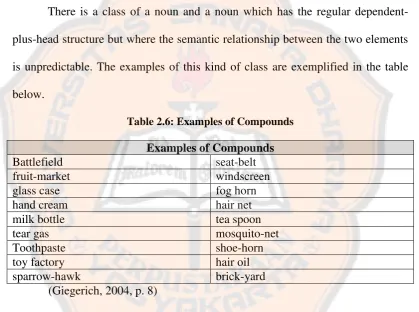
There is a class of a noun and a noun which has the regular
dependent-plus-head structure but where the semantic relationship between the two elements
is unpredictable. The examples of this kind of class are exemplified in the table
below.
Table 2.6: Examples of Compounds
Examples of Compounds
Battlefield seat-belt fruit-market windscreen glass case fog horn hand cream hair net milk bottle tea spoon tear gas mosquito-net Toothpaste shoe-horn toy factory hair oil sparrow-hawk brick-yard (Giegerich, 2004, p. 8)
The semantic relationships which occur in such Noun and Noun have been
classified by Adams (1973: 60; 2001: 82). It can be seen that in most cases the
paraphrase „N for N‟ (milkbottle „bottle for milk‟) is correct. However, that
interpretation is only possible when the construction is fore -stressed. If it is
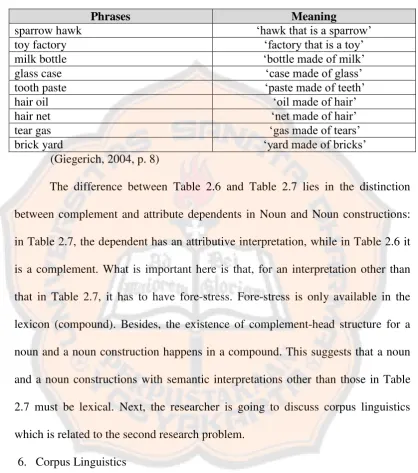
Table 2.7: Examples of Phrases
Phrases Meaning
sparrow hawk „hawk that is a sparrow‟ toy factory „factory that is a toy‟ milk bottle „bottle made of milk‟ glass case „case made of glass‟ tooth paste „paste made of teeth‟ hair oil „oil made of hair‟ hair net „net made of hair‟ tear gas „gas made of tears‟ brick yard „yard made of bricks‟ (Giegerich, 2004, p. 8)
The difference between Table 2.6 and Table 2.7 lies in the distinction
between complement and attribute dependents in Noun and Noun constructions:
in Table 2.7, the dependent has an attributive interpretation, while in Table 2.6 it
is a complement. What is important here is that, for an interpretation other than
that in Table 2.7, it has to have fore-stress. Fore-stress is only available in the
lexicon (compound). Besides, the existence of complement-head structure for a
noun and a noun construction happens in a compound. This suggests that a noun
and a noun constructions with semantic interpretations other than those in Table
2.7 must be lexical. Next, the researcher is going to discuss corpus linguistics
which is related to the second research problem.
6. Corpus Linguistics
Corpus linguistics is a study of language used through corpora (the plural
form of corpus). According to Bennet (2010), corpus is “a large principled
collection of naturally occurring examples of language stored electronically”
(p.2). Corpora can give information about the frequency, register, and how
will use a frequency list to show that information. A frequency list “displays the
words occurring in a corpus along with the number of times each word appears”
(Bennet, 2010: 5). This theory can be beneficial in this study because it will help
the researcher to make the frequency list of compound nouns that she analyzed.
However, corpus linguistics does not provide negative evidence. It means
that corpus linguistics cannot tell that the word is correct or not. It only tells us
that this word exists in the corpus or not. Besides, corpus linguistics cannot
provide all possible language at one time. It means that the language in the corpus
is not random but it is prepared and planned before. The last thing is corpus
linguistics also cannot explain the reasons why this language in the corpus is like
this. The researcher should use his or her intuitions to answer and explain that
question.
7. Previous Research
Swastikasari (2009) did almost similar study to this research. Her title of
the thesis is “A Study on the Common and Compound Nouns Used by the
Indonesian and non-Indonesian Writers in the Opinion Column of The Jakarta
Post”. She analyzed all nouns that she could find in the articles. However, in this
thesis, the researcher only analyzed compound nouns. In her thesis, she used two
opinions articles about Global Warming from The Jakarta Post in September and
October 2007. The articles are taken from the Indonesian writer and
non-Indonesian writer.
She presented the table of frequency, type, form, and marker of the
and analyzes them in terms of frequency, type, form, and marker. She included
compound as one of the types of the selected nouns. From the 29 nouns in the
article written by Indonesian writer, there are 6 compound nouns. Meanwhile,
there are seven compound nouns from 23 nouns found in the opinion article of
non-Indonesian writer. It proves that compound nouns are frequently used in the
articles. Based on the findings by Swastikasari in 2009, the researcher tried to
prove that compound nouns occur commonly in the articles of The Jakarta Post.
The previous theories are related to the study about compound nouns.
After discussing those related theories in theoretical description, the researcher
provides the theoretical framework. It contains the theories which are used to
answer the research problems. Those theories can be seen in the following section.
B. Theoretical Framework
In English, there is a term called compound. Compound is a group of
words which act as one single lexical item. There are four lexical categories in
English. Those categories are Noun, Adjective, Verb, and Preposition. In other
words, there are four kinds of compounds in English. However, in this thesis, the
researcher is only going to discuss compound nouns found in the articles of The
Jakarta Post.
In order to answer the first research problem, researcher will use the theory
from Bauer (1983), Curme (1947), Frank (1972), Katamba (1993), Matthews
(2009), O‟ Graddy (1997), Plag (2003), and Quirk et al (1985) to determine the
in the article whether they are formed by Noun and Noun, Adjective and Noun,
Preposition and Noun, or Verb and Noun. After that, the researcher is going to
differentiate the types of compound nouns using the theory from Katamba (1993)
and O‟Graddy (1997). Those types of compounds are endocentric, exocentric, and
verbal compounds. Endocentric means the meaning of the compound is related to
the meaning of its rightmost morpheme, while exocentric means the opposite of
endocentric. Verbal compound is related to endocentric compound which the head
of the compound is derived from verb. For example is “goal keeper”. Besides, the
researcher tries to explore left-headed compounds which are not common in
English.
Next, the researcher will use Bennet‟s (2010) theory about corpus
linguistics to answer the second research problem. The compound nouns found in
the articles will be listed into a frequency list. By doing so, we can see the
26
CHAPTER III
METHODOLOGY
In this chapter, the researcher discusses the research methodology used to
answer the research problems. There are six sections that will be discussed in this
chapter. Those sections are the research method, the sources of data, the research
instruments, the data gathering technique, the data analysis technique, and the
research procedure.
A. Research Method
The research method used to answer the research problems in this thesis is
qualitative research. According to Ary et al (2002), the goal of qualitative research
is the depth of understanding rather than the numerical data. Moreover, “data
analysis in qualitative research is often done concurrently or simultaneously with
data collection through an iterative, recursive, and dynamic process” (Ary et al,
2010, p. 481). It means that the researcher also did the data analysis while
collecting the data. In addition, “qualitative data might be quantitized by counting
the number of times a particular word is used or the number of times a particular
theme is identified” (Ary et al, 2010, p. 564). That is why the researcher used
frequency list to expose the data in this study. This kind of study is also called
mixed method because the data collection is qualitative but the data analysis is
Specifically, the type of research used in this study is document analysis. It
is one of the methods used in qualitative research. According to Corbin and
Strauss (2008), document analysis is a systematic procedure to review or evaluate
both printed and online document. Besides, Fraenkel and Wallen (1993) declare
that the purpose of document analysis is to “obtain an in-depth look at a particular
set of materials” (p. 380) after reviewing the document.
B. Sources of Data
The sources of data in this study were taken from the articles in The
Jakarta Post online edition. The articles used in this study are in the Sci-Tech and
Digital Life sections. The researcher believed that there are a lot of compound
nouns in these sections.
Moreover, the researcher decided to analyze the articles released in late
2014 until early 2015. The articles were written by national writers and
international writers. The researcher chose 25 articles written by national and
international writers. It is because in that period of time, there were only those 25
articles in The Jakarta Post online edition. In other words, the researcher did
convenient sampling because she could access and took the data that had been
there.
C. Research Instruments
In this study, the researcher acts as human instrument. It is because the
changing conditions” (Guba & Lincoln, 1994, p.12). This statement means that
the researcher can process the data immediately and confirm the source or related
references if there is uncertainty.
Besides, Guba and Lincoln (1994) add that it is only humans who can
collect the confusing data and then process it so that it becomes available and
easier for others to understand it. It means that only the researcher who could do
the analysis. After that, she interpreted the data in easier way so that other people
can get the meaning of the data.
D. Data Gathering Technique
The data in this study were collected from the articles of The Jakarta Post
online edition. The researcher used the online edition because the development of
technology makes many people prefer to go online rather than read the printed
newspaper. The researcher selected the articles by looking at particular topics
which have more compounds than the others. Those particular topics are Sci-Tech
and Digital Life. Besides, the researcher paid attention on the date of publication
(late 2014 until early 2015).
There are four steps that the researcher took in the study to gather the data.
First, the researcher conducted the research by analyzing the online articles of The
Jakarta Post. After that, the researcher collected the information from the
dictionary and the references (theories). Next, the researcher selected 25 articles
After that, the researcher collected the selected compound nouns found in the
articles.
E. Data Analysis Technique
The data that had been gathered were the selected compound nouns. Those
data then were analyzed based on the theories from Bauer (1983), Curme (1947),
Frank (1972), Katamba (1993), Matthews (2009), O’ Graddy (1997), Plag (2003),
and Quirk et al (1985) to decide whether this type of compound was made from
Noun-Noun, Adjective-Noun, Preposition-Noun, or Verb-Noun. The researcher
did the analysis while also collecting the data. After the researcher explored all of
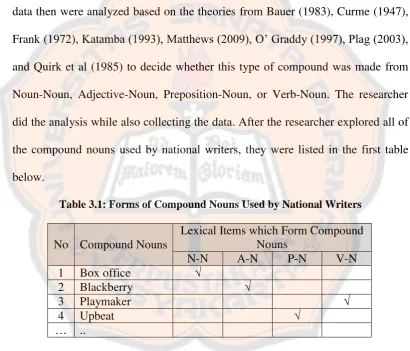
the compound nouns used by national writers, they were listed in the first table
below.
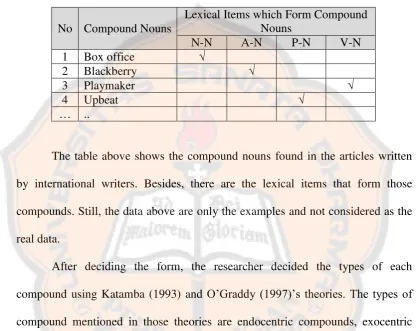
Table 3.1: Forms of Compound Nouns Used by National Writers
No Compound Nouns
Lexical Items which Form Compound Nouns
N-N A-N P-N V-N 1 Box office √
2 Blackberry √
3 Playmaker √
4 Upbeat √
… ..
The table above contains the examples of compound nouns. However,
those examples are not the real data. Those examples are provided to give visual
description to the readers of how the data will look like.
Besides deciding the lexical items that form compound nouns used by
international writers. The table is similar to the previous table. The only difference
is that the next table exhibits the compounds used by international writers.
Table 3.2:Types of Compound Nouns Used by National Writers
No Compound Nouns
Lexical Items which Form Compound Nouns
N-N A-N P-N V-N 1 Box office √
2 Blackberry √
3 Playmaker √
4 Upbeat √
… ..
The table above shows the compound nouns found in the articles written
by international writers. Besides, there are the lexical items that form those
compounds. Still, the data above are only the examples and not considered as the
real data.
After deciding the form, the researcher decided the types of each
compound using Katamba (1993) and O’Graddy (1997)’s theories. The types of
compound mentioned in those theories are endocentric compounds, exocentric
compounds, and verbal compounds. The table below was used to present the data.
Table 3.3:Forms of Compound Nouns Used by International Writers
No Compound Nouns
Types of Compounds
Endo Exo Verbal 1 Box office √
2 Blackberry √
3 Playmaker √
4 Upbeat √
The previous table is used to show the types of the chosen compound
nouns used by national writers. However, the researcher did not only discuss
compound nouns used by national writers but also international writers.
Therefore, the researcher also provided the table below to show the types of
compound nouns used by international writers.
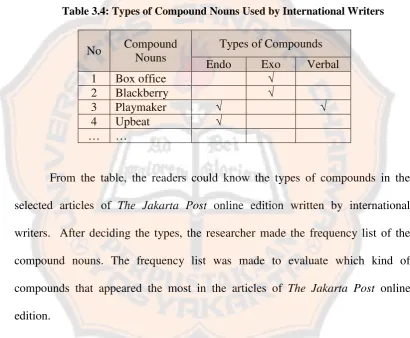
Table 3.4:Types of Compound Nouns Used by International Writers
No Compound Nouns
Types of Compounds
Endo Exo Verbal 1 Box office √
2 Blackberry √
3 Playmaker √ √ 4 Upbeat √
… …
From the table, the readers could know the types of compounds in the
selected articles of The Jakarta Post online edition written by international
writers. After deciding the types, the researcher made the frequency list of the
compound nouns. The frequency list was made to evaluate which kind of
compounds that appeared the most in the articles of The Jakarta Post online
edition.
The articles that had been selected in The Jakarta Post online edition were
divided into two parts. The first part is the articles written by national writers and
the second part is the articles written by international writers. From columns
Sci-Tech and Digital Life in the period of late 2014 up to early 2015, there were nine
articles written by national writers and 16 articles written by international writers.
writers than national writers at that period of time. That period was chosen
randomly by the researcher because the research was conducted in February 2015.
The table below displays the lexical items that form the compound nouns
used by national writers. Besides, the next table shows the types of the compound
nouns. Those tables could be seen below.
Table 3.5:Frequency of Forms Used by National Writers
NO Articles
Table 3.6:Frequency of Types Used by National Writers
NO Articles Frequency of Types Words Percen-tage
The first table above shows the lexical items that formed compound nouns
used by national writers. The second table displays the types of compound nouns
as well. The articles are sorted from the oldest news until the latest news based on
the date of publication.
After discussing the articles from national writers, the researcher moved to
before by providing data in tables. The following tables contain the articles
written by international writers. The tables exhibit the frequency of lexical items
of the compound nouns and their types.
Table 3.7:Frequency of Forms Used by International Writers
NO Articles
Table 3.8:Frequency of Types Used by International Writers
NO Articles Frequency of Types Words Percen-tage
Those are the tables which are used to display the data from international
writers. The articles written by international writers were also sorted from the
oldest to the newest. Next, the researcher also provided a table that exhibits the
percentage of compound nouns used by national and international writers.
Table 3.9:Percentage of Types Used by National and International Writers
2 3 4
…
Total Average
From the previous tables, the readers could know what types of
compounds that frequently occur in the articles written by both national and
international writers in the period of late 2014 until early 2015. Next, the
researcher explains the procedure that she did to conduct the research.
F. Research Procedure
There are seven steps conducted in this study. Those steps were taken in
order to gather and analyze the data found by the researcher. The following are the
steps that the researcher took in this study:
1. Observing The Jakarta Post online edition to look for the articles which
have compound nouns in it
The problem of finding compounds was not simple matters.
Sometimes, the compound nouns in the article were not so many or even
none. Because of that, the researcher had to read so many articles to
gather data as much as possible.
2. Getting the information from the dictionary and related references
This was done to check whether the words found in the article were
compounds or phrases. It was also to make sure and convince the