BLOCKHOLDER OWNERSHIP, CAPITAL STRUCTURE AND MANUFACTURE COMPANY VALUE IN
INDONESIA STOCK EXCHANGE
Yuliani Sriwijaya University E-mail: [email protected]
Raya Palembang-Prabumulih Street KM 32, Inderalaya (Ogan Ilir), 30662, South Sumatra, Indonesia
ABSTRACT
The capital markets have been in the emerging market category for example, the Indonesia Stock Exchange. In connection with this condition, it has been known that the behavior of issuers and investors are still relatively unstable. This behavior is quite different to market conditions in other countries, which have become the efficient market. The number of listed companies is still relatively small compared to the number of listed companies on stock exchanges in developed countries. The research aims to measure and to find empirical evidence, the direct effect of blockholder ownership and capital structure on company value. It will investigate and examine the mediating effect of capital structure on company value. The research was conducted at manufacturing company in Indonesia Stock Exchange (IDX) for five years. This research use census sampling, with number 36 of companies that were analyzed with Structural Equation Modeling (SEM). The result shows di-rectly the blockholder ownership does not have significant effect to company value. Capital struc-ture has mediating effect to the relationship between blockholder ownership and company value. This finding Explains that the indirect role of capital structure can increase of company value. In addition, capital structure directly has significant effect to company value.
Key words: Block-holder Ownership, Capital Structure, Company value.
KEPEMILIKAN BLOCKHOLDER, STRUKTUR MODAL DAN NILAI PERUSAHAAN MANUFAKTUR DI BURSA EFEK INDONESIA
ABSTRAK
Pasar modal yang telah berkategori pasar yang berkembang misalnya, Bursa Efek Indonesia. Dari kondisi yang ada, telah diketahui bahwa perilaku emiten dan investor masih relatif labil. Perilaku ini sangat berbeda dengan kondisi pasar di negara-negara lain yang telah menjadi pasar yang efisien. Jumlah perusahaan yang terdaftar masih relatif kecil dibandingkan dengan jumlah perusahaan yang terdaftar di bursa efek di negara maju. Penelitian ini bertujuan untuk mengukur dan menemukan bukti empiris tentang pengaruh langsung kepemilikan blockholder, struktur modal terhadap nilai perusahaan, untuk menyelidiki dan menguji pengaruh mediasi struktur modal terhadap nilai perusahaan. Penelitian dilakukan pada perusahaan manufaktur di Bursa Efek Indonesia (BEI) selama lima tahun. Metode pengambilan sampel penelitian ini adalah sensus dengan jumlah 36 perusahaan yang dianalisis dengan Model Persamaan Struk-tural (SEM). Hasil penelitian menunjukkan bahwa kepemilikan blockholder tidak berpengaruh signifikan terhadap nilai perusahaan. Struktur modal memiliki dampak mediasi pada hubungan antara kepemilikan blockholder dan nilai perusahaan. Temuan ini menjelaskan bahwa peran tidak langsung struktur modal dapat meningkatkan nilai perusahaan. Selain itu struktur modal secara langsung berpengaruh signifikan terhadap nilai perusahaan.
INTRODUCTION
Company’s shareholding structure can be distinguished into following four perspec-tives. 1) Based on investor’s position, the company ownership structure company is divided into insider ownership and outsider ownership. 2) Based on the owners’ perspec-tive, company ownership structure is divided into managerial ownership and institutional public. 3) Based on nationality, company shareholding structure is divided into foreign ownership and domestic ownership. 4) Based on percentage of shares owned, the company ownership structure divided into blockholder and non-blockholder company ownership.
The high blockholder ownership propor-tion has a greater role for management to op-timize the company value. However, at a cer-tain level, it can cause any deviation man-agement actions, which ultimately harm the minority shareholders (Morck et al. 1988; Shleifer and Vishny 1997). Researchers who have studied the effect blockholder on com-pany value are Prowse (1993), Vera-Minguez & Ugedo-Martin (2007). They found the re-sults for countries that have implemented good governance principles, characterized by mechanism controlling legal system of own-ership, blockholder effects tend to be nega-tive. This finding is very different from the results of Driffield et al. (2007), and then studied again in Indonesia context by Sujono (2010).
Sujono (2010) outlines that, in companies manufacturing sector, the higher blockholder ownership, the higher company value, or sta-tistically significant and positive. Blockholder ownership is measured by percentage in top 5% by individuals’ holding company and non-individual non-holding company. Re-search La Porta et al. (1998) concluded that ownership high concentration in Indonesia due to a weak legal system that protects mi-nority investor. Study Claessens et al. (2000) concluded that more than 50% of companies listed on Indonesia Stock Exchange con-trolled by the family. Claessens et al. also interpret the pyramid system is a way to ex-propriate the minority shareholders.
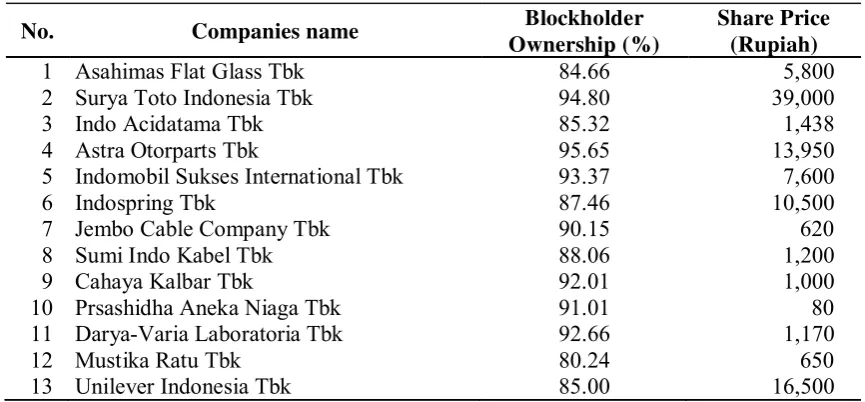
Indonesia Stock Exchange is one of cap-ital markets in the emerging market cate-gory. The behavior of issuers and investors are still relatively unstable. This behavior is quite different to market conditions in other countries, which have become the efficient market. The number of listed companies is still relatively small compared to the number of listed companies on stock exchanges in developed countries. The manufacturing sec-tor is one secsec-tor that has more issuers than other sectors. Therefore, this research uses the manufacturing sector objects, based on observations condition of blockholder own-ership and company value. Values reflected in the Company's stock price as market me-chanisms emitten, as shown by Table 1.
Table 1 shows, in the 2010 several com-panies including the manufacturing sector, overall blockholder ownership is above 50%. This large percentage make management de-cisions, from the perspective of large number of shares held, predominantly coming from blockholder ownership. When you look at the share price performance in the year based on the market mechanism, the investors did not see who the owner of these shares. This fact is evidenced though blockholder almost 100% but the market appreciation to share price still low. The higher blockholder own-ership did not interact to ensure market com-pany value, as reflected in the share price.
have a significant and positive impact on the capital structure. While Hagelin et al. (2006) concluded that the proportion of outside blockholder ownership above 50% has a sig-nificant and positive impact on company capital structure.
Driffield et al. (2007) makes empirical studies the relationship blockholder owner-ship on company value in four East Asian countries, namely Korea, Indonesia, Malay-sia and Thailand. The study's findings are Indonesia has concentrated ownership more than 50% by 47 companies, is higher than the three other countries. Hence, share own-ership effect on company value is significant and positive, with 10% significant level Em-pirical Study of Stock Exchange by Sujono (2010) found that blockholder ownership, as measured by the proportion of share owner-ship above 5% by individuals, holding com-panies and non-individual and non-holding company, significant and positive effect on company value but no significant the capital structure.
Based on the inconsistent findings be-tween Anderson et al. (2003); Hagelin et al. (2006), and Sujono (2010), researchers exam-ined the effect of blockholder ownership structure return on capital structure and com-pany value using a sample of firms in the manufacturing sector. The reason for
choos-ing this sector is that it is because firms in the manufacturing sector have the largest per-centage compared with other sectors in IDX.
Based on the explanation in background, there are findings inconsistencies of previ-ous researchers. Therefore, it is necessary to study again the effect blockholder ownership structure on capital structure and company value. The formulations of the problem in this study are: first, whether the blockholder ownership have a significant direct effect on company value? Secondly, whether the capi-tal structure has a significant direct effect on company value? Thirdly, whether the capital structure mediate the effect of blockholder ownership on company value?.
This study aims to: first, measure and find empirical evidence of a direct influence blockholder ownership on company value, and second, to measure and find the direct influence of capital structure on company value. Third, investigate and to test the me-diating effect of capital structure on com-pany value. The results of this study are ex-pected to contribute as follows: First, giving discourses and illustrations for the develop-ment of managedevelop-ment knowledge, particu-larly Financial Management, Investment and Portfolio Management. Secondly, empirical studies enrich for researchers engaged in the study of business economics and lecturer on
Table 1
Block-holder Ownership Comparison and Share Price in 2010
No. Companies name Blockholder
Ownership (%)
Share Price (Rupiah)
1 Asahimas Flat Glass Tbk 84.66 5,800
2 Surya Toto Indonesia Tbk 94.80 39,000
3 Indo Acidatama Tbk 85.32 1,438
4 Astra Otorparts Tbk 95.65 13,950
5 Indomobil Sukses International Tbk 93.37 7,600
6 Indospring Tbk 87.46 10,500
7 Jembo Cable Company Tbk 90.15 620
8 Sumi Indo Kabel Tbk 88.06 1,200
9 Cahaya Kalbar Tbk 92.01 1,000
10 Prsashidha Aneka Niaga Tbk 91.01 80
11 Darya-Varia Laboratoria Tbk 92.66 1,170
12 Mustika Ratu Tbk 80.24 650
13 Unilever Indonesia Tbk 85.00 16,500
topics of the lecture will be teaching materi-als. Third, the results of this study can be a reference for economics students, especially students who take the concentration of Fi-nancial Management, who wish to study in depth the topic of blockholder ownership, capital structure and company value.
THEORETICAL FRAMEWORK AND HYPOTHESIS
Thought Research Framework
Financial management is a science of how a company still continues to survive in the course of its business and keep thinking about the welfare of shareholders and maxi-mum profit. In its activities, a financial man-ager on duty to make three decisions, in its function as a corporate financial decision-makers. These three decisions are to make, 1) Investment Decision, in this case how to make investment decisions with respect to the rate of return to be earned. The financial manager can select the required investment opportunity that generates optimal returns. 2) Financing Decision, in this case how fi-nancial managers have the ability to manage the funds namely seeking funding with con-sidering the cost of debt to be borne by the company. If wrong in decision making, in the long run will lead to financial distress. 3) Dividend Policy, this decision will be related to how fund managers are able prospering
shareholders. In terms of dividend policy, financial managers will determine the right decision because it involves the use of com-pany external fund sources.
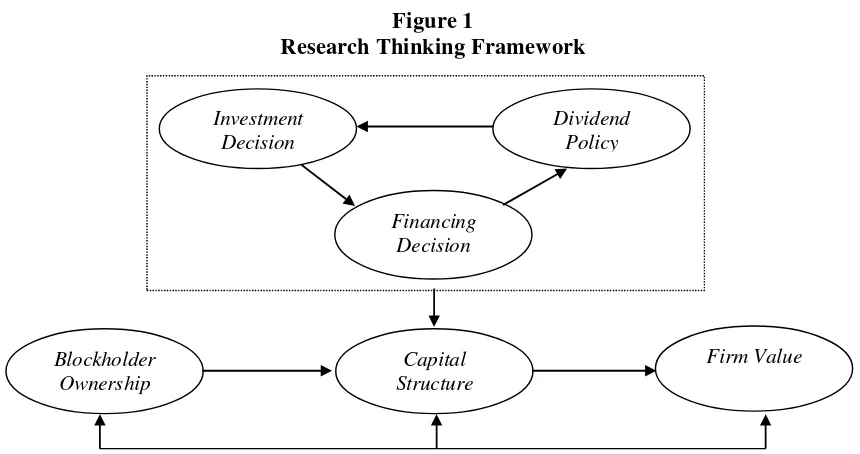
This study looks at the second decision, the financing decision. Relation here is will affect the company value due to the com-pany's capital structure. Searching the re-search results about impact the capital struc-ture on company value is still diverse. Re-search in Indonesia by Sujoko (2006), Su-jono (2010), Made Sudarma (2004), and Sumiati (2011) make observations on manu-facturing sector. The findings are not consis-tent. The capital structure is defined as a balance among the amounts of long term debt to equity that will reflect the company's solvency. High debt is not always bad for the company. In this theory, it appears the theories related to capital structure. Further-more, this study discusses blockholder own-ership structure, by examining how if the share ownership is a holding company. Therefore, the framework of this study can be illustrated in Figure 1.
Hypothesis
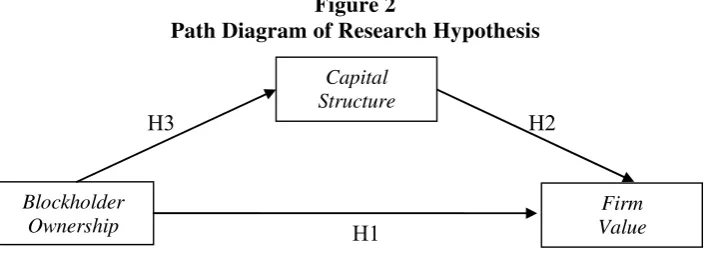
Based the conceptual framework model that has been constructed and transformed into path diagram in Figure 2, it is described the causality of construct used.
Hypothesis 1: The higher blockholder
owner-Figure 1
Research Thinking Framework
Investment Decision
Dividend Policy
Financing Decision
Capital Structure
Firm Value Blockholder
ship structure, the higher the company value. Despite the belief that a high proportion of share ownership has a bigger role in order to management maximize the company (Jen-sen & Meckling 1976; Zeckhouser & Pound 1990), but blockholder shareholding in a cer-tain level will cause deviation of management actions that would be detrimental to minority shareholders (Morck et al. 1988; Shleifer and Vishny 1997). This occurs if the blockholder is not function. However, if the blockholder perform the higher the blockholder owner-ship, the higher company value will be. Em-pirical studies show there is a positive and significant effect between blockholder own-ership structure on company value (Driffield et al. 2007; Sujono, 2010). Meanwhile, re-searches in countries that refer to control me-chanisms of the legal system by applying the governance principles, the effect of block-holder ownership structures tend to be nega-tive (Prowse 1993; Vera-Minguez & Ugedo-Martin, 2007).
Hypothesis 2: The higher the capital struc-ture, the higher company value.
When companies are faced with invest-ment opportunities, according to the pecking order hypothesis, the sequence of internal financing is a internal corporate finance, debt and equity. If based on trade-off theory, to look at investment opportunities, firms will prefer debt. There is a number of debt tends to reduce the company cost of capital, so that the optimum capital structure will be achieved. The Increased of leverage is ex-pected to have a positive impact on company value, all the cost debt and bankruptcy cost is lower than the rate of return investment.
Empirical evidence suggests that capital
structure have significant and positive effect on company value (Fama and French 1998). The results of different studies by Sujono (2010) showed the effects of capital struc-ture on company value are negative and sig-nificant. According Sujono (2010), in con-trast to results of previous studies, indicated that debt financing undertaken by the com-pany in Indonesia Capital Market has ex-ceeded the optimum. That is, the cost of bankruptcy and agency costs outweigh the benefits of tax savings.
Hypothesis 3: Ownership block-holder will be stronger if it is mediated by the capital struc-ture, thereby increasing the company's value.
Jensen and Meckling (1976) and Jensen (1986) predict the presence of blockholder will encourage companies to use debt to en-hance shareholder value. In this hypothesis, capital structure mediates the effect of blockholder ownership on company value. The predictions also suggest that block-holder prefers dividends over a little so that there is more free cash flow. The Increased amount of free cash flow will be directed to investments, both tangible and intangible assets, so enhance shareholder value. The research results of Sujono (2010) obtained a negative coefficient and insignificant. This means that in order to increase the company value, blockholder no need to use debt. Without using any debt, ownership concen-tration can increase the company value.
RESEARCH METHOD Research Design
Scientific research can be distinguished ac-cording to scientific explanation scope that will be generated by a study (Augusty, 2011:
Figure 2
Path Diagram of Research Hypothesis
Blockholder Ownership
Capital Structure
Firm Value H1
3). In this study, by their nature to seek an explanation of the causal-effect relationship between some of the concepts or variables that are developed, the research design study is built causality hypothesis-deductive ap-proach.
Population and Sample, Data Collection Methods
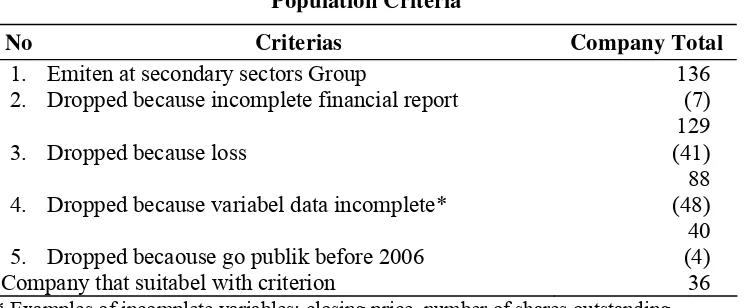
The population of this research is companies included in the industrial and manufacturing sector, or included in the secondary sectors. Based IDX Statistical Highlights of 2010, total there are 136 companies. Criteria in this study population are shown on Table 2. Based on criteria in Table 2, there are 36 companies qualified. This study used a satu-rated sample (census). The analysis unit is pooling data or panel data, with the observa-tion period (t) = five years (2006-2010) and N = 36 (Annex) company. Therefore the number of observation is 180 cases. The data collection methods is by accessing the Inter-net using official website of Indonesia Stock Exchange, http://www.idx.co.id/MainMenu/ Emiten/CompanyProfile/SubmittedOffline, IDX Fact Book 2006-2010, Annual Report 2006-2010, IDX Monthly from January to December of 2006-2010.
Operational Variable of Research
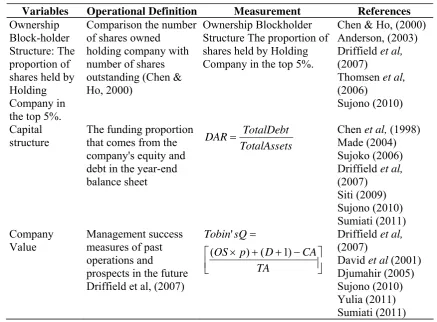
This study used three variables follows: blockholder, capital structure and company value. Each study variables operationally defined in Table 3.
Descriptive Statistics Analysis
Descriptive statistical analysis is used to provide an overview or descriptive empirical data collected in the study (Augusty, 2011: 271). This study uses a descriptive statistical analysis in the form of statistical averages that illustrated by tables.
Inferential Statistical Analysis
Augusty (2011: 276) defines that inferential statistics are used to test the management conception stated in research hypothesis. The research hypothesis was answered using tra-ditional methods of Structural Equation Mod-el (SEM) analysis with AMOS 16.0 software. This test is used to interpret whether the model presented already qualified. Augusty also suggested, if the goodness of fit index is not met, the model modification but must be supported and justified by theory.
DATA ANALYSIS AND DISCUSSION Descriptive Statistics Analysis
Descriptively, variables described to analyze research data. This study uses blockholder ownership, capital structure and corporate value variables. Study object is manufactur-ing sector in IDX. Observation period is 2006-2010 or five years. Descriptively, de-scription presented below.
Blockhoder ownership means that owner is a holding company, with the proportion of shares held by investors more than 5%. Ta-ble 4 presents the average conditions in In-donesia blockholder ownership at
manufac-Table 2 Population Criteria
No Criterias Company Total
1. Emiten at secondary sectors Group 136
2. Dropped because incomplete financial report (7) 129 3.
4.
5.
Dropped because loss
Dropped because variabel data incomplete*
Dropped becaouse go publik before 2006
(41) 88 (48) 40 (4)
Company that suitabel with criterion 36
turing sector. In 2006, the number block-holder ownership reached 66.29% of all company shares. That is, only about 33.71% shares not owned by holding company, namely owned by individuals, pension funds institutions or cooperative company. Thus, during 2003, asset control manufacturing company is in holding company. Conditions of 2005-2010 had no significant difference, blockholder control the company's shares ranged from 66.29% to 69.56%. This means that over four years period, there is no sig-nificant change of corporate control by blockholder.
Blockholder ownership shows, if looked at every year, PT. Astra Otoparts Tbk has a high ownership structure, amounting to 95.65% in 2010. High ownership concentra-tion means the monitoring factors can be performed entirely by the blockholder. Per-centage composition of the ownership in each year is 86.72% (2006), 84.72% (2007), 86.72% (2008) and 93.91% (2009). The
lowest blockholder ownership is PT. Ultra Jaya Milk Limited, amounting to 21.40% in 2006 and 2007. The average blockholder ownership over observation period is 68.47%, meaning that blockholder owner-ship in Indonesia is still concentrated in holding company.
In this study, proxy of capital structure is Debt to Asset Ratio (DAR), a comparison of Total Debt to Total Assets of the com-pany. DAR average sample in firms manu-facturing sector over the past five years is 44.81%. That is, every dollar assets, fi-nanced 0.448 by debt. The ratio DAR high will impact the company solvency, and the dependence on external funding sources are also high. Conditions DAR company within range 2.3% in 2006-2008 to 8.4%, there is an increment. In 2009-2010 the average DAR decline. This indicates that manufac-turing companies began to reduce the exter-nal funding sources.
Highest DAR is 47.85%, indicating
Indo-Table 3
Variables Operational Definition and Research Measurement
Variables Operational Definition Measurement References
Ownership Block-holder Structure: The proportion of shares held by Holding Company in the top 5%.
Comparison the number of shares owned
holding company with number of shares outstanding (Chen & Ho, 2000)
Ownership Blockholder Structure The proportion of shares held by Holding Company in the top 5%.
Chen & Ho, (2000) Anderson, (2003) Driffield et al, (2007)
The funding proportion that comes from the company's equity and debt in the year-end balance sheet
s Driffield et al, (2007) measures of past operations and
prospects in the future Driffield et al, (2007)
nesia Company’s dependence on external funding is quite large, nearly 50% funded with debt. Companies with the highest DAR ratio in 2006 were PT. Indomobil Sukses Interna-tional Tbk, amounted to 90.95%. Total Debt is Rp 4,418,690,000,000, total company assets is Rp 4,018,950,000,000. Lowest DAR in 2006 was PT. Mustika Ratu Tbk, with a debt ratio 9.41%. The cosmetics sector company has small dependency with external funding. That is, more internal funding sources used to fi-nance the company's activities.
In this research, Company value variable measured by Tobin's Q indicator. Based on table above, it can be seen that during 2006-2010 period, there was an increase signifi-cantly, from 37% to 75%. Tobin's Q value indicates that average company still has fair-ly high investment opportunities, or has a substantial competitive advantage. Theoreti-cally, the Tobin's Q value of sample firms should be improved, because the company has good prospects of more than 100%. Ce-ment companies have good investCe-ment op-portunities. PT. Semen Gresik (Persero) Tbk has a Tobin's Q ratio of 5.47% in 2010 and 1.81% in 2009, and 5.30% in 2007, PT. Aci-datam Indo Tbk, in 2006, the company owned by PT. Darya-Varia Laboratories.
Inferential Statistical Analysis
Classical assumption is tested by finding the multivariate outlier, using Mahalanobis dis-tance, to know the distance between the ob-served values the overall average variables. Criteria multivariate outlier be done by comparing the degree of freedom χ2 value against a number of parameters to be esti-mated, for both endogenous and exogenous variables. At p 0.01 level and there are 10
variables, and then the value of χ2 is 16.266. Based on χ2 value, it compared the Maha-lanobis distance. There are eight observation outliers, i.e. 6, 40, 41, 44, 107.147, 174.171, deleted from next process, so the observa-tions become 172. Normality assumption test conducted with critical value ±2.58. Based on the output obtained, normality tests were fulfilled on multivariate value of -0.529. Based on these criteria, the value is sufficient. Normality on the output is pre-sented in Table 5.
Before testing the study hypotheses, it carried out an estimate of structural model and evaluation of model suitability to input data. Structural equation test is based on the cut-off value, as used in the confirmatory analysis. Based on Goodness of Fit Overall, all criteria above indicate a good model. The model used is recursive analysis (no regres-sion reciprocal correlation between latent variable). The observations number is 172. Chi-square value is 0.000; with 3 df and probability values is infinite, with Chi-square value is small. Another measure of model fit is GFI, RMSEA. AMOS output obtained from GFI = 1.00 (both models); RMSEA = 0.211 (both models). Overall the model is acceptable.
Discussion of Hypotheses
This study proposed three hypotheses. The discussion based on AMOS output results are presented in the Table 6.
The effect Block-holder ownership struc-ture to company value variables, proxies by Tobin's Q, showed significant results with the positive direction. This reflects the greater percentage of shares held, at a rate of more than 5%, does not affect the increase of com
Table 4
Descriptive Statistics of Research Variable
Year (%) No Variable
2006 2007 2008 2009 2010 Mean Max Min
1 Blockholder 66.29 69.02 68.01 69.49 69.56 68.47 69.56 66.29
2 Capital Structure 47.85 47.45 46.35 41.80 40.62 44.81 47.85 40.62
pany value. This finding is on the contrary with Sujono (2010), Driffield et al. (2007), Grosfeld (2006); Olayinka, (2011). Despite the belief that a high proportion of share owner-ship has a bigger role in order management maximize the company value, the blockholder ownership in a certain level will cause devia-tion by management, which would be detri-mental to minority shareholders. This condi-tion occurs if the blockholder not funccondi-tion. The findings of this study indicate that condi-tion because the shareholding structure in In-donesia tends to be concentrated.
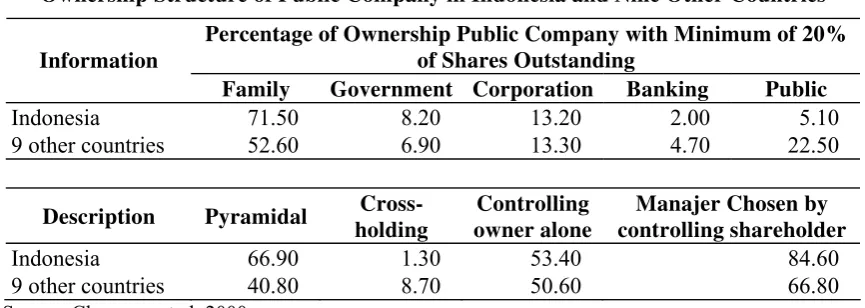
These research findings also demon-strate the agency type in Indonesia (La Porta et al. 1998; Claessens et al. 2000). La Porta et al. (1998) stated the cause of high owner-ship concentration in Indonesia is the lack of legal system that protects minority investors. Compared to other countries in the world, Indonesia's capital market called emerging markets or developing markets. In contrast, Claessens et al. (2000) stated that more than 50% of companies in Stock Exchange con-trolled by family. Pyramid system suggested by Claessens et al. becomes takeover tool of minority shareholders. Table 7 presented Claessen et al. results regarding the owner-ship structure of listed companies in Indone-sia.
Table 7 reveals, when using cutoff point 20% as control rights, there are 71.50% In-donesia public companies controlled by fam-ily, 8.20% controlled by the government, 13.20% is controlled by a corporation, 2.00 controlled by banks and the public itself is only control 5.10%. The results of Claessens et al. indicate that public companies shares ownership in Indonesia is inverse compared public companies in nine other countries, in line with study sample Claessens et al. The table above also shows that 66.90% of pub-lic companies in Indonesia to strengthen its position through Pyramidal structures, 1.3% through cross-holding ownership, 53.40% owned by the owners themselves, and 84.60% of public companies in Indonesia puts the managers appointed by the share-holders.
Capital structure significantly influences the company value. This study results are consistent with studies of Sujono (2010), Djumahir (2005), Sumiati (2011), but in contrast to Yulia (2011). Capital structure in this study uses DAR indicators, which is measured as total debt to total assets. The results reflect the company value has in-creased. Initially, Modigliani and Miller (1958) proposed capital structure on com-pany value is not related.
Table 5
Normality Assessment
Variables Min Max Skew C.R. Kurtosis C.R.
BO 21.400 95.650 -.709 -3.794 -.388 -1.038
CS 9.410 91.820 .457 2.448 -.597 -1.598
CV .000 1.670 1.100 5.892 .663 1.774
Multivariate -.442 .529
BO= Blockholder Ownership; CS= Capital Structure; CV= Company Value Sources: Data Processing Results
Table 6
Hypothesis decision for Manufacturing Company in Indonesia
Standardize Effect Independent
Variables
Dependent Variables
Intervening
Variable Direct Indirect Total Prob Decisions
BO CV -- 0.356 -- -- 0.452 (H1) Nonsignificant
CS CV -- 0.007 -- -- 0.000 (H2) Significant
BO CV CS 0.046 0.000 0.046 0.000 (H3) Significant
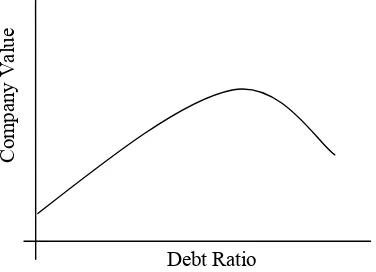
Yet, Modigliani & Miller (1963) generate the opposite conclusion, that maximum debt level will indicate the maximum level of com-pany value. That is derived from tax deducti-ble, as the effect of obligation to pay interest on debt. These results confirmed in Sumiati research (2011) that there is an influence and a non linear (quadratic) relationship between capital structure and company value. When debt ratio increases, which is a measure of capital structure, the company value increases, indicated by the positive coefficient of capital structure (Y1). Then, after reaching the opti-mum capital structure, the increase in debt will lower the company value. Non-linear relation-ship between the debt ratio to companies value in Indonesia looks like Figure 3.
Blockholder influence on company val-ue mediated by capital structure is positive and significant. To increase the company value, block-holder should use the debt. Us-ing debt, ownership concentration can en-hance shareholder value. This finding is not consistent with Sujono (2010) who found that this result is significant with a total di-rect and an indidi-rect influence is 0.2760. Pre-dictions of Jensen and Meckling (1976) and Jensen (1986) that the presence of block-holder will encourage companies to use debt to increase the company value can be im-plemented in Indonesia's capital markets. If looked at the capital structure data, average emitten in the study sample had a Debt to Asset Ratio (DAR) of 44.81%. This ratio reflects that sample firms use nearly 50%
debt to fund its operations. DAR average of manufacturing companies during 2006-2010 is Rp 0, 4481 of every dollar assets owned that used to guarantee repayment. High DAR also affects the company's high de-pendence on external funding.
CONCLUSION, IMPLICATION, SUG-GESTION AND LIMITATIONS
Some important notes in this study were: 1). Blockholder ownership structure does not increase the company value with direct test-ing. This reflects that Indonesia capital mar-ket characterized by concentrated ownership structures, that blockholder is not active in doing the function. 2). under direct examina-tion, capital structure can directly increase the company value. It means, the relations between two variables are linear up to a cer-tain point when there is tax deductible. However, the results of previous studies (Sumiati, 2011) explain that their relation-ship is non-linear. After reaching the optimal capital structure, the corporate value will drop. 3). Blockholder ownership structure mediated by capital structure to enhance shareholder value. This means that, in order to enhance company value, the blockholder must use an external funding source.
Based on above findings, following rec-ommendations can be suggested. 1) Block-holder ownership structure in Indonesia Capital Market is one important determinant in maximizing corporate value. This in-volves company funding. The insignificant
Table 7
Ownership Structure of Public Company in Indonesia and Nine Other Countries
Percentage of Ownership Public Company with Minimum of 20% of Shares Outstanding
Information
Family Government Corporation Banking Public
Indonesia 71.50 8.20 13.20 2.00 5.10
9 other countries 52.60 6.90 13.30 4.70 22.50
Description Pyramidal Cross-holding
Controlling owner alone
Manajer Chosen by controlling shareholder
Indonesia 66.90 1.30 53.40 84.60
9 other countries 40.80 8.70 50.60 66.80
results would be an idea for further research. On the other hand, an alternative grouping, as individual and non-holding company and individual blockholder that has not been in-vestigated in this study, become a note for further research. 2). Capital structure and company value has a linear relationship. Adversely, there is no previous studies de-scribing the relationship between the two is non-linear. The findings difference could be developed by including all the companies in the manufacturing sector in order to obtain a better description. 3). Then, researchers can add the determinants of capital structure riables such as external effects of macro va-riables on company funding decisions.
REFERENCES
Anderson, Ronald C, Mansi, Sattar A, Reeb, David M 2003, ‘Founding family ownership and the agency cost of debt’, Journal of Financial Econom-ics, Vol. 68, pp. 263-285.
Augusty Ferdinand 2011, Metode penelitian manajemen. pedoman penelitian untuk penulisan skripsi, tesis dan disertasi ilmu manajemen, Edisi 3, Fakultas Ekonomi dan Bisnis Universitas Di-ponegoro: Semarang.
Chen, Sheng-Syan & Ho, Kim W 2000, ‘Corporate diversification, ownership structure, and firm value: the singa-pore evidence’, International Review of Financial Analysis, (9), pp 315-326. Claessens Stijn, Djankov Simeon, Lang,
Larry H P 2000, ‘The separation of ownership and control in east asian corporations’, Journal of Financial Economics, 58, pp. 81-112.
Djumahir 2005, ‘Pengaruh variabel-variabel tax shield dan non-tax shield terhadap struktur modal dan nilai perusahaan’, Disertasi tak diterbitkan, Program Doktor Ilmu Manajemen Universitas Brawijaya Malang.
Driffield Nigel, Mahambare Vidya, Pal Sarmistha 2007, ‘How does ownership structure affect capital structure and firm value? recent evidence from east asia’, Economics of Transition, Vol. 15 (3), pp. 535-573.
Fama, Euegene F & French, Kenneth R 1998, ‘Taxes, financing decisions, and firm value’, The Journal of Finance, Vol. 53, Issue 3, pp. 819-843.
Hagelin Niclas, Holmen Martin, Pramborg Bengt 2006, ‘Family ownership, dual-class shares, and risk management’, Global Finance Journal, 16, pp. 283-301.
Jensen, Michael C 1986, ‘Agency cost of free cash flow, corporate finance and takeover’, American Economic Re-view, Vol.76, No. 2, pp. 247-263. Jensen, Michael C & Meckling, Wiliam H
1976, ‘Theory of the firms: managerial behavior, agency costs and ownership structure’, Journal of Financial Eco-nomics, Vol. 3, No.4, pp. 305-360. Kasbi Salmah 2009, ‘Ownership
concentra-Figure 3
Non Linear relationship between Debt Ratio to Company value Indonesia Findings
Sources: Sumiati (2011).
Debt Ratio
Compan
tion and capital structure adjustments’, (Online), http://basepub.dauphine.fr/ bitstream/handle/123456789/3862/kas bi_salma.PDF?sequence=1, (Viewed 18 Februari 2012).
La Porta, Rafael, Lopez-de-Silanes, Florencio, Shleifer, Andrei, Vishny, Robert W 1998, ‘Law and finance’, Journal of Po-litical Economy,Vol.106, pp.1113-1155. Made Sudarma 2004, ‘Pengaruh struktur
kepemilikan saham, faktor intern, fak-tor ekstern terhadap struktur modal dan nilai perusahaan’, Disertasi tak di-terbitkan, Program Doktor Ilmu Akun-tansi Universitas Brawijaya, Malang. Miller, Merton H & Modigliani, Franco
1963, ‘Dividend policy and market valuation: a reply’. The Journal of Business, Vol. 36, Issue 1, pp.116-119. Modigliani, Franco & Miller, Merton H
1958, ‘The cost of capital, corporation finance and the theory of investment’, The American Economic Review, Vol. 48, No.3, pp. 261-275.
Morck Randall, Shleifer Andrei, Vishny Ro-bert W 1988, ‘Management ownership and market valuation: an emprical analysis’, Journal of Financial Eco-nomics, Vol. 20, pp. 293-315.
Olayinka Akinlo 2011, ‘Determinants of capi-tal structure: evidence from nigerian panel data’, African Economic and Business Review, Vol. 9, No.1, pp. 1-16. Prowse, Stephen D 1993, ‘The structure of
corporate ownership in Japan’, The Journal of Finance, Vol. 47, Issue 1, pp. 1121-1140.
Shleifer, Andrei & Vishny, Robert W 1997, ‘A survey of corporate governance’, The Journal of Finance, Vol. 52, No. 2, pp. 737-783.
Siti Aisjah, 2009, ‘Strategi diversifikasi kor-porat, struktur modal dan nilai perusa-haan (Studi pada perusaperusa-haan yang ter-catat di Bursa Efek Indonesia)’, Diser-tasi tak diterbitkan, Program Pascasar-jana Fakultas Ekonomi Universitas Brawijaya.
Sujoko 2006, ‘Pengaruh struktur
ke-pemilikan saham, strategi diversifikasi, leverage, faktor internal dan faktor ek-sternal terhadap nilai perusahaan (studi pada perusahaan manufaktur dan non-manufaktur di Bursa Efek Jakarta)’, Disertasi tak diterbitkan, Program Doktor Ilmu Manajemen Universitas Brawijaya, Malang.
Sujono, 2010, ‘Determinan struktur modal, inovasi dan nilai perusahaan (studi pada industri manufaktur di Bursa Efek Indonesia), Ringkasan Disertasi tak diterbitkan, Program Doktor Ilmu Manajemen Universitas Brawijaya, Malang.
Sumiati, 2011, ’Kekuatan pasar, struktur modal dan nilai perusahaan (studi pada perusahaan manufaktur yang terdaftar di Bursa Efek Indonesia),’ Proceeding Master & Doctorate Journey in Man-agement Science, Malang, pp. 67-82. Thomsen, S, Pedersen, T & Kvist, Hans K
2006, ‘Blockholder ownership: effect on firm value in market and control based governance systems’, Journal of Corporate Finance, 12, pp. 246-269. Vera-Minguez, Antonio & Ugedo-Martin,
Juan F 2007, ‘Does ownership struc-ture affect value? A panel data analy-sis for the Spanish market’, Interna-tional Review of Financial Analysis, 16, pp. 81-98.
Yermack David, 1996, ‘Higher market valua-tion of companies with a small board of directors’, Journal of Financial Eco-nomic, Vol.40, Issue 2, pp. 185-211. Yulia Efni 2011, ‘Pengaruh keputusan
pen-danaan, keputusan investasi, kebijakan dividen terhadap nilai perusahaan yang dimediasi oleh risiko (studi pada sek-tor properti dan real estate di Bursa Efek Indonesia)’, Ringkasan Disertasi, Universitas Brawijaya Malang.