AVIATION LEGAL ISSUES IN INDONESIA AND THAILAND:
TOWARDS BETTER PASSENGERS’ RIGHTS IN ASEAN
Ridha Aditya Nugraha* and Lalin Kovudhikulrungsri**
* Air Power Centre of Indonesia
**Universiteit Leiden, International Institute of Air and Space Law, Leiden University
A r t i c l e I n f o
Received : 22 February 2016 | Received in revised form : 18 February 2017 | Accepted : 23 March 2017
Corresponding author’s e-mail : [email protected], [email protected]
Abstract
The aviation business in the ASEAN region has shown significant growth during the last decade. With the enactment of ASEAN Open Skies, there is no doubt that intra-ASEAN flights will continue to increase rapidly with Indonesia and Thailand experiencing significant effects from such development. Considering current rapid market capitalizatio n, there is an urgency to establish equilibrium between commercial and passengers’ rights. Flight delays, cancellations, and denied boarding, either on domestic or international flights, are the main airline passengers’ rights issues that are always relevant and must be kept up-to-date with recent developments. In the context of the so-called integrated ASEAN skies, the urgency to establish a uniform legal framework on passengers’ rights has become essential. Learning from the current international legal framework, namely the Warsaw Convention, the Montreal Convention, and EU Regulation No. 261/2004, they could present the source of best solution. Considering that the latter was established by another regional initiative, it could be a particularly valuable guide for ASEAN, even though the current integration level of the EU and ASEAN are quite different. Also of importance, the bomb threat hoax phenomenon within Indonesia and Thailand shall also be discussed. Passengers’ rights must also be protected against the implications of such irresponsible acts.
Keywords: bomb threat, compensation, delay, flight cancellation, denied boarding passengers’ rights
Abstrak
Bisnis penerbangan di ASEAN telah tumbuh secara signifikan dalam dekade terakhir ini. Tidak dapat dipungkiri bahwa dengan berlakunya ASEAN Open Skies, maka jumlah penerbangan intra-ASEAN akan semakin meningkat; dan tentunya Indonesia dan Thailand akan mengalami dampak signifikan dari perkembangan tersebut. Melihat gencarnya kapitalisasi pasar yang terjadi dalam bisnis penerbangan, muncul suatu urgensi untuk menemukan titik ekuilibrium antara perlindungan hak-hak penumpang pesawat terbang dengan kepentingan komersial. Keterlambatan atau pembatalan penerbangan, hingga penolakan untuk mengangkut penumpang dalam suatu rute penerbangan, baik pada rute domestik maupun internasional, merupakan isu-isu utama yang relevan terkait perihal hak-hak penumpang; dimana seharusnya ketentuannya selalu disesuaikan dengan perkembangan terkini. Dalam konteks semakin terintegrasinya langit ASEAN, maka semakin nyatalah urgensi akan dibentuknya kerangka hukum yang mampu melindungi hak-hak para penumpang pesawat terbang. Salah satu langkah terbaik yang dapat ditempuh adalah dengan mempelajari kerangka hukum internasional yang telah ada, antara lain Konvensi Warsawa, Konvensi Montreal, dan Regulasi Uni Eropa No. 261/2004. Mengingat regulasi yang terakhir ini dibentuk oleh suatu kerjasama regional, sudah seharusnya ASEAN dapat belajar banyak darinya; terlepas adanya perbedaan bentuk dan tingkat integrasi antara Uni Eropa dan ASEAN. Satu hal yang juga tidak kalah penting, tulisan ini juga membahas mengenai fenomena maraknya bercanda bom di Indonesia dan Thailand. Hak-hak penumpang juga harus dilindungi dari dampak tindakan yang tidak bertanggungjawab ini.
I. INTRODUCTION
Liberalization of air services in the Association of Southeast Asian Nations (hereinafter referred to as ASEAN) region, known as the ASEAN Single Aviation Market (hereinafter referred to as ASAM) or ASEAN Open Skies, fundamentally benefits passengers not only by removing limitations on the number of international flights within the member states but also on account of lower airfares. Simultaneously, this creates more competition among the member states’ airlines. Correlating to the increasing number of air traffic is the concern over rules applying to these international flights, especially rules on passengers’ rights.
The International Civil Aviation Organization (ICAO) has brought attention to different rules on passengers’ rights in international air transport among countries and adopted a view that in order to avoid any legal uncertainty, states should minimize the differences in the contents and application of regulations.1 Passengers’
rights, as seen from its expression, is certainly favor of consumers. On the other hand, however, it is also necessary for airlines in terms of branding, marketing, and reputation.2 Accordingly, this paper also aims to eliminate as many differences in rules
on passengers’ rights in ASEAN with a view to balance rights and duties between passengers and airlines. Passengers’ rights in this paper, however, are limited only to the rights in the event of flight disruptions, namely, flight delays, denied boarding, and flight cancellations.
As ASEAN does not have legislative powers, no legal framework on this issue has been passed even though a study raises concerns that a policy on consumer rights in the aviation sector should be developed.3 This paper discusses relevant domestic laws
in Indonesia and Thailand respectively, and the current private international law on international air carriage. Bomb threat hoax, a trending incident in both Indonesia and Thailand, and its linkage to flight disruptions is also examined. Finally, this paper proposes an option for harmonizing or mitigating differences among ASEAN member states by studying an initiative by the European Union (EU) as an example of another regional initiative.
II. BOMB THREATS AND INNOCENT PASSENGERS’ RIGHTS
A. Indonesia: Too Many Irresponsible Hoaxes
Irresponsible hoax about bringing a bomb on-board an aircraft has become rather widespread among Indonesian airline passengers recently. There were fifteen cases related to hoaxes of a bomb threat between 2015-2016.4 There have been various
reasons underlying such irresponsible act, ranging from making a hoax ‘accidentally’ to expressing anger due to long delay, security check, and in response to the unpleasant behavior of flight attendants. Fortunately, such infamous trend of hoax does not appear in other transportation modes, such as railway and sea travel. Otherwise the ability to operate reliable transportation in this country would become unimaginable.
The Indonesian Aviation Law5 had come into force six years before bomb threat
1 Ruwantissa Abeyratne, Regulation of Air Transport: The Slumbering Sentinels (Heidelberg: Springer,
2014), p. 85.
2 Ruwantissa Abeyratne, Aeronomics and Law: Fixing Anomalies (Heidelberg: Springer, 2012), p. 104. 3 Peter Forsyth, et. al.,Preparing ASEAN for Open Sky,Final report, AADCP Regional Economic Policy
Support Facility. Research Project 02/008, February 2004,p. 118.
4 HukumOnline, “Waspada! Bercanda Soal Bom di Pesawat Bisa Dipenjara [Beware! Bomb Hoax on
Bo-ard of an Airplane Can End up in Prison ],” http://www.hukumonline.com/berita/baca/lt568e24c702bd1/ waspada-bercanda-soal-bom-di-pesawat-bisa-dipenjara, accessed February 14, 2016.
hoaxes became a trend. The law refers to bomb threat hoaxes as act of providing false information6, which is deemed as unlawful interference. Sanction against providing
false information is already regulated in the Indonesian Aviation Law. Further details are indicated in the table below:7
Table 1
Degree of Damage Sanctions
Providing false information (in this case meaning a bomb threat hoax) which endangers aviation safety
Maximum 1 (one) year imprisonment
Providing false information which results in aircraft accident or property loss
Maximum 8 (eight) years imprisonment
Providing false information which causes fatalities Maximum 15 (fifteen) years imprisonment
Fortunately, there is not any loophole for this kind of irresponsible act within the Indonesian Aviation Law. Any unlawful act can be legally processed at any given time. In fact, Ignasius Jonan, the current Minister of Transportation, has spoken up firmly guaranteeing that any infringement shall be processed according to the Indonesian Aviation Law.8 Following up on the said statement, the case of Mr. Russel was one
of the few that could still be traced online. Last December 2015, he was detained after a bomb threat hoax in an Ambon-Langgur flight, on-board Wings Air IW-1504 flight.9 He has even become a suspect in the said case. However, so far there has not
been a single court decision, and neither have been from the other fourteen cases that occurred last year. It leaves an open question concerning law enforcement, whatever the reason behind it. The Batik Air ID 6179 incident10, still related to a bomb threat
hoax, involving a former army high officer’s son that ended with discontinuing the legal process has worsened the public opinion on law enforcement in dealing with this issue.
It is interesting to see there is not any punitive fine specified in Article 437 of the Indonesian Aviation Law, regardless of the severity of the damages caused. It means any irresponsible hoax which endangers aviation safety shall lead to imprisonment, without the possibility of an alternative of paying a fine. However, consequently, when
No. 1 Year 2009 (Law No. 1, SG. No. 1 Year 2009).
6 Ibid, Art. 344.
7 Indonesia, Undang-Undang tentang Penerbangan (Law regarding Aviation), UU No. 1 Tahun 2009, LN
No. 1 Year 2009 (Law No. 1, SG. No. 1 Year 2009) The Indonesian Aviation Law, Art. 437.
8 Estu Suryowati, “Menhub Pastikan yang Bercanda Bawa Bom di Bandara Tetap Diproses Hukum
[Minister of Transportation Reassures that the Legal Process against Enactors of Bomb Hoax on Airflight
Will Continue],” http://bisniskeuangan.kompas.com/read/2016/01/16/150026826/Menhub.Pastikan. yang.Bercanda.Bawa.Bom.di.Bandara.Tetap.Diproses.Hukum, accessed February 14, 2016.
9 Satu Maluku, “Bercanda Bom, Penumpang Tujuan Langgur Terancam Penjara 9 Tahun
[Jok-ing about bomb, a passenger bound for Langgur fac[Jok-ing jail sentence of 9 years],” http://satumaluku. com/2015/12/05/bercanda-bom-penumpang-tujuan-langgur-terancam-penjara-9-tahun/, accessed Feb-ruary 14, 2016.
10 Siwalimanews, “Usut Kasus Bercanda Bawa Bom di Pesawat: DPRD Desak Polisi Periksa Anak Nono
law enforcement is in any doubt, perpetrators are able to walk away without having to face any consequences. It would be better to make them pay for their irresponsible act, which would mean income for the state.
B. Thailand
In 2014, the then Director of the Department of Civil Aviation of Thailand accepted that a hoax bomb threat to domestic air services in Thailand had rarely happened and was seldom reported in the news.11 Before the entry into force of the new Act
on Certain Offences Against Air Navigation of 201512 (hereinafter the “Act of 2015”),
there has never been a case filed with the Supreme Court of Thailand on this issue. One of the main reasons is that the sanction under the Penal Code, the former applicable law in case of a bomb hoax, is so low that it is normally not allowed to appeal to the higher court.
However, under the new Act of 2015, a person can be jailed and fined for a maximum amount of THB200,000 (approximately USD5,600). This is in addition to potential civil litigation. Even though as of February 2016 there was no final judgment rendered by the court on bomb hoax under the Act of 2015, there was a high chance of a case. From November 2015 to January 2016, at least three bomb threats have been reported in the news.13 In other words, there was one hoax per month, excluding any
possible hoaxes which may have not received publicity. It is assumed that the serious sanction of the Act of 2015 is one of the causes which makes a bomb hoax newsworthy. Taking one of the three cases as an instance, a 23-year-old man, ironically working in the transportation sector, who confessed to making a bomb hoax to flirt with a flight attendant who was helping a passenger to place a bag in the overhead cabin is now facing a criminal charge and a civil lawsuit filed by an airline as well as a disciplinary punishment by his employer.14
11 “Air Asia Bomb Threat,” http://www.thairath.co.th/content/446016, accessed February 17, 2016. 12 Thailand, Act on Certain Offences Against Air Navigation,B.E. 2558 (2015) (Royal Gazette No. 132
Part 10 Kor).
13 The Jakarta Post, “Lion Air Flight Canceled after Passenger Makes Bomb Joke,”
http://www.the-jakartapost.com/news/2015/11/02/lion-air-flight-canceled-after-passenger-makes-bomb-joke.html, ac-cessed February 17, 2016; Nation Multimedia “Bangkok Airways Flight Delayed Following Bomb Hoax,”
http://www.nationmultimedia.com/breakingnews/Bangkok-Airways-flight-delayed-following-bomb-hoax-30274777.html, accessed February 17, 2016; The Phuket News “Thai Man, 20, Arrested, Charged for Sarcastic ‘Shoe Bomb’ Remarks During Airport Security Inspection,” http://www.thephuketnews. com/thai-man-20-arrested-charged-for-sarcastic-shoe-bomb-remarks-during-airport-security-inspec-tion-55727.php, accessed February 17, 2016.
14 Coconuts, “Thai Lion Air Seeks THB2 Million Compensation from Flirty Bomb Joker,”
Table 215
Degree of Damage under the Act of 2015 Sanctions
Providing false information which alarms persons
in an airport or on board an aircraft in flight
Not exceeding five years imprisonment or not exceeding THB200,000 fine (approximately
USD5,600) or both
Providing false information which endangers the
safety of an aircraft in flight
Five to fifteen years imprisonment or THB200,000 to 600,000 fine (approximately USD5,600 to
16,800) or both Being an accessory to the commission of an
offence Same punishment as the offender of such offence Attempting to commit the offence Same punishment as the offender of such offence
Generally, making a bomb hoax is not a new criminal offence in Thailand since it has been codified in the Thai Penal Code.16 Article 384 of Thai Penal Code provides a
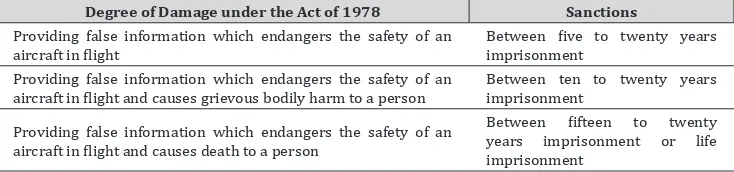
sanction of imprisonment not exceeding one month or fine not exceeding THB10,000 (approximately USD280). The interesting issue is that the Act of 2015 adds this offence specifically for air transport and significantly increases the sentence. As seen from Table I and II, before the enactment of the Act of 2015, a bomb threat was a petty offence. The Act on Certain Offences Against Air Navigation of 1978 (hereinafter the “Act of 1978”), repealed by the Act of 2015, only covered incidents when the safety of an aircraft in flight was harmed.17 Accordingly, in the event of a bomb hoax, the entry
into force of the Act of 2015 increases the level of sanctions in two aspects. First, it increases the term of imprisonment and the amount of a fine. Second, the scope is broader because the first paragraph of Article 22 the Act of 2015 expands to include a bomb hoax made at an airport.
Table 318
Degree of Damage under the Act of 1978 Sanctions Providing false information which endangers the safety of an
aircraft in flight Between five to twenty years imprisonment Providing false information which endangers the safety of an
aircraft in flight and causes grievous bodily harm to a person
Between ten to twenty years imprisonment
Providing false information which endangers the safety of an
aircraft in flight and causes death to a person
Between fifteen to twenty
years imprisonment or life imprisonment
It is without doubt that this Act of 2015 applies to domestic flights. If it regulated incidents for only these routes, the possibility of applying this law to a foreigner would not be high. Nevertheless, in reality, as evident from the three cases reported in the news, despite the fact that they occurred on domestic air services, one of the hoaxes was made by a foreigner who may not know how severe the sentence for this charge is. It needs to be mentioned that under the Thai Penal Code, ignorantia juris non
excusat, a legal principle holding that ignorance of the law excuses no one, is adhered to.19 What is worse for foreigners is that the jurisdiction includes international flights
15 Thailand, “Act of 2015,” arts. 22-24.
16 Thailand, Penal Code, B.E. 2499 (1956) (Royal Gazette No. 73, Part 95, Special Issue Page 1),art. 384. 17 Thailand, Act on Certain Offences Against Air Navigation,B.E. 2521 (1978) (Royal Gazette No. 95, Part
87 Special Issue).
and foreign airlines in some circumstances even when a person made a hoax outside the territory of Thailand. One of such situations is when a bomb threat is committed on board a Thai aircraft while such aircraft is not in the territory of Thailand, such as an international flight.20 The jurisdiction of such act includes a case when offence is
committed on board a foreign aircraft which lands in the territory of Thailand with the alleged offender on board.21
C. Is There Any Protective Measure for Innocent Passengers?
A bomb hoax is criminalized under the Indonesian and Thai legal framework respectively. Regardless of the level of punishment in each of these two countries, the essence of the legal framework is to inhibit a person from making an ill-conceived attempt at humor. However, if a bomb threat still occurs against an aircraft, they shall follow the procedures to search for a bomb, such as evacuating passengers from the aircraft and inspecting all baggage.
Turning to the concerns of fellow passengers, after being evacuated, amid being frightened by a bomb threat, they have to stray at an airport without any knowledge as to when they can travel further, or even if another transit or connecting flight will be available. It must be highlighted that this procedure may lead to either flight delay or flight cancellation.22 None of the abovementioned laws focus on innocent
passengers; hence, the existing legal framework on flight disruptions plays a critical role in mitigating this issue for innocent passengers during a bomb threat incident. The law will be analyzed further in the section below.
III. FLIGHT DELAY, CANCELLATION, AND DENIED BOARDING: AIRLINES’ CLASSICAL ISSUES
A. Indonesia
Recently, just one year ago, following numerous flight delays, Minister of Transportation Regulation No. 8923 (hereinafter referred to as “Indonesian Regulation
No. 89”) was enacted. The regulation is aimed to protect airline passengers’ rights travelling on domestic routes by establishing a delay management standard. Furthermore, the regulation protects airline passengers in more than just mere delay matters, but also on denied boarding and flight cancellation issues.24
According to Indonesian Regulation No. 89, delay is defined as “time differences between the scheduled departure or arrival time with its actual realization”.25 Such a
pro-passenger provision makes it more difficult for the airlines to neglect their duty.
20 Thailand, “Act of 2015,” art. 42. 21 Thailand, “Act of 2015,” art. 44(1).
22 Nation Multimedia, “Bangkok Airways Flight Delayed Following Bomb Hoax,”
http://www.nation-multimedia.com/breakingnews/Bangkok-Airways-flight-delayed-following-bomb-hoax-30274777.html, accessed February 17, 2016; The Jakarta Post, “Lion Air Flight Canceled after Passenger Makes Bomb Joke,”
http://www.thejakartapost.com/news/2015/11/02/lion-air-flight-canceled-after-passenger-makes-bomb-joke.html, accessed February 17, 2016.
23 Indonesia, Peraturan Menteri Perhubungan tentang Penanganan Keterlambatan Penerbangan (Delay
Management) Pada Badan Usaha Angkutan Udara Niaga Berjadwal di Indonesia (Minister of Transportation Regulation regarding Delay Management on Scheduled Commercial Airline in Indonesia), Permenhub No. 89 Tahun 2015, BNRI No. 716 Year 2015 (Minister Regulation No. 89 Year 2015, SG No. 716 Year 2015); hereinafter referred as “Indonesian Regulation”
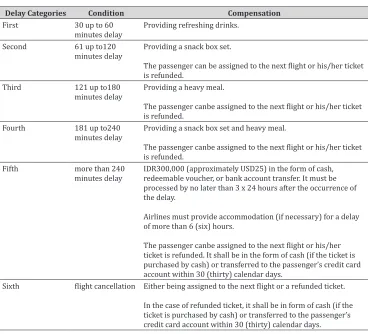
Under this regulation, flight delay is classified into six categories26 which can be seen
below.
Table 4
Delay Categories Condition Compensation
First 30 up to 60 minutes delay
Providing refreshing drinks.
Second 61 up to120 minutes delay
Providing a snack box set.
The passenger can be assigned to the next flight or his/her ticket
is refunded. Third 121 up to180
minutes delay
Providing a heavy meal.
The passenger canbe assigned to the next flight or his/her ticket
is refunded. Fourth 181 up to240
minutes delay
Providing a snack box set and heavy meal.
The passenger canbe assigned to the next flight or his/her ticket
is refunded. Fifth more than 240
minutes delay
IDR300,000 (approximately USD25) in the form of cash, redeemable voucher, or bank account transfer. It must be processed by no later than 3 x 24 hours after the occurrence of the delay.
Airlines must provide accommodation (if necessary) for a delay of more than 6 (six) hours.
The passenger canbe assigned to the next flight or his/her
ticket is refunded. It shall be in the form of cash (if the ticket is purchased by cash) or transferred to the passenger’s credit card account within 30 (thirty) calendar days.
Sixth flight cancellation Either being assigned to the next flight or a refunded ticket.
In the case of refunded ticket, it shall be in form of cash (if the ticket is purchased by cash) or transferred to the passenger’s credit card account within 30 (thirty) calendar days.
It must be highlighted that in the event of being assigned to another flight, regardless of the category, the airline shall pay for any price differences in the event of service reduction from business class to economy class.27 A clear message emanating
from this regulation is that passengers must not be burdened with any extra fees. Time limits for ticket refund and delay compensation are also being set up, closing a loophole in terms of postponing the payment or transfer. It is interesting to note that the insurance industry is also being involved specifically in dealing with the fifth delay category.28 The insurance industry’s involvement is considered a way to guarantee
an adequate amount of funds to compensate passengers. It is thus quite evident that numerous preventive measures are being established by the government with a view to protecting passengers’ rights.
Indonesian Regulation No. 89 provides for no compensation for any delay caused
26 Ibid., arts. 3(1), 10, and 11. 27 Ibid., art. 10.
by force majeure or airport operational factor. The former applies globally, from national laws to regional initiative regulation. Compensation shall only be granted for delay caused by the airline management’s fault, namely due to i) tardiness of pilot, co-pilot, and crew; ii) tardiness of the catering service; iii) tardiness of ground service; iv) waiting for last check-in, transfer or connecting (flight) passengers; and v) unpreparedness of the aircraft.29 Generally the delay compensation provisions seem
fair enough, however they fail to address the current situation of airport overcapacity. It has become public knowledge that major Indonesian airports are operating over their capacity, including the Soekarno-Hatta International Airport (CGK).30 With a
view to such situation, the provision excluding delay compensation due to airport operational factor needs to be reviewed further. There is a potential for airlines to use this provision, such as departure slot time or refueling issues, to evade the management’s responsibility. Supposedly an airline should not always be suspected and blamed for every delay that occurs. However, there has been increasing public distrust towards airlines’ poor performance due to lack of law enforcement, namely failure to impose heavy sanctions on neglectful airlines.
Indonesian Regulation No. 89 takes a more generous attitude towards airlines. If a bomb threat occurs, any delay or cancellation caused is considered beyond the airline’s control. Thus there is no fault on the airline’s part. As a consequence, passengers are not entitled to any right to care, refund, reschedule or compensation. In Indonesia, innocent passengers’ rights are not protected against bomb threats or any irresponsible passenger making a bomb hoax.
When it comes to international flights, there are more than one legal frameworks dealing with the delay issue. At least when the airline departs from an Indonesian airport, an obligation to take care of the passengers with refreshing drinks, a snack box, a heavy meal, and even overnight accommodation, i.e. “a right to care” occurs. However, when it comes to compensation matters, it appears that Indonesian Regulation No. 89 is put aside due to various reasons, ranging from ‘technical’ issues of distributing the cash compensation up to a chance for higher amount of compensation at the destination, either according to national law or international convention.
Speaking of delays, currently it is Lion Air who has been receiving the most public attention. The airline’s numerous delay cases have become a phenomenon in the recent years.31 Lion Air has had numerous issues with fulfilling its service obligation
under the regulation, ranging from absence of its officers when delay occurs32 to
29 Ibid., art. 5.
30 Hari Cahyono, “Awas, Lampu Kuning Kondisi Aviasi Indonesia [Watchout, The Yellow Light of
In-donesian Aviation Condition],” http://beritatrans.com/2016/02/11/awas-lampu-kuning-kondisi-aviasi-indonesia/, accessed February 15, 2016; Bandara Online, “10 Bandara Angkasa Pura II Over Kapasitas [10 Angkasa Pura II’s airport are overcapacity,” http://bandaraonline.com/airport/10-bandara-angkasa-pura-ii-over-kapasitas, accessed February 15, 2016.
31 Georgia Diebelius, “Pilot Banned from Flying After ‘Offering Divorced Air Hostess as Compensation
for a Delay on a Flight to Bali,” http://www.dailymail.co.uk/travel/travel_news/article-3326809/Pilot-banned-flying-offering-divorced-AIR-HOSTESS-compensation-delay-flight-Bali.html, accessed February 15, 2016; HukumOnline, “Lima Kasus Maskapai Penerbangan yang Dibawa ke Pengadilan, [Five Airline Cases Brought to the Court],” http://www.hukumonline.com/berita/baca/lt54d046d9261ac/lima-kasus-maskapai-penerbangan-yang-dibawa-ke-pengadilan, accessed February 15, 2016., accessed 15 February 2016.
32 Robertus Belarminus, “Dikejar-kejar Penumpang, Petugas Lion Air Kabur [Chased by Passengers,
problems with fulfillment of delay compensation.33 However, serious sanctions are
yet to be applied.34 Reducing the number of allotted routes or license revocation,
two of the heaviest sanctions according to Indonesian Regulation No. 89, seem at the moment to be merely lip service. Questions have arisen as to whether there is a link between sanctions and the airline owner’s position within the government, which ultimately dulls the law enforcement that should have taken place.
Following increasing legal awareness among Indonesian airline passengers, some delay and denied boarding cases have ended up at the Indonesian Supreme Court. Most of the time, immaterial damage has become the main objective during these suits, even though it was not always granted in the full amount.35 Indeed, this kind of
consumer legal pressure needs to be encouraged in order to create a balance between the growing business and the rights of airline passengers.
Ultimately, despite the existence of pro-consumer regulations, the Indonesian government is fully aware of airlines’ role in developing the economy. Their potential insolvency due to ‘too tight’ regulations would mean a disaster. Attempts have been made towards a win-win solution in the form of delay compensation in the amount of IDR300,000 (approximately USD25), by replacing Indonesian Minister of Transportation Regulation No. 7736 (hereinafter referred to as “Indonesian Regulation
No. 77”) with Indonesian Regulation No.89. It raises the delay time from four hours to five hours making it eligible for passengers to obtain compensation. It is a relief for the airlines, considering the current airport overcapacity situation and unreliability of available human resources.
B. Thailand
In Thailand, two pieces of legislation protect passengers in relation to flight disruptions; however, their scope of application is limited and parts of their contents are inconsistent.
The Announcement of the Ministry of Transport on Protection of Passenger Rights
33 Salman Mardira, “Uang Kompensasi Tak Sesuai, Penumpang Lion Air Protes [Compensation Not
Ad-equate, Lion Air Passnger Protests],” http://news.okezone.com/read/2015/12/01/340/1258703/uang-kompensasi-tak-sesuai-penumpang-lion-air-protes?page=1, accessed February 16, 2016; Kompas, “Delay 5 Jam, Lion Air Tak Berikan Kompensasi untuk Penumpang [Five hour delay, Lion Air did not give the com-pensation for the passengers],” http://nasional.kompas.com/read/2015/01/05/01135611/Delay.5.Jam. Lion.Air.Tak.Berikan.Kompensasi.untuk.Penumpang, accessed 16 February 2016. Suwarjono, “Terlambat 5 Jam, Lion Air Tolak Beri Kompensasi [Delay for 5 hours, Lion Air Refuses to Grant Compensation],” http:// www.suara.com/news/2015/02/23/164731/terlambat-5-jam-lion-air-tolak-beri-kompensasi, accessed February 16, 2016.
34 Erik Purnama Putra, “Menhub Jonan Dituding Takut Hadapi Lion Air [Minister of Transportation
Jonan Accused of Being Afraid to Encounter Lion Air],” http://www.republika.co.id/berita/nasional/ umum/15/02/21/nk3rxo-menhub-jonan-dituding-takut-hadapi-lion-air, accessed February 16, 2016; Safyra Primadhyta and Elisa Valenta Sari, “Ignasius Jonan Bebaskan Lion Air dari Sanksi Pembekuan Izin [Ignasius Jonan Releases Lion Air from the Sanction of License Revocation],” http://www.cnnindonesia. com/ekonomi/20150220220007-92-33711/ignasius-jonan-bebaskan-lion-air-dari-sanksi-pembekuan-izin/, accessed February 16, 2016; “Lion Air Cuma Kena Sanksi Teguran [Lion Air is only sanctioned with warning],” http://www.gresnews.com/berita/ekonomi/181212-lion-air-cuma-kena-sanksi-teguran/0/, accessed February 16, 2016; BBC, “Kementerian Perhubungan Jatuhkan Sanksi untuk Lion Air [Ministry of Transport sanctioned Lion Air],” http://www.bbc.com/indonesia/berita_indonesia/2015/02/150220_ sanksi_lionair, accessed February 16, 2016.
35 Supreme Court of the Republic of Indonesia, “Decision No. 2130 K/Pdt/2013,” p. 12. Supreme Court
of the Republic of Indonesia, “Decision No. 411/PDT.G/2013/PN.JKT.PST.,” p. 24-25.
Using Thai Carriers’ Services for Domestic Scheduled Routes of 201037 (hereinafter
referred to as the “Announcement of 2010”) applies only to a domestic scheduled flight operated by a Thai air carrier. Hence, even though at present only Thai national air carriers perform domestic air services, foreign air carriers which may do so in the future if law permits are not regulated under this announcement. Moreover, any international route, regardless of whether the air carrier departs from an airport situated in the territory of Thailand, is not regulated by the Announcement of 2010. Hence, there is a chance that passengers who travel from the same airport and face a similar flight disruption are treated differently only because one is on a domestic flight while the other travels abroad. This can happen even if they are carried by the same air carrier.
Another defect of the Announcement of 2010 is that a domestic or international charter flight was not covered. Due to the limited scope of the announcement at that time, in 2012 approximately 400 Thai passengers on a charter flight operated by PC Air had been left stranded at an airport in South Korea for more than 24 hours since the airport refused to let the Thai-licensed air carrier to take off.38 Accordingly,
Thailand passed the Announcement of the Ministry of Transport on Protection of Passenger Rights related to Charter Flight Services39 in 2013 (hereinafter the
“Charter Announcement of 2013”). In spite of filling the loophole on international and domestic charter flight services, the Charter Announcement of 2013, basing its jurisdiction on the Thai operating license, fails to cover any foreign air carrier which operates a charter flight service from an airport situated in the territory of Thailand.40
Both announcements protect passengers in case of a flight delay and a flight cancellation, but only the Announcement of 2010 covers an event of denied boarding. The drafters of the Charter Announcement of 2013 did not see a reason to regulate this because a tour agency will check a number and conditions of passengers beforehand and a possibility of denied boarding in a charter flight is almost zero.
A flight delay under both announcements means “a flight that operates later than the scheduled flight timetable”.41 Hence, calculation of the length of delay is based
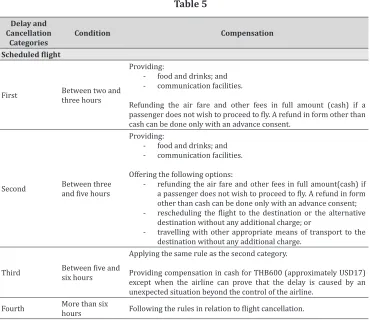
on the waiting time before the flight in question is resumed. Not all durations of delay entitle compensation under both announcements, only a delay of more than two hours triggers the protection. A delay of more than six hours equals a flight cancellation in terms of passenger protection. The difference is on classification of the length of delay in each announcement. As seen in Table V, while the Announcement of 2010 categorizes the waiting time due to a flight delay into four classes, the Charter Announcement of 2013 roughly divides them into two classes. Moreover, passengers on a delayed charter flight are not entitled to the same right to refund or reschedule and the right to compensation as passengers on a delayed scheduled flight. It is assumed that the drafters of the Announcement of 2010 may have been inspired by the European Court of Justice42 (ECJ) decision in Sturgeon v. Condor and Bock v Air France hence the announcement only compensates passengers in the event of
37 Thailand, Announcement of the Ministry of Transport on Protection of Passenger Rights Using Thai
Carriers’ Services for Domestic Scheduled Routes,B.E. 2553 (2010) (Royal Gazette No. 129, Special Part 128 Ngor).
38 Nation Multimedia, “PC Air Ordered to Suspend Flight,”
http://www.nationmultimedia.com/nation-al/PC-air-ordered-to-suspend-flight-30192607.html, accessed February 19, 2016.
39 Thailand, Announcement of the Ministry of Transport on Protection of Passenger Rights Related to
Charter Flight Services,B.E. 2556 (2013) (Royal Gazette No. 130, Special Part 90 Ngor).
40 Charter Announcement of 2013, section 3.
41 Announcement of 2010, section 2. See also Charter Announcement of 2013, section 2.
42 Since 2013 the European Court of Justice has been referred to as the Court of Justice of the European
experiencing a delay of more than five hour.43
In relation to a flight cancellation, both announcements add a duty to provide accommodation if the next flight will depart on the following day of the original schedule of the former flight.44 Again, the right to compensation is excluded in the
event of cancellation of a charter flight in all cases because from the drafters’ point of view of a contractual relationship in a charter flight whereby a passenger enters into a contract with a tour agency, not an airline.45
Denied boarding under the Announcement of 2010 creates the same rights as a flight cancellation.46 However, the practical problem is that the rights are subject to
being denied on any unreasonable ground, whereas airlines normally claim that the reason is not discriminatory and that it is fair.
An airline is free from compensating when a disruption is a result of an unexpected situation beyond the control of an airline (force majeure).47 Unfortunately, no conclusive definition on the expression “unexpected situation beyond the control of an air carrier” is given in details. At best, the Announcement of 2010 provides examples which include political situations, weather conditions, and unapproved strikes.48 However, the force majeure does not exempt an air carrier from a duty to
care and also to refund or reschedule. In mid-February 2016, Nok Air cancelled nine scheduled domestic flights following an unapproved pilot strike.49 Although the right
to compensation under the Announcement of 2010 does not cover this case as a result of being an unexpected event, passengers can bring a private right of action against the airline.
With regard to bomb threat, one may argue that the flight cannot operate according to the schedule as a result of the bomb threat procedures. However, an air carrier is free from liability since they must comply with the international standard to ensure safety of all passengers on board. Nevertheless, passengers flying domestic flights in Thailand are still entitled to the right to care, reschedule or refund since they are covered under the Thai announcements.
43 Court of Justice of the European Union, “Joined Cases C-402/07 and C-432/07.”
44 Announcement of 2010, section 5(2)(c). See also Charter Announcement of 2013, section 7(3)(c). 45 Thailand, Announcement of the Ministry of Transport on Protection of Passenger Rights Using Thai
Carriers’ Services for Domestic Scheduled Routes, B.E. 2553 (2010) (Royal Gazette No. 129, Special Part 128 Ngor), section 5(3)(c).
46 Announcement of 2010, section 5.
47 Announcement of 2010, sections 4(3)(b), 5(3)(c). 48 Announcement of 2010, section 4(3)(b).
49 Bangkok Post, “Pilot Strike Grounds Nok Air Flights,”
Table 5
Delay and Cancellation
Categories
Condition Compensation
Scheduled flight
First Between two and three hours
Providing:
- food and drinks; and - communication facilities.
Refunding the air fare and other fees in full amount (cash) if a
passenger does not wish to proceed to fly. A refund in form other than
cash can be done only with an advance consent.
Second Between three
and five hours
Providing:
- food and drinks; and - communication facilities.
Offering the following options:
- refunding the air fare and other fees in full amount(cash) if
a passenger does not wish to proceed to fly. A refund in form
other than cash can be done only with an advance consent;
- rescheduling the flight to the destination or the alternative
destination without any additional charge; or
- travelling with other appropriate means of transport to the destination without any additional charge.
Third Between five and six hours
Applying the same rule as the second category.
Providing compensation in cash for THB600 (approximately USD17) except when the airline can prove that the delay is caused by an unexpected situation beyond the control of the airline.
Fourth More than six
C a n c e l l a t i o n and denied boarding
Offering the following options:
- refunding the air fare and other fees in full amount (cash)
if a passenger does not wish to proceed to fly. A refund in form
other than cash can be done only with an advance consent; or
- rescheduling the flight to the destination as specified
in the ticket or to alternative destination close to the original destination within the same day, the next day or any other day as requested by the passenger.
Providing:
- food and drinks;
- communication facilities; and
- a hotel room for at least one night and a transportation
between the airport and hotel if the new flight is scheduled to
depart later than the original schedule for one day.
Providing compensation in cash for THB1,200 (approximately USD34) except when the airline can prove the following:
- the airline has notified the passengers about the cancellation of flight not less than three days prior to the departure date; - the airline has notified the passenger about the cancellation
of flight prior to the departure date less than three days but arrival time of the new offered flight is less than three hours
difference (+- 3 hours); or
- the cancellation of flight is caused by an unexpected situation
beyond the control of the airline (force majeure) such as political situations, bad weather, security, any other situation
that may affect the safety of flight operations of aircraft and
passengers. Italso includes a situation such as when a large number of staff take unapproved time off work or any other act undertakenby staff of an organization related to the
hours Following the rules in relation to the cancellation of flight.
Cancellation
- refunding the air fare and other fees in full; or
- rescheduling the flight to the destination or any alternative
destination without any additional charge.
Providing accommodationfor at least one night and transportation
between the airport and hotel if the new flight is scheduled to depart
In order to prevent any abuse of right to compensation, the Announcement of 2010 only allows an airline to compensate in the form of a travel voucher when the passenger agrees in advance under a written form.50 When an airline fails to comply
with the announcement, the passenger is entitled to lodge a complaint to the Civil Aviation Authority of Thailand.51 However, this announcement does not specify any
time limitation. Moreover, it does not guarantee the length of the investigation process. The Charter Announcement of 2013 takes another approach due mainly to the PC Air event. Even though the Charter Announcement of 2013 lacks a provision on complaint procedure, it commands a precondition to a charter airline to submit a letter of bank guarantee with sufficient value for the entirety of charter flight services; accordingly, in case of refund and other expenses beyond the airline’s capability to pay, such bank guarantee can be used.52 The enforcement measure for a scheduled or
charter airline that fails to care for a passenger is considered as failure to comply with the conditions attached to the air operating license.53 Accordingly, a penalty of up to
one year imprisonment or a fine of up to THB20,000 (approximately USD1,680), or both, can be imposed.54 Thus far, such sanction has never been imposed on any airline
in Thailand. However, an airline’s operating license was suspended once due to its failure to take care of its passengers.55
As of 2016, in practice there has been no record of any complaint in relation to flight disruptions or penalties. In any case, the complaint under either of the above mentioned two announcements does not bar a passenger to pursue a private right of action. Before the entry into force of the International Carriage by Air Act56 (hereinafter
referred to as the “International Carriage Act”), the Thai Civil and Commercial Code and a contract of carriage had been the basis of claim. After the entry into force of the International Carriage Act,57 an action for compensation for flight delay is under the
exclusivity of this act.58 Since the latter has been in force for less than a year, there has
not been any judgment on this exclusivity issue to date. It remains to be seen whether Thailand will follow the European Union’s approach or rule that the International Carriage Act preempts any remedy.59
C. Today’s Magna Carta in International Carriage by Air: The Warsaw Conven-tion of 1929 and the Montreal ConvenConven-tion of 1999
Air transport has an international nature which leads to many different applications of law and many different jurisdictions. It calls for harmonization on certain liabilities under a contract on international air carriage; and it is governed by international conventions, namely the Convention for the Unification of Certain Rules Relating to International Carriage by Air of 192960 (hereinafter referred to as the “Warsaw
50 Announcement of 2010, sections 4(3), 6. 51 Announcement of 2010, section 10.
52 Charter Announcement of 2013, sections 4, 16. 53 Announcement of 2010, preamble.
54 Thailand, Declaration of the Revolutionary Council No. 58, B.E. 2515 (27 January 1972) (Royal Gazette
No. 2515/15/3 Por.), order nos. 4, 7,9, 16.
55 “PC Air Ordered to Suspend Flight,”
http://www.nationmultimedia.com/national/PC-air-ordered-to-suspend-flight-30192607.html, accessed March 3, 2016.
56 Thailand, International Carriage by Air Act,B.E. 2558 (2015) (Royal Gazette No. 132 Part 10 Kor). 57 International Carriage Act, section 2. The act comes into force after the expiration of ninety days
from the date of its publication in the Government Gazette, February 13, 2015.
58 International Carriage Act, section 54.
59 See Part IV below. Court of Justice of the European Union, “Case C-344/04.”
60 Convention for the Unification of Certain Rules Relating to International Carriage by Air, Warsaw, 12
Convention”) and the Convention for the Unification of Certain Rules for International Carriage by Air of 199961 (hereinafter referred to as the “Montreal Convention”). The
Warsaw Convention and the Montreal Convention similarly apply to a passenger only if a journey is held between two Contracting States; or within a Contracting State if there is an agreed stopping place within the territory of another State. 62
With an objective to harmonize the rules in international air transport, both conventions contain similar provisions in relation to types of an air carrier’s liability and those excluded from the scope of liability. The Warsaw Convention clearly unifies the liability rules by forcing an injured person to bring any action for damages that are subject to the conditions and limits under this convention solely.63 This concept
is followed and elaborated upon in more detail by its successor, the Montreal Convention.64 In short, any action for damages under the purview of these two
international conventions must be claimed under them solely.
Delay is under the scope of liability under both the Warsaw and Montreal Convention.65 Hence, both conventions provide the sole remedy for delay.66 The
Warsaw Convention relieves an air carrier from liability if it proves it took “all necessary measures” to avoid the damage or it was impossible to do so.67 The
Montreal Convention replaces the first relief with if an air carrier proves that it took “all measures that could reasonably be required to avoid the damage” and leaves the second claim untouched.68 While the defense in the Warsaw Convention seems a
standard one, the revised one in the Montreal Convention makes more sense because if all necessary measures as required in the Warsaw Convention are taken, the damage cannot occur.69
Neither of the above mentioned two conventions defines delay. Actually, the drafters of the Montreal Convention intended not to define it.70 It is viewed that delay
implies a discrepancy between the expected time and the actual time at which the carrier performs its duties.71 In this case, even though neither of the above mentioned
two conventions literally covers flight cancellation and denied boarding, they can fit into the regime of delay. This is because in instances of both cancellation and denied boarding, a passenger cannot travel on the flight that such person expects an airline to perform the duties under the contract of carriage between them. One may partially argue that in case of denied boarding, an airline operates a flight but only a person is denied to board such flight so it is not delay on an airline’s side. However, from the passenger’s side, the contract is not performed. Such interpretation of nonfeasance and misfeasance is not uniform either in an academic world or among judiciary circles. At the end of the spectrum, a cancellation and denied boarding are considered as a nonfeasance and both conventions only cover the misfeasance of the contract of
61 Convention for the Unification of Certain Rules for International Carriage by Air, Montreal, May 28,
1999, United Nations Treaty Series, Vol 2242, No. 33917.
62 The Warsaw Convention, art 1; the Montreal Convention, art 1. 63 Ibid., art 24.
64 The Montreal Convention, art 29.
65 The Warsaw Convention, art 19. See also The Montreal Convention, art 19.
66 Paul B. Larsen et al., Aviation Law Cases, Laws and Related Sources (Leiden: Martinus Nijhoff
Publish-ers, 2012), p. 340.
67 The Warsaw Convention, art 20. 68 The Montreal Convention, art 19.
69 Paul S. Dempsey and Michael Milde, International Air Carrier Liability: The Montreal Convention of
1999 (Montreal: McGill University, 2005), p. 177.
70 Jae Woon Lee and Joseph Charles Wheeler, “Air Carrier Liability for Delay: A Plea to Return to
Inter-national Uniformity,” Journal of Air Law and Commerce 77(Winter, 2012), p. 50.
71 I.H.Ph. Diederiks-Verschoor, revised by Pablo Mendes de Leon and Michael Butler, An Introduction to
carriage, in this case a delay.72
Dempsey and Johansson acknowledge this confusing concept as a result from a different view toward the concept of delay between Anglo-American law and Continental law.73 While the former covers non-performance of contract into the
notion of delay, the latter does not.74 Accordingly, the decisions of courts are varied.
Cases on denied boarding have mostly involved overbooking or bumping. Courts in Osmas Erdem v. Germanair75 and King v. American Airlines76 ruled that denied
boarding was considered as delay. If bumping is on a return flight, it is a delay.77 On the
contrary, other courts adjudicated that a provision on delay did not apply to denied boarding because it was a breach of contract under domestic law.78 In an event of
flight cancellation, the rulings are more uniform than those in case of denied boarding. Flight cancellation constitutes a non-performance of contract. This holds true even in a cancellation of a return flight due to a strike.79 Since it is a non-performance of
contract, it falls outside the scope of the conventions; therefore, the applicable law is a domestic law.80
From these case laws, it is possible that denied boarding lies under the Warsaw Convention or the Montreal Convention. Certainly delay comes under these two conventions. The question is whether the scope of passenger protection as provided in Indonesia and Thailand are preempted by the scope under both conventions. It is worth noting that in the United States, a passenger has an option to receive compensation provided for by the regulation and relieve an air carrier from further liability or to seek any restitution under applicable law.81 So it links a compensation
scheme to the Warsaw Convention or the Montreal Convention in the case of an event occurring on an international flight.
D. Comparison Between Indonesia and Thailand: Lessons from Each Neighbor and the Magna Carta
In recent years, airline passengers’ rights protection in Indonesia and Thailand seems to be heading on a similar path. Both countries have enacted or amended their legal framework related to this issue. It must be kept in mind that the differences between these two countries, especially in their respective legal systems and aviation business practices, have led to different approaches to ensure airline passengers’ rights.
Both Indonesian and Thai legal framework have defined what a flight delay is. Following this milestone, flight delays are classified into several categories based on duration. While in Indonesia it is classified into six categories; in Thailand delay
72 Jorn J. Wegter, “The ECJ Decision of 10 January 2006 on the Validity of Regulation 261/2004:
Ignor-ing the Exclusivity of the Montreal Convention,” Air and Space Law 31,no. 2 (April 2006), p. 139.
73 Paul Stephen Dempsey and Svante O. Johansson, “Montreal v. Brussels: The Conflict of Laws on the
Issue of Delay in International Air Carriage,”Air and Space Law 35, no. 3 (2010), p. 210.
74 Ibid.
75 Osman Erdem v. Germanair, District Court (1971) (Landgericht)
Düsseldorf, Federal Republic of Germany, cited in I.H.Ph. Diederiks-Verschoor, revised by Pablo Mendes de Leon and Michael Butler, “An Introduction to Air Law,” p. 183.
76 King v. Am. Airlines, Inc. (2002) 2d Cir. 77 Paradis v. Ghana Airways Ltd (2004)SDNY.
78 Wogel vMexicana Airlines (1987) 7th Cir.; Weiss v. El Al Israel Airlines, Ltd. (2006) SDNY. 79 Mullaney v. Delta Air Lines (2009) SDNY.
80 Ibid.
81 14 CFR 250, sec 250.9 - written explanation of denied boarding compensation and boarding
categories depend on the nature of the flight, whether it is a scheduled or chartered flight. Within the Thai legal framework, delay is classified into four categories for the former and into two categories for the latter. Airline passengers’ rights are more strongly protected in Thailand since chartered passengers are also covered and clearly mentioned in its legal framework, namely the Charter Announcement of 2013. It must be highlighted, that unlike in Thailand, Indonesian Regulation No. 89 only regulates delay compensation for scheduled flights, thus leaving chartered or non-scheduled flight passengers unprotected. However, Indonesian Regulation No. 89 has a broader scope compared to the Thai announcements since it is also applicable for international flights departing from any Indonesian airport, while the latter is only applicable for domestic flights.
Speaking of the compensation amount, a question arises as to whether IDR300,000 (approximately USD25) still meets today’s standard. This is the same value as was determined by Indonesian Regulation No. 77, the predecessor of the current Indonesian Regulation No. 89, between 2011-2015, thus ignoring inflation and posing the depreciation burden on passengers. At the same tim,e the compensation amount in Thailand is similar to the one in Indonesia. It is ‘only’ THB600 (approximately USD17) for a delay between five and six hours or THB1,200 (approximately USD34) for flight cancellation or denied boarding. Such a ‘small’ compensation amount leaves a doubt whether it is adequate to cover passengers’ basic needs or damages. Unlike in Thailand, there is no compensation for flight cancellation in Indonesia.
At the very least, in Thailand the airline is obliged to provide communication facilities when a flight delay, cancellation, or denied boarding case occurs. Such kind of obligation does not exist within the Indonesian legal framework.
The absence of setting up a maximum limit of delay impacts the definition of flight cancellation. It is considered as the ultimate stage of delay within the Indonesian legal framework; while in Thailand, cancellation and delay are clearly treated separately as two different issues. Such a ‘simple’ yet important issue needs to be settled if there will be an ASEAN legal framework on airline passengers’ in regards to flight delay, cancellation, and denied boarding in the coming years.
Speaking of right to care, airline passengers flying domestic flights are more protected in Thailand than in Indonesia. Neither of the above stated two Thai announcements distinguish reasons of delay, thus the airline must provide food and drinks for any category of delay no matter the cause, ranging from the airline management’s fault to bad weather (force majeure). However, force majeure is the exception for the airline to not grant compensation. The latter situation is 180 degrees different from that in Indonesia, where there must be a fault on the airline’s part in order to trigger right to care and compensation.
At the moment, Indonesia has already ratified the Montreal Convention. Thailand finds itself more ‘sovereign’ by not ratifying any of these conventions, leaving international flight passengers protection solely to Thai national law and reducing state (actor) responsibility. However, there are discussions to ratify the Montreal Convention in Thailand within recent years,82 in order to protect airline passengers’
more.
Finally, law enforcement remains one of the main issues in both countries. Lack of sanctions towards airlines which clearly fail to fulfill their obligation seems to be the norm. Publication records on sanctions are also not easily accessible, thus leaving a hard task for protecting passengers’ rights.
IV. UNIFORMITY OF AIRLINE PASSENGERS’ RIGHTS THROUGH A REGIONAL INITIATIVE LEGAL FRAMEWORK: IS IT JUST A DREAM?
A. EU Regulation No. 261/2004: Establishing an Example for Others
The EU83, as a regional initiative, takes another approach under Regulation (EC)
261/200484 (hereinafter referred to as “EU Regulation No. 261”), which provides the
right to care, refund, reroute, and compensation. This is quite similar to the scope of the Indonesian and Thai legal framework. In International Air Transport Association
and European Low Fares Airline Association v. Department for Transport, the Court
82 Thailand, Cabinet Resolution dated 18 February 2015 on approval for accession to the Montreal
Con-vention 1999 subject to the fact that Thailand revises its International Carriage by Air Act, B.E. 2558 (2015).
83 The aims set out in the EU treaties are achieved by several types of legal act. Some are binding, others
are not. Some apply to all EU countries, others to just a few. The nature of a “regulation” means it must be applied in its entirety across the EU; thus it is a binding legislative act. There are some others which are less binding, namely i.) directive (a legislative act that sets out a goal that all EU countries must achieve. How-ever, it is up to the individual countries to devise their own laws on how to reach these goals); ii.) decision (binding on those to whom it is addressed, either an EU country or an individual company, and is directly applicable); iii.) recommendation (not binding - it allows the institutions to make their views known and to suggest a line of action without imposing any legal obligation on those to whom it is addressed); and iv.) opinion (an instrument that allows the institutions to make a statement in a non-binding fashion; in other words without imposing any legal obligation on those to whom it is addressed). European Union, “Regula-tions, Directives, and other acts,” http://europa.eu/eu-law/decision-making/legal-acts/index_en.htm, ac-cessed May 30, 2016.
84 European Union, Regulation (EC) No 261/2004 of the European Parliament and of the Council of 11
of Justice of the European Union (CJEU) upheld that EU Regulation No. 261 did not violate the Montreal Convention.85 From the CJEU’s viewpoint, the regulation is of
a public nature while the Montreal Convention is of a private one and both aim to recover damage with a different approach. The CJEU distinguished damage in case of delay into two types: one is identical to all passengers and the other is individual damage.86 The Montreal Convention provides a channel of claim for the latter damage
while EU Regulation No. 261 provides a scope of protection for the damage sustained to all passengers. Hence the scope is dissimilar and not preempted by the Montreal Convention.87 This reasoning is also applied for the right to compensation which is not
trumped by the Montreal Convention.88
In short, EU Regulation No. 261 is a measure to protect during the pre-flight or delay on departure while the Warsaw Convention and the Montreal Convention provide post-flight or delay on arrival remedy. It must be highlighted that several air law scholars criticize this judgment. They affirm that the Montreal Convention precludes consumer protection measures because of the exclusivity clause.89 On
the contrary, from the EU law’s perspective, this judgment is sound and clarifies the relationship between public law and private international law.90
It needs to be duly noted that damage from delay under EU Regulation No. 261 does not literally include compensation.91 The CJEU subsequently applied this reasoning to
the right to compensation which is not trumped over by the Montreal Convention and expanded the right to compensation in case of delay for more than three hours.92 This
broad expansion led to increasing criticism on disregarding the exclusivity principle under the Warsaw Convention and Montreal Convention and rewriting the law.93
The protective measures under EU Regulation No. 261 have given rise to many disputes between air carriers and passengers, so it is under revision to clarify and balance the rights and obligations. Consumer protection measures include the right to compensation in the event of long delays; the right to information about flight disruption; and the rights when missing a connecting flight.94 At the same time, the
financial capacities of airlines are taken into account by the drafters; thus the proposal limits the obligation to compensation in case of long delay based on distance of the route as well as confines the duty to offer an accommodation.95 Yet, in spite of this
effort to balance rights and duties, it is not an exaggeration to say that even though
85 Court of Justice of the European Union, “Case C-344/04.” 86 Ibid.
87 Ibid.
88 Court of Justice of the European Union, “Case C-204/08.”
89 Wegter, “The ECJ Decision,” p.146; Dempsey and Johansson, “Montreal v. Brussels,” p. 219-220; Lee
and Wheeler, “Air Carrier Liability for Delay,” p. 65-67.
90 Kieran St. Clair Bradley, “Case C-344/04, The Queen ex parte International Air Transport
Associa-tion, European Low Fares Airline Association v. Department for Transport, Judgment of the Court (Grand Chamber) of 10 January 2006, nyr,” Common Market Law Review, 43 (2006), p. 1124.
91 EU Regulation No. 261, art 6.
92 Court of Justice of the European Union, “Case C-204/08.”. Court of Justice of the European Union,
“Joint Cases C-402/07 and C-432/07.”
93 John Balfour, “Airline Liability for Delays: The Court of Justice of the EU Rewrites EC Regulation
261/2004,” Air and Space Law 35, no.1 (2010), p. 75; Kinga Arnold and Pablo Mendes de Leon, “Regulation (EC) 261/2004 in the Light of the Recent Decisions of the European Court of Justice: Time for a Change?!,” Air and Space Law 35, no. 2 (2010), p. 326.
94 European Union, Proposal for a Regulation of the European Parliament and of the Council amending
Regulation (EC) No 261/2004 establishing common rules on compensation and assistance to passengers
in the event of denied boarding and of cancellation of long delay of flights and Regulation (EC) No. 2027/97
on air carrier liability in respect of the carriage of passengers and their baggage by air, 2013/0072 (COD), art 1.
the aviation sector and scholars have raised concerns about the overlapping remedies by international and regional law, in particular on delay, the proposal for revising EU Regulation No. 261 has still provided passengers’ protection in cases of delay.
B. Will There Be An ‘ASEAN 261’?
The ASEAN Multilateral Agreement on Air Services96 and ASEAN Multilateral
Agreement on the Full Liberalization of Passenger Air Services97 contain no specific
provisions on airline passengers’ protection, even though this issue is one of the key economic elements in ASAM. According to the implementation framework of ASAM, neither the ASEAN Air Transport Working Group nor other specialized transport groups are responsible for implementing consumer protection, which has to be governed by an ASEAN all-sector approach by 2015.98 In other words, it falls under
the jurisdiction of the ASEAN Committee on Consumer Protection (ACCP).
The ACCP has fostered consumer protection within ASEAN since 2007.99 Under the
ASEAN Economic Community Blueprint, the measures adopted by the ACCP concern the notification and information of exchange mechanism, cross border consumer redress mechanisms, and capacity building.100 From these measures, the ACCP is
silent on central legislation on consumer protection in ASEAN. With regard to the aviation industry, there are no laws dictating the protection of air passengers. In its policy digest as to which objective should enhance consumer protection illustrated in case studies, only issues dealing with low-fare airlines on misleading and unfair practices are explained.101
Speaking of the chance establishing a uniformity of passengers’ rights protection in ASEAN, it is most likely that this regional initiative will not be entirely able to ‘duplicate’ EU Regulation No. 261. It seems that ‘ASEAN 261’, in terms of compensation, could not be successfully implemented in the future so-called intra-ASEAN flights, considering the nature of differences between ASEAN and EU. Huge disparities in living standards among the member states, for example between Singapore and Myanmar, would be one of the main barriers apart from the legal enforcement issue which has no effective watch dog at the moment. The financial viability and different financial capability among the member states’ airlines should also be taken into account. This point was raised while preparing ASEAN Open Skies, especially regarding new entrant carriers.102 Failure to do so means putting too much pressure on the ASEAN
airline industry, which could discourage its growth and corresponding benefits for the member states’ economic development. Moreover, excluding the compensation scheme will prevent any possible debate on conflict with the Warsaw Convention or the Montreal Convention. In addition, promoting right to care to passengers whose flight is disrupted could enhance the airline’s reputation. Hopefully ASEAN will be
96 ASEAN, ASEAN Multilateral Agreement on Air Services, Manila, 20 May 2009.
97 ASEAN, ASEAN Multilateral Agreement on the Full Liberalization of Passenger Air Services, Bandar
Seri Begawan, 12 November 2010.
98 International Civil Aviation Organization, “Implementation Framework Of The Asean Single Aviation
Market,” http://www.icao.int/APAC/Meetings/2013_APSAPG3/Flimsy%202%20ASAM%20Implementa-tion%20Framework.pdf, accessed March 1, 2016.
99 ASEAN Secretariat, Consumer Protection Digests and Case Studies: A Policy Guide (Vol. I) (Jakarta:
ASEAN Secretariat, 2014), p. iii.
100 Yue Chia Siow and Michael G. Plummer, ASEAN Economic Cooperation and Integration: Progress,
Challenges and Future Directions (Cambridge: Cambridge University Press, 2015), p. 117.
101 ASEAN Secretariat, “Consumer Protection Digest,” pp. 93-98.
102 Peter Forsyth et al.,Preparing ASEAN for Open Sky, AADCP Regional Economic Policy Support Facility