Repor t
in BRief
Fostering Transformative Research in the
Geographical Sciences
Transformative research drives science forward by redeining entire ields of study, forming new research communities, and even launching new industries. Such research brings great rewards, but also carries great risks for funding agencies that are challenged to identify, at their earliest stages, those projects that have the potential to yield trans-formative results. By reviewing how transtrans-formative research emerged in the past, the report identiies several factors that could help nurture such groundbreaking projects in the geographical sciences, including the open sharing of ideas, rapid dissemination of indings, and breaking down institutional barriers between disciplines.
in contrast to basic research, which moves forward through the continuous, incre-mental accumulation of knowledge, transformative research pioneers new ideas, new technologies, or new questions to rapidly push the boundaries of current understanding. Such projects have the potential to yield great advances—but at the same time, their unconventional nature brings a signiicant chance of failure.
Research-funding agencies have long sought to encourage and support transfor-mative research through special funding initiatives, but assessments of these programs provide a mixed picture of their effectiveness. A central and ongoing challenge lies in identifying transformative research projects at the time they are proposed—before any results have been generated-- in order to minimize the risk to funding agencies.
At the request of the national Science foundation (nSf), this report provides insight into how transformative science in the geographical sciences evolved in the past, in order to help nurture and bring transformative research to fruition in the future. To carry out its charge, the committee gathered information from a broad cross-section of the geograph-ical sciences and afiliated disciplines, as well as experts in assessing research outcomes, via a workshop, an online questionnaire, and a literature review. Many of the report’s indings and recommendations are directed to the report’s primary sponsor, the nSf’s Geography and Spatial Sciences (GSS) program, but are also relevant to the work of other agencies, institutions, and individuals.
Recent tRansfoRmative advances in the GeoGRaphical
sciences
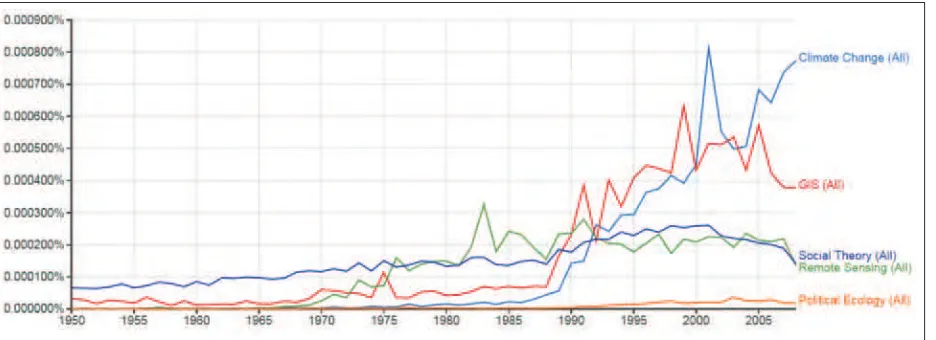
The committee reviewed ive transformative areas of geographical research that have taken shape over the past 65 years to explore how transformative research has emerged
July 2016
An ongoing challenge
lies in identifying
in the past, and to identify early indicators of transformative potential of this research. These ive examples are identiied under the broad rubrics of Political ecology, Spatial Social Theory, Remote Sensing of the environment, Geographic information Sciences (GiS), and Global Climate Change. The inventors and early innovators, sources of ideas, and stimuli responsible for the development and widespread diffusion of these transformative research areas within and beyond the geographical sciences were considered.
puttinG it toGetheR: a Recipe foR
tRansfoRmative ReseaRch
By assessing the ive case studies identiied in Box 1, the report’s authoring committee identiied factors important to the emergence and success of transformative research.
1. technology push or market pull —The impetus
for innovation has often been a technology push, where inventors recognize that a newly created technology or idea has an unrecognized, widespread need. Market pull is where an innovation is created to meet a demand.2. evolution or Revolution—The case studies outlined
in the report indicate that transformative research can arise in a rapid, revolutionary manner, or over a relatively long time period. One common element is that the innovators worked broadly beyond disciplinary constraints, were effec-tive communicators, and had persistence in advancing the transformative research agenda.3. effective modes of diffusion and
develop-ment—The diffusion and further devel op ment of research
ideas can be facilitated by face-to-face meetings and direct communication between developers and early adopters through a series of workshops, symposia, and formal research groups. Another key factor is the timely and open distribution of data upon completion of studies—this is a requirement for research supported by the national Science foundation and other U.S. government agencies.These observations led to the development of four over-arching indings:
finding 1: Transformative innovations can arise from a wide variety of individuals and groups, from a wide variety of intel-lectual sources, including older and long-ignored ideas, and through revolutionary and evolutionary paths.
finding 2: An open innovation system in academic sciences and research can encourage the exchange of information, even among competing groups, and helps to achieve the desire of the nation, funding agency, or foundation for the most rapid, productive, and eficient academic research sector.
finding 3: The promotion of rapid communication among innovators and adopters is critical for the development as well as the diffusion of transformative innovations.
finding 4: There are no established indicators that would identify speciic individuals or concepts as sources of transfor-mative innovation prior to the conduct of research.
the cuRRent context: challenGes to the
ReseaRch enteRpRise
The examples of transformative science identiied in this report developed in an era of strong federal and state investment in science, and the parallel development of America’s system of higher education. Many of today’s most challenging problems require approaches that are of a similar scale and scope, but with scarce resources and shifting priorities, funders are chal-lenged to choose between protecting existing portfolios of projects and programs, or redirecting resources toward more revolutionary problem solving. Placing the potential for transformative research in the geographical sciences into this contemporary context, the committee sees four challenges to the American research enterprise:
1. federal research and development (R&D) funding levels are likely to decline, or at least remain stable, in the near term. Competition for scarce resources will pit existing programs and institutions against revolutionary developments.
2. After three decades of growth, state-level funding for R&D has stabilized and is in decline in many states. 3. in the near term, demographics point to a
proportion-ately smaller cohort of individuals available to pursue undergraduate education. Pursuit of graduate education is responsive to levels of undergraduate debt, stagnant wages, and uncertainty over future investments in further education.
4. Developing countries are building educational systems capable of supplying the skilled labor that is required to attract R&D investments. The U.S. system of R&D and higher education now has rivals.
fosteRinG tRansfoRmative ReseaRch
today
focusing its discussion on the geographical sciences—and speciically, work funded by the nSf’s GSS program—the report’s authoring committee identiied factors that could help maximize funding investments in transformative research.
initiatives in education—The GSS program helps
prepare young geographical scientists for research careers by granting funding through programs such as the Research experience for Undergraduates and Research experience for Teachers initiatives, and makes additional types of awards in support of geographic education at all levels. While these awards often give students valuable lab and research experi-ence, the awards could do more to help foster transformative research by engendering the kinds of critical, creative, and independent thinking that such research requires.Recommendation 1: Gss should examine the degree to which its awards, especially those in support of geographic education, foster the potential for trans-formative research among the students who beneit from these awards, and encourage principal inves-tigators to give attention to such potential in their proposals.
the Research culture
—
The geographical sciences are
already a mulidisciplinary culture, in which collaboraion
across the boundaries of the tradiional disciplines is not
only common, but encouraged. In the past, transformaive
ideas have oten stemmed from such collaboraion. There
remain many ways, however, in which the diversity of the
geographical sciences could be further strengthened. For
example, women, lesbian, gay, bisexual, and transgender
individuals, and ethnic minoriies may sill be underrep
-resented, especially in certain areas of the geographical
sciences, despite the potenial for such groups to bring
new, transformaive ideas to the research table.
further, although collaboration with europe and many Commonwealth countries is common in the geographical sciences, and collaboration with researchers in China is increasing, collaboration with many other parts of the world remains adversely impacted by differences in language and research culture, problems with travel and communication, personal security, and the lack of bilateral or multilateral funding programs.
Much could be done to foster increased interaction with industry, the military, and the intelligence community. for example, exchange and internship programs could provide increased opportunities for exposure to new and potentially transformative ideas.
Recommendation 2: Gss should continue to empha-size the nsf policies and programs that are designed to increase ethnic, age, and gender diversity among its awardees.
Recommendation 3: in the interests of fostering transformative research, Gss should also recognize the importance of research collaboration among nations, among disciplines, and among academics, industry, government, and the military and intelli-gence communities.
funding practices
—The processes of proposal review are essentially conservative, and can work against projects thatFor More Information . . . The national Academies appointed the above committee of experts to address the speciic task requested by the national Science foundation. The members volunteered their time for this activity; their report is peer-reviewed and signed off by both the committee members and the national Academies of Sciences, engineering, and Medicine. This report brief was prepared by the Academies based on the committee’s report.
for more information, contact the Board on earth Sciences and Resources at (202) 334-2744 or visit http:/nationalacad-emies.org/besr. Copies of Fostering Transformative Research in the Geographical Sciences are available from the national Academies Press, 500 fifth Street, nW, Washington, D.C. 20001; (800) 624-6242; www.nap.edu.
Permission granted to reproduce this brief in its entirety with no additions or alterations. Permission for images/igures must be obtained from their original source.
Copyright 2016 by the National Academy of Sciences. All rights reserved.
Division on earth and Life Studies might offer the potential for high return, but also carry high
risk. Thus, one way to encourage transformative research might lie in a review and revision of the proposal process.
for example, nSf has modiied the rules it uses to evaluate submissions to its CReATiV program, one of the programs designed to foster transformative research, by raising the dollar limit on projects that can be approved without external review by more than an order of magnitude. Presumably this stems from the belief that external reviewers are more likely to be conservative than nSf’s own program oficers, who are likely to be invested in the foundation’s goal of supporting
transformative research. Another option could be termed “progressive funding”, in which promising ideas would irst be awarded small seed grants through a streamlined review process. if the results were promising, a subsequent proposal could be made for a second, larger phase of funding. Keeping the initial award small would reduce the risk to the agency.
Recommendation 4: in the interest of being more supportive of transformative research, Gss should work with other groups within and beyond nsf to explore and evaluate the novel approaches to research funding and proposal review discussed in the report.
committee on identifyinG tRansfoRmative ReseaRch in the GeoGRaphical sciences
michael f. Goodchild (Chair), University of California, Santa Barbara (emeritus); amy K. Glasmeier, Massachusetts institute of Technology, Cambridge; Glen m. macdonald, University of California, Los Angeles; mark d. lange (Study Director), elizabeth a. eide (Board Director), nicholas d. Rogers (Financial and Research Associate), eric J. edkin (Senior Program Assistant), national Academies of Sciences, engineering, and Medicine
References
Congressional Budget Ofice (CBO). 2014. Federal Policies and Innovation. Washington, DC: CBO.