1 2 3
Research Institute of Fiber Producing Forest, FORDA, Jl. Raya Bangkinang-Kuok km 9 Kampar Riau. Corresponding Author: [email protected]
Forest Microbiology Laboratory, Forest Conservation and Rehabilitation Research and Development Center, Jl. Gunung Batu No. 5, Bogor, 16610
TREES
Eka Novriyanti and Erdy Santosa
Agarwood, the wood of the God, has high appreciation due to its multiuse and high economic value. It is actually, a resinous matter accumulated in the wood tissue as the corresponding trees respond to pathogen attack or environmental stress (BSN, 1999; Barden 2000). This exalted commodity is yielded from some tropical trees of family, whereas two of its most sought genera, and , have been listed in Appendix II CITES due to the declination of the natural resources (CITES, 2004).
1,2 3
ABSTRACT
I. INTRODUCTION
Phenolic is well known as a secondary metabolite that plays an important role in plant defense system. Information about the fungi-impeded role of secondary metabolite is important in achieving success of artificial agarwood production, in that fungi induction imparted to the selected potential trees will be more effective and efficient. This research was aimed to investigate the correlation of agarwood tree phenolics in relation with the susceptibility of corresponding trees to attack in the formation of agarwood and observing total phenolics
content of and trees prior to inoculation. Twenty trees of
at Carita, a Forest Area for Special Function (FASF) and ten of at Dramaga Research Forest were inoculated with isolate of in spiral pattern around their stem from ground level to about 1.5 m in height. Prior to inoculation, wood strips were taken off from the stem for total phenolics content. The result revealed that total phenolics content and infection area tended to have a negative correlation. Since the quantity of agarwood is highly related with the infection area, then trees with lower phenolics content should be selected for the more effective and efficient artificial agarwood production.
Agarwood formation is poorly understood, even in their natural habitat. However, it is assumed that the formation is triggered when the plants are under stress because of environmental condition or pathogen attack. Thus, the formation process of agarwood in the stem is considered as chemically plant defense mechanisms against unfavorable condition. Therefore, when artificial agarwood is believed as a promising effort to offset the lack of wild stock (Barden , 2000; Akter and Neelim 2008; Subiakto ., 2011), it is essential to study the chemical defense of the plant so that treatment given to the selected potential trees will be more effective and efficient. Moreover, knowledge of agarwood tree's chemical defense system is important in achieving success of artificial agarwood production.
Phenolics is an organic compound characterized by hydroxyl group (-OH) that are bounded to benzene or other complex-aromatic rings (Lattanzio ., 2006; Bhattacharya ., 2010). Phenolics are hydrophilic compound that includes stilbene, lignan, hydrolysable tannin, condensed tannin, and flavanoids in this compound group (Sjostrom, 1995). These phenolics are believed for their role in plant defense system. Those compounds typify plants secondary metabolites that are abundantly existed in plants, including enormous groups of bioactive content (Marinova , 2005). Some studies have defined phenolics as anti-fungal compound. Carboxylic acid and furan derivates (Xiros , 2010), vanillic and caffeic acid (Samapundo , 2007), also cinnamic acid (Ponts ., 2011) are among phenolic acids that were reported to be capable in inhibiting the growth of spp. Phenolics containing compound such as eusiderin, a neo lignan that was extracted from ulin wood (
) (Syafii , 1985) and angolensin from wood is toxic to and wood rot fungi (Pilotti ., 1995). Shieh and Sumimoto (1992) isolated some cedrol compounds from wood of
that had anti fungal activity. Meanwhile, lignan, a product of oxidative reaction of polyphenol by - linkage, was reported to have inhibitory effect on fungal growth (Céspedes ., 2006; Cho ., 2007). In many cases, total phenol content was identified for its effect on plant resistance against disease. Total phenol is increasing at infected cell, indicating that phenol is synthesized during infection or being transported from surrounding tissues (Vidhyasekaran, 2000).
Agarwood is denoted as phytoalexin compounds of the producing-tree. The agarwood resin is considered as plant secondary metabolite produced as its responses to infection or stress. The healthy tree never produced the exalted scent secondary metabolite that could only be found in under stressed one (Yuan ., 1992; Isnaini, 2004).
This paper presented a study on a relation of phenolics content in agarwood-producing trees with the agarwood formation that was artificially induced by
fungus. It was assumed that lower phenolics content would give larger infection et al.
zwageri et al. Pterocarpus indicus
Coriolus versicolor Tyromyces polutris et al
produced. The objectives of this study were to investigate the pre-inoculation total phenolics content of and that were represented by wood strips; and the correlation of total phenolics content with the susceptibility of and
in the agarwood formation.
The samples consisted of ten trees in Dramaga Research Forest and twenty trees of at Forest Area for Special Function (FASF), Carita. The trees were about 10 years old (1998 plantation). Juice inoculants of were obtained from Laboratory of Forest Microbiology at the Forest Conservation and Rehabilitation Research and Development Center, Bogor.
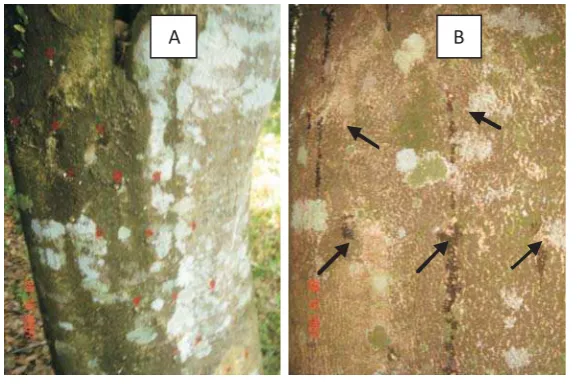
Inoculation was deployed in a spiral pattern at stem area extending from the ground level to 1.5 m in height, wood strips were taken from that area representing pre-inoculation total phenolics condition (Figure 1). Those samples comprised of wood strips with dimension of 3 x 3 cm, which was further transformed into wood mills that passed through 40 mesh but retained on 60 mesh.
A. crassna A. microcarpa
A. crassna A. microcarpa
A. crassna A. microcarpa
F. solani II. MATERIALS AND METHODS
A. Pre-Inoculation Sampling
A B
Figure 1. Inoculation pattern on the stem of agarwood trees
B. Analysis of Total Phenolics in Pre-Inoculated Wood Mill
C. Inoculation Procedure
D. Observation and Data Collection
III. RESULTS AND DISCUSSION
There were about 30 groups of the collected wood mills, which corresponded to 30 samples (20 from and 10 from ). Each of these groups was weighed as much as 1 gram, further extracted by 10 ml of 70% acetone. The extract solution was then added with 0.5 ml folin ciocalteau reagent 1 N and 2.5 ml solution of 20% Na CO . After 15 minutes, the determination of total phenolics content of this solution was carried out using spectrophotometer (Shimadzu, Japan) at UV-visible wavelength ( ) of 725 nm. Total phenolics content is expressed as ppm of tannic acid. This method is a modified method of those stated originally by Asami (2003), where Tannic acid was used as standard instead of Gallic acid.
Sample trees were inoculated with to induce agarwood formation. The agarwood, which was represented by infection area, was then compared to the phenolics content of the pre-inoculated wood strips. Inoculation was deployed in three spiral patterns around the stem each containing 15 injection holes, thus there were 45 injection holes per tree (Figure 1).
Parameter for assessing susceptibility of the trees is infection area. Beside the pre-inoculation time (H0), there were three consecutive observation times: three days after inoculation (H3); two months after inoculation (B2); and six months after inoculation (B6).
Total phenolics content varied for each sample tree, the lowest is 0.06% (w/w) and the highest is 0.23% (w/w) (Figure 2). The average of total phenolics content for each location revealed that the value was significantly higher for trees at Dramaga than for those at Carita, which were 0.18% (w/w) and 0.15% (w/w), respectively.
A. microcarpa A. crassna
et al.
F. solani
2 3
Figure 2. Total phenolics content of pre-inoculated agarwood trees as measured using folin ciocalteu method
Notes: CP: trees at Carita (i = 1, 2, 3,…, 20); DP: trees at Dramaga (j = 1, 2,
3,…, 10)
A. Microcarpa A. crassna
Infection
Tree no. Total Phenolics
(%, w/w) Length (mm) Width (mm) Extent (mm2)
A. microcarpa
CP15 0.06 27.5 10.5 188.0
CP14 0.08 50.0 15.0 490.0
CP13 0.11 32.0 10.0 263.0
CP6 0.12 68.0 11.0 498.0
CP3 0.12 33.5 10.0 230.0
CP7 0.12 41.5 12.5 331.0
CP19 0.13 25.0 8.0 124.0
CP16 0.13 26.5 10.8 168.5
CP5 0.14 59.0 20.5 712.0
CP17 0.15 35.0 9.0 212.0
CP9 0.16 41.5 13.5 382.0
CP2 0.16 44.0 11.0 302.0
CP4 0.16 46.0 21.5 609.0
CP8 0.17 21.0 9.5 152.0
CP10 0.17 40.0 10.0 250.0
CP20 0.17 29.0 10.0 171.0
CP12 0.19 32.0 11.0 226.0
CP1 0.22 36.0 10.5 245.0
CP18 0.22 36.0 10.3 221.0
CP11 0.23 44.0 9.0 254.0
Average 0.15 38.4 11.7 301.4
A. crassna
DP4 0.13 49.5 8.0 194.5
DP10 0.14 22.0 4.5 47.5
DP3 0.16 27.0 7.0 113.0
DP9 0.17 24.5 6.0 80.5
DP8 0.17 36.5 6.5 148.0
DP5 0.19 43.8 7.8 167.5
DP6 0.19 25.0 6.3 103.5
DP1 0.21 39.8 10.5 273.5
DP2 0.21 43.5 10.5 207.5
DP7 0.23 31.5 5.5 107.0
Average 0.18** 34.3ns 7.3** 144.3**
Table 1. Total phenolics content of pre-inoculated agarwood trees and infection area of the corresponding species after six months inoculation withF. solani
Notes: Trees were ordered based on the total phenolics content; CP: code for tress at Carita region, species of ; DP: code for trees at Dramaga region, species of . * denotes that the value is significantly higher than the opposite treatment (***: p<0.001, **: p<0.05, *: p<0.10); 'ns' means that the value is not significantly different from the opposite treatment, analyzed by Two-tailed T-Test.
A.
In average, the tree infection area at Carita was bigger than that at Dramaga, whereas the total phenolics content at former location was significantly lower than that at the later (Table 1). This fact confirmed the former assumption that the lower the phenolics content, the more susceptible the tree to the attack by , hence the bigger the necrosis.
Total phenolics content and infection area that represent tree susceptibility were plotted into two-dimensional graph in order to assess the tendency of their relation. Total phenolics content and infection area had a tendency of negative correlation (Figure 3) which was indicated by the higher the phenolics content the smaller the infection area tended to be. This result is concomitant with the study by Del Río (2003) that reported the greater inhibition against sp. related with the higher total phenolics content of the extract. The coefficient of determination was quite low (R = 0.115) which designated the weak correlation between the two variables. This weak correlation suggested there are another factors beside the phenolics content that had bigger effect to the infection area of the tree.
F. solani
et al. Phytophthora
2
Figure 3. Correlation tendency of total phenolics content and infection area of agarwood trees at Carita and Dramaga, induced by fungi
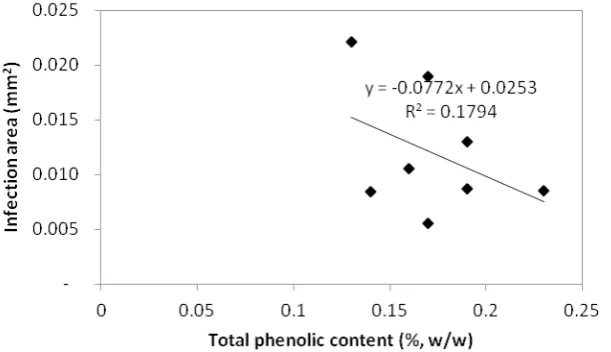
Negative correlation tendency was also shown when sample trees are distinctly differentiated into research locations/tree species (Figures 4 and 5). Whether it was
at Dramaga or at Carita, both species showed a tendency of negative correlation between total phenolics content and infection area. Weak correlations also shown at both Carita and Dramaga, coefficient of determination (R ) were 0.313 and 0.179, respectively.
F. solani
A.
crassna A. microcarpa
Figure 4. Correlation between total phenolics content and infection area of stem at Carita
A. microcarpa
Figure 5. Correlation between total phenolics content and infection area of stem at Dramaga
A. crassna
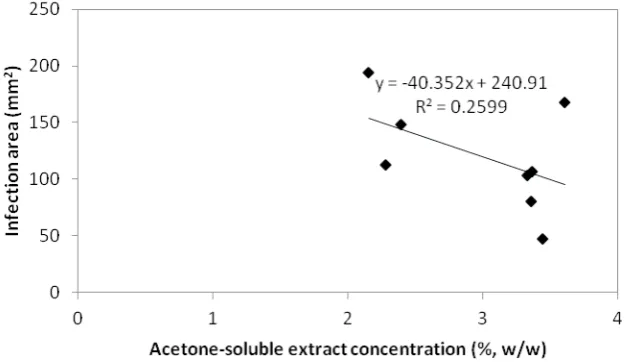
caused by (Figure 6). Although the correlation was weak (R = 0.259), the negative correlation indicated that smaller infection occurred if the tree had higher extractives content. However, the weak correlation pointed that the single effect of secondary metabolites, such as extractives and phenolics content to the infection area was weak.
F. solani 2
Figure 6. Correlation of acetone soluble extracts concentration of and infection area induced by
Agarwood is resulted from the tree defense mechanism. However, plants defense is determined by various factors. Haukioja (2003) stated that various mechanisms involved in creating birch defense, tree species that grow in temperate zones. Therefore, a weak correlation between single factors such as total phenolics content with the infection area of the agarwood tree is possible to observe, since the infection was resulted from various mechanism that work altogether.
We assumed that the tree's defense of these agarwood producing-species is triggered by attack. However the formation of necrosis area is not affected by only a single factor of secondary metabolite content, as observed moderately weak correlation between plant's total phenolics content with the infection area. Plant defense is affected by three components, the resistance of the host plant, the virulence of the pathogen or the intensity of the attack and the environmental factors ( . humidity, rainfall, air temperature, soil type and fertility, nutrient status, other surrounding plants, etc.) (Agrios, 1997; Turjaman and Santosa, 2011). Therefore, in order to attain achievement in agarwood formation, the secondary metabolite cannot be considered separately with other factors, such as microclimate, site quality, inducer agent and genetic of both host plant and inducer agent. In other word, instead of resulted from a
A. crassna F. solani
F. solani
single factor, some factors would work altogether in creating successful agarwood formation.
Plants have great abilities in synthesizing aromatic substances, mostly are phenol or its oxygen-substituted derivates (Cowan, 1999). Those substances are secondary metabolites that are frequently active as defense mechanism against microorganism, insects, or herbivore predation. Trees will exert a response to the pressure, like a bad environment, disease invasion and herbivore predation with defense system such as secondary metabolite compounds. The strain sustained at resistant tree will cause higher concentration of defense compounds to be synthesized, whereby the greater the strain intensity the higher the concentration of synthesized compounds. In contrary, those synthesized defense compounds will be less in concentration or not even traced when less-resistant tree suffers harsh condition, because defense compounds synthesized by susceptible tree are not satisfactorily enough in retarding the damage caused by the unfavorable condition (Cowan, 1999).
The total phenolics content of the plant plays a considerable role in the agarwood formation, although it may work more pronouncedly in a system with other various factors rather than only in a single factor. The lower total phenolics content in the tree could result in the larger area of the infection, which means that the larger quantity of agarwood could be yielded or artificially induced.
The finding further suggested considering to select trees with relatively lower total phenolics content in order to acquire more intensive artificial agarwood inducement by using fungi. Trees with relatively lower phenolics content are assumed more susceptible to the agarwood formation. However, since the agarwood formation must be resulted from various aspects, then another factors should be also included in the account.
The authors would like to thank the Ministry of Forestry, Government of Indonesia, Laboratory of Forest Microbiology of Forest Conservation and Rehabilitation Research and Development Center and the ITTO Project PD 425/06 Rev.1 (I) for funding the research. Further, the authors full gratitude to M. Turjaman, PhD., Dr. I.R. Sitepu, Prof. W. Syafii, Dr. G. Pari and Prof. S. Achmadi for their valuable help and discussions. After all, appreciation is also presented to all staffs of the Laboratory of Forest Microbiology, especially Mr. Najmulah and Mr. Aryanto for IV. CONCLUSION
REFERENCES
Agrios, G.N. 1997. Plant Pathology. Fourth Edition.Academic Press, California. Akter, N. and A.Z. Neelim. 2008. Agarwood plantation at BRAC Tea Estate:
introduction, environmental factors and financial analysis. BRAC Research Report, July 2008, Dhaka, Bangladesh.
Asami, D.K., Y.J. Hong, D.M. Barrett and A.E. Mitchell. 2003. Comparison of the total phenolics and ascorbic acid content of freeze-dried and air-dried marionberry, strawberry, and corn grown using conventional, organic, and sustainable agricultural practices. Journal of Agricultural. And Food Chemistry 51: 1237-1241.
Badan Standarisasi Nasional [BSN]. 1999. SNI 01-5009.1-1999: . Jakarta.
Barden, A., N.A. Anak, T. Mulliken and M. Song. 2000. Heart of the matter: agarwood
use and trade and CITES implementation for .
www.traffic.org. Downloaded at 22 of May 2007.
Bhattacharya, A., P. Sood and V. Citovski. 2010. The roles of plant phenolics in defence
and communication during and infection. Molecular
Plant Pathology 11 (5): 705-719.
Céspedes, C.L., J.G. Avila, A.M. García, J. Becerra, C. Flores, P. Aqueveque, M. Bittner, M. Hoenesen, M. Martinez and M. Silva. 2006. Antifungal and antibacterial activities of (Mol.) K. Koch heartwood lignans. Naturforsch 61c: 35-43.
Cho, J.Y., G.J. Choi, S.W. Son, K.S. Jang, H.K. Lim, S.O. Lee, N.D. Sung, K.Y. Cho and J-C. Kim. 2007. Isolation and antifungal activity of lignans from
against various plant pathogenic fungi. Pest Management Science 69: 935-940.
Convention on International Trade in Endangered Species of Wild Fauna and flora [CITES]. 2004. Amendments to Appendices I and II of CITES. http://www.cites.org/common/cop/13/raw/props/ID-Aguilaria-Gyrinops.pdf.
Cowan, M. 1999. Plant products as antimicrobial agents. 12 (4): 564 582.
Del Río, J.A., A.G. Báidez, J.M. Botía and A. Ortuño. 2003. Enhancement of phenolic compounds in olive plants ( L.) and their influence onresistance against . Food Chemistry 83: 75-78.
Forestry Commission GIFNFC. 2007. Chemicals from trees. http://treechemicals. csl.gov.uk/review/extraction.cfm. Downloaded at 14 of July 2007.
Hakkioja, E. 2003. How do birch defense operate. Proceeding IUFRO on orest insect population dynamic and host influences. Kanazawa, Japan. Pp. 26-30.
Isnaini, Y. 2004. Induction of gubal agarwood production through fungi inoculation and biotic factor application (Dissertation). Graduate School of Institut Pertanian Bogor, Bogor. Unpublished.
Lattanzio, V., V.M.T. Lattanzio and A. Cardinali. 2006. Role of phenolics in the resistance mechanism of plants against fungal pathogens and insect. Phytochemistry Advances in Research: 23-67.
Marinova, D., F. Ribarova and M. Atanassova. 2005. Total phenolics and total flavanoids in Bulgarian fruits and vegetables. Journal of the University of Chemical Technology and Metallurgy 40 (3): 255-260.
Pilotti, C.A., R. Kondo, K. Shimidzu and K. Sakai. 1995. An examination of the anti fungal component in the heartwood extracts of . Journal of the Japan Wood Research Society 4 (6): 593-597.
Ponts, N., L. Pinson-Gadais, A-L. Boutigny, C. Barreau and F. Richard-Forget. 2011. Cinnamic-derived acids significantly affect growth and in vitro synthesis of type B trichothecenes. Phytopathology 101: 929-934.
Samapundo, S., B. De Meulenae, D. Osei-Nimoh, Y. Lamboni, J. Debevere and F. Devlieghere. 2007. Can phenolic compounds be used for the protection of corn from fungal invasion and mycotoxin contamination during storage? Food microbial 24: 465-473.
Shieh, J.C. and M. Shimamoto. 1992. Antifungal wood component of . Journal of the Japan Wood Research Society 38 (5): 482-489.
Sjostrom E. 1995. Wood Chemistry, basic and utilization. Second Edition. : Sastrohamidjojo, H. (Translator). Prawirohatmodjo, S. (Ed.). Gadjah Mada University Press, Yogyakarta.
Subiakto, A., A. Santoso and M. Turjaman. 2011. Financial analysis on gaharu (eaglewood) plantation. : Turjaman, M. (Ed.): Bioinduction Technology, for sustainable development and conservation of gaharu. Proceeding of Gaharu Workshop, Bogor, Indonesia. Pp. 59-66.
Syafii, W., T. Yoshimoto and M. Samijima. 1985. Neolignan from the heartwood of
Turjaman, M. and E. Santosa. 2011. Teknologi inokulasi dan perkembangannya untuk menghasilkan gubal gaharu berkualitas tinggi.
Vidhyasekaran, P. 2000. Physiology of Disease Resistant in Plant. CRC Press Inc., Florida.
Xiros, C., C. Vafiadi, T. Pachos and P. Christakopoulos. 2011. Toxicity tolerance of toward inhibitory compounds formed during pretreatment of lignocellulosic materials. Journal of Chemical Technology and Biotechnology 86: 223 230.
Yuan, Q.S., L. Bi-Yao and Z. Liang-Feng. 1992. Formation of oxo-agarospirol in . Plant Physiology Communications 28 (5): 336-339.
Http:// gaharublog.files.wordpress.com/2011/05/2-inokulasi-gaharu.pdf. Downloaded at December 21 2011.st
Fusarium oxysporum