Universal
Social
Protection
Country Cases
Global Partnership for Universal Social Protection
USP2030
Universal Social Protection
World Bank
Internaional Labour Oice
African Union | EU-OECD-Finland Social Protecion Systems Programme | Experise France | Food and Agriculture Organisaion (FAO) | German Development Cooperaion | Help Age Internaional | Internaional Policy
Center for Inclusive Growth UNDP | Inter-american Development Bank | Internaional Council of Social Welfare (ICSW) | Save the Children |
ISBN 978-92-2-131572-8 print ISBN 978-92-2-131573-5 web pdf
Introducion 1
Argenina
Universal social protecion for children and adolescents 5
Argenina
Universal maternity protecion 11
Azerbaijan
Universal Pensions 17
Bolivia
Universal Pensions 27
Botswana
Universal old-age pensions 33
Brazil
Universal old-age pensions 39
Cabo Verde
Universal Pensions 47
China
Universal Pensions 53
Georgia
Universal old-age pensions 59
Kosovo
Universal old-age pensions 64
Lesotho
Universal pensions 70
Maldives
Universal old-age pensions 76
Mongolia
The Universal Child Money Programme 81
Mongolia
Universal old-age pensions 89
Namibia
The Basic Social Grant for all older persons 95
Nepal
Universal old-age and disability pensions, and other universal allowances 103
South Africa
Universal disability grants 110
South Africa
Universal pensions 115
Thailand
Universal Pensions 121
Timor-Leste
Universal old-age and disability pensions 126
Trinidad and Tobago
Universal Pensions 134
Ukraine
Universal old-age, disability and survivors pensions 146
Zanzibar
The universal Pension Scheme 156
Developmental impacts of expanding social protecion 163
Sub-Saharan Africa: Economic and producive impacts of naional cash
transfers programmes 173
Financing universal social protecion 182
Introducion
Transforming our World: The 2030 Agenda for Sustainable Development, was
adopted by Heads of State and Governments in September 2015 as a plan of acion for people, planet and prosperity that calls for eradicaing poverty. All countries and all stakeholders, acing in collaboraive partnership, are called to implement this plan.
Sustainable Development Goal 1 (SDG1) calls for ending poverty in all its forms and dimensions, including eradicaing extreme poverty by 2030. It aims
to ensure that all people enjoy a basic standard of living, including through social protecion systems. Countries are called to ensure social protecion systems for all, including loors for the poor and vulnerable, increase access to basic services, and support people harmed by climate-related extreme events and other economic, social, and environmental shocks and disasters. Target 1.3 (Goal 1) seeks to implement naionally appropriate social protecion systems
and measures for all, including loors, and by 2030 achieve substanial coverage of the poor and the vulnerable.
The Global Partnership for Universal Social Protecion (USP2030) was established to support this objecive. The USP 2030 was launched in September 2016 at the ime of the UN General Assembly, by the Internaional Labor Organizaion (ILO) and the World Bank Group (WBG) in partnership with the African Union, the Food and Agriculture Organizaion (FAO), the European Commission, the Inter-American Development Bank (IDB), Organizaion of Economic Cooperaion and Development (OECD), the United Naional Development Programme (UNDP) and its Internaional Poverty Centre for Inclusive Growth (IPC-IG), the United Naions Children’s Fund (UNICEF) and others, along with Belgian, Finnish, French and German development cooperaion, and internaional civil society organizaions such as HelpAge, the Internaional Council of Social Welfare (ICSW), Save the Children, among others.
Introducion
The objecive of USP2030 is to increase the number of countries that can provide universal social protecion, supporing countries to design and implement universal and sustainable social protecion systems, joining eforts of the internaional agencies, donors, and governments in providing
social protecion coverage for all people. Universal coverage and access to
social protecion are central to ending poverty and boosing shared prosperity, the World Bank’s twin goals by 2030. Universal social protecion coverage is at the core of the ILO’s mandate, guided by ILO social security standards including the Social Protecion Floors Recommendaion No. 202, adopted by 185 Member states in 2012. Many countries have embarked in expanding social protecion coverage and are reporing signiicant progress. However, the poorest countries coninue to have enormous coverage gaps. The ILO’s “World Social Protecion Report 2017-19 on Universal Social Protecion to Achieve the Sustainable Development Goals” indicates that despite signiicant progress in the extension of social protecion in many parts of the world, only 45 percent of the global populaion are efecively covered by at least one social protecion beneit, while the remaining 55 percent – as many as 4 billion people – are let unprotected.
Universal social protecion refers to the integrated set of policies and programs designed to provide income security and support to all people across the life cycle, with paricular atenion to the poor and the vulnerable. Universal social protecion includes adequate cash transfers for all who need it, especially: children; beneits/support for people of working age in case of maternity, disability, work injury or for those without jobs; and pensions for all older persons. This protecion can be provided through social insurance, tax-funded social assistance/safety nets beneits, public works programmes and other schemes guaranteeing basic income security. Social protecion programs aim at speciic demographic groups of the populaion (e.g., children, persons with disabiliies, women and men of the working age, older persons, etc.) and at households in chronic or transient (for instance, caused by shock such as a natural disaster) poverty. The objecive of the social protecion programmes is oten not only to provide income support, but also to build up resilience to shocks and enhance connecions to producive aciviies.
Introducion
and reduces poverty, promotes social inclusion and dignity of vulnerable populaions; (ii) it contributes to economic growth through increases in consumpion, savings and investment at the household level and macro level; (iii) it promotes human development and formalizaion; (iv) it increases producivity and employability by enhancing human capital and producive assets; (v) it protects individuals and families against the losses due to shocks, whether they be pandemics, natural disasters, or economic downturns; (vi) it builds poliical stability and social peace, reducing inequaliies, social tensions and violent conlict; enhancing social cohesion and paricipaion; (vii) it is a human right that everyone, as a member of society, should enjoy, including children, mothers, persons with disabiliies, workers, older persons, migrants, indigenous peoples and minoriies.
Countries have many opions/pathways to achieve universal social protecion coverage. USP2030 partners will work with countries to help advance the
Introducion
Countries have used many opions to inance universal social protecion.
Those opions include: (i) re-allocaing public expenditures (e.g., from inancing public subsidies to inancing speciic programs); (ii) increasing tax revenues, including revenue generated from taxaion of natural resources; (iii) using the reducions of debt or debt servicing; (iv) expanding social security coverage and contributory revenues, among other inancing opions. Regardless of inancing mechanisms and sources, universal social protecion systems should be equitable and sustainable.
This publicaion presents country examples that document diferent pathways to achieve universal social protecion coverage. These country cases encompass a wide range of programs, country seings and regions, including Sub-Saharan Africa (Botswana, Cabo Verde, Lesotho, Namibia, South Africa and Zanzibar), Europe and Central Asia (Azerbaijan, Georgia, Kosovo and Ukraine), Lain America and Caribbean (Argenina, Bolivia, Brazil and Trinidad and Tobago), East Asia and Paciic (China, Mongolia, Thailand and Timor-Leste), and South Asia Region (Maldives, Nepal). As all these case studies indicate, there is no “one size its all” in achieving universal social protecion objecives. Every country has its own vision and path for achieving it, depending on the country prioriies, inancing and implementaion capacity.
Argenina
Universal social protecion
for children and adolescents
In 2009, the Universal Child Allowance (UCA) was introduced in response to the efects of the global crisis, and with the aim of consolidaing sev-eral non-contributory transfer pro-grammes for families with children. This non-contributory cash transfer programme expanded coverage to children under age 18 (and disabled children without any age limit), as well as to unemployed workers, infor-mal workers, domesic workers and
monotribuistas (Monotribuistas are
mainly low-income, self-employed workers paricipaing in the Simpliied Regime for Small-scale Contributors, known as the Monotributo. This is a
simpliied, integrated tax system that rolls income, value-added and social security taxes into a single monthly payment).
The provision of income insurance for families with children and adolescents is made up of three components: contributory family allowances (CFA), non-contributory family allowances and tax deducions from income (tax on earnings) for higher-income workers with children.
Main lessons learned
• The integraion of the contributory and non-contributory components is a strategy to guarantee the consolidaion of “comprehensive social security systems” and to ensure the universal protecion of children and adolescents, in accordance with the provisions of ILO Social Protecion Floors Recommendaion, 2012 (No. 202) and the Convenion on the Rights of the Child.
• The introducion of the UCA has enabled the development of a system to support the income of families with children, according to the employment status of the adults responsible for the children and adolescents and the income earned. The system has three components: contributory component, non-contributory component and tax deducions for higher-income workers.
Argenina: Universal social protecion for children and adolescents
per cent).
In legal terms, the UCA was created through a Decree of the Naional Execuive Branch (1.602/09), which modiied the Law of Family Allowances (N° 24.714).
This decree established the incorpo-raion of a non-contributory sub-sys-tem within the General Family Allow-ance Regime. In other words, both types of beneits are now regulated by this Law.
2. Structure and main
characterisics of protecion of
children and adolescents
As menioned, the provision of income security for children and adolescents in Argenina has three components:
• Contributory family allowances (CFA), composed of the “Family
Child Allowance,” which covers the dependents of formal middle- and
Coverage data
Together, these three components reach approximately 83 per cent of children and adolescents in Argenina. In absolute terms, some 10.3 million children and adolescents are covered by an income transfer mechanism.
1. Background
Since the late 1990s, several iniiaives have been introduced to provide income security for households with children. During the 2000s, social assistance programmes used the presence of children in the household as a reference, and programmes for the social protecion of children were even implemented at the sub-naional level. The UCA was introduced in Argenina as a result of years of intense discussion on proposals designed to universalize protecion of children and adolescents. One of the most noteworthy proposals was the extension of family allowances. The almost universal coverage achieved is due to several factors, most notably the implementaion of the UCA, the increase in formal employment that expanded contributory coverage levels and the incorporaion of monotribuistas in the CFA component (April 2016).
Also of note is the extension of non-contributory pensions to mothers of seven or more children, which provides income security to large families (between 2003 and 2014, the number of main beneiciaries increased by 471
Figure 1: Overview of social protecion
Argenina: Universal social protecion for children and adolescents
and UCA beneiciaries receive the same amount ($ 966). In 2015, the automaic mobility of beneits (twice annually) based on the pension mobility index was established by law. The Naional Social Security Admin-istraion (ANSES) is responsible for managing both contributory and non-contributory family allowances. In other words, the ANSES receives applicaions, processes and evaluates them and pays both beneits).
The integraion of the contributory and non-contributory components (CFA and UCA) pave the way for the consolidaion of a “comprehensive social security system” as established in the ILO Social Protecion Floors Recommendaion, 2012 (No. 202). Nearly six years ater the UCA was implemented, evidence indicates that these social protecion programmes of high coverage do not have a negaive impact on labor market variables. This posiive result is largely due to the coordinaion among programmes that guarantee income and to acive labour market policies.
Several factors explain the fact that 17 per cent of children and adolescents are not covered under any scheme. This group mainly includes children and adolescents whose parents: i) are employees with higher earnings – or slightly lower earnings – than the established ceilings; ii) they are higher-income monotribuistas; iii) they are independent workers; or iv) they are immigrants residing in the country for less than three years. The situaion of low-income employees, beneiciaries
of certain social security guarantees (unemployment and work injury) and, since April 2016, dependents of workers of the Monotributo regime.
• Non-contributory family allow-ances, composed of the Universal
Child Allowance (UCA), which is a semi-condiional cash transfer for each child and disabled child of un-employed workers, those of the in-formal economy, social monotribui -stas and domesic workers.
The cash transfer is semi-condiion-al: the 80 per cent is granted through the usual system of social security payments while the remaining 20 per cent is paid once the main beneiciary conirms health checkups, immuniza-ion records and ceriicaimmuniza-ion of com-pleion of the school year of children and adolescents, whichever is the case.
The UCA is a component of the non-contributory pillar, together with family allowances for dependents of beneiciaries of old-age pensions and of beneiciaries of certain non-con-tributory pensions (disability and for-mer soldiers in the Falklands War).
• Deducion or tax credit for each child, for higher-income workers
who pay income tax. The tax credit is the component available to higher-income workers who pay individual income tax.
Argenina: Universal social protecion for children and adolescents
poverty and inequality. Studies (Bertranou, 2010; Maurizio and Vázquez, 2014) have shown that UCA reduced poverty rates, especially extreme poverty. There is also empirical evidence that suggests that the UCA contributes to improved income distribuion, as measured both by the Gini coeicient and in terms of income gaps (Hintze and Costa, 2014 and Curcio and Beccaria, 2013). Addiionally, some studies found that the UCA had a posiive impact on school atendance of adolescents aged 16 and 17 (the group with the highest dropout rates) as well as on reducing child labour (Jiménez and Jiménez, 2015). Nevertheless, given the lack of available standardized data, more evidence is needed on the impact of this programme on school atendance, paricularly with respect to secondary school.
The implementaion of this policy also led to a 50 per cent increase in the number of children enrolled in the SUMAR Plan – guaranteed health beneits – and a 14 per cent increase in the number of pregnant women enrolled (MSAL, 2012).
5. What are the challenges?
The main challenges for policies to guarantee income security for children and adolescents can be summarized as follows:
• Despite eforts to increase UCA
coverage, the challenge remains children and adolescents not under
family care should also be menioned given that they are not included in any of the current protecion components. Moreover, there are children and adolescents who are eligible for one of the established schemes but who do not receive beneits for a variety of reasons, especially: problems associated with family relaions; problems associated with their or their parents’ ideniicaion documents; and non-compliance with some requirements for access.
3. Financing
The contributory component is inanced through employers’ contribuions to social security while social security resources cover the cost of the UCA.
As a result of the expanded coverage, the resources allocated to cash transfers for children and adolescents have been sharply increased. In 2014, the amount allocated to the protecion of this segment of the populaion was 1.04 per cent of GDP, where the principal components were the UCA (0.50%), the CFA (0.46%) and the family allowances for people receiving an old age pension (0.08%).
4. What is the impact of
the UCA?
Argenina: Universal social protecion for children and adolescents
Bertranou, F. (coord.) 2010. Aportes para un piso de protección social en Argenina: el caso de las asignaciones familiares. Buenos Aires, ILO Country Oice for Argenina.
Bertranou, F., Casalí, P. and Schwarzer, H., 2014. La estrategia de desarrollo de los sistemas de seguridad social de la OIT. El papel de los pisos de protección social en América Laina y el Caribe. ILO Regional Oice for Lain America and the Caribbean, Lima.
Bertranou, F., Cetrángolo, O., Casanova, L., Beccaria, A and Folgar, J. 2015. Desempeño y Financiamiento de la Protección Social en Argenina. Buenos Aires, ILO Country Oice for Argenina.
Casalí, P. and Schwarzer, H., 2010. Social Protecion Floor: Conceptual Development and Applicaion in Lain America. 2010 Labour Overview. ILO Regional Oice for Lain America and the Caribbean, Lima.
Curcio, J. and Beccaria, A. 2013. Políicas de protección social y su impacto en la situación de la niñez y de sus familias. El caso de la Asignación Universal por Hijo para Protección Social a tres años de su implementación, XI
Naional Poliical Science Congress, Paraná.
Hintze, S. and Costa, M. 2014. “Capacidad protectoria de la Asignación Universal por Hijo para Protección Social: problemas y debates a cuatro años de su implementación,” in Danani, C. and Hintze, S. (Coords.) Protecciones y desprotecciones II: Problemas y debates de la seguridad social en la Argenina. Buenos Aires, Universidad Nacional de General Sarmiento.
to incorporate a large number of eligible children and adolescents who for diferent reasons face barriers to accessing the beneits.
• The role of established condiions
needs to be redeined to emphasize the concept of the “universal right” of children and adolescents to health and educaion.
• The suiciency of UCA beneits
should be assessed in an efort to enable children and adolescents to get out of poverty.
• A micro-assessment of the UCA
should be conducted to idenify botlenecks and propose reforms that help facilitate programme implementaion and compliance with established condiions.
This Universal Social Protection brief was produced by Alejandra Beccaria, Luis Casanova and Pablo Casalí of the ILO, with contribuions from Sebasián Waisgrais and Javier Curcio of UNICEF. It was reviewed by Isabel Oriz of the ILO.
References
Arcidiácono, P., Carmona Barrenechea, V. and Straschnoy, M. 2011 “La asignación universal por hijo para protección social: rupturas y coninuidades ¿Hacia un esquema universal?,”
Argenina: Universal social protecion for children and adolescents
Argenina
Universal maternity
protecion
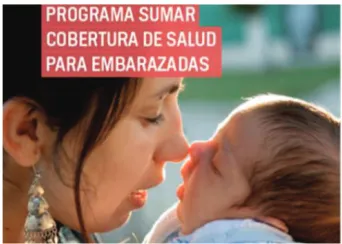
Argenina’s Consituion provides for the protecion of pregnant and lactat-ing female workers. Social protecion in the case of maternity includes mater-nity protecion in the workplace, con-tributory and non-concon-tributory family allowances and pensions for mothers with 7 or more children. In addiion, several programmes provide universal access to basic social services such as the programme SUMAR which ofers basic health services including ante-natal and postante-natal consultaions and delivery. The naional legal framework also provides paid and unpaid mater-nity leave and paid patermater-nity leave for registered workers.
1. Towards universal maternity
protecion
Maternity protecion in Argenina en-compasses both transfers in cash and in kind. It includes income security measures through a number of social transfer programmes, universal ac-cess to basic social services and provi-sions for maternity leave. Argenina’s maternity protecion policy is in line with the Social Protecion Floors Rec-ommendaion, 2012 (No.202).
Main lessons learned
• In line with ILO’s Recommenda-ion No. 202, maternity protec-ion in Argenina encompasses both transfers in cash and in kind. It includes income security meas-ures through a number of social transfer programmes, universal access to basic social services and provisions for maternity leave. Universal maternity protecion in Argenina had impressive results, child and maternal mortality have been reduced by 34 per cent and 24 per cent respecively.
• The contributory and non-contributory programmes are administered by the Naional Social Security Administraion (ANSES); complementary health programmes are operated or regulated by the Naional Health Ministry; good coordinaion among insituions is required to guarantee a comprehensive maternity protecion.
• The establishment of an adapted legal framework ensures the sustainability of social protecion programmes.
2. How is the system organized?
non-Argenina: Universal maternity protecion
the two programmes and income tax deducions brings the coverage to 74.3 per cent of all children below the age of 18 years. At the same ime, the Naional Commission for Social Pensions of the Ministry of Social Development administers the pensions for mothers with 7 or more children.
contributory allowances were established in 2009 and 2011 respecively: the universal child allowance (Asignación Universal por Hijo) and the pregnancy allowance (Asignación por Embarazo).
The contributory and non-contributory programmes are administered by the Naional Social Security Administraion (ANSES). Out of a total number of 13 million children and teenagers below the age of 18 years, the Universal Child Allowance and Pregnancy Allowance cover 7 million, i.e. a coverage rate of 53.8 per cent. In addiion, income tax reducions are applied to families with children. The combinaion of
Programme Provisions Beneiciaries
Beneiciaries Contributory programmes
Maternity
protecion in the work place
Monthly income replacement equivalent to 100% of the workers’ salary
Employees covered by the Law on work related risks and
unemployment protecion
Family allowances
• Prenatal: between AR$ 199 and 2,084 (US$ 13 and 141) per month
• Per birth: AR$ 1,125 (US$ 76) • Per adopion: AR$6748 (US$ 456) • Per child: between AR$ 199 and 2,084 (US$
13 and 141) per month • School allowance: between AR$ 808 and
1615 (US$ 55 and 109) per year
Same as above, plus beneiciar-ies of the pension system and non-contributory pension, up to a maximum monthly family income set in the Law (of AR$
60,000 = US$ 4,054)
Non-contributory programmes
Universal Child
Allowance AR$ 966 (US$ 65) per month per child, with condiionaliies on health and educaion unemployed persons, workers Beneiciaries of the Monotax, in the informal economy with income levels below the mini-mum wage, domesic workers Pregnancy
Allowance
AR$ 966 (US$ 65) per month staring from week 12 of pregnancy and unil the child birth
or the interrupion of pregnancy Pensions for moth
-ers with 7 or more
children
Lifeime monthly amount equivalent to the minimum old age pension of AR$ 4958.90
(US$ 335) (ANSES, March 2016)
Mothers with 7 or more chil-dren (own or adopted chilchil-dren)
Table 1. Social transfers programmes
Argenina: Universal maternity protecion
age that are without any contributory social health protecion. In 2015 the Programme SUMAR was covering 13 million people. According to the naional census, the populaion without any social health protecion was 14 million in 2010. Therefore the Programme SUMAR has contributed to signiicantly close the social health protecion gap in Argenina.
The programme is operated by the Naional Health Ministry and is inanced from the public budget. It is linked with the Universal Child Allowance and the Pregnancy Allowance.
In addiion the naional legal framework includes paid and unpaid maternity leave for female workers in registered or formal employment. Although there are some diferences between the maternity leave in the public and private sectors, in both cases the beneits are of 100 per cent of the salary during the total period of the maternity leave. The beneits are inanced from the social security. As far as universal access to basic
social services is concerned, female workers in the formal economy can access social health services of trade unions. They can also access prepaid health care services in private clinics and sanatoriums. The programme SUMAR plays an important role as it provides access to basic health care to vulnerable families with the objecive to reduce child and maternal mortality, strengthen access to health care for school age children and teenagers, and improve the overall care provided to women through regular health check-ups. The Programme SUMAR was created in 2012 in the context of the extension of coverage of the Plan Nacer (2005). The Programme SUMAR contributed to facilitate access to health care for pregnant women and children up to 6 years of age. It was then extended to children and teenagers of between 6 and 19 years of age, and consequently to men and women of 20 to 64 years of
Sub-system Insituions Coverage
Public system
Public provincial and district hospitals
as well as primary health centres Provides health services to all the populaion
Programme SUMAR Essenial public health funcions
pro-gramme (FESP) Programmes Remediar and Redes
Provides health services to the vulner-able populaion
System of social
services Naional social services system
Covers health risks for salaried workers and their families
Private subsystem Enterprises providing prepaid health packages in sanatoriums and private clinics
Provides coverage to those that pay a premium
Table 2. Health services
Argenina: Universal maternity protecion unpaid maternity leave only applies to female workers in registered paid employment.
Men are enitled to a paternity leave of between two and ive days and cannot beneit from the unpaid leave.
3. What are the main impacts
on people’s lives?
Over the last ten years, maternity protecion coverage was increased and reinforced by linkages and synergies between the various programmes. Thanks to major ailiaion eforts of the Programme
SUMAR, 230,000 children have entered the Universal Child Allowance and in 2014 47,000 women have automaically received the Pregnancy Allowance.
Exising Universal Child Allowance and Pregnancy Allowance combined with income tax deducions for families with children beneit 74.3 per cent of all children below the age of 18 years. The Programme SUMAR had also a signiicant impact by facilitaing access to health care to 13 million people. These intervenions have contributed to improve the quality of life of the most vulnerable families in Argenina and their implementaion is one of the most signiicant progresses made in the ight against poverty.
Due to the linkages that exist between the programmes, the Universal Child Allowance and Pregnancy Allowance have in 2014 contributed to increase
Selected measures Legal protecion Maternity leave Lactaing periods
Private sector
Dismissals are prohibited during the pregnancy, the maternity leave and
7.5 months before and ater the delivery date
90 days
2 periods of 30 minutes each unil
the child reaches 12 months
Public sector
Same rights as permanent staf members (Law on Labour
Contract does not apply during the maternity
period) hour each unil the child reaches
12 months Opion to reach or
leave the oice 2 hours in earlier or
later
Table 3. Maternity leave in the registered or formal sector
Argenina: Universal maternity protecion
(No. 156) that was raiied by Argenina in 1988.
• Promote fathers’ co-responsibility in
child care by extending paternity leave to uncovered groups and increasing the duraion of the paternity leave.
• Improve Labour Law compliance
through prevenion and inspecion measures.
• Extend the maternity leave to
female workers in the informal economy.
This Universal Social Protecion brief was produced by Analía Calero. It was reviewed by Victoria Giroud, Fabio Durán-Valverde, Valerie Schmit and Isabel Oriz of the ILO.
References
ANSES.2015. Administración Nacional de la Seguridad Social. www.anses.gob.ar
ILO. 2012. Recommendaion concerning Naional Floors of Social Protecion, 2012 (No. 202) www.ilo.org/dyn/normlex/es/f? p=NORMLEXPUB:12100:0::NO::P12100_ INSTRUMENT_ID:3065524
ILO. 2009. Protección de la maternidad. Notas OIT sobre Trabajo y Familia N°4. www.ilo. org/americas/publicaciones/notas-trabajo-y-familia/lang--es/index.htm
the enrolment of children and pregnant women in the Programme SUMAR by 50 per cent and 14 per cent respecively. Thanks to the extension of maternity protecion in the past decade, child and maternal mortality have been reduced by 34 per cent and 24 per cent respecively. The Programme SUMAR was rewarded by the Geneva Health Forum and highlighted as a model and source of inspiraion for other countries (Ministry of Health, 2015).
4. What are the main
challenges?
One of the main challenges relies in the inclusion of the right to care as one of the components of the social protecion system (ILO, 2014). To ensure that the right to care can become a reality, recommendaions include:
• Raify ILO’s Maternity Protecion
Convenion, 2000 (No. 183) in order to extend the duraion of maternity leave from 12 to 14 weeks.
• Create the necessary legal framework
Argenina: Universal maternity protecion
ILO. 2010. Maternity at work: A review of naional legislaion. Second ediion. Geneva. www.ilo.org/global/publicaions/ilo-bookstore/ order-online/books/WCMS_142159/lang--es/ index.htm
ILO. 2012. “Avances en la consolidación de la protección social en Argenina.” Notas OIT. Trabajo decente en Argenina. Buenos Aires. www.ilo.org/buenosaires/publicaciones/notas-trabajo-decente/WCMS_221702/lang--es/ index.htm
ILO. 2014. Recibir y brindar cuidados en condiciones de equidad: desaíos de la protección social y las políicas de empleo en Argenina. Documento de trabajo Nº 5. www.ilo.org/buenosaires/publicaciones/ WCMS_302535/lang--es/index.htm Ministerio de Salud. 2013. Plan para la reducción de la mortalidad materno-infanil de las mujeres y las adolescentes. www.msal.gov. ar/plan-reduccion-mortalidad
Ministerio de Salud de la Nación. 2014. Memoria Anual, Programa SUMAR, 2013. www.msal.gov.ar/sumar/images/stories/pdf/ memoria-anual-sumar-2013.pdf
Universal coverage for old-age,
disability and survivors: one
step further to achieving social
protecion for all
Social protecion has been one of the leading prioriies of the Azerbaijan Republic for the past years. The pension system is representaive of the country’s ability to develop and implement universal coverage taking into account a large number of self-employed worker (almost 1 million), and an important informal economy. Historically, Azerbaijan has inherited a universal soviet pension system which was underinanced during irst years of independence. The situaion was characterised by poliical and economic turmoil of the early 1990s, as well as and large number of Internally Displaced Persons as a consequence of armed conlicts. In 2001 the government has started a major pension reform for three main social risks: old-age, disability and survivors. The country rapid economic achievements were parially reinvested in social protecion, which helped considerably reducing poverty and vulnerability. Indeed, social protecion loors helped miigaing
Main lessons learned
• Azerbaijan illustrates how a former soviet republic can progress towards universal pension coverage, integraing important coverage constrains. Strong poliical commitment is key to develop an eicient system and to further reform it.
• Azerbaijan has demonstrated its willingness for reinvesing economic growth in social protecion and generaing higher beneits rates, progressively bringing them towards minimum subsistence revenues.
• The system was built to be highly adaptable to the ever-changing socio-economic structure of the country, and to cope with possible economic shocks. However, only parial indexaion of pensions ater the currency devaluaion and high inlaion in 2015 did not allow to cover the consequences of economic crises for the beneiciaries of pension schemes in Azerbaijan. In this regards, more eforts are necessary in order to ensure beneit adequacy.
• A muli-ier system guarantees a variety of resources and important dexterity of the system. However, the introducion of third pillar in the situaion of
Universal Pensions
Azerbaijan: Universal Pensions
This universality is reached by
combinaion of labour pensions
(social security part) for those cleared minimum qualifying period, and social allowances for those who are not qualiied to receive labour pension for three aforemenioned risks (social assistance part).
Although since 2006 the labour pension system is based on a 3-pillars structure (basic pension + insurance part + voluntary savings), the third pillar was not really implemented. A personal accouning system has been established in the mandatory state social insurance area, which enabled the provision of pensions and the transiion to insurance principles. This was followed by the implementaion of a card system in order to facilitate payments.
Coverage
At present there are 1.3 million beneiciaries of diferent labour pension schemes in the country (including old age, disability and survivor). It is necessary to add to this
economic turmoil on naional and on regional inancial markets can represent some diiculies.
• The wide coverage of the personal accouning system, based on a unique insurance-pension system, was facilitated by the introducion of a card system for payments.
the impact of economic crises, due to the country’s heavy reliance on oil. However, recent downturn in oil prices and rapid devaluaion of naional currency in 2015 had an important impact on the real pensions’ level.
1. What does the system
look like?
Azerbaijan’s social protecion
system is under the responsibility
of the Ministry of Labour and
Social Protecion of the Populaion (MLSPP). Since March 2016, the State Social Protecion Fund (SSPF)
was integrated in the structure of the MLSPP. Before, the SSPF had an independent structure and carried out important pension reforms in the social security branches.
The universal coverage in Azerbaijan is achieved for three major social risks:
Azerbaijan: Universal Pensions
to a labour pension. Since 1 January 2010, the reirement age is 63 for men and 60 for women, with possibiliies of early reirement. Those not eligible for a labour pension are enitled to social pensions at the age of 67 for men and 62 for women.
The labour pension is calculated as the sum of three components: 1) a basic lat-rate beneit (110 AZN since February 2016) ixed directly by order the government, 2) insured part revised each year, based on the consumer price index and ixed by the formula SH=PSK/T where, SH-amount of insured part, PSK- pension capital recorded in the insurance part of the personal account of the insured from 1 January 2006 on the date of graning old-age labour pension plus pension capital for the mandatory social contribuion years of insured person for the period of prior 2006, T- number of months (144 months according to legislaion) of the expected pension payment period and 3) voluntary funded element. The basic lat-rate pension as well as minimum pension are ixed in relaion minimum wage in Azerbaijan which is 105 AZN since February 2016. The amount of these minimum standards have progressed during last years in order to reach progressively the subsistence minimum for the persons who are incapable of work, which is 115 AZN in 2016. This subsistence minimum for diferent categories of populaion is reconsidered every year based on basket of selected igure 0.2 million persons covered by
social allowances for the same risks paid through MLSPP1:
Table 1. Overview of the number of labour pensions and social allowances beneiciaries
Oicially, the coverage is universal because the enitlement is automaic (either on labour pension or on social allowance). However, some problems with coverage were observed in the past, especially related with oicial recogniion of disability and thus enitlement of disability beneits. In 2015, 3.09 million personal accounts were registered for social insurance part. However, an important layer of economically acive populaion is registered as self-employed people, represening around 22 % of the employed populaion.
Beneit packages
At least 12 years of covered employment is required to be enitled
¹ The MLSPP is paying other social allowances, but they are not making part of this note because they don’t illustrate the universal approach.
Labour pensions
Social
Allowances
Old-age 781 238 13 833
Disability 374 466 139 041
Survivors 144 242 41 286
Total 1 299 946 194 160
Azerbaijan: Universal Pensions
(105 AZN in 2016). Diferent rates apply depending on the sectors and regions.
Land owners must contribute with rates depending of the land category. The rate per capita and per hectare, is 2% to 12% of the minimum wage.
Other categories: Civil servants,
military, prosecutors, etc. have a special compulsory contribuion.
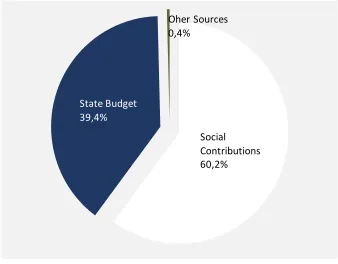
Figure 1. Sources of inancing of the
insurance part of the pension system
Legal aspects
18 February 1997 – Law “On Social Insurance” № 250-IQ, which determines the legal, economic and organisaional aspects of the social insurance.
27 November 2001 – Law “On Personal Accounts in the State Social Insurance System” № 221-IIQ, which regulates the data collecion in the commodiies and services.
The average labour pension amount per month is 177.6 AZN in the beginning of 2016 (whereas average old-age pension of 197.6 AZN). The social allowances are ixed as follows: 66 AZN for old-age and disability, 61 AZN for survivors).
The pension adequacy represent an issue because the average replacement rate represents between 38% and 45 % compared to oicial salary. At the same ime, the studies show the posiive impact of universal pensions on the absolute poverty rate.
Financing
In 2014, 1,743,743.240 million AZN of social contribuions were collected by SSPF. They were distributed as follows:
• Public entities (employers and employees): 36%
• Self-employed: 2% • Other employers: 62%
Employees pay 3% of their monthly
gross income to the MLSPP, employers
22%. They are in charge of transferring the enire contribuion to the MLSPP at the same ime than the salary. In the end, half of the contribuion will go on the employee’s personal account.
Self-employed persons: 10 to 50% of the naional monthly minimum wage
Social Contributions 60,2% State Budget
39,4%
Azerbaijan: Universal Pensions
personal individual accounts for the provision of social security rights in the future.
7 February 2006 – Law “On Labour Pensions” № 54-IIIQ, which introduced the labour pension rights of ciizens, rules for the implementaion and establishes a pension provision system. government. It determines the rights and the obligaions of the inspecion bodies and entrepreneurs.
2. How was this achieved?
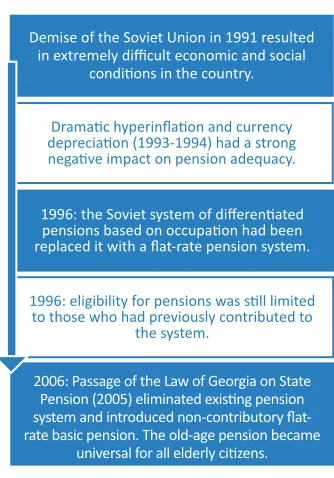
Historically, Azerbaijan has inherited universal soviet pension system which was criically underinanced during irst years of independence. Although the State Social Protecion Fund was established in 1991, the basic informaion for management of pension system was missing: employment records and employment periods, income levels for workers who used to live in other Soviet republics. Furthermore, the situaion was worsened by socio-poliical and economical cataclysms of the early 1990s and large number of Internally Displaced Persons.
Staring from the beginning of 2000s,
the country’s economic posiive results set condiions for improvement in the socially oriented policy of the State. The social protecion become a development priority of the government and the provisions are made in order to bring extremely law but universal social beneits close to subsistence minimums.
In 2001, with support of internaional
organisaions, the government
adopted a 3-ier pension system
reform concept, including a
reinforcement of basic pay-as-you-go component, an addiional mandatory insurance part, and a third voluntary scheme.
The second pillar was actually
implemented in 2006 with
introducion of individual accounts. The works on implementaion of third pillar were under way during last years, however present economic situaion represent a serious obstacle for such development.
Azerbaijan: Universal Pensions
Overcoming constraints
The beneits adequacy in the social protecion system in Azerbaijan represents an important issue. Although the government has demonstrated important eforts to bring the social protecion beneits closer to the level of minimum subsistence standards of populaion between 2000 and 2015, the last developments in the economy of Azerbaijan have seriously undermined these policies.
The economic crisis and high inlaion rates IN 2015 can represent an important threat, to the State capacity to deliver on the long-run pensions indexed on prices. Thus, the subsistence minimums themselves where only parially indexed ater the devaluaion of 2015. Scarce resources will be accompanied by a larger demand in terms of beneiciaries impacted by the crisis but also in terms of pension amount.
for the same categories of peoples.
Furthermore, the government
expects a reducion of administraive costs for the management of social protecion system in the period of deicit of budgetary resources.
The insurance and pension reforms led to the creaion of a system including funcions related to social insurance, personal accouning and pension provision. The following documents contain guidelines for future reform and improvements:
a) Development Concept “Azerbaijan – 2020: The vision of the future”
Aricle 7.3 sets the main goals of pension system, including voluntary social insurance and non-state pension funds.
b) State Programme on Development of the Insurance-Pension System in 2009-2015, was approved by a Presidenial Order in 2008. It aims at developing a viable system and ensuring its coninuous improvement, and to guarantee a proper pension provision.
Azerbaijan: Universal Pensions
Region Europe & Central Asia
Income level Lower middle income
Annual populaion growth (2014) 1.2%
Populaion above 65 years old (2016) 5.6% of total populaion Life expectancy at birth for women/ men (2014) 71.6 / 76.8
HDI (2014) 0.751 [78/188]
GDP (in billion current US$, 2015) 53,047 GDP growth (2015) - 1.1 % GDP per capita (current US$, 2015) 5 496,34 GNI per capita, Atlas method (current US$,
2015) 6560 $
General government inal consumpion expenditure (% of GDP) 12,51%
Minimum wage 105 AZN
Average salary in 2015 466,9 AZN
Labour force paricipaion rate (% ages 15 and older, 2015) 66.1% Employment to populaion raio, ages 15-24,
total (%) (modelled ILO esimate) 30.4% Number of economically acive populaion –
thsd. Persons
4915,3
Unemployed persons, thsd. Persons 243,7 People beneiing from unemployment beneits 1543
Number of pensioners 1 494 106 (87 % through labour pensions and others through social allowances) People beneiing from an old age labour
pension 785 068
Amount of old-age social allowance 66 Azn Amount of survivor social allowance 61 Azn Amount of basic-lat rate beneit for old-age
labour pension 110 Azn
Amount of the minimum pensions
allocated 110 Azn
Poverty rate (2015) 5%
Urban populaion (2015) 54,62% Sources:
World Development Indicator (WB/WDI) Human Development Indicator (UNDP/HDI)
The State Staisical Commitee of the Republic of Azerbaijan
Azerbaijan: Universal Pensions
forecasts show that if the present trend will coninue, the number of beneiciaries of social allowances will raise because important part of populaion will note have any rights to labour pension2.
3. What are the main results
in terms of impact on people’s
lives?
Economic results demonstrated by Azerbaijan since 2000s due to posiive dynamics of energy prices have enabled the Government to achieve an improvement of ciizen’s well-being, through reinforcing the qualitaive aspects of the social protecion system and economic development, based on internaional best pracices. However, it is necessary to further develop a comprehensive insurance and pension system that relect the country’s economic and social situaion.
During the recent years a number of important measures were taken in the area of improving the standards of living of the populaion, serious steps were made in the direcion of improving the pension provision of the ciizens.
According to the studies made in 2009, the social protecion system had a very posiive impact on the absolute poverty reducion. Thus, the universal social protecion system had reduced the absolute poverty rate from 30.9% to 10.9 %, with special posiive impact ² See Durin & Tretyak (2012)
Indeed, annual level of consumer price index deined by corresponding execuive body is taken into consideraion in case of re-establishing basic part of old-age labour pension. The insurance part of a labour pension and pension capital accumulated in the insurance part of a personal account are indexed at least once a year to the level of the consumer prices index established by the appropriate execuive body. The social insurance pensions inancing represent several concerns. According to pension reform concept, the public budget was responsible for the inancing of pension liabiliies for the period of rights acquired before 1992. However, in reality the public budget covers only the diference between beneits which should be paid as labour pensions and the contribuions collected through pensions system. In this regards, the efecive introducion of third pillar of the pension system is diicult.
Azerbaijan: Universal Pensions
based on actuarial calculaions and staisical data, with the corresponding acion plan. Harmonizaion of pension schemes with the country’s socio-economic development, as well as building and strengthening capacity should enable Azerbaijan to deine the long-term development prioriies of these systems.
This Universal Social Protecion brief was produced by Olivia de Vendeuvre of Experise France. It was reviewed by Andrei Tretyak of Experise France, and Isabel Oriz, Mariko Ouchi and Loveleen De of the ILO.
References
Azerbaijan State Social Protecion Fund web-page: www.sspf.gov.az
ILO (1999), Republic of Azerbaijan: Prelim
-inary Assessment of the Social Protecion System.
Internaional Social Security Associaion (ISSA) webpage: www.issa.int
Fan, Lida; Habibov, Nazim; ISSA.
Blackwell Publishing. 2007. “Social protec-ion and poverty in Azerbaijan, a low-income country in transiion: implicaions of a house-hold survey”, (Internaional Social Security Review, N° 4, vol. 60, p 47-68 (October/De-cember 2007))
of old-age and disability pensions3. Although the more recent igures were not found, the posiive impact of universal social protecion system on poverty elevaion remains strong.
4. What’s next?
Now that the irst two iers of the system (ixed allowance and insurance) are well established, Government plans to develop a third pillar, based on savings, as sipulated in the pension provision reform concept and in the development concept Azerbaijan 2020. This would diversify the inancial sources of the pension system and thus its sustainability, while allowing higher pension rates. This pillar should nonetheless be developed taking carefully into account the inlaion rates, economic situaion and stability of inancial markets.
Azerbaijan: Universal Pensions
Durin, F & A. Tretyak (2012), “Disabled peoples in Azerbaijan: model for projecions and long-term trends”, Social Protecion in Azerbaijan N°4
Bolivia
Universal Pensions
Renta Dignidad (“Dignity
Pension”): Making the social
protecion loor a reality for all
older people
Despite having the lowest GDP per capita in South America, Bolivia has achieved one of the highest coverage rates in old-age pensions. With the introducion of the non-contributory old-age pension Renta Dignidad in 2007, Bolivia closed coverage gaps and achieved universal coverage.
Renta Dignidad costs around 1 per cent of the country’s GDP and is inanced by public revenues generated from taxes on oil and gas producion and dividends from a group of state-owned companies.
The impacts of Renta Dignidad on people’s lives are remarkable. For example, the programme led to a reducion in the poverty rate by 14 percentage points at the household level. Renta Dignidad has secured the incomes and consumpion of beneiciaries, reduced child labour, and increased school enrolment. In households receiving the beneit, child labour has been halved and school enrolment has reached close to 100 per cent.
Main lessons learned
• Bolivia’s Renta Dignidad programme shows that universal social protecion for older persons is achievable, even in developing countries.
• This non-contributory social protecion programme has a signiicant impact on poverty reducion for older persons and other family members living with the elderly; ithas reduced poverty by 14 percentage points.
• Poliical will and the government’s commitment are essenial. In paricular, increasing iscal space is indispensable to signiicantly extending old-age pension coverage. Renta Dignidad is inanced by revenues from natural hydrocarbon resources.
• Renta Dignidad is administered by the Ministry of Economy and Public Finance but the Bolivian Armed Forces have also played a criical role in achieving higher coverage rates in remote rural areas. There are over 200 payment points installed in military faciliies and its mobile units.
Bolivia: Universal Pensions
These amounts represent 38 per cent of the poverty line and 21 per cent of the minimum wage, respecively.
Financing
The scheme’s cost (beneits plus administraive costs) amounts to roughly 1 per cent of GDP. It is inanced from two sources: resources derived from a direct tax on hydrocarbons and dividends from naionalized public enterprises that are earmarked to inance the Renta Dignidad. The Government’s revenue from the exploitaion and sale of hydrocarbons has increased tremendously. This in turn has brought about a signiicant increase in iscal revenues and hence iscal space for inancing social protecion.
Legal aspects
Renta Dignidad was established in 2007 by Act No. 3791, replacing the previous social pension scheme known as BONOSOL. The beneit is guaranteed under the Consituion of 2009, which states that “all older persons have the right to a digniied old age, with human quality and warmth. The State shall provide a lifelong old-age pension in the framework of the integrated social security system, as sipulated by legislaion.” Eligible beneiciaries must be at least 60 years of age, be a Bolivian or naturalized ciizen, be domiciled in the country, and have a naional idenity document.
1. What does the pension
system look like?
Renta Dignidad is a universal programme, i.e. there are no condiions or means tests to receive the beneit. Along with the country’s condiional cash transfer programmes, Bono Juancito Pinto (for school children) and the Bono Juana Azurduy (for expectant and new mothers and their infants), Renta Dignidad is another step forward towards creaing a naional social protecion loor.
Key igures
• Renta Dignidad reaches 91 per cent of the populaion over the age of 60.
• The monthly beneit amount is 250 bolivianos (BOB) (US$35.9) for beneiciaries without a contributory pension. BOB200 ($28.7) is paid to recipients of the contributory scheme.
• Involvement of the armed forces has played a criical role to achieve higher coverage rates in rural areas.
Beneit packages
Bolivia: Universal Pensions
generated by these enterprises were earmarked to inance the Renta Dignidad. Second, in 2006, the Government renaionalized the hydrocarbon sector and recovered ownership and control of the country’s natural hydrocarbon resources. The allocaion of revenues from this sector was renegoiated with an 82 per cent share of revenues going to the State and 18 per cent to private companies. This allowed for the creaion of iscal space for inancing social protecion.
Figure 1. Cost of Renta Dignidad in percent -age of GDP
3. What is the impact on
people’s lives?
Outcome
Renta Dignidad is the irst, and so far only, universal pension programme in Lain America. The efecive coverage rate reaches more than 90 per cent of people over the age of 60.
Insituional arrangements for
delivery
Renta Dignidad is administered by the Ministry of Economy and Public Finance with cooperaion from the military and the naional banking system in the delivery of beneits. The pension is paid on a monthly basis. The payments are made in more than 1,100 payment centres across the enire country, including branches of inancial insituions and Naional Armed Forces payment centres. Involvement of the armed forces has played a criical role in reaching high coverage rates in remote rural areas. There are more than 200 payment points installed in military faciliies and its mobile units. All military mobile units are equipped with mobile satellite dishes. The centralized database of beneiciaries can be accessed from any place in the country, allowing beneiciaries to collect their pensions anywhere.
2. How was this major
breakthrough achieved?
Consolidaion of Renta Dignidad as a universal social pension can be explained by two main factors. First, in the course of privaizing public enterprises in 1995, half of the shares of these companies were sold to foreign investors, while around 48 per cent were granted to Bolivians 21 years of age or older. Ater the renaionalizaion, the dividends
Bolivia: Universal Pensions
Impact on the economy
The impact of social pensions on local development and formalizaion is well known. Before the introducion of the Renta Dignidad, there were many people of all ages without naional personal ideniicaion (ID) documents in rural areas. The registraion campaign conducted by the programme reached members of households of all ages, including working-age people. The growing number of people with personal IDs and the posiive impacts of the social pension on local demand for goods and services in rural areas have contributed to the formalizaion of the rural economy.
4. What’s next?
Bolivia has made signiicant eforts to universalize its social pension system. The Government is now focusing on improving the administraive and inancial governance of the programme, improving the adequacy of beneits, as well as creaing complementary linkages with other social protecion programmes. Next steps include:
Impact on people’s lives
Renta Dignidad led to a reducion in the poverty rate at the household level by 14 percentage points. The pension stabilizes households’ incomes and contributes to boost consumpion levels. Posiive impacts on child labour and educaion are also signiicant. A study conducted by UDAPE (Escobar Loza et al., 2013) shows that children living in households receiving Renta Dignidad beneits are less likely to be working (a reducion of 8.4 percentage points) compared to children in households that do not beneit from Renta Dignidad. Meanwhile, school enrolment rates were 8 percentage points higher in households receiving the social pension, making the enrolment rate close to 100 per cent for this group.
Figure 2. Number of Renta Dignidad beneiciaries
Source: APS. Estadísicas 2014.
Introduction of the Renta Dignidad programme, replacing the previous BONOSOL, reduced the minimum age
for pension eligibility from 65 to 60,
bringing out a signiicant expansion in
Bolivia: Universal Pensions
1. overcoming administraive issues to cover the remaining 10 per cent of older persons who are not yet part of Renta Dignidad;
2. maintaining and improving i-nancial governance in order to ensure the sustainability of the programme in the long run;
3. exploring opions for increasing the beneit level, which remains modest; and
4. coninuing to strengthen the coor-dinaion mechanisms with other so-cial protecion programmes.
Bolivia’s Renta Dignidad is a successful example of guaranteeing universal social protecion for older persons. Such achievements would not have been possible without the strong poliical will and commitment of the Government to universalize the coverage of social pensions and secure inancing sources for universal social protecion policies.
This Universal Social Protecion brief was produced by Fabio Durán-Valverde and Tomas Barbero of the ILO. It was reviewed by Rocco BUSCO of the European Commission, Charles Knox-Vydmanov of HelpAge, Isabel Oriz and Valérie Schmit of the ILO.
References
Autoridad de Fiscalización y Control de Pensiones y Seguros. Estadísicas. Available at: www.aps.gob.bo/estadisicas/Paginas/ Renta-Dignidad.aspx.
Durán-Valverde, F.; Pacheco, F. 2012. Fiscal space and the extension of social protecion: Lessons learnt from developing countries (Ge-neva, ILO). Available at: www.social-protec- ion.org/gimi/gess/RessourcePDF.acion?res-source.ressourceId=34168.
Escobar Loza, F.; Marínez Wilde, S.;
Mendizábal Córdova, J. 2013. El impacto de la Renta Dignidad: Políica de redistribución del ingreso, consumo y reducción de la pobreza en hogares con personas adultas mayores (La Paz, UDAPE). Available at: www.udape. gob.bo/evaluaciondeimpacto/12_Documen-to_Impacto%20Renta%20Dignidad.pdf.
ILO. 2012. Social Protecion Floors Recom
-mendaion (No. 202). Available at: www. ilo.org/dyn/normlex/en/f?p=NORMLEXPU-B:12100:0::NO::P12100_ INSTRUMENT_ ID:3065524.
—. 2014. World Social Protecion Report 2014/2015: Building economic recovery, inclu
Bolivia: Universal Pensions
Botswana
Botswana’s social protecion (SP) programmes, including its universal, noncontributory old age pension, are among the most extensive in coninental Africa. At the same ime, its eforts are among the least recognized. This is due in part to the country’s small populaion; the fact that programmes are funded almost enirely from naional revenues; limited published documentaion; and a lack of internaional donor
involvement. Botswana’s long
experience in extending social protecion to its ciizens deserves to be more widely known.
Main lessons learned
• A stable and compeiive poliical system, a consistently growing economy, carefully managed naional inances and a strongly-entrenched ‘social compact’ have provided highly supporive condiions for the building of Botswana’s SP system over a period of 50 years, including the introducion of a universal old age pension.
• The universal pension and other SP programmes have contributed substanially to the reducion in overall levels of economic poverty and related deprivaions. Extreme poverty in Botswana was reduced from 23.4 per cent in 2003 to 6.4 per cent in 2009-10. The universal pension has also contributed to the maintenance of a society with high levels of social harmony and cohesion.
• Short term responses to external shocks can also, under more broadly conducive condiions, provide impetus and opportunity for the expansion of rouine SP measures.
• Insituionalizing the delivery of diferent SP measures within a range of government agencies has provided coninuity and experience in implementaion; but could beneit further from overall strategic coordinaion and stronger impact evaluaion.
Botswana: Universal old-age pensions
naional registraion card or, where necessary, by local assessment commitees with the assistance of the Village development Commitee. The elderly who are inirm appoint a proxy to collect the cash transfer on their behalf but need to ill a Life Declaraion Form every 6 months and they are assisted in their homes for this purpose.
In 2012-13 the monthly payment was raised by 15% to compensate for inlaion and in that year its total cost was Pula 279 million, equivalent to some US$ 34 million or roughly 0.2 per cent of Botswana’s GDP.
Table 1. Botswana Universal State Pension: beneiciaries and expenditure
Year beneiciariesPension Beneit (Pula) Expenditure (Pula, mil)
2009-10 96,118 220 239
2010-11 94,252 220 240
2011-12 91,385 220 249
2012-13 93,639 250 279
2013-14 98199 250 304
2014-15 100,471 300 304
2015-16 102,323 330 394
There is a 10% budgetary incremental needs every year due to the increase in the lifespan of the elderly atributed to good and free healthcare for the elderly.
• Recent economic pressures have led to greater emphasis on issues of eiciency as a means of boosing th sustainability of SP systems. Botswana shows that this can be done without undermining the role of universal pensions as a key pillar of an inclusive naional vision based on social harmony and jusice.
The Universal Old Age Pension
Botswana’s old age pension was introduced in 1996 as a universal beneit from the start. It provides a monthly cash transfer to all ciizens aged 65 and above, who make up about 4.5% of the total populaion. The number of beneiciaries is very close to 100% of the esimated populaion in this age group, conirming a very high take-up. Monthly beneits are set at a level, equivalent to around US$ 30, which is esimated at just over a third of the food poverty line. This is arguably both quite modest and sustainable.
Transfers are made by the Ministry of Local Government and Rural Development through the Department of Social Protecion to Post Oice accounts. The beneiciaries use smartcards to redeem their dues at any Post Oice or mobile Point of Sale Device. These are quite easily accessible to a populaion which is mainly concentrated in large villages and towns.
Beneiciaries are veriied through a