#1#%+06'40#6+10#./'6*1&5%1//+66'')7+&'.+0'5(148#.++10 1(37#.+6#6+8'#0&37#06+6#6+8'(11&/+%41$+1.1)+%#.1((+%+#. /'6*1&51(#0#.;5+5
(GNFUKPG 2JKNKR $KQ%QPVTQN 5[UVGOU +PE 5' PF 5VTGGV $GNNGXWG 9# 75# #DG[VC %CTNQU 75 (QQF CPF &TWI #FOKPKUVTCVKQP 5GCHQQF 2TQFWEVU 4GUGCTEJ %GPVGT TF &TKXG 5' $QVJGNN 9# 75#
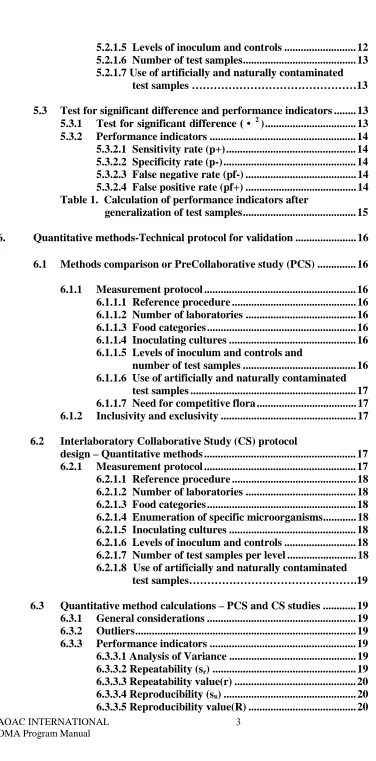
6CDNGQHEQPVGPVU 2CIG
3.3 Validation of an alternative method... 6
3.4 Analyte ... 6
3.5 Qualitative method... 6
3.6 Quantitative method ... 6
3.7 Methods comparison or precollaborative study... 6
3.8 Interlaboratory collaborative study ... 6
3.9 Fractional recovery ... 6
3.10 Ruggedness testing (RT)... 6
4. Validation protocol ... 7
4.1 Validation options ... 7
4.2 The OMA method ... 7
4.3 Participants of the official methods SM Process... 7
4.3.1 The official methods board (OMB)... 7
4.3.2 Methods committee (MC) ... 7
4.3.3 Methods committee statistician (MCS) ... 7
4.3.4 Methods Committee safety advisor (MCSA) ... 8
4.3.5 General referee (GR)... 8
4.3.6 Study Director (SD) or organizing laboratory responsibilities ……….8
4.3.7 Collaborators ... 9
5. Qualitative methods – Technical protocol for validation ... 9
5.1 Methods comparison or precollaborative study (PCS)... 9
5.1.1 Measurement protocol ... 9
5.1.1.1 Reference procedure... 9
5.1.1.2 Number of laboratories ... 9
5.1.1.3 Food categories... 9
5.1.1.4 Inoculating cultures and conditions of microorganisms………...…………..……….10
5.1.1.5 Levels of inoculum and controls ... 10
5.1.1.6 Number of test samples... 10
5.1.1.7 Naturally contaminated test samples ... 11
5.1.1.8 Need for competitive microflora ... 11
5.1.1.9 Inclusivity and exclusivity ... 11
5.1.1.10 Contaminated controls ... 11
5.2 Interlaboratory collaborative study (CS)... 11
5.2.1 Measurement protocol ... 11
5.2.1.1 Reference procedure ... 12
5.2.1.2 Number of laboratories ... 12
5.2.1.3 Food categories... 12
5.2.1.5 Levels of inoculum and controls ... 12
5.2.1.6 Number of test samples... 13
5.2.1.7 Use of artificially and naturally contaminated test samples ………13
5.3 Test for significant difference and performance indicators ... 13
5.3.1 TGUV HQT UKIPKHKECPV FKHHGTGPEG • 2 )... 13
5.3.2 Performance indicators ... 14
5.3.2.1 Sensitivity rate (p+) ... 14
5.3.2.2 Specificity rate (p-)... 14
5.3.2.3 False negative rate (pf-) ... 14
5.3.2.4 False positive rate (pf+) ... 14
Table 1. Calculation of performance indicators after generalization of test samples... 15
6. Quantitative methods-Technical protocol for validation ... 16
6.1 Methods comparison or PreCollaborative study (PCS) ... 16
6.1.1 Measurement protocol ... 16
6.1.1.1 Reference procedure ... 16
6.1.1.2 Number of laboratories ... 16
6.1.1.3 Food categories... 16
6.1.1.4 Inoculating cultures ... 16
6.1.1.5 Levels of inoculum and controls and number of test samples ... 16
6.1.1.6 Use of artificially and naturally contaminated test samples ... 17
6.1.1.7 Need for competitive flora ... 17
6.1.2 Inclusivity and exclusivity ... 17
6.2 Interlaboratory Collaborative Study (CS) protocol design – Quantitative methods ... 17
6.2.1 Measurement protocol ... 17
6.2.1.1 Reference procedure ... 18
6.2.1.2 Number of laboratories ... 18
6.2.1.3 Food categories... 18
6.2.1.4 Enumeration of specific microorganisms... 18
6.2.1.5 Inoculating cultures ... 18
6.2.1.6 Levels of inoculum and controls ... 18
6.2.1.7 Number of test samples per level ... 18
6.2.1.8 Use of artificially and naturally contaminated test samples……….19
6.3 Quantitative method calculations – PCS and CS studies ... 19
6.3.1 General considerations ... 19
6.3.2 Outliers... 19
6.3.3 Performance indicators ... 19
6.3.3.1 Analysis of Variance ... 19
6.3.3.6 Relative standard deviation (RSD) ... 20 6.3.3.7 Calculations ... 20
7.0 References………. ... 20-21
1 Scope
The purpose of this document is to provide comprehensive guidelines for conducting AOAC INTERNATIONAL (AOACI) food microbiological Methods Comparison or Precollaborative
studies and Interlaboratory Collaborative studies for those methods submitted for AOAC® Official
MethodsSM Program (OMA) status. The guidelines define steps involved in the validation process including selection of the Study Director (SD), ruggedness testing, the Methods Comparison or Precollaborative Study that includes inclusivity/exclusivity testing, the Interlaboratory Collaborative Study, and the approval process by AOACI.
These microbiological guidelines were provided by the Methods Committee on Microbiology and Extraneous Materials as part of an initiative to specify validation criteria for Methods Comparison/ Precollaborative studies and Interlaboratory Collaborative studies and to harmonize validation methodology with ISO 16140. They have been adopted by the AOACI Board of Directors. AOAC INTERNATIONAL thanks the Methods Committee on Microbiology and Extraneous Materials for their contribution in the development of these guidelines.
2 Applicability
These guidelines are applicable to the validation of any alternative method, whether proprietary or non-proprietary, that is submitted to AOACI for OMA status recognition. It is the intent of this guideline to harmonize validation procedures with ISO standard 16140, Protocol for the Validation
of Alternative Methods. Data produced for an alternative method that satisfies the protocol
requirements and acceptance criteria contained in ISO 16140 may be reciprocally recognized and may apply toward validation requirements specified in these guidelines; however, some additional data could be required.
3 Terms and definitions
3.1
alternative method
method of analysis that demonstrates or estimates, for a given category of products, the same
analyte (3.4) as is measured by using the corresponding reference method (3.2). The method can be proprietary or non-commercial and does not need to cover an entire analysis procedure, that is, from the preparation of samples to the test results.
3.2
reference method
3.3
validation of an alternative method
demonstration that adequate confidence is provided when the results obtained by the alternative method are comparable to those obtained using the reference method using the statistical criteria contained in the approved validation protocol
3.4 analyte
component measured by the method of analysis. In the case of microbiological methods, it is the microorganism or associated by-products (e.g. enzymes or toxins)
3.5
qualitative method
method of analysis whose response is either the presence or absence of the analyte (3.4) detected either directly or indirectly in a certain amount of sample
3.6
quantitative method
method of analysis whose response is the amount of the analyte (3.4) measured either directly (e.g. enumeration in a mass or a volume), or indirectly (e.g. color absorbance, impedance, etc.) in a certain amount of sample
3.7
methods comparison or precollaborative study
a study, performed by the organizing laboratory or Study Director (SD) of the alternative method against the reference method
3.8
interlaboratory collaborative study
study of the alternative method’s performance using common samples in numerous laboratories and under the control of the organizing laboratory or SD
3.9
fractional recovery
validation criterion that is satisfied when a common set of samples (e.g. inoculation level), yields a partial number of positive determinations and a partial number of negative determinations on that same set of samples. The proportion of positive samples should approximate 50% of the total number of samples in the set
3.10
ruggedness testing (RT)
4 Validation protocol
4.1 Validation options
There are three validation options available through of AOACI and its subsidiary AOAC Research
Institute (AOAC-RI). They are the AOAC ® Official Methods SM Program (OMA), AOAC ®
Peer-Verified MethodsSM Program (PVM) and AOAC ® Performance Tested MethodsSM Program (PTM).
This document will only address the Official Methods SM Program (OMA). For information
regarding the other two validation schemes, see references, Section 7 (5) and 7 (7).
4.2 The OMA method
AOACI OMA methods are validated by the Interlaboratory Collaborative Study (CS), in which experienced, competent analysts (collaborators) work independently in different laboratories under the direction of a SD using a specific method to analyze replicated test samples for a particular analyte. The SD, who is supervised by the General Referee (GR), manages the CS. The selected method may be subjected to ruggedness testing prior to the Methods Comparison or Collaborative Study to determine its behavior under various in-house operating conditions. (See section 3.10).
4.3 Participants of the Official MethodsSM Process
There are many technical experts who participate in the Official Methods SM process. Each serves a
unique, defined role and their functions are described below and in the Official Methods SMProgram
Manual.
4.3.1 The Official Methods Board (OMB)
OMB consists of a Chair and the chairs of the 11 Methods Committees. The OMB approves Final Action status for First Action methods.
4.3.2 Methods committee (MC)
Reviews protocols for Methods Comparison and Interlaboratory Collaborative studies, reviews completed studies, grants First Action status to new and revised methods, and recommends revisions or repeals, Final Action and surplus status to the Official Methods Board. Recommend scientists for appointment or termination as General Referees. Evaluate performances of General Referees; recommend re-appointments as appropriate.
4.3.3 Methods committee statistician (MCS)
4.3.4 Methods committee safety advisor (MCSA)
Reviews protocols and Collaborative studies submitted to the Methods Committee. Examines the proposed method and study design for possible hazards and ensures that appropriate safety
precaution statements are listed when necessary.
4.3.5 General referee (GR)
A senior scientist in Microbiology with experience using the Collaborative Study process. Recommends scientists for appointment as Study Directors and advises them on method development concepts. Reviews the studies and recommends appropriate action on proposed methods to the Methods Committee.
4.3.6 Study director (SD) or organizing laboratory responsibilities
A volunteer required to be an expert in the particular area of study involved. Responsible for administration of the validation process and conducting the Interlaboratory study. Proposes the reference methodology, develops in-house validation data and develops a protocol for the Interlaboratory Collaborative validation of the method following AOACI guidelines.
The responsibilities of the SD/Organizing Laboratory are summarized as follows:
(1) selects a method to be validated
(2) conducts in-house ruggedness testing (optional procedure)
(3) conducts a Methods Comparison/Pre-collaborative Study and submits to AOACI for
methods committee approval
(4) prepares a Collaborative Study protocol and submits to AOACI for methods committee
approval
(5) prepares samples, ships samples to participants, conducts study and analyzes results
(6) Prepares manuscripts containing results and methods in AOAC format and submits to
GR, MCS, MCSA, MC and OMB for review and approval upon completion of the PCS and CS
4.3.7 Collaborators
5 Qualitative methods - Technical protocol for validation
5.1 Methods comparison or Precollaborative Study (PCS)
5.1.1 Measurement protocol
The Precollaborative Study (PCS), also known as the Methods Comparison Study, is a formal submission requirement for OMA microbiology methods and is normally conducted in the organizing laboratory. It precedes the Interlaboratory Collaborative Study. The purpose of a Precollaborative Study is to define the applicability claims of a proposed OMA method by demonstrating the applicability of the method to various food categories. For OMA methods, the applicability statement immediately follows the method title. The applicability statement for microbiological methods is generally concerned with target analyte and food type coverage.
5.1.1.1 Reference procedure
Alternative methods are always compared to a reference culture method. Reference culture methods contained in AOACI OMA, FDA/BAM or USDA (for meat and poultry products) are examples of reference methods. (see item 3.2)
5.1.1.2 Number of laboratories
The PCS is normally conducted in the organizing laboratory.
5.1.1.3 Food categories
Refer to the Recommended Food Categories and Food Types for Microbiological Methods contained in Annex A. Analyze at least twenty (20) diverse food types selected from the food categories contained in Annex A, if the applicability claim is for all or most foods.
Note:
AOAC INTERNATIONAL has recognized Salmonella methods for ALL FOODS and has recognized other target microorganisms, including E. coli O157, Listeria, and Campylobacter methods for only the range of food categories or specific food types included in the PCS and CS.
If it is sought to validate the method for all or most foods, study at least six categories of food and 20 food types. This number may be reduced to 1, 2, 3 ,4 or 5 categories if the validation of
alternative method is restricted to these stated categories. The recommended categories are listed in Annex A.
If it is not possible to acquire a sufficient number of naturally contaminated food types for each of the categories, artificial contamination of food samples is permissible.
5.1.1.4 Inoculating cultures and conditions of microorganisms
Foods are commonly inoculated with the organism of interest since naturally contaminated products are infrequently available. For a genus level method, such as Salmonella detection, numerous strains representing different serovars are required.
Typically a different isolate, strain, serotype or species is used for each food type. The product inoculation should be conducted with a pure culture of one strain. Mixed cultures are not recommended.
Microorganisms in processed foods are typically stressed, thus the contaminating microorganisms are also stressed for these types of foods. Microorganism stress may occur at the time of
inoculation or during preparation of the food. Raw, unprocessed foods may be inoculated with unstressed organisms. Lyophilized inocula are generally used for dry powder/granulated foods and wet inocula are used for wet foods. Inoculated samples of solid food types, if included, are held at appropriate storage conditions to stabilize the population prior to analysis.
5.1.1.5 Levels of inoculum and controls
Each food type is divided into at least 2 portions. One portion serves as the negative control, one portion is inoculated at a level that will produce fractional recovery (see 3.9). Control and inoculated test samples should be prepared at the same time. Depending on the organizing
laboratory’s confidence in satisfying this validation criterion it may be advisable to prepare a third portion that has a high inoculum level. This level is optional as the only acceptance requirement is fractional recovery at one level. The target for the low inoculum level is typically set at the lowest detection limit of the test method, e.g. 1-5 cfu/25 g test portion. The high inoculum is set at 10-50 cfu/25 g test portion. Additional inoculum levels may be added as necessary.
More than one inoculum level may be used to increase the probability that one level will exhibit fractional recovery. Inoculum levels that test totally positive or negative are not useful in determining the lowest detection limit of the method and do not satisfy validation requirements.
Most Probable Number (MPN) quantification of contamination levels is conducted in the
organizing laboratory on the day that the analysis of test samples is initiated (see reference, Section 7 (12)).
5.1.1.6 Number of test samples
The number of test portions per inoculum level is 20. To use the McNemar statistic, test samples must be paired. If, for example, the test and reference methods each require a separate 25 g test portion because the primarily enrichment media are different, then 20 test samples of at least 50 g each should be drawn from the inoculated or control portions. From each 50 g test sample, paired 25 g test portions are prepared. It is permissible to share initial test portions when applicable such that pairing is through the use of the same homogenate or enrichment broth. This is the situation when both the alternative method and the reference method share a common pre-enrichment medium.
At least 2 lots of each naturally contaminated food type are required. However, naturally contaminated products are infrequently available to most analysts. An effort should be made to obtain them as they are most representative of the method usage environment. For these products, there is no negative control. Twenty replicates are analyzed per lot. If all test portions are positive, dilute the test sample to obtain fractional positives and repeat analysis of the lot.
5.1.1.8 Need for competitive microflora
It is more realistic and challenging to include microorganisms that act as competitors to the analyte microorganisms. The purpose of including these organisms is to more closely simulate conditions found in nature. It is sufficient to demonstrate this recovery in one food type. This requirement may be satisfied in the Methods Comparison Study. The competitor contamination levels should be at least one logarithm higher than the target microorganism.
5.1.1.9 Inclusivity and exclusivity
Inclusivity or sensitivity is the ability of the alternative method to detect the target analyte from a wide range of strains. Exclusivity or specificity is the lack of interference in the alternative method from a relevant range of non-target strains, which are potentially cross-reactive.
Generate inclusivity and exclusivity data to substantiate that the method is reactive for the major serotypes of the specified microorganism and is non-reactive to other related genera and/or species. Select at least 50 pure strains of the specific microorganism and select at least 30 strains of
potentially competitive strains to be analyzed as pure culture preparations. For Salmonella
methods, this number of target analyte strains is increased to at least 100 strains that are selected to represent the majority of known serovars of Salmonella.
5.1.1.10 Contaminated controls
Inoculated test samples and uninoculated controls are prepared at the same time. If any
uninoculated control test portion is positive for the inoculated microorganism, the results are invalid and the run is repeated because it is assumed that cross contamination has occurred. Control
samples are not included with naturally contaminated food types.
5.2 Interlaboratory Collaborative Study (CS)
5.2.1 Measurement protocol
5.2.1.1 Reference procedure
Alternative methods are always compared to a reference culture method. Reference culture methods contained in AOACI OMA, FDA/BAM or USDA (for meat and poultry products) are examples of reference methods.
5.2.1.2 Number of laboratories
A minimum of 10 valid laboratories data sets per food type is needed. The SD should plan on including at least 12-15 laboratories per food because some laboratories are generally eliminated for various reasons. No guidelines have been established for qualitative methods involving very
expensive equipment. It is advisable to consult with General Referee and Committee Statistician.
5.2.1.3 Food categories
The number of different food categories depends on the applicability of the method. If the method is specific to only one category (e.g. detection of Campylobacter in oysters), only one type of food need be included. If the applicability is wider (e.g. detection of Salmonella in all foods), then 6 food categories shall be included in the CS. As mentioned previously, the data from both the PCS and CS studies form the basis for defining the method applicability statement.
5.2.1.4 Inoculating cultures
The inoculating microorganisms must represent different genera, species and/or toxin-producing microorganisms that are intended to be included in the method applicability statement. The choice of cultures should be broad enough to represent the inherent variation in the microorganisms of interest.
Typically a different isolate, strain, serotype or species is used for each food type. The product inoculation should be conducted with a pure culture of one strain. Mixed cultures are not recommended.
Microorganisms in processed foods are typically stressed, thus the contaminating microorganisms are also stressed for these types of foods. Microorganism stress may occur at the time of
inoculation or during preparation of the food. Raw, unprocessed foods may be inoculated with unstressed organisms. Lyophilized inocula are generally used for dry powder/granulated foods and wet inocula are used for wet foods. Inoculated samples of solid food types, if included, are held at appropriate storage conditions to stabilize the population prior to analysis. Products must be innoculated to assure homogeneity of the analyte in each food type.
5.2.1.5 Levels of inoculum and controls
Each food type is divided into 3 portions. One portion serves as the negative control, one portion is inoculated at a level ( usually the low inoculum level) that will produce fractional recovery (see
3.9), and a third portion is inoculated at a high inoculum level. Control and inoculated test samples
Most Probable Number (MPN) quantification of contamination levels is conducted in the
organizing laboratory on the day that the analysis of test samples is initiated. MPN’s are conducted according to the reference culture method specified in the protocol.
5.2.1.6 Number of test samples
Six test portions per analyte level for each food type and six negative (uninoculated) control portions for each food type are required. Test portions are to be blind coded when sent to participating laboratories for analysis.
5.2.1.7 Use of artificially and naturally contaminated test samples
The use of both naturally and artificially contaminated test samples are strongly encouraged. Naturally contaminated foods are not always available, therefore, artificially contaminated test samples are acceptable.
5.3 Test for significant difference and performance indicators
These are applicable to both the Precollaborative and Collaborative Studies. Examine data to determine whether any laboratory shows consistent aberrant results, which differ from the rest of the determinations from the other laboratories to a greater degree than could be reasonably expected or found by chance alone. Perform outlier tests in order to discard the outlying values (see
reference, Section 7 (8)).
5.3.1 Test for significant difference ( • 2 )
The proportion confirmed positive for the alternative method must not be statistically different from the proportion confirmed positive to the reference method for each food type and each inoculation
level. McNemar’s test (a Chi square ( • 2 ) test) is used to compare the proportions for the methods.
A Chi-square value < 3.84 indicates that the proportions positive for the alternative and reference methods are not statistically different at the 5% level of significance. This criterion must be satisfied for each level of each food type. However, a significant difference between the proportions positive for the two methods is acceptable provided that the alternative method demonstrates superior
recovery to the reference method.
Chi-square, as defined by McNemar, is:
(
)
b
Where a = test samples confirmed positive by the alternative method but tested negative by the reference method, b= test samples that tested negative by the alternative method but are confirmed positive by the reference method. Refer to Table 1 for method of calculation from study data.
that food must be removed from the applicability statement or the method must be modified and additional testing performed to demonstrate that the results are now acceptable.
If no assignable cause for the failure can be found, the failure may be assumed to be attributable to random error. In this case, the specific food category can be re-evaluated by testing three (3) lots of the food product according to the above protocol
5.3.2 Performance indicators
The four performance indicators for qualitative methods are sensitivity, specificity, false negative rate and false positive rate. Together with the test for significant difference (5.3.1), these
performance indicators provide a total assessment of the test method. Table 1 provides the calculations of these four performance indicators. Enter method results in the Table 1 format and calculate the performance indicators according to the formulae provided.
5.3.2.1 Sensitivity rate (p+) for a food type and inoculation level
The probability that the method, alternative or reference, will classify a test sample as positive, given that a test sample is a known positive. A known positive refers to the confirmation of innoculated analyte.
Sensitivity rate is defined as: Total number of confirmed positive test portions by the method divided by total number of confirmed positive test portions by both the alternative and reference methods.
5.3.2.2 Specificity rate (p-) for a food type and inoculation level
The probability that the method will classify the test sample as negative, given that the test sample is a known negative. A known negative refers to a confirmed negative test portion.
Specificity rate is defined as: Total number of analyzed negative test portions by the method divided by total number of confirmed negative test portions by both the alternative and reference methods.
For microbiological methods involving a confirmation step, a presumptive positive result is taken through the cultural procedure and confirmed to be a positive or determined to be a negative. In other words, the confirmation procedure allows the sample to be reclassified as a known positive or a known negative. As such, the specificity rate of results after confirmation is always 100%.
5.3.2.3 False negative rate (pf-) for a food type and inoculation level
The probability that a test sample is a known positive, given that the test sample has been classified as negative by the method. pf- is the number of misclassified known positives divided by the total number of positive test samples (misclassified positives plus the number of correctly classified known positives) obtained with the method.
Incidence of false negatives equals 100 minus the sensitivity rate.
The probability that a test sample is a known negative, given that the test sample has been classified as positive by the method. pf+ is the number of misclassified known negatives divided by the total test samples (misclassified positives plus the number of correctly classified known negatives) obtained with the method.
Enter study data in Table 1 and calculate the test for significant difference and performance indicators as shown below. This calculation should be done at each inoculation level.
Table 1. Calculation of performance indicators after generalized categorization of test samples (8)
Test Result b
Status of Test ______________________
Samples a Positive Negative Total
____________ _________ ________ ______________
Positive N11 N12 N1.
Negative N21 N22 N2.
Total N.1 N.2 N = N1. + N2. or N.1 + N.2
a
Status defined by reference method
D6GUV 4GUWNV KU FGHKPGF CU VJG CNVGTPCVKXG OGVJQF TGUWNV (QT UGPUKVKXKV[ ECNEWNCVKQP WUG OGVJQF TGUWNVU CHVGT
EQPHKTOCVKQP
N= The number of results in any particular cell. First subscript is the row and second subscript is the column. Examples: N11: Row 1, Column 1; N1. : Row 1 total; N2._: Column 2 total; N12 :Row 1, Column 2.
Chi-square • 2 ) = (( N12 - N21) -1)2 / ( N12 + N21), degrees of freedom (df) =1
Sensitivity rate = p+ = N11/N1.= P(T/S) where P(T/S) is the probability that the test is positive given that a randomly chosen test sample is a true positive. Refer to Table 1, define test result as results of completed method (screen assay with confirmation) of positive assay.
Specificity rate = p- = N22/N2.= P(T/S) where P(T/S) is the probability that the test is negative given that a randomly chosen test sample is a true negative. Refer to Table 1, define test result as results of completed method (screen assay with confirmation) of positive assay. Specificity should be recalculated with the negative control results included.
(CNUG PGICVKXG TCVG RH 00A L UGPUKVKXKV[ TCVG 265 YJGTG 265 KU VJG RTQDCDKNKV[
VJCV VJG VGUV KU PGICVKXG HQT UCORNGU VJCV EQPVCKP VJG CPCN[VG
6 Quantitative methods- Technical protocol for validation
6.1 Methods comparison or pre-collaborative study
6.1.1 Measurement protocol
The Precollaborative Study (PCS), also known as the Methods Comparison Study, is a formal submission requirement for OMA microbiology methods and is normally conducted in the organizing laboratory.It precedes the Interlaboratory Collaborative Study. The purpose of a Precollaborative Study is to define the applicability claims of a proposed OMA microbiology method by demonstrating the applicability of the method to various food categories. For OMA methods, the applicability statement immediately follows the method title. The applicability statement for microbiological methods is generally concerned with target analyte and food type coverage.
6.1.1.1 Reference procedure
Alternative methods are always compared to a reference culture method. Reference culture methods contained in AOACI OMA, FDA/BAM or USDA (for meat and poultry products) are examples of reference methods.
6.1.1.2 Number of laboratories
The PCS is normally conducted in the organizing laboratory.
6.1.1.3 Food categories
Refer to the Recommended Food Categories and Food Types for Microbiological Methods contained in Annex A. Analyze at least twenty (20) diverse food types selected from the food categories contained in Annex A, if the applicability claim is for all or most foods.
Note:
AOAC INTERNATIONAL has recognized Salmonella methods for ALL FOODS and has recognized other target microorganisms, including E. coli O157, Listeria, and Campylobacter methods for only the range of food categories or specific food types included in the PCS and CS.
6.1.1.4 Inoculating cultures
Inoculating cultures are used only if the method is for a specific target analyte which may not routinely be found in all food types (e.g. enumeration of Listeria spp.) or a certain type has been referenced and the subject flora (e.g. yeast) has not been found in measurable levels.
6.1.1.5 Levels of inoculum and controls and number of test samples
respectively. Intermediate levels may be added to improve precision but they are not required.
6.1.1.6 Use of artificially and naturally contaminated test samples
Approximately 50% of the food types should be naturally contaminated unless the method is for a specific microorganism that may not be naturally occurring in that number of food types. For the food types that are naturally contaminated, 3 different lots are required per food type. There are no uninoculated controls for the food types that are naturally contaminated.
The balance of the food types may be either naturally contaminated or artificially contaminated.
6.1.1.7 Need for competitive flora
For those alternative methods that are specific for target organisms, it is more realistic and
challenging to include microorganisms that act as competitors to the analyte microorganisms. The purpose of including these organisms is to more closely simulate conditions found in nature. It is sufficient to demonstrate this recovery in one food type. This requirement may be satisfied in the Methods Comparison Study. The competitor contamination levels, which may be naturally occurring or artificially introduced, should be at least one logarithm higher than the target microorganism.
6.1.2 Inclusivity and exclusivity
This requirement is not applicable to total viable count, yeast and mold count or similar total enumeration methods that are not directed at specific microorganisms.
Inclusivity is the ability of the alternative method to detect the target analyte from a wide range of strains. Exclusivity is the lack of interference in the alternative method from a relevant range of non-target strains, which are potentially cross-reactive.
Generate inclusivity and exclusivity data to substantiate that the method is reactive for the major serotypes of the specified microorganism and is non-reactive to other related genera and/or species.
In microbiology, except in the case of total counting methods, the inclusivity and exclusivity is established by the analysis of:
— at least 30 pure strains of the specific microorganism being studied.
— at least 20 pure strains of potentially competitive strains, taken from strains known to
commonly cause interference with the target analyte.
6.2 Interlaboratory collaborative Study (CS) protocol design – Quantitative methods
6.2.1 Measurement protocol
actual practice.
6.2.1.1 Reference procedure
Alternative methods are always compared to a reference culture method. Reference culture methods contained in AOACI OMA, FDA/BAM or USDA (for meat and poultry products) are examples of reference methods.
6.2.1.2 Number of laboratories
A minimum of eight laboratories reporting valid data for each food type is required. It is suggested that at least 10-14 laboratories begin the analysis. In special cases involving very expensive
equipment or specialized laboratories, the study may be conducted with a minimum of five laboratories.
6.2.1.3 Food categories
The number of different food categories depends on the applicability of the method. If the method is specific to only one category (e.g. enumeration of Listeria spp. in fresh, unpasteurized cheese), only one type of food type needs to be included. If the applicability is wider (e.g. enumeration of total plate count in foods), then 6 food categories shall be included in the CS. As mentioned previously, the data from both the PCS and CS studies form the basis for defining the method applicability statement.
6.2.1.4 Enumeration of specific microorganisms
If the alternative method is for enumeration of a specific microorganism, it may be necessary to include certain food types known to support the growth of such analytes. The inoculating
microorganisms must represent different genera, species and/or toxin-producing microorganisms that are intended to be included in the method applicability statement. The choice of strains should be broad enough to represent the inherent variation in the microorganisms of interest.
6.2.1.5 Inoculating cultures
Inoculating cultures are used only if the method is for a specific target analyte which may not routinely be found in all food types (e.g. enumeration of Listeria spp.) or lots of a certain type that have been analyzed and the subject flora (e.g. yeast) have not been found in measurable levels.
6.2.1.6 Levels of inoculum and controls
6.2.1.7 Number of test samples per level
For each food type ( 3 contamination levels and the uninoculated control)2 test portions are analyzed by the alternative method and 2 test portions are analyzed by the reference method.
6.2.1.8 Use of artificially and naturally contaminated test samples
The use of both naturally and artificially contaminated test samples is strongly encouraged.
Because naturally contaminated foods are not always available particularly for methods applicable to specific microorganisms, artificially contaminated test samples may be used.
6.3 Quantitative method calculations – PCS and CS studies
For detailed explanation of the quantitative method calculations to be performed, refer to Youden and Steiner, section 7 (10).
6.3.1 General considerations
In microbiology, the data often does not show a normal statistical distribution. In order to get a more symmetric distribution, counts should be transformed into logarithms. Other more complicated procedures can also be used.
Data from study results should first be plotted. The vertical y-axis (dependent variable) is used for the alternative method and the horizontal x-axis (independent variable) for the reference method. This independent variable x is considered to be accurate and have known values. Usually major discrepancies will be apparent.
6.3.1.1 Initial Review of Data
The Study Director may first plot the collaborative study results, material by material (or one value against the other for a split level [Youden pair], value vs laboratory, preferably in ascending or descending order of reported average concentration. Usually major discrepancies will be apparent: displaced means, unduly spread replicates, outlying values, differences between methods,
consistently high or low laboratory rankings, etc.
Only valid data should be included in the statistical analysis. Valid data are values that the Study Director has no reason to suspect as being wrong. Invalid data may result when: (1) the method is not followed; (2) a nonlinear calibration curve is found although a linear curve is expected; (3) system suitability specifications were not met; (4) resolution is inadequate; (5) distorted absorption curves arise; (6) unexpected reactions occur; or (7) other atypical phenomena materialize. Other potential causes of invalid data are noted previously.
6.3.2 Outliers
greater amount than could be reasonably expected or found by chance alone. Perform outlier tests (Cochran, Dixon, Grubbs) in order to discard the outlying values and to obtain a better estimate (see reference, Section 7 (10) and 7 (11)).
6.3.3 Performance indicators
Performance indicators for quantitative methods include repeatability, reproducibility and relative standard deviations.
6.3.3.1 Analysis of variance
To determine if the alternative method mean is not statistically different from the reference method mean, a one way analysis of variance or a paired t-test by food type and inoculation level is
performed (see reference, Section 7 (10)).
6.3.3.2 Repeatability (sr)
The repeatability is within laboratory precision, designated Sr or the closeness of agreement
between successive and independent results obtained by the same method on identical test material, under the same conditions (e.g. apparatus, operator, laboratory and incubation time).
6.3.3.3 Repeatability value (r)
The repeatability value is the value below which the absolute difference between 2 single test results obtained under repeatability conditions may be expected to lie within 95% probability.
6.3.3.4 Reproducibility (sR)
The reproducibility is among laboratories precision, designated SR, or the closeness of agreement
between single test results on identical test material using the same method and obtained by operators in different laboratories using different equipment.
6.3.3.5 Reproducibility value (R)
The reproducibility value is the value below which the absolute difference between single test results under reproducibility conditions may be expected to lie within 95% probability.
6.3.3.6 Relative standard deviation (RSD)
Relative standard deviation (RSD) is a useful measure of precision in quantitative studies. RSD is
computed by dividing SR and Sr by the mean. This is done so that one can compare variability of
sets with different means. RSD values are independent of the amount of analyte over a reasonable range and facilitate comparison of variabilities at different concentrations. The result of a
6.3.3.7 Calculations
For details, refer to Youden and Steiner, section 7 (10).
7 References
(1) AOAC INTERNATIONAL (1989) Handbook for AOAC Members, 6th Ed., AOAC
INTERNATIONAL, Gaithersburg, MD 20877-2417 USA
(2) Andrews, W. H. (1987) J.AOAC Int. 70, 931-936
(3) Andrews, W.H. (1996) Food Control 7, 19-29
(4) Andrews, W.H. (1996) Trends in Food & Tech. 7, 147-151
(5) AOAC ® Peer-Verified MethodsSM Program, AOAC INTERNATIONAL, Gaithersburg,
MD 20877-2417 USA
(6) AOAC INTERNATIONAL (1995) Quick and Easy, AOAC INTERNATIONAL,
Gaithersburg, MD 20877-2417 USA
(7) AOAC Research Institute. AOAC ® Performance Tested MethodsSM Program, AOAC
INTERNATIONAL, Gaithersburg, MD 20877-2417 USA
(8) McClure, F.D. (1990) J. AOAC Int. 73, 953
(9) ISO 16140, (2000) Microbiology of food and animal feeding stuffs Protocol for the
validation of alternative methods, ISO TC 34/SC 9
(10)Youden, W.J. and Steiner, E.H., (1987) Statistical Manual of the Association of
Official Analytical Chemists Qualitative and Quantitative Checklist
(11) Dixon, W. J., and Massey, F. J., Introduction to Statistical Analysis, 3rd Ed.,
McGraw- Hill Book Co., New York, 1969
(12) Bacteriological Analytical Manual (1998) 8th Ed., Revision A, AOAC International,
#PPGZ #
%NCUUKHKECVKQP QH HQQF ECVGIQTKGU HQT XCNKFCVKQP UVWFKGU
(QQF ECVGIQTKGU CPFQT HQQF V[RGU VJCV QPG YQWNF NKMG VQ KPENWFG KP C XCNKFCVKQP UVWF[ DWV VJCV CTG PQV HQWPF QP VJKU NKUV UJQWNF DG TGXKGYGF D[ VJG CRRTQRTKCVG )GPGTCN 4GHGTGG CPF VJG /GVJQFU %QOOKVVGG QP /KETQDKQNQI[ CPF 'ZVTCPGQWU /CVGTKCNU
# (QQF CPF CPKOCN HGGF UVWHH UCORNGU
6CDNG # L (QQF ECVGIQTKGU TGNGXCPV VQ HQQFDQTPG RCVJQIGPKE DCEVGTKC
(QQF ECVGIQTKGU CTG NKUVGF KP DQNF HQQF OCVTKEGU CTG NKUVGF KP NGHV EQNWOP
0QVGU 'ZCORNGU QH TGRTGUGPVCVKXG HQQF RTQFWEVU EQPVCKPGF KP HQQF ECVGIQTKGU
% (KUJ CPF UGCHQQF RTQFWEVU 4CYUJTKORHKUJUVKEMUUWTKOKTCYHKUJHKNGV TCYQ[UVGTUTCYOWUUGNUTCYENCOUEQQMGF ETCYHKUJUOQMGFHKUJRCUVGWTK\GFETCDOGCV & (TWKVU CPF XGIGVCDNG DCUGF RTQFWEVU (TGUJHTQ\GPHTWKVUQTFTKGFHTWKVUQTCPIGLWKEG