J. Phys. A: Math. Theor.40(2007) 13209–13215 doi:10.1088/1751-8113/40/44/002
A relationship of mean-field theory for a driven lattice
gas to an exact equilibrium density functional
W S Brams Dwandaru1,2and Matthias Schmidt1,3
1H H Wills Physics Laboratory, University of Bristol, Tyndall Avenue, Bristol BS8 1TL, UK 2Physics Education Department, Yogyakarta State University, Yogyakarta, Indonesia
3Institut f¨ur Theoretische Physik II, Heinrich-Heine-Universit¨at D¨usseldorf, Universit¨atsstraße 1,
D-40225 D¨usseldorf, Germany
Received 17 July 2007, in final form 18 July 2007 Published 16 October 2007
Online atstacks.iop.org/JPhysA/40/13209
Abstract
We consider the totally asymmetric exclusion process (TASEP) of particles on a one-dimensional lattice that interact with site exclusion and are driven into one direction only. The mean-field approximation of the dynamical equation for the one-particle density of this model is shown to be equivalent to the exact Euler–Lagrange equations for the equilibrium density profiles of a binary mixture. In this mixture particles occupy one (two) lattice sites and correspond to resting (moving) particles in the TASEP. Despite the strict absence of bulk phase transitions in the equilibrium mixture, the influence of density-dependent external potentials is shown to induce abrupt changes in the one-body density that are equivalent to the exact out-of-equilibrium phase transitions between steady states in the TASEP with open boundaries.
PACS numbers: 05.60.Cd, 61.20.Gy, 61.20.Lc
An important conceptual distinction between equilibrium and non-equilibrium statistical physics is often emphasized [1–4]: the former possesses a well-defined general theory, based on Gibbs ensembles, whereas the latter does not. In equilibrium cases density functional theory (DFT) provides a powerful framework for obtaining in principle all static properties of a system, in particular in inhomogeneous situations where the one-body density distribution varies in space [5,6]. There is a variety of approaches that aim at generalizing DFT to non-equilibrium, such as the dynamic density functional theory (DDFT) by Kawasaki [7] and by Marconi and Tarazona [8,9] and the time-dependent density functional theory (TDFT) [4] pioneered by Dieterich and co-workers. DDFT has been tested successfully in a variety of situations [10, 11], including non-equilibrium sedimentation of hard spheres under gravity, where excellent agreement with results from Brownian Dynamics computer simulations and from experiments using confocal microscopy of colloidal dispersions was found [12]. Nevertheless the DDFT is approximative [13, 14] and it is hence of practical interest to develop the framework further.
1 2 x
α β
x+1 t
2
L
... ...
k(x,t)
i=1 1 1
t+1
static
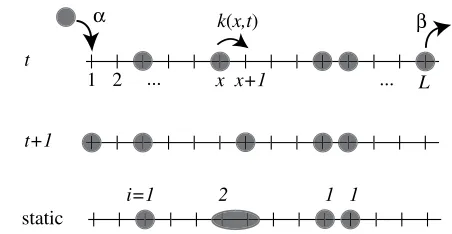
Figure 1. Illustration of the relationship between the TASEP and the hard core lattice gas. In the TASEP particles (grey dots) occupy a one-dimensional lattice, labelled byx=1, . . . , L. A particle can hop from sitexto sitex+ 1 at ratek(x, t ). The system is coupled to an input and an output reservoir with ratesαandβ, respectively. In the equilibrium binary mixture particles on a lattice occupy one (speciesi=1) or two (speciesi=2) lattice sites. The position coordinate of the two particles is taken as the left excluded site.
Finding relationships between equilibrium and non-equilibrium situations is both of fundamental as well as of practical importance; the generalization of the Yang–Lee theory of equilibrium phase transitions to non-equilibrium transition by Blythe and Evans [15] is a primary example of such an achievement; see also [16,17]. Here we investigate a relationship between inhomogeneous equilibrium and driven non-equilibrium systems using the specific example of a monomer-dimer hard core lattice fluid on the one hand and the totally asymmetric exclusion process (TASEP) on the other hand; both are simple one-dimensional models. The relationship is established via associating the one-body distribution functions of one model with those of the other and is (at present) of approximative nature. One particularly fascinating aspect is that DFT can be applied to examine the properties of the TASEP. Our arguments are general and we discuss their applicability to other models.
The TASEP has been studied extensively in the past as a fundamental model for one-dimensional transport [1–3, 18–23], with applications in intracellular transport, traffic and transport in porous media; exact solutions are known [22,23]. Consider a one-dimensional lattice withLconsecutive sites, labelled byx =1, . . . , L. At timeta particle can hop from sitexto the neighbouring sitex+ 1 with ratek(x, t )provided that sitex+ 1 is empty; here we have chosen formally the most general case and allow the hopping ratek(x, t )to vary in space (see e.g. [24]) and time. We consider the case of open boundaries, where site 1 is filled with particles at rateαand siteLis emptied with rateβ; the upper two panels of figure1show an illustration. Introducing the occupation numberτ (x, t )which is unity (zero) if sitexis occupied (empty) at timet, the local instantaneous current distribution is given by the exact expression
j (x, t )=k(x, t )τ (x, t )(1−τ (x+ 1, t )), (1)
where ·denotes an average over an ensemble of realizations of the TASEP. The term on the right-hand side of equation (1) is the product of the hopping rate and the probability of sitexbeing occupied while sitex + 1 is empty; for this combination of occupation numbers a move fromxtox+ 1 is possible without violating the site exclusion condition. The time-resolved local density distribution is obtained asρ(x, t ) = τ (x, t ), and its time evolution is determined by requiring the local conservation of the number of particles, expressed as a continuity equation
∂ρ(x, t )
with the discrete partial derivatives defined as ∂ρ(x, t )/∂t = ρ(x, t + 1)−ρ(x, t ) and
∇j (x, t )=j (x+ 1, t )−j (x, t ). The celebrated mean-field theory for the TASEP is obtained by assuming the factorization of the nearest neighbour occupancy correlations in equation (1),
τ (x, t )τ (x+ 1, t ) ≈ τ (x, t )τ (x+ 1, t ) =ρ(x, t )ρ(x+ 1, t ), and hence taking the current distribution to be
j (x, t )=k(x, t )ρ(x, t )[1−ρ(x+ 1, t )]. (3)
For steady states, where∂ρ(x, t )/∂t =0 and hencej (x, t )=const, this theory predicts the exact out-of-equilibrium phase diagram of the TASEP as a function of the boundary ratesα
andβ [18, 25] (discussed below). Corresponding results for the (inhomogeneous) density profiles are approximative.
Density functional theory (DFT) is a powerful tool for investigating equilibrium properties, in particular of inhomogeneous systems that are exposed to the influence of external potentials
Viext(x)acting on speciesi(in the case of mixtures) [5,6]. Here we focus on one-dimensional lattice systems with space coordinate x = 1, . . . , L as above and denote the occupation numbers of speciesiat sitexbyτi(x). As we treat static properties, there is no dependence on timet. Particles interact with pairwise interaction potentialsVij(x, x′)that act between a particle of speciesiat sitexand a particle of speciesj at sitex′ (and consideringx < x′ suffices). The density profile of speciesiis the grand canonical averageρi(x)= τi(x), and we restrict ourselves in the following to binary mixtures such thati=1,2. In DFT the grand potential is expressed as a functional of the one-body density distributions,ρ1(x)andρ2(x),
as
˜
([ρ1, ρ2], µ1, µ2, T , L)=F ([ρ1, ρ2], T , L)+ i=1,2
L
x=1
Viext(x)−µi
ρi(x), (4)
whereF ([ρ1, ρ1], T , L)is the Helmholtz free energy functional4,µiis the chemical potential of speciesi =1,2 andTis temperature. The equilibrium density distributions are those that minimize the grand potential, i.e. that fulfil the Euler–Lagrange equations
δ(˜ [ρ1, ρ2], µ1, µ2, T , L) δρi(x)
=0, i=1,2. (5)
The value of the grand potential at equilibrium, , is obtained by inserting the solutions of equation (5) for ρ1(x)and ρ2(x) into the grand potential functional, equation (4), i.e. (µ1, µ2, T , L) = (˜ [ρ1, ρ2], µ1, µ2, T , L). The Helmholtz free energy functional F is
conveniently split into the free energy functional of an ideal gas (second term on the right hand side below) and an excess (over ideal) part,Fexc, that is due to interactions between the
particles:
F ([ρ1, ρ2], T , L)=Fexc([ρ1, ρ2], T , L)+kBT
i=1,2
L
x=1
ρi(x)(ln(ρi(x))−1), (6)
wherekB is the Boltzmann constant. The framework as outlined above is exact. In typical
applications,Fexc[ρ1, ρ2] is unknown for a given model fluid (specified byVij(x, x′)), and one has to rely on an approximation for it in order to calculate density profiles and the grand potential (and hence all thermodynamic quantities) for given external potentialsViext(x)via solving (possibly numerically) equation (5).
4 Strictly speaking, for lattice models ˜andFare not functionals but rather functions of the discrete set of variables
In the following we apply DFT to an equilibrium mixture of small (species 1) and large (species 2) hard core particles that occupy one and two lattice sites, respectively. This model can be viewed as a discrete version of the Tonks gas [26]. In detail, the interactions between particles are such that a particle at sitexexcludes particles of both species from sitexand that a particle of species 2 at sitexadditionally excludes particles of both species from sitex+ 1. These exclusion rules are equivalent to pair potentials given byV11(x, x′)= ∞ifx =x′and zero otherwise;V12(x, x′)= ∞ifx =x′and zero otherwise;V21(x, x′)= ∞ifx′−x 1
and zero otherwise; andV22(x−x′)= ∞ifx′−x1 and zero otherwise. Theexactexcess
free energy functional for this model [27–29] is given by
Fexc[ρ1, ρ2]=kBT
L
x=1
[0(ρ1(x)+ρ2(x)+ρ2(x+ 1))−0(ρ2(x))], (7)
where the function(·)is given by0(η)=(1−η)ln(1−η)+ηand can be interpreted as the excess free energy density of a ‘zero-dimensional’ system, i.e. that of an isolated site with mean occupancy numberη. Using equations (4) and (6) and carrying out the derivatives in equation (5) yields the two Euler–Lagrange equations
ρ1(x)=z1(x)[1−ρ1(x)−ρ2(x−1)−ρ2(x)], (8)
ρ2(x)=z2(x)[1−ρ2(x)−ρ2(x+ 1)−ρ1(x+ 1)][1−ρ2(x−1)−ρ2(x)−ρ1(x)]
1−ρ2(x)
, (9)
wherezi(x)=expµi−Viext(x)
kBTis the local fugacity of speciesiat sitex. To lowest
order inρ2(x), corresponding to neglecting interactions between particles of species 2, one
can simplify equations (8) and (9) to obtain
z1(x)=
ρ1(x)
1−ρ1(x)
, (10)
ρ2(x)= z2(x)
z1(x)
ρ1(x)[1−ρ1(x+ 1)]. (11)
We are now in a position to detail the relationship between the two models. Our key finding is that the linearized Euler–Lagrange equation for species 2, equation (11), becomes equivalent to the mean-field expression for the current in the TASEP, equation (3), upon making the following identification of the fields of the two models:
ρ1(x, t )=ρ(x, t ), (12)
ρ2(x, t )=j (x, t ), (13)
z1(x) z2(x)
=k(x, t ). (14)
This mapping exploits an intuitive similarity of the binary mixture and the TASEP: small particles in the binary mixture resemble particles at rest in the TASEP, equation (12). Large particles in the binary mixture resemble particles in the TASEP that move (and hence contributes to the current), equation (13); this is because a successful move fromxtox+ 1 implies that sitexis occupied and sitex+ 1 is empty—a configuration that is enforced in the binary mixture by the extended size of the particle of species 2, see figure1. The ratio
z1(x)/z2(x)is the Boltzmann factor of the free energy cost of an identity (species) exchange
0 20 40 60 80 100
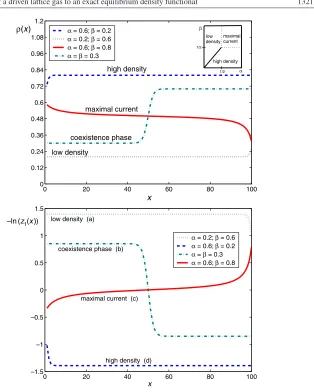
Figure 2. Upper panel. Representative density profilesρ(x)as a function of positionxfor the TASEP with open boundaries. Results are obtained from mean-field theory for a system of sizeL = 100 in the high density phase(α = 0.6, β = 0.2, dashed line), low density phase
(α = 0.2, β = 0.6, dotted line), maximal current phase(α = 0.6, β = 0.8, solid line) and coexistence between high and low density phases(α =β =0.3, dash-dotted line). The inset shows the out-of-equilibrium phase diagram of the TASEP as a function ofαandβincluding high density, low density, maximal current and coexistence (thick line) phases. Lower panel. Local fugacitiesz1(x)of small particles that generate the same density profiles for species 1,ρ1(x), as shown in the upper panel.
(This figure is in colour only in the electronic version)
(species 1) and transforming it into a particle that moves (species 2), see the Lower panel of figure1. We note further that using equation (12) the right-hand side of equation (10) becomesρ(x)/(1−ρ(x))which is known as the ‘auxiliary field’ in the mean-field theory for the TASEP, which we recover here as the local fugacityz1(x)in the binary mixture.
To illustrate the correspondence between the two models, we have calculated the one-body distributions for four typical steady states, as characterized by the input and output rates,
numerical minimization of the density functional, using Picard iteration, and from using a recursion formulation of the mean-field equation for the TASEP. The inhomogeneous local fugacityz1(x)of small particles (shown in the lower panel of figure2) generates the same
density profile for species 1,ρ1(x), as shown in the upper panel for each of the four cases. The non-equilibrium phase diagram of the TASEP includes maximal current phase, high-density, low-density phase and coexistence between the latter, as a function ofαandβ (see the inset of figure2). The phase diagram as obtained from the mean-field theory is exact. It is worth emphasizing that the DFT generates the same phase diagram; this seems at first sight to contradict the rigourous absence of equilibrium phase transitions in one-dimensional models with short-ranged interparticle forces (for a discussion see e.g. [30]). However, closer inspection resolves this puzzle, as the equilibrium problem is stated in a slightly non-standard way. Note that the steady-state conditionj (x, t )=const translates via (12) toρ2(x)=const.
Hence the equilibrium problem consists of solving forρ1(x)andz1(x)given a known field z1(x)/z2(x)and the above condition ρ2(x)= const. Hence the apparent phase transitions
are generated by sudden changes in the external fieldsz1(x)andz2(x). Note that the profiles
shown in figure2are approximate (in particular the exact profile of the coexistence phase has a linear dependence onx).
We are now in a position to generalize the considerations above and to outline a DFT-based approach for driven lattice models other than the simple TASEP, i.e. models that include particles of arbitrary size [31], mixtures of different species, as well as higher spatial dimensions [32]. Given such a model the following steps need to be carried out. (i) To treat particles at rest as species 1 (monomers in the example above) and to introduce new species ithat correspond to moving particles; for hard core models the shape of those particles is obtained from ‘fusing’ the particle shape before the move and that after the move (species 2 of dimers in the example above). (ii) To treat the equilibrium mixture with DFT. There is a variety of approaches to obtain approximate DFTs in cases where the exact free energy functional is unknown; the recent lattice fundamental measure theory [28, 29] provides a particularly powerful means to construct systematically such approximations. (iii) To obtain the Euler–Lagrange equations for the mixture and to identify the hopping rate in the direction iwith the ratio of fugacitieszi/z1, wherez1 is the local fugacity of species 1, andzi is the local fugacity of speciesi.
As an example we sketch the application to the TASEP in two spatial dimensions [32], where particles are driven on a square lattice (x, y) with rate k(x, y, t ) in the positive x direction and behave diffusively in theydirection, i.e. jump with ratek′(x, y, t )in the positive or negativey direction. We keep the above monomers (species 1) and dimers (species 2), and introduce two further quasi-species, whose particles correspond to moves in the positive
y direction (species 3) and negativey direction (species 4). The hard core pair interactions model dimers that are aligned along they direction and are such that particles of species 3 occupy sites(x, y)and(x, y+ 1)and particles of species 4 occupy sites(x, y)and(x, y−1). The approach of [28,29] is well suited to formulate a DFT for this four-component mixture. As above, the density profile of species 2, ρ2(x, y), is identified with the (partial) current
across the ‘bond’(x, y)to(x+ 1, y). The density profiles of the new species correspond to the partial current from(x, y)to(x, y+ 1)(species 3) and from(x, y)to(x, y−1)(species 4). The hopping rates are associated with the local fugacities viak(x, y, t )=z1(x, y)/z2(x, y)
andk′(x, y, t ) = z
in equilibrium DFT proves advantageous, in particular in the case of more complicated models than those considered here.
As a further outlook, it might be interesting to investigate whether one might be able to find, at least on a formal level, a density functional representation that is equivalent to the exact equations of motion of the one-dimensional TASEP, equation (1), rather than the mean-field version (3).
Acknowledgments
We acknowledge useful discussions with A Maciołek, D Mukamel, N B Wilding J F Annett, A J Archer, R Evans and R M L Evans. M S thanks the EPSRC and the German Science Foundation (DFG-SFB TR6/D3) for support. W S B D thanks the British Council for support through a Chevening Scholarship.
References
[1] Schmittmann B and Zia R 1995Phase Transitions and Critical Phenomenaed C Domb and J L Lebowitz (London: Academic)
[2] Mukamel D 2000Soft and Fragile Matter: Nonequilibrium Dynamics, Metastability and Flowed M E Cates and M R Evans (Bristol: Institute of Physics Publishing) p 205, see alsoPreprintcond-mat/0003424
[3] Helbing D 2001Rev. Mod. Phys.731067
[4] Gouyet J, Plapp M, Dieterich W and Maass P 2003Adv. Phys.52523 [5] Evans R 1979Adv. Phys.28143
[6] Evans R 1992Fundamentals of Inhomogeneous Fluidsed D Henderson (New York: Dekker) chapter 3, p 85 [7] Kawasaki K 1994PhysicaA20835
[8] Marini Bettolo Marconi U and Tarazona P 1999J. Chem. Phys.1108032
[9] Marini Bettolo Marconi U and Tarazona P 2000J. Phys.: Condensed Matter12A413 [10] Dzubiella J and Likos C N 2003J. Phys.: Condensed Matter15L147
[11] Penna F, Dzubiella J and Tarazona P 2003Phys. Rev.E68061407
[12] Royall C P, Dzubiella J, Schmidt M and van Blaaderen A 2007Phys. Rev. Lett.98188304 [13] Archer A J and Evans R 2004J. Chem. Phys.1214246
[14] Chan G K L and Finken R 2005Phys. Rev. Lett.94183001 [15] Blythe R A and Evans M R 2003Braz. J. Phys.33464
[16] Brak R, de Gier J and Rittenberg V 2004J. Phys. A: Math. Gen.374303
[17] Blythe R A, Janke W, Johnston D A and Kenna R 2004J. Stat. Mech.JSTAT10(2004)P10007 [18] Krug J 1991Phys. Rev. Lett.671882
[19] Tilstra L G and Ernst M H 1998J. Phys. A: Math. Gen.315033 [20] Chowdhury D, Santen L and Schadschneider A 2000Phys. Rep.329199 [21] Hinsch H and Frey E 2006Phys. Rev. Lett.97095701
[22] Derrida B, Domany E and Mukamel D 1992J. Stat. Phys.69667
[23] Derrida B, Evans M R, Hakim V and Pasquier V 1993J. Phys. A: Math. Gen.261493 [24] Lakatos G, Chou T and Kolomeisky A 2005Phys. Rev.E71011103
[25] Kolomeisky A B, Sch¨utz G M, Kolomeisky E B and Straley J P 1998J. Phys. A: Math. Gen.316911 [26] Tonks L 1936Phys. Rev.50955
[27] Percus J K 1976J. Stat. Phys.15505
[28] Lafuente L and Cuesta J A 2002Phys. Rev. Lett.89145701 [29] Lafuente L and Cuesta J A 2004Phys. Rev. Lett.93130603 [30] Cuesta J A and S´anchez A 2004J. Stat. Phys.115869 [31] Lakatos G and Chou T 2003J. Phys. A: Math. Gen.362027