The Effect of Audit Quality Attributes on the Cost of Equity Capital
(Empirical Study on Manufacturing Companies Listed In Indonesia Stock Exchange Year2014-2016)
Eka Wina Septiana Vita1, Kartika Hendra Titisari2, Anita Wijayanti3 1,2,3
Accounting Department Faculty Of Economics, Universitas Islam Batik Surakarta Jl. KH. Agus Salim No 10, Sondakan, Laweyan, Surakarta 57147 Indonesia
Abstract: This research aims to examine and analyze the effect of audit quality attributes on the cost of equity capital. The audit quality attributes is measure by the size of the public accounting firm, the industry specialty auditor and audit tenure. Meanwhile, the cost of equity capital is measure by using the PE Ratio. The population in this study is all manufacturing companies listed on Indonesia Stock Exchange on 2014-2016. Sampling technique using purposive sampling method obtained by samples 237 companies during the year observation. The result showed that the variable size of the public accounting firm and the industry specialization of the auditor negatively affect the cost of equity capital. Meanwhile, audit tenure does not affect the cost of equity capital. Based on the determination coefficient test (R2) obtained the coefficient of determination with adjusted R2 of 0,527. These result show that 52,7% of variables cost of equity capital can be explained by the size of the public accounting firm, the industry specialization of auditors and audit tenure. While, the rest of 47, 3% is explained by other factors outside the model in this research.
Keywords: [audit quality attributes ; cost of equity capital]
1. INTRODUCTION
The separation of ownership and control of the company caused the asymmetry of information between company managers and investors (Hajiha & Sobhani, 2012). Currently, the transparency and the quality of financial information is the basis of economic decision-making of investors, creditors, and other users. Auditing reduces the information asymmetry that exists between managers and stakeholders of the company by allowing outside parties to verify the validity of the financial statements (Hajiha & Sobhani, 2012).
According (Khurana & Raman, 2004) Audit is a requirement for users of financial statements. The role of the monitoring of audits designed to improve information about the company. This will reduce the asymmetry of information
between the company and investors. The greater the risk of information encountered by investors, the greater the value the quality of audits. Audit information reduces the risk faced by investors because it allows them to verify the validity of the financial statements. Any warranty on the quality audit will lower the cost of equity capital.
Specialization industry Auditors as differential, this strategy gives Auditors a competitive advantage. Thus, the specification of the industry was able to give a better auditor quality. An auditor independence will be lost if there is a very close relationship between the Auditors with clients because it will influence the opinions and attitudes of the auditors themselves.
An auditor independence will be lost if there is a very close relationship between the Auditors with clients
because it will influence the opinions and attitudes of the auditors themselves. One of the most influential is auditing a long tenure.
Auditing a long tenure would give rise to a sense of emotional kinship between the public accounting or with the client as a result, the quality of the audit work the auditor competence and will decrease.
The cost of equity capital is the return expected by investors as they invested money in the company. In other words, the cost of capital earned from trade between risk and return. This is an important fact that must considered by the manager that the risk information is reported to affect the rate of return investors. The risk of information depending on the level of classified information and the accuracy of the information reported.
(Hajiha & Sobhani, 2012) stated that research conducted (Khurana & Raman, 2004), Hope et al (2008), Ahmed et al (2008), Stoke et al (2009) provide evidence of a direct relationship between the different dimensions of quality audits are related positively with a cost of equity capital.
According to (Jensen & Meckling, 1976) in (Setiawan & Daljono, 2014) Agency theory is the relationship that occurs in a contract between a party with other parties. In the contract, there are two parties namely the owner (the principal) and an agent is give a party authorized by the owner to take a decision in accordance with the interests of the principal. Agency theory assumes that all individuals Act in their own interests. Shareholders acting as principals assumed are interested only in the financial result increased or their investment in the company. While the agents assumed to receive gratification in the form of financial compensation and
the terms that accompany such a relationship.
(DeAngelo, 1981) indicated that big Auditors ten to deliver high-quality audit services on certain clients rather than small Auditors because of dependence in economic matters the auditor on the client can be ignored for Auditors and Auditors have great larger losses (losses will lose its reputation) in case of failure of the audit, the Auditors compared to small.
Balsam and Krishnan (2003) in (Desiliani & Meiranto, 2015) says that the auditor specialists tend to invest more in the recruitment and training of staff, information technology and audit technology more sophisticated than the non-Auditors specialist. Industrial specialist Auditors also tend to have an incentive to keep their reputation and avoid damage to reputation. This shows that the specialist auditor industry providing quality higher than the audit the auditor of non-specialist. As a result, they tend to be not in the intervention by representatives of management.
After several years of auditor audit services to clients that will generate a close sense of family then can impact the decline in the quality of financial reporting. Audit the audit resulted in the tenure of high quality, so that should reduce the risk of information and produce a cost of equity capital is lower.
2. THEORITICAL FRAMEWORK
The theoritical framework of this research is illustrated as follows:
H1
H2
H3
Figure 1. Theoritical Framework
3. RESEARCH METHODS
Research method using the method of content analysis, data type used is the quantitative data. The source data used are secondary data. The data collection method used is the documentation. Data analysis technique used was multiple linier regression analysis. The population in this study was all company listed on Indonesia stock exchange year 2014-2016 by using the purposed sampling.
Data Analysis Technique
Data analysis techniques used in this research are as follows:
a. Descriptive statistics on do to get an overview of the variables within a research
b. A classic Assumption Test
1) Test of Normality was done to know that normally distributed data to regression
2) Autocorrelation test was conduct to find out the residual in a single observation.
3) Multicollinearity test aims to find out there or whether the
same relationship between free variables used.
4) The heteroskedasticity test aims to analyze, the occurrence of inequalities between the residual.
c. Multiple linear regression analysis is the technique through a coefficient parameter to know the magnitude of the influence of variables is independent of the dependent variable. The regression model in this research:
Y = α + β1X1 + β2X2 + β3X3 + e
Information:
Y : The cost of equity capital X1 : Size of public accounting
firm
X2 : Auditor Industry Specialities X3 : Audit Tenure
α : constant
β1 - β3 : Regression coefficient e : error
d. The F-test is done to see the impact of influence between independent variables to dependent variables simultaneously
e. T-test was conduct to know the influence of partially dependent variable against the independent variable.
f. Determination of coefficient of test done to measure the proportion of the variation in the free variables in explains zero regression.
4. RESEARCH RESULT
Result of Data Collection
The object of this research is a company listed on Indonesia Stock Exchange in 2014-2016. This research using method of purposive sampling so at 237 companies was outstanding research into the sample. The cost of equity capital measured with PE Ratio.
Public accounting firm size (X1)
Audit specialty industries (X2)
Audit tenure (X3)
Figure 2. PE Ratio
Classical Assumption Test Result The Descriptive Statistics Analysis
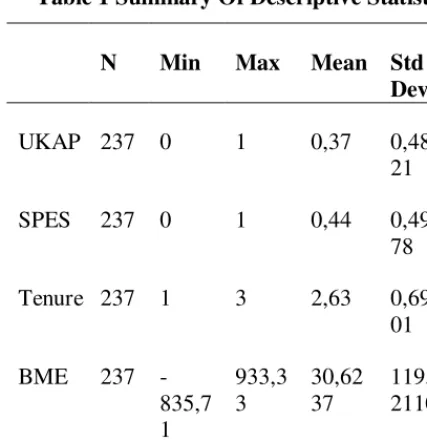
The result of the analysis of descriptive the public accounting firm size, Audit specialty industries, Audit tenure and the cost of equity capital is serving the following:
Table 1 Summary Of Descriptive Statistic
N Min Max Mean Std
Source of Data Processed 2017
The average size of a public accountant at the manufacturing companies listed on the Indonesia stock exchange (IDX) in 2014-2016 of 0.37 standard deviation of 0.48321 to or greater than the average value, thus indicating that research data of the size of the public accountant. The average value of specialization industrial auditors at manufacturing companies listed on the Indonesia stock exchange (IDX) in 2014-2016 of 0,44 with standard deviation of 0.49878 to or greater than the average value, thus indicating that research data of specialization industry Auditors varies. The average of value audit tenure at manufacturing companies listed on the
Indonesia stock exchange (IDX) in 2014-2016 of 2.63 with a standard deviation of 0.69801 or smaller than the average value, thus indicating that the research data audit of tenure does not varies. The average of value of the equity cost of capital in the manufacturing companies listed on the Indonesia stock exchange (IDX) in 2014-2016 of 30.6237 with a standard deviation of 119.02110 to or greater than the average value, thus indicating that the data the study of the equity cost of capital varies.
Table 2 Frequency and Percentage of Dependent Variable
Variable Frequency Percentage UKAP Big 4 SPES Specialty
Audit
Source of Data Processed 2017
Classic Assumption Test
A classic assumption test result that include a test of normality, multicollinearity, heteroskedastic, and autocorrelation are presented in the table bellowed:
Table 3 Summary of Normality Test
Variable N
Source of Data Processed 2017 PE Ratio = Price Per Shares
Form table 3 it is known that the Kolmogorov-Smirnov test showed 0,05 significance. So the regression model has a normal distribution. So in inclusion, normally distributed data and can move on to next test. The next test is the multicollinearity table shown bellow:
Table 4 Summary of Multicollinearity
Varia
Source Data Of Processed 2017
Based on the above table, the value of tolerance all variables are above 0,1 and the value VIF is less than 10 so that it can be concluded there is no Multicollinearity between the variables.
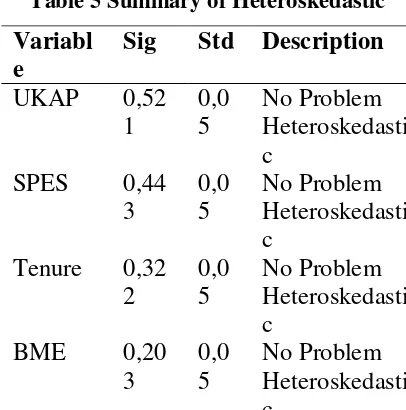
Table 5 Summary of Heteroskedastic
Variabl
Source of Data Processed 2017
Based on the table note that the results of the heteroskedastic on the value Sig Tailed is greater than 0,05 so it can
be said that there are no problem heteroskedasticity.
Autocorrelation test the result can be seen in the table bellowed:
Table 6 Summary of Autocorrelation
D
Sourced of Data Processed 2017
From table 6 above known values of dL is 1,763 and dU is 1,813 and value of 4-dU is 2,187 and 4-dL is 2,237. From the calculation of the value of DW= 2,000 between dU=1,763 and 4-dU=2,237, so that it can be concluded there is no autocorrelation.
Table 7 Summary of F Test
F count
Sig. F table Description
7,453 0,000 2,640 Accepted
Sourced of Data Processed 2017
Based on the above table, the value of F is count 7,453. The value of F tables retrieved from table statistic F test with sig 0,05 with df 1 (number variables-1) = (4-1)= 3 df2 obtained from (n-k-1) = 237-4-1 = 232 (n is the number of data and k is the number of independent variables). The result obtained for F count was 7,453 > F table value 2,640, then accepted the H1 and Ho are rejected.
Table 8 Summary of t Test UKAP
Variable t Sig Stand
Based on a test of t, the t value obtained of -2.027 indicates that the size of the public accountant has a negative direction and obtained the value of Standart < 0.05 (0.01 < 0.05) then the Ha received. It can conclude that the size of the public accountant significantly negative effect on the equity cost of capital.
Table 9 Summary of t Test SPES
Variabl
Source of Data Processed 2017
Based on a test of t, the t value obtained of -1,972 indicates that the audit industries specialty has a negative direction and obtained the value of Standart < 0.05 (0.03 < 0.05) then the Ha received. It can conclude that the audit specialty industries significantly negative effect on the equity cost of capital.
Table 10 Summary of t Test Audit Tenure
Variabl
Sourced of Data Processed 2017
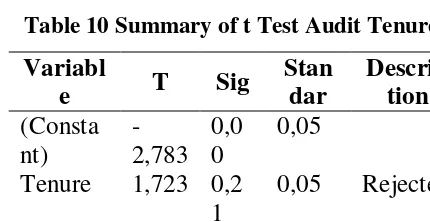
Based on a test of t, the t value obtained from 1.723 audits showed that tenure has a positive direction and obtained the value of sig of > 0.05 (0.212 > 0.05) then Ha was rejected. It can be conclude that the audit of tenure does not affect significantly towards the cost of equity capital.
The result of multiple linear regression analysis using SPSS can be seen the table bellowed:
Table 11. Summary of Multiple linear Regression Sourced of Data Processed 2017
Based on the result of regression analysis obtained by the following equation :
Y=-2.237 – 0.363 X1 – 0.135 X2 + 1.174 X3
Determination of coefficient of test results can be seen in the table bellowed:
Table 12 Summary of Adjusted R Square
R R
0,527 0,88573 Influential 52,7 %
Source of Data Processed 2017
Discussion
a. The effect of size public accounting firm on the cost of equity capital
The size of the public accountant significantly negative effect on the equity cost of capital. The results of this research are consistent with research conducted by (Fernando, Abdel-Meguid, & Elder, 2010), (Desiliani & Meiranto, 2015), (Setiawan & Daljono, 2014). This is because the Big 4 only selecting the best services in the audit. The best service it will give rise to investor confidence. Trust given this will reduce the cost of equity capital. The public accounting firm of the Big 4 is a public accounting firm of a good quality, so it is assume that owned auditor has the ability and attitude of independence. As a result, they tend to be not in the intervention by representatives of management.
b. The effect of auditor's industry specialization on the equity cost of capital.
The auditor’s industry specialization significantly negative effect on the equity cost of capital. The results of this study are in line with research (Hajiha & Sobhani, 2012), (Fernando, Abdel-Meguid, & Elder, 2010), (Herusetya, 2012). According to Balsam & Krishnan (2003) in (Hajiha & Sobhani, 2012) States that the auditor specialists tend to invest more staff training and recruitment services, information technology, and technology audit cutting edge than the Auditors of non-specialists. An auditor who is a specialist in the industry also tends to have an incentive to protect their reputation capital and avoid damage to reputation.
c. The effect of audit tenure on the cost of equity capital
The audit tenure no effect on the equity cost of capital. The results of this study are in line with (Suparno & Kiswara, 2013), (Desiliani & Meiranto, 2015), (Arta & Sari, 2013). According (Desiliani & Meiranto, 2015) stating that there is an indication of a positive relationship between audit tenure with equity cost of capital. Based on the results of the audit of research, tenure can enlarge equity cost of capital. The old Alliance auditor 's assessment can lead to a growing bias against the potential risk of the company can valuated investors increased more than expected rate of return increased.
Conclusion
The results of testing hypotheses 1 and 2 which States the size of the public accountant to the equity cost of capital, and industrial specialties auditor effect on equity capital costs supported by empirical evidence with a level of significance of 5%.
assessment can lead to a growing bias against the potential risk of the company so can valuated investors increased more than expected the rate of return increased.
The company is expect to further realize the importance of the quality of an audit in the future so that conflicts between ownership and control that may cause the information asymmetry and the problems that increase the cost of capital requested by an investor can be overcome. The company can fix these conflicts by publishing credible financial statements.
Suggestions that further research is needed to develop the next can do is research sampling not only from the manufacturing company but also other industries such as LQ45, real estate, banking or telecommunications and increased research into the period of 5 years, so that subsequent research results better.
5. REFERENES
Arta, D. U., & Sari. (2013). Kualitas Audit Dan Biaya Modal Ekuitas Perusahaan Manufaktur Yang Terdaftar Di Bursa Efek
Indonesia. Universitas Sumatera
Utara Journal Of Accounting ,
1-7.
Chang, C. S., Wong, W. T., & Chang, C. Y. (2011). Integration of Project-Based Learning Strategy with Mobile Learning : Case Study of Mangrove Wetland Ecology Exploration Project. Tamkang Journal of Science and
Energy, 14 (3), 265-273.
DeAngelo, L. (1981). Auditor size and auditor quality. Journal of Accounting and Economics,Vol. 3
No. 3 , 183-99.
Desiliani, N., & Meiranto, W. (2015). Pengaruh Ukuran Kantor Akuntan
Publik, Spesialisasi Industri Auditor Dan Audit Tenure Pada Biaya Modal Ekuitas ( Studi Empiris Pada Perusahaan Yang Terdaftar di Bursa Efek
Indonesia Tahun 2010 – 2012). Diponegoro Journal Of Accounting
Vol 4 No 1 , 1-8.
Fernando, G. D., Abdel-Meguid, A. M., & Elder, R. J. (2010). Audit Quality Attributes, Client Size And Cost Of Equity Capital. Review Of
Accounting And Finance ,
363-381.
Hajiha, Z., & Sobhani, N. (2012). Audit Quality And Cost Of Equity Capital: Evidence Of Iran.
International Research Journal
Of Finance And Economics ,
159-171.
Herusetya, A. (2012). Dapatkah Kualitas Audit Mengurangi Biaya Modal Ekuitas Ex- Ante? Jaai Volume
16 No 1 , 48-61.
Houqe, M. N., Ahmed, K., & Zijl, T. V. (2011). Audit Quality, Earnings Management, And Cost Of Equity Capital: Evidence From India.
Https://Ssrn.Com/Abstract=1967293 , 1-39.
Jensen, M., & Meckling, W. (1976). Theory Of The Firm, Managerial Behaviour, Agency Costs & Ownership Structure.
Journal Of Financial Economics ,
305- 360.
Khurana, I., & Raman, K. (2004). Litigation Risk And The Financial Reporting Credibility Of Big 4 Versus Non-Big 4 Audits: Evidence From Anglo- American Countries. The Accounting Review,
Kirana, P. A. (2013). Pengaruh Kualitas Audit Terhadap Cost Of Equity Capital (Studi Empiris Pada Perusahaan Yang Terdaftar Di Bursa Efek Indonesia Tahun 2011). Diponegoro Of Journal Of
Accounting , 1-14.
Li, Y., Stokes, D., Taylor, S., & Wong, L. (2009). Audit Quality, Accounting Attributes And The Cost Of Equity Capital.
Http://Ssrn.Com/Abstract=1481823 ,
1- 32.
Setiawan, J. A., & Daljono. (2014). Pengaruh Kualitas Audit Terhadap Manajemen Laba Dan Biaya Modal Ekuitas. Diponegoro
Journal Of Accounting , 1- 9.
Suparno, D. P., & Kiswara, E. (2013). Analisis Hubungan Antara Atribut Kualitas Audit Dengan Biaya Modal Ekuitas. Diponegoro