THE EFFECT OF COMIC STRIPS TOWARD EIGHTH GRADE
STUDENTS IN RECOUNT TEXT OF MTS MUSLIMAT NU
PALANGKARAYA
THESISProposed to the Language Education Department of the Faculty of Teacher Training and Education of the State Islamic Institute of Palangka Raya in Partial Fulfillment of
the Requirement for the Degree of Sarjana Pendidikan
By:
Nanik Wulandari
1201120790
STATE ISLAMIC INSTITUTE OF PALANGKA RAYA FACULTY OF TEACHER TRAINING AND EDUCATION
LANGUAGE EDUCATION DEPARTMENT STUDY PROGRAM OF ENGLISH EDUCATION
THE EFFECT OF COMIC STRIPS TOWARD EIGHTH
GRADE STUDENTS IN RECOUNT TEXT OF MTS MUSLIMAT
NU PALANGKARAYA
ABSTRACTThe purposes of this research was to measure the effectiveness of using comic strips toward the eighth grade students in recount text of MTS Muslimat NU Palangka Raya. The type of study was quasi-experimental design and the researcher used quantitative approach in finding out the answer of problem of study. The writer
designed the lesson plan, conducted the treatment, and observed the students‟ scores
by pre-test and post-test. The population of this research was class VIIIA, VIIIB and VIIIC in MTs Muslimat NU Palangka Raya. The total of population was 105 students and the sample of this research was 70 students in class VIIIA and VIIIC. The writer applied Independent Sample T-Test calculation to test the hypothesis to analyze the data.
The result testing normality found significance (0.426) that was higher than
significance level (α = 0.05) it could be concluded the data was in normal distribution. The result homogeneity showed that the sigficance observed (0.312) higher than (α =
0.01) it could be concluded that the data was homogeneity distribution. The result of independent sample T-Test with SPSS 21.0 and manual calculation: The result of
tobservedwas 10.322and the ttablewas 2.00 at 5% and 2,67 at 1% . The result of testing hypothesis determined that the Alternative Hypothesis (Ha) stating that there was any significant effect of using comic strips toward the eight grade students in recount text of MTS Muslimat NU Palangka Raya was accepted and the Null Hypothesis (Ho) stating that there was no any significant effect of of using comic strips comic strips toward the eight grade students in recount text of MTS Muslimat NU Palangka Raya was rejected. It meant that there was any significant effect of using comic strips toward the eight grade students in recount text of MTS Muslimat NU Palangka Raya
Key Words: Effect, Comis Strips, Writing Ability, Recount Text.
PENGARUH KOMIK STRIP TERHADAP SISWA KEDELAPAN
DALAM TEKS RECOUNT DI MTS MUSLIMAT NU PALANGKA
RAYA
ABSTRAK
Tujuan dari penelitian ini adalah untuk mengukur efektivitas menggunakan komik stripsterhadap siswa kelas delapan dalam recount teks di MTS Muslimat NU Palangka Raya. Jenis penelitian adalah desain kuasi-eksperimental dan peneliti menggunakan pendekatan kuantitatif dalam mencari tahu jawaban dari masalah penelitian. Penulis merancang rencana pelajaran, melakukan tindakan, dan mengamati nilai siswa dari pre-test dan post-test. Populasi penelitian ini adalah kelas VIIIA, VIIIB dan VIIIC di MTs Muslimat NU Palangka Raya. Total populasi adalah 105 siswa dan sampel penelitian ini adalah 70 siswa di VIIIA kelas dan VIIIC. Penulis menerapkan Independent Sample T-Test perhitungan untuk menguji hipotesis untuk menganalisis data.
Hasil pengujian normalitas ditemukan signifikansi (0,426) yang lebih tinggi dari
tingkat signifikansi (α = 0,05) dapat disimpulkan data dalam distribusi normal. Hasil homogenitas menunjukkan bahwa sigficance diamati (0,312) lebih tinggi dari (α =
0,01) dapat disimpulkan bahwa data itu distribusi homogenitas. Hasil sampel independen T-Test dengan SPSS 21.0 dan perhitungan manual: hasil tobserved adalah 10,322 dan ttabel adalah 2,00 pada 5% dan 2,67 pada 1%. Hasil pengujian hipotesis ditentukan bahwa Hipotesis Alternatif (Ha) yang menyatakan bahwa ada pengaruh yang signifikan dari menggunakan komik strips terhadap siswa kelas delapan dalam recount teks di MTS Muslimat NU Palangka Raya diterima dan Hipotesis Nol (Ho) yang menyatakan bahwa tidak ada pengaruh yang signifikan dari penggunaan komikstrips terhadap siswa kelas delapan dalam recount teks di MTS Muslimat NU Palangka Raya ditolak. Ini berarti bahwa ada pengaruh yang signifikan dari menggunakan komik strips terhadap siswa kelas delapan dalam recount teks di MTS Muslimat NU Palangka Raya.
Kata kunci: Pengaruh, Comis Strips, Kemampuan Menulis, Recount Text.
ACKNOWLEDGMENTS
Alhamdulillah and praise belong to Allah the Almighty, because of HisBlessing and Mercy, the researcher is able to accomplish this thesis entitled:THE EFFECT OF COMIC STRIPS MEDIA ON WRITING SKILL OF RECOUNT TEXT PRODUCED BY THE EIGHTH GRADE STUDENTS OF MTS MUSLIMAT NU PALANGKARAYA.
This thesis is written to fulfill one of the requirements to get title of Sarjana Pendidikan(S.Pd.) in the English Program, the Department of Language Education, the State Islamic Institute of Palangka Raya. Many people have contributed guidance, suggestion, and support to improve the researcher‟s thesis, therefore the researcher would like to express her greatest gratitude to:
1. Dr. Ibnu Elmi A.S. Pelu, S.H., M.H., the Director of the State Islamic Institute of Palangka Raya (IAIN), for his direction and encouragement.
2. Drs. Fahmi, M.Pd the Chair of Faculty of Tarbiyah and Teaching Training for hisagreement so that the writer can complete the requirements of writing this thesis.
3. Dra. Hj. Rodhatul Jennah, M.Pd, The Vice Chairman of Academic Affairs, for hisagreement so that the writer can complete the requirements of writing this thesis.
4. Santi Erliana, M.Pd The Chair of Department of Language Education, for her agreement so that the writer can complete the requirements of writing this thesis.
5. M. Zaini Miftah, M.Pd, The chief of the English Education Study Program, for hispermission so that the writer can complete the requirements of writing this thesis also for his guidance, suggestion, and encouragement during the accomplishment of this thesis.
7. Rita Sukaesih, S.Pd, M.Si. as the headmaster of MTs Muslimat NU Palangka Raya, for the time and opportunity that has been given during the accomplishment of this thesis.
8. Trini Roestiani, S.Pd as the English teacher in MTs Muslimat NU Palangka Raya, for the time and opportunity that has been given during the accomplishment of this thesis.
9. Muhammad Hamdan, S.Pd.I as the English teacher in MTs Muslimat NU Palangka Raya, for the time and opportunity that has been given during the accomplishment of this thesis.
10.All English lecturers of IAINof Palangka Raya for the support. 11.My family who always give support morally and spiritually.
12.Last, all my friends who have helped the accomplishment of this thesis.
The researcher realizes that this thesis is not perfect; therefore some constructive critical and suggestion are warmly welcomed. She hopes that may Allah always keeps us on the straight path, rewards, and blesses us for what we do and this writing can be useful for all of us.
Palangka Raya, November 2016 The Writer
NANIK WULANDARI SRN.1201120790
DEDICATION
This thesis nicely dedicated to my beloved father
Mr. Sakur Kurniawan
and
to my beloved mother
MOTTO
ِِهللِلْيِبَسىِفَوُهَفِمْلِعْلاِبَلَطىِفَجَرَخْنَم
“Barang siapa keluar untuk mencari Ilmu
m
aka dia berada di jalan Allah “
TABLE OF CONTENTS
COVER PAGE ... i
APPROVAL OF THE THESIS ADVISORY COMMITTEE ... ii
OFFICIAL NOTE ... iii
NOTA DINAS ... iv
LIST OF LEGALIZATION ... v
ABSTRACT ... vi
ABSTRAK ... vii
ACKNOWLEDGMENTS ... viii
DECLARATION OF AUTHENTICCATION ... x
DEDICATION ... xi
MOTTO ... xii
TABLE OF CONTENTS ... xiii
LIST OF TABLES ... xiv
LIST OF FIGURES ... xvi
LIST OF ABBREVIATION ... xvii
LIST OF APPENDICES... xviii
CHAPTER I INTRODUCTION A. Background of Study ... 1
B. Problem of the Study ... 4
C. Objective of the Study ... 5
D. Significance of the Study ... 5
E. Variable of the Study ... 6
F. Hyphothesis of the Study ... 7
G. Assumption of the Study ... 7
H. Scope and Limitations ... 7
I. Definition of Key Terms ... 8
J. Frame of Discussion ... 8
CHAPTER II REVIEW OF RELATED LITERATURE A. Previous Study ... 11
1. Definition of Recount Text ... 26
2. Generic Structure of Recount Text ... 27
3. Linguistic Features ... 27
4. Model of Recount Text ... 27
E. Comic Strips ... 28
1. Definition of Comic Strips ... 28
2. Advantages of Comic Strips ... 29
3. Procedure in Teaching with Comic Strips ... 30
CHAPTER III RESEARCH METHOD A. The Place of the Study ... 32
B. Research Design ... 32
C. Population and Sample ... 34
D. Research Instrument ... 35
E. Instrument Validity ... 37
F. Instrument Reability ... 39
G. Data Collection Procedure ... 39
H. Data Analysis Procedure ... 41
CHAPTER IV RESULT OF THE STUDY
A. Research Findings
1. The Result of Pre-Test Score of the Experiment
and Control Group ... 45 a. Description data of Pre-Test Score of the
ExperimentGroup ... 45 b. Description data of Pre-Test Score of the
ControlGroup ... 53 c. The Result of Post-Test Score of the
Experiment Group ... 59 d. Description data of Post-Test Score of the
ControlGroup ... . 66 B. Validity of Pretest and Posttest ... 72
...
C. Reliability of Pretest and Posttest ... 79
D. Test of Normality and Homogeneity ... 83
E. Result of The Data Analyses ... 86
1. Testing Hypothesis Using Manual Calculation .. 87
2. Testing Hypohthesis Using SPSS 21.0 ... 89
LIST OF TABLES
Table 2.1 Rubric Score ... 21
Table 3.1The Scheme of Quasi Experimental Design ... 33
Table 3.2 Sample of Research... 35
Table 3.3 Significant of Content Validity... 37
Table 3.4 Criteria of Validity... 38
Table 3.5Inter Rater Coefficient Correlation and Interpretation... 39
Table 4.1 Pre Test Score of Experimental Group... 45
Tabel 4.2 The Combination of Pre test Score... 47
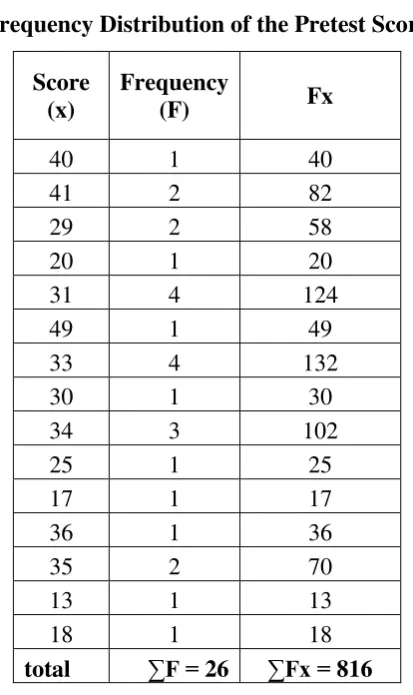
Tabel 4.3 frequency distribution of pre test score... 49 Tabel 4.4 Calculating Mean, Median, Modus, Standar Deviation and StandardError of Pre-Test Score of Experiment Group... 49
Table 4.10 The Combination of Pretest Score...
61
Table 4.11 Frequency Distribution of the Post test Score ...
63
Table 4.12 Calculating Mean, Standard Deviation and StandarsError of
Post Test Scores of Experimental Group...
64
Tabel 4.13 Post Test Scores in Control
Group...66Table 4.14The Combination of Post test
Score...67
Table 4.15 Frequency Distribution of the Post test Score ... 69
Table 4.16 Calculating Mean, Standard Deviation and Standars Error of Post Test Scores of Control Group ... 70
Table 4.17 Pearson Product Moment Correlation of Pre-test in Experiment Group ... 72
Table 4.18 Pearson Product Moment Correlation of Pre-test in Control Group ... 74
Table 4.19 Pearson Product Moment Correlation of Post-test in Experiment Group ... 76
Table 4.20 Pearson Product Moment Correlation of Post-test in Control Group ... 77
Table 4.21Reliability of Pre-test in Experiment Group ... 79
Table 4.23Reliability of Pre-test in ControlGroup ... 80
Table 4.25 Reliability of Post-test inExperiment Group ... 81
Table 4.27 Reliability of Post-test in Control Group ... 82
Table 4.29 Testing Normality Experiment Group... 83
Table 4.30 Testing Normality of Control Group ... 84
Table 4.31 Testing Homogenity Experiment Group ... 85
Table 4.32 Testing Homogenity of Control Group ... 86
Table 4.33 Table forStandard Deviation and the Standard Error of
Posttest in Experiment and Control Group ... 87
...
Table 4.34Mean, Standard Deviation and the Standard Error of
PostTest Experiment and Control group using
SPSS 21. Program ... 88
Table 4.35 The Calculation of T Test Using SPSS 21.0 ... 89
Table 4.36 The Result of T Test Using SPSS 21.0 ... .. 90
LIST OF FIGURES
Figure 3.1 The Schema of Research... 40
Figure 3.2 The Schema of Collecting and Analysis Data... 44
Figure 4.1 The Frequency Distribution of Pre test Score in
Experimental Group... 51
Figure 4.2 The Frequency of Post Test Score in
Experimental and Control Group...
LIST OF ABBREVIATIONS
DF : Degree of Fredom
Ha : Alternative Hypothesis
H0 : Null Hypothesis
MTs : Madrassah Tsanawiyah
EFL : English Foreign Language
NU : Nahdatul Ulama
IAIN : Institut Agama Islam Negeri
SPSS : Statistical Product and Service Solution
SE : Standard Error
SD : Standard Deviation
F : Frequency
X1 : Eksperiment Group
X2 : Eksperiment Class
X : Recount Text
Y : Score
LIST OF APPENDICES
Appendix 1 : Schedule of Research
Appendix 2 : Syllabus and Lesson Plan
Appendix 3 : Comic Strips
Appendix 4 : Students‟ Name
Appendix 6 : Students‟ Result of Pre Test Appendix 7 : Students‟ Result of Post Test Appendix 8 : Letters
Appendix 9 : Curriculum Vitae
CHAPTER I
CHAPTER I
INTRODUCTION
A. Background of The Study
Language is a system of arbitrary conventionalized vocal, written, or
gestural symbols that enables members or a given community to communicate
intelligibly with another.1 The factions of language can be applied in our daily life. Language communication media can be grouped into three basic forms,
namely, written (reading and writing), orally (listening and speaking) and
graphic (drawing and sketching). All of them are very important and has
different way to teach and improve. One of them is writing skill, all people can
transfer their knowledge to the next generations by writing. It shows that,
writing have important roles. Because of that, people will get information by
writing. That is reason, why human being needs to learn writing correctly.
Writing is an important productive skill that can be usedin learning other
receptive and productive skills.2 The purpose of teaching English is to master four skills, they are listening, speaking, reading and writing.Therefore
teachers have to determine the effective strategies to improve their interest
and ability in writing. And the main problem that leads to the low interest in
writing is the lack of media that can give them a big picture of the story they
want to write. English Foreign Language students has a difficulty in making a
brain connecting between their ideas with how to write so they need a media
for making more easy in writing. The use of interesting media also
1
H. Brown Douglas, Principles of Language and Teaching fourth edition. New York: Longman,Inc, 2000.p.5
contributes to the better learning process, both improving students‟
participation and their interest in classroom activity which might lead them
to have better ability in writing.
Writing is a skill which must be taught and practiced. It is an essential
feature of learning a language because itprovides a very good means of
foxing the vocabulary,spelling and sentence pattern. It becomes an
importantaspect of students‟ expression at a higher stage However, writing is
the most painfully and formallylearned of other areas of English in the
NationalCurriculum. When a topic isdiscussed in and English Foreign
Language class, the first problem occurs. English Foreign Language students
tend to spend too much time in finding out an ideaabout the topic given to
write because not all students haveeither the same experience with the topic or
the ability todig ideas very quickly. Furthermore, the following problemcomes
as it is not only difficult in finding out the ideas, butthere is also a problem of
writing dealing with grammar,vocabulary, and coherence because most of
the English Foreign Language students do not get used to use English in their
daily life.
The problem is even greater when the difficulty of writingis supported
by a problem of monotonous English Foreign Language classes. The fact
stated that the teacher tended to use singlepictures and even taught a
writing class in a moretraditional way; teaching writing without any media.
Theseconditions of course led a class to be more monotonous.Problems
occured when the students feel bored to attend a class without media.
Other problems raised in the product of their writing were not merely
Single pictures, indeed, can help students to gain an illustration of the topic.
However, the illustration is not as much as they need as the ideas to write.
Therefore, the students need media to stimulate and to activate their thought
in order to make a better piece of writing, and the media are expected to create
a more interesting writing class. The fact above is from writer‟s experience in
Teaching Practice English II.
Students in level of Junior High School are required tobe able to
understand and create various written texts,monologs, and essays in the
forms of procedure,descriptive, recount, narrative, and report. The researcher
conduct a thorough investigation towards writing, particularlyrecount
writing because a recount text that involvescharacters and events is
suitable with the features of comicstrips that contained continuing
characters involving incertain situations.3
English comic is a media that can be used in every year, since
elementary to senior high school. English comics is one of teaching media that
can make the students to be interesting. The narration of comic is set out
through the layout of the images, and while as a films, there may be many
people who work on one work, one vision of the narrative guides the work.
Comics as an educational tool is tomotivate the students‟ ability. Comic can makes learning process more easy.
Based on the explanation above, this research was important to found the
new media in the learning process. There were some reasons of this study:
1. English comics are able increase the student‟s ability in writing skill
3Eldina, et al., The Effect of Using Comic Strips on the Eighth Grade Students‟
2. English comics is one of the interesting media in teaching writing
skill
3. English comics help the students to expres their ideas in writing skill
To make sure whether or not the students comprehend the English
comics on writing recount text, a study entitles “The Effect of Comic Strips Toward Eighth Grade Students in Recount Text of MTs Muslimat NU Palangka Raya”.
B. Problem of the Study
Based on the things that have been explained in the background of the
study above, the problem of this research:
1. Does the eighth grade students of MTs Muslimat NU Palangka Raya
have better ability in writing recount text with comic strips media?
C. Objective of Study
Based on the problems of the study, the objective of the study wasto
measure whether there was significant improvement on the students‟ writing recount text by using comic strips of the eighth grade students in MTs
Muslimat NU Palangka Raya.
D. Significance of Study
There were two significance of the study in this research: the first was
theoritically, in thistheoritically significance the researcher expects that the results of this study may become a useful evaluation for eight grade MTS
writing recount text. It will also give beneficial contribution for teacher to
recognize their students‟ strategies in writing recount text.
The second was some practically significances. The students will get the
descriptions of their ability in comprehending writing recount text also to
measure the progresses of their ability. The teacher will better prepare the
materials in teaching recount text and know what their students face through
recount text by english comic strips in writing. The Institution was able to
measure the quality of education, explore the strenght and weakness of the
school and plan better teaching programs.The other researcherwill give
contribution as the material for other researcher and the library references.
E. Variable of the Study
According to Arikunto, variables are the object ofthe research.4 There were two variables in this study,as follows:
1. Independent variable : comic strips media used in teaching recount
text (X)
a. X1 : experiment group is the group where used comic strip media
to teach recount text
b. X2 : control group is the group where comic strip media will not
be applied
2. Dependent variable : Score of writing that involved in this study (Y)
F. Hyphothesis
The hyphothesis of this study as follows:
4
(+) Ha: The students taught recount text by using comic strips have
better ability in writing recount text than the students taught
recount text by non comic strips at the eighth grade students
of MTs Muslimat NU Palangka Raya.
(-) Ho: The students taught recount text by comic strips does not
have better ability inwriting recount text than the students
taught recount text by non comic strips at the eighth grade
students of MTs Muslimat NU Palangka Raya
G. Assumption of The Study
In this study, the researcher assump the students‟ writing skill of
recount text will improve with using of comic strips in the classroom.
H. Scope and Limitation
The study was to measure the effect of comic strips especially to
improve student ability in writing recount text with the material for the eighth
grade students. It based on the syllabus at the eighth grade students ofMTs
Muslimat NU Palangka Raya. The subject of this study were the eighth grade
students of MTs Muslimat NU Palangka Raya in academic year 2016/2017.
I. Definition of Key Terms 1. Effect
Effect is something about as a result. That also mean a change of
effect comic strips media on writing skill of recount text at the eighth
grade students
2. Writing
Writing is a series of related text-making activities: generating,
arranging and developing ideas in sentences: drafting, shaping, re-reading
the text, editing and revising.5 In this study writing is writing recount text in the term of paragraphing that made by the students at eighth grade of
MTs Muslimat NU Palangka Raya.
3. Recount Text
Recount text is a story that retells past events, usually in the order
which they happened. There for the experience of the readers themselves,
such as their adventure and their day‟s activities. In this study recount text
means writing that made by the students at eighth grade of MTs Muslimat
NU Palangka Raya or that used in this study.
4. Comic Strip
Comic strip is a sequence of drawings arranged in interrelated panels
to display brief humor or form a narrative, often serialized, with text in
ballons and captions.
J. Framework of Discussion
The frameworks of the discussion of this study were:
Chapter I: Introductionwhich consisted of background of the study,
previous study, research focus, problem of study, objective
of study,significance of study, variables of the study,
hypothesis, assumption of the study, scope and limitation
5
of the study, definition of key terms and framework
discussion.
Chapter II: Review of related literature which consisted of related
study
Chapter III: Research method consisted of research design, population
and sample, research instrument, data collection procedure,
CHAPTER II
REVIEW TO RELATED
CHAPTER II
REVIEW OF RELATED LITERATURE
In this section, the researcher briefly review the broad perspectives that have
shaped the previous study, the process of writing, the nature of writing, the element of
writing, the teaching of writing, definition of recount text, comic strips, comic strips
as an instructional media of teaching, and comic strips a a media in teaching recount
text.
A. Previous Study
There is previous study to support this study as follows:
Eldina, et al, “The Effect of Using Comic Strips on the Eighth Grade
Students‟ Recount Writing Achievementat SMPN 1 Jember in the 2013/2014
Academic Year” This research was a quasi-experimental research with post-test only design. The purpose of this research was toinvestigate
whether or not there was significant effect of using comic strips on the
eighth grade students‟ writingachievement. The result of the data analysis proved that comic strips had a significant effecton the eighth grade students‟
recount writing achievement. It was verified by the value of significant
column of Lavene‟stest which was 0.036. Because it was lower than 0.05, the null hypothesis (H0) was rejected, and the alternative hypothesis(Ha) was
accepted.6
Lili Purwanitasari“Using Comic Strips To Improve The Ability Of Students Of SMP Negeri 2 Malang In Writing Recount” This study used
6Eldina, et al., The Effect of Using Comic Strips on the Eighth Grade Students‟
Recount Writing Achievementat SMPN 1 Jember in the 2013/2014 Academic Year. Jember: Jember University:2014
collaborative classroom action research. The researcher together with the help
of classroom English teacher designed the lesson plans and set the criteria of
success. The classroom English teacher acted as the observer during the
teaching and learning process while the researcher taught in the class. The
research was conducted in two cycles. Each cycle consisted of two meetings
which covered: planning an action, implementing the action, observing the
action, and reflecting on the observation.
The researcher introduced comic strips during the implementation of the
action. It was followed by modeling how to make outlines from comic strips
before starting writing, how to write the draft, how to revise the draft, and how
to write the final product. In addition, the students are also asked to produce a
recount composition through the writing process: prewriting, drafting, revising
and final version. The result of the research showed that comic strips
successfully improved the students‟ ability in writing recount text especially in
terms of content, language use, and spelling. The scores of the students‟
writing products improve significantly from preliminary study to Cycle I and
from Cycle I to Cycle II on content, language use, and spelling.7
The similarities between their research with this research is conduct on
writing recount text and using comic strips media. Although has a differences
that is the second previous studies using collaborative classroom action
research and using cycle 1 until cycle 2 to analyze the data.
7
Lili Purwanitasari “Using Comic Strips To Improve The Ability Of Students Of SMP
B. Writing
1. The Nature of Writing
There are some definitions about writing. Dullay states that writing is
only mode in which both linguistics manipulation task and communication
task have been given.8Fauziatialso gave statement that writing as a process is oriented to words work progress and the development of new skills, rather
than merely evaluative task, the classroom practices, therefore, will vary from
each other.9 In other words, Nunan also stated that writing activity as commonly conceived, is a highly sophisticated skill combining a number of
diverse elements, only of which are strictly linguistic.10
Donn stated that writing is culturally specific learnedbehavior. We learn
to write if we are members of a literate society and if only someone teaches
us.11 According to Hornby, writing is an activity or occupation of writing.12 Based on the statements, it can be concluded that writing is an active
Productive more clearly; writing is an act or process to produce some
infomation in their mind that should be expressed into writing form. Writing
will be the best if the students guide on the rules defined. It usually refers to
contents, organization, grammatical, usage and mechanics, sentence structure,
mastery on vocabulary and so on.
2. Elements of Writing
There were five elements of writing, there were:
8
Heidi Dullay, et al. Language two. New York: Oxford University Press, 1982, p. 226.
9
Endang Fauziati,. Teaching as a Foreign Language. Surakarta: Muhammadiyah University Press, 2002, p.151.
10
David Nunan, Language Teaching Methodology. A Text Book for Teachers, Sidney: Practice Hall International, 1988, p. 69.
11
Bryne Donn. Teaching Writing Skill, England : Long Man 1979, p. 334.
12
a. Central Idea
This element of good writing involves focusing on a clear,
manageable idea, argument, or thesis around which to organize your
material. It includes selecting subordinate ideas that support and
reinforce your central idea. The important point of central idea: 1)
Purpose or central idea is sufficiently limited for meaningful
discussion. 2) Central idea is clearly stated, normally in the opening. 3)
All subordinate ideas relate clearly to the central idea.
b. Organization
This element of writing has to do with coherent arrangement of
material. It involves keeping the reader oriented to the central and
subordinate ideas. Good organization is logical and sequential. It
guides the reader between divisions of the material. The important
point of organization: 1) Introduction orients the reader to the central
idea and the line of reasoning. 2) Material is arranged in a logical and
coherent sequence; subordinate ideas are effectively identified.
ransitions are clear and helpful. 3) Conclusion or closing summarizes
the argument, emphasizes the central idea, and leaves the reader with a
sense of completion.
c. Supporting Material
Explanations, examples, statistics, and quotations make the
ideas and information presented meaningful and memorable for the
reader. In exposition, the role of supporting material is to clarify; in
Examples are relevant, specific, detailed, sufficient, and persuasive. 2)
Quotations support the argument.
d. Expression, Word Choice, And Point Of View
Language is clear, specific, accurate, and appropriate to the
audience, purpose, and material. Variety in sentence structure and
length creates emphasis. The important point of expression, word
choice, and point of view: 1) Word choice is clear, specific, accurate,
unassuming, and free of clichés and misused jargon. 2) Sentences are
free of wordiness and ambiguity.
e. Spelling, Grammar, and Punctuation
This element of good writing counts only when it‟s wrong. Fair
or not, your reader will notice your spelling, grammar, or punctuation
only when you make a mistake. The important point of spelling,
grammar, and punctuation: 1) Spelling, including technical terms and
proper names, is correct. 2) Correct words are used to convey the
intended meaning. 3) Generally accepted rules of grammar and syntax
are followed, including pronoun/noun agreement, subject/verb
agreement, appropriate verb tense, pronoun case, possessive forms,
parallel construction, etc. 4) Punctuation, particularly
commaplacement, reflects standard usage. 5) Copy is free of
mechanical errors and mistakes in proofreading.13
3. The Process of Writing
The process of writing is a time for people to express and share
their thoughts until they have expressed their ideas clearly. Teachers can
13
help students to write more effectively through giving motivation or
creativity teaching. There are three major stages in writing process. They are
prewriting, drafting, and editing.
a. Prewriting.
Prewriting is the initial step which covers all activity the
researcher does before actually starting to write. This step is to make
a plan or an outline about what to write and how to write. Here, the
researcher brainstorms the ideas and determines the topics. This step
helps students to make the writing will be complete andcoherent.14 The techniques include free-writing, outlining, note taking of
discussion or thinking process, writing a thesis statement and
conducting research if necessary.
b. Drafting.
In this step, the topics and ideas from prewriting is
developed. It concern with developing the paragraph.The paragraph
is usually the development from one topic that is expressed in the
topic sentences. A draft usually contains many paragraphs that were
developed from existing topics in prewriting.15 A first draft puts ideas down on paper for the first time. The researcher may write as
much as possible in accordance with a predetermined topic until
find the most appropriate sentence. In this stage, some people
aim for perfection when they write a first draft, the writer
wants to get everything correct.
14
George E. Wishon&Julia M. Burks. Let‟s Write English, Revised Edition. New York: LettonEducational Publishing.1980, p.371
15
c. Editing.
the message and the coherence of the paragraph. Here the ideas and
the organization can be concerned more. Moreover, it can be used
to correct errors including grammar, spelling, punctuation, and
capitalization.
Based on the theories about writing process, it can be
concluded that the process of writing has three major stages, they are
pre writing, drafting, and editing. (1) Prewriting is the initial step
which covers all activity the researcher does before actually starting
to write. This step is to make a plan or an outline about what to
write and how to write. (2) Drafting is the process that the topics
and ideas from prewriting is developed.The paragraph is usually
evaluates the draft that the researcher has made. Those evaluated are
the word choice, paragraph structure, and organization. It can be
done by independently, peer reviewer, or consult the expert
(teacher). It helpsthe researcher to know what comes across well and
what seems confusing.
4. Writing Assessment
The term assessment refers to the wide variety of methods or tools that educators use to evaluate, measure, and document the academic
readiness, learning progress, skill acquisition, or educational needs of
students. Internationally, assessment is alternated as the nature of teaching
and learning in post-compulsory education changes.17 a. Process Assessment
This step aims to giving information about students‟
performance. There are three kinds of measurements:
1) Writing process checklist is formatting for observing
student‟s writing, and as a teacher uses note to students‟
writing process stage.
2) The discussion on aspects of the writing process. In this
kind, the teacher and students to discuss about student‟s
writing, include topic selection, prewriting activities,
word choices, type of revision, etc.
3) Self-assessment is persuading students to think their
writing process.
17
b. Product Assessment
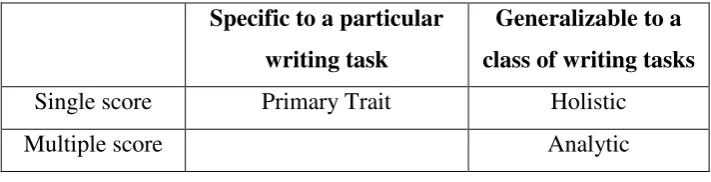
Single score Primary Trait Holistic
Multiple score Analytic
In this researchusedanalytic scoring that appropriate to assessing
recount short paragraph. Analytic scoring is a scoring procedure in a piece of
writing with referring to a list sub skill. In addition, rated on several aspect of
writing that has a single score.There are five aspects are content,
organization, vocabulary, language use, and mechanics.20
Based on the procedure of implementation above the researcher
should has criteria or scoring guide that had been prepared before do
evaluation. The researcher prepared the scoring guide for recount paragraph
writing as follows:
Table 2.1
Scoring Guide for Recount Paragraph Writing
18
Laila Tanor, The Effect Guided-Questions Strategy on the Students’ in Writing Recount Text at the Tenth Grade of SMA NU Palangka Raya, Unpublished Thesis, Palangka Raya: IAIN Palangka Raya, 2015, p. 25.
19
Sara Cushing Weigle, Assessment Writing, Atlanta: Cambridge University Press, 2002, p. 109.
20Ibid,
No The items to be evaluated
Score Description
1 Content orientation 7 Show the complete parts of orientation that are the people involved, the time, the places and the situation which make the readers understand and interest to read a story
6 Well focused idea based on the topic of an activity. Does not show one part of orientation, e.g there is no place. Therefore the readers have not received the complete information from the story.
5 The researcher focuses idea based on the topic of an activity. Does not show two parts of the orientation, therefore thereaders get confused the story given.
4 The researcher focuses idea based on the topic of an activity. Does not show three parts of the orientation, therefore the story is hard to understand for the readers.
3 The researcher not focuses idea based on the topic of an activity.Directly explains the events without orientation. The researcher not focuses idea based on the topic of an activity.
2 Sequent of events 7 State two events/more in a logical and has write in each events that makes the story flow in coherence.
6 Stated two events but has no unity in each event that disturbsthe coherence of story.
5 Stated only one event and the story have unity so the story is easy to understand
4 Stated only one event and the story have to unity so the story is not easy to understand.
are signals the end, summarize the story and leaves his/her comment. Therefore, readers get the idea of story
6 The idea of personal opinion about the topic or event is clear.Does not show one part of re-orientation, but the reader still get the idea of the story summary so the reader do not realized that story is finish paragraph but the meaning is not obscured
10 4-6 errors of words form such as noun, action verbs, conjunction and adjective show in the paragraph and the meaning is not obscured. 5 7-9 errors of words form such as noun, action
verbs, conjunction and adjective show in the paragraph and the meaning is not obscured. 1 More than 9 errors of words form, so the
5 Grammar 15 The paragraph contains complete sentences and correct in form of past tense.
10 Mostly complete sentence, there are 1-3 errors in form of past tense evaluated in form of past tense.
6 Spelling 15 The words are correct in writing, so the writer is good in
spelling.
10 Makes 1-3 errors in spelling in the story. 5 Makes 4-6 errors in spelling in the story 3 Makes 7-9 errors in spelling in the story 1 More than 9 errors in spelling in the story
7 Punctuation 15 The paragraph shows that there are no mistakes in punctuation and capitalization so the paragraph is exceptionally easy to read.
10 The paragraph shows that 1/2 mistakes in using punctuation and capitalization but the paragraph is still easy to read.
5 The paragraph shows that 3/5 mistakes in using punctuation and capitalization but the paragraph is still easy to read.
3 The paragraph shows that 5/7 mistakes in using punctuation and capitalization but the paragraph is still easy to read.
C. The Teachingof Writing
Related to the aim of the teaching and learning English in Indonesia as
mandated by theNational Curriculum, especially in, writing in junior high
school is aimed to improve the students‟ communicative competence both
spoken and written to achieve the functional stage literacy.21 So, there are two forms of language, spoken and written that should be learned by student
as stated in the curriculum.
Teaching writing is different from teaching speaking. The differences
are the characteristic of the language use for communication.22 It is easy to convey the meaning in speaking because the speaker faces the listener
directly. If the listener doesnot understand what the speaker, means she or he
can repeat and use gesture to help the listener understand the meaning. Unlike
speaking, writing is more complicated because it is not only arranging
words into sentences but also make it meaningful and coherent
sentences.23
In writing, the researcher should use the appropriate word to make
readers understand what the researcher wants to tell. The researcher should
also use the correct grammar in order not to make readers confused when they
read the writing. The teachers' role in teaching writing class is to provide
understanding to the students that writing is a form of language for
communication in written text. It may provide an opportunity to help
21
National Education Department (Depdiknas), Kurikulum 2006 Standar Kompetensi MataPelajaranBahasa Inggris(Jakarta: Depdiknas, 2006). p. 278
22
Penny Ur, A Course in Language Teaching, (Cambridge: Cambridge University Press, 1996). p.159
23
students to improve their vocabulary and helps students to choose an
appropriate grammar and language use in their writing so their writing can be
understood easier.
The purpose of writing is the expression of ideas and the
presenting a message to the reader. Therefore, the most important thing of the
writing is the idea. In addition, the writer also requires to notice to the
formal aspects: neat handwriting, correct spelling and punctuation, as well as
acceptable grammar. The main role of the teacher is to teach students to make
an order of sentences which express their meaning most effectively.
D. Recount Text
1. The Definition of Recount Text
According to Hyland, recount is a kind of genre that has social
function to retell event for the purpose of informing or entertaining. The
tense that used in recount text is past tense.24Recount text is a kind of text that retell past events, usually in the order in which they occurred, to
provide the audience with a description of what occurred and when it
occurredand it is presenting series of events. When referring to the
information in the school books, recount text is a text that telling the
reader about one story, action or activity.
Based on the definition of recount about retelling events for the
purpose of informing or entertaining, a recount text has text organization
24
that consists of three parts. They are classified into orientation that provides
the setting and introduces participants about the background information
answering who, when, where and why: events which are about what
happened and in what sequence:and re-orientation which is optional-closure
of events.
2. The Purpose of Recount Text
A recount has social function. Recount “tell what happened”. The
purpose of social recount is to document a series of events and evaluate
their significance in some way. It is also to give the audience a descriptions
of what occurred and when it occurred. The purpose of the literary or dtory
is to tell a sequence of events so that it entertains.
3. Generic Structure of Recount Text
a. Orientation : tells who was involved, what happened, where the
events took place, and when it happened.
b. Events : tell what happened and in what sequence.
c. Reorientation : consists of optional-closure of events/ending.
4. Language features of Recount Text
a. It is written in the past tense (she yelled, it nipped, she walked)
b. It is made of words which connect events in time, such as next,
later, when, then, after, first, at the same time, as soon as she left,
late on friday)
c. Recounts describe events, it is made of verbs (action words), and
of adverbs (which describe or add more detail to verbs)
d. The details are often chosen to add interest or humour to the recount.
f. The passive voice may be used, (Factual Recount)
Here the example of recount text:
Our trip to the blue mountain
Orientation On Friday we went to the Blue Mountains. We stayed
at David and Della‟s house. It has a big garden with
lots of colorful flowers and tennis court.
Event 1 On Saturday we saw the Three sisters and we went on the scenic railway. It was scary. Then, Mummy and I
went shopping with Della. We went to some antique
shops and I tried in some old hats.
Event 2 On Sunday we went on the Scenic Skyway and it rocked. We saw ockatoos having a shower.
Reorientation In the afternoon we went home.
E. Comic Strips 1. Definition
The word “comic” is taken from the Greek “komikos”, which
means funny or cute. Yunus states that picture in comics that are related to
establish a series or sequences and the function is to tell stories or sequence
event. Thus, comic is as a picture story in which each picture is stated in a
box. It is the series of one story of picture, and in general, it is complicated by
words that are texted in balloon above the speaker head to indicate the speaker
speeches.
Comic strips are a short series of funny drawings with a little text which
or a cartoon with words in balloon and captions. They are made of three or
four pictures in the box that tell a story with one or more characters.
Some comic strips tell different events every day. In other comic strips, the
stories are presented day to day continuously and give complete humor ideas
each day until it is finish. And then with the same characters, it starts a new
story.25
2. Advantages of Comic Strips as An Instructional Media
25Noemi Csabay “Using Comic Strips In Language Classes”
One of visual aids that can be used to teach language as a media is comic
strips. Comic strips also has several advantages:
a. Effective to clarify information because clear picture help to
understanding the material easier. In addition, since it is a kind of
picture, comic strips can give information about a complicated
story through a few pictures. So that it can help students to
clarify the message and avoid the misunderstanding in getting
the information.
b. Comic strips have sequence picture in some box that tell story
step by step, so that it can help students to understanding the
message easier.
c. Comic strips also help students to learn to choose an appropriate
word to present their idea. It seems that using comic strips as a
media can increase the students‟ vocabulary and language use.
d. Comic strips are possible to give a response and comments about
events and issues that are going on in the news. So students can find
other knowledge outside the classroom on issues that are happening
in the news.
e. Comic strips help the students to generate ideas for their writing.
Each strip is three or four panels of pictures that have own
events. Thus it works as a stimulus for the students in the
pre-writing process.
f. Comic strips enable to help students to determine the organization of
the text. It is orientation, events, and reorientation.
The procedures of writing:
a. Pre-writing
1) Introducing recount text
2) Brainstorming their ideas about holiday
3) Introducing purpose, example and pattern recount text
4) Introducing concept of comic strips
b. Whilst-writing
1) Choose one of holiday experiences
2) Write the recount story with applying the comic stripsto a recount
paragraph (Drafting). The steps of applying Comic Strips to teach
recount text, they are:
(a) For Orientation Paragraph
It consists of the title, for example “My Holiday in Tangkiling Hills”. In this step, the teacher ask the students to
draw the tangkiling in first box af comic strips. Then, it consists
of who was involved, what happened, where the events took
place, and when it happened.
(b) For Events
Every recount story has events, in this learning process the
students draw their every best moments of their holiday then
write in the events paragraph. In writing this part, the teacher also
explained about past form especially in form of verb 2. After
that, guidence the students to connecting their sentences with
(c) Re-Orientation
This part consists of optionalclosure of events/ending. For
example “we back home after climbed..., it was an amazing holiday, We were very happy with our holiday.” The teacher
guidance what are their feel when they holiday into setence of
re-orientation.
c. Post-writing
1) Final draft
CHAPTER III
CHAPTER III
RESEARCH METHOD
In this part, the researcher described about research method that used in
conducting the research. The purpose was to answer the problem of the study. This
chapter consist of research design, population and sample, instruments of the study,
instrument try out, validity, reliability, normality, homogenety, data collection
procedures, and data analysis.
A. Place of The Study
The place of the study was in Mts Muslimat NU Palangka Raya at Pilau
Street. Madrasah Tsanawiyah Muslimat Nahdatul Ulama‟ built on 1994 in Palangka Raya, it under the Yayasan Pendidikan Muslimat NU (YPMNU) that leading by Hj.
Rasyidah Basri. It also has other education instution there were: Raudatul Atfal (RA),
Madrasah Ibtidaiyah (MI) and Madrasah Aliyah (MA). MTs Muslimat NU got “A” accreditation on 15thJuly 2007.
B. Research Design
In this study, the researcher used quasi-experimental design. Quasi
experimental design was similar to randomized experimental research in that
involve manipulation of an independent variable but differ in that subjects
were not randomly assigned to treatment group.26 There was many situations in educational research in which not is not possible to conduct a true
26
Donald Ary, Jacobs & Razavieh, Introduction To Research In Education. (Eight Edition). United Stated: Wadsworth Cengange Learning. New york: CBS College Publishing, 2010, p.316
experiment neither full control over the scheduling of experimental conditions
nor the ability to randomize can be always realized.
This design was compatible with the research purpose which wants to
evaluate the effect of using comic strips media in teaching writing recount
text. To observe the data about the students achievement in writing skill, the
researcherobtained the data from the result the students‟ score both in pre-test and post-test. The researcher used nonrandomized control group
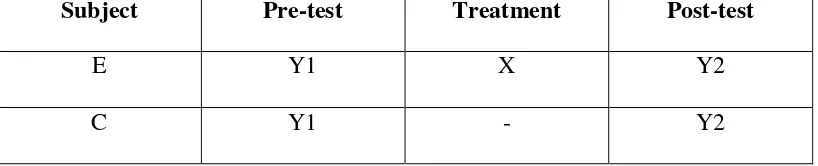
pre-test,post-test design with a kind of treatment. There was two groups in this model,
control group and experiment group. Both groups given pre-test to measure
the score of students before treatment given ( Y1 and Y1). The treatment will
be given for experiment group (X). Post test given for both groups to meaure
the students score after treatment was given (Y2 and Y2). The scheme of this
model:
Table 3.1
The Scheme Of Quasi Experimental Design Nonrandomized Control Group, Pre-Test And Post-Test Design
Subject Pre-test Treatment Post-test
E Y1 X Y2
C Y1 - Y2
Where :
E : Experiment group C : Control group
In the present study, the researcher taught the students directly with the
same material. Therefore, the used of comic strips media was apply on
The researcher implement comic strips media for the experiment group in
four-hour of english class. The researcher provide the taught learning by comic strips
media for the students to get in involved in the class and essay task with some
procedures. The control groups work with conventional method use text only in
learning recount text.
C. Population and Sample
1. Population
A population was defined as all members of any well-defined class of
people, events objects. If someone wants to research all of the elements in
research on census study.27 Population was the larger group to which a researcher wishes to generalize.28The population of this study was all of the eighth grade students in MTs Muslimat NU Palangka Raya. There was
three class of the eighth grade VIII-A, VIII-B, VIII-C in academic year
2015/2016. Every class has 35 students, so the population in this research
was 105 students.
2. Sample
Sample was a part of population. According to Ary, “Sample is a group selected from population for observation in a study.29For the sample, the researcher took two classes to be the sample, the first class was
experiment group used Comic Strips media and the second class was
control group non-use Comic strips media. According to Ary, it is very
27
Donald Ary, et.al, Introduction to Research, p.311
28
Ibid, p.647
29
difficult, if not impossible to list all the members of a target population and
select the sample from among them.30
Therefore, the researcher used cluster sampling. Because the unit
chosen was not an individual but a group of individuals who was naturally
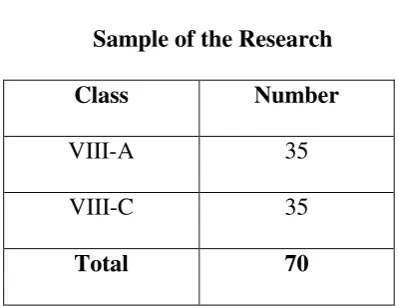
together orgrouped by the school.31 Those was the students of VIII A and VIII C.
Table 3.2
Sample of the Research
Class Number
VIII-A 35
VIII-C 35
Total 70
D. Research Instrument
The data needed for this study would be gathered by test and research
instrument try out. The researcher used the achievement test. Achievement test
was widely use in educational research,as well as in school system. It used to
measure what individual have learned. Achievement test measure mastery and
profiency in different area of knowledge. The researcher construct the
question by itself.
1. Test
30
Donald Ary, (et all) Introduction To Research In Education Eighth. United State : Wadsworth (Engage Learnoing, 2010), p.154
31
Test was measurement tool that very important for education
research.32 This study usedcomic strips for writing test about recount text. The researcher collected the data from pretest and post-test.
From them find the effect of comic strips media on writing recount
text. Pretest was given in first before treatment. The last test was
post-test. It aimed to compare the pre-test scores to the post-test
scores. In the treatment the researchertaughtrecount text with comic
strips media for find the effect to the student‟s score. 2. Documentation
Documentation was one way to support the data with directly from
the place of research, activity, photos that the relevant research and
data. The researcher collected some information data classes, the
students‟ name list, syllabi, and score of students. All those data
would collect from the documents that available at MTS Muslimat
NU Palangka Raya.
E. Instruments Validity 1. Content Validity
Content validity was a requirement of the test performance that being
to measuring.33 The researcher usedrecount text test that is based on syllabiof the first semester. The test measured the students‟writing ability.
32
Arief Furchan, Pengantar Penelitian Dalam Pendidikan,Yogyakarta: Pustaka Pelajar,
33
Table 3.3
Significant of Content Validity
Competence
Standard Material Type of Test
Kind of
Face validity was a design to achieve the performance on the test.34 In this study, the test items used English and suitable on the syllabi of English
subject in MTS Muslimat NU Palangka Raya, with following:
a. Writing test instruction on the test.
b. Scoring system for evaluation the test.
c. Writing recount text for the kind of the test.
d. The language of items is English.
e. The test is suitable on the syllabi.
3. Construct Validity
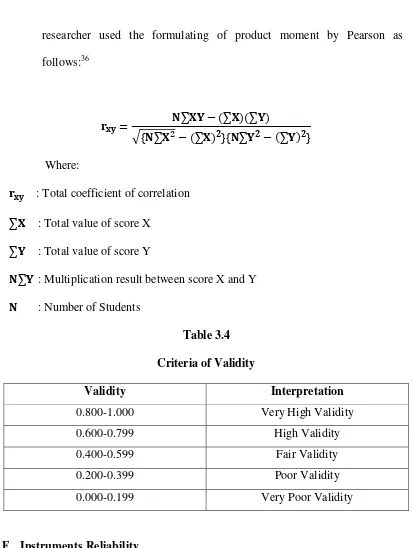
researcher used the formulating of product moment by Pearson as
Reliability refers to the consistence of score.37 In this study, the researcher employed on two raters. They are the researcher self and the teacher.The
coefficient and interpretation of inter rater reliability according to Djiwandono
as show in table 3.5:
36
Ridwan, Metode dan Teknik Menyusun Thesis, Bandung: Alfabeta, 2007, p. 110.
37Ibid,
Table 3.5
Inter-Rater Coefficients Correlation Interpretation
Correlation Coefficient Interpretation
0.90 to 1.00 or -0.90 to -1.00 Very High or Negative Correlation
0.70 to 0.89 or -0.70 to -0.89 High Positive or Negative Correlation
0.50 to 0.69 or -0.50 to -0.69 Moderate Positive or Negative
Correlation
0.30 to 0.49 or -0.30 to -0.49 Low Positive or negative correlation
0.00 to 0.29 or -0.00 to -0.29 Little if any Correlation
After doing inter-rater realibility, the researcher examined the reability of
the items by using Alfa Cronbach Technique.
G. Data Collection Procedure
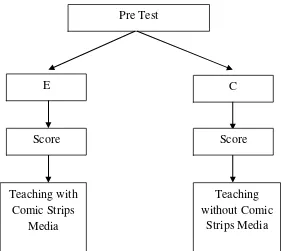
In this research, the researcher used schema for conducting the research. The
figure below:
Pre Test
E C
Score Score
Teaching with Comic Strips
Media
Teaching without Comic
Figure 3.1 The Schema of Research
In this study, the researcher used some procedures to collect the data. The
procedures consists some steps as follows :
1. The researcher gave pre-test to the experiment group (E) and control group
(C).
2. On the contrary, the researcher taught recount text to the experiment
group by using comic strip media and taught recount text tothe control
group by using non-comic strip media.
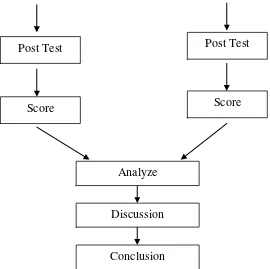
H. Data Analysis Procedure
The researcher analyse the data with a few of way, they are :
1. The researcher collected the result of the test
2. The researcher gave score for the students that suitable with the criteria
3. The researcher arranged into the table of students‟ score Analyze
Score Score
Post Test Post Test
Discussion
4. The researcher collected the score of the student work sheet result. With
the table:
Code of Students Experimental Class
Y X
SUM (∑)
Where:
Y : Pre-test
X : Post-test
5. Tabulating the data into the distribution of frequency of the score table,
then found out the mean of students‟ score, standard deviation, and
standard error of variable by using the formulas bellow:
a. Mean
Where:
M = Mean
F = Frequency
= The sum of
X= The scores
b. Measuring the sum of standard deviation.
√
Where:
SD = Standard deviation
= The total number of respondents
that became analyze whether both groups have normal distribution or not.
7. The researcher used homogeneity test. It used for relatively same variant
or not.
8. Then the researcher applied all of them into t-test formula. That purpose is
to find there is effect of comic strips media in writing recount text or not.
The formula is : 39
Where:
MD = Mean of Different
SEMD = Standard error of the mean
= T Test
Anas Sudijono, Pengantar Statistik Pendidikan, Jakarta:Rajawali Press, 2012, p.282.
39
9. The last, the researcher calculate degree of freedom (d.f) by using formula:
df = N-1
After getting counted, then the researcher will compare with it to
t-table of certain significant level. If the t-countis higher than t-t-table, it means
that there is positive effect of comic strips media on writing recount. In
addition, the researcher used SPSS 21.0 program to compare the data.
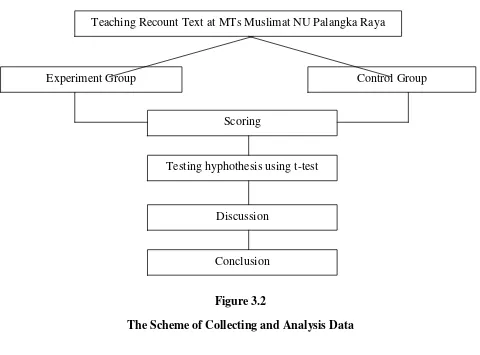
After that, the interpretation made to answer the research problem. To
sum up, the procedures of collecting data and analysis data, as describe in
figure :
g
CHAPTER IV
Figure 3.2
The Scheme of Collecting and Analysis Data
Teaching Recount Text at MTs Muslimat NU Palangka Raya
Control Group Experiment Group
Scoring
Conclusion Discussion
CHAPTER IV
CHAPTER IV
RESEARCH FINDINGS AND DISCUSSION
In this chapter, the researcher presented the data which had been collected
from the research. The data were obtained from the students‟ pre testan post test scores in writing recount text with treatment by comic strips and without non comic
strips.
A. Research Findings
1. The Result of Pre Test and Post Test in Experimental Group and Control Group
In this section, it would be described the obtained data of improvement
the students‟ writing scores after and before taught by using comic strips
media. The presented data consisted of Mean, Median, Modus, Standard
Deviation, Standard Error, and the figure.
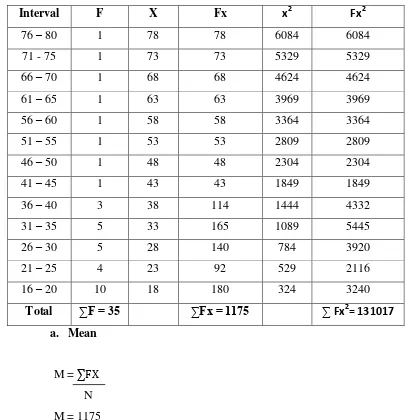
a. Distribution of Pre Test Scores in Experimental Group Table 4.1
2 7 5 6 10 10 10 10
The table above is combination each components of pretest score by first
rater (R1) and second Rater (R2). And the next table, the researchercombines
the score become the final score.