Informasi Dokumen
- Penulis:
- Heri Sudarmadi
- Pengajar:
- Bambang Setiawan, ST, MT
- Ir. Ary Setyawan, M.Sc, Ph.D
- Setiono ST, M.Sc
- Sekolah: Universitas Sebelas Maret
- Mata Pelajaran: Civil Engineering
- Topik: Pemanfaatan Batu Kuning (Dolomite Limestone) sebagai Bahan Subbase Course Jalan Ditinjau dari Besarnya Nilai k v pada Pengujian Standard Proctor dan CBR dalam Kondisi Unsoaked
- Tipe: Skripsi
- Tahun: 2011
- Kota: Surakarta
Ringkasan Dokumen
I. BAB 1 PENDAHULUAN
This chapter sets the stage for the research by establishing the background, problem statement, limitations, objectives, and benefits of the study. The background highlights the widespread use of roads in Indonesia, the frequent occurrence of road damage due to factors like subbase course instability and poor compaction, and the potential cost savings and efficiency gains from utilizing local materials. The research focuses on dolomite limestone (batu kuning) as a subbase course material, specifically in the context of unsoaked conditions (dry season). The problem statement clearly articulates the research questions focusing on the characteristics of batu kuning, the optimal mix design incorporating sand and gravel, and the resulting CBR unsoaked and kv values. The chapter also defines the scope of the study and outlines its theoretical and practical significance. This introduction effectively contextualizes the research within the broader field of civil engineering, particularly road construction and material science.
1.1. Latar Belakang
This section provides the context for the research, emphasizing the importance of road infrastructure in Indonesia and the prevalent issue of road damage. It introduces the use of local materials like dolomite limestone (batu kuning) as a cost-effective and efficient alternative for road construction, specifically focusing on its application as a subbase course material. The section highlights the problem of road deterioration in the Miri district of Sragen regency and the need for sustainable and locally sourced solutions. This introduction effectively establishes the rationale behind the choice of research topic and its practical implications.
1.2. Rumusan Masalah
This section clearly outlines the key research questions that the study aims to address. These questions focus on the characteristics of the dolomite limestone, the optimal mix design for the subbase course material including local aggregates, the unsoaked California Bearing Ratio (CBR) values of the different mix designs, and the determination of the vertical modulus of subgrade reaction (kv) based on the CBR values. The concise and focused nature of these research questions provides a clear direction for the study, ensuring that all research activities are aligned with its core objectives. This section demonstrates a sound understanding of research methodology and the importance of formulating well-defined questions.
1.3. Batasan Masalah
This section clearly defines the boundaries of the research, specifying the testing methodology (British Standard), the origin of the dolomite limestone (Soko village, Miri district, Sragen regency), the specific material being studied (dolomite limestone for the subbase course), and the mixture variations to be investigated. These limitations ensure the feasibility and focus of the research, preventing it from becoming overly broad or unmanageable. The explicit statement of limitations is crucial for maintaining the integrity and credibility of the research, as it clarifies what aspects are not covered by the study.
1.4. Tujuan Penelitian
The objectives of the research are clearly stated, focusing on analyzing the characteristics of the dolomite limestone and other aggregates, determining the optimal mix design for the subbase course, and analyzing the CBR unsoaked and kv values for each variation. These objectives directly address the research questions, providing a clear roadmap for the research activities. The structured presentation of the objectives ensures that the research is focused and measurable, facilitating the evaluation of its success.
1.5. Manfaat Penelitian
This section outlines the theoretical and practical implications of the research. The theoretical contribution lies in establishing the relationship between the Standard Proctor compaction test, CBR unsoaked, and kv values for the subbase course. The practical applications involve providing field guidance on material characteristics, mixture variations, and the use of dolomite limestone as a subbase course material. This section effectively connects the research to its potential impacts, demonstrating the value and relevance of the study.
II. BAB 2 LANDASAN TEORI
This chapter provides the theoretical underpinnings of the research. It reviews relevant literature on pavement design, emphasizing the importance of granular materials in the subbase course. It explores the properties of dolomite limestone and its suitability as a road construction material. The chapter presents the theoretical concepts of Standard Proctor compaction, CBR testing, and the determination of the vertical modulus of subgrade reaction (kv), emphasizing the principles and methods involved in these tests. The inclusion of relevant figures and tables enhances the clarity and comprehension of the theoretical framework. This section successfully demonstrates the researcher's understanding of relevant theories and principles that inform the research methodology and interpretation of findings.
2.1. Tinjauan Pustaka
This section reviews existing literature on pavement design, focusing on the selection of materials and layer thicknesses to achieve optimal performance and cost-effectiveness. It examines previous research on the use of limestone as a road construction material, highlighting its physical properties and suitability for various pavement layers. The review includes studies examining the performance of limestone as a subbase, base, and surface course material, providing a broader context for the current research. This review of relevant literature demonstrates a critical engagement with existing knowledge and identifies gaps that this research seeks to fill.
2.2. Dasar Teori
This section delves into the theoretical foundations of pavement design and material testing, explaining the components of flexible pavement structures (subbase, base, and surface courses) and their functions. It provides a detailed description of the subbase course, its role in load distribution, and the selection criteria for appropriate materials. The section explains the properties of dolomite limestone and other granular materials, linking them to the overall pavement design. Finally, it introduces the key testing methods: Standard Proctor compaction, CBR, and kv determination, providing a clear theoretical basis for the subsequent methodology section. This foundational section provides a complete and clear theoretical framework for the subsequent stages of the research.
2.2.1 Struktur Lapis Perkerasan
This subsection details the structure of flexible pavements, outlining the layers (subbase, base, and surface course) and their respective functions. It explains the importance of each layer in load distribution and the overall structural performance of the pavement. This detailed explanation provides a clear context for understanding the role of the subbase course in this research.
2.2.2 Lapis Pondasi Bawah (Subbase Course)
This subsection focuses specifically on the subbase course, discussing its functions (load support, material efficiency, base course protection, and ease of construction). It explains the need for a subbase course based on factors like weak subgrade conditions and weather protection. It also explores various material options for the subbase course, including stabilized soils. This subsection reinforces the importance of the subbase course and its relevance to the current research.
2.2.3 Material Struktur Lapis Perkerasan
This subsection discusses the properties of dolomite limestone, its chemical composition, and its physical characteristics (color, hardness, acid resistance). It highlights its suitability as a granular material for pavement construction, linking it to the overall context of pavement design and material selection. The discussion of granular material mixtures, including aggregates and binders, lays the foundation for the experimental design.
2.2.4 Pengujian Pemadatan Standar (Standard Proctor Test)
This subsection explains the Standard Proctor compaction test, its purpose (removing air from the soil), and its importance in enhancing soil strength, reducing water sensitivity, and minimizing compressibility and permeability. It discusses the relationship between dry density, water content, and porosity, and provides a theoretical basis for understanding the compaction characteristics of the materials used in the study. This detailed description is essential for understanding the methodology of the research.
2.2.5 California Bearing Ratio (CBR)
This subsection explains the California Bearing Ratio (CBR) test, a crucial method for evaluating the strength and bearing capacity of soils. The definition, procedure, and interpretation of CBR values are discussed in detail. The relationship between CBR, dry density, and water content is highlighted, along with the use of CBR values in pavement design. The section also touches upon the limitations of soaked CBR testing, setting the stage for the use of unsoaked CBR in this study. This thorough explanation lays the groundwork for the subsequent analysis of results.
2.2.6 Koefisien Reaksi Subgrade Arah Vertikal (kv)
This subsection introduces the concept of the vertical modulus of subgrade reaction (kv), defined as the ratio of unit soil reaction stress to the resulting settlement. It explains its use in elastic foundation calculations and its importance in pavement design. Methods for determining kv, including empirical correlations with CBR values, are discussed. This theoretical understanding is fundamental for interpreting the kv values obtained in the experimental phase of the research.
III. BAB 3 METODE PENELITIAN
This chapter details the research methodology, encompassing sample collection, laboratory testing procedures, and data analysis. The sample collection process describes the selection of dolomite limestone, sand, and gravel samples from specific locations. The laboratory testing section outlines the procedures for determining physical properties (specific gravity, gradation, abrasion, Atterberg limits), compaction (Standard Proctor), and CBR (unsoaked). Data analysis is described, including correlations between mixture variations, CBR values, and kv values. A flowchart illustrates the overall research workflow. This comprehensive methodology section provides a clear, step-by-step guide to the research process, allowing for replication and evaluation of the findings.
3.1. Pengambilan Sampel Material
This section describes the process of collecting samples of dolomite limestone, sand, and gravel from specified locations. The detailed information on the sampling sites ensures the reproducibility and validity of the results. This section is crucial for ensuring the transparency and traceability of the materials used in the study.
3.2. Pengujian Laboratorium
This section outlines the various laboratory tests conducted on the collected samples. These tests include classifying the materials using standard methods (specific gravity, gradation, abrasion, Atterberg limits), determining compaction characteristics using the Standard Proctor test, and measuring unsoaked CBR values. The detailed descriptions of these procedures ensure transparency and replicability of the research. This systematic presentation of testing methods strengthens the validity of the research design.
3.2.1 Bahan dan Alat Penelitian
This subsection lists all the materials and equipment used in the study. A complete inventory of materials and equipment ensures that the research is accurately documented and verifiable. This detailed list adds to the overall transparency and reproducibility of the research.
3.2.2 Pengujian Klasifikasi
This subsection details the tests performed to classify the materials, focusing on physical characteristics such as specific gravity, gradation, abrasion resistance, and Atterberg limits. The selection of appropriate testing methods ensures the accuracy and reliability of the material characterization. Reference to relevant ASTM standards reinforces the methodological rigor of the study.
3.2.3 Pengujian Pemadatan
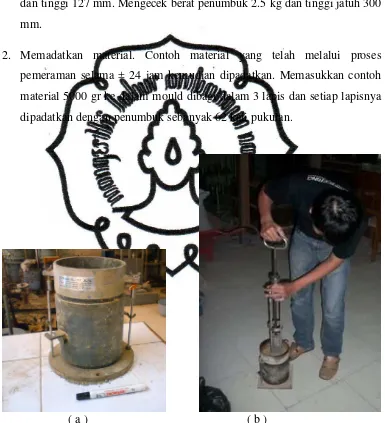
This subsection provides a detailed account of the Standard Proctor compaction test, including the preparation of specimens, the compaction process, and the measurement of dry density and optimum water content. The step-by-step instructions enhance the clarity and reproducibility of the research. Detailed procedures for the compaction testing ensure the accurate and consistent determination of optimal compaction parameters.
3.2.4 Pengujian Pemadatan CBR
This subsection details the CBR (California Bearing Ratio) test, including specimen preparation, compaction procedure, and data collection. This step-by-step instruction ensures transparency and aids in the reproducibility of the experiments. The precise instructions enhance the reliability and accuracy of the CBR test results.
3.2.5 Pengujian Penetrasi CBR
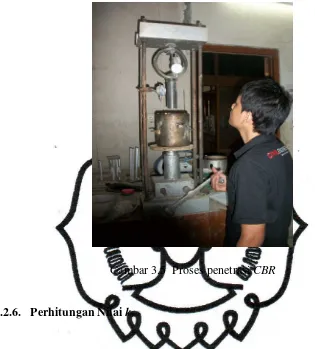
This subsection describes the CBR penetration test, explaining the apparatus, procedure, and data recording. The detailed description ensures that the results are reliable and reproducible. The standardized methodology increases the credibility of the research.
3.2.6 Perhitungan Nilai kv
This subsection describes the method used to estimate the vertical modulus of subgrade reaction (kv) from the CBR results. This explanation highlights the use of nomograms to estimate kv from CBR values, thereby connecting the experimental results to an important engineering parameter. The detailed explanation of the calculation method clarifies how the kv value was derived from the experimental data.
3.3. Output/Keluaran Penelitian
This section describes the expected outputs of the research, including the analysis of material properties, CBR values, and kv values. This section outlines the data analysis procedures, focusing on the correlations between mixture variations and engineering properties. The correlation analysis is crucial for interpreting the relationship between material composition and pavement performance. This structured approach ensures the focus of data analysis remains aligned with the core research questions.
3.4. Alur Penelitian
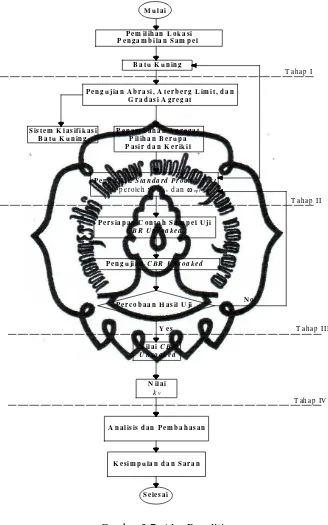
This section provides a flowchart summarizing the entire research process, from material selection and testing to data analysis and conclusion. The flowchart visually depicts the flow of the research, making it easy to understand the overall research methodology. The visual representation of the research workflow aids in comprehension and highlights the logical progression of the research steps.
IV. BAB 4 ANALISIS DAN PEMBAHASAN
This chapter presents the analysis and discussion of the research findings. The results of the material tests (abrasion, specific gravity, gradation, Atterberg limits) for the dolomite limestone, sand, and gravel are presented and discussed, assessing their suitability as pavement materials. The analysis focuses on the compaction characteristics (maximum dry density and optimum moisture content) from Standard Proctor tests and the unsoaked CBR and kv values for different mix designs. The interpretation of results focuses on the relationships between mixture variations, compaction characteristics, CBR values, and kv values, providing insights into the performance of dolomite limestone as a subbase course material. The discussion section links the experimental findings to the theoretical framework established in Chapter 2 and provides answers to the research questions outlined in Chapter 1. The chapter concludes with a summary of the key findings and their implications for pavement design and construction.
4.1. Hasil Pengujian Material
This section presents the results of the laboratory tests conducted on the dolomite limestone, sand, and gravel samples. It includes detailed tables and figures showing the values obtained for each test (abrasion, specific gravity, gradation, Atterberg limits). The presentation of results is clear, concise, and well-organized, facilitating an easy understanding of the material characteristics. A thorough description of the material properties is critical for supporting the interpretation of the experimental results.
4.1.1 Hasil Pengujian Batu Kuning
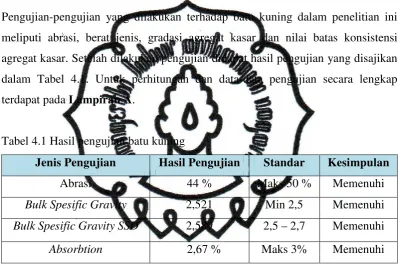
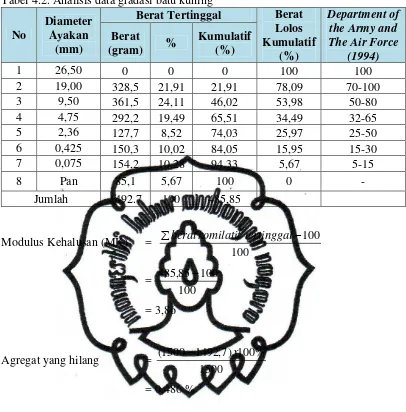
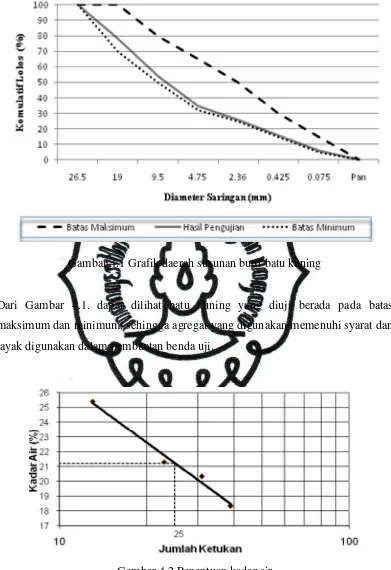
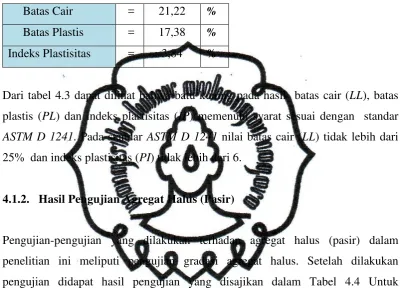
This subsection focuses specifically on the results of tests conducted on the dolomite limestone sample. It presents the test results (abrasion, specific gravity, gradation, Atterberg limits) and assesses whether these properties meet the required standards for pavement materials. The detailed analysis of the material's properties forms the basis for understanding its suitability as a subbase material.
4.1.2 Hasil Pengujian Agregat Halus (Pasir)
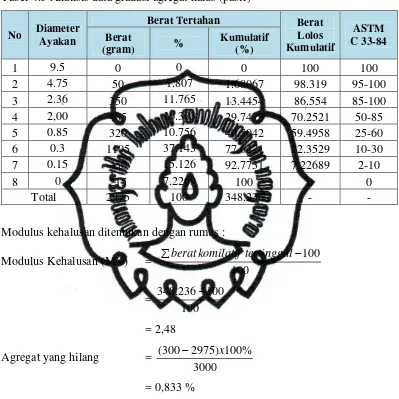
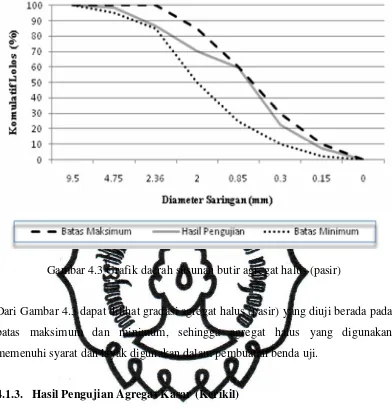
This subsection presents the results of tests conducted on the sand sample, focusing on gradation characteristics. The results are presented in tabular format, and compared against the relevant standards for pavement aggregates. The analysis assesses whether the sand meets the requirements for use in pavement construction.
4.1.3 Hasil Pengujian Agregat Kasar (Kerikil)
This subsection presents the results of tests conducted on the gravel sample, again focusing on gradation characteristics. The results are presented in a clear and organized format, allowing for a straightforward comparison with the required standards. The analysis determines the suitability of the gravel as a component in the pavement mixture.
4.2. Variasi Rancangan Penelitian
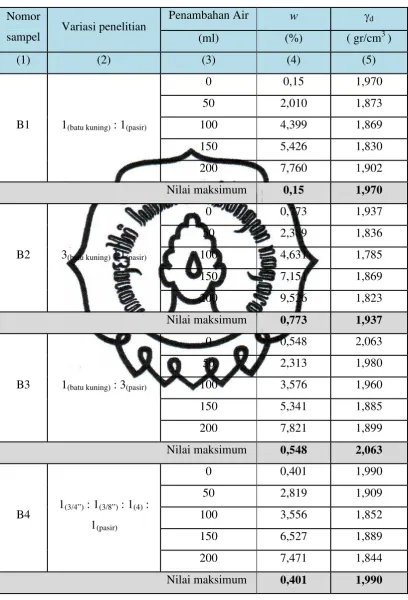
This section describes the different mix designs used in the study, detailing the proportions of dolomite limestone, sand, and gravel in each variation. The clear description of mix design variations is crucial for understanding the basis of comparison among different experimental groups. The systematic variation of the mix design enables a thorough investigation of the influence of each component on the overall pavement performance.