THE USE OF READING RACE GAME TO IMPROVE THE
STUDENTS
’S
READING SKILL AT EIGHTH GRADE OF MTs
RAUDLATUDDIN SALAMKANCI BANDONGAN MAGELANG
IN THE ACADEMIC YEAR OF 2016/2017
A GRADUATING PAPER
Submitted to the Board Examiners as a Partial Fulfillment of Requirements
for the Degree of Sarjana Pendidikan (S.Pd) of English Education Department of Teacher Training and Education Faculty
State Institute for Islamic Studies (IAIN) Salatiga
BY:
EKA OKTAVIANI 113-12-101
ENGLISH EDUCATION DEPARTMENT
TEACHER TRAINING AND EDUCATION FACULTY STATE INSTITUTE FOR ISLAMIC STUDIES (IAIN) SALATIGA
MOTTO
“bissmillah try to be useful for other”
“Success needs a struggle”
( EkaOktaviani )
DEDICATION
This graduating paper is sincerely dedicated for:
1. My beloved parents, my mother (Suratmi) and my father (Amin) who always pray, guide, motivate me to become useful person. They are my hero, thanks for all generosity, finance, and encouragement, and also thanks for your love, trust, and everlasting praying. Allah bless you mom and dad.
2. My beloved future husband (Rudiantoro), my btother( MiftahulIlmi) who always pray, motivate and support me.Thanks for your kindness, support, and prayer and everything that you gave for me.
3. My big Family RaudlatuddinSalamaknciMagelang who always pray and support me.
ACKNOWLEDGEMENT
Bismillahirrahmanirrahim,
In the name of Allah, the most gracious and merciful, the kings of universe and space. Thanks to Allah because the writer could complete this study as one of requirement to finish study in English and Education Department of States Institute for Islamic Studies.
This graduating paper would not have been completed without support, guidance and guidance from individual and institution. Therefore, the writer would like to express special thanks to:
1. Dr. RahmatHariyadi, M. Pd. as the Rector of State Institute for Islamic Studies (IAIN) Salatiga, thanks for the time I spend for studying in IAIN Salatiga.
2. Noor Malihah, Ph. D. as the Head of English Education Department of States Institute for Islamic Studies (IAIN) Salatiga. Thank for all her suggestions, recommendations and supports for this graduating paper from the beginning until the end.
4. All lecturers in English Department Faculty of IAINSalatiga. Thanks for all guidance, knowledge, support, and etc.
5. My beloved mother (Suratmi), father (Amin), and all his family. Thanks for love, support, and praying.
6. My beloved future husband (Rudiantoro), brother ( MiftahulIlmi), sister (Puput Tri Arsita) Thanks for love, support, and praying.
7. My big family of MI RaudlatuddinSalamkanciMagelang thanks very much for your support and praying.
8. All of my friends TBI ‘12.
9. My new Family KKN Pengarengan 1 ( PakCariksekeluarga, Miftah, Didin, Syaifudin, Rochanah, Masruroh, Auliadina, and Alfi ) thank for your support. 10.All of staffs who help the writer in processing of thesis administration.
11.Everybody who has helped me in finishing this thesis. Thanks for all supports, advice, suggestion and other helps that they all give. I hopes that this study will be useful for everyone.
Salatiga, 8th September 2016 The writer
EkaOktaviani 113-12-101
ABSTRACT
Eka Oktaviani.2016.The Use of Reading Race Game to Improve Students’ Reading Skill at Eighth Grade of MTs Raudlatuddin Salamkanci Bandongan Magelang in the Academic Year of 2016/2017.A Graduating Paper.Teacher Training and Education Faculty. English Education Department.State Institute of Islamic Studies (IAIN).Counselor:Mashlihatul Umami, S. Pd.I, M.A.
Keyword:Reading Skill, Reading Race Game
This Research is aimed to improve the students‘ reading skill through Reading Race Gam. This research has three objectives of the study are 1) how is the implementation of Reading Race Game to improve students‘ reading skill? 2) how far is the improvement of the students‘ reading skill of the eighth grade students of MTs Raudlatuddin Salamkanci Bandongan Magelang?. This research was conducted at MTs Raudlatuddin salamkanci Bandongan Magelang in the academic year of 2016/2017 especially in VIII A class. The method of this research used Classroom Action Research (CAR). There were two cycles: each cycles comprised planning, implementing of the action, observing and reflecting. The techniques of collecting data are observation, test and documentation. From the result, the researcher found several finding of it. The result shows an improvement of students‘ reading skill by using Reading Race Game method. It can be seen from the mean score of pre-test and post-test. in cycle I 70.17 > 63.35. In cycle II: 85.35 >74.05. It means that the use of Reading Race Game is able to improve student‘s reading skill.
TABLE OF CONTENTS
TITLE PAGE ………..……. i
DECLARATION ……………. ii
ATTENTIVE COUNSELOR……….. iii
CERTIFICATION PAGE………... iv
MOTTO ………...……….……… v
DEDICATION……….……….……… vi
ACKNOWLEDGEMENT………... vii
ABSTRACT………... ix
TABLE OF CONTENTS……………. x
LIST OF TABLE……….. xi
CHAPTER I INTRODUCTION A. Background of Study……… 1
B. Statements of the Study..……… 5
C. Objectives of Study….……….. 5
D. Limitation of the Study……….. 6
E. Benefits of the Study………...……… 6
F. Clarification of the Study……… 7
CHAPTER II THEORITICAL REVIEW
A. Previous Research ……….. 10
B. Reading…...…..………. .12
1. Nature of Reading ……….…..……….………. ……….. 12
2. Purpose of Reading ………….…..………. …… 14
3. Technique of Reading………..………. ……... 16
4. Principles of Reading………... 19
5. Types of Reading……… 20
C. Reading Skill……… 22
1. Teaching English in Junior High school……… 24
2. Teaching Reading for Eighth grade Students……...…..……… 25
D. Reading Race Game……...………. 28
1. Definition of Reading Race Game……….…..………. 28
2. Purpose of Reading Race Game…….…………...………. 29
3. Instructions of Reading Race Game …….……….…..………….. 30
CHAPTER III METHOD OF RESEACRH A. Setting and Time of the Research ………..……… 32
B. Subject of the Research..……… … 33
C. Method of the Research……….. … 36
D. Procedure ofthe Research………. …. 37
E. Technique of Collecting Data…………..……….. …. 40
CHAPTER IV DATA ANALYSIS
A. Implementation of Research………. 43
B. Improvement and Discussion……… 57 CHAPTER V CLOSURE
A. Conclusion………. 61
B. Suggestion………. 62
REFERENCES……….. 64
LIST OF TABLES AND FIGURES
Table 3.1: Subject for eleventh grade students ………. ………. 35 Table 4.1: Result of pre-test and post-test cycle I…..…………... 47 Table 4.2: Result of the Observation sheet cycle I…..…………..…... 50 Table 4.3: Result of pre-test and post-test cycle II……….…….. …… 54 Table 4.4 Result of the Observation sheet cycle II………. 56 Table 4.5 Mean and T-Calculation of student score……… 58
LIST OF FIGURES
LIST OF APPENDICES
1. Detail of the MTs RaudlatuddinSalamakanci
2. Vision and Mission of MTs RaudlatuddinSalamkanci 3. Subjects in eighth grade of MTs RaudlotuddinSalamkanci 4. Teachers of MTs Raudlotuddin SalamkanciBandongan 5. Students of MTs Raudlotuddin Salamkanci Bandongan
6. Student‘s Activities of MTs Raudlotuddin Salamkanci Bandongan 7. Facilities in MTs Raudlotuddin Salamakanci Bandongan
8. Teaching media in MTs RaudlotuddinSalamkanciBandongan 9. Lesson Plan for Cycle I
10.Lesson Plan for Cycle II 11.Pre Test and Post Test cycle I
12.Student‘s score Pre Test and Post Test cycle I 13.Observation Sheet cycle I
14.Pre Test and Post Test Cycle II
15.Student‘s score Pre Test and Post Test cycle I 16.Observation sheet cycle II
17.Picture
18.SuratIjinPembimbingSkripsi 19.SuratIjinPenelitian
CHAPTER I INTRODUCTION
A. Background of the Study
In Indonesia, English as a foreign language so many Indonesian people feel difficult to learn it. Indonesia Introduces English since in elementary school even since in kindergarten as a local content to give English to children as early as possible in order to prepare them in covering the globalization era. English became compulsory subject in Junior high school, Senior high school and University. In junior high school, the students who graduate from school are expected to communicate in English both in oral and written form.
In English there are four skills which are identified as paramount importance; listening, speaking, reading and writing (Brown, 2001). Among these four skills, reading is difficult to master since it needs many competencies including the mastery of content, vocabulary, language and grammar. Teaching English is not easy, English teacher should not only master the language, but they should also be able to make their students learn.
Reading is one of the language skill in English, should be mastered by students because reading is an essential factor that influences an activity in Communication. The ability to read opens up new knowledge and opportunities. It enables students to gain information, to get some pleasure, and do many things
that are part of modern life, such as, reading newspapers, magazines, maps and so on, so that people usually said that reading is the window of the world.
The importance of reading is also stated in the School-based Curriculum of Junior High School (Depdiknas, 2006). The target of the English teaching and learning is to enable students to gain the functional literacy which is the ability to communicate both in simple oral and written English to deal with the daily life contexts, such as reading and understanding newspapers or manuals. In other words, students are expected to be able to comprehend English texts in order to learn new knowledge, ideas and concepts.
One of the difficulties faces by student in Junior high school is to mastery reading Skill. According Wallace (2003:4) states that one of the difficulties which young learners, especially EFL learners, may have is the incapability to understand texts. Klingner (2007:4), also stated that the students tend to have learning disabilities on their reading comprehension. The students demonstrate many problems associated with low comprehension, including poor decoding, fluency and comprehension.
The writer made an interview in pre observation data to the English teacher. From the result on the interview, it revealed that the eighth grade of junior high school students had a problem in reading.The writer asked to the teacher about the students‘ reading skill, the teacher said that the students weak in
students of MTs Rudlatuddin Salamkanci Bandongan Magelang had a problem with reading that was the students‘ reading skill was still low. It could be seen from the students‘ achievement reading score. There were some facts that
indicated the problem. First, students‘ interest of reading was still low. Second,
They got it difficult in understanding sentences, finding the meaning of the sentences or only understood the outline of the text content. The students needed a lot of time in understanding the text, they did not use chance to read English text either at home or in English lesson. Finally, the students had difficulties in doing exercises. Those all made their achievement became low and caused failure in teaching and learning process.
The writer analyzes that the problem caused from the students, teacher and the environment. From the student side first, almost all of the student have the bad habit that is the students like read the text silently. They don‘t like to read louder.
Second, most the students prefer read the text alone. They never discuss with other friends and sharing the difficulties that faces by them from the text. Third, the students have a low motivation to read the text. They just read the text in the classroom and wait the teacher give command to read. The last the students had poor vocabulary so that they have difficulties to find the main idea in the text.
The causes came from the teacher, based on the observation of the writer, the researcher found that the teacher‘s ways of the teaching influence of the
students‘ reading. Speaking too fast, unclear explanation and monotonous
are also still using traditional methods in teaching reading. It cause the student have a low motivation to learn reading. In the classroom the teacher just asked the students to read Book student worksheet (LKS) and teacher asked the students to do exercise following the text. The education of the teacher also became the caused the students low to mastery reading skill and also make the students difficult to understand what the teacher explained.
The last causes is from the environment and the material around of the students and the teacher. MTs Raudlotuddin Salamkanci Bandogan Magelang is located in the small village in Magelang. Almost of the material was manual or traditional so that the students not interesting to learn. The environment is not support around of the school many people have low motivation in the education.
Based on the problems above, the researcher tries to implement Reading Race game to improve motivation and reading ability of the students at grade eight. Reading Race Game is one the kind of game that appropriate used by teacher in Teaching and learning .Reading Race is a fast – paced game that gives students practice reading the word on word bricks out loud. By using Reading Race Game the students can be more interested and enjoy in the Learning English especially the students more interested and enjoy practice to read of the text. By employing the game the researcher hopes that the students of eighth grade can improve their reading skill.
Reading Race game can improve Reading skill of the students. So the researcher make a classroom action research with the tittle ― THE USE OF READING RACE GAME TO IMPROVE STUDENTS READING SKILL AT EIGHTH GRADE OF MTs RAUDLATUDDIN SALAMKANCI BANDONGAN MAGELANG IN THE ACADEMIC YEARS OF 2015/2016‖
B. Statement of the Problems
Based on the above primary observation‘s the researcher, this research
aimed giving answer on the following problems:
1. How is the implementation Reading Race Game to improve the students‘ reading Skill for the eighth grade student of MTs Raudlatuddin Salamkanci Bandongan Magelang in academic year 2015/2016?
2. How far is the improvement Reading Race Game in improving reading skill for the eighth students of MTs Raudlatuddin Salamkanci Bandongan Magelang in academic year 2015/2016?
C. Objectives of the Study
Dealing with the problems statement, the objectives of this classroom action research are as follow:
2. To find out how far improvement the student‘s reading skill after using Reading Race Game of the eighth grade students of MTs Raudltuddin Salamkanci Bandongan Magelang in academic year of 2015/2016.
D. Limitation of the Study
In order to avoid any misinterpretation of the problems, the researcher would like to limit the scope of the study. In this research, the writer only focused on the use of reading race game to improve reading skill especially in reading aloud of the grade eight student of MTs Raudlatuddin Salamkanci Bandongan Magelang in academic year 2015/2016
E. Benefit of Research
The result of this research is expected to be able to give benefits such as, follow:
1. For the students : it is hoped that this research can improve their reading skill 2. For the teacher: it is hoped that this study will provide much information for
the improvement of the quality in teaching and learning process.
3. For the school: It is hoped that this new technique of teaching reading will enrich teaching method in this school.
F. Clarification of Key Term 1. Reading
According to Aebersold and Field (1997: 15) say that reading is what happens when people look at a text and assign meaning to the written symbols in that text, further, the text and the reader are the two physical entities necessary for the reading process to begin.
While, Davies (1995:1) says that reading is a private activity. It is a mental or cognitive process, which involves a reader in trying to follow and respond to a message from a writer, who is in distant space and time. Due to this privacy, the process of reading and responding to a writer is not directly observable.
2. Reading Race Game
Reading race game is one the kind of game that appropriate used by teacher in Teaching and Learning. Reading Race is a fast – paced game that gives students practice reading the word on word bricks out loud.
3. Reading Skill
The skill of reading is used by the reader to anticipate text information, selecting key information, organize and mentally summarize information, monitor comprehension, repair comprehension breakdowns, and match comprehension output to the reader goals. Every reader has their own way of reading to do that which is appropriate with them. The teacher should give some skills to the students to make them comprehend text easily. Using the skills, the students may increase the pleasure and effectiveness of reading activity.
G. Graduating Paper Outline
This research divided into five chapters. In order to make easy to understand this paper, the researchers convey the kind of the graduating paper in the following:
Chapter I: Chapter I is introduction. It consists of background of study which mentions the researchers‘ reasons why the researchers choose the topic
Chapter II is literary review. It will consist of related literature review. In this chapter, the researchers will divide into two parts, namely: previous research and theoritical framework.
Chapter III is research methodology. This chapter will deal with the object of research, research types, data sources, the method of collecting data and the method of analyzing data.
Chapter IV is data analysis. It will consist of analysis on students‘
reading skill of MTs Raudlatuddin Salamkanci Bandongan Magelang in the English learning activities will be used in their teaching process.
CHAPTER II
REVIEW OF RELATED LITERATURE LITERATURE REVIEW
A. Previous Researches
There are some researches were conducted related to this research about Reading Skill. The first Research was done by Anis Fihayati years 2015 from English Education Department Faculty of Language and Art Yogyakarta State University. with the title of ― Improving the Teaching and Learning process of Reading by Using Silent Card shuffle strategy for seventh grade students of SMP N 15 Yogyakarta in Academic Year of 2014 / 2015‖. She uses class action research method. The research aim at improving the teaching and learning process of reading by using silent card shuffle strategy for the seventh grade students at SMP N 15 Yogyakarta in academic year of 2014/2015 the result of the research showed that the use of the SCSS in combination with applying various media and activities could improve the teaching of reading.
The second research was done by Indi Nikmatul Inayah (2015) from English Department of Educational Faculty Institute for Islamic Studies (STAIN) as previous research which has tittle is “The Use of Reciprocal Teaching Technique to Improve Students‘ Reading Skill in Tenth Years
result of her research showed that Reciprocal Teaching Technique can help the students of SMK N 1 Ngablak in improving reading skill. It means that the use of Reciprocal Teaching is able to improve the students‘ reading skill.
The third research created by Dhanastri Herningtiyas from English Education Department Faculty of Language and Art Yogyakarta State University. The title is ―The Effect of the word Card on the Reading Comprehension achievement of grade X students of SMA N 1 Prambanan in the academic year of 2013/2014‖ The objective of this research is to find out
whether there is a significant difference between the reading comprehension achievements of grade X students of SMA N 1 Prambanan in the academic year of 2013/2014 who are taught using the word card strategy and that of those who are taught without using the strategy. The findings of the research show that that the value of significance is 0.400 which is above the level of significance (0.05). It means that there is no significant. Finally, the word card strategy can be applied as an alternative of vocabulary learning in combination with controlled-vocabulary exercises in the classrooms and with careful attention of the repetition system in memorization process.
The last research written by Ika Kusriani from English Eductaion Department Faculty of Language and Art Yogyakarta State Universiy the title is ―Using Jigsaw Technique to Improve Reading Comprehension Skill of the
Grade VIIIB of SMP N3 MLATI through jigsaw technique. The result of the research show that show that using jigsaw technique can improve the students‘ reading comprehension and the students‘ reading involvement in the
reading class.
B. Reading
There are four skills in English Language Teaching. There are consists of Listening, speaking, reading, and writing. That are four basic languages of English to mastery in English.one of them there is reading skill. Reading is one of the important things to mastery in English. Students need good reading ability to get more knowledge and more new information. To increase of reading skill they have to practice continually and extensively.
1. Nature of Reading
According Connie Weaver (2009 ) says that Reading is a process very much determined by what the reader‘s brain and emotions and beliefs
bring to the reading: the knowledge/information (or misinformation, absence of information), strategies for processing text, moods, fears and joys—all of it.
In his introduction to Alderson (2000) on assessing reading, Lyle Bachman notes: "Reading through which we can access worlds of ideas and feelings, as well as the knowledge of ages and visions of the future, is at once the most extensively researched and the most enigmatic of the so-called language skills.
Reading is also a comprehending process. This process is assumed to be the fundamental goal of reading. People read to understand what the writer intended to say through writing, while all cognitive processes involved in reading is related to comprehension. Besides Grabe, Alderson (2000, 3-18) defines reading as interactive model as well. The interaction in reading process happens during reading. There are two kinds of interactions which are interaction between the reader and the text and interaction between the reader and the writer. The interaction between the reader and the texts happens when the reader constructs a personal interpretation of the text through recognizing the written symbols. While when the reader tries to get the writer‘s intention,
reader brings a wide range of background knowledge and number of skills used in comprehending and interpreting a text.
According to Bernhardt et.al. (2003:6), reading is consists of two processes: word recognition and comprehension. Word recognition is process to perceive how written symbol correspond to one‘s spoken language.
Comprehension is process of making sense of word, sentences and connected text. Readers typically make use of background knowledge, vocabulary, grammatical knowledge, experience with text and other strategies to help them understand written text.
According to Williams (1996: 51), there are three main phases needed to be followed in reading activity, namely:
a. Pre – reading: aimed to introduce and arouse learners‘ interest in the topic. Giving reason to read and some questions that related to learners‘
background knowledge ideas and opinion would motivate learners‘
eagerness to read the whole text.
b. Whilst reading: aimed to help students understanding the purpose and texts‘ structure and to clarify texts‘ content. Some activities like
answering comprehension question, completing diagram or maps, making list and taking notes are whilst reading type work.
c. Post – reading: aimed to consolidate what has been read with learners‘ own, interest, or ideas.
There are six main purpose of reading comprehensive according Grabe (2009: 8 – 10). The purpose includes:
a. Reading for information
The combination of scanning (identifying a specific graphic form) and skimming (building a simple quick understanding of the text) allows a reader to search information.
b. Reading for quick understanding (skimming)
Reading for quick understanding used for variety of other reasons and so may be seen as a superordinate purpose. The readers used skimming when they want to determine what a text is about and whether or not they want to spend more time reading it.
c. Reading to learn
Reading to learn is often carried out in academic and professional settings. Reading to learn places more processing demands on the reader because the reader is expected to remember the main ideas and many supporting ideas and be able to recall this information as needed.
d. Reading to evaluate, critique, and use information
It often also represents an increased level of demand and a more complex interaction of reading processes.
Reading for general comprehension is the most common purpose for reading among fluent readers, and it is the default assumption for the term reading comprehension.
Based on the explanation above the writer conclude that reading for general comprehension is related with the purpose of reading aloud, the purpose of reading for general comprehension is to reading among fluent of the reader.
3. Techniques of Reading
Many people have different ways and technique in reading Different reader may have their own ways and techniques in accordance with their favor and purpose. According Francoise Grellet (1998: 40) proposed many ways of reading as follows:
a. Skimming: quickly running one‘s eyes across a whole text ( an essay, article, or chapter) to get the gist of it. The reader goes through the text extremely quickly. The purpose of skimming is simply to see what a text is about. The reader skims in order to satisfy a very general curiosity about a text.
100). The purpose of scanning is to extract certain specific information without reading the whole text (Brown, 1994: 293)
c. Extensive Reading: reading longer text usually for someone‘s pleasure. This is a fluency activity, mainly involving global understanding.
d. Intensive Reading
Read short text to extract specific information. This is more on accuracy activity involving reading for detail. In this course, each text is read carefully and thoroughly for maximum comprehension.
According Express Learning tell To become an active reader there are several ways :
1) Skimming Ahead and Jumping Back
Skimming ahead enables you to see what‘s coming up in your
reading. Skimming through the text before the hand will prepare you for what you are about to read. It‘s a lot like checking out the hills and curves in the course before a cross-country race. If you know what‘s ahead, you know how to pace yourself, so you‘re prepared to handle
what‘s to come. When you have finished what you reading, jump
back. Review the summaries, headings, and highlighted information in the text.
Marking up the text creates a direct physical link between you and the words you‘re reading. It forces you to pay closer attention to
the words you read and takes you to a higher level of comprehension. 3) Circling Unfamiliar Words
One of the most important habits to develop is that of circling and looking up unfamiliar words and phrases. If possible, don‘t sit
down to read without a dictionary by your side. It is not uncommon for the meaning of an entire sentence to hinge on the meaning of a single word or phrase, and if you don‘t know what that word or phrase
means, you won‘t understand the sentence. Besides, this habit enables
you to quickly and steadily expand your vocabulary, so you‘ll be a more confident reader and speaker
4) Making Marginal Notes
Recording your questions and reactions in the margins turns you from a passive receiver of information into an active participant in a dialogue. (If you‘re reading a library book, write your reactions in a
notebook.) You will get much more out of the ideas and information you read about if you create a ―conversation‖ with the writer.
5) Making Observations
choice of words; the structure of the sentences and paragraphs; any repetition of words or ideas; important details about people, places, and things; and so on.
Based on the explanation, there are many technique of reading.one of them there is intensive reading. The writer conclude that appropriate use as a technique in reading aloud for the students, intensive reading is more on accuracy activity involving reading for detail, so using intensive reading in reading aloud can extract specific information.
4. Principles of Reading
There are several principles behind the teaching of reading according to Harmer (2001: 70) include:
a. Reading is not a passive skill. Reading is an incredibly active occupation. To do it successfully, we have to understand what the words mean.
b. Students need to be engaged with what they are reading. As with everything else in lessons, students who are not engaged with the reading text, actively, not interested in what they are doing, are less likely to benefit.
d. Prediction is a major factor in reading. When we read texts in our own language, we frequently have a good idea of the context before we actually read.
e. Match the task to the topic. Once a decision has been taken about what reading text the students are going to read, we need to choose good reading tasks, the right kind of questions, engaging and useful puzzle etc. f. Good teacher exploit reading text to the full. They integrate the reading
text into interesting class sequences, using the topic for discuss and further tasks, using the language for study and later activation.
5. Types of Reading
According to Patel and Jain (2008: 117-123) the types of reading: a. Intensive Reading
Intensive reading is related to further in language learning under the teacher‘s guidance. Intensive reading will provide a basic for
this reading is to read shorted text. This reading is done to carry out to get specific information.
b. Extensive Reading
Extensive reading is used to obtain a general understanding of a subject and includes reading longer texts for pleasure. The reader wants to know about something. The reader doesn‘t care about specific or
important information after reading. Usually people read for to keep them update.
c. Aloud Reading
Aloud reading is basic form of classroom organization and disciplines. In reading aloud, the students are confronted with written sentences which haven‘t spoken before. The aim of reading aloud is the
achievement or better speaking ability and the pronunciation of the students.
According to Elizabeth (2004: 286 - 288) aloud reading means reading a book by producing sounds audible to other. Reading aloud by the teacher can help the students in the improvement of their listening ability. Reading aloud is useful at specific moment alone. Reading aloud prevents the students from learning to understand the meaning of a sentence even when he may not know one word in the sentence.
Silent reading is a very important skill in teaching of English. This reading should be employed to increase reading ability among learners. Silent reading is done to acquire a lot of information. Silent reading must be based on student‘s selected text. Silent reading enables
the students to read completely silently without making sounds and moving his lips. It helps him read with speed, ease and fluency. It aids comprehension and expands the student‘s vocabulary.
From the explanation above, there are many types of reading with each definition. One of them there is reading aloud. Reading aloud is one of the basic competences in teaching reading. In Reading aloud, the students are confronted with written sentences which haven‘t spoken
before. The aim of reading aloud is the achievement or better speaking ability and the pronunciation of the students.
C. Reading Skill
Definitional component of reading skill which is stated by Perfetti (2001) is an individual standing on some reading assessment. From the assessment result, the researcher will indicate and categorize the students into some categories. It will guide the researcher to decide what the researcher should do to them.
output to the reader goals. Every reader has their own way of reading to do that which is appropriate with them. The teacher should give some skills to the students to make them comprehend text easily. Using the skills, the students may increase the pleasure and effectiveness of reading activity.
In academic field, reading aims at some things new to learn. Learning will be successful when there is a change in mind by knowing something from unknown. After knowing something, students have to understand the thing so that they can apply the knowledge in a real life or at least they can pass their school exam. To gain this successful process, the students should have a skill to bring them into a good comprehension in reading a text.
As stated by Brown (2004: 187-188), there are two major skills of reading. They are micro-skills and macro-skills. The readers, in micro-skills, must have skills when they deal with graphemes and orthographic patterns and linguistic signal.
According to Davis (1968) in Anderson he defines eight skills in reading: 1. Recalling word meaning
2. Drawing inferences about the meaning of word in context 3. Finding answer to question answered explicitly or in paraphrase 4. Weaving together ideas in the content
5. Drawing inferences from the content
8. Following the structures of a passage
According to Kintsch and Van Dijk (1978) there are two level reading skills:
a. Micro processes
Micro processes have to do with local, phrase-by-phrase understanding b. Macro Processes
Macro processes have to do with global understanding
Based on the explanation the researcher conclude that reading skill is one of of the important skill that comprehend by students. Using the skill, the students may increase the pleasure and effectiveness of reading activity. 1. Teaching English in Junior High School
Students in Junior high school consider as teens or young adults whose ages range between thirteen and fifteen. This age often called with puberty condition. According Brown (2001: 92) state that students at those age are in an age of transitions, confusion, self-consciousness, growing and changing bodies and minds.
Those can be some factors that need to be concerned about in teaching English for teens.
From the explanation when the teacher would to like to teach English in junior high school the teacher should know about the characteristic of the students. And also the teacher should know about what and how to teach them.
According Harmer (2001: 39) there are some characteristics of junior high school students are positive and negative characters. The main characteristic is that the junior high school students are emotionally unstable. Since they are in the search of individual identity and tend to be disruptive in class, it can cause discipline problems during teaching and learning process. Their changing in physical and also emotional makes them to be very sensitive. They act depend on the stimuli; if they are interested in something, they can perform good responses. They also have a great potential for creativity and a passionate commitment to things which interest them. If they are engaged, they have a great capacity to learn. In that case, teaching junior high school students need to provoke students‘ engagement with material
which is relevant and involving (Harmer, 2001: 39). 2. Teaching Reading for grade eight Students
learning for junior high school in Indonesia is to enable students to gain the functional literacy. That is the ability to communicate in simple written English to deal with the daily life contexts, such as reading and understanding newspapers or manuals (Depdiknas: 2006).
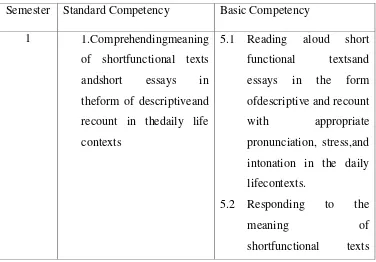
From the explanation above the writer conclude that students are expected to be able to comprehend English texts in order to learn new knowledge, ideas and concepts. There are some standard of competencies and basic competencies that the eight grade students of junior high school have to fulfill in order to learn reading.
Figure 2.1
Standard and basic competencies of the grade eight junior high School Semester Standard Competency Basic Competency
Semester Standard Competency Basic Competency accurately
andappropriately in the daily lifecontexts.
5.3 Responding to the meaning and therhetoric of the short essays ofdescriptive and recount textsaccurately and appropriately in thedaily life contexts.
2 11. Comprehendingmeaning of shortessays in the formof recount andnarrative to interactin daily lifecontexts.
11.1 Reading aloud short functional texts and essays in the form of recountand narrative with appropriate pronunciation, stress, andintonation in the daily life contexts. 11.2 Responding to the
meaning of short functional texts accurately
andappropriately in the daily life contexts. 11.3 Responding to the
Semester Standard Competency Basic Competency
ofrecount and narrative textsaccurately and appropriately in the daily life contexts.
There are some indicators of reading aloud in reading Skill: a) The students are able to say the words of the text with the correct
pronunciation
b) The students are able to read the text fluently
c) The students are able to read of the text with correct intonation d) The students are able to read of the text accurately
Based on the table above we know that the purpose of reading can be seen in traditional view which to gain information and also for enjoyment. The aim of reading in teaching and learning is to communicate with the target language by the written text. The students are expected to read and understand the English texts to deal with the real life communication where there are a lot of the ways to understand about the written text.
D. Reading Race Game
In the teaching and learning there are many kinds game that can used to teach the students to increase their reading skill. One of them there is reading race game.
Reading race game is one of kind of the game used to increase in reading skill. Reading Race Game is a fast – paced game that makes students practice reading the word on Word bricks out loud (Office of English Language Programs Bureau of Educational and Cultural AffairsUnited States Department of State Washington, D.C., 2013, pp102)
Bricks are blocks made from baked clay that are used for building houses, walls, and buildings. Word Bricks are also for building, but they are used for building sentences in English. The Word Bricks that come with Activate: Games for Learning American English are made from thick paper and have English words written on both sides of the ‗brick.‘ The bricks are
printed with a wide range of words in English: nouns, verbs, adjectives, adverbs, articles, pronouns, and so on—all of the building blocks that students need to form complete phrases and sentences in English. (Office of English Language Programs Bureau of Educational and Cultural AffairsUnited States Department of State Washington, D.C., 2013, pp103)
complementary meanings (such as boy and girl, happy and sad, many and some).With Word Bricks, students learn the patterns of English through repeated exploration of the language, through doing, rather than through the study of explicitly taught rules. (Office of English Language Programs Bureau of Educational and Cultural Affairs United States Department of State Washington, D.C., 2013, pp102)
From the explanation above the writer conclude that reading race game is the game used word bricks to persuade the students to practice read the word loud.
2. Purpose of Reading Race Game
According book Activate: Games for Learning American English (2013: 102) the purpose of the game is to see how many Word Bricks each team can read out loud in 1 minute. More read more the students practice read the word brick it mean that the student improve their skill to read.(Office of English Language Programs Bureau of Educational and Cultural Affairs United States Department of State Washington, D.C., 2013, pp102)
3. Instruction of reading race game
All of the students (the players) sit in pairs or small groups, and give each team as many Word Bricks as possible (divide the entire collection of Word Bricks evenly among all the pairs or groups)
a. Tell players that they will have 1 minute to read the words on as many Word Bricks as possible. In their teams, players should take turns picking up a Word Brick and reading the words on it as fast as possible.
b. When the teacher start the timer, Player 1 take a brick, reads the words on it, and places the brick in a ―read‖ pile.
c. Then Player 2 does the same as soon as Player 1 finishes, and so on. d. At the end of 1 minute, players count how many words they have read
aloud and record their totals.
e. If teams exhaust all their Word Bricks before one minute is up, they should begin again using the same pile of bricks.
f. The player may have the teams play again with the same or different Word Bricks and try to break their previous record.
CHAPTER III
METHOD OF RESEARCH
This chapter points out about place, time and methodology. This research is conducted in MTs Raudlatuddin Salamkanci Bandongan Magelang, it discusses about setting and time of research, the content of research method there are types of the research, population, sample data sources, technique of data collection and technique of data analyzes. The each point is discussed further into detail explanation.
A. Setting and Time of the Research 1. Time
This research carried in eighth grade students of MTs Raudlotuddin Salamakanci Bandongan Magelang in the academic year of 2016/ 2017. There were some steps in this research: preparation, implementation, analyses of the data and report writing. The detail of each activity were as follow:
1) Preparation
a) 9th May 2016 : Proposal Draft Consultation b) 29th July 2016 : Instrument consultation 2) Implementation
a) 15th June 2016 : Research Permission b) 08th August -19th August 2016 : Data Collection 3) Analyses OF Data and Research Report
a) 19th September 2016 : Data Analyses
b) 26th September 2015 : Research Report 2. Place
This research is conducted in MTs Raudlatuddin Salamkanci Bandongan Magelang. The explanation about this school described as follows:
Name of school : MTs Raudlotuddin Salamkanci Bandongan Magelang
Address : Kanci Rt 02 Rw 03 Salamkanci BandongMagelang Acreditation : B
Email : [email protected] School status : private
Headmaster : Muhamad Kamdani,S.Ag
The locations of MTs Raudlotuddin Salamkanci in Kanci 2 Rt 02 Rw 03 Salamkanci Bandongan Magelang. It was built on state-own area as wide 590 m2 and building area as wide 470 m2. The total number of students MTs Raudlotuddin Salamkanci Bandongan Magelang in academic year of 2016/2017 is 112 students. They are consists of 55 male students and 57 female students.
B. Subject of the Research
They are 11 Male and 6 Female. Their native language is Indonesian language. The average age of the participants is 14 years old. They have English lesson once meeting in a week which is a meeting along with two hours lesson; one hour lesson is 40 minutes.
1. Population
According to Arikunto (2002: 108), the population is all members of the research subject. So, the population is all individuals that involve in that research. The researcher takes population in the grade eighth MTs Raudlatuddin Salamkanci Bandongan Magelang in the academic year of 2016/2017. The total number of population is 36. They are 21 male students and 15 female students.
2. Sample
Sample is a part of population representative which is researched Arikunto (2002: 109). The researcher takes one class of the sample on the eighth grade of students MTs Raudlotuddin Salamkanci Bandongan Magelang. From the total of the population of 36 students, the writer takes eighth grade A as the sample of this research. They consist of 17 students. They are 11 male students and 6 female students.
Purposive sampling is a technique to takes sample based on consideration, Sugiyono (2008: 85).
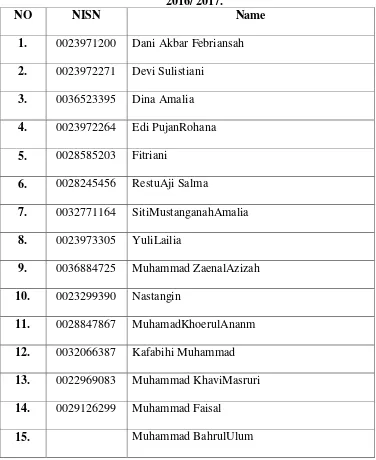
Table 3.1 List of Sample of MTs
RaudlatuddinSalamkanciBandonganMagelang in Academic year of 2016/ 2017.
NO NISN Name
1. 0023971200 Dani Akbar Febriansah 2. 0023972271 Devi Sulistiani
3. 0036523395 Dina Amalia 4. 0023972264 Edi PujanRohana 5. 0028585203 Fitriani
6. 0028245456 RestuAji Salma
7. 0032771164 SitiMustanganahAmalia 8. 0023973305 YuliLailia
9. 0036884725 Muhammad ZaenalAzizah 10. 0023299390 Nastangin
11. 0028847867 MuhamadKhoerulAnanm 12. 0032066387 Kafabihi Muhammad 13. 0022969083 Muhammad KhaviMasruri 14. 0029126299 Muhammad Faisal
16. IrfanAldiPratama
17. 0038565613 SansanSuniwaKasalDzalfikar
C. Method of the Research
The research method used in this study is action research. According to SuhasimiArikuto (PenelitianTindakanKelas, 2007:2) methodology of this research stands from three words, classroom, action and research. So there are three term can be explained:
1. Research
Research is activities to observe object of research that use a way and a methodology together information or data to boost quality of thing which is very interesting and important for teacher.
2. Action
Action is a point to an activity which is done to special purpose.
3. A Classroom
Beside definition above, there are some definitions of action research. The first definition is given by Kemmisin Hopkins (1993:44) that action research is a form of self reflective enquiry undertaken by participants in social situation in order to improve the rationality and justices, their understanding of these practices and the situations in which the practices are carried out.
Second, according to Dove Ebbutt in Hopkins (1993:45), action research is about the systematic study of attempts to improve educational practice by groups of participants by means of their own practical action and by means of their own reflection upon the effects of those actions.
Third, definition is given by Robert Rapport in Hopkins (1993:45) that action research aims to contribute both to the practical concerns of people in an immediate problematic situation and to the goals of social science by joint collaboration within a mutually acceptable ethical framework.
Based on many definitions above about action research; the researcher can conclude that classroom action research is methodology of research with the main purpose to boost or improve something what he or she intended to by applying new treatment or idea in certain sequence such as planning, action, observation on action and reflection.
This study use classroom action research in MTs Raudlotuddin Salamkanci Bandongan Magelang on July, so in this case the writer use some steps as Kemmis and Taggart stated. There are two cycles in this action research.
According to Kemmis and Taggart (1990) in each cycle the procedure are as follows.
1. Planning
The Activities in the planning which do by writer and collaborator are: a. Preparing materials, making lesson-plan and designing the steps in doing
the action.
b. Preparing list students‘ name and scoring
c. Preparing teaching aids (e.g. riddle cards, picture, rewards, etc)
d. Preparing sheets for classroom observation (to know the situation of teaching-learning process when the method or technique or mode is applied)
e. Preparing a test. (to know whether student‘s reading ability in reading improves or not)
2. Action
a. Introduction/ greeting
b. Check of the present of the students c. Giving pretest.
d. Teaching Reading by using Reading Race Game
f. Giving posttest. 3. Observation
Observation is one of the instruments used in collecting the data. As a scientific method, observation can be systematically used to observe and note the phenomena investigated like students feeling, thinking and everything they do in teaching learning process. The researcher plans this observation flexible and open to record the unexpected case. Here, the observer is Ruchayah Retnowati,S.Pd.I the friend of the researcher.
4. Reflection
The result of the observation is analyzed. It is to remember what happened that has been recorded in observation. Reflection seeks to make sense of the process, problems and issues in strategic action. It looks account of the variety of perspectives possible in the social situation and comprehends the issues and circumstances in which they arose. Reflection has evaluative aspect; is asks the researcher to weight the experience, to judge whether effects (and issues which arose) were desirable and suggest ways of proceeding. The researcher‘s reflection is done by discussing with
his collaborator. Then the next cycle can be Decided or designed. The procedures above are briefly illustrated in the following scheme.
Figure 3.2
Source: Kemmis in Hopkins (1993: 48)
E. Technique of Collecting Data
Techniques of collecting data which are used in this research are as follows:
1. Observation
Observation used to observe the teaching learning process and the students‘ activities when the method is applied. In the observation, the
researcher used technique which is field note 2. Test
The researcher uses test as one of instrument in order to know the students‘ ability and to know how well the students can improve their reading
3. Documentation
The researcher needs documentation to know about the teacher, student, structure or organization, profile of the school, and the location of the school.
F. Technique Of Data Analysis
The researcher would like to analyze the data by the action research To analyzing data, there are two ways to analyze the data, they are:.
1. Descriptive technique
The writer used the descriptive technique to analyze students participation, interest, and students behavior during the teaching learning process. The writer will describe all activity that happened in the classroom. In descriptive technique, the researcher analyzes the observation sheet which has been made by the collaborator.
2. Statistical technique
A statistical technique is used to calculate the result of the test, In scoring the test, the students score is counted with the following formula: a. Mean
M : Mean of students‘ score
D : Difference between pre-test post-test N : Total number of students
c. Test
To be able to know whether there is a significant improvement or not between pre-test and post-test, researcher using t-test after calculate the SD. The formula is :
: T-test for the differences of pre-test and pos-test SD : Deviation Standard for one sample t-test
CHAPTER IV DATA ANALYSIS
This chapter focuses on analyzing the data collected. The researcher gives the detail of the findings. It show the finding of the data collected since in the beginning until the ending of the research. The findings consist of the results of the cycle I and cycle II. There are two cycles are treatments of the implementation of the Reading Race Game method in the reading comprehension.
A. Implementation of Research
In this research, the researcher acts as a teacher and learning process is observed her collaborator, Ruchayah RetnowatiS.Pd.I. The writer arranged two cycles, each cycles consist of planning, action, observation and reflection. The whole steps of this research are explained in the description below:
1. Cycle I a. Planning
Before conducting the research, the researcher prepared the instruments of the research, they are:
a. Prepare the schedule of the research
b. Prepare the materials and making lesson plan c. Designing the steps doing the action
e. Preparing an observation sheet ( to know the situation of teaching learning process when method is implemented )
f. Preparing s test (to know whether students‘ reading comprehension is improve or not when the method is applied). Pre Test was given to the students before applying of Reading Race Game and Post Test was given to the students after applying method.
b. Implementation of the action
On Monday, 8th August 2016, the teacher (writer) and the observer entered the English class. The situation was so crowded. Some the students still talk with other friends and the other students were not at their desks and keep walking around. Right after the teacher greeted them, they started to go back to their own desks. The teacher greeted them by saying ―Good morning everyone ―. ― I am fine thank you and you ―answered the
students. The teacher opened the lesson by introducing herself and checked the students‘ attendance.
Before the lesson, the teacher asked to the students who had read invitation card. Almost of the students say that they had ever read invitation card, then the teacher gave 20 minutes for student to do Pre Test. She asked the students one by one to come in front of the class to read an invitation card. After all of the students finished read the invitation card, she began teaching learning process. The teacher started with asked to the students who are like reading. Any of the students say that their
hobbies are reading. The teacher gave the motivation to the student about important of reading. She told that reading is the window of the world. So the teacher told about the important of reading. After that the teacher asked to the student about words that often appear in the invitation card. The student mentions one by one the words that often they read in the invitation card. While the students mention words that often they read, the teacher wrote them in the whiteboard. After the teacher finished wrote the word in the whiteboard, the teacher read the word and then the students repeated after the teacher. The teacher then introduced the model of games in studying English especially reading using Reading Race Game. She took out the word brick from the bag and then the teacher saw to the student about the card. Then the teacher explains about the role of the reading race game.
After the teacher explains about the role of reading race game, the teacher divided the students into some group. The group consist of 5- 6 students. After that the teacher given the students command and the teacher started the game. The students did the reading race game. After the each of the group finished do the game the teacher count how many word got by the students. (―I want to divide you into some groups, each
possible. The players should take turns picking up a Word Brick and reading the words on it as fast as possible. When I start the timer, Player 1 picks up a brick, reads the words on it, and places the brick in this box. Then Player 2 does the same as soon as Player 1 finishes, and so on. At the end of 1 minute, players count how many words they have read aloud and record their totals. If teams exhaust all their Word Bricks before 1 minute is up, they should begin again using the same box of bricks. Do you understand?”
Finally, the teacher gave summary to the students. The students felt more enjoy because the situations more spirit than previous meeting. Then, the teacher gave students 20 minute to read an invitation card one by one as a post-test. After finishing the post-test, the teacher closed the meeting.
c. Observation
In the first cycle, the researcher obtains the field note from her partner. By monitoring the students‘ activity in this action, the teacher and
the observer saw that the students were not ready yet when the teacher (the writer) came to the class. It can be seen for the students‘ attitude. The
them in English class using Reading Race Game and was monitored by observer.
There were some students showed that they had difficulties in reading a text. Most of them were lack in pronunciation. In addition most of the students still had score under the standardized (KKM). Nevertheless, there were some other students got good score and had good skill in reading.
d. Reflection
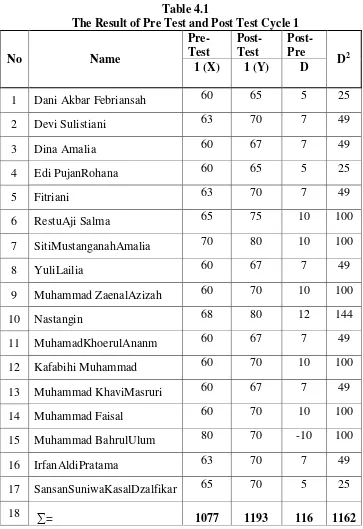
After analyzing the result of the action in cycle 1, the students‘ reading skill was improved. It can be seen by average of the post-test, which is higher than the average of the pre-test.
Table 4.1
The Result of Pre Test and Post Test Cycle 1
No Name
M =
M = M = 63.35
b. Mean of Post-Test I
M =
M =
M = 70.17
c. Mean of Pre-Test = 63.35 d. Mean of Post-Test = 70.17
e. Mean of Pre- Test than Post-Test
f. There is an improvement of reading Comprehension through Reading Race Game between Pre Test I ( before the action ) and the Post – Test I (after the action)
2) Calculating of Standard Deviation
From the data above, the teacher calculates SD Pre Test and Post Test
√ ( )
SD = √
SD = √
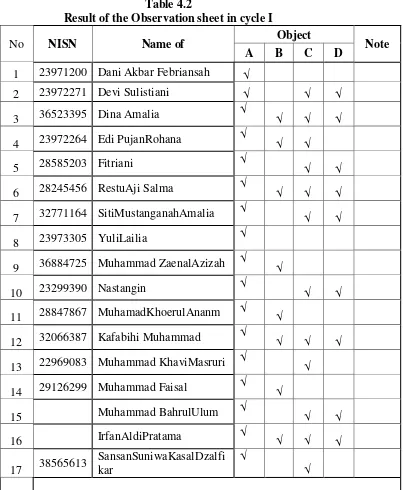
Table 4.2
Result of the Observation sheet in cycle I
No NISN Name of Object Note
B. Activeness in asking question D. Enthusiasm in doing test
2. Cycle II
Based on the result of cycle I, it is better to the teacher to continue the next cycle.
a. Planning
Before conducting the research, the researcher prepared the instrument of research, in the following:
1) Preparing lesson plan 2) Preparing material
3) Preparing list of the students‘ name and scoring
4) Preparing an observation sheet (to know the situation of teaching learning process when method implemented)
5) Preparing a test 9 to know whether students‘ reading comprehension is improve or not when the method is applied.
b. Implementation of the action
Before starting the lesson, the teacher reviewed the previous lesson. After reviewing the previous material, the teacher gave a text to the students and then they read the text one by one as the pre-test. They spent about 20 minutes to finish it and the teacher continued the lesson.
The teacher explained about the greeting card wrote the word that uses in greeting card in the whiteboard then, the teacher reads the words three times and the student repeat after the teacher. At the moment, teacher asked them to gather their group which same with the previous meeting. The teacher prepared the brick word with the word about greeting card. They worked same with the game the last meeting.
Then, the teacher gave students 20 minutes to read the text about greeting card one by one as the post-test. After that the teacher closed the meeting.
c. Observation
In cycle II, the researcher still used same method like in the Cycle I but, she used the different material to teach reading. She used text greeting card. The Teaching Learning process in cycle II is more active than cycle I. They had more easy to read the word in brick word.
The researcher would like to analyze the students‘ improvement in reading
comprehension by calculating the result of pretest and posttest. From the result of this cycle it shows that there is an improvement compare with the previous cycle. It is shows that the students made increase in their reading skill.
d. Reflection
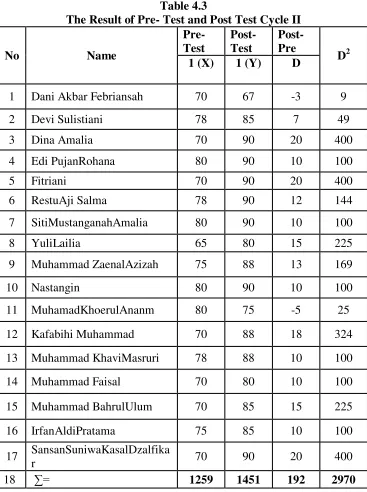
The following table is the final result score of the students‘ in
cycle II.
Table 4.3
The Result of Pre- Test and Post Test Cycle II
No Name
a) Mean of Pre Test II Game between Pre Test II ( before the action ) and the Post Test II (after the action)
2) Calculating of Standard Deviation
SD = √ 2
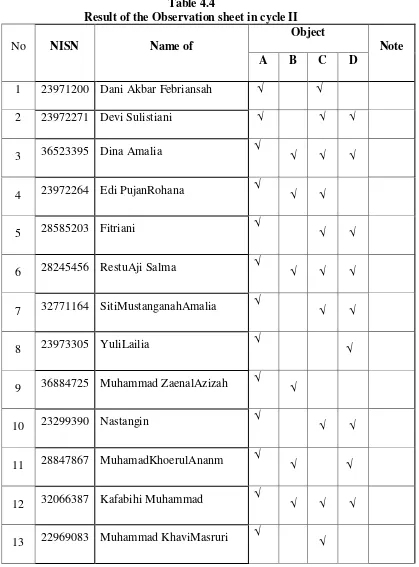
Table 4.4
Result of the Observation sheet in cycle II
No NISN Name of
Object
Note
A B C D
1 23971200 Dani Akbar Febriansah √ √ 2 23972271 Devi Sulistiani √ √ √
3 36523395 Dina Amalia √ √ √ √
4 23972264 Edi PujanRohana √ √ √
5 28585203 Fitriani √ √ √
6 28245456 RestuAji Salma √ √ √ √
7 32771164 SitiMustanganahAmalia √ √ √
8 23973305 YuliLailia √ √
9 36884725 Muhammad ZaenalAzizah √ √
10 23299390 Nastangin √ √ √
11 28847867 MuhamadKhoerulAnanm √ √ √
12 32066387 Kafabihi Muhammad √ √ √ √
14 29126299 Muhammad Faisal √ √ √ √
15 Muhammad BahrulUlum √ √ √
16 IrfanAldiPratama √ √ √ √
17 38565613 SansanSuniwaKasalDzalfikar √ √ √
Explanations:
A. Pay attention C.Activeness in responding question B. Activeness in asking question D. Enthusiasm in doing test
B. Improvement and Discussion 1. Improvement
From the result of analyzing in cycle I and cycle II. There is significant improvement on the students‘ reading ability. That will be
explained in the table below:
Table 4.5
The Mean and T- Calculation of students’ scores
No Analyze Cycle I Cycle II
1. Mean
Post Test 70.17 85.35
2. t- Table N=17 2.11 2.11
3. t- Calculation 5.87 6.60
The table shows that T- Calculation is higher than T- table which means there is significant improvement to the students‘ reading comprehension from cycle I and Cycle II. The result of t- calculation in cycle I is 5.87 and Cycle II is 6.60. It means that the application of Reading Race Game can improve students‘ reading skill. It means that the application of Reading Race Game can improve students‘ reading Skill. From the
finding research above, it can be shown that the using of Reading Race Game can improve the students‘ reading skill because this method encourage
the students do the best for their group.
In addition, the mean of Pre Test and Post Test in each cycle improved significantly. The mean of the Pre Test in cycle I is 63.35 and Post Test cycle I IS 70.18. In cycle II, the mean of Pre Test and Post Test is 74.05 and 85.35.