• Tidak ada hasil yang ditemukan

burning bebas perpus

N/A
N/A
Protected

Academic year: 2017

Membagikan "burning bebas perpus"

Copied!
105
0
0

Teks penuh

(1)

THE IMPLEMENTATION OF DICTATION TECHNIQUE TO INCREASE STUDENTS’ ABILITY IN LISTENING SKILL

AT SMK-1 ALFATTAH MEDAN

THESIS

Submitted to the Tarbiyah Faculty and Teachers Training State University for Islamic Studies (UIN) North Sumatera Medan as a Partial F ulfillment

Requirement for S1 Degree

By:

Intan Nurjannah Nasution NIM: 34.13.3.182

Advisor I Advisor II

Dr. Hj. Siti Zubaidah, M.Ag Dr. Hj. Farida Repelita Wati Kembaren, M. Hum NIP. 19530723 199203 2 001 NIP. 19690217 200701 2 024

DEPARTMENT OF ENGLISH EDUCATION FACULTY OF TARBIYAH AND TEACHERS’ TRAINING

STATE ISLAMIC UNIVERSITY OF NORTH SUMATRA MEDAN

(2)

ABSTRACT

Name : IntanNurjannahNasution NIM : 34.13.3.182

Faculty : Faculty of Tarbiyah and Teachers Training Department :Educational English Department

Advisor I : Dr. Hj. SitiZubaidah, M. Ag

Advisor II : Dr. Hj. Farida RepelitaWatiKembaren, M. Hum Title :“The Implementation of Dictation Technique to

Increase Students’ Ability in Listening Skill’

Skripsi, Medan: Department of English Education, Faculty of Tarbiyah and Teachers Training, State Islamic University of North Sumatera, Medan 2017.

This research was aimed to find out the improvement of the students‟ ability

in listening skill by using dictation technique. The subject of this research was a class that is tenth grade students SMK-1 Al-Fattah Medan, in academic year 2016/2017. It consisted of 30 students in one class. This research was conducting by using Classroom Action Research(CAR) that consisted of four phases; planning, acting, observing and reflecting.The technique of analyzing data was applied in this research were qualitative and quantitative. The qualitative data was gained from observation, interview and documentation. The quantitative data was gained from tests such as pre-test, post-test I and post-test II. The qualitative data were analyzing from the observation sheet, interview sheet and documentation of photos. The quantitative data were analyzing from pre test and post test. The result of the research showed there was increasing in students‟ ability in listening skill by using dictation technique. It can be seen from the mean of the pre test was 62, the post test I was 72.3 and the post test II was 81.2. Otherwise the total of percentage from pre test was 33%, post test I was 57% and post test II was 100%. It showed that the Implementation of Dictation Technique could improve students‟ ability in listening skill and could effect on students‟ understanding in orally English word. The students could more active, enthusiastic and interesting in the learning activity. It can be concluded that the implementation of dictation technique was effective to improve students‟ ability in listening skill. Keyword: Listening Skill, Dictation Technique, Classroom Action

Research Acknowledge by:

(3)

TABEL OF CONTENTS

TABEL OF CONTENTS ... i

LIST OF TABLE ... iv

LIST OF PICTURE ... v

LIST OF APPENDIX ... vi

LIST OF ABBREVIATION ... vii

CHAPTER I INTRODUCTION ... 1

A. Background Of Study ... 1

B. The Identification Of Problem ... 3

C. The Limitation of Problem ... 4

D. The Formulation of Problem ... 4

E. The aim of study ... 4

F. The Significant of Study ... 4

CHAPTER II REVIEW OF LITERATURE ... 6

A. Theoretical Framework ... 6

1. Listening ... 6

a. The Nature of Listening ... 6

b. Kinds of Listening ... 8

c. Elements of Good Listening... 13

(4)

e. The Importance of Listening ... 13

f. The ways to Increasing Listening skill... 14

2. Technique ... 14

3. Dictation ... 15

a. The Definitions of Dictation ... 15

b. Types of Dictation ... 16

c. Material‟s Preparation for Dictation ... 18

d. The Advantages of Dictation ... 18

B. Conceptual Framework ... 20

C. Related Study ... 21

D. Hypothesis ... 22

CHAPTER III RESEARCH METHOD ... 23

A. The Subject of Research... 23

B. Location and Time of Research ... 23

C. Research Design ... 23

D. Procedures of Research ... 30

E. Instrument of Collecting Data ... 32

F. Scoring of Listening Test ... 35

G. Technique of Collecting Data ... 35

H. Technique for Analyzing Data ... 36

(5)

A. The Presentation of The Data ... 38

1. The Quantitative Data ... 38

2. The Qualitative Data ... 41

B. Data Analysis ... 43

1. Analysis of Quantitative Data ... 43

2. Analysis of Qualitative Data ... 48

C. Discussion ... 53

CHAPTER V CONCLUSION AND SUGGESTION ... 55

A. Conclusion ... 55

B. Suggestion ... 56

(6)

LIST OF TABLE

TABLE TITLE PAGE

I Table of Scoring Listening ... 34

II The Score of Students‟ Listening Test ... 37

III The Comparison Students‟ Score ... 38

IV Data Frequency Distribution for Score ... 42

V The Mean of Students‟ Score ... 44

(7)

LIST OF PICTURE

PICTURE TITLE PAGE

(8)

LIST OF APPENDIX

APPENDIX TITLE

A Lesson Plan Cycle I and II

B Test Items

C Observation Sheet

D Interview Guideline

E Calculation of Students‟ Score

(9)

LIST OF ABBREVIATION

SMK : Sekolah Menengah Kejuruan MTs : Madrasah Tsanawiyah SD : Sekolah Dasar

SDN : Sekolah Dasar Negeri AK : Akuntansi

(10)

CHAPTER I

INTRODUCTION

A. The Background of the Study

Listening is not same with hearing. Hearing just involves sounds reception in the passive meaning, while listening covering the active analyzing from the wave of sound. The process is same like the differences between “seeing” and “reading”. In

the seeing as generally in the passive condition, while reading focused on instrumental approach of the reader. In listening there is a desire and ability to listen. Therefore, in listening covered by listening and understanding on what we hear at the same time.1

According to the School Based Curriculum , listening is the language skill that should be mastered by students. In the Standard of Competence and Basic Competence from the Junior High School, the students are expected to have good ability in comprehending and responding to the spoken language such as in transactional or interpersonal conversation. In this case, listening is an important skill that urgently needed in comprehending to the spoken language.

In reality, the students are stuck with bad listening habits that come in the way of effective listening. They often tend to do something while listening, or get

(11)

must learn to get over such thing and not allow external influences affect their listening skill.

Based on my experience in SMK-1 Al-Fattah Medan when the rsearcher was senior high school, the teacher has never thought us about listening activity in the learning English. She always wrote down the materials on the board and asked us to read and memorizing it. That‟s why we do not know what the teacher said when she

explained in English. Because of that, we also get bad mark in our listening test when we took try out examination.

In teaching listening, the teacher can use many techniques to make the students understand about the lesson easily, such as media, asking and answering, etc. We know that there are many kinds of technique that can be used in teaching learning process. This training for active listening comes into play by technique. One of them is Dictation Technique.

Dictation is one of technique that can be used in teaching listening. In the

Longman dictionary of Applied Linguistics ,‟dictation‟ is defined as a technique used

in both language teaching and language testing in which a passage is read aloud to students or test takers, with pauses during which they must try to write down what they have heard as accurately as possible.2 Davis and Rinvolucri defines that dictation as decoding the sounds of English and recoding them in writing. Dictation

2Semin Kazazoğlu.

(12)

can also increase student‟s ability in mastering foreign language and increasing

student‟s ability in listening skill. 3

Based on this idea, it is clear that for getting the aim of education a teacher as the transfer of knowledge should have strategy or technique in learning process. By using strategy teaching and learning process will be effective and efficient. According to Merriam Webster‟s Dictionary, Strategy is method devised for making or doing

something or attaining.4 Based on it we know that strategy is a way to get that effective result in learning process.

Based on the explanation above the researcher found the difficulties that was faced by students in the school, that is why the researcher motivated the teacher to use some technique in learning process. In this case the researcher suggested to use dictation technique that reputed can solve their problems. That is why the researcher want to conduct a research with the title “ The Implementation of Dictation to

Increase Students’ Ability in Listening Skill.

B. The Identification of Problem

Based on background above, there were some problems in the teaching and learning listening. The problems were :

1. The students get difficulties to understand what the speaker says in listening.

2. The teacher does not use various strategy or technique in teaching listening.

3. The student‟s interest in learning English is low.

3

Paul Davis and Mario Rinvolucri. 1993. Dictation- New Methods New Possibilities. New York: ambridge University Press.

4Merriam Webster‟s New,

(13)

C. The limitation of Problem

The limitation in this research are just two factors. They are the Dictation Technique in process of learning and the student‟s ability in listening skill.

D. The Formulation of Problem

The researcher formulated the problem of the research as follow :

1. How is the student‟s ability on listening by using dictation technique?

2. How the dictation technique can increase the students‟ ability in listening skill?

E. The Aim of Study

The aims of this study are :

 To know student‟s ability in listening skill by using dictation technique

 To find out whether the dictation technique can increase students‟ ability in

listening skill.

F. The Significance of study

This research was conducted with expectation that it will be useful to all of readers and especially for the researcher.

1. The Theoretical Significant

a. This research expected to adding information to the readers how to increase ability in listening skill.

b. This research expected can be used as a reference to readers to know

(14)

2. The Practical Significant.

a. This research expected can give more knowledge to the readers and also

the researcher.

b. This research expected can give more information to the teacher about technique in learning teaching process.

c. This research expected can give more motivated to the students to

(15)

6 the research, theories are needed to explained some concepts applies concerning into

the research. The terms must be clarified to have some perspective of the

implementation in the field. The following terms are used in this study are:

1. Listening

a. The Nature of Listening

Listening is a skill that tends to get neglected.5 One of the reason for this is the feeling among language teachers that this skill is automatically acquired by the learner as be learns to speak the language. According to Hornby,listening come from a verb to listen which means to make an effort to hear somebody or something.6 Howatt Dakin as quoted by Saricoban , “listening” is the ability to identify and

5

George Herman Persulessy, Listening Improvement Exercises For Student Of English As A Foreign Language, (Jakarta, 1998) tpn, p.5

6

(16)

understand what others saying. This involves understanding a speaker‟s accent or

pronunciation, his grammar and his vocabulary and grasping his meaning.7

Allah SWT also said in the Qur‟an surah Al-Baqarah verse 171

لقْعي

ل

ْم ف

ْمعٌي

ٌمْكب

مص

ءاد

ءاعد

َلإ

ع ْسي

ل

ا ب

قعْ ي

يذَلا

لث ك

يذَلاا رفك

لثم

Which means “ And the example of those disbelieve, is as that of him who

shout to the (flock of sheep) that hears nothing but calls and cries. (they are) deaf, dumb and blind. So they do not understand.” (Al-Baqarah : 171). From this verse we

can conclude that listening is a process to start mind. Equally, by listening we can

learn and understand everything. 8

From definition above, clearly that listening is the ability to hearing and understanding the meaning of something or sounds from somebody. Listening is not only hearing process, but also process of understanding catch the point of what other people saying. Listening is the process of making sense out of what we hear. Listening is more complex than merely hearing. It is a process that consist of four stages : sensing and attending understanding and interpreting, remembering and

responding. Listening is an active process of receiving, deciphering, and perceiving.9

1. Receiving : The process of hearing and remembering the message. Receiving is typically the first step involved in listening to a message.

7

Arif Saricoban. 2006. The Teaching of Listening. http://iteslj.org/ (Accessed on 14 December 2016)

8

Ibid . p.46

9

(17)

2. Deciphering : The process of decoding the message to gain an understanding if

its meaning. Deciphering is typically the second step involved in listening to a message.

3. Perceiving : The process of focusing on message content as well as sender tone to gauge an appropriate response to a message. Perceiving is typically the third step involved in listening to a message.

b. Kinds of Listening

1. False listening

False listening occurs where a person is pretending to listen but is not hearing anything that is being said. They may not smile and grunt in all the right places, but do not actually take in anything that is said. This is a skill that may be finely honed by people who do a lot of inconsequential listening, such as political and royalty. Their goal with their audience is to make a good impression in very short space of time before they move on, never to talk to that person again. It is also something practiced by couples, particularly where one side does most of the talking. However, the need for relationship hear can lead to this being spotted and consequent conflict.

2. Initial listening

(18)

3. Selective listening

Selective listening involves listening for particular things and ignoring others. We thus hear what we want to hear and pay little attention to 'extraneous' detail. Partial listening Partial listening is what most of us do most of the time. We listen to the other person with the best of intent and then become distracted, either by stray thoughts or by something that the other person has said. We consequently dip inside our own heads for a short while as we figure out what they really mean or formulate a question for them, before coming back into the room and starting to listen again. This can be problematic when the other person has moved on and we are unable to pick up the threads of what is being said. We thus easily can fall into false listening, at least for a short while. This can be embarrassing, of course, if they suddenly ask your opinion. A tip here: own up, admitting that you had lost the thread of the conversation and asking them to repeat what was said.

4. Partial listening

(19)

A tip here: own up, admitting that you had lost the thread of the conversation and asking them to repeat what was said.

5. Full listening

Full listening happen where the listener pays close and careful attention to what is being said, seeking carefully to understand the full content that the speaker is seeking to put across. This may be very active form listening, with pauses of summaries and testing that understanding is complete. By the end of the conversation, the listener and the speaker will probably agree that the listener has fully understood what was said.

6. Deep listening

In deep listening, you listen between the lines of what is said, hearing the emotion, watching the body language, detecting needs and goals, identifying preferences and biases, perceiving beliefs and values, and so on. To listen deeply, you need a strong understanding of human psychology (which the sites seeks to give you ) and to pay attention not just to the words by the whole person.

7. Discriminative listening

(20)

as they are unable distinguish the subtle sounds that are required in that language. Likewise, a person who cannot hear the subtleties of emotional variation in another person's voice will be less likely to be able to discern the emotions the other person is experiencing. Listening is a visual as well as auditory act, as we communicate much through body language. We thus also need to be able to discriminate between muscle and skeletal movements that signify different meanings.

8. Biased listening

Biased listening is listening through the filter of personal bias i.e the person hears only what they want to listen. That‟s mean when the person hears only what they want to hear, typically misinterpreting what the other person says based on the stereo types and other biases that they have. Such biased listening is often very evaluative in nature.

9. Evaluative listening

(21)

whether it is helpful to us. Evaluative listening is also called critical, judgmental or interpretive listening.

10.Appreciated listening

That is looking for ways to accept and appreciate the other person through what they say. Seeking opportunity to praise. In this listening, we seek certain information which will appreciate, for example that which helps meet our needs and goals. We use appreciated listening when we are listening to good music, poetry or may be even the stirring word of a great leader.

11.Sympathetic listening

When we listen empathetically, we go beyond sympathy to seek a truer understand how others are feeling. This requires excellent discrimination and close attention to the nuances of emotional signals when we are being truly empathetic, we actually feel what they are feeling. In sympathetic listening we care about the other person and show this concern in the way we pay close attention and express our sorrow for their ills and happiness at their joys.

12.Therapeutic listening

In this listening, the listener has a purpose of not only empathizing with the speaker but also to use this deep connection in order to help the speaker understand,

change or develop in some way.10

10

(22)

c. Elements of good listening :

a. Attention : the focused perception of both visual and verbal stimuli b. Understanding : assigning meaning to the messages received

c. Responding : make return by some action as if in answer d. Remembering : the storing of meaningful information 11

d. The process of listening

An ordinary person usually takes the following three processes in listening :

a. The listener perceives sound

b. The listener decodes the sounds he or she has perceived, recognizing them as

certain linguistic forms, and

c. The listener decodes the forms he or she has recognized, this time

comprehending the meaning of the forms.12

e. The Importance of Listening

Good listening skills make workers more productive. The ability to listen carefully will allow a person to :

1. Understands assignments and find and what is expected from

2. Answer questions

3. Find underlying meanings in what others say.

11

Michael H. Hoppe, Active Listening: Improve Your Ability to Listen and Lead.Center for Creative Leadership, 2006,

12

(23)

f. Ways to increasing Listening Skill

1. Face the speaker.

2. Maintain eye contact.

3. Minimize external distraction

4. Respond appropriately

5. Focus solely on what the speaker is saying

6. Minimize internal distraction

7. Keep and open mind

8. Avoid letting the speaker know how you handled a similar situation

9. Even if the speaker is launching a complaint against you, wait until they finish

to defend your self

10.Engage yourself. 13

2. Technique

According to Gerlach and Ely, technique is a way, tool, or media that used by teacher to directing the students to their purpose. In KBBI technique is interpreted as a method or a way to doing something that has correlation with art. Al Kahzin said , lesson technique can interpreted as way that doing by someone in implementing a method specifically.14

13

Babita Tyagi(Dept.of Proffesional Comm., RKGIT, GZB), listening : An Imporrtant Skill and Its Various Aspects, p. 5-6

14

NN,(2015), Macam-Macam Tekhnik Pembelajara n,

(24)

3. Dictation

a. The definition of dictation

Davis and Rinvolucri, defines dictation as decoding the sounds of (English)

and recording them in writing 15 Dictation is when the teacher reads the passage three

times. The first time the teacher reads it at a normal speak, while the student just listen. The second time he reads the passage phrase by phrase, pausing long enough to allow students to write down that they have heard . the last time the teacher again

reads at a normal speed, and students check their work.16

In the Longman dictionary of applied Linguistics, „dictation „ is defined as

technique used in both language teaching and language testing in which a passage is read aloud to student or test takers, with pauses during which they must try to write down what they heard as accurately as possible.

From the definition above, we can conclude that „Dictation‟ is a process to

listening something (may be sentence, word or passage)from the teacher and the students record it in the their mind then write down in the their note. And students hopped to perceive the contents of the passage and recognized all the words and sentences being read so that they are able to put these aural codes into written symbols.

Dictation is used to evaluate most of aspects of language simultaneously. It means that when students do the dictation , they do not only pay attention to the sound of the words read by the teacher but also understand about the meaning and

15Semin Kazazoğlu.

Dictation as a Language Learning Tool, Elseiver Ltd., 2012. 16

(25)

be able to transfer the dictated passages to their book note. They forced to pay attention to the passage dictated and write down what they perceive by sound, sight and feeling in the second language at the same time span allowed for a response in the first language. if they fail to concentrate on their listening, they will not able to make quick guess what they actually have to write. It is clear implies that dictation is used to assess the student‟s ability, in this case is listening skill. This technique hoped

can be motivated students in learning English and check whether the teaching aims have been satisfactorily fulfilled or not.

b. Types of Dictation

According to Oller, there are five types of dictation procedures that have been used in a variety of ways as testing techniques. Those five ways are elaborated as follows :

1. Standard dictation

Standard dictation is probably the best known. Students are required to write verbal sequences of material as spoken by a teacher or played back from a recording. The material should be presented at a normal conversational speed and is given in sequences that are long enough to challenge students short term memory.

2. Partial dictation

(26)

because more sensory information is given concerning the message; a partial version and a complete spoken version.

3. Dictation with competing noise

This type dictation is rather difficult because the material is presented with adding noise. The kind of dictation drills the students to be used to every day communication context where language is used in less than ideal acoustic condition ; for example , we are trying to have a conversation in someone‟s

living room when the television and air conditioner are producing a high level of competing noise or trying to hear a message over to public address system in a busy situation, etc.

4. Dicto-Comp

This type of dictation is actually a combination of two forms, namely dictation and composition. Here, the teacher read the whole passage three times and the students are only given chance to write their work after the teacher has finished the third reading. They should recall the whole story and write the story as a reproduction of what they heard.

5. Elicited imitation

In this case, the student listen to the material, but instead of write down the material, the students are asked to repeat it or otherwise recount

what was said.17 is a research technique aiming at revealing learners‟

grammatical competence (see competence/performance ) by requiring them to

17

(27)

repeat sentences, the argument being that, when their capacity is strained, their mistakes will reveal their underlying rule system.

c. Material’s Preparation and Procedures to giving dictation test.

It is important for the teachers to make some preparation when they are going to give dictation text to their students. There are some preparation that must be followed, those are :

1. Teachers have to select suitable materials to be dictated.

2. The words that dictated should have been taught to the students before.

3. The words dictated should be selected and chosen from simple words.

4. Teachers gave to select suitable procedures which are appropriated in giving

dictation test.

There are two ways of giving dictation test : The teacher reads the words directly by himself, or use the Words dictated have been recorded before. The teacher is required to read the passage here times in all: first, at normal; speed; then, with pauses between phrases or natural word groups so that the students my write down what they have just heard, and finally, at normal speed once more so they can check their work.

d. The Advantages of Dictation

There are some advantages according to Montalvana, those are :

1. Dictation can help develop all four language skills in an integrative way.

2. As students develop their aural comprehension of meaning also of the

(28)

3. Discussion helps to develop short-term memory. Students practice retaining meaningful phrases or whole sentences before writing them down.

4. Practice in careful listening will be useful later on in note taking exercise.

5. Correcting dictation can lead to oral communication

6. Dictation can serve as an excellent review exercise

7. Dictation is psychologically powerful and challenging.

8. Dictation fosters unconscious thinking in the new language.

9. If the students do well, dictation is motivating.

10.Dictation involves the whole class, no matter how large it is.

11.During and after the dictation, all the students are active.

12.Correction can be done by the students.

13.Dictation can be prepared for mixed ability groups.

14.Dictation can be prepared for any level

15.The students, as well as the teacher, can get instant feedback (if the exercise is

corrected immediately)

16.The dictation passage can (and should) be completely prepared in advance (it also can be taped).

17.Dictation can be administered quite effectively by an inexperienced teacher.

18.While dictating, the teacher can move about, giving individual attention.

19.Dictation exercise can pull the class together, for example, during those

valuable first minute.

(29)

21.Research has shown the learning to write down what you hear can encourage the development literacy.18

B. Conceptual Framework

In the school, listening is an important skill that must be mastered by the students. Listening is a receptive skill involving respond to the spoken language. in the listening process, the students do not only hearing the sound of the speaker but they also need to know the context and understand about the speaker‟s aims.

Based on the observation, many of students had any difficulties in knowing what they listened. They just hearing what the people said whereas some of them doing something else at the time of teaching process in listening subject. Regarding to this problem, effort need to be implemented to help the students easier in listening comprehension. Because of that, the researcher choose the dictation technique to solve the problem. The use of dictation technique expectedly could solve the student‟s listening problems and their listening skill.

18

(30)

C. Related Study

Dian Lestari (2013) „Improving Students‟ Listening Skills By Using Song At

MTs TELADAN PAHLAWAN MEDAN. The population of this study was one class of grade VII students of MTs which consist of 37 students. To collect the data the researcher used quantitative data (listening test), and qualitative data (interview and observation). Based on the data analysis, it was found that the students‟ score

improved. It can be seen from the data that she show in her thesis.

Ika Ratna Melawanti (2007) „Dictation As a Testing Technique In Measuring

The Student‟s Listening Skill‟(A case to collect the data the researcher use study of

(31)

data analysis, it was found that dictation test success to measuring student‟s listening skill. It can be seen from the score of the students are in average 7-9.

Niluh Putu Oka Arisona (2013) Teaching Spelling Through Dictation to the fifth grade Students of SDN 3 Subagan in academic year 2012/2013. The population on this study was in one class that consist of 22 students which consisted 16 males and 6 females students. This research is success conducted in this location. It was the previously shown that the students average score in the pre test was 54 then improve to 63,46. This main score was calculated the average point in the post test I = 60.36, post test II = 66.55. after following the second cycle treatments the students achievement raised significantly 78.73.it‟s mean score was also derived from adding

two means score of post test III = 76 and post test IV = 81.45 . therefore the dictation contributed significantly to improve the students‟ on spelling words.

D. Hypothesis

The student‟s ability in listening skill would be increase by implementation of

(32)

23 CHAPTER III

RESEARCH METHOD

A. The Subject of the Research

The subject of this research is the tenth grade students of SMK-1Al-Fattah Medan Academic year 2016/2017. In SMK-1 Al-Fattah there are two classes of tenth grade. They are X AP that consist of 30 students and X AK that has the same number with X AP, they are 30 students. The total number of students on tenth grade in SMK-1 Al-Fattah Medan are 60 students. For the submit of this research, the researcher take the X AP that consist of 30 students.

B. Location and Time of Study

This research was conducted in That located on Cemara Street no. 172 Kelurahan Pulo Barat Darat II kecamatan Medan Timur, Medan and conducted on April 2017. This school was chosen because I have studied in this school when I was senior high school. By the experience of the researcher when researcher was as a student in that school and by the interview with one of the English teacher in the school, I interested to applied dictation technique to increase students‟ ability in listening skill. Because a long as I become a student, I never taught the materials by using dictation technique.

C. Research Design

(33)

research in this class with the planning, acting, observing and reflecting that has aims to improve the quality of learning process in the classroom through the certain action with a cycle.19

Wallace contended that action research referred to class room investigation initiate by researcher, perhaps teacher, who looked critical at their own practice with the purpose of understanding and improving their teaching and the quality of education. Action research involved the collection and analysis of data related to aspect of professional practice. It was a loop process, in the sense that the process could be repeated (reframing the problem, collection fresh data, rethinking the analysis) until found satisfied solution.20

According to Arikunto, Classroom Action Research consist of three words that can be understood as follow :

1. Research

Examine the activity of an object, use the rules of a particular methodology to obtain data or information to improve the quality of a thing that interest and important for researcher.

2. Action

Some activities that are deliberately made with a specific purpose, which in this study form a series o cycle of activity.

19

Kunandar, Langkah Mudah Penelitian Tindakan Kelas, (Jakarta: Raja Wali Press,2008) p.41

20

M.J Wallace, Action Research for Language Teacher. (Cambridge: Cambridge University

(34)

3. Class

Class is a group of students who are in the same ime receive the same lesson from a teacher. Restrictions written for understanding of the notion that class is long to knock out a misconception and is widely understood by the public with the classroom but a group of students who were studying .

By combining these three words, Classroom Action Research is a reflection to activity which is intentionally appeared, and happened in class. The Classroom Action research term was originally created by Kurt Lewin, an American Sociolog. He was the first expert that introduce Action Research. Kurt Lewin‟s model represent

elementary model which was later developed by other expert.21

Classroom action research is combination of Qualitative research and Quantitative research. In Classroom Action research, the data collected qualitatively and analyzed quantitatively. Action research is different from formal research, which aims to test hypothesis and build theory as general. Action research aims to as further improve performance, and contextual nature not to generalize the result. However, the result of action research can be applied by others who have a background similar to that researchers process.22

Based on explanation above, action research is qualified to be used in order to see the improvement of students‟ ability in the skill of English lesson but in this case is listening skill through dictation technique. It is expected by using action research; the improvement of students‟ listening skill was achieved.

21

Suharsimi Arikunto, Penelitian Tindakan Kelas. (Jakarta: Bumi Aksara, 2010), p. 59

22

(35)

According to the type of this research that is action research, this research has form cycle stages. Each of the cycle consisted of four steps namely ; planning, Action, observing, and reflecting.

1. Planning

Planning is to develop an action plan critically to improve what had happened. Classroom action research should be composed and the term of the definition must be perspective on the action. collection activity observation n the form of PBM performance changes process.

4. Reflection

(36)

this phase, the writer will take the feedback from the result of the observation. The purpose is to improve student‟s listening skill.23

The relationship of the components was view as a cycle. Visually the phase can be presented as the picture bellow :

Picture 1. Elementary Model of Action Research by Kurt Lewin

23

Kunandar, Langkah Mudah Penelitian Tindakan Kelas,.(Jakarta: Raja Wali Pers, 2008) p.41

Planning

Acting

(37)

Phase above, which forming one cycle, can be continued to next cycle with plan, action, observe and reflection repeat pursuant to reach result at the previous cycle. Thereby, picture 1 above can be develop to become picture 2;

Picture 2. Develop basic model

Amount of cycle is an Action Research depend on the main problem faced by have solved or not.24

24

Suwarto. WA, Penelitian Tindakan Kelas dan Struktur Penulisannya. (Jakarta: Perdana Media Group, 2009)p. 5-6

Plan

Reflect Act

Observe

Plan

Reflect Act

(38)

In the case of this research, which conducted by two cycles, the chain of Classroom Action Research can be seen I this following figure:

Picture 3. The Pattern of Classroom Action Research in two cycle

PLAN

PLAN REFLECT

OBSERVED

REFLECT

ACTION ACTION

(39)

D. The Procedure of Research

Cycle 1

In the first cycle, it consist of planning, action, and observation planning. Planning is the arrangement for doing something. In planning it is considered everything which is related to the action that will be done and it also prepares everything that will be needed in teaching and learning process.

1. Planning

a. Preparing lesson plan for 3 meetings and the teaching media

b. Preparing the pre test in order to know the basic skill of students toward

listening skill

c. Interviewing the English teacher in order to know the students skill is listening and students background

d. Preparing observation sheet in order to know the development that

existed during the applying dictation technique and also see the student reaction and the condition as a whole

e. Interviewing the students to predict their problem in listening and to gain their comments about listening

f. Determining the collaborator who helped the researches to do research,

(40)

2. Action

Action was the process of doing something. It was the implementation of planning. The researcher was flexible and ready to situation changing in the school. Thus, the action was dynamic, needed immediately decision for what would be done and completed simple evaluation.

3. Observation

a. View and record the process and action learning in the classroom directly, observed activities include the activities of the teachers in learning process. b. Record the student‟s ability to understand material of conversation.

c. The observation do by the English teacher in class X AP.

4. Reflection

This reflection discuss with collaborators on observational data or records to consider the problem posed by the teacher, student or the use..

Cycle II

1. Planning

The result of cycle 1 indicated that is there any improving in the students‟

(41)

2. Action

In this second cycle the teacher will begin to teach English with using dictation technique. Teacher will give the blank paper than playing the recorder in three times then ask the students to write down what have their heard.

3. Observation

1. Noting and recording learning activities

2. Analyze the data with percentages techniques and qualitative analyze of data

obtained from the list of interviews, and observation

3. Summing up the success

4. Reflection

Assess the thing that happened after the action. E. The Instrument of Collecting Data

The data are collected by using quantitative and qualitative way. Quantitative is broadly used to describe what could be counted or measured and could be considered „objective‟. The quantitative data are collected by computing the score of

(42)

Qualitative is used to describe data which cannot be counted or measured in an objective way, therefore it is also called as „subjective‟.25 The qualitative data is bused to describe the situation during the teaching process. The qualitative data collected by using interview sheet, observation sheet, and documentation.

1. Interview

According to Bogdan and Biklen that interview is conversation aimed to get information usually consisted of two person or more.26 Interview sheets is used to know students feelings, problems, and other conditions and students idea or attitude in studying listening by using dictation technique. The researcher do the interview not only with student as subject of research, but also with the English teacher. By interviewing the teacher researcher will know students‟ ability because the teacher

knows her students more. The researcher also want to know teachers‟ opinion,

suggestion and ideas to help her to do the research.

2. Observation

Observation sheet is used to measure the level of students‟ activities during teaching learning process and to students‟ participations level in teaching-learning process. Therefore, this observation sheet is focused on the situation of teaching learning process, students‟ activities behaviors, and students skill by using dictation technique. By using observation, the researcher sure that she will get the real data,

25

Wallace. Michael. J, Action Research for Language Teacher. (United Kingdom: Cambridge University, 1988) p.38

26

(43)

especially to get the qualitative data, about condition in the learning process, students‟ ability and the problem that students have in learning English directly.

3. Test

Test is sequence of practice which is used to measured skills, intelligence, ability and attitude own by individual or group. The form of the test is essay test. Which consist of arranging the word, filling the blank space and matching the word to the sentence. There are two kinds of this classroom action research test they are pre-test and post-test.

a. Pre-test

Pre-test is a test before dictation as teaching technique.

b. Post-test

Post-test function is to know the means of the score experimental group.

The procedure of this test administration as follow:

1. Students were given the sheet test

2. Students were asked to write their name and class

3. Students were hear the explanation from the teacher, how to do the task.

4. Students were given time to answer the questions.

5. Collected the test from the students when time was over.

(44)

F. Scoring of listening test

In scoring the written test, the cumulative score is raging from 0-100. In order

we know the students‟ ability in listening skill. There are some criteria that must be

considered.

3.1Table of scoring listening test

Scores Categories

85-100 Very good

75-84 Good

60-74 Moderate

40-59 Low

0-39 Failure

In this research, the student would be hoped to get the score upper to moderate category. It means this research would be finished if the student got a good or very good score category. In additional, the target was 70 to 100 students‟ means score. It‟s mean the students can pass the test when they get the score more than 70. If they

get under 70 they are fail in the test. G. Technique of Collecting Data

The data was collected by observation, interview, documentation and the test.

Observation, interview and documentation were done to know the students‟ activity

and the students‟ need in the learning process (qualitative data) during the research

(45)

the kinds of test that used was essay test. That is the test of students‟ listening skill before and after treatment. In actions, the data was collected twice, in action 1 and 2.

The pre-test (before) data was to know students‟ development before treatment. Then,

post-test (after) was taken to know students‟ ability in listening skill after giving the treatment.

H. Technique for Analyzing the Data

This study applied qualitative and quantitative data. The qualitative data is used to describe the situation during the teaching process and the quantitative data is used to analyzed the score of the students‟ listening. By applying these data this is

expected to get satisfying result. The qualitative data are analyzed from interview and observation sheet to describe the improvement of the students‟ listening skill by using

dictation technique. The quantitative data are collected and analyzed by computing the score of listening test. To collect the data, the researcher observed these activities by using dictation technique.

To know the mean of the students score of assessment given in each treatment, the observer applied the following formula.27

Where

X = the mean of the students‟ score

27

Anas Sudjiono, Pengantar Evaluasi Pendidikan.(Jakarta: PT.Raja Grafindo Persada, 2006) p. 327

(46)

∑X= the total score of the students

N= the number of the students

Next, to categorize the writer of students who competent to listen a conversation, the following formula is;

Where;

P= percentage of students who get the point 70

R = the number of the students who get point above 70 T= the total number of students who do the test.

(47)

38 CHAPTER IV

DATA ANALYSIS AND DISCUSSION

A. The Presentation of The Data

The data in this research was taken from Observation Sheet, Interview and listening test. When collecting the data, researcher did the observation in the classroom and interviewing the teacher and the students. The researcher asked students about study English and also about their problems in English. Then researcher consulted with the teacher about what they should do. It is include about the technique that will conducted and how the way solving the students‟ problem

about English lesson.

The main focus of this research was actions which were done in two cycles. Every cycle had four phases namely planning, acting, observing and reflecting. The researcher was done only in one class. The class was chosen is X AP which consisted of 30 students. They were consisted of women only. They were never absent during the researcher was conducting the research from the first meeting until the last meeting.

1. The Quantitative Data

(48)

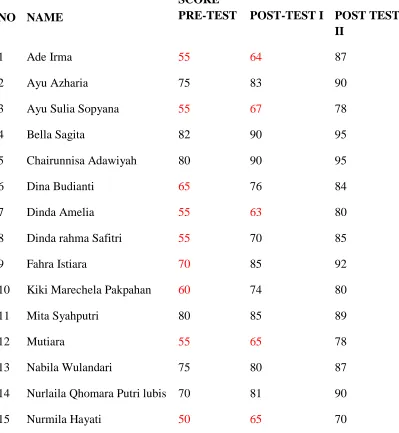
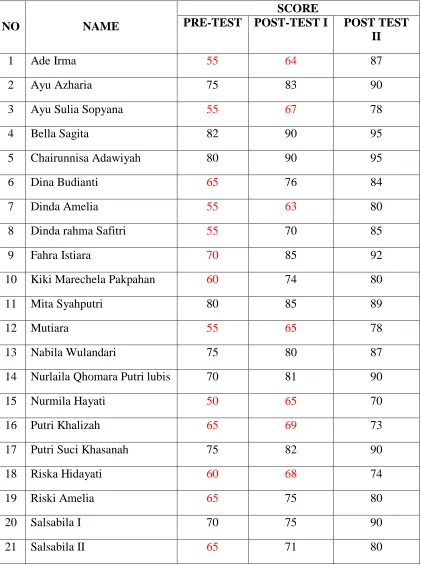
was relevant with the topic which has been discussed of each cycle in the classroom. The listening test was carried out in two cycles. In the two cycles, researcher conducted six meetings. The listening test was given to the student at the end of the cycle. The result of the students‟ score could be seen in the following table.

Table 4.1 The Score of Students Listening Test

NO NAME

SCORE

(49)

16 Putri Khalizah 65 69 73

Data source : Was taken from statistic of SMK -1 Al-Fattah Medan

The improvement of the students‟ score in listening through dictation has

showed from the mean of the students‟ score in the first until the third test. The mean

of the third listening test was the highest among the other test. The students‟ score in

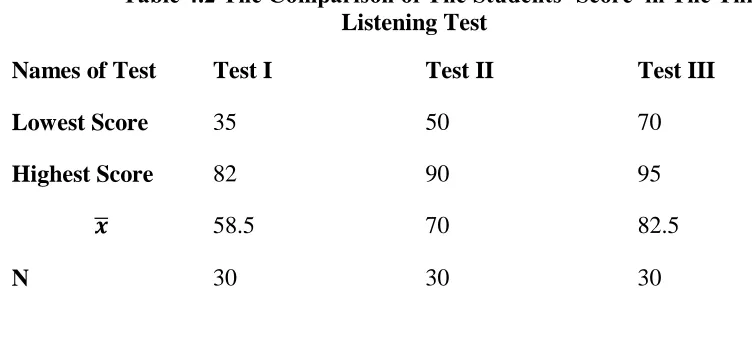
(50)

the third test, the lowest score was 70 and the highest one was 95. The comparison of the students‟ score in listening tests can be seen in the table 4.2.

Table 4.2 The Comparison of The Students’ Score in The Three Listening Test

Names of Test Test I Test II Test III

Lowest Score 35 50 70

Highest Score 82 90 95

̅ 58.5 70 82.5

N 30 30 30

It can be concluded that the students‟ listening skill through dictation

technique had increased from 50 to 90. The calculation can be seen in appendix E. The students were said master the lesson if they got score 70. The percentage of the students who got score over 70 also showed improvement. It is seen from the students‟ score from the first meeting to the last meeting.

2. The Qualitative Data

a. Observation Sheet

From observation sheet, the researcher was noted the students‟ attitude during

(51)

teaching and learning process. Besides that, researcher paid attention to the ways that used by teacher during teaching learning process.

The improvement of students‟ in comprehend the orally word also kept

paying attention for teacher since the first meeting until the last meeting. In fact, the students serious in teaching learning process, but some of them get low score in the pre-test. It is causes they have problem in their word comprehend. In the other word, they have low vocabulary. But in the cycle II, they are serious than before. They did the dictation test personally. In the second test, they have good score than before. It can be seen from their comprehending the word was improved after process of the teaching and learning using the dictation. However, some of the students still get low score.

b. Interview

The interview was done the interview with miss Isma Juliana as an English teacher on Monday April 10th 2017 in the first meeting. From the interview, it was found that the teacher had problem in teaching and learning English, it is some of the students still lack of the vocabulary, lack of interested to the English subject and they are felt confused to the English subject. That‟s why the teacher said some of them

who lack in vocabulary got low score.

Teacher hopes that dictation is one of the good technique that can improve the students‟ comprehensive in the orally word. She thought that her students will interest

to this technique in the learning process. Because she said, she is seldom using this

(52)

teacher use dictation in the learning process. But researcher make the teacher trust that researcher will make the students interest with her lesson when used the dictation technique.

The researcher also interviewed the students of the class X AP in the same time to know their problem in learning English. They faced difficulties in comprehend the lesson and teacher explanation because they still lack of vocabulary and lack of comprehend it orally. It could be useful to interview them in order to know the background of their difficulties. From the interview the researcher concluded that their problem is difficult to understand what the teacher said when the teacher talked in English and lack of vocabulary.

In the last meeting, researcher also interviewed the teacher and students to know their opinion after learnt by using dictation technique. The teacher said that she is very interest to apply the dictation for the next meeting to improve the students ability, maybe not only for the their listening skill but also in other aspect of English. In the other side, dictation makes them more interest to English subject. The transcription of interview could be seen in appendix D.

c. Documentation

(53)

test and their reaction during the teaching and learning process. The documentation could be seen at appendix F.

B. Data Analysis

1. Analysis of Quantitative Data

Based on table 4.1. The score of students in dictation and listening test increased from the pre-test, post test in cycle I until post test in cycle II. The researcher gave them listening test with dictation way, arranging the word until matching the word at the end of the topic which has been finished to be discussed or the end of cycle. It was found out that the students‟ score for the vocabulary test kept

improving from meeting to meeting. The students score in post test of cycle I was higher than the pre test, and the post test of cycle II was higher was the post test of cycle I.

Table 4.2 Data Frequency Distribution for Score

a. Pre Test

Number Interval Frequency Percentage Quality Category

4 76-85 4 students 13.3 % A Very High

3 66-75 7 Students 23.3.% B High

2 56-65 7 students 23.3% C Enough

1 46-55 8 students 26.6 % D Low

(54)

Total 30 students 100 %

b. Post Test I

Number Interval Frequency Percentage Quality Category

4 81-90 8 students 26.6% A Very High

3 71-80 7 students 23.3% B High

2 61-70 10 students 33.3% C Enough

1 51-60 2 students 6.6 % D Low

0 0-50 3 students 10 % E Very Low

Total 30 students 100 %

c. Post Test II

Number Interval Frequency Percentage Quality Category

4 86-95 10 students 33.3% A Very High

3 76-85 10 students 33.3% B High

2 66-75 10 students 33.3% C Enough

1 56-65 - - D Low

0 0-55 - - E Very Low

(55)

The improvement of the students‟ score in comprehending the orally vocabulary through dictation technique also could be seen from the mean of the

students‟ score during the research. The researcher applied the following formula:

̅ ∑

Where :

̅ ∑

N = The number of students

In the pre test the total of the score of the students was 1862 and the number of students was 30, so mean was:

̅

In the post test I the total of the score of the students was 2169 and the number of students was 30, so mean was:

̅

In the post test II the total of the score of the students was 2437 and the number of students was 30, so mean was:

(56)

Table 4.3 The Mean of Students’ Score

̅ Pre Test Post Test I Post Test II

Mean 62 72.3 81.2

The mean of the students score in the Post test of cycle II was highest, so it could be said that the students‟ listening skill improved from 62 to 81.2.

The number of students was calculated by applying the formula:

In which:

P = The percentage of students who get point 70

R = The number of students who get point up 70

T = The total of number students who do the test

The percentage of the improvement of students‟ vocabulary could be seen as follows:

1. Pre Test

(57)

2. Post Test I

3. Post Test II

The result showed the improvement of the students‟ score from the pre test to

(58)

Table 4.4 Percentage of Students’ that Comprehend the Oral Word

Test Number of Students Percentage

Pre Test 10 33.3 %

Post Test I 17 56.6 %

Post Test II 30 100 %

2. Analysis of Qualitative Data

The qualitative data were taken from result of interview, observation and documentation. Both teacher and students‟ behavior during the process of teaching

and learning process in the classroom were evaluated in the qualitative data. In the qualitative data there are two cycles, cycle I and II, and the activities are:

1) Cycle I

The cycle I was done in three meetings included the orientation test. The researcher as the teacher tried to increase the students‟ listening skill trough Dictation technique. Dictation technique would be success to enhance the students‟

comprehend in the word orally, if: a) the students looked interest in studying through dictation, b) the students eager to share their opinion through dictation technique, the students looked more active and creative in learning process, and c) the students‟

(59)

Planning

First of all, researcher prepared and made a lesson plan for 2 meetings. The topic which discussed was about Present Continuous Tense. In planning of Action Research, researcher had been prepared:

1. Dictation material (conversation) the title of the dictation material is “Carrol Activity” and the test sheet about the topic.

2. Prepared the lyric of the song the title is “My Love” by Westlife.

Acting

The First Meeting : In the first meeting researcher introduced herself and the

purpose to came to that school. Then, researcher explained them a bit little about the pre-test then researcher gave them pre-test sheet and we are started to did the test.

researcher turn on the voice recorder of conversation that title is “Carrol Activity”,

then the students paid full attention to it for two times. After that researcher turn on the voice recorder with per sentence it‟s in order the students could write down the

sentence in the sheet. We did it till finished. The last researcher turn on the voice recorder in order the students could correcting their written before they submitted it.

(60)

sentence and researcher asked them to come forward and wrote the answer on the blackboard. After that, we looked for the difficult word and the students noted it in their note book.

The Second Meeting: In the second meeting, for the first one the researcher

did the warmed up before started the study. The researcher asked them about the difficult vocabulary that has noted by them. Then gave them a material, that is “Present Continuous Tense” . The researcher offering explanation to them about the

material and gave some examples of it. After that the researcher asked them to come forward and gave the example. Then we were correcting it together.

After done about the material, researcher applied the dictation technique to them with used the same conversation that used in pre-test. The researcher as the speaker read it till two times and they were listening it carefully. After that they start to write the sentence until the end. When they have done the dictation, researcher asked them to analyzed the conversation which the verb that added “ing” in it. Then

they wrote it on the blackboard and make one sentence of it.

The Third Meeting: in the third meeting we were about a west song that the

title is “My Love” by Westlife. Researcher turn on the song and we sang the song

(61)

researcher has dictated to them. In the last of meeting researcher asked them to prepare the lyric of ‟I Have a Dream” by Westlife for the test in the next meeting.

Observing

The observation was done to observe how the students‟ behavior and what the

students‟ problems during the teaching and learning process. Most of the students

participated affectively during the teaching and learning process and also when they did the dictation task and the test, although they did not understand and felt unusual with this technique. They were enthusiastic and enjoyable about the topic which discussed by teacher in the classroom. They also seriously to answered the question that gave by researcher.

Reflecting

Based on the result of the score of the test in cycle I and observation, action and improvement was needed. Actually, students‟ score in the test of post-test I was

improved than the score of pre test. But, it needed more improvement in their vocabulary because some of them still confused and difficult to understand some vocabulary.

2) Cycle II

(62)

three meetings. It was expected that the second cycle of action research would get better than cycle I. In this cycle, researcher gave them more motivation and also more explanation about vocabulary which suitable with the topic discussion. The activities of second cycle of action research as follows:

Planning

The researcher prepared lesson plan and emphasized the teaching and learning

process in teaching students‟ listening skill. The topic of study in this meeting was

about song that the title was “I have a Dream” by Westlife. The teaching and learning

process almost same like the process in cycle I and also the preparation of it:

1. Prepared the lyrics song and the test sheet of the song.

2. Prepared some of sentence to got students‟ activeness.

3. Prepared the conversation : the script and the test sheet also.

Acting

In the cycle II, in this cycle the activity almost same like previous cycle. The first meeting, the researcher and students sang the song together after that the

researcher gave the test of it. For the second meeting, researcher gave them some of sentence and asked them to wrote it in their note then wrote it on the blackboard. The third meeting, the researcher used it just to gave the students listening test for the

post-test II. Before teacher taught the lesson, it would be better to do the warmed up to the students. The warmed up of was still in form of question and students should be answered the question which given to them.

(63)

The observation was still done for the last time. The activity of students was observed and it showed that most of the students did not have problems anymore in the comprehending the orally word. But they still need to mastering more vocabulary in order they are familiar with the English word even it is oral or written they really liked the topic and the ways which given by researcher. They were active during teaching and learning process and more enthusiastic than before.

Reflecting

Having checked the students‟ listening test that was consisted of matching the

word, arranging the word and the paragraph, and also the „true or falls” test, it found

that the students‟ score showed the improvement. Based on the observation and the

result of their test, researcher concluded that the students had become accustomed to

listen the sentence and the conversation in the oral form. The students‟ score on the

second cycle had improved than in the first cycle. In this phase researcher stopping the research because the improvement has showed.

C. Discussion

Dictation technique was applied to increase the students‟ ability in the

listening skill. In fact, not only listening skill but also in the writing and reading skill. Dictation is one of technique that benefits to increase students comprehensive in the oral word and make them easier to remember the lesson. This research had proved the effectiveness of applying dictation technique. It was shown in Table 4.1. The students‟ score from orientation test, cycle I test and cycle II test. It was because the

(64)

Students‟ data in cycle II test showed that the mean of students‟ score was

higher that the mean of the students‟ score in cycle I test and also better that

orientation test. In the last test of cycle II, all of the students or 30 students got the score above 70, and the higher score is 90. This improvement not only happened in the mean of students‟ score but also the expression, interest and excitement of

(65)

56 CHAPTER V

CONCLUSION AND SUGGGESTION

A. Conclusion

1. After analyzing the data the researcher found out that the students‟ ability in the listening skill was increased after the researcher used the dictation technique. It can be seen by the improvement of their score. It was proved by

the data which showed that the mean of the students‟ test in cycle II (81.2)

was higher than test in the cycle I (72.3), and also the improvement of students‟ score who got score over 70 showed that percentage in the test of

cycle II (100%) was higher than the test in cycle I (57%) and also higher than the pre test (33%). Therefore, Dictation Technique can increase students‟

ability in listening skill at tenth grade in SMK-1 Al-Fattah Medan.

2. Dictation technique can increase students‟ ability in listening skill. It can be seen when the researcher gave the last listening test and all of the students did it very excited without imitate from their friends. It can be seen also from the result of the last listening test. They are got better score from the first cycle to the next cycle.

Gambar

TABEL OF CONTENTS ...................................................................................
Table 4.1 The Score of Students Listening Test
Table 4.2 The Comparison of The Students’ Score  in The Three Listening Test
Table 4.1 The Score of Students Vocabulary Test

Referensi

Garis besar

Dokumen terkait

Puzzle is a technique of teaching that is using an intellectual quotient to understand English, especially vocabulary mastery that as a basic skill of English

They will not be printed in your test book, so you must listen carefully to understand.. what the speakers

But there are some difficulties in listening skill about the song lyrics you raise me up, for example in identification part use the theory Bloomfield 2010:9. -

The test are used to collect vocabulary mastery data (in the form of multiple choice test which consist of 50 items) and listening skill (in the form of

Nazariah. The Correlation Between Students’ Vocabulary Mastery and Their Listening Ability of The Eleventh Grade at Integrated Islamic Senior High School Qardhan

They shared: …I usually watch English movies with subtitles on the Internet.….S2-11 …I often listen to English songs from e-websites….S2-7 …I often learn vocabulary from playing

In the learning process when the teacher read a text, students will try to understand the text by listening carefully and try to improve their writing skill and they try to write by

According to Zuchdi 1995: 3-7 vocabulary mastery is a person's ability to recognize, understand and use words well and correctly by listening, speaking, reading and writing.The