Dietary supplementation of probiotics in poultry exposeD to heat stress – a review
Sugiharto Sugiharto♦, Turrini Yudiarti, Isroli Isroli, Endang Widiastuti, Endang Kusumanti
Faculty of Animal and Agricultural Sciences, Diponegoro University, Semarang, Central Java, Indonesia
♦Corresponding author: [email protected]
abstract
heat-related stress has become a serious problem in poultry industry along with the global tem-peratures rise. heat stress causes detrimental effects on physiology, immunology and microbiology resulting in abnormalities and impaired performances of birds. several nutritional strategies have been conducted to counteract the detrimental effects of heat stress in poultry, including dietary supplementation of probiotics. this strategy has been proposed to ameliorate the intestinal eco-system, physiological conditions and immune eco-system, leading to the improved performance and
health of birds subjected to heat stress. This review presents the potential beneits of probiotics
against heat stress in poultry from the viewpoint of intestinal microbial ecology, morphology and structure, physiological conditions, immune system and production performances. the possible
mechanisms through which probiotics may give beneicial impacts on heat-stressed birds are also
discussed along with the data reporting the possible drawbacks of using probiotics in heat-stressed poultry.
Key words: poultry, heat stress, probiotics, performance, health
heat stress (Lara and Rostagno, 2013). This review aimed at elucidating the dietary supplementation of probiotics in ameliorating the deleterious effects of heat stress in poultry. To prepare the review, we conducted a literature search with focus on the
potential beneits and drawbacks of probiotics on heat-stressed poultry (broiler, hen,
duck and quail) using the following criteria: (1) peer-reviewed journal articles in English were included; (2) chapters in an edited book were selectively included; (3) studies on humans and rodents were selectively included to verify and/or support the data on poultry. The key words used during literature search included probiotics, heat stress, chicken, microbe, immune system, physiology, growth. For collection of the
related articles, we employed several scientiic portals including Elsevier Science -Direct, EBSCO E-journal, Proquest Research Library, Cambridge University Press E-Journal and Springerlink E-Journal. We also used Google Scholar when we did not
ind any intended articles through the above mentioned scientiic portals.
heat stress in poultry
Stress is a term describing the responses of the body to abnormal conditions that potentially interrupt homeostasis or normal physiological equilibrium (Sahin et al., 2009; Lara and Rostagno, 2013). In poultry, stress is characterized by the changes in behaviour, biochemistry and physiology that are all addressed to re-establish ho-meostasis (Sahin et al., 2009). At molecular level, stress may change the expres-sion of genes like heat-shock protein (HSP) including HSP 40 and HSP 90 that are involved in self-regulation and compensation to maintain homeostasis (Sun et al., 2015). High ambient temperature is one of the important factors inducing stress in birds. Due to the global warming, high temperature has recently become one of the most important stressors affecting poultry industry worldwide (Lara and Rostagno, 2013). Hence, effort has to be undertaken to cope with the detrimental effects of heat stress on poultry.
impacts of heat stress on intestinal morphology and microbiology
Heat stress has been shown to impair the intestinal morphology and barrier integ-rity of chickens (Song et al., 2013, 2014), leading to impaired digestive and absorp-tive capacity and increased permeability to luminal antigens and toxins. A number of factors have been attributed to the impaired intestinal morphology and integrity
of birds exposed to heat stress, including the diversion of systemic blood lows from
internal organs to peripheral circulation (in order to dissipate heat), which may cause ischemia and hypoxia in the intestinal epithelial cells (Al-Fataftah and Abdelqader, 2014; Song et al., 2014). Corticosterone has also been inferred to be responsible for the damage of intestinal mucosa in birds exposed to high temperature (Quinteiro-Filho et al., 2010), as this hormone can delay proliferation of the intestinal epithelial cells that in turn lowers intestinal villus height and crypt depth (Hu and Guo, 2008).
Moreover, corticosterone may induce the production of proinlammatory agents
al. (2012), this unbalanced intestinal microbiota may distort the regulation of intestinal epithelial cell turnover, epithelial restitution and reorganization of tight junctions. Such distortion may in turn provoke the changes in intestinal morphology and integrity.
impacts of heat stress on physiology and immune system
It has been reported that heat stress can adversely change the metabolic status and physiological equilibrium in birds (Donkoh, 1989; Rhoads et al., 2013), leading to health problems and high mortality rate (Lara and Rostagno, 2013). Indeed, heat stress decreased blood Na, K and partial pressure of carbon dioxide (pCO2), which may disturb acid-base balance and cause respiratory alkalosis, respectively (Borges et al., 2004). Moreover, heat stress increased serum concentrations of corticosterone (Sohail et al., 2012), glucose, triglycerides, total cholesterol and low-density lipo-protein (LDL)-cholesterol (Habibian et al., 2014), while decreasing the concentra-tion of haemoglobin (Borges et al., 2004), triiodothyronine (T3) (Tollba and Sabry, 2004), plasma protein (Donkoh, 1989; Tollba and Sabry, 2004), uric acid (Sun et al., 2015) and high-density lipoprotein (HDL)-cholesterol of broilers (Habibian et al., 2014). Unlike the above mentioned studies, Tollba and Sabry (2004) reported that
heat stress decreased plasma glucose, while Sun et al. (2015) did not ind any signii -cant difference in plasma corticosterone between heat-stressed and control chickens. The extent and duration of heat exposure may be the reason for these discrepancies,
as Zulkili et al. (2006) reported that blood glucose levels of birds declined with
long-term heat exposure.
Heat stress has been shown to compromise immune functions of poultry and therefore increase the susceptibility of birds to infections and increase the mortality and morbidity (Habibian et al., 2014; Akhavan-Salamat and Ghasemi, 2015; Hos-seini-Vashan et al., 2015). The increased and decreased production of corticosterone (Sohail et al., 2012; Deng et al., 2012) and antioxidant enzymes (Sahin et al., 2009; Hosseini-Vashan et al., 2015), respectively, have been attributed to the compromised immune functions in birds exposed to heat stress. The increase in corticosterone level induced lymphoid organ involution (Quinteiro-Filho et al., 2010; Yang et al., 2015), changed the characteristics of heterophil and lymphocyte (Shini et al., 2008; Akhavan-Salamat and Ghasemi, 2015) and affected the levels of tumor necrosis fac-tor (TNF) alpha, interleukin (IL)-2 and immunoglobulin (Ig) G (Yang et al., 2015).
The decreased level of antioxidant enzymes may be associated with the insuficient
protection of immune cells from the oxidative stress which increase during heat stress (Sahin et al., 2009).
impacts of heat stress on performance
mor-phology and lowered digestive enzyme activity; Song et al., 2013, 2014; Chen et al., 2014) and metabolism (due to lowered activity of thyroid hormones; Tollba and Sabry, 2004; Sohail et al., 2010), altered endocrine status (increased corticosterone hormone; Deng et al., 2012; Sohail et al., 2012), metabolic shifts at the systemic and cellular levels and changes in body composition (Rhoads et al., 2013).
probiotics and heat stress
As part of the nutritional strategies, inclusion of feed additives in the diet has been conducted for ameliorating the negative effects of heat stress in poultry (Lara and Rostagno, 2013). Among feed additives, probiotics have gained more attention from poultry nutritionists as this additive is reported capable of improving the physi-ological conditions, intestinal morphology and structure, immune system and thus performance and well being of heat-stressed poultry (Al-Fataftah and Abdelqader,
2014; Jahromi et al., 2015). Apart from these beneicial effects, some studies re -ported no effect of probiotics on heat-stressed poultry (Sandikci et al., 2004; Sohail et al., 2013, 2015). This will be the subject of discussion in the following section of this review paper.
probiotics and intestinal microbial ecology of heat-stressed poultry
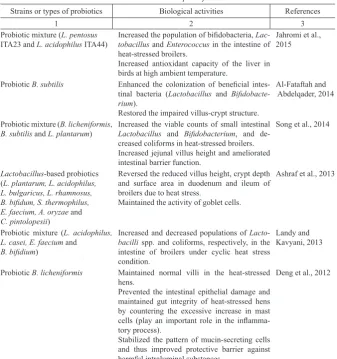
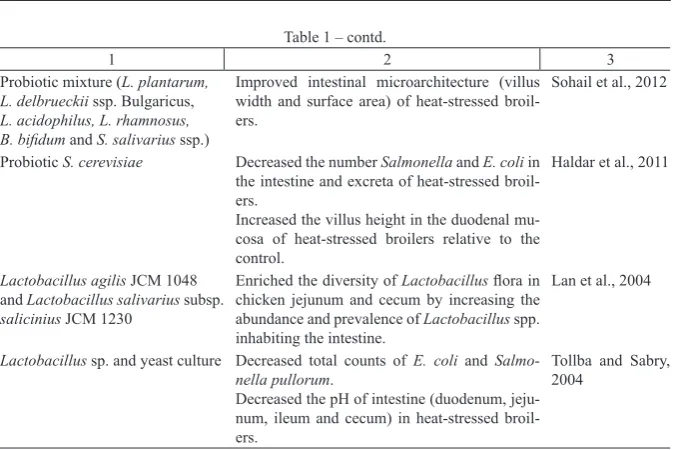
A number of studies have reported the potential beneits of probiotics on the
intestinal microbial diversity and population in poultry subjected to high ambient
temperature (Table 1). The mechanisms through which probiotics elicit beneicial
impacts and/or re-establish the balanced intestinal microbial diversity and
popula-tions in birds have been elucidated elsewhere (Sugiharto, 2016). In contrast to the
above mentioned studies, Sohail et al. (2013) reported no effect of probiotic mixture (L. plantarum, L. acidophilus, L. bulgaricus, L. rhamnosus, B. biidum, S. thermo
-philus, E. faecium, A. oryzae and C. pintolopesii) on the populations of Clostridium
perfringens, total coliforms and Escherichia coli in the jejunum and cecum of heat-stressed broilers. Likewise, Sohail et al. (2015) demonstrated that probiotic mixture (L. plantarum, L. acidophilus, L. bulgaricus, L. rhamnosus, B. biidum, S. thermo -philus and E. faecium) had no positive effect on the abundance of probiotic bacteria
in the cecum and trachea of heat-stressed broiler. The different type and dose of probiotic microorganisms used as well as the different part of gastrointestinal organs observed may explain the above discrepancy.
probiotics and intestinal morphology of heat-stressed poultry
Several studies have revealed the potential beneits of probiotics in improving
the intestinal morphology and integrity of birds subjected to heat stress (Table 1). Probiotics may reverse the impaired villus-crypt structure of heat-stressed birds, for example, by controlling the corticosterone level (Sohail et al., 2012; Lei et al., 2013)
and the excessive release of proinlammatory agents that can cause intestinal tissue
mucus-producing goblet cells located in the ileal villi (Sandikci et al., 2004). Conversely, probiotic B. licheniformis was able to maintain (comparable to those in birds reared under thermoneutral) goblet cell counts in the ileum and cecum of heat-stressed hens in the study of Deng et al. (2012). Likewise, Lactobacillus-based probiotics enhanced goblet cell counts in the duodenum and jejunum of heat-stressed broilers (Ashraf et al., 2013). One possible mechanism by which probiotics enhanced goblet cell counts was that probiotics may regulate mucin mRNA expression and acceler-ate the differentiation of goblet cells (Smirnov et al., 2005). Different from the latter studies, Sandikci et al. (2004) reported that probiotic S. cerevisiae had no impact on the goblet cell counts along the small intestinal segments of quails. These discrepan-cies were perhaps due to the different type of probiotic, animals or intestinal seg-ments used in the experiseg-ments.
Table 1. Examples of probiotic treatments to improve intestinal microbiology and morphology of heat-stressed poultry
Strains or types of probiotics Biological activities References
1 2 3
Probiotic mixture (L. pentosus ITA23 and L. acidophilus ITA44)
Increased the population of biidobacteria, Lac-tobacillus and Enterococcus in the intestine of heat-stressed broilers.
Increased antioxidant capacity of the liver in birds at high ambient temperature.
Jahromi et al., 2015
Probiotic B. subtilis Enhanced the colonization of beneicial intes -tinal bacteria (Lactobacillus and Biidobacte -rium).
Restored the impaired villus-crypt structure.
Al-Fataftah and Abdelqader, 2014
Probiotic mixture (B. licheniformis,
B. subtilis and L. plantarum)
Increased the viable counts of small intestinal
Lactobacillus and Biidobacterium, and de-creased coliforms in heat-stressed broilers. Increased jejunal villus height and ameliorated intestinal barrier function.
Reversed the reduced villus height, crypt depth and surface area in duodenum and ileum of broilers due to heat stress.
Increased and decreased populations of Lacto-bacilli spp. and coliforms, respectively, in the intestine of broilers under cyclic heat stress condition.
Landy and Kavyani, 2013
Probiotic B. licheniformis Maintained normal villi in the heat-stressed hens.
Prevented the intestinal epithelial damage and maintained gut integrity of heat-stressed hens by countering the excessive increase in mast
cells (play an important role in the inlamma -tory process).
Stabilized the pattern of mucin-secreting cells and thus improved protective barrier against harmful intraluminal substances.
Table 1 – contd.
1 2 3
Probiotic mixture (L. plantarum,
L. delbrueckii ssp. Bulgaricus,
L. acidophilus, L. rhamnosus,
B. biidum and S. salivarius ssp.)
Improved intestinal microarchitecture (villus width and surface area) of heat-stressed broil-ers.
Sohail et al., 2012
Probiotic S. cerevisiae Decreased the number Salmonella and E. coli in the intestine and excreta of heat-stressed broil-ers.
Increased the villus height in the duodenal mu-cosa of heat-stressed broilers relative to the control.
Haldar et al., 2011
Lactobacillusagilis JCM 1048 and Lactobacillus salivarius subsp.
salicinius JCM 1230
Enriched the diversity of Lactobacillus lora in
chicken jejunum and cecum by increasing the abundance and prevalence of Lactobacillus spp. inhabiting the intestine.
Lan et al., 2004
Lactobacillus sp. and yeast culture Decreased total counts of E. coli and
Salmo-nella pullorum.
Decreased the pH of intestine (duodenum, jeju-num, ileum and cecum) in heat-stressed broil-ers.
Tollba and Sabry, 2004
In the study of Song et al. (2014), there was a tendency that administration of pro-biotics mixture (B. licheniformis, B. subtilis and L. plantarum) in the diet alleviated the increased intestinal mucosal permeability of heat-stressed chickens as indicated by the improvement on transepithelial electrical resistance (TER) and permeability
of luorescein isothiocyanate dextran 4 kDa (FD4) in jejunal mucosa. In addition to proinlammatory agents, reactive oxygen species (ROS) generated during heat stress
can increase intestinal permeability in birds (Lara and Rostagno, 2013). Interest-ingly, Sohail et al. (2011) found that probiotic mixture (L. plantarum, L.
acidophi-lus, L. bulgaricus, L. rhamnosus, B. biidum, S. thermophiacidophi-lus, E. faecium, A. oryzae and C. pintolopesii) decreased serum total oxidants concentration in heat-stressed broilers, comparable with that in thermoneutral, and thus may reverse the increased intestinal permeability. Concomitant with this, Jahromi et al. (2015) reported that feeding a mixture of L. pentosus ITA23 and L. acidophilus ITA44 prevented the adverse effects of heat stress on the antioxidant capacity of liver. It was hypothesized that probiotics might produce some bioactive substances with free radical chelating ability (such as glutathione) that potentially prevents oxidative damage (Sohail et al., 2011). In line with this hypothesis, Lutgendorff et al. (2009) reported that probiotic pre-treatment prevented oxidative stress in Sprague-Dawley rats by increasing mu-cosal glutathione biosynthesis.
probiotics and physiological variables of heat-stressed poultry
Several works have indicated the potential beneits of probiotics in ameliorat
-ing the impaired physiological conditions in poultry due to heat stress. Zulkili et al. (2006) reported that probiotic-enhanced water acidiier (Acid-Pak 4-WayTM,
chloride, zinc sulfate, ferrous sulfate, magnesium sulfate, cellulase, S. faecium and
L. acidophilus) helped in restoring serum Na and K levels of broilers following one day of heat exposure. However, it is not clear whether probiotic microorganisms or electrolytes (sodium chloride, sodium citrate, potassium chloride) which played dominant roles in restoring serum Na and K levels in heat-stressed broilers, as limit-ed information is available to support our view. Probiotic treatment has been demon-strated to increase serum concentration of T3 (Tollba and Sabry, 2004) and T4 (Sohail et al., 2010) in broilers subjected to heat stress. Considering that thyroid hormones play important roles in stimulating the synthesis of many structural proteins, en-zymes and hormones, the increased levels of thyroid hormones following probiotic supplementation are reasonably expected to improve digestion and metabolism in heat-stressed chickens (Aluwong et al., 2013). One possible factor that might be re-sponsible for enhancing the concentrations of T3 and T4 in probiotics-supplemented heat-stressed birds was the reduced circulating level of corticosterone (Sohail et al., 2012), as elevated concentration of corticosterone may result in hypothyroid activity (Ganong, 2005).
It has been reported that probiotic (Protexin® Boost) treatment increased uric acid
level in the serum of heat-stressed birds (Hasan et al., 2015), which may indicate the reduced protein digestibility in birds (Saki et al., 2005). This seems to be contradicto-ry with the study of Tollba and Sabcontradicto-ry (2004) reporting that probiotics (Lactobacillus
sp. and yeast culture) increased total plasma protein (indicator of high protein digest-ibility). Considering that uric acid is an important antioxidative agent (de Oliveira and Burini, 2012), the increased level of uric acid may be a mechanism of probiotic in alleviating the oxidative damage following heat stress in birds. The increased level of total serum glucose in response to heat stress has been reported to be alleviated by
provision of probiotic-enhanced water acidiier in the study of Zulkili et al. (2006).
In this case, probiotics might decrease the concentration of corticosterone that in turn
decreased gluconeogenesis in heat-stressed birds (Zulkili et al., 2006). Heat stress is
associated with the decreased concentration of some haematological variables such as haemoglobin (Borges et al., 2004). Hasan et al. (2015) showed that probiotics (Protexin® Boost) increased haemoglobin concentration in birds subjected to heat stress. In contrast, Rahimi and Khakseidi (2006) did not ind any effect of probiotics
(Bioplus 2B containing of B. subtilis CH201 and B. licheniformis CH200) on
hae-moglobin concentration in heat-stressed chickens. The different type of probiotics used in the diets of heat-stressed birds seemed to be the reason for the discrepancy.
probiotics and immunity of heat-stressed poultry
re-duced corticosterone level may be beneicial for restoring the normal function and
development of immune system.
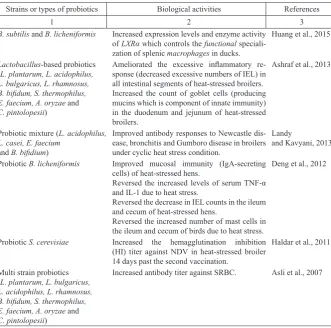
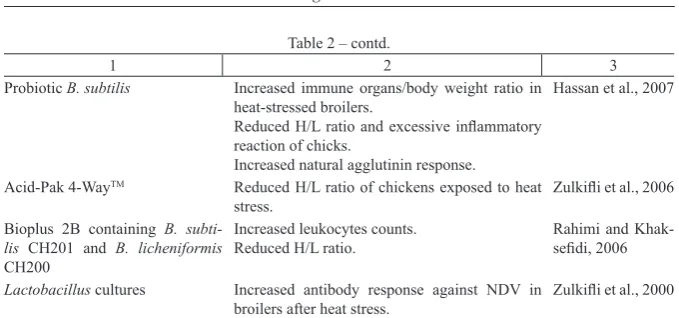
The lowered antibody response to infectious agents is usually believed to in-crease the mortality of heat-stressed chickens. Probiotic administration has been
found to enhance antibody responses (Zulkili et al., 2000; Asli et al., 2007; Haldar
et al., 2011; Deng et al., 2012; Landy and Kavyani, 2013) as well as leukocytes
count (Rahimi and Khakseidi, 2006) in birds reared under hot temperature. How -ever, some studies reported no effect of probiotic treatment on the antibody level in heat-stressed birds. Sohail et al. (2010) reported that Lactobacillus-based probiotics (L. plantarum, L. acidophilus, L. bulgaricus, L. rhamnosus, B. biidum, S. thermo
-philus, E. faecium, A. oryzae and C. pintolopesii) did not affect the antibody titers against Newcastle disease virus (NDV) and infectious bursal disease virus (IBDV) in broilers subjected to heat stress. Similar report was revealed by Rahimi and
Khakse-idi (2006), in which Bioplus 2B containing B. subtilis CH201 and B. licheniformis
CH200 did not inluence antibody production against sheep red blood cells (SRBC)
antigen and NDV vaccination in heat-stressed broilers at different ages. The exact rationale for this discrepancy was not clear, but the different type and dose of probi-otics used in the experiments seemed to be responsible.
Intraepithelial lymphocytes (IEL) are important components of the host immune system that can rapidly respond to infection (Sheridan and Lefrançois, 2010). Heat stress is known to lower the number of IEL in the ileum and cecum of laying hens at
61 (but not at 62) weeks of age (Deng et al., 2012). Indeed, probiotic B. licheniformis reversed the decreased number of IEL due to heat stress in the latter study. In contrast to the above data, Ashraf et al. (2013) reported that IEL in all the segments of small intestine of broilers increased with heat stress. This increase was probably associated
with initiation of the inlammatory response by heat stress (Quinteiro-Filho et al., 2010). It should be noted that exaggerated inlammatory responses may be delete -rious (induce immunopathology) for poultry. Treatment with Lactobacillus-based probiotics (L. plantarum, L. acidophilus, L. bulgaricus, L. rhamnosus, B. biidum, S. thermophilus, E. faecium, A. oryzae and C. pintolopesii) indeed alleviated the in-creased count of IEL in all intestinal segments of heat-stressed broilers (Ashraf et al., 2013), and therefore the balanced mucosal immune responses could be maintained. In laying hens, the increase in serum corticosterone due to heat stress was
associ-ated with the increased mast cells in the ileum and cecum and TNF-α and IL-1 in the
serum (Deng et al., 2012). Probiotic B. licheniformis reversed the increased count of
mast cells as well as TNF-α and IL-1 in the study of Deng et al. (2012), and thus the excessive inlammatory responses in the small intestine of heat-stressed hens could
be prevented.
probiotic administration has been reported by several authors able to improve the intestinal microbial diversity and population, and thus immune system of poultry un-der heat stress condition (Al-Fataftah and Abdelqaun-der, 2014; Song et al., 2014). The mechanisms through which intestinal microbial ecosystem affects the immune
sys-tem of birds have extensively been reviewed elsewhere (Sugiharto, 2016). Recently,
dyslipidemia (elevation of plasma cholesterol, triglycerides, or both, or a low HDL
level) has been believed to be a marker of inlammation in human studies (Aulinas et al., 2015). Concomitant with the enhanced levels of the conventional inlammatory marker such as TNF-α and IL-1 (Deng et al., 2012), heat stress in poultry was also
associated with the dyslipidemia (Habibian et al., 2014). There is growing evidence that probiotics can control dyslipidemia in birds subjected to heat stress as reported by Tollba and Sabry (2004) when providing Lactobacillus sp. and yeast culture. Cor-responding report was shown by Sohail et al. (2010) when feeding Lactobacillus -based probiotic to heat-stressed broilers.
Table 2. Examples of probiotic treatments to improve immune system of heat-stressed poultry
Strains or types of probiotics Biological activities References
1 2 3
B. subtilis and B. licheniformis Increased expression levels and enzyme activity of LXRα which controls the functional speciali-zation of splenic macrophages in ducks.
Huang et al., 2015
Ameliorated the excessive inlammatory re -sponse (decreased excessive numbers of IEL) in all intestinal segments of heat-stressed broilers. Increased the count of goblet cells (producing mucins which is component of innate immunity) in the duodenum and jejunum of heat-stressed broilers. ease, bronchitis and Gumboro disease in broilers under cyclic heat stress condition.
Landy
and Kavyani, 2013
Probiotic B. licheniformis Improved mucosal immunity (IgA-secreting cells) of heat-stressed hens.
Reversed the increased levels of serum TNF-α
and IL-1 due to heat stress.
Reversed the decrease in IEL counts in the ileum and cecum of heat-stressed hens.
Reversed the increased number of mast cells in the ileum and cecum of birds due to heat stress.
Deng et al., 2012
Probiotic S. cerevisiae Increased the hemagglutination inhibition (HI) titer against NDV in heat-stressed broiler
Table 2 – contd.
1 2 3
Probiotic B. subtilis Increased immune organs/body weight ratio in heat-stressed broilers.
Reduced H/L ratio and excessive inlammatory
reaction of chicks.
Increased natural agglutinin response.
Hassan et al., 2007
Acid-Pak 4-WayTM Reduced H/L ratio of chickens exposed to heat
stress.
Zulkili et al., 2006
Bioplus 2B containing B. subti-lis CH201 and B. licheniformis CH200
Increased leukocytes counts. Reduced H/L ratio.
Rahimi and
Khak-seidi, 2006
Lactobacillus cultures Increased antibody response against NDV in broilers after heat stress.
Zulkili et al., 2000
probiotics and performance of heat-stressed poultry
Probiotics have been exploited to ameliorate the detrimental impacts of heat stress on poultry performance (Lara and Rostagno, 2013). Jahromi et al. (2015) reported that incorporation of a mixture of L. pentosus ITA23 and L. acidophilus
ITA44 into diets improved the growth and feed conversion ratio (FCR) of broilers exposed to heat. Similarly, Al-Fataftah and Abdelqader (2014) showed that dietary supplementation of Bacillus subtilis was effective in improving the growth perfor-mance, while Song et al. (2014) reported that supplemental probiotics (contained B. licheniformis, B. subtilis and L. plantarum) improved feed to gain ratio of broiler chickens reared under hot temperature. In heat-stressed laying hens, administration of multi strain probiotics (L. plantarum, L. bulgaricus, L. acidophilus, L. rhamnosus,
B. biidum, S. thermophilus, E. faecium, A. oryzae and C. pintolopesii) (Asli et al., 2007) or probiotic B. licheniformis (Deng et al., 2012) increased egg production and feed intake. Apart from the potential of probiotics in improving the performances of heat-stressed birds, Lara and Rostagno (2013) suggested that the effect of feed additives including probiotic on the performance of heat-stressed chickens is not always discernible. This can be seen in the study of Sohail et al. (2012) and (2013), in which probiotic mixture containing L. plantarum, L. delbrueckii ssp. Bulgaricus,
L. acidophilus, L. rhamnosus, B. biidum and S. salivarius ssp. Thermophilus and E. faecium as well as probiotic mixture containing L. plantarum, L. acidophilus,
L. bulgaricus, L. rhamnosus, B. biidum, S. thermophilus, E. faecium, A. oryzae and C. pintolopesii, respectively, could not signiicantly improve the growth performance
of broilers under heat stress condition. The type or species and the dose of probiotics used and the ambient temperature applied during the study may be responsible for the above discrepancy.
One of the predisposing factors for the impaired growth performance in heat-stressed chickens is the reduced activities of digestive enzymes (Ca2+-Mg2+
-adeno-sine triphosphatase [ATPase], Na+-K+-ATPase, maltase, sucrase, and alkaline
phos-phatase) which impede digestion and hence limit the nutrient utilization by birds
(Chen et al., 2014). To date, the deinite mechanism through which probiotics could
improve the performance of poultry exposed to heat remains unclear. However,
by increasing the digestive enzyme activity and decreasing bacterial enzyme activ-ity. It has been known that heat stress can decrease feed digestibility of the differ-ent compondiffer-ents of the diets including starch, fats and proteins (Bonnet et al., 1997; Lara and Rostagno, 2013). With regard to protein, administration of probiotics may improve protein digestibility and decrease ammonia production, and hence improve
the growth performance of poultry exposed to heat (Sugiharto, 2016). Apart from the
enhanced digestive enzyme activity, probiotic microorganisms have been found to produce several enzymes that are not produced by host to help hydrolyzing complex macromolecules (Nayak, 2011). Taking this into view, it is therefore reasonable to expect that probiotics may be useful to improve the digestibility in birds which have reduced dietary digestibility during heat stress.
The reduced thyroid hormones activities due to heat stress could be a major prob-lem for the growth performance of broilers (Sohail et al., 2010). Tollba and Sabry (2004) revealed that Lactobacillus sp. and yeast culture increased plasma T3 while Sohail et al. (2010) reported that Lactobacillus-based probiotics enhanced serum T4 concentrations in heat-stressed broilers. There is evidence that thyroid hormones
possess enterotrophic effects in rats (Tutton, 1976). Hence, the increased level of
thyroid hormones (after probiotic administration in heat-stressed chickens) is reason-ably expected to increase villus surface area, which eventually improves the absorp-tive capacity of the chickens. In addition, the increased level of thyroid hormones
would be beneicial for alleviating the impaired growth performance in heat-stressed
chickens, given that thyroid hormones play important roles in regulating the meta-bolic processes essential for normal growth and development (Mullur et al., 2014).
conclusions
Due to global temperatures rise, heat stress has recently become a serious threat to poultry production in most poultry producing countries. Heat stress can impair physiology, immunology and microbiology of poultry and thus performances of birds. Probiotics seem to be useful to ameliorate the detrimental effects of heat stress in poultry, given that probiotics may improve intestinal microbial ecology and mor-phology, physiological conditions, immune system and performance of birds reared under heat stress condition. However, probiotics should be used with caution as some studies reported no effect.
references
A k h a v a n - S a l a m a t H., G h a s e m i H.A. (2015). Alleviation of chronic heat stress in broilers by dietary supplementation of betaine and turmeric rhizome powder: dynamics of performance,
leu-kocyte proile, humoral immunity, and antioxidant status. Trop. Anim. Health Prod., doi: 10.1007/
s11250-015-0941-1.
A l - F a t a f t a h A.R., A b d e l q a d e r A. (2014). Effects of dietary Bacillus subtilis on heat-stressed
broilers performance, intestinal morphology and microlora composition. Anim. Feed Sci. Technol.,
198: 279–285.
A l u w o n g T., H a s s a n F., D z e n d a T., K a w u M., A y o J. (2013). Effect of different levels of
A s h r a f S., Z a n e b H., Y o u s a f M.S., I j a z A., S o h a i l M.U., M u t i S., U s m a n M.M., I j a z S., R e h m a n H. (2013). Effect of dietary supplementation of prebiotics and probiotics on intestinal microarchitecture in broilers reared under cyclic heat stress. J. Anim. Physiol. Anim. Nutr.
(Berl)., 97: 68–73.
A s l i M.M., H o s s e i n i S.A., L o t f o l l a h i a n H., S h a r i a t m a d a r i F. (2007). Effect of probiot-ics, yeast, vitamin E and vitamin C supplements on performance and immune response of laying hen
during high environmental temperature. Int. J. Poult. Sci., 6: 895–900.
A u l i n a s A., R a m í r e z M.J., B a r a h o n a M.J., Va l a s s i E., R e s m i n i E., M a t o E., S a n - t o s A., C r e s p o I., B e l l O., S u r r a l l é s J., W e b b S.M. (2015). Dyslipidemia and chronic
inlammation markers are correlated with telomere length shortening in Cushing’s syndrome. PLoS
ONE, 10: e0120185.
B e s k i S.S.M., A l - S a r d a r y S.Y.T. (2015). Effects of dietary supplementation of probiotic and
syn-biotic on broiler chickens hematology and intestinal integrity. Int. J. Poult. Sci., 14: 31–36.
B o n n e t S., G e r a e r t P.A., L e s s i r e M., C a r r e B., G u i l l a u m i n S. (1997). Effect of high
ambient temperature on feed digestibility in broilers. Poult. Sci., 76: 857–863.
B o r g e s S.A., F i s c h e r d a S i l v a A.V., M a j o r k a A., H o o g e D.M., C u m m i n g s K.R. (2004). Physiological responses of broiler chickens to heat stress and dietary electrolyte balance (sodium plus potassium minus chloride, milliequivalents per kilogram). Poult. Sci., 83: 1551–1558. B u r k h o l d e r K.M., T h o m p s o n K.L., E i n s t e i n M.E., A p p l e g a t e T.J., P a t t e r s o n J.A.
(2008). Inluence of stressors on normal intestinal microbiota, intestinal morphology, and suscepti -bility to Salmonella Enteritidis colonization in broilers. Poult. Sci., 87: 1734–1741.
C h e n Z., Wa n g B., X i e J., Ta n g J. (2014). Effect of γ-aminobutyric acid on digestive enzymes,
absorption function, and immune function of intestinal mucosa in heat-stressed chicken. Poult. Sci., 93: 2490–2500.
D a s S., P a l a i T.K., M i s h r a S.R., D a s D., J e n a B. (2011). Nutrition in relation to diseases and heat stress in poultry. Vet. World, 4: 429–432.
d e O l i v e i r a E.P., B u r i n i R.C. (2012). High plasma uric acid concentration: causes and
conse-quences. Diabetol. Metab. Syndr., 4: 12, doi: 10.1186/1758-5996-4-12.
D e n g W., D o n g X.F., T o n g J.M., Z h a n g Q. (2012). The probiotic Bacillus licheniformis ame-liorates heat stress-induced impairment of egg production, gut morphology, and intestinal mucosal immunity in laying hens. Poult. Sci., 91: 575–582.
D o n k o h A. (1989). Ambient temperature: a factor affecting performance and physiological response
of broiler chickens. Int. J. Biometeorol., 33: 259–265.
G a n o n g W.F. (2005). The thyroid gland. In Review of Medical Physiology. 22nd ed. McGraw-Hill, Singapore.
H a b i b i a n M., G h a z i S., M o e i n i M.M., A b d o l m o h a m m a d i A. (2014). Effects of dietary selenium and vitamin E on immune response and biological blood parameters of broilers reared under thermoneutral or heat stress conditions. Int. J. Biometeorol., 58: 741–752.
H a l d a r S., G h o s h T.K., W a t i T., B e d f o r d M.R. (2011). Effects of yeast (Saccharomyces cere
-visiae) and yeast protein concentrate on production performance of broiler chickens exposed to heat stress and challenged with Salmonella enteritidis. Anim. Feed Sci. Technol., 168: 61–71.
H a s a n S., H o s s a i n M.M., A l a m J., B h u i y a n M.E.R. (2015). Beneicial effect of probiotic on
growth performance and hemato-biochemical parameters in broilers during heat stress. IJIAS, 10: 244–249.
H a s s a n A.M., A b d E L A z e e m M.H., H u s s e i n M.M., O s m a n M.M., A b d E l - W a h e d Z.H. (2007). Effect of chronic heat stress on broiler chicks performance and immune system. SCVMJ,
12: 55–68.
H o s s e i n i - Va s h a n S.J., G o l i a n A., Y a g h o b f a r A. (2015). Growth, immune, antioxidant, and bone responses of heat stress-exposed broilers fed diets supplemented with tomato pomace. Int. J. Biometeorol., DOI 10.1007/s00484-015-1112-9.
H u X., G u o Y. (2008). Corticosterone administration alters small intestinal morphology and function of broiler chickens. Asian-Aust. J. Anim. Sci., 21: 1773–1778.
H u a n g Z., M u C., C h e n Y., Z h u Z., C h e n C., L a n L., X u Q., Z h a o W., C h e n G. (2015). Effects of dietary probiotic supplementation on LXRα and CYP7α1 gene expression, liver enzyme
J a h r o m i M.F., A l t a h e r Y.W., S h o k r y a z d a n P., E b r a h i m i R., E b r a h i m i M., I d r u s Z., T u f a r e l l i V., L i a n g J.B. (2015). Dietary supplementation of a mixture of Lactobacillus strains enhances performance of broiler chickens raised under heat stress conditions. Int. J. Biometeorol., doi:10.1007/s00484-015-1103-x
K h a k s e f i d i A., R a h i m i S.H. (2004). Evaluation of the effect of probiotic on blood factors, per-formance and carcass characteristic of broiler chicks under heat stress. Agric. Sci. Technol., 18: 149–158.
L a n P.T.N., S a k a m o t o M., B e n n o Y. (2004). Effects of two probiotic Lactobacillus strains on jejunal and cecal microbiota of broiler chicken under acute heat stress condition as revealed by
molecular analysis of 16S rRNA genes. Microbiol. Immunol., 48: 917–929.
L a n d y N., K a v y a n i A. (2013). Effects of using a multi-strain probiotic on performance, immune
responses and cecal microlora composition in broiler chickens reared under cyclic heat stress condi -tion. Iran. J. Appl. Anim. Sci., 3: 703–708.
L a r a L.J., R o s t a g n o M.H. (2013). Impact of heat stress on poultry production. Animals, 3:
356–369.
L e i K., L i Y.L., Yu D.Y., R a j p u t I.R., L i W.F. (2013). Inluence of dietary inclusion of Bacillus
licheniformis on laying performance, egg quality, antioxidant enzyme activities, and intestinal bar-rier function of laying hens. Poult. Sci., 92: 2389–2395.
L u t g e n d o r f f F., N i j m e i j e r R.M., S a n d s t r ö m P.M., T r u l s s o n L.M., M a g n u s - s o n K.E., T i m m e r m a n H.M., v a n M i n n e n L.P., R i j k e r s G.T., G o o s z e n H.G., A k -k e r m a n s L.M.A., S ö d e r h o l m J.D. (2009). Probiotics prevent intestinal barrier dysfunction in acute pancreatitis in rats via induction of ileal mucosal glutathione biosynthesis. PLoS ONE, 4: e4512.
M u l l u r R., L i u Y.Y., B r e n t G.A. (2014). Thyroid hormone regulation of metabolism. Physiol. Rev., 94: 355–382.
N a y a k S.K. (2011). Biology of eukaryotic probiotics. In: Probiotics, M.T. Liong (ed.). Microbiology
Monographs 21, doi: 10.1007/978-3-642-20838-6_2.
Q u i n t e i r o - F i l h o W.M., R i b e i r o A., F e r r a z - d e - P a u l a V., P i n h e i r o M.L., S a - k a i M., S á L.R.M., F e r r e i r a A.J.P., P a l e r m o - N e t o J. (2010). Heat stress impairs perfor-mance parameters, induces intestinal injury, and decreases macrophage activity in broiler chickens. Poult. Sci., 89: 1905–1914.
R a h i m i S.H., K h a k s e f i d i A. (2006). A comparison between the effects of a probiotic (Bioplus
2B) and an antibiotic (virginiamycin) on the performance of broiler chickens under heat stress con-dition. Iran. J. Vet. Res., 7: 23–28.
R h o a d s R.P., B a u m g a r d L.H., S u a g e e J.K., S a n d e r s S.R. (2013). Nutritional interventions
to alleviate the negative consequences of heat stress. Adv. Nutr., 4: 267–276.
S a h i n K., S a h i n N., K u c u k O., H a y i r l i A., P r a s a d A.S. (2009). Role of dietary zinc in
heat-stressed poultry: A review. Poult. Sci., 88: 2176–2183.
S a k i A.A., M a z u g i M.T., K a m y a b A. (2005). Effect of mannanase on broiler performance, ileal and in-vitro protein digestibility, uric acid and litter moisture in broiler feeding. Int. J. Poult. Sci.,
4: 21–26.
S a n d i k c i M., E r e n U., O n o l A.G., K u m S. (2004). The effect of heat stress and the use of
Sac-charomyces cerevisiae or (and) bacitracin zinc against heat stress on the intestinal mucosa in quails.
Revue Méd. Vét., 155: 552–556.
S h e r i d a n B.S., L e f r a n ç o i s L. (2010). Intraepithelial lymphocytes: to serve and protect. Curr. Gastroenterol. Rep., 12: 513–521.
S h i n i S., K a i s e r P., S h i n i A., B r y d e n W.L. (2008). Differential alterations in ultrastructural morphology of chicken heterophils and lymphocytes induced by corticosterone and lipopolysac-charide. Vet. Immunol. Immunopathol., 122: 83–93.
S m i r n o v A., P e r e z R., A m i t - R o m a c h E., S k l a n D., U n i Z. (2005). Mucin dynamics and microbial populations in chicken small intestine are changed by dietary probiotic and antibiotic growth promoter supplementation. J. Nutr., 135: 187–192.
S o h a i l M.U., R a h m a n Z.U., I j a z A., Y o u s a f M.S., A s h r a f K., Y a q u b T., Z a n e b H., A n w a r H., R e h m a n H. (2011). Single or combined effects of mannan-oligosaccharides and probiotic supplements on the total oxidants, total antioxidants, enzymatic antioxidants, liver en-zymes, and serum trace minerals in cyclic heat-stressed broilers. Poult. Sci., 90: 2573–2577. S o h a i l M.U., H u m e M.E., B y r d J.A., N i s b e t D.J., I j a z A., S o h a i l A., S h a b b i r M.Z.,
R e h m a n H. (2012). Effect of supplementation of prebiotic mannan-oligosaccharides and pro-biotic mixture on growth performance of broilers subjected to chronic heat stress. Poult. Sci., 91: 2235–2240.
S o h a i l M.U., I j a z A., Y o u n u s M., S h a b b i r M.Z., K a m r a n Z., A h m a d S., A n w a r H., Yousaf M.S., Ashraf K., Shahzad A.H., Rehman H. (2013). Effect of supplementation of mannan oligosaccharide and probiotic on growth performance, relative weights of viscera, and population of selected intestinal bacteria in cyclic heat-stressed broilers. J. Appl. Poult. Res., 22: 485–491. S o h a i l M.U., H u m e M.E., B y r d J.A., N i s b e t D.J., S h a b b i r M.Z., I j a z A., R e h m a n H.
(2015). Molecular analysis of the caecal and tracheal microbiome of heat-stressed broilers
supple-mented with prebiotic and probiotic. Avian Pathol., 44: 67–74.
S o n g J., J i a o L.F., X i a o K., L u a n Z.S., H u a C.H., S h i B., Z h a n X.A. (2013).
Cello-ligosac-charide ameliorates heat stress-induced impairment of intestinal microlora, morphology and barrier
integrity in broilers. Anim. Feed Sci. Technol., 185: 175– 181.
S o n g J., X i a o K., K e Y.L., J i a o L.F., H u C.H., D i a o Q.Y., S h i B., Z o u X.T. (2014). Effect of
a probiotic mixture on intestinal microlora, morphology, and barrier integrity of broilers subjected
to heat stress. Poult. Sci., 93: 581–588.
S u g i h a r t o S. (2016). Role of nutraceuticals in gut health and growth performance of poultry. J. Saudi
Soc. Agric. Sci., 15: 99–111.
S u n H., J i a n g R., X u S., Z h a n g Z., X u G., Z h e n g J., Q u L. (2015). Transcriptome responses
to heat stress in hypothalamus of a meat-type chicken. J. Anim. Sci. Biotechnol., 6: 6.
T o l l b a A.A., S a b r y M.M. (2004). Effect of microbial probiotics on performance of broiler chicks under normal or heat stress conditions. 2- bacteria concentration or yeast culture. Egypt. Poult. Sci., 24: 333–349.
T u t t o n P.J.M. (1976). The inluence of thyroidectomy and of triiodothyronine administration on epi -thelial cell proliferation in the jejunum of rat. Virchows Arch. B. Cell Path., 20: 139–142. Y a n g J., L i u L., S h e i k h a h m a d i A., W a n g Y., L i C., J i a o H., L i n H., S o n g Z. (2015).
Effects of corticosterone and dietary energy on immune function of broiler chickens. PLoS ONE, 10: e0119750.
Yu L.C.H., W a n g J.T., W e i S.C., N i Y.H. (2012). Host-microbial interactions and regulation of intestinal epithelial barrier function: From physiology to pathology. World J. Gastrointest. Patho-physiol., 3: 27–43.
Z u l k i f l i I., A b d u l l a h N., A z r i n N.M., H o Y.W. (2000). Growth performance and immune response of two commercial broiler strains fed diets containing Lactobacillus cultures and oxytetra-cycline under heat stress conditions. Brit. Poultry Sci., 41: 593–597.
Z u l k i f l i I., J u r i a h K., H t i n N.N., N o r a z l i n a I. (2006). Response of heat-distressed broiler chickens to virginiamycin and probiotic-enhanced water acidiier (Acid-Pak 4-WayTM) supplementa-tion, and early age feed restriction. Arch. Gelugelkd., 70: 119–126.