BIOACTIVITY AND CLONING OF A NEW ANTIBACTERIAL LECTIN PROTEIN IN SPONGE
Gelliodes
sp
.
FROM BARANGLOMPO ISLAND IN SOUTH SULAWESI INDONESIA
TERRESTRIAL
Hanapi Usman, Prastawa Budi, and Ahyar Ahmad
* Department of Chemistry, Hasanuddin University, Makassar, 90245 IndonesiaReceived October 5, 2009; Accepted April 26, 2010
ABSTRACT
A research on antibacterial bioactivity of protein fraction isolated from several species of sponges of Barang Lompo Island has been conducted. Pre-purification of protein using fractional method, showed maximum bioactivity with the inhibition zone of 26 mm to Salmonella typhy from sponge Gelliodes sp. with the saturation level of ammonium sulfate of 40-60%. Further purification of this fraction using column chromatography followed by protein sequencing, indicated that pure protein as lectin, and behaves as a single-band on SDS-PAGE with molecular weight of 21 kDa. Based on amino acids partial sequence, we cloned and sequenced cDNA encoding lectin protein. It consists of 552 nucleotides encoding 183 amino acid residues including a putative initiation Met. To obtain it in large amounts, the coding sequence of lectin was cloned into pGEX-2TK vector and expression as a lectin fusion protein in Escherichia coli. Recombinant lectin exhibited a similar antibacterial activity to the native lectin. The recombinant lectin had stronger antibacterial activity toward S. typhy and S. aureus (G+) with the diameters of inhibition zone were 16 mm and 17 mm, respectively. This research might provide significant results for the following research on the antibacterial action in molecular level of lectin protein from marine sponges.
Keywords: sponge, Gelliodes sp., lectin, Recombinant protein, antibacterial activity
INTRODUCTION
Indonesia, as a maritime country with ocean area of 75% covering the country, has abundant source of marine biota, among them are varieties of sponge species. Some species have been reported containing bioactive compounds that have been widely applied in the pharmaceutical industries [1].
In parallel to the trend of disease pattern changes such as the resistance of disease germs towards a certain medicine, the efforts to find new medicines are therefore necessarily to be carried out. Until recently, marine natural resources have not been optimally utilized. Therefore, any efforts to identify potential bioactive compounds from marine natural resources will be of a great interest [2].
Protein as antibacterial medicine has been promising since it can be well accepted by human body and has a few side effects. Therefore, research on the use of protein as a source of medicines is tremendously growing. Moreover, the genes in a group of protein can be cloned to produce large scale of antibacterial medicine using genetic engineering.
Lectins are defined as proteins/glycoproteins possessing at least one non-catalytic domain which binds reversibly to a specific mono- or oligosaccharide [3]. Over the last few decades, lectins have become a topic of interest to a large number of researchers owing
to their potentially exploitable biological properties including antitumor [4-5], immunomodulatory and anti-insect [6], antifungal [7], and antibacterial bioactivities [8]. Because of their sugar binding properties, lectins have been extensively studied and used as molecular tools for the study of carbohydrate architecture and dynamics on the cell surface, and have been exploited for such practical applications as distinguishing between normal and malignant cells [9-10], and coating of drugs to enhance their gastrointestinal tract absorption [11-12].
variety of plant and animal species interests researchers in the field of biochemistry and molecular biology. The more is known about the lectins, the wider the applications of this type of proteins that can be achieved. In this study, we report for the first time the purification, characterization, and cDNA cloning of a new antibacterial lectin protein isolated from sponge of Gelliodes sp. So far, no lectin activity and cloning of the gene encoding this protein have been reported in sponge in details, especially sponge species from Indonesia terrestrial.
EXPERIMENTAL SECTION
Materials
Sponges Ianthella flabelliformis, Cribrochalina sp., Phylospongia foliancens, and Gelliodes sp. was collected by scuba diving in the region of Barang Lompo Island, South Sulawesi Province, Indonesian terrestrial. pGEX-2TK vector, CM-cellulose, Sephadex G-100, E. coli BL21 component cells, and Trizol reagent kit were purchased from Amersham Pharmacia Biotech. Mono S resin was purchased from GE Healthcare Hong Kong. Ampicilline, BSA, and lysozyme were purchased from Sigma.
Instrumentation
Instruments that used in this work are HPLC (Hitachi) with Diode Array detector and TSK gel ODS 120T column, Protein sequencing (Perkin-Elmer) Applied Biosystems Division, model 473A for amino acid sequencing. DNA sequencing (Perkin-Elmer) Applied Biosystems Division, model 310 for sequencing of cDNA. Autoclave, clean bench, Shimadzu UV/Vis spectrometer, and shaker incubator were used for bacterial preparation.
Procedure
Isolation and Purification of antibacterial protein from sponges
Five hundred grams of fresh sponges Ianthella flabelliformis, Cribrochalina sp., Phylospongia foliancens, and Gelliodes sp. were homogenized with warring blender using 500 mL of buffer solution A (Tris-HCl 0.02 M pH 7.3, NaCl 0.2 M, CaCl2 0.01 M, -mercaptoetanol 1%, Triton X-100 0.5%). Next, resultant was filtered with Buchner, and the filtrate obtained was then freezed and liquefied between 2 or 3 times. Then centrifugized at 10,000 x g and 4 °C for 30 min, and finally the obtained supernatant was stored in a refrigerator before being tested for antibacterial agent and further purification steps. The supernatant (whole
extracts) containing protein and having antibacterial activities was then fractionated using ammonium sulphate at saturated levels of 0-30, 30-40, 40-60, and 60-80%, respectively.
The precipitates obtained after fractionation at various saturation level of ammonium sulphate was then suspended in 5 mL of buffer B (Tris-HCl 0.02 M pH 7.3, NaCl 0.2 M, CaCl2 0.01 M), and then dialyzed in buffer solution C (Tris-HCl 0.01 M pH 7.3, NaCl 0.2 M, CaCl20.01 M) using cellophane pocket (Sigma) until obtaining colorless buffer. After dialysis, each protein fraction was then undergoing antibacterial using ammonium sulphate fraction as mentioned above.
The protein fraction of ammonium sulphate with maximum antibacterial activity (100 mg) of sponge Gelliodessp.was dissolved in 5 mL of 20 mM Tris-HCl buffer (pH 7.3) and centrifuged (12,000 x g, 5 min). The supernatant were loaded on a CM-cellulose gel column 5 × 18 cm (Amersham Pharmacia Biotech, Sweden) which had been equilibrated with the same buffer. After the unbound proteins had been eluted, bound proteins with antibacterial activity were eluted with 1 M NaCl in 20 mM Tris-HCl buffer (pH 7.3), dialyzed, lyophilized, and then subjected to gel filtration using a Sephadex G-100 (Pharmacia, USA) column (1.5 x134 cm). After the unbound proteins had been eluted, bound proteins with antibacterial activity were eluted with the same buffer, dialyzed, lyophilized, and then subjected to ion exchange chromatography by fast protein liquid chromatography (FPLC) using an AKTA purifier (GE Healthcare, Hong Kong, China) on Mono S column (GE Healthcare, Hong Kong) in 20 mM Tris-HCl buffer (pH 7.3). The elution proteins were monitored at 280 nm by UV spectrometer. After each step, the protein profiles of the active fractions were analyzed by sodium dodecyl sulfate-polyacrylamide gel electrophoresis (SDS-PAGE) with 14% separating gel. Proteins were detected by Coomassie Brilliant Blue R staining.
Protein quantitative concentration
The calculation of protein concentration at different purification steps was determined based on Lowry method [21] using Bovine Serum Albumin (BSA) as a standard.
Amino acid sequencing and gene cloning encoding lectin protein
acetonitrile (0–80% in 70 min) in 0.1% trifluoroacetic acid (TFA). The N-terminal amino acid sequences of lectin and its proteolytic peptide fragments were determined using a protein sequencer (Applied Biosystems Division, Model 473A, Perkin-Elmer).
Cloning and sequencing of cDNA encoding lectin from sponge Gelliodes sp.
Based on conserved amino acid sequences (PLQGRSQKTE and GNEDCLDLRT) from partial amino acid sequence of native lectin protein from sponge Gelliodes sp. deduced from their cDNAs, sense and antisense degenerate oligonucleotide primer pairs L1
and L2 containing sequences
5'-cctcttcagggtaggagccagaaaaccgag-3' and 5'-cgtcctgaggtcaaggcagtcctcgtttcc-3', respectively, were constructed. A PCR product of 422 nucleotides, corresponding to a part of the coding regions of sponge Gelliodessp. lectin was prepared from theGelliodes sp. cDNAs using the two degenerate primers. To obtain full-length Gell Lectin cDNAs, using the resultant PCR product as a probe, we screened theGelliodes spZAP II cDNA library, using poly(A) mRNAs prepared by Trizol reagent kit from the spongeGelliodessp cells, according to Ahmad, et al. [22]. The entire nucleotide sequences of both strands of the largest cDNA insert were sequenced by the dye terminator method (Applied Biosystems Division, Model 310, Perkin-Elmer).
Expression and production of the recombinant GST-lectin fusion protein in E.coli
The GST Gene Fusion System (Pharmacia Biotech Inc.) was used to express lectin protein following the procedure of Ahmad, et al. [22]. An overnight culture of E. coli BL21 containing pGEX-2T lectin cDNA was diluted 1:10, grown at 37 °C to an optical density (OD)600 of 1.0, and induced with 60 M IPTG for 3 h at 37 °C. The culture was centrifuged and the pellet suspended in 10 mL of lysis buffer (Tris-HCl 0.02 M pH 7.3, NaCl 2 M, CaCl20.01 M,-mercaptoetanol 1%, Triton X-100 0.5%), containing 0.1% (v/v) phenylbenzosulfonyl fluoride and 1 mg/mL lysozyme. Following 15-min incubation on ice, dithiothreitol and Sarkosyl were added to 5 mM and 1.5% final volumes, respectively. The sample was sonicated for 2 min on ice in a water bath sonicator, centrifuged, and Triton X-100 (2% final volume) was added to the supernatant. Next, glutathione agarose beads were added to the supernatant and incubated for 20 min at 4 °C with gentle rotation. The beads were collected by centrifugation at 3,000 x g for 2 min and washed five times with cold PBS buffer. The fusion protein (GST-Lectin) were eluted with 4 mL of 20 mM glutathione in 20 mM Tris-HCl, pH 7.3, and the resultant eluate was concentrated with a Millipore membrane, followed by the addition of glycerol to a final
concentration of 20%. The samples obtained were resolved by 14% SDS-PAGE, according to Sambrook et al. [23]. The recombinant GST-lectin fusion protein concentrations were determined by the Lowry method [21] using mentioned before BSA as a standard. The antibacterial activity of the recombinant GST-lectin fusion protein together with the native lectin protein was determined as later described.
Antibacterial activity assays
Antibacterial activity assays against Echerichia coli, Staphylococcus aureus, Salmonella typhi, and Vibrio cholerae was conducted using diffusion method [24-25]. All about 20μL of samples (whole extract and protein fractions obtained at each purification step, approximately 4 μg), were applied into sterile paper disc (diameter 6 mm), then put on the agar surface of the bacterial test culture. After 24 h incubation at 37 °C, the diameter of inhibition zone was determined in millimeter. The same procedure was applied to 20 μL GST alone (approximately 4μg) and 20μL ampicilline (approximately 30 ppm) as negative and positive control, respectively. The assays was conducted in duplo and repeated three times to produce representative experimental data.
RESULT AND DISCUSSION
Screening and pre-purification of native
antibacterial protein
In the first experiment of antibacterial testing, it was obvious that each protein fraction from four species of sponges at various level of saturated ammonium sulphate exhibited inhibition activity for all sponge samples as indicated by clear zone for every tested media (Fig. 1). This proved that all sponge samples contained protein compounds having ability to inhibit pathogenic bacterial growth. Among the species investigated, protein fraction on 40-60% ammonium sulphate saturation of sponge Gelliodes, sp. was the most promising species tested by providing highly activity against both Gram-positive and Gram-negative bacteria. Thus, these fractions are very promising and we select for further efforts on purification and cloning of the gene encoding bioactive protein compound for future experiment.
Purification of native antibacterial protein from spongeGelliodessp.
Fig 1. The diameter of Inhibition zone of antibacterial derived from sponge (A) Ianthella flabelliformis, (B) Cribrochalinasp., (C)Phylospongia foliancens, and (D) Gelliodes sp. at various levels of percentages saturated of ammonium sulphate.
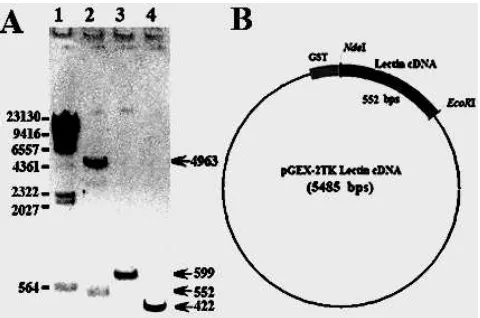
Fig 3. Schematic representation of the lectin gene synthesis by the RT-PCR and plack hybridization method and the construction of pGEX-2TK fusion vector. A) Agarose gel electrophoresis of DNA fragment of RT-PCR product and recombinant plasmid. Lane 1, DNA lambda/HindIII marker; lane 2, two fragments DNA containing pGEX-2TK vector (4963 bps) and insert of Lectin DNA minus 5’ untranslation region (552 bps) digested by NdeI/EcoRI restriction enzymes of recombinant plasmid in B; lane 3, largest cDNA insert (599 bps) from positive clone; and lane 4, RT-PCR product of lectin DNA as probe (422 bps). B) Restriction map of pGEX-2TK lectin cDNA plasmid.
to the CM were eluted using a gradient from 0.1 to 0.5 M Tris-HCl pH 7.3 at a flow rate of 1 mL/min and 60 fractions were collected. The fractions eluting between tubes number 24 to 28 demonstrated antibacterial activity (Fig. 2A). Next, the protein fraction from CM-cellulose cation-exchange column that demonstrated antibacterial activity, were applied to gel filtration chromatography on Sephadex-G100, resulting two peaks were collected. Peak 1 showed no antibacterial activity, but peak 2 indicated antibacterial activity (Fig. 2B). For preparing protein sequencing, peak 2 was further purified by FPLC on Mono S column using a shallower acetonitrile gradient, giving the single peak of pure protein Fig. 2C). Based on the SDS-PAGE (14%), the molecular weight of the purified lectin protein was estimated to be around 21 kDa (Fig. 2D), and it is consistent with that calculated by Bioedit 7.9 software, giving the molecular weight of 20,822 Da (result not shown).
Amino acid sequencing and gene cloning encoding lectin protein
Enzymatic digests of native lectin protein with endoproteinase C were separated by RP-HPLC and subjected to protein sequencing, resulting the partial
N-Fig 4.The cDNA and deduced amino acid sequence of lectin protein. Fragment DNA (422 bps) as probe synthesis by RT-PCR amplification of total sponge Gelliodes sp. cDNAs was inserted into pGEX-2TK vector to yield pGEX-2TK Lectin recombinant plasmid. The nucleotide sequence was analyzed by the dideoxy chain-termination method. The result of N-terminal amino acid sequencing obtained from protein sequencing is indicated in box and the two primers L1 and L2 oligonucleotide were obtained based partial amino acids sequencing is underlined.
Fig 5.Comparison of the aligned amino acid sequences of lectin of sponge Gelliodes sp. (Gell_lectin) with Crustacea Penaeus monodon (Pm_Lectin, Genebank DQ078266), Chordata Anguilla japonica (Aj_lectin, Genebank: AB060538), and mollusca Pteria penguin (Pp_lectin, Genebank: AB037167). The complete amino acid sequences of four proteins of marine organisms are shown. The positions of the amino acid sequence are indicated on the ends. Amino acid residues that are identical in two is marked with:and three is marked with
. and analogous amino acids in all these proteins are indicated by bold letter.
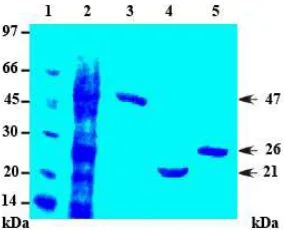
Fig 6. Electrophoresis SDS-PAGE (14%) analysis of the recombinant GST-lectin fusion protein and native lectin protein. Lane 1, Protein marker; Lane 2, Whole extract protein in E. coli cell containing pGEX-2TK lectin cDNA; Lane 3, GST-lectin fusion protein; Lane 4, native lectin protein and Lane 5, GST protein.
Fig 7. The diameters of inhibition zone resulting from the expression of the native lectin and recombinant of GST-lectin fusion protein (approximately 4 μg), negative control (GST, approximately 4 μg), and positive control (ampicilline, approximately 30 ppm) against different bacterial strain test.
weight of 20,822 Da (result not shown). The candidate for an initiation codon ATG was found at nucleotide position 21. The stop codon at position 552 was followed by a polyadenylation signal, AGAAAA, starting at position 569. Amino acid sequences of the isolated peptides derived from sponge lectin corresponded exactly to the protein sequence deduced from the cDNA sequence, clearly indicating that the isolated cDNA clone codes for lectin protein.
Based on Bioedit 7.9 software of the amino acids sequence revealed high homology with the Pm_lectin protein from crustacea (68%), but low homology with the Pp_lectin protein from mollusca (24%), and Aj_lectin protein from chordata (22%) (Fig. 5). This results clearly that the fragment DNA isolated from sponge Gelliodes sp.is a gene encoding lectin protein, and also this gene really could be amplified using the generated primer pairs from the partial amino acid sequence of native lectin protein. Therefore, future intensive research is
needed to trace the existence of this gene and their product, especially to determine another activity to strengthen the structural and functional analysis of lectin protein.
Expression and purification of the recombinant lectin protein inE. coli
could be purified to more than 95% homogeneity, using glutathione agarose beads (see lane 3 in Fig. 6).
Antibacterial activity of the recombinant GST-lectin fusion protein
The antibacterial activity of the recombinant GST-lectin fusion protein against different bacterial test was performed by agar diffusion assay. The recombinant lectin displayed antibacterial activity not only against S. typhy and S. aureus (Gram positive) but also against strains of E. coli and V. cholerae (Gram negative). The inhibitory effect of the recombinant lectin was observed towards S. typhy, S. aureus, V. cholerae and E. coli strains with the diameters of inhibition zone of 11 mm, 10 mm, 16 mm, and 18 mm respectively, indicating a good agreement with results of native lectin. The negative control of GST protein in the same concentration had no corresponding antibacterial activity on the entire bacterial strain test. The recombinant lectin had stronger antibacterial activity towardS. typhyandS. aureus, with the diameters of inhibition zones of 1.5 times more than that of the other Gram negative bacterial test using the same expression product. Regarding the two strains of Gram negative E. coli and V. cholerae,is resulted the diameters of inhibition zones which are almost the same as that using positive control of ampicilline (approximately 30 ppm) (Fig. 7).
Molecular structures of different lectins isolated from various crustaceans and chordata are quite different. Most purified lectins are multimeric proteins, containing a unique subunit ranging from 20 to 40 kDa [26]. We found Gelliodes lectin to be a monomer on SDS-PAGE gels conditions with molecular weight of 21 kDa, however, its ability to cause antibacterial suggests that it may be oligomeric although is might not covalent bond, disulphide-bonded forms are seen on gels. In addition, we concluded that Gelliodes lectin is not a glycoprotein on the-basis of the results of various experiments and sequence analysis. Analysis of a recombinant product of lectin protein in E. coli shows that its activity does not require glycosylation. Most lectins are glycoproteins, but the glycosyl in lectins may be not involved in carbohydrate recognition.
Individual animal species probably contain several lectins, including C-type lectins of different specificities, for detecting a variety of pathogens. Recognition of microorganisms by these lectins may trigger different immune responses. Although multiple lectins have been isolated from some marine invertebrates, such as tunicates [27], sponges [28], crustaceans [29], echinoderms [30], and fish egg [31], but no further study on its gene was published until now in sponges, especially from Indonesian terrestrial. Moreover, we had purified, cloned and identified an antibacterial lectin gene
from sponge Gelliodes sp. in Barang Lompo Island, South Sulawesi Province, Indonesian terrestrial and found that lectin protein contained antibacterial activity, especially toward S. typhy and S. aureus (G+). The biological function of lectin protein in spongeGelliodes sp. itself is not yet known, but this lectin plays some roles in the self-defense system of sponge Gelliodes sp. It should be noted that lectin protein from sponge Gelliodes sp. interacted with not only Gram-negative but also Gram-positive bacteria. Although these bioactivity of lectin may be appears to function as a pattern recognition protein specific for Gram-negative bacteria through its interaction with LPS, and also as an opsonin to increase the efficiency of hemocyte phagocytosis. Lectin protein combined with LPS causes’ rapid agglutination of Gram-negative bacteria, and lectin protein combined with phagocytes causes sensitization of the phagocytes to bacteria. These works might provide a significant foundation for the following research on the antibacterial action in molecular level of lectin protein from marine sponges and also it would be helpful to recognize lectin's role in the marine invertebrate innate immunity.
CONCLUSION
In this paper, a novel antibacterial lectin with molecular weight of 21 kDa from spongeGelliodes sp. was characterized, and its cDNA was cloned and expressed inE. colias recombinant protein. Our results indicate that lectin from sponge Gelliodes sp. acts primarily on gram-negative bacteria especially to S. typhyandS. aureus.
ACKNOWLEDGEMENT
The authors thank to the head of Biochemistry Laboratory and Pharmaceutical Microbiology Laboratory of Hasanuddin University Indonesia for sample preparation and antibacterial testing’s. Thank to M. Tanekhy for editorial reading of the manuscript. This research was supported by National Strategic Research Project of Hasanuddin University under the contract number of 07/H4.LK.26/SP3-UH/2009.
REFERENCES
2. Blunt, J.W., Copp, B.R., Hu, W.-P., Munro, M.H.G., and Northcote, P.T., 2007,Nat. Prod. Rep., 24, 31-86.
3. Van Damme, E.J.M., Lannoo N., Fouquaert E., and Peumans W.J., 2003, Glycoconjugate J., 20, 449-460.
4. Abdullaev, F.I., and de Mejía E.G., 1997, Nat. Toxins, 5, 157-163.
5. Ye, X.Y., Ng, T.B., Tsang, P.W.K., and Wang, J. 2001,J. Protein Chem., 20, 367-375.
6. Rubinstein, N., Ilarregui, J.M., Toscano, M.A., and Rabinovich, G.A., 2004,Tissue Antigens,64, 1–12. 7. Barrientos, L.G., and Gronenborn, A.M., 2005,
Mini-Rev. Med. Chem.,5, 21-31.
8. Pusztai, A., Grant, G., Spencer, R.J., Duguid, T.J., Brown, D.S., Ewen, S.W., Peumans, W.J., Van Damme, E.J. and Bardocz, S., 1993, J. Appl. Bacteriol., 75, 360-368.
9. Sharon, N., 1993, Trends Biochem. Sci., 18, 221-226.
10. Padma, P., Komath, S.S., and Swamy, M.J., 1998, Biochem. Mol. Biol. Int., 45, 911-922.
11. Naisbett, B., and Woodley, J., 1990, Biochem. Soc. Trans.,18, 879-880.
12. Lehr C-M., 2000,J. Controlled Release, 65, 19-29. 13. Bao, J.K., Zhou, H., Zeng, Z.K., and Yang, L., 1996,
Chin. J. Appl. Environ. Biol.,2, 214-219.
14. Baĭĭmiev, A.K.H., Gubaĭdullin, I.I., Baĭmiev A.K.H., and Chemeris A.V., 2007, Mol. Biol. (Mosc.), 41, 940-942.
15. Gabius, H.J., 1997,Eur. J. Biochem.,243, 543-576. 16. Kilpatrick, D.C., 2002,Biochim. Biophys. Acta,1572,
187-197.
17. Muramoto, K., and Kamiya, H., 1986, Biochim. Biophys. Acta,874, 285-295.
18. Giga, Y., Ikai, A., and Takahashi, K., 1987, J. Biol. Chem., 262, 6197-6203.
19. Inamori, K., Saito, T., Iwaki, D., Nagira, T., Iwanaga, S., Ari-saka, F., and Kawabata, S., 1999, J. Biol. Chem.,274, 22, 3272-3278.
20. Suzuki, T., Takai, T., Furukohri, K., and Kawamura Nakauchi, K.M., 1990, J. Biol. Chem., 265, 1274-1281.
21. .Lowry, O.H., Rosenbrough, N.J., Farrand, A.L., and Randall, R.L., 1951,J. Biol. Chem., 193, 265-275.
22. Ahmad, A., Takami, Y., and Nakayama, T., 1999, J. Biol. Chem.,274, 23, 16646-16653.
23. Sambrook, J., Fritsch, E.F., and Maniatis, T., 1989, Molecular cloning: a laboratory manual, 2nd ed., Cold Spring Harbor, New York: Cold Spring Harbor Laboratory Press.
24. Schroder, H.C., Ushijima, H., Krasko, A., Gamulin, V., Thakur, N.L., Diehl-Seifert, B., Mueller, I.M., and Mueller, W.E.G., 2003,J. Biol. Chem.,278, 35, 32810-32817.
25. Ely, R., Supriya, T., and Naik, C.G., 2004,J. Exp. Mar. Biol. Ecol., 21, 4, 1-7.
26. Marques, M.R.F., and Barracco, M.A., 2000, Aquaculture,191, 5, 23-44.
27. Nair, S.V., Pearce, S., Green, P.L., Mahajan, D., Newton, R.A., and Raftos, D.A., 2000, Comp. Biochem. Physiol. B: Biochem. Mol. Biol., 125, 279-289.
28. Miarons, P.B., and Fresno, M., 2000, J. Biol. Chem.,275, 28, 29283-29289.
29. Cominetti, M.R., Marques, M.R., Lorenzini, D.M., Lofgren, S.E., Daffre, S., and Barracco, M.A., 2002, Dev. Comp. Immunol.,26, 715-721.
30. Hatakeyama, T., Kohzaki, H., Nagatomo, H., and Yamasaki, N., 1994, J. Biochem. (Tokyo), 116, 209-214.