SWUP
Proximate analysis of Kasem (the fermentation of blended shrimp &
rice) local food of Grobogan Purwodadi Central Java, Indonesia
Listyonoa and Retno Sri Iswarib
aDepartment of Biology, UIN Walisongo, Jl. Prof. Hamka Ngalian, Semarang 50185, Indonesia bPostgraduate State University of Semarang, Jl. Bendan Ngisor Sampangan, Semarang 50232,
Indonesia
Email: a[email protected]; b[email protected]
Abstract
Kasem is locally processed foods from Grobogan, Purwodadi, Central Java, Indonesia, These foods consumed by the locals especially those with diabetes. Made of the fermentation mixture of shrimp and rice for 24 hours. The advantages of the fermentation process are eliminating or reducing anti-nutrients substances, increasing nutrients, improving digestibility, healthful, durable, increasing antioxidant activity, having a higher value, stimulating the immune system cells and preventing from diabetic conditions. The purpose of this study is to determine the results of the test of Kasem proximate and what substances were changed after the fermentation with the aid of bacteria Proteus mirabilis, Pseudomonas aeruginosa, Klebsiella azaenae on shrimp. The protein proximate test by using Kjeldahl-Micro method, the carbohydrates and sugar test by using Luff Schoorl method, the fat test by using Soxlet extraction method, the water content test by using by oven method, the ash and fiber test by using grafimetri method. The fermentation treatment test: K1 consists of 50gr of shrimp mixed with 125 gr of white rice, K2 consists of 75gr of shrimp mixed with 125 gr of white rice and K3 consists of 100gr of shrimp mixed with 125 grams of rice and K as a control (rice only). Each treatment was treated with six repetitions (ferderer: (n-1) (k-1) ≥ 15). The error level of simple variant analysis is 1%, a further test then using Scheffe test to determine the significance difference between treatments. The protein content shows significant differences between K, K1, K2 and K3 and level increasing occurred (K = 1.84gr, K1= 18.3 g, K2 = 19.3gr, K3 = 20.9gr). The carbohydrate levels shows significant differences between K, K1, K2, and K3 and reduction occurred (K = 31.69gr, K1 = 22.64gr, K2 = 22.70gr, K3 = 24.70gr). Sugar levels shows significant differences between K, K1, K2, K3, reduction occurred (K = 4.1gr, K1 = 2.85gr, K2 = 2.69gr, K3 = 2.71gr). Fat content shows no significant difference between K, K1, K2, and K3 and level-increasing occurred (K = 0.03gr, K1 = 0.7gr, K2 = 0.81gr, K3 = 1.03gr). Fiber content shows no significant difference between K1 and K with a decline (K = 1.62gr, K1 = 0.72gr, K2 = 0.89gr, K3 = 1.10gr). The data above indicates the decline in carbohydrates, sugars and fiber from processed Kasem meanwhile for protein and fat shows an increase.
Keywords kasem, local food, proximate analysis
1.
Introduction
banana leaves and steamed). Traditional fermentation is one of the most economical and oldest methods of producing and preserving food (Chavan & Kadam, 1989).
Some advantages gained from the process of making the product through fermentation process is to eliminate or reduce anti-nutrients substances, improve the nutritional content, increase digestibility, raise the level of health, more healthful, also raising the storage time, long-lasting, durable, and has a higher selling value.
Fermented food products from Asia and Oceania have been categorized into five: fermentation product groups cereals, fermented fish and fermented meat products, fermented vegetable products, fermented soy products, and alcoholic beverages (Soni et al., 2014). Fermented shrimp extract produces natural antioxidants as a substitution of synthetic additives such as butylate-dhydroxyanisole (BHA), butylatedhydroxytoluene (BHT), and tert-Butylhydroquinone (TBHQ) besides squid and algae, which are useful in inhibiting diseases, such as heart disease, diabetes mellitus, and neurological disorders. (Huang et al., 2011). Fermentation with fishery materials and rice can improve starter cultures in case of the accumulation of GABA, and can be used as starter cultures to produce GABA (c-Aminobutyric Acid). c-Aminobutyric acid used as a neurotransmitter, physiological functions such as tranquilizers, diuretics, and hypotensive activities, effective regulation of depression, insomnia, and autonomic disorders, amelioration of chronic alcoholrelated symptom, stimulation of the immune system cells and prevention of diabetic conditions (Thwe et al., 2011)
The fermentation of shrimp heads with the aid of Bacillus icheniformis OPL-007 produces total substances of phenols, polysaccharides, reducing sugars, free amino acids and organic acids. Besides those, inside the liquid of the fermentation founded eight essential amino acids and non-protein amino acids.The liquid fermentation showed a strong antioxidant capacity. Bio-deproteinization of SHW by Bacillus icheniformis OPL-007 can increase the antioxidant activity, and SHW has potential application in the production of functional food. (Mao et al., 2013). BalaoBalao is a fermented cooked rice and shrimp (Penaeusindicus or Macrobrachium species). The acidic mixture becomes during fermentation, and the shrimp shell reddens and softens. It is commonly prepared for the table in sauteed form and is eaten either as an appetizer or main dish (Web1).
2.
Materials and methods
2.1 Sample
SWUP
2.2. Analysis of the experiment
The protein proximate test by using Kjeldahl-Micro method, the carbohydrates
and sugar test by using Luff Schoorl method, the fat test by using Soxlet extraction
method, the water content test by using by oven method, the ash and fiber test by
using grafimetric method.
3.
Results and discussion
Result of proximate analysis for each treatment can be seen on Tables 1 and 2.
Table 1. Data of rice proximate (K).
Treatment Substances
Protein Fat Carbohydrate Sugar Fiber Ash
K 1.84 0.03 31.69 4.10 1.62 1.42
Table 2. Data of proximate test result for Kasem fermentation.
Treatment Substances
Protein Fat Carbohydrate Sugar Fiber Ash
K1 18.31 0.70 22.64 2.85 0.72 2.75
K2 19.29 0.81 22.70 2.69 0.89 2.52
K3 20.90 1.03 24.70 2.71 1.10 2.28
The above data was analyzed by Variant Analysis with standard error 1%, a
further test done with
Scheffe test to determine the significance and significant
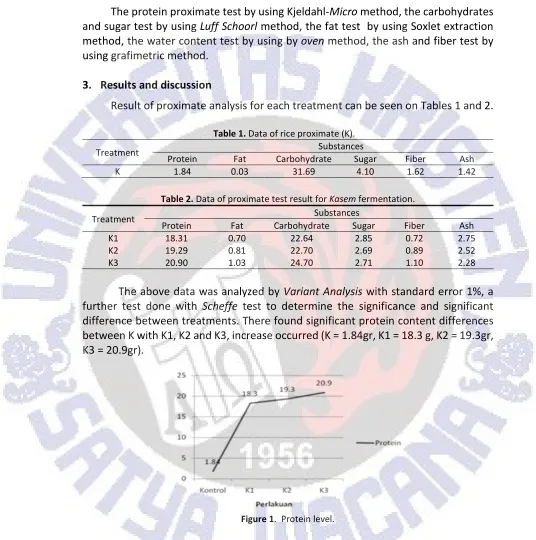
difference between treatments. There found significant protein content differences
between K with K1, K2 and K3, increase occurred (K = 1.84gr, K1 = 18.3 g, K2 = 19.3gr,
K3 = 20.9gr).
Figure 1. Protein level.
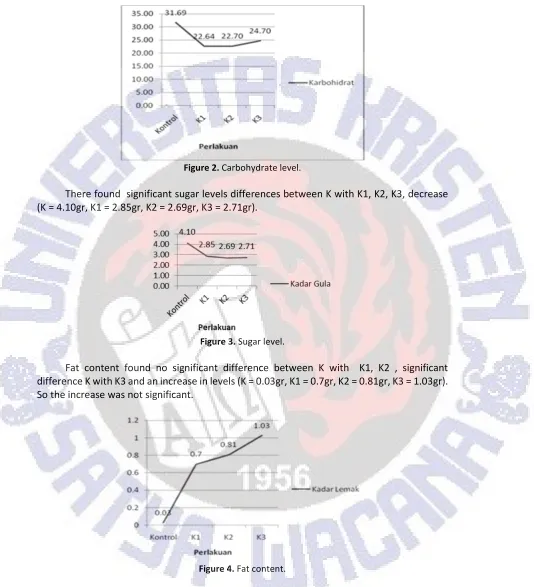
Figure 2. Carbohydrate level.
There found significant sugar levels differences between K with K1, K2, K3, decrease (K = 4.10gr, K1 = 2.85gr, K2 = 2.69gr, K3 = 2.71gr).
Figure 3. Sugar level.
Fat content found no significant difference between K with K1, K2 , significant difference K with K3 and an increase in levels (K = 0.03gr, K1 = 0.7gr, K2 = 0.81gr, K3 = 1.03gr). So the increase was not significant.
Figure 4. Fat content.
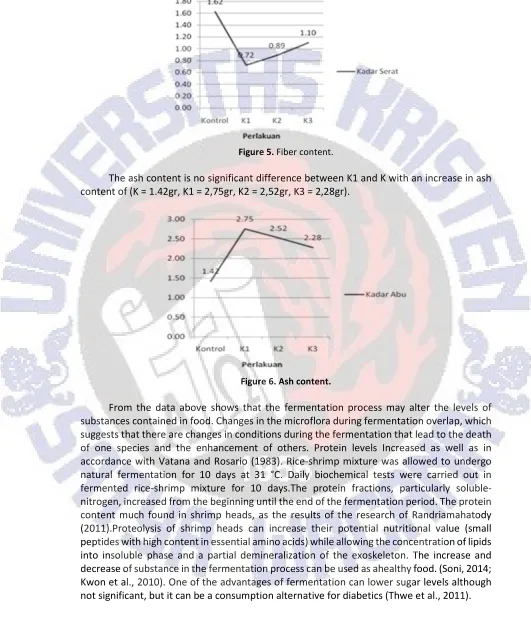
SWUP Figure 5. Fiber content.
The ash content is no significant difference between K1 and K with an increase in ash content of (K = 1.42gr, K1 = 2,75gr, K2 = 2,52gr, K3 = 2,28gr).
Figure 6. Ash content.
4.
Conclusions and remarks
In this study can be concluded that the making of Kasem (The Fermentation of Blended Shrimp & Rice) may change the content of substances in rice. The different levels of mixture concentration can affect the substances. Substances which its content increased is protein, fat, and there are significant differences between treatments. Carbohydrate, sugar, and fiber level are decreased, this may be an alternative food for carbohydrates and sugar diet.
References
Chavan, J.K., & Kadam, S.S. (1989). Critical reviews in food science and nutrition. Food Science, 28(5). Huang, G.R., Zhao, J., & Jiang, J.-X. (2011). Effect of defatting and enzyme type on antioxidative activity
of shrimp processing by products hydrolysate. Food Sci. Biotechnol., 20(3), 651–657.
Mao, L., He, X., Kan, & Yu (2013). Antioxidant properties of bio-active substances from shrimp head
fermented by Bacillus licheniformis OPL-007. Springer Science+Business Media New York 2013.
Randriamahatody, Z., Sylla, K.S.B., Nguyen, H.T.M., Donnay-Moreno, C., Razanamparany, L., Bourgougnon, N., & Bergé, J.P. (2011). Proteolysis of shrimp by-products (Peaneusmonodon) from Madagascar. CyTA - Journal of Food November 2011, 9(3), 220–228.
Soni, S., & Dey, G. (2014). Perspectives on global fermented foods. British Food Journal, 116(11), 1767– 1787.
Thwe, S.M., Kobayashi, T., Luan, T., Shirai, T., Onodera, M., Hamada-Sato, N., & Imada, C. (2011). Isolation, characterization, and utilization of c-aminobutyric acid (GABA)-producing lactic acid bacteria from Myanmar fishery products fermented with boiled rice. Food Science and Technology, 77(2), 279–288.
Vatana, P., & Del Rosario, R.R. (1983). Biochemical changes in fermented rice-shrimp (Macrobrachiumidella) mixture: Changes in protein fractions. Food Chemistry, 12(1), 33–43. Web1. www.ncbi.nlm.nih.gov/books/NBK23-468/Applications of Biotechnology to Fermented Foods: