Fast-fashion Social Campaign Advertisement in YouTube:
Does Brand Storrytelling Impacted Behavior Intention to
Use? (Study case in Surabaya, Indonesia)
Ritzky Karina Brahmana
1& Raphael Vivaldo
2121-131, Jalan Siwalankerto 60236, Petra Christian University Surabaya, [email protected] 1 121-131, Jalan Siwalankerto 60236, Petra Christian University Surabaya, [email protected]2
Abstract: One of the common tools that usually to be used is advertising. Today, there are many advertisements in YouTube. Especially for fast-fashion company which needed them to make it easier communicated with their target market. Many fashion lover are really fond with YouTube. But there are later issues about fast-fashion. It’s about waste of the products, children’s employee, fabrics that is not environmental friendly, etc. There are many people gained awareness about these social issues. Many companies also concerned about them and tried to convinced people by social campaign in YouTube. This research analyzed how people will have a behavior intention to use the brand through brand storytelling in their social campaign advertisement by YouTube. The respondents would be 100 people in Surabaya city, Indonesia. The results is brand storytelling is important to make people perceived more about advertisement value and enjoyment to impact the behavior intention to use.
Key Words: Brand Storytelling, Technology Acceptance Model, Perceived Enjoyment, Perceived Advertisement Value, Behavior Intention to Use, Social Campaign Advertisement in YouTube.
1. Introduction
Olivia is a social media active user. She is a fashion blogger and also one of influencer in fashion field. She also concerned about social issues whereas she involved in many causes. One of the causes that she followed is children happiness. She won’t use any product/brand who use children as their employee and being so active in social media to share her opinion about it. She has about hundred thousands subscribers. Her favorite portal is YouTube. She also uploaded many videos about her daily activities and done a Vlog (Video Blog) in it. Mostly, she saw about Fashion matters in YouTube because she loves it. Those videos that she watched in YouTube would be her references for her Vlog and her daily lifestyle.
YouTube also known one of social media that will give you information from people, to people, and by people that bring some information that will be benefiting anyone who saw it (Mangold & Faulds, 2009). Based on Defy Media survey (cited in Variety, 2016) in 2016, mostly people used YouTube and find many videos as their entertainment from it besides channel televisions. Statistically based on that survey, the youngster until young adults (13 – 24 years old) will spent their time approximately at least 12,1 hours per week. For the youngster they could spend 2,5 times to see video online rather watched channel televisions (Variety, 2016). Based on research, in January 2017, YouTube is the most accessed Social Media in Internet to find any information and watched the videos portal in Indonesia (Hootsuite, 2017, cited from Setara.net). This research supported by Chip Indonesia (2016) research that found 8 from 10 people would be spent around 30-60 minutes per day to watch and interact by YouTube. Statistically, this year, Indonesia ranked 17th in the world as the people who searched about fashion matters in YouTube (googletrends, 2017). The fashion bloggers that originally from Indonesia also showed thousands subscribers for each of them. The fashion bloggers from Indonesia is about more less thousands people. The famous fashion bloggers such as Elle Jess (22,252 subscribers), Sonia Eryka (9,286 subscribers), Anastasia Siantar (8,214 subscribers) showed how Indonesian people really want to know about the latest fashion (YouTube, 2017). They also are the endorsers for many fast-fashions’ companies.
Those facts turned many companies saw the opportunities to put their advertisement in YouTube rather than in channel televisions. Advertising is one of the effective tools in marketing to grasp people attention and communicate the brand and statistically almost 70% people love to see the videos rather than non-video advertisement (Hubspot, 2016, cited from bikinvideomarketing.com). Regarding Google Survey in 16 Countries based on 6299 advertisements, people love the advertisement that had interesting storytelling (thriller, funny and emotional plots) about the brand. Sometimes the advertisement, which had a strong animation, also being loved (Google, 2015). In 2016, the Head of Marketing Google in Indonesia said in Indonesia itself, majority people loved video advertisement that had a good brand storytelling (cited from tekno.kompas.com, 2017). The examples would be Line advertisement (Hari Pertama Kerja Itu Rasanya), Toyota All New Sienta (Love is A Trap), Tokopedia (Berani Memulai, Berani Berusaha), and many more (Swa.co.id, 2017), Those advertisements showed how people loves many advertisements which had a good brand storytelling and performed their opinion and intention to the brand.
Brand story needed if the company already settled and had a good brand image. The Brand story needed to tell (Brand Storytelling) what they want to communicate to the customer and being one of investation in branding for the company itself. The Brand storytelling also needed to do properly and precisely to the exact segmentation. Basically, in today era where everything is becoming digitalized, social media becomes the option as the facilitation to mediate and communicate the brand as the promotion place. Advertisement is one of promotion tools that have been used in many social medias. One of social media form or platform is YouTube. This social media form (YouTube) where now mostly called as social network is being one of media places for many companies to put their advertisement. As YouTube is one of technology that have been used mostly for social media video based, so it will be suitable if to find out did people really acceptance the technology based on brand storytelling and changed the behavior how they use it. This research will examine the relatedness of brand storytelling to behavior intention by technology acceptance models about social campaign advertisement (YouTube) in the fast-fashion industries.
2. Related Literature 2.1 Brand Storytelling
An effective and attractive advertisement needed the exact strategy to communicate the brand/product. The activities of advertisement and how its tells the story needed to be prepared precisely to reach and grasp the exact market. All of the social campaign will be effective, if the brand could be formed into the story telling about their vision and mission by its advertisement. It means the advertisement activity should be done by social media and brought social issues that will show the brand causes by its story or mostly people mentioned it as brand story (Cronin, 2016). When Brand is telling the story about it and touched the emotional sides of the customer it will form the benefit from affected the psychology of the customer (Holt,2004; cited from Woodside, 2010). A story line is an important element in the process molded the customers’ senses (Ardley, 2006, p.197). The story that communicated to the customer is very crucial process to relate the customer with the brand itself. A strong story-line and impressed people would connect and engage the customer while communicating the brand image (Fog et. Al., 2010). Especially a story that could relate with personal feeling will bring meaningful goal for someone (Escalas, 1998, p.273). According to Schank (1999) human’s memories always story-based in their mind. A story could develop awareness, emphaty, recognition, recall, and giving purpose to the brand (Singh & Sonnenburg, 2012; cited from Pera & Viglia, 2016). A communication while telling the story in a video proved more effective, faster and more useful (Nottingham, 2012; cited in Wendt et. Al., 2016). The previous research about brand storytelling showed customer invited the brand identity by brand story telling (Escalas, 2004; cited in Holt & Thompson, 2004). Brand storytelling identically how the customers defined themselves as an individu by the message that tell by its brand (Fog et al, 2010).
2.2 Technology Acceptance Model
and perceived ease of use to explain the behavior while using the computer. These components related with trust component in TRA.
In this research, it will adopted two more theories about perceived in behavior which are perceived enjoyment and perceived advertisement value.
2.2.1 Perceived Ease of Use
Perceived ease of use defined as how people believe that they could use any technology system easily without any effort (Davis, 1986). The previous research showed perceived ease of use influenced perceived usefulness, attitude, and behavior intention (Bugembe, 2010). Brahmana & Brahmana (2011) also found association between TTF (Task Technology Fit) which has been examined extensively in technology area in TAM context. In TAM context, perceived ease of use is an important determinant as its influence comes in the early stage of technology user’s experience (Davis, 1989; cited in Brahmana & Brahmana, 2011)
2.2.2 Perceived Usefulness
Perceived usefulness defined how far the technology would increase their performance by using it. The previous research shows that the perceived usefulness have a positive and significant influence of the use of information systems (Davis, 1989; Chau, 1996 in Igbaria et al, 1997). (Davis, 1989; Chau, 1996 in Igbaria et al, 1997). Another previous studies also showed that perceived usefulness have significant impact that affects attitude, behvior intention, and intention to use a technology compared other constructs (Gardner dan Amaroso, 2004).
Other literature has found that usefulness refers to consumers’ perception that using the Internet as a shopping medium enhances the outcome of their shopping experience (Brahmana & Brahmana, 2011). Papatla (2011) as cited in Brahmana & Brahmana (2011) also found the role of experience on the usefulness of the online shop and relationship between TTF and Perceived ease of use.
2.2.3 Perceived Enjoyment
Perceived enjoyment positively affected towards user’s technology acceptance (Teo et. al., 1999; Venkatesh, 2000; van der Heijden, 2004; Lin&Lu, 2011). Perceived enjoyment as the intrinsically motivator also has an influence towards perceived usefulness and perceived ease of use. It also has a strong impact towards behavior intention in technology context (Venkatesh, 2000; Li&Lu, 2011; Hwan&Yi, 2002 cited in Brahmana&Brahmana, 2013). Another studies showed if the perceived enjoyment is high, so the perceived ease of use and perceived usefulness is being high too (Pinho and Soares, 2011; Teo et al, 1999; Teo and Noyes, 2011; van der Heijden, 2004). Perceived enjoyment refers to an extrinsic motivation in which extent of using technology is perceived be personally enjoyable (Davis et al, 1992; Webster & Martochhio, 1992 cited in Brahmana & Brahmana, 2013)
2.2.4 Perceived Advertisement Value
According to Zeng et. al. (2009) the value of advertisement will provide the whole picture of it to the customer (Ducoffe, 1995; Zeng et. al., 2009 cited in Soares & Pinho, 2013) is the measurement of advertisement effectiveness either it traditionally or technology based (Ducoffe, 1995 cited in Soares & Pinho, 2013). The research on online advertising also showed that the advertisement offered values to Internet users into more relevant information (Ducoffe, 1996; cited in Zeng et al, 2009). Thus, the advertiser could choose their segmentation efficiently and targeting the market precisely that would be suitable with their product/brand.
2.3 Behavior Intention to Use
users (e.g. the intention), which includes various searching activities and pay attention for matching and purchasing the product (Rodgers & Thorson, 2000 cited from Zeng et. al., 2009). The more relevant of advertisement messages in the context of media, the more likely the message can affect attitude customer positively and influenced their behaviour response towards to the advertisement.
2.4. Social Campaign
When you already had a good image of your brand, so the social campaign usually will become a good tools to do to gain more awareness and introduce the brand identity deeply to the customer. It is also known as one of long-term investment tools for the brand itself. Especially in the fast-fashion industry, engagement could be developed by their social campaign. Social campaign literally means the changing behaviour related from unhealthy habits becomes healthy habits (Sampogna et. al., 2017). It is about how we are going to showed the bad habit reduced and changed it into good habit that will be benefitted the society and environment and achieved sustainability in living. It is about how to gain awareness regarding the social topic under consideration. In advertising, the brand will focus upon the emotional component of attitudes and aim raising public awareness about social issues under consideration and influence beliefs, and eventually, behaviour (Harris, 2009, p.111 cited from Petrovici & Dobrescu, 2013). Social campaign also known as responsible behaviour that may be justified by the fact that emotions reactions to aspect which seems extremely important for well being that triggering mental processes from the communication form of the brand (Ekman, 2003, p.48; cited from Petrovici & Dobrescu, 2013).
3. Empirical Model and Framework
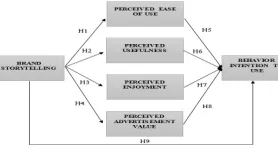
This research aims to investigate the role of Brand Storytelling in how people perceived it in technology platform and how it will shape their behavior intention for any brand in fast-fashion based on social campaign advertisement. The model showed in Figure 1.
Figure 1. Conceptual Model
H1: Thebrand storytelling influenced the perceived ease of use.
H2: The brand storytelling influenced the perceived usefulness.
H3: The brand storytelling influenced the perceived enjoyment.
H4: The brand storytelling influenced the perceived advertisement value.
H5: The impact of brand storytelling on behavior intention to use is mediated by the perceived extent of perceived ease of use.
H6: The impact of brand storytelling on behavior intention to use is mediated by the perceived extent of perceived usefulness.
H7: The impact of brand storytelling on behavior intention to use is mediated by the perceived extent of perceived enjoyment.
H8: The impact of brand storytelling on behavior intention to use is mediated by the perceived extent of perceived advertisement value.
H9: The brand storytelling influenced the behaviour intention to use.
IV. Data
spread by send the links of Google Forms to the messengers such as LINE, Watsapps, and e-mail. The respondents are 100 people. A questionnaire using a five-point Likert scale was used to gather data for each construct of the research model. All instruments were adapted and adopted from previous literatures and were modified to measure brand storytelling, TAM, and BiTU. The profile of the respondents can be seen in Table 1 at below.
Table 1. Respondents’ profile
Occupation Percentage Income per month Percentage Domicile Region Percentage Gender Percentage
Students 45% < Rp. 2.500.000,00 54% East Surabaya 29% Female 49% perceived usefulness and perceived enjoyment were adopted from Brahmana & Brahmana (2011). The perceived advertisement was adapted from Zeng et. al. (2009) which we also modified for some items. The behaviour intention to use was adopted from Davis (1989). The measures of the items was tested from their reliability, construct validity, and discriminant validity.
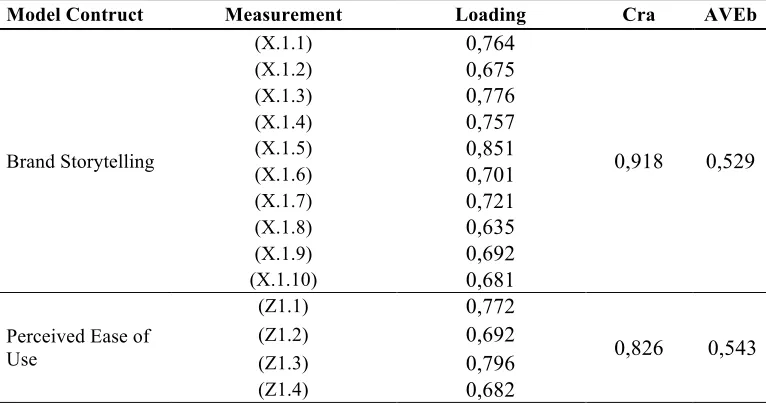
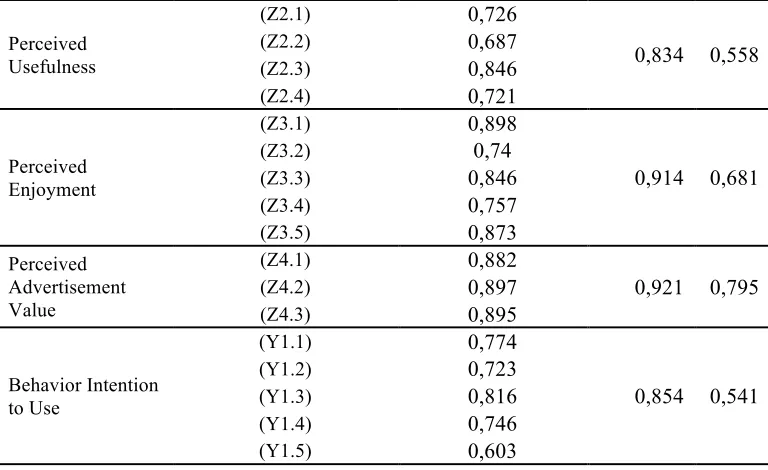
V. Results criterion of composite reability. The lowest value will be perceived ease of use which is 0.826.
Model Contruct Measurement Loading Cra AVEb
Perceived
Notes : BS = Brandstorytelling; PeoU = Perceived Ease of Use; PU = Perceived Usefulness; Penj = Perceived Enjoyment; PAV = Perceived Advertisement Value; BitU = Behavior Intention to Use.
5.2 Discriminant Validity
Table 3 (below) showed that the correlation for each construct lesser than the average variance which extracted by the indicators. The indicators means its measured the construct that indicate adequate discriminant validity. As a whole, the measurement model demonstrated adequate convergent validity and discriminant validity.
Table 4 (below) showed the numbers of Cronbach Alpha as the measurement of the reliability of your indicators in variables. The value of Cronbach Alpha shouldn’t under 0.6. In this research, it showed the value is over 0.6 that the lowest value is 0.732. It means the variables are reliable.
Construct Measurement items Cronbach's α rho_A
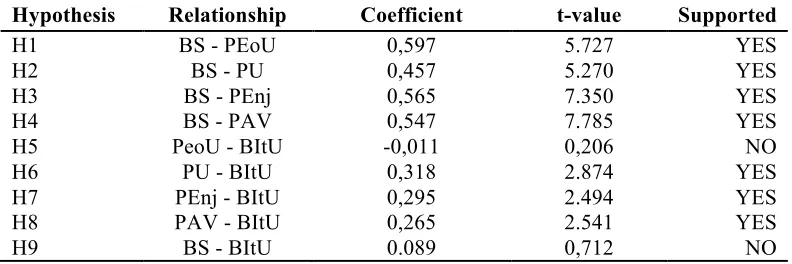
relation. There are two relations that not met the requirements which were Perceived Ease of Use – Behavior Intention to Use (0.206) and Brand Storytelling – Behavior Intention to Use (0.712).
Hypothesis Relationship Coefficient t-value Supported
H1 BS - PEoU 0,597 5.727 YES
H2 BS - PU 0,457 5.270 YES
H3 BS - PEnj 0,565 7.350 YES
H4 BS - PAV 0,547 7.785 YES
H5 PeoU - BItU -0,011 0,206 NO
H6 PU - BItU 0,318 2.874 YES
H7 PEnj - BItU 0,295 2.494 YES
H8 PAV - BItU 0,265 2.541 YES
H9 BS - BItU 0.089 0,712 NO
Table 5 Path Coefficient and Hypothesis Testing
VI. Discussions & Conclusions
Based on the results that this research had it showed that social campaign in fast-fashion industry could be one of tools to gain some experience and would attract the customer to do it while they used YouTube in their daily life. It showed the usefulness and advertisement value will impact how the customer will react to their behaviour intention and basically the brand story telling will influence them to do more about social campaign.
The most interesting thing was the respondents, either it will be male or female, they are really aware about the story what the brand offers in the advertisement. It also could lead that somehow if we are going to talk about social issue although it will provide emotional approach, the gender will not has any differences how they will feel to do a good cause. And it is also especially surprising in Surabaya, they already has a good awareness in fast-fashion about social campaign. Probably the story that the brand offered also had a big role on it so they could feel the enjoyment and bring them to have a consideration about how they will has behaviour intention about it. Interestingly, the easiness of use has been so low and somehow not influenced the behaviour intention, probably it caused by many people already not think about easiness at all since they already make a habit to use YouTube in their daily life. And we also found that the brand storytelling couldn’t impact the behaviour intention strongly if there is no enjoyment, values or usefulness by the audiences.
For the future research, it would be better if you can find out about mood or self-congruity will increase the behaviour intention to use until their actual to use.
VII. References
Amoroso, D. L. & Gardner, C. (2004). Development of an Instrument to Measure the Acceptance of Internet Technology by Consumers. Proceedings of the Hawaii International Conference on System Sciences
Ardley, B. (2006). Telling stories about strategies: a narratological approach to marketing planning. The Marketing Review, 6 (3), p. 197
Bugembe, J, (2010). Perceived Usefulness, Perceived Ease of Use, Attitude, and Actual Usage of a New Financial Management System: A Case Study of Uganda National Examinations Board. Dissertation of Markere University Business School, pp. 9-28.
Brahmana, R. K. & Brahmana, R. (2011). Attitudinal Explanation On Virtual Shopping Intention. International Conference on Information Systems For Business Competitiveness, Vo l, pp. 1-5
Brahmana, R. K. & Brahmana, R. (2013). What Factors Drive Job Seekers Attitude in Using E Recruitment?. The South East Asian Journal of Management. Vol 7 (2), pp. 1-12.
Davis, F.D. (1986), “A Technology Acceptance Model for Empirically Testing New End-User Information Systems: Theory and Results”, doctoral dissertation, MIT Sloan School of Management, Cambridge, MA
Escalas, J. E. (1998). “Advertising narratives: What are hey and how do they work?” in B. Stern (ed.). Representing consumers: Voices, views, and visions (pp. 267-289). New York: Routledge & Kegan Paul.
Fishbein, M. & Ajzen, I. (1975), Belief, Attitude, Intention and Behavior: An Introduction to Theory and Research, Addison-Wesley, Reading, MA
Fog, K., Budtz, C., Munch, P., & Blanchette, S. (2010). Storytelling: Branding in Practice, 2nd Ed. Berlin: Springer
Holt, D. B. & Thompson, C. J. (2004). Man-of-Action Heroes: The Pursuit of Heroic Masculinity in Everyday Consumption. Journal of Consumer Research, Vol 31, pp. 425-440.
Igbaria, M., Zinatelli, N., Cragg, P., & Cavaye, A.L.M. (1997). Personal Computing Acceptance Factors in Small Firms: A Structural Equation Model. MIS Quaterly, Vol.21 (3), pp. 279-305. Lin, K. and Lu, H. (2011), "Why people use social networking sites: An empirical study integrating
network externalities and motivation theory", Computer in Human Behavior, vol. 27, pp. 1152-1161
Mangold, W.G. & Faulds, D. J. (2009). Social Media: The New Hybrid Element of the Promotion Mix. Business Horizons, 52(1), pp. 357-365.
Pera, R. & Viglia, G. (2016). Exploring How Video Digital Storytelling Builds Relationship Experiences: Video Storytelling Builds Relationship. Psychology and Marketing. Vol 33 (12), pp. 1142-1150
Petrovicia, A. & Dobrescu, T. (2013). New Trends in Responsible Romania: Social Campaigns. Social and Behavioral Sciences, Vol 92, pp. 697 – 701
Pinho, J. C. M. R. & Soares. A. M. (2011). Examining the technology acceptance model in the adoption of social networks. Journal of Research in Interactive Marketing Vol. 5 (2-3), pp. 116-129.
Sampogna, G., Bakolis, I., Evans-Lacko, S., Robinson, E., Thornicroft, G., & Henderson, C. (2017). The impact of social marketing campaigns on reducing mental health stigma: Results from the 2009–2014 Time to Change programme. European Psychiatry, Vol 40, pp. 116–122
Schank, R. C. (1999) Dynamic Memory Revisited. Cambridge, UK: Cambridge University Press. Soares, A., Pinho, J.C. and Nobre, H. (2012). From social to marketing interactions: the role
social networks, Journal of Transnational Management, Vol. 17 (1), pp. 45-62.
Teo, T. S. H., Lim, V. K. G., & Lai, R. Y. C. (1999). Intrinsic and extrinsic motivation in Internet usage. Omega, Vol 27 (1), pp. 25-37
Teo, T., & Noyes, J. (2011). An assessment of the influence of perceived enjoyment and attitude on the intention to use technology among preservice teachers: A structural equation modeling approach, Computers and Education, Vol 57, pp. 1645-1653.
Van der Heijden, H. (2004). User Acceptance of Hedonic Information Systems. MIS Quarterly Vol. 28. (4), pp. 695-704
Venktatesh, V. & Davis, F.D. (2000), “A theoretical extension of the technology acceptance model: four longitudinal field studies”, Management Science, Vol. 46 (2), pp. 186-204. Woodside, A. G. (2010). Brand–Consumer Storytelling Theory and Research: Introduction to a
Psychology & Marketing Special Issue .Journal of Psychology & Marketing, Vol. 27(6), pp. 531–540
Wendt, L. M., Griesbaum, J. & Kölle, R. (2016). Product Advertising and Viral Stealth Marketing in Online Videos: A description and comparison of comments on YouTube. Aslib Journal of Information Management, Vol. 68 (3), pp. 1-19