(MATERIALS)
BAHAN
A. Organik: dari Mamalia, Burung, Ikan,
Serangga dan Reptil
pelapis kayu bermotif belat/ eplat kayu kayu keras kayu lunak resin untuk varnis kayu merambat bambu goni rami rotan (serat) sisal rami halus linen
minyak biji rami kapas/ katun kertas bubur kertas getah perca tempurung (kelapa) resin fosil karet (perekat) kanji emas perak tembaga besi (iron) aluminium timbal timah seng perunggu kuningan timah+timbal timah+tembaga+antimony tembaga+timah/ emas tiruan lempengan emas lempengan perak lempengan tiruan (?) nikel (nickel) kaca porselain terakota keramik plaster semen biru batu pualam putih batu granit batu marmer batu mutiara kerang laut permata tulen batu pasir cinnabar
bahan komposisi (dekorasi bingkai) pigments mica talek/ gip cat varnis lak papan hardboard formica celluloid (plastik) bakelit polyester vinyl epoksi nilon
gading beruang laut gading gajah tulang ikan paus
tempurung/ kulit kura-kura kulit kasar/ bersisik (dari ikan pari, hiu, anjing laut)
kulit ular
(resin) laka/ shellac gelatin
ancur 1/ fish glue ancur 2/ animal glue tempera/ kuning telur kasein (pospoprotein) lilin/ malam
perkamen/ kertas kulit kulit mentah
kulit berpenyamak sebagian kulit berpenyamak kulit berbulu rambut
rambut kaku/ kasar bulu ayam
bulu burung halus (liur ulat) sutera wool
lakan (wool, rambut) tulang
angga/ tanduk bercabang tanduk
gading/ taring ikan paus
B. Organik: dari Pohon, Perdu, Tumbuhan,
Rumputan
C. Anorganik: Logam dan Campurannya
D. Anorganik: Buatan dan Yang Terjadi Secara
Alami
E. Bahan Buatan Lain
A. Organic: from Mamals, Birds, Fish,
Insects and Reptils
parchment raw hide semi-tanned leather tanned leather pelts/ fur hair bristle quill feathers/ down silk wool
felt (wool, fur, hair) bone* antler* horn whale ivory walrus ivory* elephant ivory* baleen* tortoise shell shagreen (ray, seal,
shark skin) snake skin shellac gelatin
fish glue (isinglass) animal glue egg tempera casein waxes
B. Organic: from Trees, Shrubs, Plants,
Grasses
decorative wood veneers oak/ ash splints hard woods soft woods resin for varnish willow bambo jute (burlap) hemp rattan sisal flax linen linsed oil cotton paper papier-mache guttapercha
vegetable ivory (palm nut) amber
rubber
starch adhesive
C. Inorganic: Metals and Their Alloys
gold silver cooper iron aluminum lead tin zinc bronze brass pewter Britannia metal ormolu gold leaf silver leaf immitation leaf nickel
D. Inorganic: Man-made and Naturally
Occuring
glass porcelain unfired clay ceramics plaster portland cement alabaster granite marble mother-of-pearl marine shell gem stone sand stonecinnabar (red mercuric sulphide) composition (frame decoration) pigments mica soap stone
E. Other Man-made Materials
paints varnishes lacquer Masonite Formica celluloid Bakelite polyester vinyl epoxies nylon * These materials also have an inorganic component; besides the organic protein
collagen, the inorganic calcium phosphate (hydroxy apatite) is present. Ref.: Bachmann, K., Edit. (1992:131-133)
Tabel 2.
Bahan Sensitif Terhadap Kelembaban Tinggi
(Materials Sensitive to High Relative Humidity)
Bahan
(Materials)
40% RH, or lower 45 - 55% RH 45 - 55% RH 50 - 55% RH, constant/ stable 50 - 55% RH, constant 40% RH, or lower 50 - 55% RH, constant 50 - 55% RH, constant 50 - 55% RH, constant 45 - 55% RH, constant 60 - 65% RH, constant 50 - 55% RH, constantKondisi yang direkomendasi
(Recommended Condition)
Akibatnya
(Result)
logam (metal) kertas (paper) tekstil (textile) kayu (wood)kayu bercat (painted wood)
logam bercat (painted metal)
tatakan, pelapis kayu (inlay, veneer)
bahan penyempurna (finishes)
perkamen, gading (parchment, ivory)
bubur kertas (papier-mache)
bahan keranjang/ anyaman
(basket materials)
kolase kertas (decoupage surface)
korosi/ karat (corrosion)
jamuran, noda (mold, stains)
jamuran, noda (mold, stains)
jamuran, bengkok (fungal attack, warping)
cat mengelupas (flaking paint)
korosi, cat mengelupas
(corrosion, flaking paint)
lepas/ copot bagian-bagiannya
(detachment)
jamuran/ noda (mold, stains)
melengkung/ gelombang, jamur
(warping, mold)
jamuran/ noda (mold, stains)
jamuran (mold)
lepas/ copot, jamuran
(detachment, mold)
Tabel 3.
Bahan Sensitif Terhadap Kelembaban Rendah
(Materials Sensitive to Low Relative Humidity)
mengkerut (checks/ dries out)
pelapukan, lapuh, kering (embrittlement)
mengkerut, rapuh (shrinkage, embrittlement)
rapuh (embrittlement)
rapuh (embrittlement)
kering, merapuh (dries out, weakens)
retak, melengkung (cracks, warps)
retak, melengkung (splits, warps)
lepas, melengkung ments, warps) 50 - 55% RH, constant/ stable 45 - 55% RH 50 - 55% RH, constant 45 - 55% RH, constant 60 - 65% RH, constant 50 - 55% RH, constant 45 - 55% RH, constant 50 - 55% RH, constant 50 - 55% RH, constant kayu (wood)
kulit mentah, kulit olahan (rawhide, leather skins)
perkamen (parchment)
bulu ayam (quill)
serat keranjang (basket fibers)
ancur, lem nabati (animal glue)
kulit kura-kura (tortoise shell)
semua gading (all ivory)
permukaan tatakan (inlaid surface)
Bahan
(Materials)
Akibatnya
(Result)
Kondisi yang direkomendasi
(Recommended Condition)
beludru (velvet)
tekstil (textile)
serat alam (natural fibers)
kayu (wood)
kertas (paper)
perekat kanji (starch)
gelatin (gelatin)
tempera telor (egg tempera)
kulit (leather, skins)
kulit berbulu (felts, furs)
bulu ayam (feathers)
sutera (silk)
wol (wool)
Tabel 4.
Bahan Yang Sering Dirusak Oleh Serangga dan Binatang Pengerat
Tabel 6.
Rekomendasi untuk Penyinaran dan Suhu Udara
(Recommendations for Light and Temperature)
Tabel 5.
Bahan Sensitif Terhadap Fluktuasi Kelembaban~Suhu
(Materials Sensitive to Humidity & Temperature Fluctuation)
rapuh, gelap (embrittlement, darkening)
persenyawaan, gelap
(crosslinking, darkening)
mengeras, kering (hardening, drying)
rapuh, pucat/ pudar ment, fading)
rapuh, pucat (embrittlement, fading)
pudar/ pucat (fading)
pucat, kerusakan struktural (fading, structural damage)
buram, pucat (develops haze, fading)
pucat/ pudar (fading)
pucat/ pudar (fading)
menguning, rapuh (yellowing, embrittlement)
hancur (deterioration crumbles)
rapuh, pucat (embrittlement, fading)
rapuh/ lapuk (embrittlement)
pucat (fading)
retak, buram (cracks, hazing)
kertas (paper)
media cat (paint media)
ancur/ lem nabati (animal glue)
kulit berbulu, bulu, rambut (furs, feather, hair)
kulit, kulit olahan (skins, leather)
pigmen, bahan celup
(pigment, dyes)
sutera, beludru (silk, velvet)
permukaan lak (lacquered surface)
permukaan cat (painted surface)
bahan dicelup warna (dyed materials)
celluloid karet (rubber)
serat alam (natural fibers)
tanduk 1, tulang, tanduk 2 (horn, bone, antler)
kayu (wood)
kayu olahan (wood finishes)
50 luxs, 18 C [1 foot. candle= 10 luxs] 50 luxs, 18 C 50 luxs, 18 C 50 luxs, 18 C 50 luxs, 18 C 50 luxs, 18 C 50 luxs, 18 C 50 luxs, 18 C 50 luxs, 18 C 50 luxs, 18 C 50 luxs, 18 C 50 luxs, 18 C 50 luxs, 18 C 150 luxs, 18 C 50 luxs, 18 C 50 luxs, 18 C
Bahan
(Materials)
Akibatnya
(Result)
Kondisi yang direkomendasi
(Recommended Condition)
keramik, batu
(ceramics, stone)
recrystallization of soluble salts resulted surface flaking and spalling can occur, causing sections of a ceramic/ stone to break off.
45 - 55% RH, 10 - 30 C
Catatan:
Some modern clays have a high salt content, and there have been instances where recently purchased objects have fallen to pieces with the absorption in the summer and subsequent drying in the winter. Ceramics with signs of salt deposit on the surface should should be maintained in a stable environment, and fluctuation relative humidity can lead to breakdown of the objects.
Bahan
(Materials)
Akibatnya
(Result)
Kondisi yang direkomendasi
(Recommended Condition)
Beberapa lempung masakini yang banyak digunakan untuk membuat keramik dan berbagai pernik-pernik untuk hiasan tekstil mengandung garam-garaman yang mudah menyerap air. Jika benda ini dimasukkan dalam ruang dingin secara mendadak, maka akan muncul deposit garam yang menempel pada permukaannya. Jika garam-garam yang mengkristal terdapat pada bagian dalam benda, maka akibatnya benda tersebut akan retak-retak, bahkan mungkin pecah.
rekristalisasi garam yang kemudian meng-akibatkan permukaan glasir mengelupas, retak-retak, bahkan mungkin benda menjadi pecah.
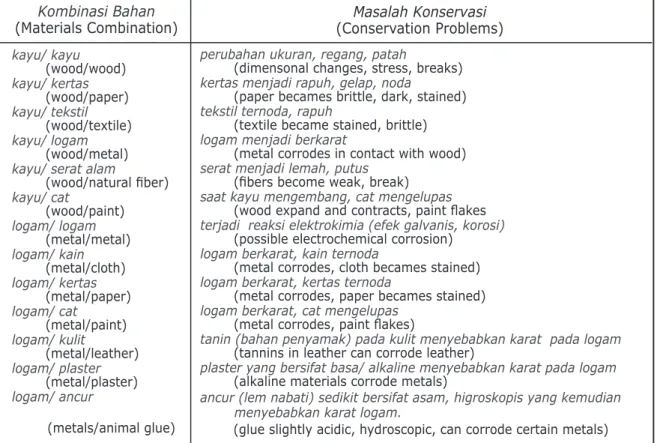
perubahan ukuran, regang, patah kertas menjadi rapuh, gelap, noda tekstil ternoda, rapuh
logam menjadi berkarat serat menjadi lemah, putus
saat kayu mengembang, cat mengelupas
terjadi reaksi elektrokimia (efek galvanis, korosi) logam berkarat, kain ternoda
logam berkarat, kertas ternoda logam berkarat, cat mengelupas
tanin (bahan penyamak) pada kulit menyebabkan karat pada logam plaster yang bersifat basa/ alkaline menyebabkan karat pada logam
Kombinasi Bahan
(Materials Combination)
(Conservation Problems)
Masalah Konservasi
(wood/wood) (wood/paper) (wood/textile) (wood/metal) (wood/natural fiber) (wood/paint) (metal/metal) (metal/cloth) (metal/paper) (metal/paint) (metal/leather) (metal/plaster)
(dimensonal changes, stress, breaks) (paper becames brittle, dark, stained) (textile became stained, brittle) (metal corrodes in contact with wood) (fibers become weak, break)
(wood expand and contracts, paint flakes (possible electrochemical corrosion) (metal corrodes, cloth becames stained) (metal corrodes, paper becames stained) (metal corrodes, paint flakes)
(tannins in leather can corrode leather) (alkaline materials corrode metals)
kayu/ kayu kayu/ kertas kayu/ tekstil kayu/ logam kayu/ serat alam kayu/ cat logam/ logam logam/ kain logam/ kertas logam/ cat logam/ kulit logam/ plaster
logam/ ancur ancur (lem nabati) sedikit bersifat asam, higroskopis yang kemudian menyebabkan karat logam.
(glue slightly acidic, hydroscopic, can corrode certain metals) (metals/animal glue)
Tabel 7.
Bahan Sensitif Terhadap Bahan Fumigasi
(Materials Sensitive to Fumigant)
Tabel 8.
Bahan-bahan Reaktif
(Reactive Materials)
Nama Bahan Kimia
(Chemical Names)
(Materials)
Bahan
karet, bulu, rambut, wool, kulit olahan, dan bahan lain yang mengandung sulfur
kayu (wood)
perekat kanji (tapioca glue)
kulit olahan, kertas lembab, cat, varnis
kuningan, tembaga, emas, perak (brass, copper, gold, silver)
logam, foto (metal/photo)
logam, foto (metal/photo)
logam, foto (metal/photo)
logam, foto (metal/photo)
logam, foto (metal/photo)
rusak, bau merkuri yang sangat menyengat
noda kecoklatan, tetapi tidak merusak (brown stained, but not destroy)
susah dilarutkan lagi (difficult to dissolve)
rusak/ larut (damage/ dissolve)
rusak/ tarnish/ korosi rusak (logam berkarat, foto
menjadi buram/ gelap) rusak (karat, gelap)
rusak (karat, gelap) rusak (karat, gelap) rusak (karat, gelap)
Methyl bromide
Methyl bromide
Methyl bromide, ethylene oxide Ethylene oxide Phosphine Carbon disulfida Carbon tetrachloride Paradichlorbenzene Paraformaldehide
Akibatnya
(Result)
(rubber, fur, hair, wool, tanned leather, and other materials content of sulphur)
damage (rusty metal, photo become blurly/dark)
damage (rust, dark) damage (rust, dark) damage (rust, dark) damage (rust, dark) (damage, tarnish/corrotion) damage, strong smelt of mercury
leather finishes, wet paper, paint, varnish
Thymol Naphthaline
DDVP (dimethyl diethyl vinyl posfat) + ethanol
Tabel 9.
Prosedur Pembasmian Serangga~Jamur Dengan Freezer
(Freezing Method for Killing Insect & Fungus)
Tabel 10.
Prosedur Pembasmian Serangga~Jamur Dengan Bahan Kimia
(Fumigation Method for Killing Insect & Fungus)
No.
Nama Serangga
Sebagian besar larva
Pupa & Kumbang 1. dewasa
Telur Kumbang 1.
Ngengat kain
Telur Kumbang 7.
(Semua fase) Kumbang 7.
(Semua fase) Kumbang 5.
Suhu dan Waktu
Catatan:
01. 02. 03. 04. 05. 06. 07. -20C, 2J. -20C, 1J -20C, 2J -5C, 3H; 10C, 3H; -5C, 3H. -10C, 9 J. 2C, 16H dan -3C, 7H. -30C, 3J.
C= derajat celcius,
M = menit,
J = jam,
H = hari.
No.
8 -10 gram 1 - 2 tablet 50 - 100 gram, 50-60 C 40 gram 4 - 13 gram 1 liter 15 - 30 gram 35 - 50 gram 100 gram 100 gramKonsentrasi/ Meter Kubik
01. 02. 03. 04. 05. 06. 07. 08. 09. 10. Naphthaline Phosphine Thymol + ethanol Paradichlorobenzene Paraformaldehide Carbon tetrachloride + Carbon disulfide (1:1) Methyl bromideMethyl bromide + Ethylene Oxide (14:86)
Methyl bromide + Ethylene Oxide (14:86)
DDVP (dimethyl diethyl vinyl posfat) + ethanol
Nama Bahan Kimia
serangga serangga + jamur jamur jamur + serangga jamur jamur + serangga serangga serangga serangga jamur + serangga
Pembasmi
14 hari 3 - 5 hari 2 hari 2 hari 2 hari 1 minggu 2 hari 2 hari 2 hari 2 hariWaktu
Lux Meter
(Measuring Instrument
for Light Intensity)
Elsec 764 UV meter (4 in 1]
Gambar 1.
Gambar 2.
(Measuring Instrument for Ultra Violet
Radiation, Light Intensity, Temperature
and Humidity)
Kuat penerangan (lux): Penerangan pada
permukaan benda secara merata seluas 1
m
2, berjarak 1 m dari titik sumber cahaya
berkekuatan 1 kandela.
Kuat cahaya (foot candle): Banyaknya
(jumlah) sinar yang jatuh pada permukaan
benda seluas 1 kaki persegi (=0,0029 m
2)
dari sumber cahaya yang berjarak 1 kaki
(=0,3048 m = 12 inci).
1. Kuat Penerangan (Illumination, E)
E = F (Fluks)
A (Luas) =
Lumen
m
2= Lux.
2. Dosis Kuat Penerangan = Lux x jam = Joule.
3. Fluks Cahaya (F) =
T =
J
Energi (Joule/m
Waktu (Jam)
2)
4. Kuat Cahaya (I) =
Cos Q = Lumen.m = Candela
E.R2
Sensor suhu
(oC)
dan
kelembaban
udara
(%)
.
KONVERSI ENERGI:
1 Joule = 107 erg.
1 kwh = 3,6 106 J.
1 Kalori = 4.186 J.
KONVERSI DAYA:
1 watt = 1 Joule/ detik.
1 HP = 0,746 watt
Energi = kekuatan untuk
melakukan usaha.
Daya = kekuatan tenaga.
Lampu TL Ultra Violet,
National, 100 volt/ 50
Hz., Type FL 205, Panjang
gelombang = 263 nm.
Energi = 2 mw/cm
2.
Tombol
untuk suhu,
kelembaban
udara, kuat
cahaya dan
radiasi ultra
violet.
Sensor radiasi
UV
(mW/Lmn)
dan Intensitas
cahaya
(Lux)
.
Panel monitor
menunjukkan besaran
angka dan satuan
Mode/ pengatur besarnya sinar yang terbaca.
Displai/ monitor harga hasil pengamatan.
Gambar 3.
(Measuring Instrument for Temperature
and Relative Humidity)
Gambar 4.
Picture 5.
Wet & Dry Bulb Psychrometer
“Wet & Dry Psychrometer”
sangat cocok digunakan untuk kalibrasi, spot reading dan pendataan data klimatologi harian. Kita dapat mengetahui besarnya suhu udara secara langsung pada bagian thermometer yang kering (kiri). Sedangkan RH-nya dapat dicari dengan merujuk selisih harga dengan thermometer yang basah (kanan). Selanjutnya besarnya RH dapat dicari pada Tabel RH yang biasa disertakan pada saat pembelian alat tersebut.Maintenans Alat:
Kain yang digunakan untuk melembabi (dengan air distilasi) thermometer merkuri diusahakan selalu bersih, dan air yang digunakan selalu air distilasi.
Sling Psychrometer
Alat ini menyerupai Wet & Dry Psychrometer, tetapi badan yang ditempeli thermometer (baik yang dry ataupun wet) dapat diputar, guna melewatkan udara pada thermometer. Belakangan perangkat ini telah dimodifikasi dengan tenaga baterai untuk memutar kipas angin yang melewatkan udara yang akan diukur suhu ataupun kelembabannya.
Wet & Dry Psychrometer
Banyak digunakan untuk kalibrasi alat-alat pengukur RH & T jenis lain.
INAKURASI + 2%
Kain selalu bersih dan harus dengan air distilasi/ deionisasi
selisih har
ga
Hasil pengukuran dari alat ini
dapat dilihat/ dibaca langsung.
Hasil pengukuran dari
alat ini dapat dilihat/
dibaca langsung.
Besarmya RH merujuk pada
“perubahan ukuran benda/ bahan
higroskopis”, seperti: rambut,
polymer atau garam kristal.
Kertas grafis Tanganan pemegang pena pencatat Tabung berputar menurut waktu (1, 7 atau 31 hari) Pena pencatat RH dan T
Catatan:
Satu orang yang
sedang istirahat
selama satu jam
setara dengan 60 ml
air, dan menghasilkan
panas setara dengan
100 watt lampu pijar.
Referensi:
Bachmann (1992:15-22)
INAKURASI:
+ 2 ~ 4% (sering dikalibrasi)
+ 30 ~ 60% (jarang/ tidak dikalibrasi)
Besarnya RH dan T yang tertulis pada kertas grafis
tidak sinkron dengan waktu yang tertera. Waktu
sesungguhnya terlambat (dikurangi) sekitar 30 menit.
Mengalami “shock” perubahan
RH dan T yang sangat mencolok.
Thermohygrometer
Bak Penampungan Air Distilasi
Humidifier
(Alat Pelembab Udara)
Essick Air 826
Dehumidifier
(Alat Penyerap Uap Air)
GoldStar DH504EL
Keterangan “Control Panel”
(1)
(2)
(3)
(4)
(5)
(6)
(7)
Tombol Operasi (Power)
Tombol pengoperasian
(RH 60 ~ 65%)
Pengoperasian non-stop
Tombol “Humidity”
Tombol “Defrost”
Lampu indikator Humidity
Lampu indikator Defrost
Control Panel Tempat masuknya uap air Bak Penampungan (Uap) AirCATATAN:
Kelembaban tidak dapat diturunkan
dibawah 40%. Efektif untuk 40 ~ 50%.
Efektif untuk luas ruangan = 10 ~ 16
meter kubik. Suhu ruangan berkisar
antara 1 ~ 35 derajat celcius.
Control Panel
Tempat Keluarnya uap air
Gambar 7.
1596 1602 1613 1619 1632 1645 1660 1695 1778 1815 1825-30 1868 1883 1900 1908 1928 1933 1945 1950 1962 1973 CE 78 400 450 500 518 600 670 700 732 900 960 1000 1279 1292 1370 1400 1453 1500 1509 1516 1528
There were mineral alum and madder imported from Mecca and Aden
(Medinah), included coral and copper.
On February 29, 1950, the Batavian Society was changed into the name
‘the Institute of Indonesian Culture’.
The fragment recontruction on terracota with straight and waved lines is an evidence for the earliest textiles.
The First Hinduism Kingdom
BCE 3000 - 2000
PRE HISTORY (NEOLITHIC)
Pithecantropus erectus
(manusia trinil). BRONZE AGE
Aji Çaka HISTORY (Kutai Kingdom)
(Kalimantan, Hindu)
800 - 200 Ikat lungsi (warp) is considered present in the time. The textile with geometrized stylization of human, bird, reptilian, and floral forms. Those like textile producing regions are Kalimantan (jackets and breechclouts from Dayak Iban, D.Bahau and D.Kenyah), Sumatera (ulos from Batak, Palepai and Tampan from Lampung), Sulawesi (Toraja), Nusatenggara (Timor and Sumbawa) and Bali. Songket or supplementary warp was also present in that time (?).
(1)
Motifs on the bronze-wares from that era is similar to the textile design and pattern of No.1. Bronze-wares from that era, for example kettle drums and axes which were influenced by the Dongson’s culture (Tongkin, Vietnam).
(2)
TARUMANEGARA
(Jawa Barat, Hindu) Chinese chronicles mention that certain King of North Sumatera wore silk cloth. The stone inscription found is as foundation of Indonesian Historic period.
(3)
(4)
MATARAM I(Jawa Tengah, Hindu)
(6)
In Aceh, sappan-wood (secang) already was one of the outstanding export stuffs tothe Arab. The secang dye work was considered as the oldest native red dye work.
(7)
Mangosteen flower motifs in Prambanan temple reliefs (also similar to inPalembang) or in Design Javanese Batik, jelamprang, attesting to origin
in the Hindu-Indonesian Period.
There was a barter trade which were Indonesian cotton cloth and Chinese silk. Silk patola cloth (may from India) also present in the era (Javanese
and Sumatrans called as ‘cindai’).
(8)
SRIWIJAYA (Sumatera Selatan, Hindu)
The Sung dynasty mentions that cotton goods from Java were used as princely presents.
(9)
* Borobudur and Prambanan
* Kain Prada
(11)
Because the fall of Constantinople in 1453, the European merchantssought to purchase spices, which at that time were very rare and quite expensive, directly the producing country, i.e. Indonesia.
King Hayam Wuruk who succeeded in
reuniting the Indonesian Archipelago
was among the re-owned rulers of that period of Hindu Kingdoms. The same
period saw the building of the Borobudur Buddist sanctuary under the Çailendra dynasty in Central Java and Prambanan Hindu temple by King Daksa.
Portuegese was the first
European to set foot in Indonesia.
(14)
(15)
MATARAM II(Jawa Tengah, Islam)
(16)
The Dutch settled in Bantam (Banten), West Java.The Dutch established the Netherlands East Indies Company (VOC).
(17)
Kolonialisasi, Jatuhnya
Kekuasaan, JAYAKARTA Governor General Jan Peterzon Coen succeeded in gaining the authority over Jayakarta, which was renamed ‘Batavia’. That time was beginning of the
colonialism by the Dutch.
(23)
Sultan Agung introduced the Islamic-Javanese calendar and was patron of the Arts and Crafts.
(20)
Gunung Merapi (a volcano name in Central Java) eruption sent a plenty of minerals, i.e. mineral alum.(22)
The Batavian (presently Jakarta) Society for the Arts and Sciences was founded in Jakarta on April 24, 1778.(19)
Indian cotton (from Madapolam and Calicut) have been supplanted by European fabrics.
In the colonialism era the Fierce battles broke out everywhere led by brave patriots, like as Prince Diponegoro (1825-1830) in Central Java.
(24)
(26)
Gunung krakatau (a volcano name in the Java Sea, close to Banten District) eruption also sent a plenty of minerals.(28)
(27)
Artificial Indigo and Alizarin were firstly used by Javanese.
Because in this period of national awakening was heralded by ‘Boedi
Oetomo’, the organization founded on May 20. Its ultimate aim was the
establishment of an Independent Indonesian State.
(29)
The Indonesian youth, in the 2nd congress on October 1928, called for unity among the Indonesian youth and pledged allegiance to ‘One Nation, Indonesia, One Motherland, Indonesia, One Language, Bahasa Indonesia’.(31)
Indonesia proclaimed the Independence and established Unity State of the Republicof Indonesia covering the territory of the former Netherlands East Indies.
(18)
(13)
MADJAPAHIT (Jawa Timur, Hindu)
HISTORICAL RECORDS
PERIODS
YEAR
The Institute was presented to the Indonesian Government which then is administered under Ministry of Education and Culture. The institution was also changed its name into Central Museum that become the National Museum to the present time.
(33)
(32)
REPUBLIC OF INDONESIA,(Negara Merdeka, Modern)
Conservation Lab for the National Museum of Indonesia. Secang-wood and mengkudu were in common use by using mineral alum (Javanese called it as tawas) and plant
alum (probably Jirek). However, the plant
alum was considered the older mordant than the mineral alum. [The raw materials were treated with oil (castor) and lye (ash from burning rice stalks, or trunks of various trees of banana) that dyes from Morinda mixed with Jirek, Symplocos fasciculata
Zoll.] Sugar, indigo, and coffee from Java and Sumatera were exported to Europe.
(21)
The new museum building (presently National Museum) was opened in Jalan Merdeka Barat 12, Jakarta.
(25)
Chinese source of the Ling and T’ang dynasties: the people of Java and North Coast of Sumatera wore cotton in use in Sumatera as early as the 6th century. There are 3 species of Gossypium, i.e. G. herbaceum (the most common), G. obtusifolium (in Southern Sumatera, cultivated by the Dutch), and G. brasiliense (Malay Peninsula, cultivated by the British).
(5)
Ikat pakan (weft) together with import silks were brought by Indians and Islamic
traders to Java and Sumatera (possibly, also applications of beads, sequins, glass/ mirrors, and gaining of the knowledge of technique for mixing color/dye). The regions
of the two islands that were contacted by the mentioned traders were as indication of silk and songket clothes, and probably silver and gold threads. Other regions: Palembang
(South Sumatera), Donggala (Central Sulawesi), Bugis (South Sulawesi) and Bali. In old Javanese written source suggest that ‘kain prada’ enjoyed very great popularity in
aristocratic circles in East Javanese Kingdom of Madjapahit. (In Bali, gold leaf was an important article of commerce imported from China and Thailand via the port of Singaraja in the latter half of the 19th century).
(10)
In Palembang, was cultivated the mulberry trees for Bombix mori foods (silk coccon), it was also in Sulawesi. Typical silk cloth colors are red, green,
blue and other bright colors. Silver and gold threads was utilized throught the supplementary weft technique, which raises the metallic threads to the surface of
the cloth with design of geometric and stylized floral meanders.
(12)
The Board Commerce and Industry of the Dutch East Indies published the Native Batik Industry. Some German synthetic dyestuffs first produced in
the years 1920 to 1928 come into use in Jakarta and Pekalongan. e.g. for red
color (aniline of Beta-hydroxy naphthoic acid, which applicable in cold water), for basic yellow (Auramine-O, Ciba Ltd., Basle), form brown (a benzidine dyestuffs, called soga-soga which developed with diazo compounds).