Page
1.4Significant of the Study……… 6
1.5Definition of Key Terms………... 6
1.6Scope of the Study……….. 7
1.7Thesis Organization………. 7
CHAPTER II LITERATURE REVIEW 2. 1The Nature of Speaking... 9
2.2 The Importance of Speaking in Language Learning………....….. 10
2.2.1 The Problem in Teaching Speaking Skill………. 12
2.2.2 The Classroom Speaking Activities………. 15
2.3 Storytelling………. 21
2.3.1 Types of Stories……… 22
2.3.2 How to Apply the Storytelling………. 26
2.3.3 The Advantages of Storytelling……… 28
2.4 Storytelling for Speaking Skills……….. 31
3.4.1 Material……… 39
3.4.1.1 Material for Treatment………. 39
3.4.1.2 Material for Pre-test and Post-test……… 40
3.4.2 Teaching Procedures……… 40
3.5 Research Instruments………. 42
3.6 Variable and Hypotheses……… 45
3.7 Research Procedure……… 46
3.8 Data Collection Technique………. 47
3.8.1 Tests……….. 47
4.1.1 The Effect of the Use of Storytelling Technique in Teaching Speaking... 56
4.1.1.1Pre-test Scores of Experimental and Control Group.……….. 57
4.1.1.2Post-test Scores of Experimental and Control Group….………... 58
4.1.2 The Students’ Attitudes towards the Implementation of the Storytelling technique in teaching Speaking ………... 60
4.1.2.1Data from Questionnaires………... 61
4.1.2.1.1 The Students’ Attitudes toward the Use of Story in English………. 61
4.1.2.1.2 The Students’ Attitudes toward the Effects of the Story……….... 61
4.1.2.1.3 The Students’ Attitudes toward the Implementation of Storytelling Technique………... 62
4.1.2.1Data from Students Interview………... 63
4.2 Discussions………. 68
CHAPTER V CONCLUSIONS AND SUGGESTIONS Page 5.1 Conclusions……… 75
5.2 Suggestions……… 76
CHAPTER I
INTRODUCTION
1.1 Background of the Study
Speaking is one of the language skills which is important for second language
learners to be developed. Furthermore, “the mastery of speaking skill in English is a
priority for many second-language or foreign language learners” (Richards, 1990: 19).
Due to the important role of English in the global era, in Depdiknas (2006), the
Indonesian government explicitly emphasizes that the purpose of teaching and learning
of English in Indonesia is to make the students do something with English. According to
the Standard of Competence for the speaking skills, junior high school students are
expected to be able to express meaningful ideas for both simple transactional (to get
something done or get the information) and interpersonal (to get in touch with others for
social purposes) communication to interact with people in their nearest environment.
Depdiknas (2006) stated that the scope of the teaching English at SMP level
covers 1) the ability to comprehend and/or produce oral and/or written texts which are
realized in an integrative way in the four language skills, i.e. listening, speaking,
reading, and writing to achieve functional literacy level, 2) the ability to comprehend
and create short functional texts, and monologues, and also essays in the forms of
communicative competence which includes linguistic competence dealing with the
knowledge of the language (grammar, vocabulary, and phonology), socio cultural
competence which relates with the use of language utterance acceptably in society,
strategic competence which deals with how to overcome problems which arise in the
process of communication, and discourse competence which deals with the ability to
construct or interpret a text based on a given context.
The objective in the speaking skill is high, so it is not easy to achieve. The
teachers and students face some difficulties in the teaching and learning of speaking.
Based on the observation in teaching-learning activity before the investigation, it was
found that the unsatisfactory condition was provoked by the monotonous teaching
technique used by the teacher. Also, the classroom activities tended to be
teacher-centered. The students were passive in the teaching-learning process. This phenomenon
above seems to be a problem that should be overcome by teachers because they are
involved directly in the teaching-learning process and they are the determinant factors
who control the students’ success in learning.
Related to the problems above, it can be said that in the EFL classroom, teachers
should try to develop speaking activities. The teachers should help their students by
providing written texts to be learned to enrich their knowledge. The teacher should
create a good learning situation in making the students happy, interested, and motivated
creating good media, conducive situations, creative activities, in which the students will
be actively engaged in the learning process.
There are many techniques that can be applied in teaching speaking such as,
having a dialogue, playing games, singing songs, story-telling, oral reporting,
role-playing, small group discussion, and debates. Looking at the subject of this study, that is
the second-year students, the story-telling technique was used because it is a technique
or an approach in teaching language. Storytelling can be an enjoyable tool for practicing
both listening skills and verbal expression (Forest, 2000: 2 cited in Fitria). Activities in
listening or reading a story can be matched with speaking by telling or retelling the story
with student’s own words.
Jennings (1992: 8) and Brumfit and Johnson (1979 in Mixon and Temu, 2006:
14) state that through story-telling, students with various language abilities find a
non-threatening medium to participate. Reading or telling a story in class is a way to learn a
new language. Through story-telling individuals can learn to express themselves and
make sense of the external world.
According to the 2006 Standard of Content, there are five genres that must be
taught to the junior high school students. They are descriptive, procedure, recount,
report, and narrative. Story is a part of narrative text. Storytelling is a technique to
perform narrative text to tell a story and entertain the audience using spoken or written
Storytelling is a good means of developing speaking skills. According to
Wendlin (in Farris, 1991: 130), engaging students in storytelling activities develops
communication skills and encourages shared learning experiences. Telling stories
enhances oral language and sharpens listening. Thornbury also states that storytelling is
a universal function of language and one of the main ingredients of casual conversation
(2005: 95). By using storytelling students can practice listening and speaking skill in a
fun and interactive way. When the teacher tells stories to students, he/she communicates
with them, entertains them, and passes on information.
Telling stories is a good way to combine instruction and entertainment. Stories
are an effective tool for language teaching (Malkina, 1995: 1 cited in Fitria). Children
usually love stories. While listening to stories, children develop a sense of structure that
will later help them to understand the more complex stories of literature (Pedersen,
1995: 2 cited in Fitria). By using storytelling the teacher can create an atmosphere in
which the students can learn English and get entertainment.
Previous studies on the storytelling technique show that the use of story in the
classroom can increase the students’ interest in learning English. A study conducted by
Ningtyas (2006) found that storytelling can increase the interest of the fifth grade of
Elementary School students in learning English. Related to the use of story, Rachmajanti
follow. Rahmana (2002) found that the combination of a story and pictures can stimulate
the students’ interest in learning English.
Based on the advantages of using storytelling in motivating students and getting
them more interested in speaking as reported by previous researchers above, this present
study was intended to see the effect of the storytelling in teaching speaking.
1.2 Research Question
The main focus in this research was to develop students’ speaking ability through
storytelling. The research questions that would be answered through this experiment
were as follows:
1 What is the effect of the use of storytelling technique in teaching speaking?
2 What are the students’ attitudes toward the implementation of the storytelling
technique in teaching speaking?
1.3Purpose of the Study
In relation to the problem of the study above, this study was intended to find out:
1. The effect of storytelling technique in teaching speaking.
2. Students’ attitudes toward the implementation of the storytelling technique in
1.4Significant of the Study
The study is expected to contribute to the English teachers, headmasters and
other researchers. For the English teachers, the finding of this study can give them an
alternative way or technique in English teaching to improve the speaking ability of the
students and enhance their motivation. For the headmasters, the finding of this study
will give them sight in order to provide teachers some facilities to develop appropriate
techniques that can be applied in teaching-learning activities. For other researchers this
finding is also expected to be reinforcing reference in carrying out a study in a similar
field.
1.5Definition of Key Terms
To avoid misinterpretation and misunderstanding on the content of the study, it
is important to give clear definitions on the terms used in this thesis.
• Storytelling is the art of orally sharing a story or experience with an audience;
usually face to face (Berman, 2006). In this study, storytelling is a technique or the
art of using language in which the teacher presents a story orally in front of the
students and also the students do the same thing in front of their fellow classmates.
• Speaking is an interactive process of constructing meaning involving producing,
ability to produce or express a story in terms of the content orally using the target
language including the performance in delivering the story.
1.6Scope of the Study
This study was focused on the implementation of the teaching of speaking using
storytelling to improve speaking skill of the second year students in Bandung. The story
materials were selected from fables. The story was presented with picture.
1.7Thesis Organization
This thesis consists of five chapters presented as follows:
1. Chapter 1: Introduction
This chapter presents the background of the study, research question, purpose of
the study, the significant of the study, research methodology, definition of key
terms, and thesis organization.
2. Chapter 2: Theoretical Framework
This chapter elaborates relevant theories that underpinned this study. The
theories deal theory with the nature of speaking, the importance of speaking in
language learning, storytelling, storytelling for speaking skills, and related
3. Chapter 3: Research Methodology
This chapter covers the research methodology of this study that covers research
question, research design, research site, participants, data collection technique,
and data analysis.
4. Chapter 4: Findings and Discussions
This chapter presents the finding and discussion the data obtained in the study.
5. Chapter 5: Conclusions and Suggestions
This chapter highlights the conclusions of the finding of this study and presents
CHAPTER III
RESEARCH METHODOLOGY
This chapter focuses on the process of conducting the research. These include
Research Design, Research Site, Research Participants, Research Instruments,
Research Procedure, Data Collection Technique, and Data Analysis.
3.1 Research Design
The design of the research was a quasi-experimental, a type of research
design which includes experimental and control groups without random sampling
(Hatch and Lazarraton, 1991). It was conducted in order to find out the significance
of using story-telling technique to improve the students’ speaking ability by
analyzing the result of the tests as quasi-experimental design (Hatch and Farhady,
1982; Hatch and Lazaraton, 1994; Dornyei, 2007). In sum, this quasi-experimental
design was used to test the Null-Hypothesis (H0); there is no difference in speaking
ability between the experimental and control group and both groups were from the
same populations. Storytelling technique was used in teaching the experimental
group, while control group was taught by using conventional technique. To support
the data from the treatment, the questionnaire and interview were also employed in
this study to see the attitudes from the students after being taught using storytelling
In this study, there were two groups of grade VIII of a Madrasah
Tsanawiyah. One group was given the experimental treatment while the other did
not (Hatch and Farhady, 1982: 22 and Fraenkle and Wallen, 2007: 273). Both of
groups’ speaking ability was tested using the storytelling test. In the treatment
activity, the experimental group was taught by using storytelling technique, while
the control group was taught normally by using conventional technique. The
treatment was conducted in six meetings, each lasted for 90 minutes. After the
treatment has been done, the posttest was given to both the experimental and control
groups.
In order to support the validity of the research, the questionnaires and
interviewed were administered at the end of the program. The questionnaires and
interviewed were used to get the data of students’ attitudes toward the use of
storytelling in teaching speaking in the classroom to answer the second research
question. The attitudes covered the students’ feelings toward the implementation of
storytelling technique and the effects of the story and the technique to their
knowledge improvement and speaking skill.
3.2 Research Site
This study was conducted at a Madrasah Tsanawiyah in Bandung. The school
has 12 classes. There are 5 classes of VII grade, 5 classes of VIII grade and 5 classes
of IX grade. The number of students for each class is 32 students. The reason of
research. Convenience factor should be taken into consideration to support the
researcher to carry out the research (Alwasilah, 2009).
3.3 Population and Sample
3.3.1 Population
Population can be defined as a group to whom the results of the study are
generalized (see Fraenkel and Wallen, 2007: 93). Based on the focus of the study,
the population of this research was the students of a MTs in grade VIII. The students
were taken as the population since speaking (narrative) can be found at the grade
eight in the draft of curriculum 2006.
3.3.2 Sample
The sample of this study was taken from the sample through purposive
sampling which sample was taken based on certain consideration, as Fraenkle and
Wallen (2007: 100) state that “on occasion, based on previous knowledge of a
population and the specific purpose of the research, investigators use personal
judgment to select a sample. Researchers assume they can use their knowledge of the
population to judge whether or not a particular sample will be representative”. Two
of the classes from the VIII grade were chosen as the sample. The total number of
the students from the two classes was 64 students. From those two classes, one class
was chosen as the experimental group and another class was chosen as the control
the result of the summative test of the last semester. These two classes had similar
achievements. To keep their privacy and confidential real identities, their names
were disguised.
3.4 Materials and Teaching Procedures
3.4.1 Materials
3.4.1.1 Material for Treatment
Hutchinson and Waters (1987: 108) categorize some elements in designing
materials. First, input, it can be a text, dialogue, video recording, diagram or any
others. Second, content focus, language is used as a mean of conveying information
and feelings about something. Third, language focus, it is to enable the learners to
use language, how it works and practices putting it back together again. The last,
task, learners use the content and language knowledge they have built up through the
unit. Regarding these, the materials were designed related to those elements which
were arranged in the lesson plan.
The materials used to gather the data in this study were the materials to
conduct a treatment in the form of lesson plan. The materials for the experimental
class and the control class were the same. They were taken from internet.
Two stories were used for six meetings to both the experimental and control
group of this study. The stories were retrieved from internet. They were chosen on
the basis of topic, length and the interest of the students.
3.4.1.2 Materials for Pre-test and Post-test
Both pre-test and post-test were in series of pictures form a natural basis for
narration (Hughes, 2003). These were used since the students were tested to check
their speaking ability in telling the story based on the pictures given. The tests were
held in 90 minutes.The pre-test was given in the first meeting in order to find out the
starting point of the students’ speaking ability before the treatments were conducted.
Meanwhile, the post-test term was conducted at the end of the teaching learning
process in order to find out the effect of the use of the storytelling technique to the
students’ speaking ability.
3.4.2 Teaching Procedures
The teaching speaking procedure for the experimental and control groups
were carried out in the same procedure by using pre-activities, whilst-activities and
post-activities. The main activities were begun with the teacher’s presentation and
ended with individual task for each student (see lesson plans for experimental and
control groups in Appendices 1 and 2).
Although both the experimental and control groups got the same procedures,
each group were treated with different teaching methods. The experimental group
was taught by using the storytelling technique and the control group was taught by
Reading activities ware implemented to both experimental and control
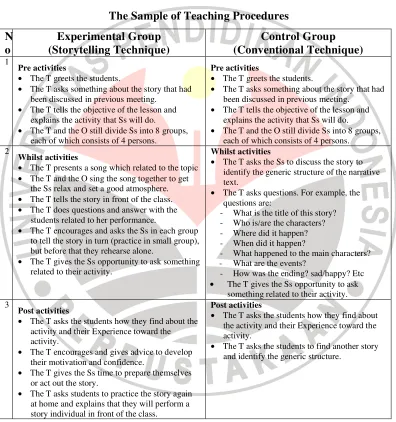
groups before they move to speaking activities. The following table shows a brief
sample of classroom activities for experimental and control groups.
Table 3.1
• The T greets the students.
• The T asks something about the story that had been discussed in previous meeting.
• The T tells the objective of the lesson and explains the activity that Ss will do.
• The T and the O still divide Ss into 8 groups, each of which consists of 4 persons.
Pre activities
• The T greets the students.
• The T asks something about the story that had been discussed in previous meeting.
• The T tells the objective of the lesson and explains the activity that Ss will do.
• The T and the O still divide Ss into 8 groups, each of which consists of 4 persons. 2
Whilst activities
• The T presents a song which related to the topic
• The T and the O sing the song together to get the Ss relax and set a good atmosphere.
• The T tells the story in front of the class.
• The T does questions and answer with the students related to her performance.
• The T encourages and asks the Ss in each group to tell the story in turn (practice in small group), but before that they rehearse alone.
• The T gives the Ss opportunity to ask something related to their activity.
Whilst activities
• The T asks the Ss to discuss the story to identify the generic structure of the narrative text.
• The T asks questions. For example, the questions are:
- What is the title of this story? - Who is/are the characters? - Where did it happen? - When did it happen?
- What happened to the main characters? - What are the events?
- How was the ending? sad/happy? Etc
• The T gives the Ss opportunity to ask something related to their activity. 3
Post activities
• The T asks the students how they find about the activity and their Experience toward the activity.
• The T encourages and gives advice to develop their motivation and confidence.
• The T gives the Ss time to prepare themselves or act out the story.
• The T asks students to practice the story again at home and explains that they will perform a story individual in front of the class.
Post activities
• The T asks the students how they find about the activity and their Experience toward the activity.
3.5 Research Instruments
Fraenkle and Wallen (2007: 113) defined instrumentation as the whole
process of preparing to collect data in a research. There were three kinds of
instruments which were employed in this research. They were recording, speaking
test, questionnaire, and interview.
The score of the students’ tests were used to know the effectiveness of
storytelling technique to improve students’ speaking ability. They were collected
through speaking test, pretest and posttest which were conducted to both
experimental and control groups. The speaking test for pretest had similar level of
validity, reliability, and level of difficulty with the speaking test for posttest. The
scoring system used in the test was adapted from Hadley, 2001 (Cited in Razak,
2009). It was in the form of rubrics for speaking ability testing which covered
Communication, Accuracy, Fluency, Vocabulary, and Pronunciation.
The questionnaire and interview were conducted to obtain data or
information about the students’ response to the implementation of the technique.
Before the instruments were administered, the validity and reliability were done.
Scarvia et al (1975) as cited in Arikunto (2007) stated that a test is valid if it
measures what it has to be measured. To obtain a valid result, this study employed
logical validity test in which the test was arranged based on the careful reasoning
conducted to measure the speaking ability, the test was in the form of oral test. The
advisors were also asked to look at the content and format of the instrument and
judge whether or not it is appropriate (Fraenkle and Wallen, 2007). In terms of the
reliability of the test, the interrater reliability was used in which raters are required to
make judgments on the language produced by the students. Interrater reliability is
essentially a variation of the equivalent forms type of reliability in that the scores are
usually produced by two raters and a correlation coefficient is calculated between
them (Brown J.D., 1988 cited in Razak, 2009). The English teacher at the school was
asked to be a rater accompanying the researcher in giving scores to the oral interview
test. The scores of the two raters then be calculated using correlation analysis.
The try out of the instrument was done on September 20th 2011 to class VIII
B which has equal ability to the class VIII C and VIII E as subjects of the study. The
process of scoring was done by the researcher and the English teacher in the school
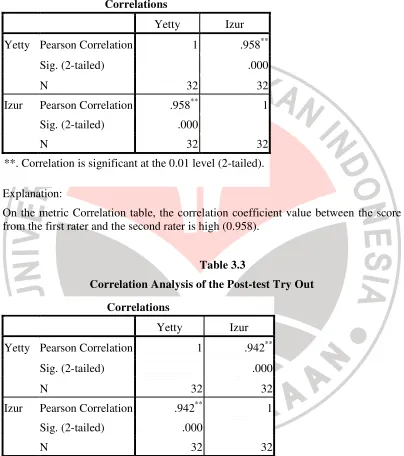
as the interrater to make sure that the score results were objective. The score result
was calculated using Correlation Analysis (Pearson Product Moment). The result of
Table 3.2
Correlation Analysis of Pre-test Try Out Correlations
Yetty Izur
Yetty Pearson Correlation 1 .958**
Sig. (2-tailed) .000
N 32 32
Izur Pearson Correlation .958** 1
Sig. (2-tailed) .000
N 32 32
**. Correlation is significant at the 0.01 level (2-tailed).
Explanation:
On the metric Correlation table, the correlation coefficient value between the score from the first rater and the second rater is high (0.958).
Table 3.3
Correlation Analysis of the Post-test Try Out Correlations
Yetty Izur
Yetty Pearson Correlation 1 .942**
Sig. (2-tailed) .000
N 32 32
Izur Pearson Correlation .942** 1
Sig. (2-tailed) .000
N 32 32
**. Correlation is significant at the 0.01 level (2-tailed).
Explanation:
The questionnaires and interview were also validated by consulting to the
expert to have logical validity and it can be stated to be valid, i.e. they are
understandable by many other people (Newman, 2003). And for the interview, the
advisors were also asked to look at the content and format of the instrument and
judge whether or not it is appropriate (Fraenkle and Wallen, 2007). In terms of
reliability, the questionnaires were analyzed for their internal consistency. For the
affective measurement and performance test scored using more than two choices like
Likert-Scales.
3.6 Variable and hypotheses
The characteristics of this study including the variabels and hypotheses are
shown in the following table:
Table 3.4
The Characteristics of the Study
Null Hypothesis (Ho) There is no difference between speaking ability of experiment and control groups.
Research Hypothesis (Hi) There is a significant difference between speaking ability of experimental and control groups.
Significant Level 0.01; two-tailed
Design Pre-test – post-test control group design
Dependent Variable Speaking ability
Measurement Score (interval)
Independent Variabel Storytelling
Measurement 1. Treatment to the experimental group
2. Treatment to the control group Statistical Procedure Independent t-test
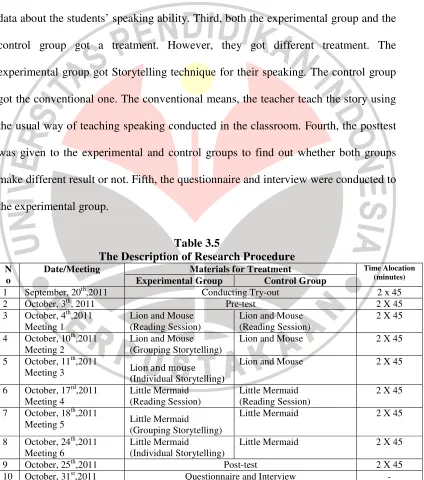
Some procedure were arranged to make the study runs in a well organized
way. The first, the try-out of the instrument was done to test its validity and
reliability of the test items. Second, the pretest was given to both experimental and
control groups. The results of the test were collected and analyzed as the preliminary
data about the students’ speaking ability. Third, both the experimental group and the
control group got a treatment. However, they got different treatment. The
experimental group got Storytelling technique for their speaking. The control group
got the conventional one. The conventional means, the teacher teach the story using
the usual way of teaching speaking conducted in the classroom. Fourth, the posttest
was given to the experimental and control groups to find out whether both groups
make different result or not. Fifth, the questionnaire and interview were conducted to
the experimental group.
Table 3.5
The Description of Research Procedure
N o
Date/Meeting Materials for Treatment Time Alocation
(minutes)
3.8 Data collection technique
Several data collection techniques were employed to this research to obtain
deep and comprehensive analysis;
3.8.1 Recording
Recording was used to record the students’ voice when they tell a story in the
test. The researcher used a tape recorder or another kind of recorder like MP4. It was
done to make the students’ utterances in the speaking test –telling a story
individually– easy to be analyzed and contrasted to the scoring rubric.
3.8.1 Tests
The tests were conducted to participants to find out their improvement in
speaking ability statistically.
3.8.1.1Pre-test
The pre-test was conducted to identify the initial skill of the students in
speaking. It was given to both experimental and control group at the first meeting
before the treatment given. The test was in the form of oral test.
3.8.1.2Post-test
The post-test was principally conducted similarly as the pre-test. It was used
to measure the effectiveness of storytelling technique in improving students’
3.8.2 Questionnaire
The questionnaire was conducted to obtain data or information about the
students’ attitudes toward the implementation of the technique to answer the second
research question. The questionnaire consisted of 11 close questions which covered
3 aspects; they were the students’ feelings toward the use of story in English, the
effects of the story and the implementation of storytelling technique to their
knowledge improvement and speaking skill. The questionnaires were written in
Bahasa Indonesia to avoid misunderstanding of students. The form of the
questionnaire was Likert Scale with the options of Strongly Agree, Agree, Uncertain,
Disagree, and Strongly Disagree. At the end of the questionnaire, an open-ended
questionnaire was also provided for the students to write about their comments on
the technique which were not covered by the close-ended questionnaire.
The questionnaire consisted of 11 statements. The statements covered three
issues: the first issue was on the students’ feeling toward reading the story
(statements number 1-2), the second issue was on the students’ feeling of the
usefulness of story (statements number 3- 5), and the third issue was on the students’
feeling to the implementation of the technique (statements number 6-11). In
addition, an open-ended questionnaire asked the students to give suggestion or
3.8.3 Interview
The interview also conducted to obtain comprehensive data along with
triangulating the data taken. This interview revealed the students’ attitudes toward
the implementation of the storytelling in teaching speaking. The interview items
were open-ended questions using semi-structured interviews, in which had aim to
reveal specific information which could be compared and contrasted with
information gained from the test and questionnaire (Dawson, 2009). In this case,
face-to-face or to-one interviews (Cresswell, 1994: 150) were conducted. A
one-to-one interview was done after the questionnaires had been already answered by the
respondents. The interview was in the form of informal conversation to the students.
The interview was done at school. The interview was conducted in order to support
the data to answer the second research question.
3.9 Data Analysis
The results of this study were based on the recording, tests, questionnaires
and interview.
3.9.1 Recording
The recording of the students’ voice in telling the story tests were scored
based on the speaking score rubrics.
3.9.2 Score Data Analysis of the Tests
This quantitative analysis was used to see whether this technique was
post-tests) that were applied. Since this research employed with quasi-experimental
design, the result of pre-test was used to seek the homogeneity of participants using
t-test (Hatch and Farhady, 1982; Hatch and Lazaraton, 1994; Dornyei, 2007) to
compare means of pre-test score to seek whether the participants is homogeny or not.
While the result of post-test was compared to seek the significant different
between two groups or it is known as intact group design (Hatch and Farhady, 1982;
Arikunto, 1993; Hatch and Lazaraton, 1994; Dornyei, 2007). The schematic
representation of this design is
( )
( )
Where G1 is experimental group, G2 is control group, x is treatment and T1 is
post-test
The post-test score was analyzed using two-tailed another t-test to seek the
significance of the program by testing the Null-hypothesis that has been presented
above, since t-test aims to compare two means of different groups (Hatch and
Farhady, 1982; Hatch and Lazaraton, 1994; Dornyei, 2007).
The interrater was used to make sure that the scoring in speaking test was
objective. The score results from two raters in both tests, pre-test and post-test, were
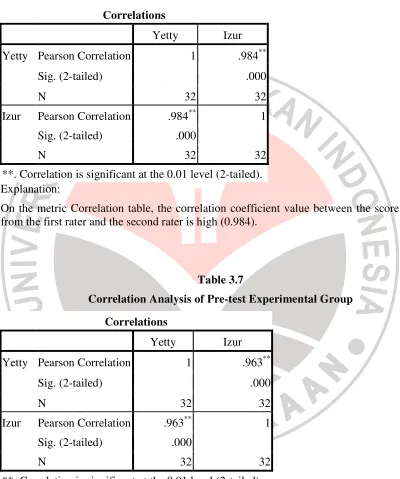
calculated using Correlation Analysis (Pearson Product Moment). The results of the
Table 3.6
Correlation Analysis of Control Group Pre-test Correlations
Yetty Izur
Yetty Pearson Correlation 1 .984**
Sig. (2-tailed) .000
N 32 32
Izur Pearson Correlation .984** 1
Sig. (2-tailed) .000
N 32 32
**. Correlation is significant at the 0.01 level (2-tailed). Explanation:
On the metric Correlation table, the correlation coefficient value between the score from the first rater and the second rater is high (0.984).
Table 3.7
Correlation Analysis of Pre-test Experimental Group Correlations
Yetty Izur
Yetty Pearson Correlation 1 .963**
Sig. (2-tailed) .000
N 32 32
Izur Pearson Correlation .963** 1
Sig. (2-tailed) .000
N 32 32
**. Correlation is significant at the 0.01 level (2-tailed). Explanation:
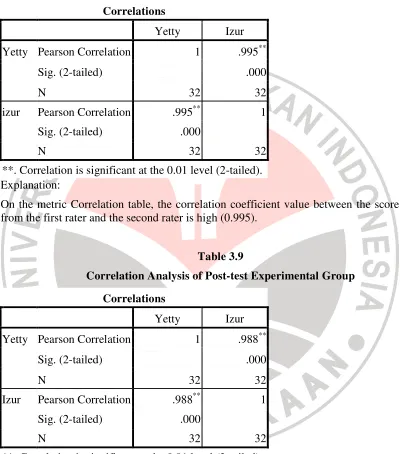
Table 3.8
Correlation analysis of Post-test Control Group Correlations
Yetty Izur
Yetty Pearson Correlation 1 .995**
Sig. (2-tailed) .000
N 32 32
izur Pearson Correlation .995** 1
Sig. (2-tailed) .000
N 32 32
**. Correlation is significant at the 0.01 level (2-tailed). Explanation:
On the metric Correlation table, the correlation coefficient value between the score from the first rater and the second rater is high (0.995).
Table 3.9
Correlation Analysis of Post-test Experimental Group Correlations
Yetty Izur
Yetty Pearson Correlation 1 .988**
Sig. (2-tailed) .000
N 32 32
Izur Pearson Correlation .988** 1
Sig. (2-tailed) .000
N 32 32
**. Correlation is significant at the 0.01 level (2-tailed). Explanation:
Since the results of the correlation computation were significant, so the
scoring was objective.
The procedure compared the means of the experimental and control groups
to find out their significant difference. If any, there might be a possibility that the
means score of the two groups are different. The significant difference can be seen
after the t-value has been obtained. The formula is:
tobs = Difference between two sample means
Standard error of differences between means
t
Se : Standard deviation of experimental group
Sc : Standard deviation of control group
The statistical analysis was used to compare the performance of both the
students of experimental and control groups and to find out whether the means of the
groups are truly different. It was intended to see if there was an influence of using
following step was to consult the value against the t-critical value in the t distribution
table and to find out the degree of freedom with the formula df = (n1 – 1 + n2 – 1)
(Hatch and Farhady, 1982: 112).
The hypotheses testing was conducted to see whether Ho is accepted or
rejected. Hatch and Farhady (1982) argue that the test alternative hypotheses (H1)
will be accepted if:
a. Mean of pre-test score is higher than that of pre-test score of the two classes
b. Mean of pre-test score of the experimental class is not different from that the
control class.
c. Mean of post-test score of experimental class is higher than that of the
control class.
To test null hypotheses (Ho), there are also some considerations should be
fulfilled. It will be received if:
a. There is no significant difference between mean of the post-test score and
pre-test score either of the experimental and control class.
b. There is no significant difference between mean of pre-test score of the two
classes.
c. There is no significant difference between mean of post-test score of the two
3.9.3 Questionnaire
The close questions data from questionnaires were analyzed by calculating it
in percentage using frequency base with the following formula:
Number of students choosing certain option
Total number of the students (32) ,100 %
The data from open-ended questions were analyzed qualitatively. They were
transcribed and summarized based on the classification.
3.9.4 Interview
The interview data was recorded and transcribed to be analyzed using coding
and categorizing (Heigham and Croker, 2009). This type of data analysis made as
sense of data by systematically looking through it, clustering or grouping similar
idea and labeling them. After being transcribed and categorized, the data were
presented in the discussion to explore students’ attitudes toward the implementation
CHAPTER V
CONCLUSIONS AND SUGGESTIONS
This last chapter presents the conclusions and suggestions drawn from the
research findings and discussion in the previous chapter. The chapter is divided into
two parts, the first is conclusions and the second is suggestions.
5.1 Conclusions
This research aimed to discover: (1) the effect of the use of the storytelling
technique in teaching speaking; and (2) the students’ attitudes toward the
implementation of the storytelling technique in teaching speaking in the classroom.
The data was collected from tests (pre- and post-test), questionnaires and interview.
Regarding to the first question, the data gained from the independent t-test, it
showed that there was a significant difference between the post-test of students in the
experimental group, who were taught by using storytelling technique, and that of
students in the control group, who were taught by using the conventional technique. It
can be concluded that the storytelling technique in teaching speaking has a significant
effect in developing students’ speaking ability.
In terms of students’ attitudes toward the implementation of storytelling
technique in teaching speaking in the classroom, the data from the questionnaires and
technique in teaching speaking. They liked this technique rather than the technique
that they got previously because they felt that it was interesting and made them enjoy
the teaching and learning process. Furthermore, the students felt that storytelling
activity could create fun and enjoyable environment in the classroom, so they would
not get bored and it could entertain them which could motivate them to learn more.
The storytelling technique was very useful in speaking class. It could help them to
develop their speaking ability and increase the students’ confidence in speaking
which helped the student to expressing their ideas and feeling easier. Finally, all these
indicate that implementing storytelling technique is worth implementing by teachers
in their classrooms.
5.2 Suggestions
As the completion of this research, the following suggestions can be given:
First, it is suggested that the teachers implement storytelling as one of
techniques in teaching English, especially in speaking class, because it give benefits
to the students’ performance. It is expected that teachers intending to implement
storytelling should be creative in finding story for the students to attract the students’
attention and interests in speaking.
Second, for further exploration, future researchers can extend the
investigation on storytelling technique by providing more samples from different
teachers and the students involved in the implementation of the storytelling technique.
Moreover, the questionnaire in this study did not cover the learning background
experience. It is important to be asked because it influences the students’ ability. So,
the further researchers should include that aspect in the questionnaire to make the
REFERENCES
Alwasilah, A. Chaedar. 2009. Pokoknya Kualitatif. Dasar-dasar Merancang dan Melakukan Penelitian Kualitatif. Jakarta: PT. Dunia Pustaka Jaya.
Arikunto, Suharsimi. 1993. Prosedur Penelitian: Suatu Pendekatan Praktek, Edisi Revisi II. Jakarta: Rineka Cipta.
Arikunto, S. 2002. Prosedur Penelitian: Suatu Pendekatan Praktek. Jakarta: Bina Aksara.
Berman, M. 2006. The Art of Storytelling, (Online), (Developing Teacher.com, accessed on April 7th, 2010).
Bing, P. C., & Gaffrey, K. 2003. Arts Resource Handbook: Activities for Students with Disabilities. Westport: Libraries Unlimited.
Brewster, Ellis & Girard. 2003. The primary English teacher’s guide. Essex: Pearson Education Limited.
Brown, H. D. 2001. Teaching by Principles: An Interactive Approach to Language Pedagogy. (2nd ed). New York: Addison Wesley Longman Inc.
Burns, A. & Joyce, H. 1999. Focus on Speaking. National Centre for English Language Teaching and Research (NCELTR). Sydney: Macquarie.
Celce, M. & Murcia. 2001. Teaching English as a Second or Foreign Language. (3rd ed). Boston: Heinle & Heinle.
Cooper, P. J., & Saxby. 1994. The Power of the Story. South Melbourne: Palgrave Macmilan Australia Pty. Ltd.
Cruz, T. C. 2001. Enhancing Literacy through the Techniques of
Storytelling,(Online), http://www.asha.org/about/publications/leader- online/archieves/2001/storytelling.htm, retrieved April 14th 2010.
Daniels, H. 2002. Literature Circles: Voice and Choice in Book Clubs and Reading Groups. Portland: Stenhouse.
Dawson, C. 2009. Introduction to Research Methods: A Practical Guide for Anyone undertaking a Research Project. Oxford: How To Books Ltd.
Depdiknas. 2006. Regulation of Minister of National Education. Indonesian Republic No. 22 Year 2006, Content Standard for Primary and Second Year at English Subject. Jakarta.
Dornyei, Z. 2007. Research Methods in Applied Linguistics. Oxford: Oxford University Press
Farris, P. J. 1993. Language Arts: A Process Approach. Illinois: Brown & Bechmark Publishers.
Fitria. 2009. Improving Students’ Listening Skills through Storytelling. Unpublished Thesis. Malang: Faculty of Letters, State University of Malang.
Fraenkle, J. R., and Wallen, N. E. (2007). How to Design and Evaluate Research in Education. Sixth Edition. Singapore: MacGraw Hill Inc.
Gebhard, J. G. 2000. Teaching English as a Foreign or Second Language. Michigan: The University of Michigan Press.
Gere, J. 1999. By word of mouth: A storytelling guide for classroom. Honolulu: Pasific Resources for Education and Learning.
Harmer, J. 2001. The Practice of English Language Teaching. (3rd ed). Essex: Pearson Education.
Hatch and Farhady. 1982. Research Design and Statistic for Applied Linguistics. Massachusetts: Newbury House Publisher, Inc.
Hatch and Lazaraton. 1994. The Research Manual; Design and Statistic for Applied Linguistics. Massachusetts: Heinle & Heinle Publishers.
Haven, K. F. 2000. Super Simple Storytelling : a Can-Do Guide foe Every Classroom Everyday. Greenwood: a Division Greenwood Publishing Group, Inc.
Heigham, J. & Croker, R. 2009. Qualitative Research in Applied Linguistics: A Practical Introduction. New York: Palgrave Macmilllan.
Hughes, A. 2003. Testing for Language Teachers: Second Edition. Cambridge: Cambridge University Press.
Jianing. 2007. Storytelling in the EFL Speaking Classroom. (Online). (http: //iteslj.org /Techniques/Jianing-Storytelling.html, accessed on April, 17th, 2010).
Katherine, L. 2001. A Project Approach to Language Learning. Canada: Pembroke
(http://www.Australianstorytelling.htm, accesed on April, 12th, 2010).
Mixon, M. & Temu, P. 2006. First Road to Learning: Language through Stories. English Teaching Forum. 43 (2): 14-17.
Newman, W. L. 2003. Social Research Method. Boston: Pearson Education.
Ningtyas, F. 2006. Using Visual Media in Storytelling Technique to Increase the Interest of the Fifth Grade Students of SDN Banjararum III in Learning English. Unpublished Thesis. Malang: Faculty of Letters, State University of Malang.
Nunan, D. 1991. Language Teaching Methodology: A Textbook for Teachers. New York: Prentice Hall International.
Nunan, D. 1999. Second Language Teaching and Learning. Hong Kong: Heinle and Heinle Publishers.
Rahmajanti, S. 1999. Promoting the Mastery of Language Components through the Mode of Reading Adapted Stories to Elementary School Aged Learners. Unpublished Thesis. Malang: Postgraduate Program, State University of Malang.
Rahmana, E. Y. 2002. Using Big Books to Arouse the Interest of the Elmentary School Students in Learning English. Unpublished Sarjana Thesis. Malang: Faculty of Letters, State University of Malang.
Richard, J. C.2008. Teaching Listening and Speaking: From Theory to Practice. New York: Cambridge University Press
Richards, J. C. and Renandya W. A. (Eds.). 2002. Methodology in Language Teaching: An Anthology of Current Practice. Cambridge: Cambridge University Press.
Roney, R. C. 2001. The Story Performance Book. New Jersey: Lawrence Erlbaum Associates, Inc Publishers.
Strauss, K. 2006. Tales with Tails: Storytelling the Wonders of the Natural World. Westport: Libraries Unlimited.
Susanti, E. R. 2004. Using Big Books to Encourage the Fifth Grade of Elementary School Students’ Participation in English Classes at SDN Penjagaan 1 Bangkalan. Unpublished Sarjana Thesis. Malang: Faculty of Letters. State University of Malang.
Thomas, M. 2003. Blending Qualitative and Quantitative. California:Vorwin Press,Inc
Thornbury, S. 2005. How to Teach Speaking. Essex: Stenton Associates.
Tompkins, G. E., & Hoskisson, K. 1995. Language Arts: Content and Teaching Strategies. New Jersey: Prentice-Hall.
Ur. P. 1996. A Course in Language Teaching: Practice and Theory. New York: Cambridge University Press.
Wiehardt, G. 2007. Definition of story. fictionwriting.about.com/od/glossary /g/story.htm (Accessed on March, 12th 2010)