THESIS
Submitted to the FKIP of University of Muhammadiyah Makassar in Partial Fulfillment of the Requirements for the degree of Sarjana Pendidikan
BY
ANDI ARI ASHARI 10535 4198 09
ENGLISH DEPARTMENT
FACULTY OF TEACHERS TRAINING AND EDUCATION MAKASSAR MUHAMMADIYAH UNIVERSITY
2014
vi
Department Faculty of Teachers Training and Education, Makassar Muhammadiyah University (under supervisor Abd. Waris Hamid and Awalia Azis).
This research aimed to find out whether or not the use of Rotating Trio Exchange improved students’ speaking performance and can arise interest toward the use of Rotating Trio Exchange. This Research applid quasi experimental method. The instrument of this research was speaking test. The population of this research was the tenth grade year students’ of SMA Negeri 6 Bulukumba. The sample consisted of two classes, one clss is an experimental group with 18 students, and another is one as control group with 18 students. The research used total sampling.
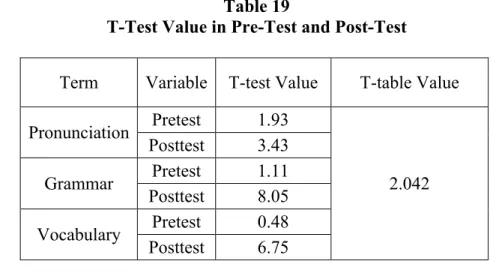
The result of the research revealed that the use of Rotating Trio Exchange improved the students’ speaking performance and aroused their interest among the students’ speaking performance i experimental group was 43,3 while in control group was 42,9 I pre-test. The t-test result in pre-test of students’ speaking performance was 0,13 while post-test was 39,7. Since t-table value is 2.042, it was found that the t-test value in pre-test was lower than t-table value (0,13<2,042). It means that there was no significant difference between the result of pre-test and post-test on control group taught by conventional way, in improving speaking performance of the students.
While in experimental group, t-test value was greater than t-tale value (3,97>2.042).
It means that there was a significant difference between the result of pre-test and post-test in improving speaking performance of the students’. It showed that the students’ speaking performance improved after receiving treatment by using Rotating Trio Exchange Based on the result of the research,, the writer concluded that using Rotating Trio Exchange improved students’ speaking performance aroused their interest.
Alhamdullilahi Robbil ‘Alamin, first of all I would like to express my deepest praise and gratitude to Allah SWT who has given me His blessing and merciful to complete this thesis. Shalawat and salam are addressed to the final chosen religious messenger, the Prophet Muhammad SAW.
I would like to convey my high appreciation and sincere thanks to my consultants Drs. Abd Waris Hamid, M, Hum and Awalia Azis, S.Pd., M.Pd. For their invaluable clear perspective, professional expertise, and motivation along the researcher finished this thesis.
I realized that many people had given their helps and useful suggestion for the finishing of this thesis. Without the assistance of them, this thesis would never have existed. Therefore, the writer would like to express her appreciation and sincere thanks to:
1. Dr. Irwan Akib, M. Pd., the rector of Makassar Muhammadiyah University.
2. Dr. A. Syukri Syamsuri, M. Hum, the dean of teacher training and education faculty.
3. Erwin Akib, S.Pd, M.Pd, the head of English Education Department of FKIP UNISMUH Makassar.
4. My heartful thank to all lectures of the FKIP UNISMUH especially to the lectures of English Department for their guidance during my study.
their time and activities for being subject of this research.
6. Unforgettable thanks to all of my friends in class I especially for my best friends Muliadi, and Ilham Fajar B.Lolo.
7. Thanks for my friends Angga, Andi, Wahid, Ijang, Ami, Iccank, Andar, Danial, Agus, Herul, Wandi, Restu, Agung, Asho, Asnawi, Echa and Erwin.
8. Thanks for my girlfriend Hasdiani, S.Pd. She has give me spirit, love, care, motivation, and everything makes me can do anything.
9. Thanks to my family in for their support.
Finally, I dedicated this thesis for my beloved parents Andi Piara, S.Pd.
and Andi Absar Abbas, S.E. Who always love, care, pray and support in my study, there is no appropriate symbol which suitable to state my thanks to them.
And also for the persons who I could not write on this paper anymore.
Makassar, June 2014 The researcher
Andi Ari Ashari
iv
APPROVAL SHEET ... ii
COUNSELLING SHEET ...iii
SURAT PERNYATAAN... ...viii
SURAT PERJANJIAN .... ...ix
MOTTO ...x
ACKNOWLEDGEMENT ... xi
ABSTRACT... xii
TABLE OF CONTENT ... xiii
CHAPTER I INTRODUCTION A. Background ...1
B. Problem Statement ...4
C. Objective of the Study...4
D. The Significance of the Study...4
E. The Scope of the Study...5
CHAPTER II REVIEW OF RELATED LITERATURE A. The Concept of Speaking ...6
1. Definition of Speaking...6
2. Speaking Performance...7
B. The Concept of Rotating Trio Exchange ...12
1. Definition of Rotating Trio Exchange...12
v
5. Tips to Solve Some Problem May Occur ...21
6. Supported Factors in Rotating Trio Exchange...22
C. The Concept of Interest...23
1. Interest...23
2. Types of Interest ...24
3. Factor Influencing Student Interest...25
4. The Measurement of Interest ...26
D. Theoretical Framework...27
E. Resume...28
F. Hypothesis...29
CHAPTER III RESEARCH METHOD A. Research Design...30
B. Population and Sample...30
C. Research Variables...31
D. The Instrument of The Research...31
E. Procedures of Collecting data...32
F. Technique of Data Analyzis...35
CHAPTER IV FINDING AND DISCUSSION A. Finding...39
B. Discussion...58
vi BIBLIOGRAPHY
APPENDIXES
CURRICULUM VITAE
1
Speaking is identified to be difficult to learn, whereas speaking is very important in human life. By speaking, people can communicate with others.
Chastain in Aras (2006: 1) stated that learning to speak is more difficult than learning to understand spoken language. Someone usually faces some troubles in social interaction like he or she cannot produce his ideas, arguments, and feeling communicatively. One sometimes can understand what others say but he or she is not able to communicate it. This may happen because of low practice, low motivation, less of communicative competence, and no self confidence. Ideally, if one could understand an expression, he should be able to produce it.
Speaking practice channels a good speaking performance, particularly to the accuracy that the students are trying to develop (Amin, 2004:1). In fact, when the students encounter and use a foreign language, they are restricted in time to use it individually, topic-based on theme, and subsequently the complex learning circumstance. That is to say to perform a practical speaking the students need to learn who they are, who they are talking to, where they are, and what they are talking about (Green and Hilton, 1984: 40). In addition, the students need to know how many times they talk, how much they talk, and how they talk. Therefore, focusing on their accuracy and fluency is the main learning process to get the students to improve their speaking
communication well by focusing on some elements above.
Based on the observation oftenth grade students in SMAN 6 Bulukumba found that the students were not good at English speaking because of some factors. First, the students do not understand, what actually the aim of speaking English is. The students practice English speaking only as compulsory to fulfill the task from the teacher. Second, the students do not have self confidence to speak in front of the class. Third, they are still lack of vocabulary, low understanding in grammar, and mispronunciation. Finally, students need to other method in learning. Some problems above are suitable with some factors that cause the students unable to improve their speaking.
Amin (2004:1) stated that the learning to speak, does not support the students to get the optimal standard achievement, because some problem cannot be avoided like: 1) the students do not know what their aim of learning English is, 2) the condition and the situation in the classroom have not been designed naturally for speaking, 3) and the students still lack the correct application of grammatical rules, the appropriate word choice and meaning, and the appropriate (acceptable) pronunciation and fluency.
One of the ways is using cooperative learning in teaching and learning process. Cooperative learning is an instructional strategy where small teams of students, usually two to six members, work together to maximize their individual and collective learning. After team members are organized into these small groups and receive instruction from their teacher, students within
each team member successfully understands and completes it (Foltz, 2009:1).
Beside that cooperative learning also defined as the instructional use of small groups that allows students to work together to maximize their own and each other as learning (Johnson, 1994:3). One of types of cooperative learning is rotating trio exchange (Isjoni, 2010:51). It is a way for participants to discuss issues with some, but usually not all; of their fellow participants. The exchanges can be easily geared to the subject matter of the teaching or learning (Silberman, 2005:92). Like others types of cooperative learning, rotating trio exchange is one of interesting technique. Basic difference with other types of cooperative learning is about the rotation of the members.
Many grouping students’ techniques, but not all of them use the rotation for group member. Rotating trio exchange is one of the teaching and learning techniques involving discussion. In the class, the application of rotating trio exchange will meet the materials and learning objectives stated in curriculum.
The materials will be developed and related to environment, culture, self esteem, and also self confidence of the students to speak in front of the class.
The purpose of rotating trio exchange is giving the opportunity to the students to improve themselves, not only in cognitive aspect, but also the affective and psychomotor aspect. The teacher can motivate the students that they get opportunity and time to improve themselves in learning, the students do not feel stress, and the students can be fun in learning, so the teacher and students can reach the objective of teaching and learning process.
the title “Improving Students’ Speaking Performance through Rotating Trio Exchange”.
B. Problem Statement
Considering the background above the writer formulated the research questions as follows:
1. How does using of Rotating Trio Exchange improve the speaking accuracy?
2. How does using of Rotating Trio Exchange improve the speaking fluency?
C. Objective Of the Study
The objective of the study are to find out:
1. This research aimed to find out whether or not the using of rotating trio exchange improves the speaking performance in term of accuracy of the students.
2. This research aimed to find out whether or not using of rotating trio exchange improves the speaking performance in term of fluency of the students.
D. Significance of the study
The result of the research in expected to be useful and helpful contribution:
1. Teachers 2. Students
3. Those who are concerned about language teaching method.
Rotating trio exchange is one of techniques that can help teachers in improving the students’ speaking performance in speaking English and interest of learning English. This technique also can be useful for the teachers to make speaking English interest for their students and it can help them to make the active classroom condition.
The result of research also expected to be useful contribution for the next research either to find out and anticipate the problems which are found in this research, or the next researchers will be easy to conduct more complete research especially in class that uses this technique, in this case rotating trio exchange technique.
C. Scope of the Study
This research was under the study of Applied Linguistics. It used technique of rotating trio exchange to improve Tenth grade students speaking performance in SMA Negeri 6 Bulukumba. It was restrict to English speaking performance in term of accuracy and fluency by using rotating trio exchange.
Speaking accuracy deals with pronunciation, grammatical and vocabulary.
The activity of this technique consisted of main steps of grouping students into trios, give rotate exchange, and general discussion. Besides, this research also to know about students’ interest toward rotating trio exchange.
6 A. The Concept of Speaking
1. Definitions of Speaking
Speaking is very important in communication. Speaking happens in everyday in communication of human interaction.
Bygate in Chandra (1991:41) suggests that oral interaction can characterized in terms of routines which are conventional ways are preceding information which can either focus on information or interaction.
Harmer (1991:46) stated that communication between human is an extremely complex and ever changing phenomenon. There are many variables that involved but there are certain generalizations that we can make about majority of communication events and these will have particular relevance for learning and teaching language. Further he states that when the people are engaged in talking to each other we can be fairly sure that they are doing for good reasons:
a. They want to say something; want is use here in general way to suggest that speaker make definite decision to address other people.
Speaking of course be force upon them, but we can still say that they feel need to speak otherwise they would be keep silent.
b. They have some communicative purpose; speakers say something because they want something to happen as a result of what they say.
They may want to charm their listener. They want to give some information or express pleasure, they may decide to be rude, to agree or complain in each of this case.
c. They select from their language store; speakers have an infinite capacity to create new sentences in order to achieve this communicative purpose they will select from the state of the language that they think is appropriate.
d. They want listen something; once again, want is used in general way.
But in order for someone to understand what they are listening or reading, they must have some desire to do so. They are interest in the communication purpose of what is being said. In general people listen to language because they want to find out what the speakers are trying to say.
2. Speaking Performance
When someone speaks, he produces some verbal aspect likes word, pronunciation, grammatical, pattern (Amin, 2004: 7). He saying and expressing ideas, opinion, or emotion. He does not only use knowledge about the language he speak itself, but also empowers and enhances strength to show about how the language he speak can be understood and meaningful. This called speaking performances. Speaking performance covers accuracy, fluency, and comprehensibility.
As speaker in any practical situation, someone will try to reach communicative purpose because it is not only about others can understand
what the point he speak but also he is required to speak as appropriately as he can. Speaking performance actually covers accuracy, fluency, and comprehensibility. When we acquire a language, we do not only learn how to compose and comprehends correct sentences and as isolated linguistic unit of random occurrence, we also learn how to use language appropriately to achieve a communicative purpose. In speaking, we do not only concern about the grammar but also make good pronunciation.
a) Accuracy
Accuracy in speaking performance deals with pronunciation, grammar, and vocabulary. Brown (1994) defined accuracy in speaking performance as the extent of the speakers to focus on the elements of phonology, grammar, and discourse in their spoken output. Beside that accuracy also defined as exactness, exact conformity to truth, or correctness, or a precision.
1) Pronunciation
Pronunciation is stress, rhythm, and intonation within the role of articulation in word. The utterance do not flow as like what the language learner convey necessarily but the utterance are functioned as the role of organ speech to pronoun the acceptable articulation of the words.
Simon and Schuster in Amin, 2004:8 define pronunciation is:
a) The act or manner of pronouncing words with reference to the production of sound, the placing of stress, intonation, etc.
b) The manner of uttering a discourse or oration.
Besides that, pronunciation is an act or result of producing the sound of speech including articulation, vowel formation, accent and reflection, often with reference to some standard of consents or acceptability. The concept of ‘pronunciation’ may be said to include:
i) The sound of the language
Some of the sound of the language may well meaningless. If you said /t/ (the line show that this is phonetic scrip) a few times, e.g. tu,tu,tu it will not mean in English.
Neither will be sound /k/, /a/, or /s/.
ii) Stress
Native speaker of a language unconsciously know about the stress and how it works. They know which syllables of words are stressed and they know how to use stress, to change the meaning of phrases, sentences and questions.
iii) Intonation
Intonation is clearly important item and competent user of the language recognize what meaning it has and can change the meaning of word they say through using it in different
ways. When we taught English, students need to use rhythm and stress correctly if they are to be understood.
2) Grammar
Grammar is the system of sentences analysis, rules, and labeling, (Allen, Brown, & Yatvin, (1986:121). It is rather the way of speaker to construct sentences in speech.
Simon and Schuster (1979:792) defined grammar as in the following:
a) The study of language which deals with the form and the structure of words (morphology), and their customary arrangement in phrases, and sentences (syntax),
b) The system of word structures and word arrangement of a given language at a given time,
c) A system of rules for speaking and writing a given language, d) A book containing such rules,
e) One’s manner of speaking or writing. It has to be learned because the valuable transmission in speech through the understanding of structural pattern.
Other definition, grammar as subject matter is the organization of words into various combinations, often representing many layers of structure, such as phrases, sentences, and complete utterances (Ba’dulu, 2001:15). The fact however, shows that the
learners’ mastery of English structure is still less as found by some previous researchers.
3) Vocabulary
Vocabulary put any words of speech to be understood. The language learners should produce the appropriate utterance to be understood. In the sense of word choice, he must choose the appropriate word as in the context. Since the words reveal the meaning of the utterances, the language learners labors under the necessity of using the words that relates to the need of what he is talking about in the communicative context.
Simon and Schuster (1979:2046) defined vocabulary is:
a) A list of word and sometimes phrases usually arranged in alphabetical order and defined; a dictionary, a glossary, a lexicon,
b) All the words of a language,
c) All the words used by a particular person, class, profession, etc.
Rivers (1991:117) argues that the articulation of an adequate vocabulary is essential for successful second language use because without an extensive vocabulary. We will unable to use the structures and functions that we have learned for comprehensible communication.
b) Fluency
Based on Webster Dictionary (1961), fluency is ready an expressive in the use of language. Fluency, that is highly complex ration relate mainly to smoothness of continuity in discourse, it is include a consideration of how sentence pattern vary in word-order and omit element of structure, and also certain aspect of the prosily of discourse (Heaton, 1988).
Fluency is probably best achieved by allowing the “stream” of speech to “flow” them, as some of this speech spills over beyond comprehensibility, the smoothness of instruction on some details of phonology, grammar or discourse.
B. The Concept of Rotating Trio Exchange 1. Definition of Rotating Trio Exchange
Many kinds of grouping students’ strategies are developed since classroom management give some advantages. Silberman in Khanafiyah (2011:99 ), said that active learning is one of set of comprehensive learning strategies to make students active from the beginning, through group work activities, so in short time, make them think about the material. Scannapieco in Kennedy (2007) said that active learning can improve the ability of complex thinking. One of the ways to activate learning is using cooperative learning. Cooperative learning is an instructional strategy where small teams of students, usually two to six members, work together to maximize their individual and collective
learning. After team members are organized into these small groups and receive instruction from their teacher, students within the team cooperate with one another and work through the assignment until each team member successfully understands and completes it (Foltz, 2009:1). Beside that cooperative learning also defined as the instructional use of small groups that allows students to work together to maximize their own and each other as learning (Johnson, 1994:3).Some key elements of cooperative learning are (Bennet in Isjoni, 2010:41):
a) Positive interdependence occurs when a gain for one student is associated with gains for other students.
b) Face to face interaction occurs when students meet each other physically (eye to eye and knee to knee) to promote each support’s learning contributing and sharing.
c) Individual accountability begins from standing on the main purpose that the students need to increase their academic achievement therefore posing them study the lesson and responsible for each given task will put them in their accountability individually.
d) Social skills include the ways of students interact with each other to achieve activity or task objectives (asking and explaining) and the ways of students interact as teammates (example praising and recognition). Since the students will be free to express their ideas to the others, others will appreciate and help if necessary.
e) Group processing (whereby the students are assessed of what they have learned, how they have learned best, and how they might do better as a learning group or team. This will be one of wonderful impressions that each students in a team tries to master the material or the lesson.
Rotating trio exchange is one of cooperative discussion technique that applied in many lessons. This is an in-depth way for participants to discuss issues with some (but usually not all) of their fellow participants.
The exchanges can be easily geared to the subject matter of the teaching or learning (Silberman, 2005:92). Rotating Trio Exchange also can be said as a way where teacher or trainer composes a variety of questions that help students begin discussion of the course content, (Wolfe, 2010:5). The question should be questions that can be discuss, not only need yes or no answers. As Wolfe, (2010:5) said that in giving question for students in form of rotating trio exchange should use questions with no right or wrong answers. Divide students into trios. Arrange them around the room so that each trio can clearly see a trio to the right and left. Give each trio an opening question that the same for each trio to discuss.
Rotating trio exchange is one of technique where the students can share with other friends. It is a technique that allow students to discuss a topic to some but usually not all of the other students in the classroom.
2. The Role of Rotating Trio Exchange
Yelismasu (2011:1) describe the procedure of doing rotating trio exchange are:
a) Teacher gives question to help students begin the discussion the lesson material.
b) Teacher should avoid the questions that only have yes or no answers.
c) Teacher divides students into three groups (trios). Position the trios in the room so that each trio can clearly see other trios to its right and to its left
d) Teacher gives every trio first question. It should be the same questions for each group to discuss as soon as possible. To make it more effective, teacher can give students exact time.
e) Teacher chooses the easiest question to begin the opinion share of students. Every student in the group trios has to get his or her turn to answer the question.
f) After students doing the discussion based on the time given by teacher, teacher asks each group to assign number for each member, for example 0, 1, and 2.
g) Teacher asks student 1 to move to other trios clockwise and or the participants with the number 2 to rotate two trios clockwise. Ask the participants with the number 0 to remain seated. (This exchange happen when teacher give other question or new question to every trios).
h) Teacher asks every student to raise their hands. It is way to make sure every student has gotten their new trio. The result is there will be new trios in the classroom. Teacher can ask the students to discuss again by using the new question.
i) Teacher better give the different difficulties for each new question.
Teacher can do the rotation as many as the question or topic, or make it suitable with the time. Teacher also should use the same steps or procedures.
j) Let students do the discussion in the classroom.
Based on explanation, it can be conclude that there are three main steps in rotating trio exchange:
1) Preparation
Compose a variety of questions and divide participants into trios.
The best configuration of groups is circle or square.
2) Main activities
Give each group an opening question to discuss. After a suitable period of discussion, ask the groups to assign each of their members.
After one section, give the students rotation. Start each new exchange with a new question. Increase the difficulty or sensitivity of the questions as you proceed.
3) Closing
Closing consists of general discussion and evaluation of the activity.
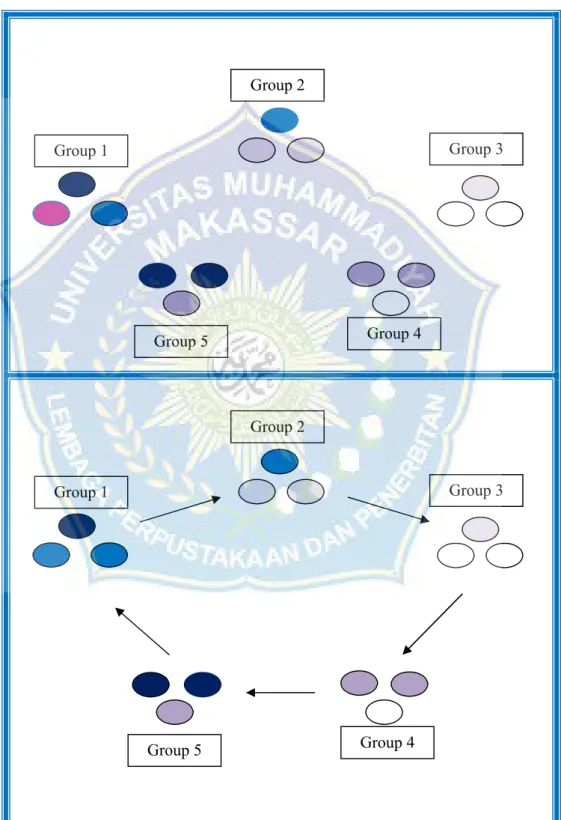
Here is the example of rotating trio exchange design when it is applied in the classroom:
Figure 1. Rotating Trio Exchange Design
Group 1
Group 4 Group 5
Group 2
Group 3
Group 2
Group 3
Group 5 Group 4
Group 1
Group 1
Group 4 Group 5
Group 2
Group 3
Group 1
Group 4 Group 5
Group 2
Group 3
3. Variations of Rotating Trio Exchange
Silberman, (2005: 92), said that there are some variations in applying rotating trio exchange technique. They are:
a) After each round of questions, quickly poll the participants about their responses before rotating individuals to new trios.
b) Use pairs or quartets or other number instead of trios.
The variations that will be applied must be suitable for the students.
That’s why the teacher has to consider many things before use of these variations. For example, to apply the variation of using other number instead of trios, the teacher should make it suitable with the number of students in the classroom.
4. Advantages of Rotating Trio Exchange
Rotating trio exchange has some advantages. Silberman in Silberman 3 pdf, (2011:219) listed advantages of positive aspects of change:
a) Can be a growth opportunity for individuals and the company b) Can provide challenges
c) Can allow the organization to remain competitive d) Can help solve problems
e) Can be a means of reaching higher goals
There are some of advantages of using change. All the positive aspects hoped can give positive effects too for teaching and learning
process, especially for students to reach their motivation in the classroom so they can join the teaching and learning process well.
Further, the advantages of rotating trio exchange are:
1. Rotating trio exchange itself
a) The technique can be applied for all lessons, (Yelismasu, 2011: 1).
Rotating trio exchange, like other cooperative learning, can used in all curriculum areas and important of the creativity of the teachers.
This structure along with number head together is an excellent substitute for the normally competitive structures in a question and answer session.
b) Rotating trio exchange gives student chance to share with friends even to different group in regulated time. Beside that students can do this activity communally. They also have many chances to process the information and increase their communicative skill (Anggraeni 2010: 33-34).
c) It is flexible since gives some variations. It is not restricted only for three students in a group. According to Silberman, (2005: 92) the teacher or trainer can use pairs or quartets instead of trios in applying rotating trio exchange.
2. Students benefits
With rotating trio exchange, the students are given time to think through their own answers to the question. They can also share the information and discuss it with other friends, and can give them a
new and an interesting technique. This, in turn, increases their sense of involvement in classroom learning and also their interests.
3. Teacher benefits
Students spend their time to ask and listen, in this case do discussion to each other more when they are in rotating trio exchange activities. More students are willing to respond in large group after they have thought about something then share it with others. The quality of the students’ responses also improves. Since rotating trio exchange is a new technique, it gives students time to work actively with the other friends, and make them more interested in the learning process.
5. Tips to Solve Some Problem May Occur
Like other cooperative learning types, some problem may occur when rotating trio exchange applied in the classroom. There are some problems and tips in rotating trio exchange activity (Anggraeni, 2010: 33- 34).
a) In doing the activity, the topic that they talk may extend, so teacher can give limited time to do discussion in each rotation.
b) Discussion possibly dominated by one student and others only become passive members of the activity so teacher should give the rule to students that everyone must understand about the topic and be active in doing the activity because it will be given recognition or reward.
c) Many rotations can make student dizzy or confuse. To decrease the rotation, teacher can give more than one topic for each rotation.
6. Supported Factors in Rotating Trio Exchange
There are some factors that can affect the application of rotating trio exchange (Yelismasu, 2011:1)
a) Teacher role: A teacher has important role to reach the success in the classroom, especially in application of rotating trio exchange technique. A teacher should have good relation with the students.
Teacher demanded develop learning activities as much as possible make students enjoy it, should not make students feel under pressure, because it is like a tradition when students are keep in the traditional ways of teaching, where students just receive, make note, and save the materials. A teacher also needs to know about the students’
competence, because every student has their own competence.
b) Students: Every student has their characteristics. To aware this fact, there should be a cooperation of all class role. In rotating trio exchange this problem tried to solve, because in rotating trio exchange, as in many other developed strategies and methods, prioritize the students’
involvement in teaching and learning activities. By using this technique, students try to work and solve problem together.
c) Media: Media also has important role for students to be success. Media can be use as a tool for students in learning process. Media not only from school, but can be developed by teacher, like card, picture, etc,
because by using media, teaching and learning process hoped can be more interesting and isn’t boring for teacher and students.
d) Environment: Education environment as one factors in supporting the success of teaching and learning process, should be planned and arranged well. It can become one of ways to make students enjoy the learning process. Before begin the class; class should become a safe, comfort, and motivated place. In this environment, student will open self and open mind to receive and do some new case. It is an ideal condition to do teaching and learning process optimally. After that we begin introduce them an academics skill. Of course to make students become well, not only in the beginning and while learning process, but after that activity, especially for society in the future time.
Rotating trio exchange is one of techniques that can be applied in the classroom. In doing the activity, other factors must be considered, like teacher role, students, media, and environment.
C. The Concept of Interest 1. Interest
Interest usually refers to an activity that a person prefers to engage in would not avoid and would choose in preference to many others activities. Interest also refers to the kinds of thing we appreciate and enjoy (Eggen and Kauchak, 1997: 1). Thus, the selection of any occupation and satisfaction we get from our work usually depend more on our interest than our ability. Interest and ability are closely related but
our interest gives us motivation to use our ability. If we are strongly in doing something, we will work hard at it than if we are not interested in.
Hilgard and Atkinson (1967) see interest as a part of personality that is usually defined according to objects or activities, that is one maybe interested in reading, music, or sport.
Basically, interest mentally condition of someone produces a response to particular situation an object that gives pleasure as well as satisfaction. So, in this case, interest should be considered because of whatever the students do, they will not do it well unless they are interested in what they are doing as Palmer in Byrne (1989) states that people learn anything well unless they are interested in what they are learning.
Based on some definition above, we can conclude that interest is a feeling of someone to like something. It is also desire of wanting to know and learn about something.
2. Types of Interest
James et al (1982) categorize interest into four types, they are:
a) Expressed interest
In general expressed interest is the verbal expression of liking or disliking something. This expression term is related to maturity and experience.
b) Manifest interest
Manifest interest is what is observable because of individuals participation in a given activity may be necessary or certain fringe benefit to occur. It is usually valuable to observe the activities related to the event as well as the individual participation the degree manifest interest.
c) Tested interest
Tested interest can be curtained by measuring the knowledge of vocabulary or other information the examinee has in specific interest idea. This measure is based on the accumulation of the relevant information as well as specialized vocabulary.
d) Inventoried interest
Inventoried interest is those determined by interest checklist. Usually an examinee is asked to check whether he or she likes or dislikes certain activities or situation. Pattern of high or low interest normally result, so that the test taker can began to areas of liking or disliking.
3. Factor Influencing Student Interest
Junaid (1992) says that basically, there are two factors that can influence the students’ motivation as well as their interest in learning, they are: internal and external factors. Internal factors such as the students’ attitude toward a subject and the students’ aptitude or linguistic ability. External factors such as school factor, which may involve the
teachers, the students, and the lesson material. Family factors such as:
mental support and social environmental factors.
4. The Measurement of Interest
Interest is about two dimensions, strong or weak. There are two principle procedures in the measurement of interest. First, the items dealt with the respondents’ liking or dislike for a wide variety of specific activities, objects, or types of person that he or she commonly encountered in daily. Second, the reason was empirically keyed for different occupation (Anastasia, 1982)
This interest inventoried were those among the first tests to employ criterions on keying of items. It was found that person engaged in different occupation was characterized by among interest that differentiated them from person in other occupations. These difference in interest extended not only to matter sprinkling directly to job activities but also to school subjects, hobbies, sports, types of plays or books the individual enjoyed, social relation and many others facets of everyday life. It thus proved feasible to prepare on inventory that explore an individual’s interest in familiar things and thereby to determine how closely his or her interest as seemed those of persons successfully engage in particular occupation in subjects.
The students’ interest has received its strongest input from educational and career counseling. In general, interest inventoried compare an individual expressed interest with these typical of person
engaged in different occupations, this is done ether in the scoring of individual item responses or in the interpretation of scores in board interest areas, or both.
D. Theoretical Framework
Since people are not good in speaking especially in a foreign language, they should find or create a certain speaking method to be applied in their speaking in order to stimulate interest in speaking.
The theoretical framework underlying this research is given as the following diagram: Figure 2. Theoretical Framework
The main components above are briefly described as follows:
1. Input refers to the student previous ability who are taught to facilitate the students to speak English.
Input
Students Previous Ability
Experimental Group Conventional
Method
Rotating Trio Exchange Control Group
Output
The improvement of students’ speaking performance:
Teaching Process
2. Teaching Process refers to way of teaching students. Conventional method refers to the activity in teaching students of control group by using group work, without using rotating trio exchange. Rotating trio exchange refers to the activity in teaching students in experimental group, consists of main steps of grouping students into trios, after that, give rotate exchange to the group, and discussion.
3. Output refers to the improvement of students’ speaking performance in speaking English in front of their friends covering their accuracy and fluency.
E. Resume
Speaking is one of the complex skills that is very important to be mastered. In this research, the researcher uses one of cooperative learning types, it is rotating trio exchange. Rotating trio exchange hopefully becomes one of useful technique for students in improving their speaking performance in term of accuracy and fluency. Accuracy covers pronunciation, grammar, and vocabulary. It also becomes an interesting technique to help students to study actively in the classroom. Interest is a positive attitude or condition that indicates an interest and enjoyment towards something. Someone who has an interest in something will be motivated to exert power and mind, also to do more on something he interested in.
When interest is associated with learning, by designing teaching- learning method or media that attract student’s interest, teachers can maximize student’s leaning outcomes.
F. Hypothesis
Based on the conceptual framework, the researcher formulated hypothesis as follows:
“There is a significant difference of speaking performance between the students who are taught by using Rotating Trio Exchange and those who are not taught by using Rotating Trio Exchange”.
30 A. Research Design
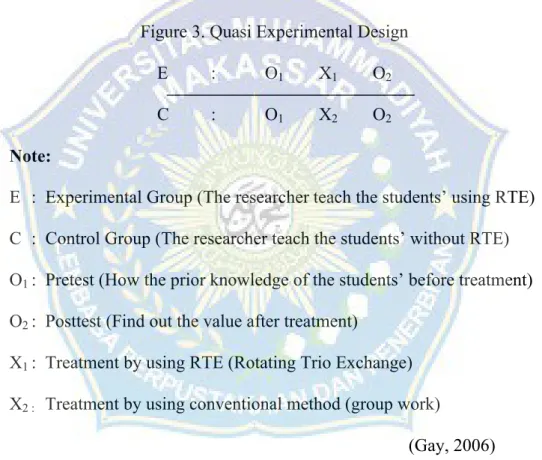
In this research, the researcher apply quasi experimental method. The researcher look at two classes as the sample, they were experimental group and control group. It is represented by the following diagram:
Figure 3. Quasi Experimental Design
E : O1 X1 O2
C : O1 X2 O2
Note:
E : Experimental Group (The researcher teach the students’ using RTE) C : Control Group (The researcher teach the students’ without RTE) O1: Pretest (How the prior knowledge of the students’ before treatment) O2: Posttest (Find out the value after treatment)
X1: Treatment by using RTE (Rotating Trio Exchange) X2 : Treatment by using conventional method (group work)
(Gay, 2006) B. Population and Sample
1. Population
The population of this research was the Tenth Year Students of SMAN 6 Bulukumba, with eight classes; each class consists of
Tenth Year in 2013-2014 academic years.
2. Sample
The research took the tenth grade Students of SMAN 6 Bulukumba in 2013-2014 academic years as population. The researcher use total sampling. The samples were class X.A as experimental group, consist of 18 students and the students of X.B as control group, and consist of 18 students. The sample consist of 36 students.
C. Research Variables
The variables of the research consist of two variables namely dependent variable and independent variable. Dependent variable was the students’ speaking performance in term of accuracy and fluency. Excellent accuracy considering if the speaker’s pronunciation is only very slightly influency by the mother tongue, two or three minor grammatical and lexical errors happen. Excellent fluency consider if the speaker speaks without too great an effort with a fairly wide range of expression and searches for words occasionally but only one or two unnatural pauses. Independent variable is the use of rotating trio exchange. The activity of this technique consists of main steps of grouping students into trios or other number instead of trios;
give rotate exchange, and discussion.
D. The Instrument of the Research
The researcher employ speaking test in pre-test and post-test. Pre-test intend to see the students’ previous ability in speaking performance in term of
know the students’ speaking performance after giving treatment. Treatments for both groups are different.
E. Procedures of Collecting Data 1. Experimental group
a. Pre-test
Before doing the treatment, the researcher gave pre-test to the students to know their prior knowledge. The researcher record the students speaking and wrote the script of the record.
b. Treatment
After giving the pre-test, the students were given treatment. It was take five meetings. In each meeting was given speaking material as follows:
1) Preparation
a) Composing a variety of questions that help participants begin discussion of the course content.
b) Dividing participants into trios. In one group consist of three students so it call trio. Set the position of the group in the room so that each group can clearly see other group to its right and to its left. The best configuration of groups is circle or square.
2) Main activities
a) Giving each group an opening question to discuss, in this case the same question for each group. Select the least threatening
that each person in the group takes a turn answering the question.
b) After a suitable period of discussion, the groups asked to assign 0, 1, or 2 to each of their members if they are trios or other number sign if there are not trios. Direct the participants with the number 1 to rotate one trio clockwise, then the participants with the number 2 to rotate two trios clockwise.
Asking the participants with the number 0 to remain seated.
They will be permanent members of a trio site. Have them raise their hands high so that rotating participants can find them. The result of each rotation will be entirely new trios.
c) Starting each new exchange with a new question. Increased the difficulty or sensitivity of the questions as you proceed.
d) Researcher could rotate trios as many times as she has questions to pose and the discussion time to allot. Use the same rotation procedure each time.
3) Closing
In closing the researcher will evaluated about the activity and gave the students some clues for the next meeting.
c. Post-test
After giving treatment, the researcher gave post-test. The researcher recorded the students speaking and wrote the script of the
treatment whether the result of the post-test is better than the result of the pretest.
d. Distribute the questionnaire.
The questioners distributed to the students after the post-test. It aimed to know students’ interest of rotating trio exchange technique.
2. Control group a. Pre-test
The researcher gave the pre-test to the students to know their prior knowledge. The researcher record the students’ speaking and wrote the script of the record.
b. Treatment
The researcher taught the students by using conventional method. Conventional method refers to group work of the students, consist four or five students. The researcher taught the students without using rotating trio exchange. The treatment for control group also take five meeting, and had the same materials with experimental group.
c. Post-test
The researcher gave post-test after teaching the students. The researcher recorded the students’ speaking and wrote the script of the record.
1. Students Speaking Performance
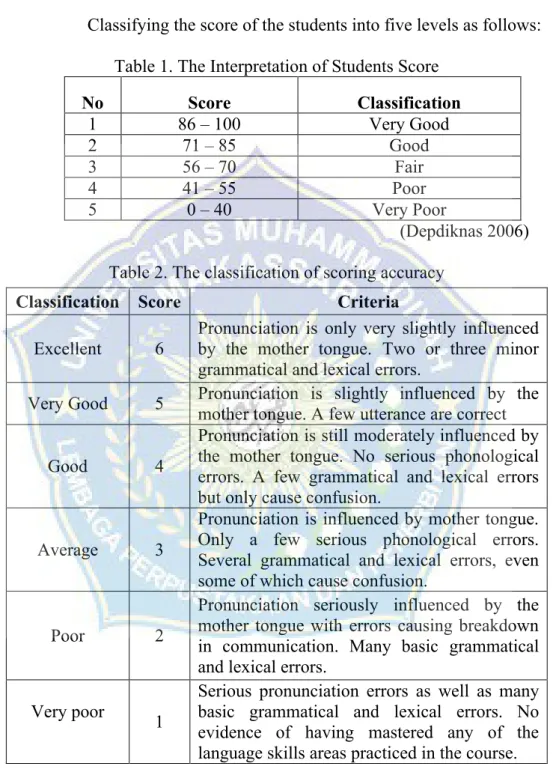
Classifying the score of the students into five levels as follows:
Table 1. The Interpretation of Students Score
No Score Classification
1 86 – 100 Very Good
2 71 – 85 Good
3 56 – 70 Fair
4 41 – 55 Poor
5 0 – 40 Very Poor
(Depdiknas 2006) Table 2. The classification of scoring accuracy
Classification Score Criteria
Excellent 6 Pronunciation is only very slightly influenced by the mother tongue. Two or three minor grammatical and lexical errors.
Very Good 5 Pronunciation is slightly influenced by the mother tongue. A few utterance are correct
Good 4
Pronunciation is still moderately influenced by the mother tongue. No serious phonological errors. A few grammatical and lexical errors but only cause confusion.
Average 3
Pronunciation is influenced by mother tongue.
Only a few serious phonological errors.
Several grammatical and lexical errors, even some of which cause confusion.
Poor 2
Pronunciation seriously influenced by the mother tongue with errors causing breakdown in communication. Many basic grammatical and lexical errors.
Very poor 1
Serious pronunciation errors as well as many basic grammatical and lexical errors. No evidence of having mastered any of the language skills areas practiced in the course.
Classification Score Criteria
Excellent 6
Speaks without too great an effort with a fairly wide range of expression. Searches for words occasionally but only one or two unnatural pauses.
Very Good 5
Has to make an effort at times and search for words. Nevertheless, smooth delivery on the whole and only a few unnatural pauses.
Good 4
Although has to make an effort and search for words, there are not too many unnatural pauses. Fairly smooth delivery mostly.
Fair 3
Has to make an effort for much of the time.
Often repeat the word which has already said.
Rather halting delivery and range of expression often limited.
Poor 2
Long pauses while he searches for the desired meaning. Frequently fragmentary and halting delivery. Almost gives up making the effort at the times. Limited range of expression.
Very Poor 1
Full of long and unnatural pauses. Very halting and fragmentary delivery. At times gives up making the effort. Very limited range of expression.
(Accuracy and Fluency Classification, Heaton: 1988) a. Calculating students score by using formula:
gain score
maximal score x 100
Depdiknas, 2006 b. Computing the frequency and the rate percentage of the student’s score by
using the following formula:
p = fq
N × 100%
Where: p : Percentage
fq : Number of correct answer N : The number of subjects
(Gay, 2006:141)
formula :
X = ∑ Which:
X : mean score
∑X : the total gain of students N : number of sample
(Gay, 2006: 320) d. Finding out the standard deviation of students’ pre-test and post-test
= ∑X −(∑x) N−1 N
Notation:
SD : Standard Deviation
∑x : total row of score
N : number of students
(Gay, 2006:321) e. Finding the significant different between pre test and post test by
calculating the value of the test. The formula as follows :
= x1−x2
SS1 + SS2 n1 + n2−2 1
n1 + 1 n2 Notation:
t = Test of significance
x2 = Mean score of control group SS1= Sum square of experimental group SS2= Sum square of control group
n1 = Number of students of experimental group n2 = Number of students of control group Where:
SS1 =∑x1 −(∑ ) SS2 =∑x2 −(∑ )
(Gay, 2006:355)
39
findings. The findings consist of the rate percentage of the students score, mean score, standard deviation, t-test value, and hypothesis testing. Then the discussion will convey more interpretation about the findings.
A. Findings
1. The Data Analysis of Speaking Test
After calculating the result of speaking test, the score of pretest in control and experimental group are presented in term of accuracy and fluency.
Accuracy deals with pronunciation, grammar, and vocabulary. The analysis as follows:
a. The Distribution of Frequency and Percentage Score
The distribution of frequency and percentage score of the students speaking accuracy, fluency, and performance are shown in findings below.
1) Speaking Accuracy
The result of data analysis of the students’ pre test accuracy in control group shows that maximum score is 55.6 and minimum score is 16.7. In post test, maximum score is 61.1 and minimum score is 22.2. In expreimental group, the maximum score is 55.6 and minimum score is 16.7 in pre test, while in post test, maximum score is 94.4 and minimum score is 22.2.
speaking accuracy is shown in table below.
Table 6
The distribution of frequency and percentage score of students’ speaking accuracy in pre-test and post-test
N
o Classification
Control Group Experimental Group Pretest Posttest Pretest Posttest
F % F % F % F %
1 Very Good 0 0 0 0 0 0 1 0
2 Good 0 0 0 0 0 0 2 16.6
3 Fair 1 5.5 2 11.1 2 11.1 6 33.3
4 Poor 3 16.6 5 27.7 7 38.8 4 22.2
5 Very Poor 14 77.7 11 61.1 9 50 5 27.7
Total 18 100 18 100 18 100 18 100
The table above shows the result of both control and experimental class.
In control class, there is only a little significance of students’ score improvement in pretest and posttest. No student gets “very good” and “good” in both pretest and posttest. Then, 1 student (5.5%) gets “fair” in pretest and 2 students (11.1%) get the same classification in posttest. For “poor”
classification, there are 3 students (16.6%) get the classification in pretest, and 5 students (27.7%) get it in posttest. Then, there are 14 students (77.7%) get “very poor” classification in pretest and 11 students (61.1%) get it in posttest. Overall, the students’ score of control class move only a little significantly both in pretest and posttest.
In experimental class, the table shows a great movement of students’
score. In pretest, there was no student get “very good” classification. But in posttest, 1 students (5.5%) get this highest classification. For “good”
posttest. Then, 2 students (11.1%) get “fair” classification in pretest and 6 students (33.3%) get it in posttest. For “poor” classification, 7 students (38.8%) get it in pretest and 4 students (22.2%) get it in post test. The last, “very poor”
classification, 9 students (50%) gets it in pretest and decreased into 5 students (27.7%) get it in post test.
Speaking accuracy deals with pronunciation, grammar, and vocabulary.
a) Pronunciation
The result of data analysis of the students’ pre test pronunciationin control group shows that maximum score is 83.3 and minimum score is 16.7. In post test, maximum score is 66.7 and minimum score is 33.3. In expreimental group, the maximum score is 66.7 and minimum score is 16.7 in pre test, while in post test, maximum score is 83.3 and minimum score is 16.7.
The distribution of frequency and percentage score of the students speaking pronunciation is shown in table below.
Table 7
The distribution of frequency and percentage score of students’ speaking pronunciation in pre-test and post-test
No Classification
Control Group Experimental Group
Pretest Posttest Pretest Posttest
F % F % F % F %
1 Very Good 0 0 0 0 0 0 0 0
2 Good 1 5.5 1 5.5 1 5.5 2 11.1
3 Fair 1 5.5 2 11.1 2 11.1 4 22.2
4 Poor 5 27.7 6 33.3 6 33.3 7 38.8
5 Very Poor 11 61.1 9 50 9 50 5 22.7
Total 18 100 18 100 18 100 18 100
In control class, no student gets “very good” in both pretest and posttest. Then, 1 student (5.5%) get “good” in pretest and no one get the same classification in posttest. In fair classification, 1students (5.5%) get it in pre test and there are 2 students (11.1%) get it in post test. For “poor” classification, there are 5 students (27.7%) get the classification in pretest, and 6 students (33.3%) get it in posttest. Then, there are 11 students (61.1%) get “very poor” classification in pretest and 9 students (50%) get it in posttest.
In experimental class, in pretest and post test, there was no student get
“very good” classification. For “good” classification, 1 student (5.5%)get it in pretest and 2 students (11.1%) get it in posttest. Then, 2 students (11.1%) get
“fair” classification in pretest and 4 students (22.2%) get it in posttest. For
“poor” classification, 6 students (33.3%) get it in pretest and 7 students (38.8%) get it in post test. The last, “very poor” classification, 9 students (50%) gets it in pretest and decreased into 5 students (27.7%) get it in post test.
b) Grammar
The result of data analysis of the students’ pre test in grammar termin control group shows that maximum score is 50 and minimum score is 16.7. In post test, maximum score is 66.7 and minimum score is 16.7. In expreimental group, the maximum score is the same with control group in pre test, while in post test, maximum score is 100 and minimum score is 16.7.
The distribution of frequency and percentage score of the students’
grammar is shown in table 8.
speakinggrammar in pre-test and post-test
N
o Classification
Control Group Experimental Group
Pretest Posttest Pretest Posttest
F % F % F % F %
1 Very Good 0 0 0 0 0 0 1 5,5
2 Good 0 0 0 0 1 5,5 3 16,6
3 Fair 1 5,5 1 5,5 2 11,1 5 27,7
4 Poor 2 11,1 5 27,7 3 16,6 4 22,2
5 Very Poor 15 83,3 12 66,6 12 66,6 5 27,7
Total 18 100 18 100 18 100 18 100
The table above shows the result of both control and experimental class.
In control class, no student gets “very good” and “good” in both pretest and posttest. Then, no student get “fair” in pretest and 1students (5.5%)get the same classification in posttest.For “poor” classification, there are 2 students (11.1%) get the classification in pretest, and 5 students (27.7%) get it in posttest. Then, there are 15 students (83.3%) get “very poor” classification in pretest and 12 students (66.6%) get it in posttest.
In experimental class, in pretest, there is no student get “very good”
classification and in post test there are 1students (5.5%). For “good”
classification, there is 1 student (5.5%) get it in pretest and 3 students (16.6%) get it in posttest. Then, 2 students(11.1) get “fair” classification in pretest and 5 students (27.7%) get it in posttest. For “poor” classification, 3 students (16.6%) get it in pretest and 4 students (22.2%) get it in post test. The last, “very poor”
classification, 12 students (66.6%) gets it in pretest and decreased into 5 students (27.7%) get it in post test.
The result of data analysis of the students’ pre test of vocabulary termin control group shows that maximum score is 66.7 and minimum score is 16.7. In post test, maximum there is no improvement of students’ vocabulary in speaking. In expreimental group, the maximum score is the same with control group in pre test, while in post test, maximum score is 100 and minimum score is 16.7.
The distribution of frequency and percentage score of the studentsgrammar is shown in table 9.
Table 9
The distribution of frequency and percentage score of students’
speakingvocabulary in pre-test and post-test
No Classification
Control Group Experimental Group Pretest Posttest Pretest Posttest
F % F % F % F %
1 Very Good 0 0 0 0 0 0 1 5,5
2 Good 0 0 0 0 0 0 3 16,6
3 Fair 1 5.5 2 11,1 1 5,5 8 44,4
4 Poor 8 44,4 7 38,8 7 38,8 3 16,6
5 Very Poor 9 50 9 50 10 55,5 3 16,6
Total 18 100 18 100 18 100 18 100
The table above shows the result of both control and experimental class.
In control class, no student gets “very good” and “good” in both pretest and posttest. Then, 1 student (5.5%) get “fair” in pretest and 2 students (11.1) in posttest.For “poor” classification, there are 8 students (44.4%) get the classification in pretest, and 7 students (38.8%) get it in posttest. Then, there are 15 students (83.3%) get “very poor” classification in pretest and 12 students (66.6%) get it in posttest.
1 student (5.5) get “good” classification and in post test there are 3 students (16.6%) get “very good” and 2 students (11.1%) get “good”. For “fair”
classification, there 2 students (11.1) get it in pretest and 5 students (27.7%) get it in posttest. For “poor” classification, 3 students (16.6%) get it in pretest and 4 students (22.2%) get it in post test. The last, “very poor” classification, 12 students (66.6%) gets it in pretest and decreased into 5 students (27.7%) get it in post test.
2) Speaking Fluency
The result of data analysis of the students’ pre test fluencyin control group shows that maximum score is 66.7 and minimum score is 16.7. In post test, maximum score is 83.3 and minimum score is 33.3. In expreimental group, the maximum score is 83.3 and minimum score is 16.7 in pre test, while in post test, maximum score is 100 and minimum score is 33.3.
The distribution of frequency and percentage score of the students speaking accuracy is shown in table below.
Table 10
The distribution of frequency and percentage score of students’
speakingfluency in pre-test and post-test
No Classification
Control Group Experimental Group Pretest Posttest Pretest Posttest
F % F % F % F %
1 Very Good 0 0 0 0 0 0 1 5.5
2 Good 0 0 1 5.5 3 16.6 3 16.6
3 Fair 3 16.6 5 27.7 2 11.1 6 33.3
4 Poor 13 72.2 10 55.5 9 50 6 33.3
5 Very Poor 2 11.1 2 11.1 4 22.2 2 11.1
Total 18 100 18 100 18 100 18 100
In control class, there is only a little significance of students’ score improvement in pretest and posttest. No student gets “very good” both in pre test and post test. for “good” classification, no students get it in pre test and post test 1 student (5.5) get the classification. Then, 3 students (16.6%) get “fair” in pretest and 5 students (27.7%) get the classification in posttest. For “poor”
classification, there are 13 students (72.2%) get the classification in pretest, and 10 students (55.5%) get it in posttest. Then, there are 2 students (11.1%) get
“very poor” classification in pretest and 2 students (11.1%) get it in posttest.
In experimental class, of pretest, there was no student get “very good”
classification. But in posttest, 1 student (5.5%) gets this highest classification.
For “good” classification, there are 3students (16.6%) get it in pretest and 3 students (16.6%) get it in posttest. Then, 2 students (11.1%) get “fair”
classification in pretest and 6 students (33.3%) get it in posttest. For “poor”
classification, 9 students (50%) get it in pretest and 6 students (33.3%) get it in post test. The last, “very poor” classification, 4 students (22.2%) gets it in pretest and decreased into 2 students (11.1%) get it in post test.
3) Speaking Performance
After calculating the data from accuracy and fluency, the final score is about speaking performance in term of accuracy and fluency. The result of data analysis of the students’ final score of accuracy and fluency in pre test in control group shows that maximum score is 61.1 and minimum score is 22.2. In post test, maximum score is 72.2 and minimum score is 27.7. In expreimental group,
test, maximum score is 97.2 and minimum score is 27.7.
The distribution of frequency and percentage score of the students speaking performance is shown in table below.
Table 11
The distribution of frequency and percentage score of students’speaking performance in pre-test and post-test
The table above shows the result of both control and experimental class.
In control class, there is only a little significance of students’ score
Improvement in pretest and posttest. No student get “very good” in both pretest and posttest. No student also gets “good” classification in pretest, but increase to 1 student (5.5%) in posttest. Then, 2 students (11.1%) get “fair” in pretest and 3 students (16.6%) get the same classification in posttest. For “poor”
classification, there are 8 students (44.4%) get the classification in pretest, and 6 students (33.3%) get it in posttest. Then, there are 8 students (44.4%) get “very poor” classification in pretest and 8 students (44.4%) get it in posttest. Overall, the students’ score of control class move only a little significantly both in pretest and posttest.
No
Classification
Control Group Experimental Group
Pretest Posttest Pretest Posttest
F % F % F % F %
1 Very Good 0 0 0 0 0 0 2 11.1
2 Good 0 0 1 5.5 0 0 3 16.6
3 Fair 2 11.1 3 16.6 3 16.6 8 44.4
4 Poor 8 44.4 6 33.3 7 38.8 2 11.1
5 Very Poor 8 44.4 8 44.4 8 44.4 3 16.6
Total 18 100 18 100 18 100 18 100
score. In pretest, there was no student got “very good” classification. But in posttest, 1 student (5.5%) gets this highest classification. For “good”
classification, 3 students (16.6) get it in pretest and 3 students (16.6%) get it in posttest. Then, 2 students (11.1%) get “fair” classification in pretest and 6 students (33.3%) got it in posttest. For “poor” classification, 9 students (50%) get it in pretest and 6 students (33.3%) get it in post test. The last, “very poor”
classification, 4 students (22.2%) gets it in pretest and decreased into 2 students (11.1%) get it in post test. The result shows that the Cooperative Learning type Rotating Trio Exchange that was applied in experimental class, can improve students’ speaking performance.
b. Mean Score and Standard Deviation
The mean score and standard deviation of the students speaking is shown in table below.
1) Speaking Accuracy
Students’ speaking accuracy can be seen in table 12.
Table 12
Mean score and standard deviation of both classes in pre-test and post-test
Test
Control Class Experimental Class Mean Score Standard
Deviation Mean Score Standard Deviation
Pretest 34.2 1.6 37.9 2.0
Posttest 39.6 3.1 64.0 3.2
The table above shows the mean score and standard deviation of both control and experimental class in pretest and posttest in term of accuracy. For
pretest. In posttest, the mean score is 39.6 and the standard deviation is 3.1. The mean score for the experimental class 37.9 and the standard deviation is 2.0 in pretest. While in posttest, the mean score is 64.0 and the standard deviation is 3.2.
Accuracy deals with pronunciation, grammar, and vocabulary. Here are the mean score and standard deviation of them.
a) Pronunciation
Students’ speaking pronunciation can be seen in table 13.
Table 13
Mean score and standard deviation of both classes in pre-test and post-test
Test
Control Class Experimental Class Mean Score Standard
Deviation Mean Score Standard Deviation
Pretest 35.0 2.4 42.2 3.1
Posttest 40.5 2.1 53.8 3.6
The table above shows the mean score and standard deviation of both control and experimental class in pretest and posttest in term of pronunciation.
For the control class, the mean score is 35.5 and the standard deviation is 2.4 in pretest. In posttest, the mean score is 40.5 and the standard deviation is 2.1. The mean score for the experimental class 42.2 and the standard deviation is 3.1 in pretest. While in posttest, the mean score is 53.8 and the standard deviation is 3.6.