The Effect Of Risk And Trust On The Behavioral Intention Of Using E-Procurement Hadri Kusuma
Rendha Pramunita
International Program, Faculty of Economics, Universitas Islam Indonesia
Abstract
Purpose – The occurrence of risk and lack of trust on technology information system has been suspected as the main causes of unwillingness of users to adopt the system. This study seeks to investigate the effect of risk and trust on the behavioral intention of using a new method of governmental auctions, e- procurement system.
Design/approach– A theoretical model was tested through a survey of 83 supply chain members using email and distributed questionnaires to the entire governmental supply chain in Yogyakarta.
Findings – Empirical results confirm the basic structure of the model. Risk and trust correlate to the behavioral intention of using e-procurement system.
Research limitations/implications – The study indicates that risk and trust were factors that are related to the behavioral intention of using e-procurement system. In addition to improving the system benefits and ease of use, the local government may focus on minimizing risk and improving trust: the system should have good security and trustworthy. This may lead to improve customer loyalty toward the system.
Originality/value– This study represents an important first step in examining and integrating risk and trust on the technology acceptance model in the supply chain context.
Keywords-e-procurement, risk, trust, behavioral intention and government
Introduction
The advancement of information technology has introduced major changes in the worldwide economic and business enterprises because of its benefits. The government of Indonesia has also used the system of information technology to help daily activities. Under the central government regulation of Indonesia, For example, each local government has been recommended to implement e-procurement system, a platform in which consumers place requests for proposals online and invite suppliers to bid for contracts (Klafft, 2009). According to Albano et al. (2008) and Hsu (2006), the governmental e-procurement generally could give preferences for local suppliers to compete in making a bid and remove centralization. The local government can also use the system to reduce purchasing and transaction costs, compare among different goods and services and save buyers’ time. The system will make it easy to get new customers, and give suppliers’ an opportunity to compete fairly.
Users of the e-procurement system, however, tend to reject the system due to its risk and untrustworthy. Risk occurs because buyers and suppliers do not meet face-to-face. Belkhamza (2009) stated that a lack of information creates risk in doing business. Uncertainty about product quality is a problem for buyers in the online environment. For example, buyers do not have easy access to get information about product quality, and therefore they are unable to judge the quality of product prior to the purchase. Buyers’ personal identification also creates a problem for suppliers because buyers can change their identities or give incorrect identities when they should pay for the products
distrust will occur immediately. Consequently, a lack of trust is one of reasons for buyers and sellers to avoid trading through online (Gefen et al., 2003).
This study seeks to investigate the effect of risk and trust on the behavioral intention of using a new method of governmental auctions, e- procurement system. To test the impact of the two factors, we integrate the variables with the existing information system acceptance model introduced by Davis (1986 and 1989), Technology Acceptance Model (TAM). The model assumes two factors influencing users adopt the system: perceived ease of use and perceived usefulness. The model, however, implies that it opens for new variables. The parsimony of the model is another reason to adopt Davis’s work as a basic model.
Theoretical Background Hypothesis Formulation
There are two reasons for people to accept or reject information technology. First, people tend to use or not use an application whether the technology will help the users performing their job better. Second, the people believe that the system is too hard to use and that the performance benefits of usage are outweighed by the effort of using the application (Davis, 1989). However, Technology Acceptance Model becomes popular because Technology Acceptance Model has been used by many information system researchers (Agarwal and Prasad, 1999; Adams et al., 1992; and Guriting and Ndubisi, 2006).
Perceived ease of use and perceived usefulness are important because they are the reasons of using Information Technology. In perceived ease of use, the user will feel clear and understandable in using information technology. Definition of perceived ease of use gives indication that a system will make users easy to operate and finish their job and the system is not designed to make the users difficult (Ndubisi et al., 20003; Davis et al., 1989; and Guriting and Ndubisi, 2006). Perceived ease of use in using e-procurement indicates that the system is easy to be understood and operated. Consequently, the users will have intention to use the system regularly.
Perceived usefulness is a belief that using information technology will enhance the job performance of users or will help the users in doing their job. Perceived usefulness to the technology usefulness can be measured by several factors, there are: (1) adopting technology can increase users’ productivity, (2) increasing job performance, (3) increasing efficiency process of users (Ndubisi et al., 20003; Davis et al., 1989; and Guriting and Ndubisi, 2006). Someone will adopt new information technology system, especially e-procurement in this research if that system can give usefulness for their job and ahievement. In the other words, the level of usefulness affects the behavioral intention of user.
Risk
Cunningham (1967) stated that risk is the magnitude that would be lost if the consequences of an act were not favorable, and the individual’s subjective feeling of certainty that the consequences will be unfavorable. Risk in online transaction will happen because the buyers and suppliers do not meet face-to-face. It will be riskier if the users of information technology are not honest when doing transaction through online, and the examples of risk in online transaction are financial risk, performance risk, time-loss risk, social risk, physical risk, psychological risk, source risk, and privacy risk (Hassan et al., 2006). Bakos and Wrynjolfsson (1993) and Nicolaou and McKnight, (2006) suggested that closer relationships with suppliers can reduce risk, especially in using information technology.
Nicolaou and McKnight (2006) stated that risk will affect negatively on the behavioral intention of information technology users. One has to accept some risk to adopt an exchange system, because transactions may or may not go as expected. Unfortunately, if the use of an electronic exchange is risky, risk perception affects a user’s intention to stop using the exchange. It means that if there is risk in the information technology, the intention of using information technology will decrease. Therefore, the first hypothesis is:
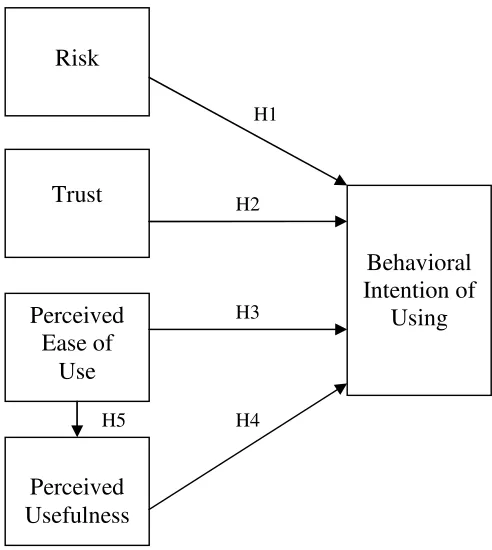
H1: There is a negative relationship between risk and behavioral intention of using
Trust
purchase information. Faced with a legal framework that eliminates illegal behaviors, the consumer must trust the vendor and reversely the vendor must trust the consumer, as in physical commercial activities and in other e-commerce settings (Williamson, 1985; Gefen, 2000; see Gefen and Straub, 2003).
A general belief in an e-vendor that results in behavioral intention is conceptualized as trust. A combination of trustworthiness, integrity and benevolence of e-vendors can increase behavioral intention if there are communication and honesty. Trust that is considered as an important part can be delivered with specific rules for communicating. By providing same perception of trust between the government and the users in a case of e-procurement, it will create a relationship to support trust and intention to use e-procurement (Gefen, 2000; Jarvenpaa and Tractinsky, 1999; see Gefen et al., 2003).
Previous research has showed that trust increases purchase intentions both directly, there are buyer-seller relationship and reducing perceived risk (Gefen, 2000; Ganesan, 1994; see Gefen et al., 2003). Consequently, Gefen et al. (2003) convinced that heightened levels of trust are also associated with heightened levels of intended use. Accordingly, the second hypothesis is:
H2: There is a positive relationship between trust and behavioral intention of using
Figure 1: Research Model
Research Method Population and Sample
The target population on this research was the users of e-procurement system in Yogyakarta. We distributed questionnaires to all current users from several companies that just attended the training of the e-procurement system conducted by LPSE (Layanan Pengadaan Secara Elektronik). The questionnaire consisted a set of statements and respondents were required to rate a Likert type of 1-6 point scale, ranging from strongly disagree to strongly agree. The study obtained 83 complete responses without considering any characteristics of users (type or size of company, income, profit, etc).
Variables
Risk
Trust
Perceived
Ease of
Use
Perceived
Usefulness
Behavioral
Intention of
Using
H5
H1
H2
H3
The focus of this study is on the variables of risk and trust. We integrate the 2 variables in to TAM. Therefore, we control the main variables of the TAM (perceived usefulness and ease of use) in our model. The following table shows number and source of questions and definitions of the research variables.
Table 1: Research Variables
Variables Number of statement References Main variables:
Risk 3 items Belkhamza (2009)
Trust 7 items Gefen et al., 2003)
Intention of Using 5 items Gefen et al. (2003)
Control variables:
Perceived Usefulness 5 items Davis (1989)
Perceived ease of use 4 items Davis (1989)
Mathematical Model
This research employed two multiple regressions to test the hypotheses. It was expected that coefficient of ß2has
negative sign while ß3 is positive. Similar to test validity and reliability, we estimated all coefficients of the two
equations using Partial Least Square method), with the help of SmartPLS.
PU = ßo1+ ß1PEOU +ε1………... (1)
BIOU = ßo2+ ß2RISK + ß3TRUS + ß4PEOU + ß5PU +ε2…... (2)
Where:
RISK : Risk
TRUS : Trust
PEOU : Perceived Ease of Use
PU : Perceived Usefulness
BIOU : Behavioral Intention of Using
Data Analysis Descriptive Data
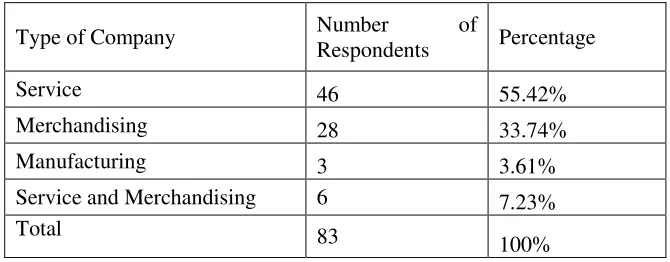
The data of the samples were from the e-procurement users by after distributing questionnaires directly to the respondents and through email. Of the 100 questionnaires distributed, 83 (83%) can be processed further. A short description of respondents is as follows.
Table 2: Respondent’s Classification Based on Company’s Type
Type of Company Number of
Respondents Percentage
Service 46 55.42%
Merchandising 28 33.74%
Manufacturing 3 3.61%
Service and Merchandising 6 7.23%
Total 83
100% Source: Primary Data
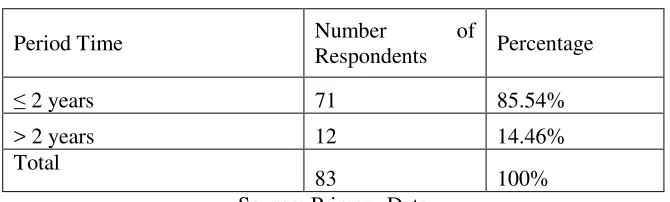
Table 3 shows that the most of respondents were relatively new users of the e-procurement system. They used the system not more than two years (71 respondents or 85.54%). Only 14.46% of the respondents already used the system more than two years.
Table 3: Respondent’s Classification Based on Period Time
Period Time Number of
Table 4: Result for Outer Loadings Original Sample
Table 4 shows outer loadings of the indicators in the model to indicate whether each item of the questionnaire is valid. All values of factor loadings are more than 0.50 and significant (t-statistic is greater than 1.64). Therefore they meet the requirement of convergent validity.
Table 5: AVE and√AVE
Table 6: Correlations of the Latent Variables
PU PEOU TRUS RISK BIOU
PU 1.000
PEOU 0.844 1.000
TRUS 0.788 0.781 1.000
RISK -0.404 -0.407 -0.599 1.000
BIOU 0.819 0.813 0.840 -0.545 1.000 Reliability Test
To test the reliability of the variables, it was indicated by the value of the composite reliability. As it is shown in the table 7, all variables were reliable. The value of the composite reliability for each construct is more than 0.70.
Table 7: Composite Reliability
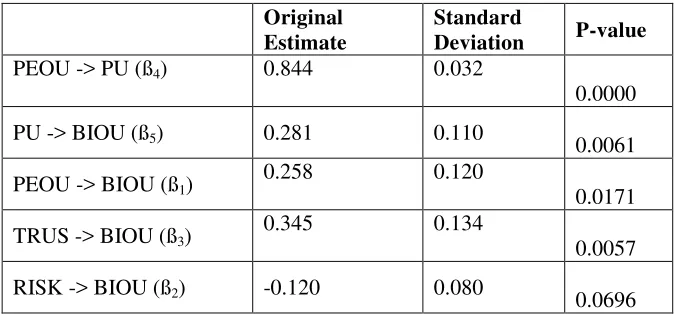
The variables in this research are risk, trust, perceived ease of use, perceived usefulness, and behavioral intention of use. Testing the inner model is intended to evaluate the relationship between one latent construct or variable and intention to use. The result provided from PLS sofware is as follows:
Table 8: Result of Hypothesis Tests Original
e-procurement system will be followed by a tendency to less uses of the system. The result of this hypothesis test is consistent with the research of Nicolaou and McKnight (2006) which stated that there is a significant negative relationship between risk and behavioral intention of using information system.
The result in the table 8 also indicates that the data supported the second hypothesis. The value of the trust coefficient is as much as 0.345 and significant at 1% level. Therefore it was interpreted that if the users of e-procurement can get transparency, integrity, and trustworthiness in doing bid or auction transactions, their intention of using e-procurement system will be high as well. This is consistent with the finding by Gefen et al. (2003) that stated that there is a significant positive relationship between trust and behavioral intention of using system.
Other results in the table 8 are a support for Technology Acceptance Model. It shows that perceived ease of use and perceived usefulness positively related to the behavioral intention of using the e-procurement system. Perceived ease of use is also related to perceived usefulness. Those findings support Davis’s Model (1986 and 1989) and Gefen et al. (2003)
Conclusions and Recommendations
As we expected, we finds that risk and trust affect the behavioral intention of using e-procurement system. The relationship between risk and behavioral intention of using e-procurement is negative while trust is positive. It implies that the government should focus on minimizing risk and improving trust of e-procurement users by having good security system and trustworthy. Good security can be performed by scanning the system regularly and having security number when doing transaction to avoid lost data lost. Advertising is one of ways to increase trustworthy because advertising gives more information about data protection, transactions, procedures, and services of e-procurement. By advertising, users are expected to be more understood about e-procurement and do not need to be afraid using e-procurement. In the other words, high degrees of social presence can build trust because of decreasing disagreement or misunderstandings. It will increase behavioral intention of users to use e-procurement.
In this research, there are several limitations that should be taken into consideration. The first limitation is in term of the scope and number of samples. The scope of the samples taken in this research is limited only to e-procurement users in Yogyakarta, and it only employs 83 respondents as the samples. Thus, the researcher expects that the future research would employ more numbers and wider scopes of samples, for example gathering information from the government as a provider of e-procurement system. The next research also needs to add certain variable such as demographic characteristics (education, age, gender, and so on). Although this research already included some of the characteristics, but it did not examine the role of them further in the e-procurement system context.
References
Albano, Gian-Luigi, Dini, Federico, Zampino, Roberto, and Fana, Marta. (2008). “The Determinants of Suppliers' Performance in E-Procurement: Evidence from the Italian Government's E-Procurement Platform”,FEEM Working Paper, No. 49.
Belkhamza, Zakariya. (2009). “The Effect of Perceived Risk on the Intention to Use E-Commerce: The Case of Algeria”,Journal of Internet Banking and Commerce, Vol. 14, No.1.
Cunningham, F L., James, Gerlach, and Michael, D Harper. (2005). “Perceived Risk and E-Banking Services: An Analysis from the Perspective of the Consumer”,Journal of Financial Services Marketing, Vol. 10, No. 2, pp. 165.
Davis, Fred D. (1986). “A Technology Acceptance Model for Empirically Testing New End-User Information Systems: Theory and Results”. Doctoral Dissertation, Sloan School of Management, Massachusetts Institute of Technology.
Eriksson, Kent, Kerem, Katri, and Nilsson, Daniel. (2005). “Customer Acceptance of Internet Banking in Estonia”,
International Journal of Bank Marketing, Vol. 23, No. 2, pp. 200-216.
Gefen, D., and Straub, D. (2003). “Managing User Trust in B2C e-Services”, E-Service Journal, Vol. 2, No. 2, pp. 7-21.
Gefen, David, Karahanna, Elena and Straub, Detmar W. (2003). “Trust and TAM in Online Shopping: An Integrated Model”,MIS Quarterly, Vol. 27, No. 1, pp. 51-90.
Ghozali, Imam. (2006).Structural Equation Modeling Metode Alternatif dengan Partial Least Square, Semarang: Universitas Diponegoro.
Guriting, Petrus, and Ndubisi, Nelson Oly. (2006). “Borneo Online Banking: Evaluating Customer Perceptions and Behavioral Intention”,Management Research News, Vol. 29, No. 1/2, pp. 6-15.
Hassan, Ahmad M., Kunz, Michelle B., Pearson, Allison W., and Mohamed, Fatma. (2006). “Conceptualization and Measurement of Perceived Risk in Online Shopping”.Marketing Management Journal, Vol. 16, No. 1, pp. 138-147.
Hsu, Locknie. (2006). “Government Procurement: A View from Asia”,Asian Journal of WTO and International Health Law and Policy, Vol. 1, No. 2, pp. 379-400.
Klafft, Michael. (2009). “E-Procurement for Consumers: Success Factors and Technology Acceptance”,
Proceedings of the International Conference on E-Learning, E-Business, Enterprise Information Systems and E-Government,H. R. Arabnia and A. Bahrami, eds., pp. 269-275.
Nicolaou, Andreas I., and McKnight, D. Harrison. (2006). “Perceived Information Quality in Data Exchanges: Effects on Risk, Trust, and Intention to Use”,Information Systems Research, Vol. 17, No. 4, pp. 332-351.
Oxford Advanced Learner’s Dictionary 2005, 7thedn, Oxford University Press.