UNESA Journal of Chemical Education ISSN: 2252-9454 Vol.5 No. 2, pp. 239-246 May 2016
DEVELOPMENT OF STUDENT WORKSHEET BASED INQUIRY TO REHEARSE PROCESS SKILLS ON ELECTROLYTE AND
NONELECTROLYTE SOLUTION SUBJECT MATTER Komang Avidia Ariyani and Dian Novita
Departemen of Chemistry, Faculty of Mathematics and Natural Sciences State University of Surabaya
Jl. Ketintang Surabaya (60231), Telp. 031-8298761 Mobile Phone: 081233069225, e-mail: [email protected]
Abstrak
Penelitian ini bertujuan mendeskripsikan kelayakan LKS berbasis inkuiri untuk melatih keterampilan proses pada materi larutan elektrolit dan nonelektrolit baik secara teoritis maupun empiris. Kelayakan teoritis ditinjau berdasarkan hasil validasi, sedangkan kelayakan empiris berdasarkan respon siswa dan observasi aktivitas siswa terhadap LKS yang dikembangkan. Keterampilan proses yang dilatihkan adalah keterampilan pengamatan, perumusan masalah, pengembangan hipotesis, pengontrolan variabel, perancangan eksperimen, pembuatan tabel data, penginterpretasian data, dan penarikan kesimpulan. Jenis penelitian ini adalah pengembangan mengacu pada model pengembangan 4-D. Pelaksanaan pengembangan pada penelitian ini hanya sampai tahap pengembangan, karena penelitian ini dilakukan untuk mengetahui kelayakan LKS yang dikembangkan ditinjau dari kelayakan isi, penyajian dan kebahasaan. Instrumen penelitian yang digunakan adalah lembar telaah, validasi, dan angket respon siswa. LKS yang dikembangkan ditelaah, kemudian divalidasi, dan diujicobakan kepada 12 siswa kelas XI MIA 2 SMAN 19 Surabaya untuk mengetahui respon siswa. Berdasarkan hasil penelitian dapat disimpulkan LKS yang dikembangkan layak untuk digunakan dengan persentase hasil validasi kelayakan isi 90,13%, penyajian 91,67% dan kebahasaan 83,33% dengan kategori sangat layak. Selain itu respon siswa menunjukkan bahwa siswa sangat merespon baik dengan persentase kriteria isi 84,80%; penyajian 89,58%, dan kebahasaan 95,83% dengan kategori amat baik. Kata-kata Kunci: Lembar Kerja Siswa, Inkuiri, keterampilan proses, larutan elektrolit dan nonelektrolit.
Abstract
The study aimed to describe the feasibility of worksheet based inquiry to rehearse process skills on electrolyte and nonelectrolyte solution subject matter to theoretically and empirically feasibility. The theoretical feasibility is reviewed based on validation result, while empirical feasibility is reviewed based on student’s response and observation of student’s activity to student worksheets. Process skills are rehearse are observing, formulating problem, formulating hypothesis, controlling variables, designing experiment, making table data, interpretating data, and making conclusion. The feasibility criteria consist of content, presentation and linguistic feasibility. This study type is development but refer to the 4-D model. This study is limited on develop stage, because the study was conducted to know the feasibility of student worksheet based on content, presentation and linguistic feasibility. The instrument of this study consists of review, validation, and student’s response sheet. Student worksheet that developed was reviewed, and tested on 12 students of class XI MIA 2 SMAN 19 Surabaya to know the student’s response. Based on the result of study can conclude that the student worksheet is feasible to be used with the percentage of validation of content feasibility is 90.13%, presentation 91.67% and linguistic 83.33% with the category is very valid. Furthermore, the empirical feasibility from students’ response shown that student response on good category to the some criteria, percentage of content feasibility is 84.80%, presentation 89.58% and linguistic 95.83% with the category is very good.
Keywords: Worksheet, Inquiry model, process skills, electrolyte and nonelectrolyte
UNESA Journal of Chemical Education ISSN: 2252-9454 Vol.5 No. 2, pp. 239-246 May 2016
PRELIMINARY
National education systems have a very complex challenge to preparing human quality resources that capable to competing in the global era. Accroding Hamalik (1994) various attempts have been made by the government for improvements in educational quality. The one is changed the Kurikulum Tingkat Satuan Pendidikan (KTSP) or School Based Curriculum (SBC) into Curriculum 2013, which aims to prepare students in Indonesia that have the ability to live as individuals and citizens who religious, productive, creative, innovative, and affective and able to contribute to society, nation, state, and world civilization [1].
According to Sanjaya (2006) one of the cause of education problems is the learning process in classroom directed to the student's ability to memorize information without being required to understand the information that is remembered to connect with everyday life [2]. The main job of teachers or educators is as a facilitator with the main job are make an activity learning, train, search, develop, manage or provide technical services in the field of education.
Chemistry acquired and developed based on experiment to seek answers from all the questions of what, why, and how the natural phenomenon, especially that have a relation to the composition, structure and properties, transformation, dynamics and energetics substance [3]. Scientists studied a natural phenomena through certain processes and scientific attitude. By using
the process and scientific attitudes, scientists acquire inventions may be fact, theory, law, and principle/ concept that called chemical products. Therefore, the learning of chemistry and chemical
assessment of learning outcomes should be consider about the characteristics of chemistry as attitude, process, and product. Chemistry as product includes a set of knowledge consists of fact, concept and principle of chemistry. Chemistry as
process/ methods of investigation
(discovery/ inquiry) include ways of thinking, attitude, and steps of scientific activities to obtain chemical products, start from finding the problem, collect the facts related to the problem, make assumptions, define variables, observation, make a measurement, perform inference, predict, collect and process data of observation/ measurement, and to summarize and communicate. Darusman (2014) states “Through the attitude this scientific attitude, students are trained to perform the process skills of the symptoms and problems that exist in nature [3]”.
Process skills approaced should be applied because science takes place more quickly so it is no longer possible teachers teach facts and concepts to students, so that by applying the process skills will be able to prepare the students to face the facts or the problems that exist in the field [4], Process skills in the study also emphasizes the development grower of certain skills to make they are able to process an information so it can be found some new thing. Process skills can be used to determine the extent of abiding by students against a fact, concept, or theory [3].
Inquiry is a series of learning
activities that involve maximally
UNESA Journal of Chemical Education ISSN: 2252-9454 Vol.5 No. 2, pp. 239-246 May 2016
in observing, formulating problem,
formulating hypotheses, designing
experiments, collect and analyzing data, and making conclusions, while the teacher is to facilitate the investigation and help students [5].
Based on the result of study that had been done by Ma’arif (2012) is development worksheet based inquiry on electrolytes and nonelectrolytes solution subject matter its showed that adherence to the experiments is very good (89.81%). Teacher assessment based on the inquiry worksheet showed that inquiry worksheet is verry accordance with standards content (88.13%), and accordance with the concept (95.33%), Worksheet used the very effective sentences (91.14%) and has very good layout and presentation (84%). The student’s response to the experiment about electrolyte and nonelectrolyte solution used inquiry worksheet is quite well with the percentage of student’s response is 76.367% [6].
Worksheet based inquiry to
rehearse process skills presents a systematically summary about chemistry, conducting experiments were prepared in accordance with the inquiry learning model, as well as steps to solve the problems by using process skills. Inquiry is choosen because its been rehearse process skills too. Students are invited to conduct the investigation through experiment by making hypotheses by problems that presented by linking concepts then directly apllied through investigation, so that the concept is remembered and understood by students not only become rote.
METHOD
Analysis Method of Validation
Analysis Method of Validation for chemistry lectures and teacher, used to
collect data during the making process of this developed worksheet is can be to be feasible or not. Fill the validation questionnaire was carried out by chemistry lectures and teacher who conducted when the developed worksheet already explored.
Validation result to electrolyte and nonelctrolyte worksheet based inquiry that developed is analyze use quantitative descriptive method. The percentage of questionnaire was obtained by calculating Likert scale as shown in Table 1:
Table 1 Likert Scale
The formula used in the calculation to obtain the percentages are:
Percentage obtained and used to determine the feasibility of worksheet using interpretation scores as follows: Table 2 Interpretation Criteria Score
Numb Percentage Category
1 0% - 20% Very Invalid
2 21% - 40% Invalid
3 41% - 67% Less Valid
4 61% - 80% Valid
5 80% - 100% Very Valid Based on the criteria according Likert scale [7] developed worksheet is valid the criteria if the percentage obtained from the validation results is ≥ 61% so it declared fit for use in learning process and there are no feasibility criteria obtained
61%.
Numb Rating Value sclae
1 Very Good 4
2 Good 3
3 Medium 2
4 Bad 1
5 Very Bad 0
UNESA Journal of Chemical Education ISSN: 2252-9454 Vol.5 No. 2, pp. 239-246 May 2016
Student’s Response Method
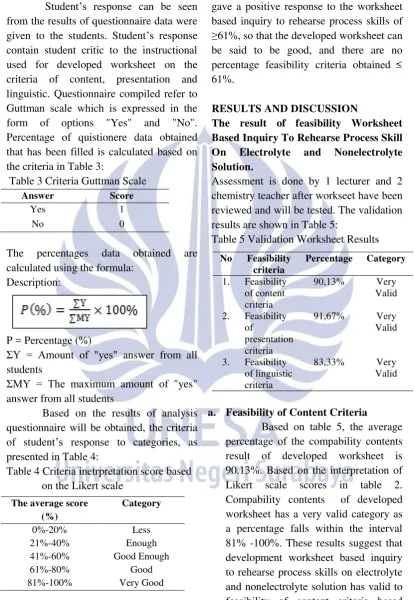
Student’s response can be seen from the results of questionnaire data were given to the students. Student’s response contain student critic to the instructional used for developed worksheet on the criteria of content, presentation and linguistic. Questionnaire compiled refer to Guttman scale which is expressed in the form of options "Yes" and "No". Percentage of quistionere data obtained that has been filled is calculated based on the criteria in Table 3:
Table 3 Criteria Guttman Scale
Answer Score
Yes 1
No 0
The percentages data obtained are calculated using the formula:
Description:
P = Percentage (%)
ΣY = Amount of "yes" answer from all students
ΣMY = The maximum amount of "yes" answer from all students
Based on the results of analysis questionnaire will be obtained, the criteria of student’s response to categories, as presented in Table 4:
Table 4 Criteria inetrpretation score based on the Likert scale
If the percentage of students who gave a positive response to the worksheet based inquiry to rehearse process skills of ≥61%, so that the developed worksheet can be said to be good, and there are no percentage feasibility criteria obtained 61%.
RESULTS AND DISCUSSION
The result of feasibility Worksheet Based Inquiry To Rehearse Process Skill On Electrolyte and Nonelectrolyte Solution.
Assessment is done by 1 lecturer and 2 chemistry teacher after workseet have been reviewed and will be tested. The validation results are shown in Table 5:
Table 5 Validation Worksheet Results
a. Feasibility of Content Criteria
Based on table 5, the average percentage of the compability contents result of developed worksheet is 90.13%. Based on the interpretation of Likert scale scores in table 2. Compability contents of developed worksheet has a very valid category as a percentage falls within the interval 81% -100%. These results suggest that development worksheet based inquiry to rehearse process skills on electrolyte and nonelectrolyte solution has valid to feasibility of content criteria based Instructional Materials Development The average score
Percentage Category
UNESA Journal of Chemical Education ISSN: 2252-9454 Vol.5 No. 2, pp. 239-246 May 2016
Guide [8]. Those criteria include: compliance with the curriculum in 2013, the suitability of the material with basic competence, relevant material with indicators of learning outcomes, the material in worksheet load truth concept, suitability with component of worksheet include the presentation of facts, concepts, images, illustrations are presented accurately, questions that exist in worksheet is easily understood and accordance with the indicators of learning outcomes, also the presenting material in worksheet is logical and systematic. These criteria are also appropriate with Andayani [9].
The validation results in aspect of content criteria is about suitability of inquiry model that are observing,
formulating problem, formulating
hypotheses, designing experiments, collect and analyzing data also making
conclusions reached an average
percentage is 90.28% to the category is Very valid.
The last validation result in aspect of content criteria is suitability of process skill component there are observation skill, formulating problem, formulating hyphothesis, controlling
variable, designing experiments,
interpretation data, and making
conclusion that reaching an average percentage is 93.75% to the category of Very valid.
b. Feasibility of presentation criteria Based on table 5, the average percentage of the compability contents result of developed worksheet is 91.67%. Based on the interpretation of Likert scale scores in table 2. Compability presentation of developed worksheet has a very valid category as
a percentage falls within the interval 81% -100%. These results suggest that development worksheet based inquiry to rehearse process skills on electrolyte and nonelectrolyte solution has valid to feasibility presentation criteria based Instructional Materials Development Guide [8]. Those criteria include the presentation of worksheets or concepts presented are logical and coherent or systematic and balanced inter-section from beginning to end, the presentation
of worksheet arouse curiosity
(motivate) the student, the presentation of the worksheet in accordance with the level of thinking and reading skills of students, presentation of worksheet can encourage students actively involved in learning activities, presentation of worksheet is exciting and fun, and develop process skills and attention to safety when conducting the experiment, the presentation of information in the worksheets are complete presented with
preface, table of contents and
bibliography [9].
c. Feasibility of linguistic criteria Based on table 5, the average
percentage of the compability
linguistics result of developed
UNESA Journal of Chemical Education ISSN: 2252-9454
understood by students, has regularity
languange between chapters,
subchapters, paragraphs and sentences, as well as writing worksheets use the terms or steadily symbols [9].
Based on the percentage of each feasibility criteria that described above, then developed worksheet based inquiry to rehearse process skills on electrolyte and nonelectrolyte is feasible for use as a percentage of each criterion 61%.
Analysis Data of Student’s Response The feasibility criterias of developed worksheet are assessed based on criteria of content, presentation and linguistic with the average percentage for each criteria 61% is that can be categorized as very good for feasibility worksheet and no criteria 61%. The results of student’s response are presented in Table 6 below:
Table 6 Results of Student’s Response
a. Content Criteria
Based on table 6 the
compability content of worksheet is 84.80%. Based on the interpretation of
Likert scale scores in Table 4. The suitability of developed worksheet has very good categories as a percentage falls within the interval 81%-100%. This is consistent with the results of validation where the validator also gives the percentage is 90.13% and has very valid categories.
The other aspect in content criteria is suitability with procces skills that are observation skills, problem formulation, formulating hypotheses, controlling variables, designing of
experiments, making table data,
interpretating data and making
conclusion with the average percentage is 86.45% and the category is very good.
The other data that can support the student’s response is student’s
comprehension test. Student’s
UNESA Journal of Chemical Education ISSN: 2252-9454 Vol.5 No. 2, pp. 239-246 May 2016
The last data that support the student’s response is observation of
student’s activity result. Data
observation of student’s activity were analyzed together with the analysis of the student’s response was analyzed descriptively by looking at the percentage of observers who answered "yes" in every aspect. Based on data from the observation of the activities contained in annex 17. The average observation percentage is 87.87% with the category is Very Good.
b. Presentation criteria
Based on Table 6 the
compability presentation of developed workheet is 89.58%. Based on the interpretation of Likert scale scores in Table 4, the suitability of developed worksheet has a very good category as a percentage falls within the interval 81%-100%. This is slightly different from the results of the validation are gain 83.33% in that aspect. According to the validator, the presentation of worksheet has been varied, interesting and fun, but students different. This is caused there are some students who are not yet finished answering all the questions in the form of worksheets well. The other possibility is caused the less experience of students to use a worksheet like developed worksheet, so
that its make student are not
accustomed to using worksheets which require students to understand the content of worksheet.
c. Linguistic criteria
Based on Table 6 the
compability linguistic of developed worksheet get a response from the student is 95.83%. Based on the
interpretation of Likert scale scores in Table 4, the suitability of developed worksheet has a very good category as a percentage falls within the interval 81% -100%. It shows that the language and terms that used in developed worksheet is easily understood by students. Results of student’s response on linguistic criteria accordance with the results of the validation, which reached an average percentage is 83.33% and the category is Very Good. Based on the percentage of each feasibility criteria that described above, then the developed of workshet based inquiry to rehearse process skill is feasible for use as a percentage of each criterion is 61%.
CLOSING
ConclusionBased on research results and discussion it can be concluded that:
1. Worksheet is very feasible to use with percentage of content feasibility is 90.13%.
2. Worksheet is very feasible to use with percentage of presentation feasibility is 91.67%,
3. Worksheet is very feasible to use with percentage of linguistic feasibility is 83.33%.
4. Student’s response result of developed worksheet showed that students give
very good response with the
percentage of content criteria is 84.80%, percentage of presentation criteria is 89.58% and percentage of linguistic criteria is 95.83%.
Suggestion
Suggestion can be given for next research are:
UNESA Journal of Chemical Education ISSN: 2252-9454 Vol.5 No. 2, pp. 239-246 May 2016
research expected to be made until the disseminate step.
2. This process skills research was done at 8 aspects, so that the next research expected to rehearse other aspects of process skills.
REFERENCES
1. Hamalik, Oemar. 1994. Dasar-dasar Pengembangan Kurikulum. Bandung: PT Remaja Rosdakarya.
2. Sanjaya, Wina. 2006. Kurikulum dan Pembelajaran. Jakarta: Kencana Prenada Media Group.
3. Darusman, Departemen Pendidikan
Nasional. 2014. Pedoman Umum
Pengembangan Bahan Ajar Sekolah Menengah Atas. Departemen
Pendidikan Nasional, Direktorat
Pendidikan menengah umum.
4. Semiawan, Conny.dkk. 1992.
Pendekatan Keterampilan Proses. Jakarta. Rineka Cipta.
5. Arends, Richard. 2012. Learning to Teach. New York: Mc Graw Hill
6. Ma’arif, Jafar. 2012. Pengembangan LKS Berbasis Inkuiri Pada Pokok Bahasan Larutan Elektrolit dan Non-Elektrolit. Skripsi tidak diterbitkan.
Jakarta: Universitas Pendidikan
Indonesia.
7. Riduwan. 2013. Skala Pengukuran Variabel-variabel Penelitian. Bandung: Alfabeta.
8. Departemen Pendidikan Nasional,
Dirjen Pendidikan Dasar dan Menengah,
Direktorat Pendidikan Menengah
Umum. 2008. Pedoman Penyusunan
Lembar Kegiatan Siswa dan Skenario Pembelajaran Sekolah Menengah Atas
9. Andayani, Nur. 2005. Syarat
Pembuatan Lembar Kerja Siswa. PT Bumi Aksara. Jakarta.