1
AN UNDERGRADUATE THESIS
USING POSSE (PREDICT , ORGANIZE, SEARCH, SUMMARIZE AND EVALUATE) STRATEGY TO IMPROVE THE STUDENTS’ READING COMPREHENSION AT THE EIGHT GRADERS OF MTS N LAMPUNG
TIMUR IN THE ACADEMIC YEAR OF 2017/2018
By:
NERA ANDANI Student Number.13107807
Tarbiyah and Teacher Training Faculty English Education Study Program
THE STATE INSTITUTE ISLAMIC STUDIES OF METRO 1438H /2017 M
USING POSSE (PREDICT , ORGANIZE, SEARCH, SUMMARIZE AND EVALUATE) STRATEGY TO IMPROVE THE STUDENTS’ READING COMPREHENSION AT THE EIGHT GRADERS OF MTS N LAMPUNG
TIMUR IN THE ACADEMIC YEAR OF 2017/2018
Presented as a Partial Fulfillment of the Requirements for the Degree of Sarjana Pendidikan (S.Pd)
in English Study Program
By:
Nera Andani
Student Number: 13107807
Tarbiyah and Teacher Training Faculty English Education Study Program
Sponsor : Drs. Kuryani Utih, M.Pd Co-Sponsor : Syahreni Siregar, M.Hum
THE STATEINSTITUTE ISLAMIC STUDIES OF METRO 1438H /2017 M
USING POSSE (PREDICT , ORGANIZE, SEARCH, SUMMARIZE AND EVALUATE) STRATEGY TO IMPROVE THE STUDENTS’ READING COMPREHENSION AT THE EIGHT GRADERS OF MTS N LAMPUNG
TIMUR IN THE ACADEMIC YEAR OF 2017/2018 ABSTRACT
BY:
NERA ANDANI
The main purpose of this research is to investigate the students‟ reading comprehension of MTS N 1 Lampung Timur and to know what extend the Posse Strategy could help the students‟ learning process. The writer tries to attest that Posse strategy can be one of the teaching strategy to improve the students‟ reading comprehension.
The researcher had outlined the problem in this research that focused on reading comprehension. It is related on the problem identification that the students do not understand about the passage and they do not interest in reading material.
In this research, the researcher conducts classroom action research (CAR) which is done in two cycles. Each cycle consist of planning, acting, observing, and reflecting. The subjects of this research is 31 students in VIII class of MTS N 1 Lampung Timur In collecting data, the researcher used test (pre-test, post test 1 and post test 2), observation and documentation. The research is conducted collaboratively with an English teacher of MTS N 1 Lampung Timur.
The result of this research shows that Posse strtaegy can be used as a teaching strategy of reading. It provided by the average mark result of pre-test and post-test show that there were improved mark. At post test I is 59 and post test II is 76 it improved 16,8 point. The researcher concluded that there was significant improvement of using Posse strategy on the reding comprehension at the eighth graders of MTS N 1 Lampung Timur.
(keyword : reading comprehension, posse strategy, classroom action reseacrh)
MENERAPKAN STRATEGI POSSE UNTUK MENINGKATKAN KEMAMPUAN PEMAHAMAN MEMBACA
DI KELAS DELAPAN MTS N 1 LAMPUNG TIMUR LAMPUNG TIMUR TAHUN AJARAN 2017/2018
ABSTRAK OLEH:
NERA ANDANI
Tujuan utama dari penelitian ini adalah untuk menunjukan bahwa kemampuan pemahaman membaca siswa MTS N 1 Lampung Timur dan untuk mengetahui sejauh mana strategi posse dapat membantu proses belajar siswa.
Penulis mencoba untuk membuktikan bahwa strategi posse dapat dapat menjadi salah satu strategy pembelajaran untuk meningkatakan kemampuan pemahaman membaca siswa.
Peneliti menggaris bawahi bahwa masalah pada penelitian ini difokuskan pada kemampuan pemahaman membaca. Terkait pada identifikasi masalah yaitu tidak memahami pesan yang ada di dalam teks, dan mereka tidak tertarik dengan materi bacaan.
Dalam penelitian ini, peneliti melaksanakan penelitian tindakan kelas yang dilakukan dalam dua siklus. Setiap siklus terdiri dari perencanaan, pelaksanaan, observasi dan refleksi. Subjek penelitian ini adalah 31 siswa kelas delapan MTS N 1 Lampung Timur. Dalam pengumpulan data, peneliti menggunakan tes (pre-test, post test 1 and post test 2), observasi dan dokumentasi. Penelitian ini bekerjasama dengan guru Bahasa Inggris MTS N 1 Lampung Timur.
Hasil penelitian ini menunjukkan bahwa strategi Posse dapat digunakan sebagai aktifitas pengajaran dalam membaca. Hal ini dibuktikan oleh hasil nilai rata-rata dari pre-test dan post-test yang menunjukkan bahwa adanya peningkatan nilai. Hasil nilai rata-rata dari post test I adalah 59 dan post test II adalah 76 dan meningkat 16,8. Peneliti menyimpulkan bahwa terdapat peningkatan yang signifikan dengan menggunakan strategi Posse pada kemampuan pemahaman membaca siswa di kelas delapan MTS N 1 Lampung Timur.
(Kata kunci : kemampuan pemahaman membaca, strategi Posse, penelitian tindakan kelas)
MOTTO
“If you are gratefull, I will give you more.” (Q.S. Ibrahim:7)
DEDICATION PAGE
This Piece of work is dedicated to:
(Mr.Haris Tamami and Mrs. Usmanila) My beloved sisters and brother
(Hasdi farizi, Lingga febrian, Feni rahmaliza and Saqila) My beloved lectures of English Education Study Program
Of Instituate Islamic College of Metro My Best Friends
(Riski,Ani,Alfi Nurkhoitamin,Neti,Dahlia,Mima,Imron and Hera) And E Class
My almamater
TABLE OF CONTENT
COVER ... i
TITLE ... ii
ABSTRACT ... iii
NOTA DINAS ... v
APPROVAL PAGE ... vii
STATEMENT OF RESEARCH ORIGINALITY ... ix
MOTTO ... x
DEDICATION PAGE ... xi
ACKNOWLEDGEMENTS ... xii
TABLE OF CONTENTS ... xiii
LIST OF TABLES ... xv
LIST OF GRAPH ... xvi
LIST OF APPENDIX ... xvii
CHAPTER I INTRODUCTION ... 1
A. Backgrond of The Study ... 1
B. Problem Identification ... 6
C. Problem Limitation ... 6
D. Problem Formulation ... 6
E. Objectives of the Study ... 7
F. Benefits of the Study ... 7
CHAPTER II THEORETICAL REVIEW ... 8
A. The Concept of Reading Comprehension ... 8
1. The Concept of Reading... 8
a. The Definition of Reading ... 8
b. The Kinds of Reading ... 12
c. The Factors That Influence In Reading ... 12
2. The Concept of Reading Comprehension ... 14
a. The Definition of Reading Comprehension ... 14
b. Reading Comprehension Strategy ... 19
c. The Measurement of Reading Comprehension ... 22
B. The Concept of Posse Strategy ... 23
1. Definition of Posse Strategy... 23
2. The Steps Of Posse Strategy ... 25
3. Implementation of Posse Strategy to Improving Reading Comprehension ... 26
4. Advantage and disadvantage of Posse Strategy ... 27
C. Action Hypothesis ... 28
CHAPTER III RESEARCH METHODOLOGY A. Operational definition of variables... 29
1. Independent Variable ... 29
2. Dependent Variable ... 30
B. Location Setting ... 31
C. Subject Of The Study ... 31
D. Research Procedure ... 31
1. The Concept Of The Car ... 31
2. Action Plan ... 33
E. Data collecting technique ... 37
1. Test ... 37
2. Observation ... 38
3. Documention ... 39
F. Data Analysis Method ... 39
G. Indicator Of Success ... 41
CHAPTER IV RESULT OF THE RESEARCH AND INTERPRETATION A. Result of The Research ... 42
1. The Description of Research Location ... 42
a. The History of MTS N 1 Lampung Timur ... 42
b. The Condition of Teacher and Official Employees in MTS N 1 Lampung Timur ... 43
c. The Number of Students‟ MTS N 1 Lampung Timur... 46
d. Organization Structure MTS N 1 Lampung Timur ... 48
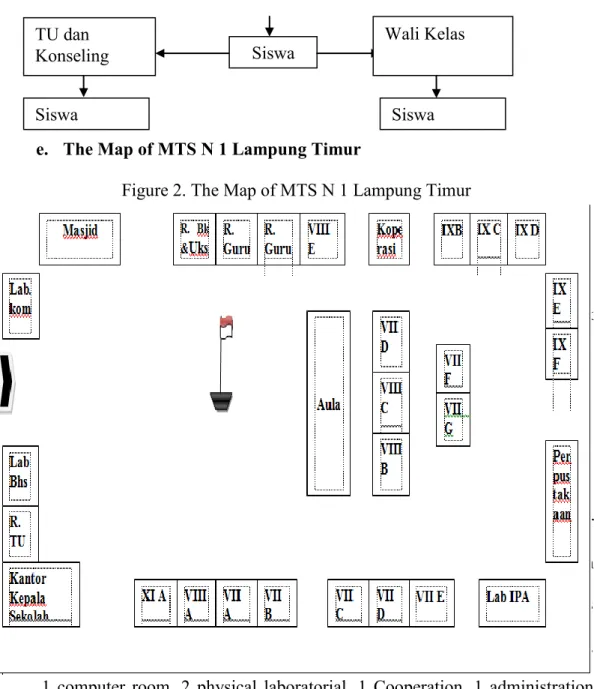
e. The Map of MTS N 1 Lampung Timur ... 48
f. Learning Facilities ... 49
B. The Description Data Result of Research ... 49
1. Action and Learning Activity in cycle1 ... 52
a. The first meeting... 52
b. The Second Meeting ... 55
2. Action and Learning Activity in cycle2 ... 61
a. The First meeting ... 61
b. The Second Meeting ... 63
C. Interpretation ... 69
1. Action and Learning Result at Cycle I ... 70
2. Action and Learning Result at Cycle 2 ... 73
D. Discussion ... 83
E. Limitation ... 84
CHAPTER V CONCLUSION AND SUGGESTION ... 85
A. Conclusion ... 85
B. Suggestion ... 85
BIBLIOGRAPHY APPENDIXES
CURRICULLUM VITAE
LIST OF APPENDICES
1. Lesson Plan.. ... 91
2. Rubrik Assesment of Reading comprehension.. ... 105
3. Sillabus ... ... 106
4. Instrument of Pre-Test of Students Reading Comprehension .. ... 109
5. Instrument of Post-Test of Students Reading Comprehension ... 113
6. Obsevation Sheet ... 121
7. Score of Pre-test, Post-test 1 and Post-test 2 ... 127
8. Observation Sheet of The Teacher Activities ... 136
9. Thesis Guidance Letter ... 144
10. Research License Letter ... 145
11. Assignment Letter from The Principle of IAIN Metro ... 146
12. Thesis Consultation Card ... 150
13. Curriculum Vitae ... 155
LIST OF TABLE
1.The Students‟ English Score at The Eighth Grade... 4
2.Data of Teacher ... 43
3.The Number of Students‟ mts n 1 Lampung Timur ... 46
4. The Students Pre-test Result of Reading Comprehension ... 50
5. Frequency of Students‟ Mark of Pre-test of Reading Comprehension ... 52
6. The Students Post-Test 1 Result of Reading in Cycle I ... 57
7. Frequency of Students‟ Mark of Post-Test 1 of Reading ... 59
8. The Students` Activities Result in Cycle I ... 61
9.Total Percentages pre-test, post-test ... 65
10. The Students‟ Mark of The Reading Post Test in Cycle II ... 59
11. Frequency of Students‟ Mark of Post-test in Cycle II... 67
12. The Students‟ Activities Result in Cycle II... 68
13.The Result Mark of Students‟ Pre-Test and Post Test 1 ... 70
14. The Result Mark of Students‟ Post Test 1 and Post Test 2 ... 73
15. The Result Mark of Students‟ Pre Test, Post Test 1 and Post Test 2 ... 76
16. The Percentage of Students‟ Mark at Post Test Cycle I and II ... 78
16. The Result of The Students‟ Activity in Cycle I and II ... 79
LIST OF GRAPH
1. The Complete Of The Students Mark On Pre-Test And Post-Test I.. ... 72 2. The Complete Of The Students Mark On Post-Test I And Post-Test
II.. ... 75 3. The Comparison Of The complete Mark Of The Students At Pre-
Test, Post Test I And Post Test II... ... 79 4. The Comparison Of Percentage Students Activity In Cycle I And
Cycle II.. ... 82
CHAPTER I INTRODUCTION A. Background of The Study
Languange is a symbol to communication. It helps the people to convey what they want to inform each other. Actually, we cannot understand what the other people say if we do not know the language and we need language not only for getting science and technology but also to make our communication is getting better. There are so many language in this world.
The one of them is English. As we know that English is an international language. So, in this era we have to know English well.
In Indonesia, English is as foreign language. It is one of subject that is learn since elementary school until university. The students have to master it well. They must study hard to make themselve understand about it. There are four basic skills in English. These are listening, speaking, writing and reading.
So, teacher should develop these four skills to make their students can use the skills to communicate with each other and express their feelings or opinions in English well.
Reading is one important skills in learning English mainly in the school. For beginner, reading is important to increase their knowledge.
Reading is a process interpreting the message. A good reader must have good ability or comprehension in order to know the meaning and the main point of the text. Reading is skill that has to be mastered by students. The students will know new knowledge and new information by reading. They are able to have
good comprehension in reading because it helps them understand what the information that they want to get. If they have not, they will difficult to get the message from the text. Reading is not only about fluently but also how the students understand the information conveyed by the writer. They should know meaning of the text in order to make them knowing the passage.
Reading Comprehension is skills to search the meaning, actively using our knowledge of the world and of the text to understand each new thing we have read. By reading, students will be able easy to get information, knowledge and idea from source they read. But so far, the learners still difficulties and to improve their Reading Comprehension because they seldom do reading activity at school and material for reading is not interesting for them.
In the school, the students almost never read English text because they feel difficult to understand the text. Because of it, their Reading Comprehension still low. In the other hand the teacher uses uninteresting strategy in teaching reading so the students bored. It is one of problem in the student. They should practice to read English text to make their Reading Comprehension better. The other way to solve this problem is the teacher using an interesting strategy to make the students interest to read English text.
There are many strategies for teaching reading. The one is POSSE (Predict-Organize-Search-Summarize-Evaluate) strategy is one of the reading strategies that can solve the problems mentioned above. This strategy incorporates reading and learning practices that effective readers and learners
use automatically. Students discuss their reading and use the strategies of predicting, organizing, searching, summarizing and evaluating to comprehend the text. The strategy not only activates prior knowledge, but also encourages students to organize their existing knowledge and then summary and elaborate on the connections between what they already knew and what they have learned.
From the explanation above, we know that approach, strategy, play a prominent role in teaching learning process. Especially in teaching reading.
Therefore, Based on pra survey that have done on March 20th, 2017, the writer found problems in English. The students do not interest to learn reading subject more. They feel difficult to understanding their reading text. Then, the students feel bored and lazy to learn reading subject. Finally, some students have low score in reading subject. The researcher would like to improving the students‟ Reading Comprehension by using POSSE (Predict-Organize-Search- Summarize-Evaluate) strategy.
This research will be held at the eight grade of MTS N 1 Lampung Timur which consists of one class for about 31 students, and after doing the pre-test at the eight grade of MTS N 1 Lampung Timur which located in Ki Hajar Dewantara/Lembayung Street, 38 B Banjar rejo Batanghari, East Lampung, the writer gets the result as bellow:
Table 1
Students’ Reading Score
No Name Score
1 AF 30
2 AN 40
3 AF 75
4 AL 20
5 AJ 30
6 ADS 50
7 AD 80
8 ADR 50
9 AES 30
10 AS 40
11 DAM 20
12 DA 20
13 EP 50
No Name Score
14 FA 20
15 FS 30
16 HZ 20
17 IR 30
18 JM 40
19 MRI 20
20 PL 30
21 PDS 20
22 RAP 40
23 RDS 40
24 RY 60
25 SA 60
26 SAP 50
27 TPA 30
28 TA 60
29 ZA 70
30 ZH 60
31 ZAA 70
29
Source: Teacher‟s archive, English Reading Score at the eight Grades of MTS N 1 Lampung Timur, on March 20th , 2017.
Table 2
The result of eight grade of MTS N 1 Lampung
No Score Frequency Percentage Criteria
1 ≥ 70 2 6.45 % Complete
2 <70 29 93,55% Incomplete
Total 31 100%
Source: result of students Reading Comprehension pre-test on March 20th 2017 The English minimum passing grade in this school is 70. It means that the students who got the score under 70 don‟t pass the examination. In fact, that 2 students have a good grade, it means 6.45% of the students have complete for the test. While, 93.55% or 29 students have incomplete in the test. it can be concluded that students‟ reading score at the eight Grade is still low.
From the information above, the researcher wanted to know whether POSSE strategy used in teaching Reading Comprehension of the eight grade students‟ of MTS N 1 Lampung Timur can improve their Reading Comprehension.
B. Problem Identification
Based on the background above, the researcher would like to identify the problem as follow:
1. The students are not interested in reading the English text.
2. The students have low ability to comprehend the text.
3. The teacher uses uninteresting strategy to teach the students.
4. Most of students have the difficulties in Reading Comprehension.
C. Problem Limitation
Based on the problem above, the researcher limits the problem that the students have low ability to comprehend the text in Reading Comprehension.
D. Problem Formulation
Based on the problem above, the researcher would like to identify the problems are follows:
“Can the use of POSSE (Predict-Organize-Search-Summarize- Evaluate) Strategy improve the students Reading Comprehension and their learning activities at the eight grade of MTS N 1 Lampung Timur”?
E. Objectives of the Study
Generally, the objective of this research is to know whether there is the improve of Reading Comprehension and their learning activities throught POSSE (Predict-Organize-Search-Summarize-Evaluate) strategy at the eight grade of MTS N 1 Lampung Timur ?
F. Benefit of the Study
The result of this classroom action research are expected:
1. For the Teacher
As a information to english teacher if POSSE (Predict-Organize- Search-Summarize-Evaluate) strategy can be effectiveness to increase students‟ Reading Comprehension.
2. For the students
As a motivation for the students in learning reading.
3. For the headmaster
This research can be used as consideration to facilitate in learning reading in future.
CHAPTER II
REVIEW OF THE RELATED THEORIES
A. The Concept Of Reading Comprehensions 1. The Concept Of Reading
a. The Definition Of Reading
There are four skills in English which should be mastered, they are reading, speaking, listening and writing and it can not be denied that reading is one of the most important. According to Sanggam Siahaan said that reading is the skill of a reader or a group to interpret information transferred by a writer.27 Meanwhile, Ur assumes that reading is decoding and translating process of written symbol into suitable sound.28 It can be understood that reading is the complex process which involves decoding and translating process as well as reader and text become the sound which can be directly understood.
Based on the explanation above, the researcher concludes that reading is a process to convey the message or information. The reader will know what they read and challenged to response the ideas of the author. In order to make the message or information that comes from the author can be understood and comprehended easily by the reader.
Then Scanlon, et.al states that reading is a process that necessitates the process of analysis, coordination, and interpretation of many resources
27 Sanggam Siahaan, The English Paragraph, (Yogyakarta: Garaha Ilmu, 2008), p. 3
28Penny Ur, A Course in Language Teaching, (Cambridge: Cambridge University Press, 1991), p.138
of information.29 In this sense, reading is activity which is carried out to gain overall understanding of the text is being read.
Furthermore, Linse and Nunan say that reading as a skill of understanding and deriving meaning from the text which requires the reader to be able to decode printed word and comprehend the text.30 Otherwise Sanggam states that reading is a skill to graps the semantics sense of the text with linguistic contextual meaning.31 It means that reading is a process which entails not only making sound the printed word but also making sense the text contextually and semantically for deep understanding. Reading is take from word “read”.
In Oxford Advanced Learners Dictionary the word “read” is explained that :
a. To look and understand the meaning of written and printed word or symbols.
b. To go through written and printed word, in silence and speaking them to other people.
c. To discover or find out about somebody or something by reading32. It means that reading is an activity that used to understand something by written or printed word.
29Donna Scanlon, et.al, Early Intervention for Reading Difficulties, (New York: The Guildford Press, 2010), p.9
30Caroline Linse and David Nunan, Practical English Language Teaching, (New York:
McGraw-Hill Company, 2005), p. 69
31 Sanggam Siahaan, Issues in Linguistics, (Yogyakarta: Graha Ilmu, 2008), p. 106
32A.s, Homby, Oxford Advance Learner’s Dictionary, (New York :Oxford University Press,2010), P. 1219.
Meanwhile, Silberstein states that reading is an active process which entails the students to work intensively and interact with the text to create significant discourse.33 In this sense an active process which involve students and text which is directed to invent good understanding from what they have read.
Besides, Nation suggests that an important part of reading is ability to recognise written forms and to connect them with their spoken forms and their meanings which involve recognising known words and translating unfamiliar words.34 Furthermore, Patel and Jain reveal that reading is not only as a source of information and pleasurable activity but also as a means of extending and consolidating someone‟s knowledge.35 From the statements it can be assumed that understanding the text has a goal to enrich someone‟s knowledge from many available sources.
Based on the statements about the essences of reading, it can be inferred that reading is a process that involves reader and text in order to understand the text as a source of information to extend someone‟s knowledge and to achieve various purposes.
33Sandra Silberstein, Techniques and Resources in Teaching Reading,(New York: Oxford University Press, 1994), p. 6
34I.S.P Nation, Teaching ESL/EFL Reading and Writing, (New York: Routledge, 2009), p. 9
35M.F Patel and Praveen M.Jain, English Language Teaching, (Jaipur: Sunrises Publishers and Distributors, 2008), p. 114
Meanwhile John and Dana state that reading is a complex interaction of cognitive process and strategies and the context.36 Based on the theoris above, it can be concluded that reading is a complex process to obtain symbolized in written or printed language. Reading involves some process that are used to get meaning from written text. It is not only an activity involving printed material as the media in order to process and gain information but also the comprehending process.
On the other definition of Karen Tankersley, reading is a complex process made up of several interlocking skills and processes.37 It can be said that reading is one of basic skills that have a positive effect, because in reading the students not only get the information of the text but also increasing their vocabulary knowledge on their spelling and on their writing through reading.
Moreover Bacon Remarks in M.F Patel and Praveen M. Jain state that "Reading makes a full man." Reading means to understand the meaning of printed, words Le. written symbols. Reading is an active process which consists of recognition and recognition and comprehension skill. Reading is an important activity in life with which one can update his/ her knowledge.38It‟s mean that reading is form of written language or written symbol that must be understand by the people to know what the
36 John S. Hedgcock and Dana R. Ferris, Teaching Readers of English Students, Texts and Context, (New York : Taylor and Francis, 2009) ,P.49
37 Karen Tankersley, Treads of Reading, (United State of America: Association for Supervision and Curriculum Development , 2003), p. 3
38 M.F Patel and Praveen M. Jain, English Language Teaching, (Jaipur: Sunrise Publisher and Distributors, 2008), p. 113
meaning or information about the text, so it can be said that reading is an important activity in human life that must be mastered by the people.
b. Kinds Of Reading
There is also a very narrow dividing line between knowing something by heart and actually reading the words.39
A. Reading Aloud
Reading Aloud is not the same as reading silently. It is a separate skill and not one which most people have that much use for outside the classroom. But it can be useful, especially with beginners in language.
Reading Aloud is often thought of as reading round the class one by one.
And although many children seem to enjoy it.
B. Silent Reading
Silent reading is what remains with most people for the rest of their lives. Nobody can guarantee that all your pupils will love books, but a possitive attitude to books and reading from the beginning will help.
c. The Factors That Influences In Reading
There are some factors that may influences reading in a second or foreign language as follows:
39Wendy A Scott and Lisbeth H. Ytreberg, Teaching English to Children,(London New York : Longman Education Text,2009), p.57.
A. Systems of Language
It is important to remember, however, that a similarity in reader–writer language does not necessarily result in fewer miscues, only miscues that tend to be more meaningful within the context of the discourse.
B. Strategies
A second factor that influences a reader‟s and writer‟s transaction with print is the strategies available to the language user and his or her flexibility in employing them. Strategies represent those cognitive processes or behaviors that the individual engages so as to create meaning through written discourse.
C. Background knowledge
Background knowledge impacts both the quality of the miscues and how a text is ultimately understood.
D. Purpose
Purpose may be to explore the environment, to ask questions and seek knowledge.
E. Assimilation and Accommodation
As meaning is constructed, it is not uncommon for the reader and writer to be changed cognitively. What the language user knows when the transaction with print terminates may be qualitatively and quantitatively different from what he or she knew when the transaction was.40
40Stephen B. Kucer, A Conceptual Base for Teaching Reading and Writing in School Settings, (New York : Taylor & Francis e-Library, 2009), p.128
2. The Concept Of Reading Comprehensions a. The Definition Of Reading Comprehensions
Reading comprehension is crucial to a student‟s sucess in school, and further, to becoming a lifelong learner. Children and young adults who struggle with reading comprehension will struggle with every subject in school, and with day to day living following school.
Comprehension is not a simple process because it needs delicate interaction of several component processes that connect information in a text with reader‟s background knowledge and experience.41 It can be assumed that comprehension is a complex process where in comprehending the text the reader integrates their prior knowledge and the text to obtain meaningful information.
Furthermore, according to McNamara “…comprehension is not always effortless and fast, of course. When beginning readers struggle over individual words, reading is slowed to a near halt and deeper levels of comprehension are seriously compromised”.42 In this sense comprehension is not the ability how fast the reader can find the information in the text but how effective their comprehension to comprehend the text. Thus, comprehension needs deeper thinking to understand the text that the readers read.
41Scot G Paris and Steven A Stahl, Children’s Reading Comprehension and Assessment, (New Jersey: Lawrence Erlbaum Associates Publishers , 2005), p.71
42Danielle S. McNamara, Reading Comprehension Strategies: Theories, Interventions, and Technologies, (New Jersey: Erlbaum Associates, inc., Publishers, 2007), p. 4
In breaf, to comprehend text is not something easy, but the readers need strategies to comprehend the text, they will be easier to comprehend.
Not only strategies the student need, but also skill is role in this case. The students must practice in reading comprehension, because it can develop their brain thinking. Goal of reading comprehension strategies are to reach good comprehension, readers can memory information what they have read in long time.
Reading Comprehensions is cognitive ability a person is able to use when interacting with the written text.43 Reading involves a variety of skills, there are summarizing, drawing conclusion, finding the main idea, paraphrashing and sequencing. This is the explanation about it :
a. Summarizing
Summarizing is the creation of a brief retelling of a text. While it may include the main idea or theme, the focus is on describing in brief form the text‟s major points. Primary- grade students often have difficulty summarizing because they want to tell everything. However, even middle school students sometimes have difficulty deciding what information to include in a summary and what not to include.The best way to teach students to summarize is to teach them to organize their summaries around text structure. Well written text is always well organized. That is, it has an internal
43Alderson, J. C. Reading in a foreign language: a reading problem or a language problem. (London: Longman, 2008), p. 126.
structure. If readers have been taught to recognize the structure of a text, they can use it when summarizing.44
Moreover, summarizing is a difficult task for students.
Students require instruction and practice in summarizing before they are able to produce good oral and written summaries of text. Interestingly, research suggests that instruction and practice in summarizing not only improves students‟ ability to summarize text, but also their overall comprehension of text content. Thus, instruction in summarization can be considered to meet dual purposes: to improve students‟ ability to summarize text and to improve their ability to comprehend text and recall.45
b. Drawing Conclussion
Drawing conclusions is just another example of inferring that in turn is just another example of predicting. An author seldom states directly what a reader should conclude.
More typically, a conclusion is implied. Consequently, drawing conclusions, like predicting and inferring, requires readers to be proactive in looking for clues in the text, thinking about what those clues trigger in prior knowledge, and making a prediction about what the author wants us to conclude on the
44Gerald G.Duffy. Explainng reading: A Resource for Teaching Concepts Skill and Strategies. Second edition.p. 153
45 Nell K. Duke and P. David Pearson, “Effective Practices for Developing Reading Comprehension” Scholastic Red 2002,p.12.
basis of what makes sense in terms of past experience.As with so many comprehension strategies, drawing conclusions is another example of the questioning good comprehenders do as they read. That is, when reading a text, readers ask themselves what the author wants them to be thinking at that point. Readers should draw conclusions when reading both narrative and expository text.46
c. Finding the Main Idea
Main idea refers to the “big idea” or the most important idea found in expository text. Narratives also have a “big idea” but we call it a “theme” .”Main idea” is often confused with “topic.” In a book about locomotives, for instance, the topic may be “locomotives,” but the main idea is what the author wants readers to understand is important about locomotives. While it is relatively easy to identify topic, it is harder to determine what the author thinks is important.47
Moreover, The main idea is what the passage is about.
In paragraphs, it is often contained in the first sentence. In longer passages, the main idea may be in the title, chapter headings, proposed solutions to problems or in concluding statements.
46Gerald G.Duffy . Explainng reading: A Resource for Teaching Concepts Skill and Strategies.p.161
47 Ibid.138
d. Paraphrasing
Parapharsing is an expressionof the meaning of word or phrase using other word or phrases, often in an attempt to make the meaning easier to understand.48
Then, paraphrasing is telling the main idea with most of the supporting details put in simpler language. Paraphrasing is usually longer than summarizing but not quite as long as the original passage.49
In paraphrase the students just rewrite the reading text using different word without changing the original meaning.
This is what is usually meant by the phrase „in your own word‟.
The paraphrase should be clearer and more easily to understood than the original.
e. Sequencing
Sequencing is one of many skills that contributes to student‟s ability to comprehend what they read. sequencing refers to the identification of the components of a story, such as the begining, middle, and end and also to the ability to retell the events within a given text in the order in which they occurred.50
Moreover, sequencing is process of putting events, ideas, and object in a logical order. Knowing the sequence of
48 Jack C. Richards, Longman Dictionary of Language Teaching and Applied Linguistics, (Malaysia: Longman, 2002), Third Edition, p.384
49 National PAAS Center“Reading On Move” https://www.teachrversion.com/skill- builder/reading-comprehesion/48779.html on November 30th 2016
50Ibid
events in a story is an important skill for students to learn.
Without it they will struggle with understanding what they read. To understand the text, students need to be able to make sense of it as it is being read so they are able to recall it later.
From the statement above, there are five skills in reading that must be mastering. In this research the researcher will improve three skills, there are: drawing conclussion, finding the main idea and sequencing.
b. Reading Comprehension Strategy
Following are ten such strategies, each of which can be practically applied to your classroom techniques.
a. Identify the purpose in reading.
How many times have you been told to read something yet you don‟t know why you‟re being asked to read it? You did only a mediocre job of retaining what you “read” and perhaps were rather slow in the process. Efficient reading consists of clearly identifying the purpose in reading something.
b. Use graphemic rules and patterns to aid in bottom-up decoding.
At the beginning levels of learning english, one of the difficulties students encounter in learning to read is making the correspondences between spoken and written english. In many
cases, learners have come aquainted with oral language and have some difficulty learning english spelling conventions.
c. Use efficient silent reading techniques for relatively rapid comprehension.
If you are teaching beginning level students, this particular strategy will not apply because they are still struggling with the control of a limid vocabulary and grammaticaly.
d. Skim the text for main ideas.
Perhaps the two most valuable reading strategies for learners (as well as native speakers) are skimming and scanning.
Skimming consists of quickly running one‟s eyes across a whole text (such as an essay, article, or chapter) for its gis. Skimming gives readers the advantage of being able to predict the purpose of the passage, the main topic, or message, and possibly some of the developing or supporting ideas. This gives them a head start as they embark on more focused reading. You can train students to skim passage by giving them, say, thirty seconds to look through a few pages of material, close their books, and then tell you what they learned.
e. Scan the text for specific information.
The second in the most valuable category is scanning, or quickly searching for some particular piece of information in a text.
Scanning exercise may ask students to look for names or dates, to
find a definition of a key concept, or to list a certain number of supporting details. The purpose of scanning is to extract specific information without reading through the whole text for academic english, scanning is absolutely essential.
f. Use the semantic mapping or clustering.
Readers can easly be overwhemed by a long string of ideas or events. The strategy of semantic mapping, or grouping ideas into meaningful clusters, helps the readers to provide some order to the chaos. Making such semantic maps can be done individually, but they make for a productive group work technique as students collectively induce order and hierarchy to a passage.
g. Guess when you aren‟t certain
This is an extremely broad category. Learners can use guessing to their advantage to.
1. Guess the meaning of a word 2. Guess a grammatical relationship 3. Guess a discourse relationship 4. Infer implied meaning
5. Guess about a cultural reference 6. Guess content messages.
h. Analize vocabulary
One way for learners to make guessing pay off when they don‟t immediately recognize a word is to analyze it in terms of what they know about it.
i. Distinguish between literal and implied meanings
This requires the application of sophisticated top-down processing skills. The fact that not all language can be interpreted appropriately by attending to its literal, syntactic surface structure makes special demands on readers.
j. Capitalize on discourse markers to process relationships.
Many discourse markers in english signal relationship among ideas as expressed through phrases, clauses, and sentences.
A clear comprehension of such markers can greatly enhance learners‟ reading efficiency.51
Many Strategies For Reading which has been explained by Brown.
The researcher concludes that all of the categories must be included in Strategies For Reading to understand and comprehend the language to achieve the aim of teaching reading.
c. The Measurement Of Reading Comprehensions
To know the achievement of reading comprehension should be measured by using the assessment of reading. There are the
51 Ibid, p. 306
measurements of reading comprehension related to Grenall and Swan, as follows:
Table 2
The Measurement of Reading Comprehension
No. Criteria Score
1. Students can identify the meaning of the ideas in the text
0-25 2. St Students can identify the communicative purpose of
the text
0-15 3. Students can identify main idea of the text 0-25 4. Students can identify information contained in
the text
0-35
Total 100
B. Concept of POSSE Strategy 1. Definition of POSSE strategy
POSSE is a framework to guide teachers and students through prereading, reading, and postreading activities designed to facilitate comprehension, particularly for children with reading problems.52
According to Carol Englert and Troy Mariage POSSE strategy is a mnemonic reading strategy developed.53 The acronym of POSSE stands for Predict, Organize, Search, Summarize, and Evaluate.
The five letters in the acronym POSSE stand for:54
52 Barbara J. Guzzetti, Literacy in America An Encyclopedia of History, Theory, and Practice, (California : USA,2002), p.470.
53Englert, C., & Lenz, Making students partners in the comprehension proces Organizing the reading “POSSE.” Learning Disability Quartely, (USA:Stenhouse Publisher,1991), p.14
54Peter Westwood, What Teachers Need to Know About Reading and Writing disabilities, (Australia:Acer Press,2008), p.45
a) Predict what issues will be covered in the text (based on your existing knowledge of the subject) and raise a question you want to answer.
b) Organise your predicted points and question and link them into a semantic map.
c) Search the text (read carefully to confi rm or discredit your predictions).
d) Summarise the points gleaned from the reading.
e) Evaluate your understanding of the text and what you have learned from it.
This strategy is designed to model habits of strong readers to students and teach them how to utilize these strategies. This reading strategy includes many reading practices that have been shown to aid , such as graphic organizers, text structures, stimulation of student background knowledge, and self-monitoring.
In addition, Englert & Marriage state that POSSE strategy is designed to activate student‟s prior knowledge about the topic and to link it with new information contained in the text.55 Freville & Collen support this by saying that POSSE is a multistep teaching strategy that not only assists students in activating the prior knowledge, but also encourages them to organize their existing knowledge and structure, and then summarize and elaborate on the connections between what they already knew and what they have learned.56
55 Ibid, p. 123.
56 Ibid, p. 145
A „strategy sheet‟ is used to cover the five aspects listed below, and students add informatio, to it in the form of a semantic map before, during and after the reading. The sheet provides a visual guide that provides direction and structure, linking what students already know with new information that is acquired while reading.
In conclusion, POSSE strategy is a assist reading strategy designed to model habits of strong readers to students by activating the background knowledge of the students and combining the existing information with the new information provided in the text.
2. Step of POSSE Strategy
There are several Steps of Evaluation strategy, such us follow :57
a) Step 1: Predict, Predicting invites readers to use their background knowledge or their experiences to find clues from the text.
b) Step 2: Organize,in this step when the students arranging their brainstormed ideas in the prediction step into a semantic map
c) Step 3: Search, In this step, the students also search for the main idea of the text.
d) Step 4: Summarizing, in this step when the students summarizing the text. In summarizing the text, students required to identify the key idea of each paragraph.
57Peter Westwood, What Teachers Need to Know About Reading and Writing disabilities, p. 45
e) Step 5: Evaluate, the students evaluate their understanding by doing the comparing and clarifying.
3. Implementation of POSSE Strategy to Improving Reading Comprehensions
a) The students predict the text by brainstorming activity. The teacher asks the students to predict what the text might tell about using text clues such as the title, headings, pictures/diagrams or initial paragraphs, etc. The brainstorming activity allows the students to tap into their prior knowledge The teacher can also guide students in the prediction step by asking questions like “What do you think this text is going to be about?” or “What clues from the text helped you make your prediction?” these questions can encourage the students to be aware of their own metacognitive processes.
b) When the students arranging their brainstormed ideas in the prediction step into a semantic map. This semantic map assists the students in organizing their thoughts and searching for the structure of the text.
c) The students also search for the main idea of the text. The teacher tells the students to read the text carefully to confirm their predictions about the ideas in the text.
d) Students required to identify the key idea of each paragraph. A good summary does not include details which are not important. Students
are encouraged to make use of heading, sub heading, and the main idea of each paragraph to summarize the text they read.
e) The students evaluate their understanding by doing the comparing and clarifying. In the comparing, the students compare the two semantic maps generated before reading the text with the semantic map that is completed after the reading of the passage. This stage supports the students in comparing prior knowledge with new information and supports them in making more in-depth connections.58
4. Advantages And Disadvantages Of POSSE Strategy a) Advantages Of POSSE Strategy
1) Student can activate their prior knowledge about the topic and link it with new information contained in the text.
2) Student can infer context that is explicit by using background knowledge.
3) Students are encouraged to organize their existing knowledge and then summarize and elaborate on the connections between what they already knew and what they have already learned.
4) Students can comprehend the text effectively by using graphic organizers used during organize and summarize steps.
58 Englert, C., & Lenz, Making students partners in the comprehension proces Organizing the reading “POSSE.” Learning Disability Quartely, p.138
5) Students can self-monitor themselves by comparing their first graphic organizer and their second one. It makes the students become active readers that can apply this strategy effectively and automatically.
b) Disadvantages Of POSSE Strategy
1) It is possible that the students will provide incorrect feedback to other students while the discussion material.
2) In the large group of the students, it will difficult for the teacher to monitor all of the communications between the students, and misinformation maybe passed through the class.59
C. Actions Hypothesis
Based on the frame of theories and assumtion researcher formulates the hypothesis as follow:
“By using POSSE strategy in teaching, the students Reading Comprehensions and their learning activities can be improved at the eighth grade of MTS N 1 Lampung Timur in the Academic Year of 2017/2018 ”.
59 Englert, C., & Lenz, Making students partners in the comprehension proces Organizing the reading “POSSE.” Learning Disability Quartely,p. 148
CHAPTER III
RESEARCH METHODOLOGY
A. Operational Definition of Variables
Variable is the construct or a characteristic that can take on different values or score. There are two variable in this research, that are Independent variable (X) and dependent variable (Y). The independent variable is POSSE strategy. Then, the dependent variable is the reading comprehension. Based on the statement above, the operational defines as follows:
1. Independent Variable
Independent variable of this research is POSSE strategy. POSSE strategy was one strategy which was used to improving reading comprehension students which was helped the students to comprehend the reading text. It was important to students know about the process of POSSE strategy. Thus, creating POSSE strategy was one way of representing and communicating one understands of conceps.
Furthermore, based on the theoretical review, the indicator of POSSE strategy in teaching reading of the eight grade of MTS N 1 Lampung Timur in the Academic Year 2017/2018 are :
a. The students know about the process and understand about POSSE teaching strategy.
b. The students can apply POSSE strategy to the reading comprehensions of the texts.
Moreover, based on the theoretical review, to measure the writer gave POSSE strategy as the treatment.
2. Dependent Variable
Dependent variable in this research is reading comprehension, which was defined as the process of reading activity to get clear information about the topic and result of POSSE strategy. To get it, the readers need comprehend the text and the readers must be recognized word.
So, they can understand text easily. It means that the students reading comprehension are the students understanding about the content of reading text that the teacher has given it to them. It can be know that, the indicator of reading comprehension are :
a. The students can be able to find the main idea from the text.
b. The students can be able to understand the meaning of the words..
c. The students be able to predict the information of the text..
To measure the reading comprehension text and POSSE teaching the writer gave a pre-test and post-test to the students. Both pre-test and post-test gave 10 items to the students as the test. The score of each question was 10 point for right answer, and 0 for false answer. So, the highest score was 100 and the lowest score was 0.
B. Location Setting
This research will be conducted at MTS N 1 Lampung Timur in the Academic Year 2017/2018. It is located on Jl. Ki Hajar Dewantara/ Lembayung Banjarrejo 38 B Batanghari Lampung Timur.
C. Subject of the Study
The students of this research are thirty two students of class VIIIof MTs N 1 Lampung Timur. The subject of this action research is students of class VIIIof MTS N 1 Lampung Timur. There were 31 students in the class VIII . In that class consist of 17 male and 14 female. The researcher has chosen this class because most of the students have low score in English lesson especially in reading. They are also less interested in English learning.
D. Research Procedure
1. The Concept of Classroom Action Research
In this research, the researcher chooses classroom action research because the researcher wants to encourage the students to active in learning process activities and improving students‟ reading comprehension by using POSSE strategy.
Jean Meniff state that “classroom action research a name given to a particular way of researching, our own learning.
34 According to Yongesh Kumar, action research is a method for improving and modifying the working system of the classroom in the school.35
Gay state in his book action research in education is any systematic inquiry conducted by teachers, principals, school counselors, or other stakeholders in the teaching learning environment that involves gathering information about the ways in which their particular schools operate, the teachers teach, and the students learn.36
According to Donald “Classroom action research is one of the approach in action reserach. Classroom action research will Involves teachers in their classrooms and can involve groups of teachers examining common issues”.37
From the explanation above, it can be inferred that classroom action research is a research in education to teaching and learning in the class to improving and modifying the system of classroom in the school.
The researcher use two cyle and each cyle consist of four elements of every cycle, they are planing, acting, observing, and reflecting. If the first cycle is success, the researcher continue to the second cycle to get good score or to solve the students‟ problem in learning reading.
34 Jean McNiffwith Jack Whitehead, Action Research Principles and Practice, (London and New York : Routledge Falmer Taylor and Francis Group, 2002 ), p. 15.
35Yonges Kumar Singh, Fundamental of Research Methodology and Statistic, (New Delhi : Publishing for One Word, 2006), p. 261.
36 Gay ,Mills, And Airasian, Educational Research: Competencies For Analysis And Applications.Tenth Edition (New York: Florida international university 2012) p.508
37 Donald, Ary. Introduction to Research in Education. Eight edition(USA. Wadsworth.
2010)p.515
Here is step of classroom action research design:
(Activities in CAR, adapted from Mc Taggart design)38
2. Action Plan
Classroom Action Research (CAR) Cycles are:
a. Cycle I 1) Planning
Planning is the first step of this classroom action research that prepare before do the action. In this step, the researcher prepare the material that relate to the teaching and
38 Valsa Khosy,Action Research for Improving Practice: A Practical Guide (London:
Paul Chapman Publishing, 2005) p.4
learning process. Here is the step that researcher makes in planning.
a) The researcher makes lesson plan.
b) The researcher prepare the material and the teaching media that needed in teaching learning process, such us a textbook, laptop, etc.
c) The researcher prepare format to observe.
d) The researcher prepare format to evaluate the students activity after teaching learning process.
2) Acting
After finishing the planning, the learning process conduct in the VIII class of MTS N 1 Lampung Timur, the researcher act as follow :
a) The researcher apply the lesson.
b) The researcher explain the advantages of POSSE strategy to improve the students reading comprehension.
c) The researcher teaching by using POSSE strategy.
d) The researcher guide the students to learn english base on the lesson plan.
Before the treatment were done, the researcher take the pre-test to the students. It have to done for one meeting.
3) Observing
In this step, the researcher observe the precess of teaching learning by using formal observation sheet. It was to write some indication, not only good indication but the bad one also written. Such us, the students good participants, students error, and students ability to answer the question. The important things in teaching learning process were noted by researcher.
4) Reflecting
Reflecting is the last step in this process. The researcher analyze and discusse the observation result during teaching process, the weakness and strenght from the action in this step.
The researcher uses the data from evaluation to make improvement for the second cycle. The researcher decide that the next style focus on the weakness in preview cycle.
b. Cycle II
1) Planning
a) The researcher makes lesson plan.
b) The researcher prepare the material and the teaching media that needed in teaching learning process, such us a textbook, laptop, etc.
c) The researcher prepare format to observe.
d) The researcher prepare format to evaluate the students activity after teaching learning process.
e) The researcher guide the students to learn english base on the lesson plan.
2) Acting
The researcher apply the action plan II, doing the treatment and giving the post-test 2.
3) Observing
In this step, researcher observe the process of teaching learning using observation and field notes to collect the data action plan II.
4) Reflecting
In this step, the researcher compare the score of pre-test and post-testthe researcher review and reflect on students‟
activity and teacher performance whether it is positive or negative, the second cycle enough or need for the next step.
CAR was applied in this study. It is regarded important for the researcher to develop reading comprehensions of VIII grade students at MTs N 1 Lampung Timur by POSSE strategy. By applying this strategy, it was expected to solve student‟s problems in teaching learning process of reading comprehension .
The classroom action research design applied in this study is a collaborative classroom action research. In this research, the researcher need a collaborator to help her in doing this action research and the 37
researcher asked the teacher‟s english namely mrs. Novi Diana Mandawasa, S.ag As a collaborator.
The writer plays a role as an English teacher who teaches reading comprehensions to the student‟s, while the real English teacher‟s role is as an observer who observes the action of the study while teaching learning activities happens in the classroom. Also acts as a collaborator when helps the writer in designing lesson plan, carrying out the reflection, and determining the follow up of the study. Here, the researcher is not only as an observer but she also took actions by making lesson plan and giving assesment. Then, also collected and analyzed data.
E. Data Collecting Technique
In collecting the data, the writer used the following technique:
1. Test
In this research the writer used test as data collection method to measure both of variables. The type of this test is written test that consist of 10 questions in multiple choice. The score of each number of the questions is 10. So, If the students can answer all of the question correctly, they will get 100 score. Then, if the students answer the question incorrectly they will get 0 score. The time of the test is 45 minutes.
The test consists of pre-test and post-test. The material in pre- test and post-test are different but have same difficulties.
38
a. Pre-test
The researcher will give the pre-test to the students this step will be conduct before presenting the special treatment to know how far the students reading comprehend.
b. Post-test
This step will be done after the treatment to know the influence of the strategy whether it is able to improve the students‟
reading comprehension. The increasement can be seen if the average score of the post-test is higher than pre-test.
2. Observation
Observation is a monitoring and recording systematically to the phenomeonon that is investigates. Its mean that observation is a data collection strategy in which the activities of subjects are visually examined.
The writer uses observation method to get the complete data about the profile of the school, the condition of the school, teachers and the students, and the facilities in MTS N 1 Lampung Timur. Observation also will be used to get information from relatively source of the students at the eight grade of MTS N 1 Lampung Timur.
The purpose of the observation is to explain the situation being investigated: activities, people, or individuals are involved in an activity and the relationship among them.
3. Documentation
Documentation is data collection method by investigating object written such as book, magazine, document, note and others. The writer applies the document to collect the data. Documentation is a way to get the data from the written language, is including the relevant book, the rules, report activity, photos, score of students‟ reading test at the eight grade of MTS N 1 Lampung Timur and the data which is relevant to help observation.
4. Field Notes
Field note is observation instrument used in CAR to provide a record of what is going on during an observation which includes description of places, people, objects, acts, activities, events, purposes, times and feelings. In this research, the researcher used field note to find out the frequency or student‟s activity during the learning process.
F. Data Analysis Method
After setting the data from the result of pre test and post test the researcher will analyze the data based on the limitation of the problem and objective of the research. To know whether there is any improving or not for the students reading comprehension use POSSE strategy after the students was given treatment. In this research, the researcher used very simple statistical formula for comparing the result of pre test and post test.
To knows the increase of the average score. The result of individual subject was put in the table. The researcher (teacher) analyzed the data
and related the result of the treatment. To find the average score, the data was analyzed by using:39
̅ ∑ Note:
x = Mean (Average score)
∑ = Sum of
X = Raw score
N = Total of Students
Formula persentage40
Furthermore, to know the result the researcher will compare between pre-test and post-test. Then, the result is matched by minimum standard at the school at least 70. If from the cycle 1, there are some students are not successful so we conduct cycle 2. The minimum cycle in classroom action research is two cycles. So, if in cycle 2 all of the students are successful. It is not continue to other cycle.
Then, the researcher using observation to know the students activities and involvement on noun through pictures during teaching learning process.
G. The Indicator of Success
39Donald Ary, p.108
40 Yonges Kumar Singh, Fundamental of Research Methodology and Statistic,), p.402.
The researcher can be states the sucessful in learning process if the result of cycle 2 more sucessful than cycle 1. Aspect that are inspect of the research are students activity and students performance of learning activity in the class.
This researcher take the indicator of success to know improving the students‟ reading comprehension by using POSSE strategy. The parameters are the students can response the teacher‟s questions and the students can answer the question (oral or written).
Indicator of success research is if ≥80% of the students get score minimum 70 in the post-test. It means through POSSE strategy in reading learning is succes to improve the students‟ reading comprehension.