The book begins with an overview of the design and construction process including applying a code of ethics to the process. A key point of the book is the incorporation of safety issues into design requirements as well as operation and maintenance activities.
His wastewater experience includes the design and start-up of eight activated sludge plants that treat high strength industrial wastewater. He has over 28 years of progressive design and management experience in water supply and treatment, wastewater collection and treatment, and environmental engineering projects.
THE DESIGN AND CONSTRUCTION PROCESSES
Setting the Stage
1-2 PROJECT PARTICIPANTS
The central issue in the professional-client relationship is the allocation of responsibility and authority in decision-making - who makes which decisions. One can view the professional-client relationship as one in which the client has the most authority and responsibility in decision-making, the professional is an employee; one in which the professional and the client are equal, either at arm's length or on a more personal level; or one in which the professional has, to varying degrees, the primary role (Bayles, 1991).
1-3 THE PROFESSIONAL–CLIENT RELATIONSHIP AND THE CODE OF ETHICS
In the case of focus in this text, the owner is a municipality or an operating authority representing several municipalities. These are ethical models that are in effect models for different distributions of authority and responsibility in decision-making.
First Canon
The scope ensures that the client understands the boundaries of the work that the engineer wants and/or can perform. In the fiduciary model, the client is dependent on the professional for much of the information he needs to give or withhold consent.
Second Canon
In short, the client must rely on the professional to use his/her knowledge and skills in the client's best interests. This does not mean that the professional simply presents a general recommendation for the client's acceptance or rejection.
Third Canon
If the terrain is simply unfamiliar to the design engineer, but not to the profession, the design engineer should hire a partner who can bring experience or receive the necessary training to become proficient.
Fourth Canon
Fifth Canon
Sixth Canon
Seventh Canon
Relevant organizations for municipal water and wastewater engineering include the American Society of Civil Engineers (Journal of Environmental Engineering), the American Water Works Association (AWWA Journal), and the Water Environment Federation (Water Environment Research.
1-4 RESPONSIBLE CARE
- The consent is given voluntarily without being subjected to force, fraud, or deception
- The consent is based on the information that a rational person would want, together with any other information requested, presented to them in an understandable form
- The decision is made by an individual competent to process the information and make rational decisions
- The consent is offered in proxy by an individual or group that collectively represents many people of like interests, concerns, and exposure to the risks that result from the
This does not mean that the customer must agree to the selection of every nut and bolt in the project, but rather that critical decision points for the customer must be identified. At these decision moments, the client must receive sufficient information to enable rational decisions.
1-5 OVERALL DESIGN PROCESS
This information should include the alternatives, the consequences of choosing one alternative over another, and the data and/or logic the engineer used to arrive at the consequences.
Project Design and Construction Delivery Processes
Study and Conceptual Design
Some of the factors to consider will differ for water supply and sewerage. Characteristic of water are the demand for water and the composition of the untreated (raw) water.
Preliminary Design
Degree of automation
Nature of maintenance history
Number of people to operate the facility
Final Design
The detailed design process is completed with an ongoing review of the project with the client. This is the end of the formal design process and the beginning of the construction phase of the project.
Incremental Design and Iteration
Quotations are obtained to finalize cost estimates, and an engineer's opinion on the likely cost and cash flow projections is prepared. Because the financial arrangements for funding the project are based on this estimate, it is essential that an accurate estimate of the cost is made.
1-6 OVERALL CONSTRUCTION PROCESS
Project Financing
Acquisition of Land or Easements
The engineer's role is to provide guidance regarding the requirements for the design. This can cause a significant delay in the start and end of the project and should be foreseen in the tender documents.
Bid Letting
In general, this is the responsibility of the client, because, as emphasized in the second canon of the Code of Ethics, it falls outside the scope of the engineer's competence. These are essential to the final project, and they also provide cost information for estimating the total funding of the project.
Construction
Report to the engineer when clarification and interpretation of the contract documents is required and forward them to the contractor. It recommends amounts that the contractor should be paid based on monitoring the progress and quality of the contractor's work (EJCDC, 2002).
Preparation of Project Record Documents
He/she will perform various tasks as stipulated in the contract between the owner and the engineer. This responsibility should be clearly stated in the contract documents or in the engineer's scope of work.
Preparation of the Operation and Maintenance Manual
The accuracy of the drawings is significantly increased if they are prepared during the course of the work and not after it has already been completed.
Start-up and Shake-down
Acceptance of the Project
Regardless of exculpatory provisions in the engineer's contract, courts have insisted that the engineer must provide a standard of responsible care (Loulakis and McLaughlin, 2007).
1-7 HINTS FROM THE FIELD
Select the appropriate client–professional relationship for a given situation that de- scribes the nature of the work and the knowledge/experience of the client
Decide if any of the ASCE canons of the Code of Ethics may be violated for a given situation that describes the proposed action
Describe the five steps of the overall design process to a client that has not had previ- ous experience with the design process for a municipal water or wastewater project
Explain the role of each of the six elements of the design criteria in setting the bound- ary conditions of the design
Identify the critical decision points for a client in the design process
Describe the six steps of the overall construction process to a client that has not had previous experience with the construction process for a municipal water or wastewater
The capital cost for each of the membrane alternatives is now estimated to be an additional $500,000. With the significant figures given, costs can be assumed to be "equal" when they are within $1,000 of each other.
Using a spreadsheet you wrote, determine by trial and error the construction cost of Alternative B in Table 1-5 that will make its total annual cost equal to the total annual cost of Alternative A. The chairman of the civil engineering department asked a local engineer to give a one-semester course on engineering economics.
EPA (1974) Design Criteria for Mechanical, Electrical, and Fluid Systems and Component Reliability, Supplement to Federal Guidelines: Design, Operation, and Maintenance of Wastewater Treatment Facilities, Report no. 1983 of the US Environmental Protection Agency) Project Evaluation in the Chemical Process Industries, McGraw-Hill, New York, pp.
GENERAL WATER SUPPLY DESIGN CONSIDERATIONS
2-1 WATER DEMAND
Design Period
Unit Water Use
This sense of responsibility reduces water consumption per per capita because customers repair leaks and make more conservative decisions about water use almost regardless of price. If the water distribution system is well managed, the water consumption per population less than if it is not well managed.
Variability of Demand
The Recommended Standards for Water Works (GLUMRB, 2003) stipulate that the design basis for water source and treatment facilities should be the maximum daily demand in the design year. The pumping facilities and distribution system pipelines are designed to maintain peak hour flow rates. When municipalities provide water for fire protection, the maximum daily demand plus the fire demand is used to estimate the peak hour flow rate.
2-2 WATER SOURCE EVALUATION
Third, because the groundwater source is often available near the point of demand, transmission costs are significantly reduced. Fourth, because natural geological materials filter the water, groundwater is often more aesthetically pleasing and to some extent protected from pollution.
Yield
Surface Water
- Select the minimum or maximum value in each 12-month interval (October to September) over the period of record
- Rank each value starting with the highest (for annual maxima) or lowest (for annual minima) as rank number one
- Compute a return period using Weibull’s formula (Weibull, 1939)
- Use a complete series to determine the long-time reliability (yield) for water supply
- Use an annual minima series to determine the need for storage
The third column is the product of the second column and the regulatory limit of 5%. The sixth column is the product of the demand and the time interval for the month.
Groundwater
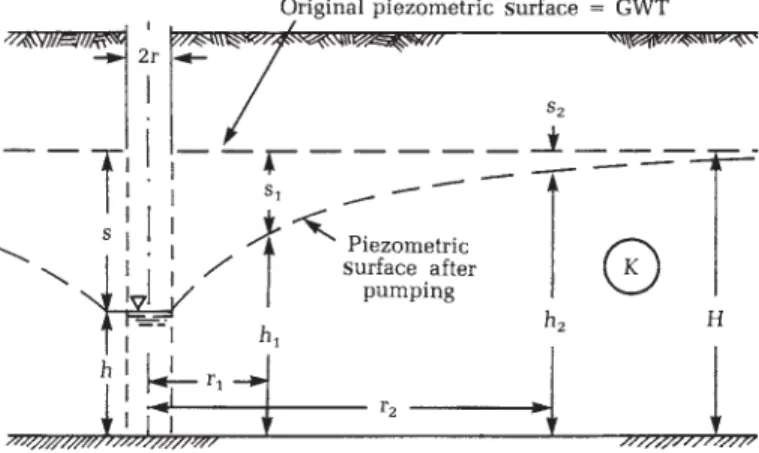
- The well is pumped at a constant rate
- Flow toward the well is radial and uniform
- Initially the piezometric surface is horizontal
- The well fully penetrates the aquifer and is screened for the entire length
- The aquifer is homogeneous, isotropic, horizontal, and of infinite horizontal extent
- Water is released from the aquifer in immediate response to a drop in the piezometric surface
The depth to the bottom of the catchment (Figure 2-5) determines the withdrawal limit of the piezometric surface. In populated areas, regulatory agencies have data that allow estimation of aquifer depth.
Reclaimed Wastewater
The aquifer depth for an unconfined aquifer is measured from the static, undamped water table to the underlying impervious layer (Figure 2-6. In theory, the aquifer depth defines a dimension of the maximum pumping extent.
2-3 WATER QUALITY
Chemical: Chemical characteristics of waters are sometimes evidenced by their observed reactions, such as the comparative performance of hard and soft waters in laundering
Microbiological: Microbiological agents are very important in their relation to public health and may also be significant in modifying the physical and chemical characteristics
Radiological: Radiological factors must be considered in areas where there is a possibility that the water may have come in contact with radioactive substances. The radioactivity
Physical Characteristics
Chemical Characteristics
Too much fluoride in the drinking water supply can cause fluorosis (staining) of the teeth, * which increases when the optimal fluoride level is exceeded. They can be acute poisons (eg As and Cr 6 ) or they can produce chronic disease (eg Pb, Cd and Hg).
Microbiological Characteristics
The coliform group of organisms normally inhabits the intestinal tracts of humans and other mammals. Thus, the presence of coliforms is an indication of fecal contamination
The dormant Giardia cysts and Cryptosporidium oocysts are carried in animals in the wild and on farms.
Radiological Characteristics
Raw Water Characteristics
A probability plot, as shown in Figure 2.8, provides a comprehensive view of the range of concentrations of the constituents to be treated. This is a field study covering a large geographical area beyond the immediate area surrounding the water supply source. The purpose of the sanitary survey is to identify potential health hazards and assess their current and future importance.
Water Quality Standards
The system also violates the MCL for total coliforms if a routine sample is fecal coliform or E. The primary and secondary maximum contaminant levels are the maximum permitted (or recommended) values of the various contaminants.
2-4 EVALUATION OF PROCESS OPTIONS
These secondary pollutant limits are the recommended maximum levels of contaminants in any public water supply system. The American Water Works Association (AWWA) has issued its own set of goals that its members strive to adhere to.
2-5 PLANT SIZING AND LAYOUT
The National Safe Drinking Water Act also provided for the establishment of a set of additional standards to establish maximum limits for those contaminants that tend to make the water unpleasant to use but that do not have any particular adverse effect on public health.
Number and Size of Process Units
Number and Size of Ancillary Units
Plant Layout
The plan must include: (1) possibility of expansion, (2) connection to the transportation network, (3) connection to the water distribution system, and (4) a system for handling residues. Similarly, since scrap is usually transported off-site, the scrap handling system is an integral part of the plant layout.
2-6 PLANT LOCATION
2-7 CHAPTER REVIEW
- Explain to a client the influence of regulatory constraints on the selection of a design period
- For a given population growth rate, select an appropriate design period
- Explain to a news media person the influence of local factors such as climate, industrial development, and meterage on a national estimate of unit demand
- Explain to a client why groundwater is often preferred as a source of water
- Use a yield curve to estimate a safe yield
- Describe the potential deleterious effects of overpumping a confined or an unconfined aquifer
- Explain the implications of a flat or steep slope in a log-probability plot of a water quality parameter in the design of a water treatment plant
- Construct a yield curve
- Construct an annual minima series
- Use mass balance techniques to estimate the required volume of a small reservoir
- Estimate the maximum sustainable drawdown of a well pumping from a confined aquifer
- Compare the results of a water analysis with water quality criteria and determine defi- ciencies that need to be remedied by treatment
- Estimate the demand flow rate for the average day, maximum day, and peak hour for a small nonindustrial community
Estimate the demand flow rate for the average day, maximum day, and peak hour for a small non-industrial community.
2-8 PROBLEMS
Using a spreadsheet you wrote and the data in Table 2-7, continue the required storage volume analysis begun in Example 2-3 through April 2001. Your impression of the degree of difficulty in operating the plant and the need for operation flexibility.
2-9 DISCUSSION QUESTIONS
2-10 REFERENCES
INTAKE STRUCTURES
3-1 INTRODUCTION
Capacity
Location
Variation with water depth due to stratification Seepage corridors "affected" by surface water must comply with surface water regulations.
Type of Intake
Because of their buoyant effects, as well as harsh winter weather and subsequent difficulties in their operation and maintenance (O&M), exposed structures are not often used in the Great Lakes and other large lakes with cold climates. Primarily, structural integrity, power availability and accessibility must be considered in the design.
Conduits
Layout
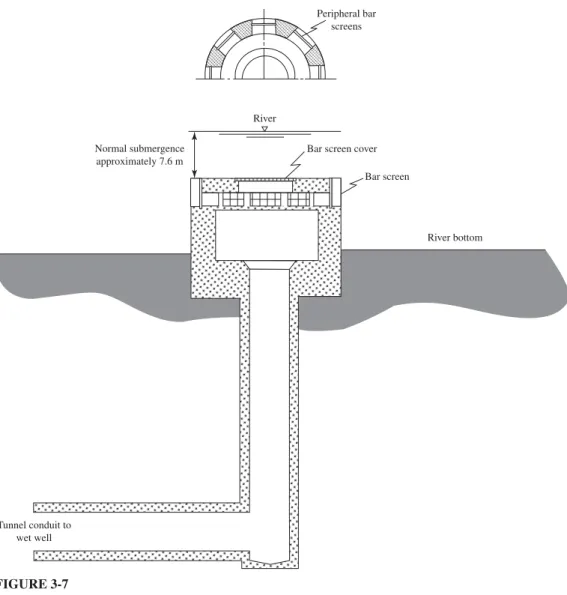
Intake Tower
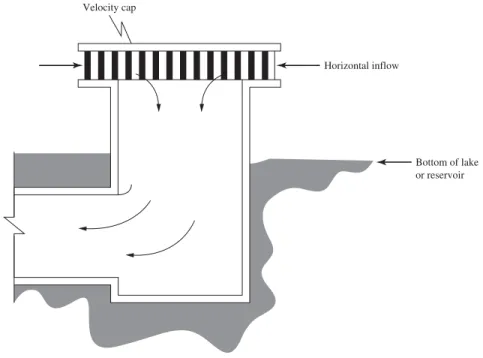
To maintain the desired inlet design speed, port design must consider the area occupied by the bars. To account for the irons, the area of the port opening must be increased by 20 percent or.
Intake Crib
Its purpose is to collect smaller material that has passed through the coarse screen but is still large enough to damage downstream equipment. Generally, it is placed in the low head pump station before the pump inlet.
Conduit
Below you will find a sketch of the minimum height of the lake and the maximum allowable water discharge in the low water pumping station. The ground cover for the pipe is approximately 1 m above the top of the pipe with an additional protective layer of crushed rock (Foellmi, 2005).
Shore Intake
Wet Well
With the exception of the tower catchment, the wet well is located on the coast or river bank. The wet well area must be large enough to accommodate the fine screen and pumps.
Pump Criteria
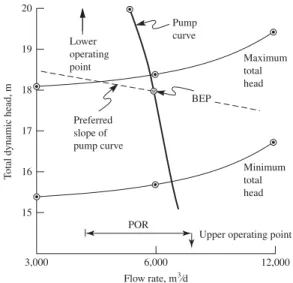
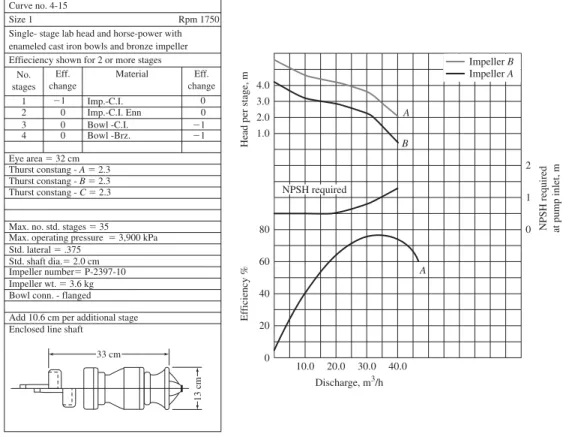
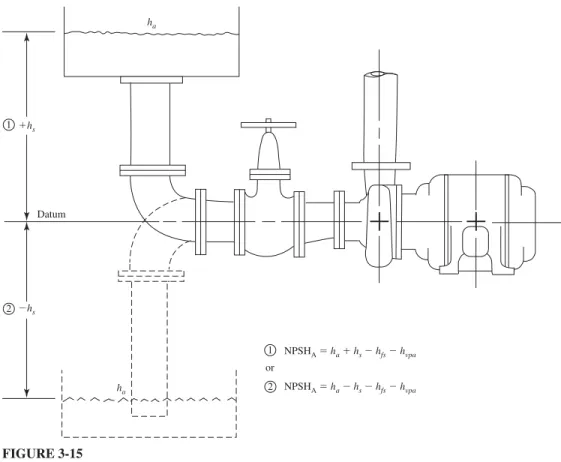
The NPSH R is a function of the pump design and operating conditions (capacity, speed and discharge head). As a result, service life within the AOR may be lower than within the POR.” The pump can be used in this region for short, infrequent periods without significant equipment deterioration (Cooper and Tchobanoglous, 2006).
Infiltration Gallery or Ranney Wells
At the crossing points in the gallery where the pipe changes direction and at the end of the gallery, a well is provided. However, the filtering action of the soil improves water quality and makes treatment easier.
In addition to the abstraction restrictions that may be imposed, the water removed from the infiltration gallery can be considered to be under the influence of surface water and therefore subject to the water quality rules applicable to surface water. Immersing the inlets in deep water (10 m appears to be the minimum, with 12 to 14 m being preferred) and sizing the inlet ports for a maximum velocity of 10 cm/s minimizes the formation of fragile ice.
Zebra Mussels
Anchor ice differs from frazil ice in that it forms in sheets and grows by attaching frazil ice.
Fish Protection
Behavioral guidance can be achieved by electric shock (Bosserman et al., 2006) or, in submerged feeders, by rate limitation (Foellmi, 2005). Frazil ice complicates the issue of fish protection, as fine-mesh systems are highly susceptible to clogging (Bosserman et al., 2006).
3-5 OPERATION AND MAINTENANCE
For zebra mussel control, the chlorine inlet must be routed to the inlet grate/rod. In hard water with high concentrations of calcium and magnesium carbonate, the addition of commercial sodium hypochlorite can cause precipitation of carbonates inside the pipe.
- For a client, sketch a diagram of a lake intake structure and a river intake structure
- List and discuss the key requirements of intake structures
- Select the appropriate screen type (coarse or fine) for a given scenario, that is, place- ment in the intake structure or type of material to be removed
- Select the appropriate type of pump from a pump catalog for a deep low-lift pump station
- Explain the advantages and disadvantages of an adjustable frequency drive for a pump to a client
- Explain, to a client, what frazil ice is and how its buildup on the intake structure may be minimized
- Explain, to a news media person, why zebra mussels are an operational problem and list two control techniques
- For a given scenario (river or lake) with appropriate data on depth, sediment, and cli- mate, select an acceptable type of intake structure
- Design an intake port given the seasonal flow rates and climate conditions
- Design a bar rack for an intake port given the seasonal flow rates and climate conditions
- Design the conduit to carry water from an offshore intake structure to a low-lift pump station
- Construct a system head curve given the elevations, pipe dimensions, and identification of the fittings
- Given a system head curve and a set of head-discharge curves, select an appropriate pump and specify (1) BEP, (2) number of stages, (3) efficiency at BEP, (4) the operat-
- Design the wet well for a low-lift pump station including specifications of (1) the depth of the wet well and (2) the location of the pump intake given the surface water level,
Because the air supply used by the divers will be released into the duct during the inspection, some means of releasing the gas must be provided; otherwise the gas "bubble" that collects in the tube will limit the flow rate. Design the wet well for a low-head pumping station including specifications of (1) depth of wet well and (2) location of pump intake given surface water level, wet well, and (2) location pump intake considering surface water level, intake channel specifications and pump NPSH.
Surface area increase of water in the wet well at maximum flow Pipe profile from the inlet structure to the low-pressure pump station. Design a pipe to transport water from a submerged intake structure to the wet well of a low head pumping station.
WELLS
4-1 INTRODUCTION
4-2 DESIGN ELEMENTS
Protection from Contamination
Reliability
Quality
Adverse Resource Impact
4-3 WELL PROTECTION
Isolation
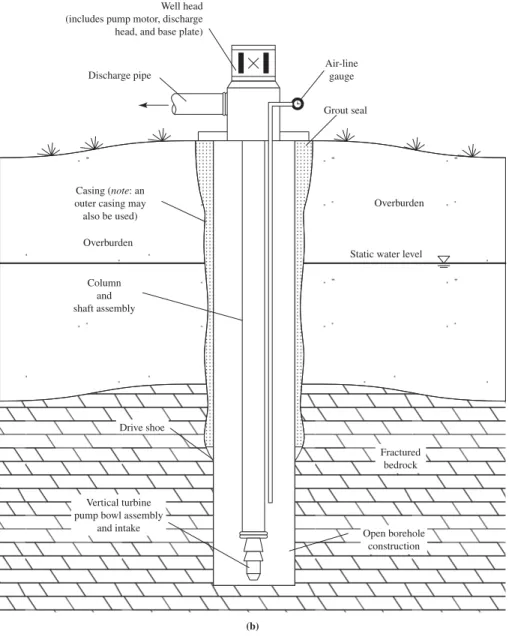
Well Construction
This method is favored when the well is to be completed with artificial gravel packing. It increases the porosity and permeability of the natural formation in the vicinity of the well.
Structural Protection
Although the solubility of HTH ® is about 215 g/L at 0 C, a more practical working solution is about one third of this concentration, i.e.
4-4 WELL DESIGN
Number of Wells
Location of Wells
The height of the water level in a pumping well (taking into account the surface of seepage, but neglecting well losses) can be estimated from. Careful engineering design will ensure that the operation of the well does not approach failure.
Pump Type
The first criterion in evaluating the results of the disturbance calculation is to determine whether or not the well operation causes the well to fail. Wells must be spaced to accommodate the hydraulic limitations of the aquifer as well as property boundaries and existing piping.
Pump Size
First, it does not provide for the surplus demand of an out-of-service well at times of peak demand. This would meet regulatory requirements to have a backup well available at times of peak demand.
Well Diameter
Well Depth
Keeping one day in the system has little impact on the well system design for this case. However, withdrawal should not lower the piezometric surface below the top of the aquifer (MSDWA, 1976).
Well Screen Length
Screen Slot Size
Screen Diameter
Screen Entrance Velocity
Pump Power
For some well systems, a submersible pump may be more appropriate than a line pump
4-5 CHAPTER REVIEW
- Sketch a subsurface cross section from the results of a well boring log and identify pertinent hydrogeologic features
- Define “isolation” as it applies to wells
- Sketch a well and label the major sanitary protection features according to this text
- Explain the purpose of a removable roof, auxilary heat, and ventilation in a well house
- Sketch a piezometric profile for a single well pumping at a high rate, and sketch a pro- file for the same well pumping at a low rate
- Sketch a piezometric profile for two or more wells located close enough together to interfere with one another
- Select the correct isolation distances for a well based on a description of the users
- Calculate the appropriate amount of disinfectant for a well given the diameter, depth of water in the well, and the reagent to be used
- Calculate the drawdown at a pumped well or observation well if you are given the proper input data
- Calculate the transmissivity and storage coefficient for an aquifer if you are provided with the results of a pumping test
- Calculate the interference effects of two or more wells
- Determine the number of wells for a small community’s well field
- Select an appropriate type of pump and the required discharge capacity to meet demand
- Select and check the appropriate diameter for a well casing
- Determine the required depth of a well
- Determine the appropriate length of well screen for a given aquifer formation
- Select the appropriate slot size given a grain size distribution
- Determine the appropriate screen diameter given the hydraulic conductivity of the aqui- fer and the slot size
- Select an appropriate pump and specify the number of stages based on a TDH calcula- tion you have performed
Calculate the appropriate amount of disinfectant for a well given the diameter, the depth of water in the well, and the reagent to be used. Determine the appropriate screen diameter considering the hydraulic conductivity of the reservoir and the gap size.
Determine the coefficient of storage for an artesian aquifer from the pumping test results shown in the table below. For the well field layout shown in Figure P-4-18, determine the effect of adding a sixth well.
RMC (2007) A Guide to Water Well Casing and Screen Selection, Roscoe Moss Company, Los Angeles, California, p. 1935) "Relationship Between Piezometric Surface Subsidence and Grade and Discharge of a Well Using Ground Water Storage", Transactions American Geophysical Union, Vol. PHS (1965) Recommended State Legislation and Regulations, US Public Health Service, Department of Health Education and Welfare, Washington, D.C. 1962) "Selected Analytical Methods for the Evaluation of Wells and Aquifers", Illinois State Water Research Bulletin 49. Journal 1970, McGraw-Hill, New York, p.
CHEMICAL HANDLING AND STORAGE
5-1 INTRODUCTION
Chlorine is shipped in containers of the following sizes: 70 kg cylinder, 900 kg cylinder * and railway tanks. It is important to note that the weight label refers only to the weight of the chemical in the cylinders and does not reflect the additional weight of the container itself.
Storage