Praise for
Engage!
“Brian Solis has shown once again his deep understanding of the power of new media. He shows how social media can give voice, credibility, and connections to both companies and their customers.”
—Price Floyd, Principal Deputy Assistant Secretary of Defense for Public Affairs
“What’s the secret to a successful company? Seasoned business owners know that it’s a combination of strong leadership and superior products. But that alone isn’t enough anymore. The leader of the future needs to connect with the customer of the future when, where, and how the customer wants, and Brian Solis lays out some of the guidelines here, going far beyond the tools that are today’s buzzwords.”
—Scott Monty, Global Digital Communications, Ford Motor Company
“Social media isn’t all that different from the new era of food trucks in Los Angeles: it’s the wild, wild West out there where the unspoken law reigns supreme and all the established protocols of traditional media are meant to be broken. For every Jesse James, there are a thousand more who aspire to rule over the law. This book will help you succeed and thrive in an era of perceived, yet strategic, lawlessness.”
—Chef Roy Choi, @KogiBBQ
“Brian Solis documents new media’s evolution and its challenge to tradi- tional marketing methods and corporate communications: Most profoundly, through social media the customer has become a more influential stakeholder.
The book provides concrete guidelines on how companies must engage in the public conversation and how they must prepare for a new era of relationships with their clients, customers, and employees.”
—Klaus Schwab, Executive Chairman, World Economic Forum
ENGAGE!
The Complete Guide for BRANDS and BUSINESSES to Build, Cultivate, and Measure Success
in the New Web
BRIAN SOLIS
John Wiley & Sons, Inc.
CopyrightC 2010 by Brian Solis. All rights reserved.
Published by John Wiley & Sons, Inc., Hoboken, New Jersey.
Published simultaneously in Canada.
No part of this publication may be reproduced, stored in a retrieval system, or transmitted in any form or by any means, electronic, mechanical, photocopying, recording, scanning, or otherwise, except as permitted under Section 107 or 108 of the 1976 United States Copyright Act, without either the prior written permission of the Publisher, or authorization through payment of the appropriate per-copy fee to the Copyright Clearance Center, Inc., 222 Rosewood Drive, Danvers, MA 01923,
(978) 750-8400, fax (978) 646-8600, or on the Web at www.copyright.com. Requests to the Publisher for permission should be addressed to the Permissions Department, John Wiley & Sons, Inc., 111 River Street, Hoboken, NJ 07030, (201) 748-6011, fax (201) 748-6008, or online at http://www.wiley.com/go/permissions.
Limit of Liability/Disclaimer of Warranty: While the publisher and author have used their best efforts in preparing this book, they make no representations or warranties with respect to the accuracy or completeness of the contents of this book and specifically disclaim any implied warranties of merchantability or fitness for a particular purpose. No warranty may be created or extended by sales representatives or written sales materials. The advice and strategies contained herein may not be suitable for your situation. You should consult with a professional where appropriate.
Neither the publisher nor author shall be liable for any loss of profit or any other commercial damages, including but not limited to special, incidental, consequential, or other damages.
For general information on our other products and services or for technical support, please contact our Customer Care Department within the United States at (800) 762-2974, outside the United States at (317) 572-3993, or fax (317) 572-4002.
Wiley also publishes its books in a variety of electronic formats. Some content that appears in print may not be available in electronic books. For more information about Wiley products, visit our website at www.wiley.com.
ISBN 978-0-470-57109-5
Printed in the United States of America 10 9 8 7 6 5 4 3 2 1
Contents
Foreword Ashton Kutcher ix
Preface xi
Introduction: Welcome to the Revolution xiii PART I THE NEW REALITY OF MARKETING AND
CUSTOMER SERVICE
Chapter 1 The Social Media Manifesto: Engage or Die 3 Chapter 2 The Case for Socializing Media, by the Numbers 17
PART II FOREVER STUDENTS OF NEW MEDIA
Chapter 3 The New Media University: Social Media 101 33 Chapter 4 The New Media University: Social Media 201 40 Chapter 5 The New Media University: Social Media 202 52 Chapter 6 The New Media University: Social Media 203 62 Chapter 7 The New Media University: Social Media 301 73 Chapter 8 The New Media University: Social Media 302 82 Chapter 9 The New Media University: Social Media 303 95
v
vi
➤CONTENTS
Chapter 10 The New Media University: Social Media 401 104 Chapter 11 The New Media University: Social Media 402 113 Chapter 12 The New Media University: Social Media 403 128 Chapter 13 The New Media University: MBA
Program—First Year 138
Chapter 14 The New Media University: MBA
Program—Second Year 152
PART III BRAND REPRESENTATIVE VERSUS THE BRAND YOU
Chapter 15 Fusing the “Me” in Social Media and the “We”
in the Social Web 163
Chapter 16 Learning and Experimentation Lead
to Experience 173
PART IV WE ARE THE CHAMPIONS
Chapter 17 Defining the Rules of Engagement 181 Chapter 18 The Conversation Prism: How to Listen 206 Chapter 19 Unveiling the New Influencers 228
PART V THE SOCIAL ARCHITECT: DEVELOPING A BLUEPRINT FOR NEW MARKETING
Chapter 20 The Human Network 243
Chapter 21 The Social Marketing Compass: Creating a Social
Media Plan 268
Chapter 22 Divide and Conquer: Building Marketing and
Service Teams Around Social Media Programs 281
Contents
➤vii PART VI A LITTLE LESS CONVERSATION, A LITTLE MORE
ACTION: RISING ABOVE THE NOISE Chapter 23 A Tale of Two Cities: Social CRM and
Relationship Management 297
Chapter 24 The Contrast between Earned and Paid:
When Paying for Friends Makes Cents 312 Chapter 25 The New Media Scorecard: Measuring
Investment Returns 321
Conclusion 347
Glossary 349
Notes 357
Index 371
Foreword
New media is creating a new generation of influencers and it is reset- ting the hierarchy of authority, while completely freaking out those who once held power without objection. The truth is that most of the existing formulas, methodologies, and systems miss or completely ig- nore the role of new influencers to inspire action, cause change, spark trends, and recruit advocates. We are absent from the exact movement that can help us connect with those who guide their peers.
In light of the new media movement, how do brands approach this now? They spam the Web with useless rhetoric. (Who cares if you’re on Facebook or Twitter?) They also distribute these horrible videos, uploading them to YouTube and then wondering why they never go viral. Look, you have seven seconds to entertain someone. If you don’t grab them in seven seconds, then you can forget about someone sitting through the rest of the video—let alone having it go viral.
But if you know what people are looking for . . . if you know where people are interacting . . . if you know what moves people, you can en- gage the human algorithm to immerse viewers and trigger meaningful interaction and vibration across the social graph.
This is why we, we as in a collective of individuals who know what’s best for us based on our passions, interests, and aspirations, are in charge of what compels us. In order to have any hope of attracting and earning our attention, you need to know whoweare.
The roles are reversing and individuals and brands have the ability to reach and rouse powerful and dedicated communities without ever having to pay for advertising. I’m just part of the bigger movement of empowering the people who care enough to change the word. Social media is socializing causes and purpose, and inciting nothing short of a revolution in stature and influence, but more importantly, literacy and innovation.
ix
x
➤FOREWORD
As we engage, we learn. And, learning is what this is all about. But we can’t grow without admitting that we have something to learn and at the same time, we have to believe in ourselves and our ability to push things forward. In the end, everything starts with engagement.
This is our time. This is your time. Engage.
ASHTONKUTCHER CO-FOUNDER OFKATALYST
Preface
We are at the beginning of something new and incredible, and its paths and processes are for the most part undefined and far from standardized. Social media is a great equalizer and it’s leveling the playing field for those who can demonstrate adeptness and vision. If this is you, it’s time to speak up. It’s time to show executives, peers, and stakeholders that you care. With a little homework, the case can be made quite easily and impressively. It just takes a little bit of extra time and passion to do so.
You are needed now more than ever to help the brand best position itself to compete in the “now web” and for the future.
It takes a champion to rally support from within.
It takes a champion to connect customer needs with company solutions.
It takes a champion to become the customer the business needs to reach.
It takes a champion to guide decision makers within the organi- zation on how to best implement social tools and services, how to use them, how to establish guidelines, and how to measure success and ROI.
You’re a purveyor of new media, but then again, so is everyone else, it seems. Suddenly, everyone is a social media expert, but very few are indeed champions and far fewer are change agents.
So what are you going to do to rise above the fray while also delivering true, incontestable value to those you are helping?
Ask yourself . . .
Are you an evangelist or a consultant?
Are you an extension of your company brand or are you an em- ployee?
Are you a leader or a follower, or are you meandering through your profession?
xi
xii
➤PREFACE
Are you confined to the role you’re in now or do you represent something with longer-term value?
Everything that’s transpiring around us is actually improving the existing foundation for our business, from service to marketing to product development to sales to executive management, and every- thing in between.
Social marketing revitalizes and empowers every facet of our workflow and its supporting ecosystem. Seeing the bigger picture and tying our knowledge to the valuable feedback from our communities will help us guide businesses towards visibility, profitability, relevance and ultimately customer loyalty.
In every single case, it doesn’t take only an expert; it requires a champion to make an impact.
You are that champion.
Advancement doesn’t come without investment though.
You may be saying to yourself, “I already have a full-time job that keeps me busy, more than busy, for eight to nine hours a day as it is.
How am I going to squeeze in the time to learn everything required for this new role, and how will I balance my workload based on what I already have to do?”
Sorry. I don’t have an easy answer or a shortcut for you.
What’s taking place right now, right in front of you, is something so tremendous that to proclaim that a cheat sheet exists would actually cheat you from truly grasping this new opportunity for personal and professional growth.
This is something so much deeper than anything I could cover “for dummies.” It’s a matter of abridgement versus immersion. Success and maturation is tied to the latter.
The good news is that you have this book. Now let’s work together to get you that MBA that will really help you excel in your career, wherever it may take you.
Think about it.
Investing extra time after hours and on weekends is the minimum ante to enroll in what I call the New Media University. With every day that passes, enrollment multiplies. The question you have to ask is whether you want to lead or follow. Please note that the risk of following is that the field will quickly become congested and choked with competition and stagnation. In contrast, when you choose to take a leadership role, you will find that challengers are scattered and in short supply. The cost, however, is that you go back to school for the near future in order to learn and acquire the skills necessary to lead your brand into the future.
While many will ask questions, few will have answers. Which side of the dialogue do you choose?
Introduction:
Welcome to the Revolution
By the time you read this book, you may have already heard or will soon hear whispers, rumblings, and rantings that social media is play- ing out.
Tune them out.
The truth is that social media may very well cease to exist as a category one day. However, while the term and category has and always will invite debate, social media’s practices and benefits are indisputable, sustainable, and enduring. And, they will always serve as an important and revered chapter in the evolution of new media.
This is not open to debate.
Influential conversations are sparked and steered by influential people right now and they exist and flourish outside of your orga- nization. The practice of listening to and learning from these con- versations in and around the social networks where they transpire is invaluable and indispensable.
Social Media. New Media. Interactive Media. Integrated Market- ing. Experiential Marketing. Public Relations. Branding. Whatever we call it, it’s simply a matter of digital Darwinism that affects any and all forms of marketing and service. In the world of democratized influence, businesses must endure a perpetual “survival of the fittest.”
Engage or die.
In June 2007, I wrote and published The Social Media Mani- festo. What started as a blog post intended to help marketers grasp and embrace the emerging and rapidly shifting landscape of social media, quickly ascended into the proclamation and rallying cry for a new, more cognizant, and in-touch epoch of customer-focused, direct-to-consumer engagement. The Social Media Manifesto intro- duced the methodologies, tools, and social networks that would eventually inspire a movement to evolve from top-down, broadcast programs to complementary and holistic forms of collaboration rooted in mutually beneficial engagement and exchanges. It served
xiii
xiv
➤INTRODUCTION: WELCOME TO THE REVOLUTION
Source: Original drawing in honor of Engage! by Hugh MacLeod, author of Ignore Everybody and also blogger @gapingvoid.
as the foundation to effectively redesign marketing communications and customer service organizations based on the art of observation, listening, engagement, learning, and adapting. It also introduced the mechanics and benefits for humanizing and diversifying the com- pany story based on the unique and varying needs of customers and peers who populate disparate online communities through their channels of influence.
And here we are now: united in our efforts to discover meaning in the philosophies and processes we long operated without. We seek inspiration and we endeavor to inspire. The people we attempted to reach over the years appear before our eyes as if they are long lost friends and relatives. The faceless have revealed their identities through their role in social media. Socialized media and the peo- ple powering the convergence are accelerating an era of engagement driven by collective consciousness, yet mindful of business, in order to attract customers and preserve their affiliation. After all, customer acquisition is only rivaled in value by customer retention.
The science of procuring attention is complemented by the deli- cate art of earning and cultivating relationships. Social media peeled back the layers of infrastructure, data, numbers, demographics, pol- itics, procedures, and all of the corporate red tape that dug trenches between our brand and our customers.
Introduction: Welcome to the Revolution
➤xv
This is our time to engage! In doing so, it is your declaration of independence from the shackles that have bound us to hollow and vain marketing techniques and practices of yesteryear. It serves as your framework to chart your own path and create your own destiny.It is your key to unlock the doors that prevent you from reaching your customers where they’re interacting and seeking solutions todayand tomorrow.
Together we are building the foundation for corporate and personal significance. We are the architects who are drafting the blueprint for a more efficient and yearned-for bridge between our story and the people who can benefit from it.
Welcome to marketing providence. The crusade you join is grow- ing in breadth and volume each and every day. You’re surrounded by like-minded individuals who seek to improve the dynamics be- tween people and the companies they represent. The tools, method- ologies, and stories shared within this book will reveal a wealth of “unmarketing” principles, strategies, and devices. It is this idea of “unmarketing” that inevitably extends all of the goals and ob- jectives merited by traditional marketing, while also elevating the experience for everyone on both sides and invariably stimulating advocacy in order to expand your presence and impact in the main- stream and distributed communities that influence perceptions and decisions.
While the methodologies, theories, experiences, and social tools discussed in the original manifesto still stand, a deeper and more modern look is necessary to garner support and champion change from within—specifically an examination of what to do and how to measure success. It is through engagement that we earn experience, connections, and prominence. There’s no doubt that the proven tenets introduced in this book will ensure your success and career longevity.
The doctrines that we examine and propose are in fact representative of best-of-breed ideals and methods unearthed and mashed-up from existing and extinct tactics to renew, edify, mature, and hone our proficiencies, conviction, knowledge, and experience.
Engage! will serve as a new manifesto, a reference point for all inward-outward-facing initiatives that incorporate two-way commu- nication. And in the process, we’ll see “unmarketing” emerge as one of the most effective forms of marketing, after all.
Until the proliferation of interactive media, traditional influence has followed a systematic top-down process of developing and pushing
“controlled” messages to audiences, rooted in one-to-many faceless broadcast campaigns.
Personality wasn’t absent in certain mediums, but it was missing from day-to-day communications.
xvi
➤INTRODUCTION: WELCOME TO THE REVOLUTION
For the most part, this pattern seemingly served its purposes, fueling the belief that brands were in control of their messages, from delivery to dissemination, among the demographics to which they were targeted.It scaled and served very well over the years, until it didn’t . . . Unbeknownst to many companies, a quiet revolution has been amassing over the last two decades, one that we document clearly in this book. And, slowly but surely, the whispers eventually intensified into roars.
The socialization of the Web and content publishing disrupted the balance and is now forcing a media renaissance that is transform- ing information distribution, human interaction, and everything that orbits this nascent ecosystem.
It is the dawn of a democratized information economy, which is engendering the emergence of champions, facilitators, and vision- aries who endeavor to manifest a more media literate society while transforming the way we publish and share relevant content.
The interactive Web heralded the arrival of mainstream consumer influence and a global ecosystem that supports and extends their ob- servations, complaints, opinions, referrals, and recommendations.
It served as a great equalizer, capsizing the existing balance and redistributing influence—and continues to do so.
Not only is it changing how we create, decipher, and share infor- mation, it is forever reshaping how brands and content publishers think about their markets and the people who define them.
Engage.
Part
I
The New Reality of
Marketing and
Customer Service
1
C h a p t e r
The Social Media Manifesto
Engage or Die
■ THE SOCIALIZATION OF MEDIA IS YEARS IN THE MAKING
In my 19-year marketing career, I’ve dedicated the last 13 years specif- ically to the practice of and experimentation in online interaction.
My findings are based solely on the chemistry of failure, success, and, well, ambivalence, which by many accounts equals either defeat or promise. The constant theme throughout has been the sustained bal- ance between the pursuit of new influencers and the incorporation of verified traditional methods. This experience, and the experiences of others, ultimately serves as the foundation for creating a new com- munications bridge between companies and customers.
Socialized media has:
➤ Rewired the processes by which consumers share experiences, expertise, and opinions.
➤ Broadened the channels available to consumers who seek in- formation.
➤ Changed how companies approach markets.
➤ Altered how companies develop products.
➤ Remodeled the processes by which companies connect with and show appreciation for their customers.
➤ Transformed the method of influence, augmenting the ranks of traditional market experts and thought leaders with enthusiasts and innovators who self-create content-publishing platforms for their views.
3
4
➤REALITY OF MARKETING AND CUSTOMER SERVICE
Source: Original artwork by Jesse Thomas (http://Jess3.com).
➤ Facilitated customers’ direct engagement in the conversations that were previously taking place without their participation.
A fundamental shift in our culture is underway and it is creating a new landscape of influencers, as well as changing how we define influence. By establishing an entirely new ecosystem that supports the socialization of information, this shift is facilitating new conver- sations that start locally, but ultimately have a global impact.
The days of “hear no evil, see no evil, speak no evil” have passed without lament.
Monologue has given way to dialogue.
The message is clear. Social media has created and magnified a new layer of influencers across all industries. It is the understand- ing of the role people play in the process of not only reading and disseminating information, but also how they share and create con- tent in which others can participate. This, and only this, allows us to truly grasp the future of communications, which is already unfolding today.
The socialization of information and the tools that enable it are the undercurrent of interactive media—and serve as the capital in- frastructure that defines the social economy.
Content is the new democracy and we, the people, are ensuring that our voices are heard.
This is your chance to reinvigorate the tired and aging models of marketing and service, build a corporate brand, and increase revenue,
The Social Media Manifesto
➤5
all while paving the way for a brighter, more rewarding, and more prosperous m´etier.How can companies implement an integrated communications strategy quickly in this new social landscape? By focusing on mul- tiple markets and influencers that will have a far greater impact on brand resonance and the bottom line than trying to reach the masses through any one message, venue, or tool.
Our actions speak louder than our words.
New media is constantly evolving and has yet to reveal its true im- pact across the entire business publishing and marketing landscape.
We’re only now starting to realize a small portion of its benefits and advantages. What we do know is that the current iteration of social media is only one chapter in a never-ending resource that continues to evolve as new media permeates every facet of every business. In fact, new media is only going to become more pervasive and, as such, become a critical factor in the success or failure of any business.
The life of the information offered in this book is interminable.
New tools and strategies will be revealed, and they will be tied to exciting case studies that document the challenges, tactics, lessons, and successes for each.
We’re just getting started.
The evolution of new media is also inducing an incredible trans- formation in customer service, community relations, public relations (PR), and corporate communications—its most dramatic evolution in decades. In the world of customer and product support, social- ized media is putting the “customer” back in customer service, re- tracting the ideologies associated with cost-cutting tactics when in- terfacing directly with the people who purchase and influence the purchasing decisions of others. Likewise, in the world of communi- cations, the democratization of media is putting the “public” back into public relations. It creates entirely new teams within organiza- tions to proactively listen, learn, engage, measure, and change in real time. And we’ll soon see it have a profound effect in the financial sector.
With the injection of social tools into the mix, people now have the ability to impact and influence the decisions of their peers, as well as other newsmakers. This new genre of media is not a game played from the sidelines however. Nor is this book written merely to inform you of the benefits only to have you go back to your day-to-day routing.
Those who participate will succeed—everyone else will either have to catch up or miss the game altogether.
Businesses will evolve, customers will gain in prominence, and brands will humanize—with or without you.
6
➤REALITY OF MARKETING AND CUSTOMER SERVICE
■ THE FUTURE OF COMMUNICATIONS AND SERVICE IS ALREADY HERE
The secret to successfully navigating the new landscape of marketing and service is understanding that socialized media is about anthropol- ogy, sociology, and ethnography, and less about technology and the social tools that captivate and connect everyone today. New media marketing and services are mash-ups of new and traditional media and processes that span across advertising, PR, customer service, mar- keting communications (marcom), human resources (HR), sales, and community relations.
Communication, whether inbound or outbound, is now powered by conversations, and the best communicators always start as the best listeners. And, the best listeners are those who empathize while they are listening.
This is where and how the future of influence takes shape.
➤ It begins with respect and an understanding of how you con- nect with and benefit those whom you’re hoping to help.
➤ Intent is defined by a genuine desire to evolve into a resource.
➤ Genuine participation is a form of new marketing, but is not reminiscent of traditional marketing formats and techniques—
it’s a new blueprint for “unmarketing.”
➤ Meaningful content can earn the creator trust, authority, and influence.
➤ Conversations can forge relationships, which are measured by social capital and trust.
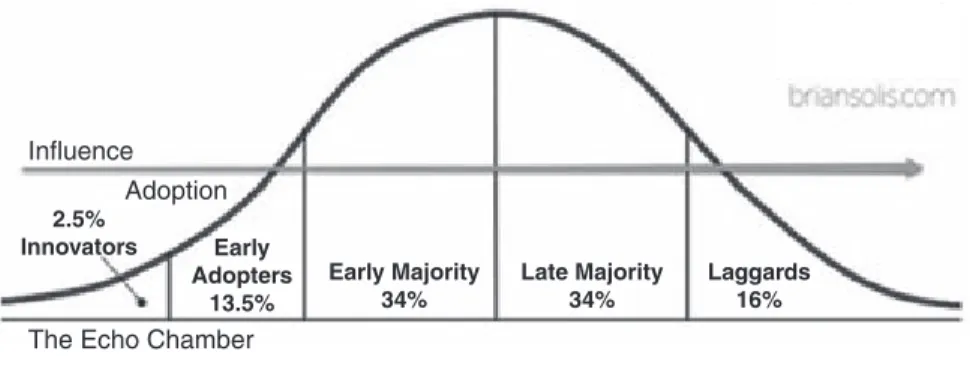
Figure 1.2 shows the range of people you will be interacting with, from innovators to laggards.
Influence Adoption 2.5%
Innovators Early Adopters
13.5%
Early Majority 34%
Late Majority 34%
Laggards 16%
The Echo Chamber
Figure 1.2
The Social Media Manifesto
➤7
These are pretty powerful statements and they are the essence of this more dynamic form of communications required to succeed today. These methodologies combine traditional marketing with the ability to develop flourishing and dynamic relationships with impor- tant individuals and groups of people who define multiple markets, thus giving us the ability to have an impact on multiple markets in the process.■ WE ARE THE CHAMPIONS, WE ARE NOT MESSENGERS
While we lead the transformation and socialization of our company’s marketing and service infrastructure, we must also ensure that our actions are discernible. Much in the same way that we attempt to cre- ate ambassadors by empowering our customers and advocates in the Social Web, we must become their ambassadors within—representing their concerns, ideas, questions, and experiences to those on our team who can provide resolution and also internal change.
Since this is a powerful new form ofsocialmedia, it begins with how we speak. This is the point at which most companies fall down, when they rely on traditional marketing instead of creating new dia- logues.
Messages are not conversations. Targets and audiences are not people. The inability to know people for who they are and what they represent prevents us from effectively and truly seeing them—which then impedes our efforts to reach them. As Doc Searls, coauthor ofThe Cluetrain Manifesto, wisely stated, “There is no market for messages.”
The market for self-promotion is finite. Yet brands, even those that experiment with social media, confuse their role and place within these new digital societies. People do not create accounts on Face- book, YouTube, Twitter, or any other social network to hear from brands. Those who are solely and intentionally seeking input from companies are joining networks such as GetSatisfaction or UserVoice, and dedicated forums such as those on Yahoo!, Google, and other bul- letin boards. The bottom line is that people are seeking answers and direction, not messages or sales pitches.
People just don’t speak or hear things in the same way companies speak about their products and services. In order to be heard, we have to communicate as though we were speaking person-to-person with our customers.
Social networks are a hub between the company and its cus- tomers. They represent a new genre of customer-focused engagement that fuses marcom, PR, product development, sales, and customer relations, all in one community. How we participate in each network
8
➤REALITY OF MARKETING AND CUSTOMER SERVICE
defines our stature within them and also determines our ability to earn friends and followers while also promoting and instilling advocacy.Everything we’re integrating into the marketing mix is aimed at sparking and cultivating conversations, as well as continuously expanding a network of lasting relationships.
■ CONVERSATIONS HAPPEN WITH OR WITHOUT YOU
In his great essay entitled “We Are the People Formerly Known as the Audience,” Jay Rosen introduced an entirely new concept of reach- ing people. In many ways, Rosen’s essay served as a manifesto for the marketing, media, and advertising industries, serving as an eye- opener to the world of democratized influence and how to recognize and embrace the opportunity it represents.
In order to reach people, we have to first figure out who they are and where they go for information. In the process, you’ll quickly discover that there is no magic bullet for reaching everyone, all at once. The strategy is in how to segment active communities from audiences—humanizing and materializing the people we wish to reach.
The best communications programs will reach out equally to tra- ditional media, A-, B-, and C-list bloggers, and communities because, while newsmakers reach the masses, peers and customers also reach each other in the communities where they congregate. This approach requires a new mindset and a new era of metrics.
Social media is about speaking with, not “at” people. This means engaging in a way that works in a conversational medium, that is, serving the best interest of both parties, while not demeaning any actions or insulting the intelligence of anyone involved.
So what of those skeptics or apprehensive executives who claim that participating on social networks will only invoke negative re- sponses and ignite potential crises?
As we’re coming to realize, the social landscape is an apparent sea filled with unforgiving predators—most of whom would love nothing more than to have marketers for every meal of the day. Nevertheless, succeeding here is the future of integrated communications, market- ing, and service.
The truth is that there will be negative commentary. However, that should not deter you from experimenting or piloting programs. Even without your participation, negative commentary already exists. In most cases, you just aren’t encountering it. This is why I like to ask business leaders the following question: “If a conversation takes place online, and you weren’t there to hear it, did it actually happen?”
The Social Media Manifesto
➤9
Yes. Yes, it did.Assuredly, every negative discussion is an opportunity to learn and also to participate in a way that may shift the discussion in a pos- itive direction. If there’s nothing else that we accomplish by partici- pating, we at least acquire the ability to contribute toward a positive public perception.
The conversations that don’t kill you only make you stronger.
And those negative threads that escalate in social networks will only accelerate without the involvement of inherent stakeholders.
■ SOCIAL MEDIA IS ONE COMPONENT OF A BROADER COMMUNICATIONS AND MARKETING STRATEGY
It’s true that everything is changing. And in many cases, it’s also true that everything old eventually becomes new again. The underlying principles of customer focus and service certainly aren’t new. In- stead, the attention on these elements may have waned, as businesses expand, contract, shift, and evolve based on market needs and trends, profit, and peer influence, as governed by the guidance of stakeholders and shareholders.
Social media is a critical part of a larger, more complete sales, service, communications, and marketing strategy that reflects and adapts to markets and the people who define them.
Therefore, we should be realistic about how we integrate social strategies into the human-powered machine of listening, learning, engaging, and evolving.
Social media is a never-ending fountain of lessons and insight.
Social media delivers new communications tools, and also new opportunities to learn how, when, and where to use them.
Social media is both distribution channels and rivers of knowl- edge, education, and experience.
Social media is a means, not an end.
Social media is a revelation that we, the people, have a voice, and through the democratization of content and ideas we can once again unite around common passions, inspire movements, and ignite change.
Social media is a chapter in the evolution of New Media.
It’s not a one-way broadcast channel. We are no longer broad- casters. We are now part of the community we wish to inform, and therefore we must establish prominence and earn influence in order to amass attention, instill enthusiasm, empower ambassadors, and create a community of loyal collaborators toward a more meaningful form of “unmarketing” and communications.
10
➤REALITY OF MARKETING AND CUSTOMER SERVICE
The previous hierarchy of messaging has collapsed. Now, in or- der to appeal to customers, clients, or potential stakeholders, we must approach them from top-down, bottom-up, and side-to-side.We must out-maneuver the elusive. We must out-think the pessimists.
We must sanction and amplify the experts and the emissaries.
■ BUILDING A BRIDGE BETWEEN YOU AND YOUR CUSTOMERS
No matter what the industry, we are all, in some way, responsible for the public relations of the organization we represent.
That’s right.
I’m not talking about PR or publicity intrinsically. Since our com- munications efforts are outward focused, visible, and indexable on the Web for all to see and find, everything we do now, whether we’re in PR or not, reflects on, and contributes to, the brand we represent.
Arming employees with knowledge, guidelines, rules, objectives, and expertise, and accordingly empowering them to participate on behalf of the brand and greater mission, creates an efficient, influential, and community-focused organization that stays in sync with stake- holders. Doing so builds an active collective of participants, powered by influential voices, in addition to employees, who will shape per- ception, steer conversations, and provide help to those seeking ad- vice. The community that once operated without us now becomes an extension of our outbound activities, beliefs, passions, and value propositions.
We are both architects and builders of strategic relationships and alliances, and we are creating the blueprints for and also constructing the bridge that connects customers and the people (you and me) who represent the companies we believe in.
In order to truly help businesses and the decision makers respon- sible for their direction, we need to learn through real work. We have to get our hands dirty. There’s just no way around it. We can learn from the mistakes and successes of our peers, but actions speak louder than words. The last thing we need are more cooks in a crowded kitchen. At the same time, we need direction and lucrative move- ment. We need thinkersanddoers. It is the only way to get smarter and, in turn, become more valuable to those you’re consulting or helping.
Immersion equals incontestable experience, perspectives, and knowledge.
Let’s get to work, build the bridge, and open up the gateways to traffic on both ends.
The Social Media Manifesto
➤11
■ BEING HUMAN VERSUS HUMANIZING YOUR STORY
It takes so much more than an understanding of the tools and popular networks to inspire change and build long-term, meaningful relation- ships. We must not forget to fuse what works today with the strategies that reach and compel those influencers and tastemakers who live on the edge and thus promote change among those who reside in the center.
The ability to set up a profile on Facebook or Twitter, the where- withal to update status in each network, the capacity to befriend peo- ple within each network, is in fact, child’s play. This is a learned practice not unlike the sending, filing, and reading of e-mail, chat- ting through instant-messaging tools, placing IP-based calls on Skype, decoding the mystery of using a short message service (SMS), or send- ing a text message from your mobile phone.
There’s a bigger, more significant opportunity to make a true im- pact within an organization. The tools are just extensions of you and your expertise and artistry. Everything starts with a deep commitment to the brand you’re representing—its culture, personality, overall po- tential, and people. Without it, you’re pushing the same old rhetoric in new places, which hardly helps you achieve your potential or the true capabilities of your team. And it certainly doesn’t inspire anyone to concern themselves with the brand’s presence in these emerging social networks that are so vital to our corporate economy.
Don’t speak to me in messages!
Put down the sales sheet or the press release.
Remove me from your broadcast mailing list.
Stop calling me at home and on my cell phone.
Give me something to believe in. Give me something to let me know that youknowwho you’re talking to.
I am influential. I am a consumer. I have a valuable social graph.
You only wish you could connect with me. I’m the gatekeeper among gatekeepers who needs direction, insight, and answers in order for me to accomplish the tasks in my life and meet my personal and professional goals. You could be just what I’m looking for, but in social media, where I dwell, I wouldn’t know it based on how you are or aren’t participating.
I’m a human being and so are you.
Treat me as such.
Alas, being human is far easier than humanizing your story.
Transparency is just not enough to convince me that I need to pay attention to you.
Get a little empathy going on and you’ll begin to facilitate mean- ingful interaction. This is the necessary commitment to adopting and
12
➤REALITY OF MARKETING AND CUSTOMER SERVICE
embodying a customer service mentality fueled by empathy and the desire to deliver resolution—one strategic engagement at a time.Feel it.
Live it.
Breathe it.
Be it.
If you don’t engage and become an internal champion, someone else will. That person may reside in your organization right now, or they may dwell in the cubicles of your competition’s offices, or both.
It’s as simple as that. The key difference though, is that you can defini- tively demonstrate how your story can impact the day-to-day work- flow of various important leaders and trendsetters, across multiple markets, because you, by default, have also become a new influencer in the process of socializing your company. While intent counts, value talks and BS walks. It’s the poetry of relationship-building, versed in the language and delivered with the swagger of someone who knows how to speak to the people because he or she is from the people.
■ SOCIAL SCIENCE IS NO LONGER AN ELECTIVE
As mentioned earlier, technology is not in or of itself the catalyst for change. Social tools facilitate the online conversations, but it’s the people who are the instigators for change.
While Generation Y (the Millennials) are entering the workforce with unprecedented knowledge of how to communicate with each other using social networks, micromedia communities, blogs, and all things social, their business discipline and work ethic are still rivaled by Baby Boomers and Generation X. And the technical aptitude of previous generations is locked into a perennial cycle of catch-up and self-education. Each generation, however, is unique and representa- tive of the reality that everyone, no matter which generation they rep- resent, still needs to learn how to hear and see things differently. It’s psychographics over demographics, and the only way to learn about and motivate people is to see and connect with those who band to- gether through tastes, preferences, interests, and passions, regardless of age, location, and gender.
Psychographics: Any attribute relating to personality, values, at- titudes, interests, or lifestyles; also referred to as IAO variables (for interests, activities, and opinions).1
Demographics: The physical characteristics of a population, such as age, sex, marital status, family size, education, geographic location, and occupation.2
The Social Media Manifesto
➤13
The knowledge of the tools is one thing. But it’s what we hear, say, and learn that traverses seamlessly across generations and technologies—as it relates to those connected by relevant data and individuals who share their interests.How people interact on Facebook is not the same as how they communicate on Twitter. Community interaction on YouTube is radically different from communication on MySpace. Each network cultivates its own culture—creating a unique society that fosters connections and socialization as determined by the network’s terms of service (ToS), technology capabilities, and, finally, by the people who join, who produce and share content, and who interact with one another.
Social sciences instruct us to study the social life of human groups.
Conducting fieldwork in the form of listening, observing, asking ques- tions, and documenting people in the natural environments of their online habitat reveals the insights necessary to successfully navigate our own immersion into each community.
Let’s take a look at the definitions of sociology, anthropology, and ethnography to appreciate the similarities in the practice of social sciences as related to our work in social media:
Sociology: The study of society, human social interaction, and the rules and processes that bind and separate people not only as individuals, but as members of associations, groups, and institu- tions.3
Anthropology: The scientific study of people, including the devel- opment of societies and cultures. It seeks to advance knowledge of who we are, how we came to be that way—and where we may go in the future.4
Ethnography: A branch of anthropology that provides scientific descriptions of human societies based on people in their natural or “native” environments—where they live, work, shop, and play.
Ethnography is based on objective fieldwork.
Through sociology, anthropology, and ethnography, we’re learn- ing to peel back the layers of online markets to see the specific groups of people and document their behavior. As such, we can effectively visualize and personify the nuances that define each online commu- nity and the distinct subcultures within it. Through impartial exam- ination, we gather the data necessary to effectively and intelligently cross over into societal immersion, in the networks that are relevant to our brand.
14
➤REALITY OF MARKETING AND CUSTOMER SERVICE
Specifically, we are looking to uncover:➤ Material social networks.
➤ People linked through common interests that are germane to our business, industry, and marketplace.
➤ Keywords commonly used by community members.
➤ Patterns for discovering and sharing information.
➤ Influence of outside networks and also the effects of existing networks on external communities.
➤ Influential voices, tiered, and how they form distinct and over- lapping connections.
➤ The personality of networks and the specific communities.
➤ The nature of threads, memes, and associated sentiment.
➤ The language of inhabitants.
➤ The prevailing culture and our potential place within it.
➤ The tools people use to communicate in and around each network.
This critical element of preliminary fieldwork helps us adapt our outreach strategies and techniques, as well as construct the poignant information and stories we wish to share with potential stakeholders and advocates. And, through observation, we’re able to find our real customers and those who influence them.
Later in the book, we’ll uncover how to specifically identify the social networks and pertinent communities to your brand.
■ ARE YOU LISTENING TO ME? PROVE IT
One of the most important steps in digital sociology and digital an- thropology is the process of uncovering the voices that define and steer your markets.
Tools and networks will come and go. Popularity will shift across existing, up-and-coming, and yet-to-be introduced services. Contrary to popular opinion, your presence is not required in every network that populates the Social Web. You need to participate and contribute only in those communities where identified customers and prospects are active.
The risk and reality is that your customers and influential trend- setters could be misinterpreting your value proposition without dis- pute or resolve. Worse yet, they’re receiving information and direction
The Social Media Manifesto
➤15
from your competitors. And if your brand is absent from these con- versations (no matter how negative), don’t breathe a sigh of relief.It means you’re off the radar screens in your customers’ decision- making processes.
In the current state of social media, online conversations, along with real-world activity, cannot be ignored. Identifying these discus- sions is only the first step, however. It takes much more than run- ning Yahoo! or Google searches or setting up Google Alerts to unearth relevant dialogue. The process of identifying influencers, applicable interaction, and associated sentiment is a much more human and sophisticated process that supersedes the work performed by even the most expensive automated Web-based or software listening applica- tions available now.
Casting a wide net in order to identify where your communities are thriving is the only way to truly identify which networks are important to your brand and business. Once you understand where these conversations are transpiring, you can observe the cultures, climate, and dialogue in order to create a participation strategy and navigate each opportunity to reach the appropriate person.
In my experience, it’slisteningthat separates social media experts from social media theorists.
Make the time. Document important and relevant discussions.
Create a Social Map that visually communicates where important di- alogue is materializing, and where you and your team are needed, as well as maintain a pulse on your ORM (online reputation manage- ment) initiatives. Use the Conversation Prism (see Chapter 18).
■ YOU ARE NOT ALONE
Everything starts with unlearning what you think you know and em- bracing everything you need to know in today’s hastily advancing and transforming social climate.
We all need to determine what we need to know to compete for the future as professionals while helping the brands we represent com- pete for mind-share in the face of this distributed and ever-thinning- attention economy.
Whichever department we represent, the only way to evolve is to forge rewarding, long-term connections with the very people we wish to reach and compel. Success is tied to the ability to gain influence in our own right, within each community that affects our business and markets. Winning organizations will effectually shift outward activity from broadcast, us-versus-them campaigns to a one-on-one, and eventually to a many-on-many, methodology that humanizes and
16
➤REALITY OF MARKETING AND CUSTOMER SERVICE
personalizes the spirit and personality of our brand. What we’re learn- ing is that the ability to move and react is where most companies be- gin. Inevitably, however, the greatest advantages of social media reside in its ability for worthy individuals and companies to shape percep- tion, steer activity, incite action, and adapt to the communities that establish the market, both today and tomorrow.Engage or die.
2
C h a p t e r
The Case for Socializing Media, by the Numbers
According to InternetWorldStats.com, there are currently 1.6 billion Internet users online around the world, compared to a world popula- tion of 7 billion.1Of those users, 251 million reside in North America.
Comscore estimates that two-thirds of global Internet users access so- cial networking sites.2
Trends indicate that online social networking is becoming the predominate form of online activity. Looking at the size of some of the most popular social networks offers an indication of the great potential for listening and learning, answering questions and solving problems, engaging potential stakeholders and advocates, and creat- ing and cultivating valuable communities.
At the time of writing this book:
➤ Registered Twitter users number between 25 and 30 million in late 2009 and early 2010.
➤ Facebook worldwide users passed the 350 million mark in late 2009.
➤ Although MySpace is undergoing a metamorphosis, it still maintains a user base of over 260 million.
➤ Google’s Orkut is hosting over 67,000,000 users.
➤ Although no longer popular in the Western world, Friendster still houses 90 million people.
➤ Classmates.com connects 50 million users.
➤ Bebo connects 35 million users.
➤ There are estimates that YouTube streams seven billion videos per month, and it is also now considered the number-two search engine, behind Google, for keyword searches.
17
18
➤REALITY OF MARKETING AND CUSTOMER SERVICE
➤ Do-it-yourself community-building network Ning claims to host 1 million communities. (Although this number is contested, the network is highly regarded as an easy way to launch, host, and cultivate custom social networks dedicated to relevant topics and companies.)
➤ Technorati tracks over 100 million blogs and indexes more than 1.5 million new blog posts in real time that introduce mil- lions of readers to new blog and social media content.
■ GETTING OUT OF THE INBOX AND INTO SOCIAL NETWORKS
No matter how much time we spend trying to keep up with the barrage of never-ending mail in our inboxes, a Nielsen report claims that social networks and blogs have overtaken e-mail, and are now the fourth most popular online activity and growing.
While this data may change over time, the documented behavior affirms your hunch—social media is just getting started.
The Nielsen report ranked online activity as follows:
1. Searches
2. General interest portals and communities 3. Software
4. Member communities 5. E-mail
As software continues to move from hard drives to the cloud (which simply means online file and data storage and application servers), and portals and online software integrate social and collab- oration features, social networking will only expand and start to rival the number-one-ranked search.
In fact, with the advent of Twitter Search, real-time search is be- coming a cultural phenomenon for discovering information related to keywords as ranked by peers and time, as opposed to traditional results that are ranked and indexed by links and search engine op- timization (SEO). As mentioned previously, YouTube is considered the second-most popular search engine, and Twitter and social net- work searches are well on their way to becoming strong alternatives to traditional search engines.
The Nielsen report “Global Faces and Networked Places”3analyzed data captured from December 2007 through December 2008 and re- vealed some very interesting statistics.
The Case for Socializing Media, by the Numbers
➤19
We learn in the report that two-thirds of the world’s Internet pop- ulation visits social networking or blogging sites—accounting for al- most 10 percent of all Internet time spent. Time spent on social net- work sites is also expanding: Across the globe in 2008, activity in member communities accounted for 1 in every 15 online minutes and eventually grew to account for 1 in every 11.While social networks initially appealed to younger audiences, they’ve become more mainstream with the passage of time. This shift has been driven primarily by Facebook, whose greatest growth has come from people aged 35 to 49 years of age (+24.1 million).
Between December 2007 through December 2008, Facebook added almost twice as many 50- to 64-year-old visitors (+13.6 million) than it added under-18-year-old visitors (+7.3 million). Consider- ing that Facebook started out as a service for university students, it is remarkable that almost one third of its global audience now falls within the 35 to 49 age group, and almost one quarter is over 50 years old.
Time spent on social networks and blogs is growing at over three times the rate of overall Internet growth.
The total amount spent online globally increased by 18 percent between December 2007 and December 2008. In the same period, however, the amount of time spent on member community sites rose by 63 percent to 45 billion minutes, and on Facebook by a massive 566 percent—from 3.1 billion to 20.5 billion minutes. Facebook has soared to become the ninth most popular brand online and now boasts the highest average time per person (3 hours 10 minutes) among the 75 most popular brands online worldwide.
In 2009 we witnessed a shift in market leadership as the seemingly invincible MySpace fell behind Facebook.
Facebook’s sudden and sharp growth in 2008 and 2009 can be at- tributed to an organized and simple design, broad appeal, focus on activity, a supporting architecture and ecosystem for third-party ap- plications, peer-to-peer activity influence, a sophisticated and simple system to trigger word-of-mouth and visitor engagement across social graphs, the ease of creating and promoting groups, fan pages, and events, and an ongoing focus on user privacy and user-generated gov- ernance that helps Facebook stay poignant and relevant amongst its users.
While reports are based on historical activity, we must also look to the future when preparing our social media strategies for pro- gramming, listening, and participating. For example, by the time this book is published, we’ll finally have access to meaningful Twitter data and numbers. At this time, internal company projections estimate 1 billion users by 2013.
20
➤REALITY OF MARKETING AND CUSTOMER SERVICE
■ BUDGETS REDIRECTED TO SOCIAL MEDIA
Fueled by a combination of popularity, curiosity, necessity, strat- egy, and trendiness, marketers are embracing a new recipe that in- jects a proactive, social approach to outbound communications and engagement—with or without all of the answers before they jump in. This approach, while courageous, requires faith, conviction, and champions who don’t necessarily have access to metrics and case studies at the sole proprietor, small and mid-sized business (SMB), and enterprise levels. Many of the most, and also least, effective cam- paigns are implemented as a method of learning. As we all know, some social media campaigns excel while others publicly flop, which fosters cynicism and fear of embracing a transparent form of open and public dialogue.
While dollars evaporate from traditional budgets previously ear- marked for advertising, public relations, events, and other return- on-investment (ROI) programs, individuals recognize social media as a cost-efficient venue for maintaining visibility, especially when compared to falling completely off the radar screens of potential cus- tomers, stakeholders, and influencers.
■ THIS IS JUST BUSINESS (B2C AND B2B):
FORRESTER RESEARCH
Forrester Research published a report entitled “Social Media Playtime Is Over”4that revealed that business-to-business (B2B) organizations were ready to increase marketing spending, especially in a market downturn.
Former Forrester analyst Jeremiah Owyang asked a direct ques- tion and the answers were incredibly telling: “Assuming that the econ- omy is in recession in the next six months, how would you change your investment in social media overall?”
Only 5 percent responded that they would decrease spending in their social media ventures, indicating that only a minority of com- panies polled were using questionable methods that didn’t make an impact. Forty-two percent would remain at the same funding level, which doesn’t necessarily reveal how companies are practicing social media, if at all, compared to traditional efforts. Perhaps most notably, however, is that a massive 53 percent intended to increase their in- vestment in social media during a recession.
This begs the question as to whether or not companies are embrac- ing social media because they believe that communities can benefit from their direct participation and associated experience, or rather
The Case for Socializing Media, by the Numbers
➤21
because social media is viewed as a lower-cost alternative to tradi- tional marketing and advertising.Be careful here, as you get what you pay for. You also earn the social capital that’s commensurate with your company’s investment of time, resources, and money.
■ MARKETINGSHERPA
MarketingSherpa also conducted research in a Social Media Market- ing and PR Benchmark Survey fielded in December 2008. While it’s an older study, remember that historical data increase relevance in establishing the case for social media over time.
According to MarketingSherpa, businesses across the board claim that they’re embracing and practicing some form of social media in outbound marketing. Again, whether they’re practicing effective, noteworthy, measurable, or even exemplary social initiatives is un- clear. Yet, a round average of 80 percent reported that social media programs were indeed in effect.
Brand managers and the executives signing the paychecks con- tinue to evaluate the effects of social media on everything includ- ing brand reputation, awareness, SEO, website traffic, leads, internal communications, and online sales. According to the MarketingSherpa study, social media had a positive impact, ranging from 50 percent to over 90 percent. Specifically, when social media is tied to influencing brand reputation, they are found to be 39 percent very effective and 53 percent somewhat effective. And when it comes to assessing the abil- ity to increase brand awareness, 37 percent of companies concluded that social media is very effective and 54 percent attested that it was somewhat effective.
Social media was viewed as responsible for increasing website traffic, with 33 percent saying it was very effective and 55 percent acknowledging that it moved the need somewhat.
In lead generation and increasing online sales, businesses claimed that social media had a very noticeable impact at 17 per- cent and 13 percent respectively and were reasonably attributable to the bottom-line effects, with 48 percent and 41 percent respectively.
The study also revealed where consumers reported obtaining information regarding brands. Seventy percent consulted social communities and networks as their primary source of information, which notched higher than a company’s own website. Online news and review sites ranked third and fourth. And after review, I would include wikis in the social communities and networks category, send- ing that number higher.
22
➤REALITY OF MARKETING AND CUSTOMER SERVICE
Many pundits have claimed that the benefits derived from imple- menting social media initiatives were clear in business to customer (B2C) cases, but wondered whether or not social media could help the B2B sector. As those who’ve worked in enterprise marketing or sales will resoundingly emphasize, B2B is driven by relationships, which is triggering the integration of social systems into customer relation- ship management (CRM). We will discuss the evolution of Social CRM in Chapter 23.The study noted that sometimes the most effective social media tactics were also the least measurable and, contrarily, the activity behind the least effective programs was sometimes the easiest to mea- sure. In many of the programs I work with today, the focus is on the ability to both implement effective programs and measure them specifically for each division they impact—from sales to service and marketing.
Responding to negative commentary posted online is not an exact science, nor can it be exactly duplicated from company to company.
What’s common however, is that listening and observing are the keys to learning.
The responses that MarketingSherpa captured are interesting and have most definitely changed over time, from companies reporting
“not monitoring” and “monitoring, but not responding,” to a majority reporting both “monitoring” and “responding.”
MarketingSherpa sorted answers by SMBs with less than 500 em- ployees and large businesses with 500 or more employees:
Only 26 percent of SMBs and 23 percent of SMEs and enterprise organizations stated that they don’t monitor social media com- mentary. I can attest to this number dropping significantly over time.
Thirty-one percent of SMBs and 47 percent of larger businesses claimed that they monitor but don’t respond externally. This too has changed, with companies engaging more in negative and neu- tral dialogue with every day that passes.
Twenty-seven percent of SMBs and 25 percent of bigger companies attempt to contact the commenter. These numbers have increased substantially as of the time of writing.
In many cases, there’s merit to consumers’ complaints and many times they require acknowledgment, response, and a commitment to fix things in order to improve a product or service. With the right counsel, more and more SMBs and enterprises will actively monitor comments and connect to customers in a public forum.
The Case for Socializing Media, by the Numbers
➤23
While numbers indicate that Social Media Marketing may, for now, be recession-proof, it is not idiot-proof. Engaging in transparent conversations in social networks to build brand-centric communities is meaningless without intelligence, sincerity, and a real-world busi- ness acumen that can tie participation to important business metrics.Listening, observing, and learning are the keys to creating any informed social or traditional program that links insight to relevant and consequential outbound engagement.
Overall, this is exactly the level of detail that many brand, market- ing, service, and public-relations professionals need to review in order to assess opportunities, risks, and benefits associated with the imple- mentation of strategic and effective day-to-day engagement programs that are unique and tailored to each brand.
■ FACEBOOK ADVERTISING TO SURPASS MYSPACE BY 2011
MySpace has been losing “face” over the course of the last few years.
With diminished traffic and attention as well as shifts in management and reductions in staff, MySpace is not only a place for friends, but also a place for skeptics.
According to a Compete.com report in July 2009, Facebook re- ceived 122,559,672 unique visits in June 2009—twice the number of rival MySpace, which realized only 60,973,908 unique visitors. In year- over-year comparisons, Facebook volume skyrocketed with 248.17 per- cent while MySpace slightly recoiled, down 5.65 percent. The good news for both networks is that June represented positive growth over the previous month, with Facebook visits growing by 8.45 percent and MySpace experiencing a bump of 7.19 percent.
Not only has Facebook surpassed MySpace in traffic, according to eMarketer,5but it also appears primed to overtake the once dominant network in ad revenue as well. Social media, and the Web in general, presents an unsteady landscape tied directly to the popularity, trendi- ness, and momentum of any given network at any given moment in time.
So, eMarketer estimates that U.S. spending at MySpace fell 15 per- cent to $495 million in 2009 from $585 million in 2008. In contrast, Facebook growth was estimated to be from $210 million in 2008 to
$230 million in 2009.
After reviewing the numbers, an interesting observation sur- faced. Advertising spending on Facebook and MySpace alone account for twice the total advertising dollars going to all other networks
24
➤REALITY OF MARKETING AND CUSTOMER SERVICE
combined. Also, widgets and applications continue to grow in popu- larity, with funding up 6.1 percent from 40 million in 2008 to $70 mil- lion in 2009.Even though Facebook 2009 estimates were roughly 40 percent of MySpace revenue, Debra Aho Williamson, eMarketer senior analyst and author of the new report,Social Network Ad Spending: A Brighter Outlook Next Year, expects Facebook to surpass MySpace revenues by 2011: “Facebook, once a distant second to MySpace, has outperformed its rival in nearly every measure of usage—and is on track to surpass MySpace in ad spending by 2011.”
Williamson also predicted a brighter future for advertising spend- ing on social networking: “The expected rebound in spending will come as more companies focus on creating and implementing an overall social marketing strategy. And it is a clear indication that the experimental phase of social network marketing is finally drawing to an end.”
Indeed, 2009 painted a bleak picture, as spending was down an estimated 3 percent. The good news is that according to eMarketer, budgets will grow by 13.2 percent in 2010 and 8.2 percent in 2011.
It’s just a matter of time until Twitter and other social networks change the distribution of advertising funds and which networks they are directed toward.
■ THE DECLINE OF TRADITIONAL ADVERTISING AND THE RISE OF “UNMARKETING”
A Forrester Research report published in 2009 provided a five-year forecast6that estimated interactive marketing spending from 2009 to 2014. The report predicts that interactive marketing in the United States will near $55 billion, will represent 21 percent of all marketing spending by 2014, and will include search marketing, display adver- tising, email marketing, social media, and mobile marketing. More significantly, however, overall advertising in traditional media will continue to decline in favor of less expensive, more effective interac- tive tools and services.
Forrester analyst Shar VanBoskirk alerts marketing and media professionals with a dire warning: “The cannibalization of traditional media will bring about a decline in overall advertising budgets, death to obsolete agencies, a publisher awakening, and a new identity for Yahoo!.”
The majority of the marketing/advertising budget appears to be earmarked for search marketing, even though the search landscape
The Case for Socializing Media, by the Numbers
➤25
is rapidly evolving to include real-time and social updates, and community and micronetworks. As a marketing professional seeking to tap into spending and visibility trends, take notice of activity in Mobile and social media over the next five years.Mobile devices not only extend the collaboration and productivity capabilities that used to tether us to fixed locations, they also bring the rise of new, highly interactive mobile platforms and networks that will increasingly capture our attention and time. Spending growth over the next five years is compounded at 27 percent, which makes it the second most notable growth factor behind social media with
$1,274 (in millions) expected to fund mobile programs in 2014.
Social media spending will increase to $3,113 (in millions) in 2014 from $716 in 2009, representing a compound annual growth rate of 34 percent—t