Copyright © 2022 Sung Min Jung
All rights reserved. The Southern Baptist Theological Seminary has permission to reproduce and disseminate this document in any form by any means for purposes chosen by the Seminary, including, without limitation, preservation, or instruction.
TEACHING GOSPEL-ORIENTED ECCLESIOLOGY TO MEMBERS OF ICHTHUS MISSION CHURCH
IN ROCKVILLE, MARYLAND
__________________
A Project Presented to the Faculty of
The Southern Baptist Theological Seminary
__________________
In Partial Fulfillment
of the Requirements for the Degree Doctor of Ministry
__________________
by Sung Min Jung
May 2022
APPROVAL SHEET
TEACHING GOSPEL-ORIENTED ECCLESIOLOGY TO MEMBERS OF ICHTHUS MISSION CHURCH
IN ROCKVILLE, MARYLAND
Sung Min Jung
Read and Approved by:
__________________________________________
Oren R. Martin (Faculty Supervisor)
__________________________________________
Shawn D. Wright
Date ______________________________
TABLE OF CONTENTS
Page
PREFACE . . . v
Chapter 1. INTRODUCTION . . . 1
Context . . . 1
Rationale . . . 3
Purpose . . . 4
Goals . . . 4
Research Methodology . . . 4
Definitions and Limitations/Delimitations . . . 6
Conclusion . . . 7
2. THE BIBLICAL AND THEOLOGICAL BASIS FOR THE PROJECT . . . 8
God’s Calling of Church as One . . . 8
Congregational Unity Transcends Cultural and Language Barriers . . . 17
Congregational Unity Transcends Functional Differences of Members . . . . 24
Conclusion . . . 29
3. CONGREGATIONAL UNITY THROUGH THE UNIQUE DYNAMICS OF ETHNIC CHURCHES . . . 30
Overcoming Generational Tension through Inter-Generational Effort . . . 30
Inter-Cultural Effort to Prepare for Rising Multi-Cultural Trend . . . 40
Overcome Typical Barriers That Ethnic Churches Face . . . 53
Chapter Page
4. PROJECT IMPLEMENTATION . . . 66
Preparation Period . . . 66
Implementation Period . . . 71
Follow-Up Period . . . .. . . 78
5. PROJECT EVALUATION . . . 81
Evaluation of the Project’s Purpose . . . 81
Evaluation of the Project’s Goals . . . 84
Strengths of the Project . . . 86
Weaknesses of the Project . . . 87
What I Would Do Differently . . . 87
Theological Reflections . . . 88
Personal Reflections . . . 90
Conclusion . . . 91
Appendix 1. BASICS OF GOSPEL-ORIENTED ECCLESIOLOGY SURVEY . . . 93
2. CURRICULUM EVALUATION . . . 98
3. SESSION 1. UNITY OF THE CHURCH IS GOD’S CALLING . . . 100
4. SESSION 2. CONGREGATIONAL UNITY TRANSCENDS CULTURAL AND LANGUAGE BARRIERS . . . 104
5. SESSION 3. CONGREGATIONAL UNITY TRANSCENDS FUNCTIONAL DIFFERENCES OF MEMBERS . . . 108
6. SESSION 4. OVERCOMING GENERATIONAL TENSION THROUGH INTER-GENERATIONAL EFFORT . . . 111
7. SESSION 5. INTER-CULTURAL EFFORT TO PREPARE FOR RISING MULTI-CULTURAL TREND . . . 115
8. SESSION 6. OVERCOME TYPICAL BARRIERS THAT ETHNIC CHURCHES FACE . . . 119
9. PRE- AND POST-TEST DATA . . . 123
PREFACE
This project would not have been possible without the loving encouragement of many people whom God sent in my life. However, first and foremost, I am thankful to my Lord and Savior Jesus Christ, who died in my place and saved me from the depth of sin and death. My Jesus comes to me and encourages with love, knowledge, and wisdom whenever I need Him. His faithfulness and steadfast love bring me up from discouraging moments in life and ministry situations.
Second, I thank the Lord for my godly parents, Min Chul Jung and Hwa Rae Jung, who led me to Jesus at my early age. Their witness of Jesus is the most precious heritage that a man could ever receive. I thank my Lord for my father in law, late elder Chang Bin Son, and his wife, Sung Bok Son. When I abruptly turned to accept God’s calling to the ministry, they blessed me and supported me through continuous prayer and encouragement.
Third, I am thankful for the privilege to serve God’s people at Ichthus Mission Church. Both Korean and English congregations inspired my study and the development of this project. They extended the support for my theological study and the project. My pastor, Haeng Joon Lee, encouraged my doctoral study at The Southern Baptist
Theological Seminary and inspired this particular subject for my project.
I sincerely thank my lovely wife, Younghak, for her steadfast love, patience, and support as my life’s companion and as a coworker in Christ. She has been a
tremendous help as I continue to serve God. She encouraged me greatly while I
developed this project. I am also thankful for my family, Hyerin and Chaerin, Christian,
The Southern Baptist Theological Seminary has equipped me with knowledge and passion so that I could better serve God. Faithful and fervent professors taught me not only through the classes but also through their lives committed to the divine callings.
I would like to thank the staff at the office of doctoral studies and the library for their timely helps. I also would like to thank Betsy Fredrick for formatting and editing my project. This project would not have been possible without Dr. Oren Martin, my project supervisor. His insightful suggestions, encouraging words, and patience with my extremely slow pace was truly appreciated.
My prayer is that this project would inspire all people at Ichthus Mission Church to unite all generations as they cross obstacles as an ethnic church. I also pray that this project could help other Asian American churches as they continue to unite multiple generations into one body.
Sung Jung Columbia, Maryland
May 2022
CHAPTER 1 INTRODUCTION
The vision of Ichthus Mission Church is to glorify God through saving, growing, serving, and evangelizing. The congregation shares this vision, yet a gap exists between groups within the congregation. Members need to see that the gospel affects all aspects of their lives, including the way they relate to one another within the church.
Teaching gospel-oriented ecclesiology to members helped them understand that the vision of the church is gospel-oriented. Members who participated the project were exhorted to live by the vision and to serve the church according to the teaching.
Context
The history of Ichthus Mission Church (IMC) goes back to 2002, when two Korean churches merged to become one new mission-oriented church. IMC is an ethnic church and is a language-specific church. The whole congregation is either ethnically Korean-born immigrants or second-generation members born in America to Korean parents. The church is highly influenced by Korean culture, food, and language.
Sunday service attendance includes around sixty people. Three quarters of the congregation speak Korean as their first language and worship services are provided in Korean. One quarter of congregation speaks English as their first language and they have separate Sunday services. The church calls these two groups Korean Ministry (KM) and English Ministry (EM) respectively. The EM consists of students and young adults in their twenties and thirties. The KM congregants are nearly all over fifty years old and many are retired. The church has three pastors and four elders. There is a lead pastor, an
English as his first language. I serve as the EM pastor and as an associate pastor to the whole congregation.
IMC grew during its first couple of years, then declined over the next decade and lost nearly two-thirds of the peak congregation. The merger of churches turned out to be unsuccessful in maintaining membership. The subsequent reduction of the
congregation caused the church to lose its capacity in a wide range of ministries, and the church gradually lost members in their thirties and forties and early fifties.
Over the time of decline, the second generation grew to become college students and young adults. They speak English as their primary language and are the main group of the EM. Not all second-generation members successfully settled at IMC, however. Some left the church or, in some cases, the faith altogether. They may have left the church because they did not acclimate to the church’s exclusive ethnicity or because of cultural barriers with first-generation KM members. Though, the remaining EM members understand their parents’ culture and the uniqueness of IMC as an ethnic church. They love the church and are willing to cooperate with the KM.
There are additional hindrances for the EM to grow and naturally merge with the older KM members. As congregants left, younger members lost older role models and mentors. The loss also heightened the gaps in language and culture between the EM and KM members. The EM members have become passive in church businesses and tend to stay away from KM instead of being engaging members of the church body.
Considering IMC’s small membership and the connectedness of the two groups, the church is pursuing “one roof, two ministries” under one leadership model.
“One roof, two ministries” means that the KM and EM exist as one church, having separate language services and ministries but cooperate for church-wide ministries under a united leadership formed by members of both groups.
IMC cannot accomplish the united model of the KM and EM without breaking
barrier, perception of a generation gap, heartache of the decline of the membership, fear of complete separation of EM and KM as has happened earlier, and indifference to the matters and businesses of the other group. Despite these issues, the New Testament calls believers to pursue unity in the gospel. The invisible wall between these groups is a barrier to the gospel and may be due to both groups’ lack of understanding of how the gospel shapes ecclesiology. Teaching gospel-oriented ecclesiology to members would bring about a united congregation—one group serving the other group as members of one body with different functions while maintaining uniqueness of the two groups.
Rationale
Church unity is a consistent teaching of Scripture, especially in the New Testament epistles. The conflicts between Jewish and Gentile Christians in the ancient church are significant and relevant because of the cultural and language barriers between the two groups, which is similar to inherent barriers between the KM and EM. Jesus came to break down the wall of hostility between Jewish and Gentile Christians. Through his sacrifice he brought peace to the two groups (Eph 2:14-16). The New Testament records the early church’s struggle to reconcile Jewish traditions with Gentile converts (cf. Acts 15; Gal 2). This reconciliation provides an applicable model for the members of IMC.
The oneness of a church has a divine cause, which is the advancement of the gospel. The apostle Paul identified with all kinds of personalities to win all kinds of persons (1 Cor 9:19-23). The KM and EM of IMC must be willing to change themselves to be able to work together in obedience to the Great Commission (Matt 28:19-20).
When this attitude of mutual deference and unity prevails, the members will walk in accordance of Christ’s calling (Rom 12:4-5). Scripture calls Christians to approach others with an open heart, embrace one another with patience and kindness, and make their best effort to maintain unity in the church (Eph 4:1-3). Jesus modeled such humble
service: “Even as the Son of Man came not to be served but to serve, and to give his life as a ransom for many” (Matt 20:28).1
Purpose
The purpose of this project was to increase congregational unity among Korean- speaking and English-speaking members of Ichthus Mission Church in Rockville, Maryland, through teaching gospel-oriented ecclesiology.
Goals
The following four goals were established to determine the completion of this project.
1. The first goal was to assess the knowledge of gospel-oriented ecclesiology and the level of desire for church unity among project participants.
2. The second goal was to develop a curriculum on gospel-centered ecclesiology and church unity.
3. The third goal was to increase participants’ knowledge of ecclesiology and motivation for unity through teaching a six-week curriculum.
4. The fourth goal was to develop a ministry plan identifying next steps toward congregational ministry integration.
Research Methodology
Four goals determined the effectiveness of the project. The first goal was to assess the knowledge of gospel-oriented ecclesiology and the level of desire for one church.
This goal was measured by administering the Basics of Gospel-Oriented Ecclesiology survey (BGOE) to ten members who speak English as their primary language or can use English without difficulty.2 This goal was considered successfully met when ten
members completed the BGOE and the responses were analyzed, yielding a clearer
1 Unless otherwise noted, all Scripture quotations are from the English Standard Version.
2 See appendix 1.
picture of the current knowledge and passion about gospel-oriented ecclesiology among IMC members.
The second goal was to develop a six-week teaching curriculum of gospel- centered ecclesiology. The curriculum covered the biblical/ theological/ practical understanding of gospel-oriented ecclesiology. This goal was measured by an expert panel consisting of the lead pastor of IMC, one retired pastor of IMC, one associate pastor of IMC, and two lead pastors of Korean churches in Virginia who have similar congregational context. This panel utilized a rubric to evaluate biblical faithfulness, teaching methodology, scope, and applicability of the curriculum.3 Each week of the curriculum was reviewed on its own rubric page and the average score from all rubrics were calculated. This goal was considered successfully met when a minimum of 90 percent of the evaluation criterion met or exceeded the sufficient level. If the 90 percent benchmark was not initially met, the material was revised until it met the standard.
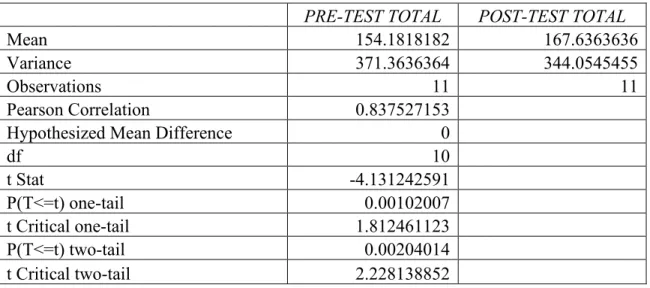
The third goal was to increase knowledge and motivation for oneness of the church through a multi-week teaching session. Participants of the BGOE participated in the teaching session. Participants were encouraged to attend all six sessions. Each session was video recorded and made available to participants who missed a session. This goal was measured by re-administrating BGOE within one week of the participants finishing the six-week teaching session. This goal was considered successfully met when a t-test for dependent samples demonstrated a positive statistically significant difference in the pre- and post-survey scores. A t-test for dependent samples “involves a comparison of the means from each group of scores and focuses on the differences between the scores.”4
3 See appendix 2.
4 Neil J. Salkind, Statistics for People Who (Think They) Hate Statistics, 3rd ed. (Thousand Oaks, CA: Sage, 2008), 191.
Since this project involved a single group of the same subjects being surveyed under two conditions, a t-test of dependent samples was the appropriate test statistic.5
The fourth goal was to develop a ministry plan identifying next steps toward congregational ministry integration. This goal was measured by administering an interview with each student whose post score indicated growth. This goal was considered
successfully met when half of the interviewees affirmed to join the ministry council to discuss continued effort for ministry integration.
Definitions and Limitations/Delimitations
Definitions of certain terms used in the project are provided here.
Ecclesiology. Ecclesiology is the study of the nature and structure of the Christian church. Ecclesiology may be succinctly defined as the “theology of Christian churches.”6
Gospel-centered ecclesiology. Gospel-centered ecclesiology is the study of the unity of the congregation of the Christian church as it serves the purpose of spreading the good news (Acts 14:7).
One limitation of the project was its small number of participants. Since the participants who were invited to the project were members of the church who speak English as their first language, the number of participants was small. To mitigate this limitation and to heighten the nature of the desired unity, KM members who speak English were invited to participate as well. One delimitation of the project was its six-week teaching. A second delimitation was that the desired goal for unity cannot be achieved by knowledge transfer alone. Without participants’ willingness to change their hearts, only superficial cognition of knowledge can be transferred. To mitigate this limitation,
5 Salkind, Statistics, 189.
6 Eliade Mircea and Charles J. Adams, eds., The Encyclopedia of Religion (New York:
Macmillan, 1987), 473.
participants were asked to dedicate time for meditation and prayer during the session for effective motivation to live by the teaching.
Conclusion
God has clearly revealed his will to his church, which is congregational unity.
God’s people shall live by his will, upholding and honoring the church, one body in Christ. The following chapters will explain how God has shown this principle through Jesus, his Word, and his servants in history.
CHAPTER 2
THE BIBLICAL AND THEOLOGICAL BASIS FOR THE PROJECT
Congregational unity is a central hallmark of the New Testament vision for the church. This chapter consists of three parts, each reflecting Bible passages to support that congregations must display unity to (1) uphold God’s calling of church as one, (2) despite cultural differences and language preferences, and (3) despite functional differences.
God’s Calling of Church as One
The apostle Paul calls the church, by the authority of Jesus Christ, to make unity without division (1 Cor 1:10). The church is also urged to do the hard work to maintain the unity. Believers are compelled to make every effort to keep unity with humility and gentleness toward others (Eph 4:1-3). Believers must be eager, zealous, and diligent (Eph 4:3) in pursuing unity. The effort to keep oneness should be with intention and purpose. The calling of church unity is holy and sovereign because the subject of the calling is the Triune God (Eph 4:4-6): “There is one body and one Spirit—just as you were called to the one hope that belongs to your calling—one Lord, one faith, one baptism, one God and Father of all, who is over all and through all and in all.”
The validity of the calling for unity is displayed by a sevenfold enumeration: one body, one Spirit, one hope, one Lord, one faith, one baptism, and one God the Father.1 God in Three Persons is perfectly and equally stated in this sevenfold oneness in the calling of the church unity. O’Brien states, “The sevenfold list is basically threefold since three of these unities allude to the three persons of the Trinity, while the remaining four refer to
1 F. F. Bruce, Commentary on the Epistles to the Ephesians and the Colossians, The New
believers’ relationship to the Spirit, Son, and Father.”2 Because of this connection, it is necessary to examine the work of the Spirit, the Lord, and the Father in the unity of church in conjunction with the other four.
The Spirit and Church Unity
The sevenfold oneness begins with the group of three—one body, one Spirit and one hope. Church is one body in Christ with many individual members to one another (Rom 12:5). This one body illustration of a church with many members recalls the human body imagery with many limbs and body parts (1 Cor 12:12-26).
O’Brien comments, “Each congregation is a local manifestation of this heavenly entity [assembly gathered around Christ].”3 Therefore, the unity of the church must be visibly maintained in each local congregation. The one body concept is not only the heavenly body but also a visible display as the unified assembly of local believers.
Stott explains that the function of the One Holy Spirit is to “indwell and animate” the one body, the church.4 Just as a human body is animated by the spirit of the person, the church is animated by the One Holy Spirit. Since there is One Holy Spirit, the church has to be one body.5 This logic legitimates the unity of the church. Bruce marks the work of the Holy Spirit in the church: “Without the Holy Spirit’s operation as its Organizer there would be no true ecclesia: for its fellowship does not hinge on official succession or corporate visibility, but on the interpenetration of a common life identified with His own, wrought by its Divine Author.”6 The operation of the Spirit in the church includes, but is
2 Peter Thomas O’Brien, The Letter to the Ephesians, The Pillar New Testament Commentary (Leicester, England: Apollos, 1999), 280.
3 O’Brien, The Letter to the Ephesians, 281.
4 John R. W. Stott, The Message of Ephesians, The Bible Speaks Today (Downers Grove, IL:
Inter-Varsity, 1986), 150.
5 O’Brien, The Letter to the Ephesians, 281.
not limited to, enabling the divided to approach the Father in unity (Eph 2:18), building the divided together into a dwelling place for God (Eph 2:22), manifesting varieties of gifts to everyone for the common good (1 Cor 12:7), and baptizing them into one body by its name (1 Cor 12:13).
When the early churches were split into classifications and cultures, the separation seemed severe and not mendable. Then the wall of hostility between the separated groups was voided and they became one group. This one group is a newly created one man in place of the two men (Eph 2:14-15). Arnold states, “This Spirit now fills the church as the new covenant temple”—the one new man is necessary in place of multiple men of numerous spirits.7
The church as one body and one Spirit is now called to the one hope through God’s sovereign calling. This weighty calling to unity is emphasized throughout the letter to the Ephesians (1:18, 4:1, 4). The repeated use of “calling” in verb and noun in both 4:1 and 4:4 expresses special emphasis.8
The calling was given not to individuals but to corporate believers as the declension of the verb “called” (Eph 4:4) is second person plural. Lincoln states that the calling of one hope “is not individual and private but corporate and public.”9 When the goal of God’s salvation is as broad as cosmic unity, it is evident that His exhortation of the calling to the church must be pursued by corporate believers.
Paul reminds that the Gentiles, the people of different backgrounds with Israel, were without God and living with no “hope” (Eph 2:12). They were strangers of the covenants of the promise of Israel. They are now brought together by the new covenant
7 Clinton E. Arnold, Ephesians, Zondervan Exegetical Commentary Series on the New Testament, vol. 10 (Grand Rapids: Zondervan, 2010), 233.
8 Frank Thielman, Ephesians, Baker Exegetical Commentary on the New Testament Grand Rapids: Baker, 2010), 257.
9 Andrew T. Lincoln, Ephesians, Word Biblical Commentary, vol. 42 (Waco, TX: Word,
of Christ Jesus effected by His blood and made into one in “one hope.” Thielman speaks of this hope nobly: “They now have hope, the same kind of hope that characterized Abraham, who believed that the God who could call things into existence out of nothing could also create a people for himself all appearances to the contrary (Rom 4:17-18).”10
The hope inherently belongs to the future. Child-bearing seemed impossible for Abraham, but he had hope based on faith that God could make something into existence out of nothing. God gives hope to the church for a future event that is not presently seen (Rom 8:24). The one hope that binds the believers into unity is an
eschatological hope that all believers can foresee the future appearance of Christ in glory (Col 1:27) and the unity of all things in heaven and earth (Eph 1:10). The work of the Spirit is to seal the hope of believers for the completion of their future inheritance at the final days (Eph 1:13-14). Arnold sees the appropriateness of grouping the Holy Spirit with “one body” and “one hope” when he thinks of the work of the Holy Spirit is to give
“one hope” for the future inheritance: “This Holy Spirit marks believers as God’s property and is a deposit on their future eschatological inheritance (1:13). Thus, Paul speaks of the ‘one hope’ believers eagerly anticipate.”11
The church, as one body motivated by one Spirit, is driven to pursue its unity in the present time foreseeing the futuristic one hope. The one hope, therefore, is meant to bring inspiration to the church of its urgent effort to demonstrate and maintain unity.12 Unity of the church is the evidence of the cosmic reconciliation of God’s plan in the fullness of time (Eph 1:10). O’Brien asserts that the oneness of the church is the demonstration of the glorious will of God: “As a foretaste of this grand hope the very existence of the church, a society of pardoned rebels, a multiracial community in which
10 Thielman, Ephesians, 257.
11 Arnold, Ephesians, 233.
Jews and Gentiles have been brought together in unity in the one body, is the means God uses to manifest his richly diverse wisdom to the principalities and powers in the
heavenly realm.”13
The Spirit is at the central place in the first triad—"one body,” “one Spirit” and
“one hope.” One Spirit breathes life to one body—the church—just as God formed man and breathed the breath of life for the man to become a living being (Gen 2:7). One spirit instills one hope to the body so that it could foretaste the cosmic unity which will come true when the time reaches to its fullness.
The Son and Church Unity
Second, the unity of the church is motivated by the next three-fold oneness comprised of one Lord, one faith, and one baptism (Eph 4:5). Having mentioned one Spirit and His functions in unifying the church through one body and one hope, the urgency of one church is inspired by the second person in the Trinity, the Lord.
The Lord is the same language used to identify Yahweh in the Septuagint (LXX).14 According to Thielman, “Deuteronomy 6:4 in the LXX, for example, reads,
‘Hear, O Israel, the Lord [κύριος] our God is one Lord [κύριος εἷς].’”15 The title, “the Lord,” then, was used to identify Christ Jesus among early believers. Paul and recipients of epistles acknowledged Jesus as Son of God and did not hesitate to call him the Lord.
The letter to the Ephesians includes more than twenty references to Jesus as Lord (1:2, 3, 15; 2:21; 4:1).16
Paul exclaims one Lord without smoothing out the phrase with conjunctions, which heightens the divine request of making one church. It is just as blunt as to say, “If
13 O’Brien, The Letter to the Ephesians, 282.
14 Arnold, Ephesians, 234.
15 Thielman, Ephesians, 258.
there is one Lord, then there must be one church.” He already mentioned that Christ is the head over the church (Eph 1:22). Therefore, one Lord possesses one body and must have full authority to orchestrate the body. Bruce relates the headship and influence when writing, “Then the head must possess a body in order to constitute a whole. . . . Christ figures not only as a Head of authority, but of influence.”17
Now, the two distinctive entities of the community of church—one faith and one baptism—follow one Lord. The two uphold “one Lord” in their central place. Why are these three written in this order? Some scholars identify the variance of the gender of the three. They are masculine, feminine, and neuter respectively, in order. The numeral one therefore, uses different forms. The triad: one Lord, one faith, one baptism, with rhetorical impact emphasizes the quality of imperativeness of divine calling to the church unity.18
O’Brien says that this second triad may have been “a traditional baptismal affirmation.”19 It sounds persuasive considering the Lord as the object of one’s faith, and the person who confesses his faith will get baptized according to the faith in the Lord.
With Christ in the central place, faith and baptism function to unite believers to the Christ. Bruce speaks the centrality of Christ: “Christ occupies the central place, and with Him are linked the inward and outward vincula that bind His people to the Savior.”20
Apostles welcomed believers who had obtained faith (2 Pet 1:1) and encouraged believers to have the same spirit of faith in God who will raise them with Jesus (2 Cor 4:13-14). Believers have one faith in one Lord. One faith may mean common content of belief or sense of trust of believers in Christ. O’Brien explains the
17 F. F. Bruce, The Epistles to the Colossians, to Philemon, and to the Ephesians, The New International Commentary on the New Testament (Grand Rapids: W. B. Eerdmans, 1984), 42, 43.
18 Lincoln, Ephesians, 239; Arnold, Ephesians, 234; Thielman, Ephesians, 257.
19 O’Brien, The Letter to the Ephesians, 282.
faith in two ways: objective and subjective. “The former (one faith) is probably objective, as many commentators suppose, referring to the substance of one’s faith (Jude 3), their common body of belief. . . . If, as is less likely, one faith is subjective, then it denotes the act or attitude of believing in Christ which is common to all members of the one body.”21 Whether in the context the faith is objective faith that is commonly professed doctrinal belief amongst Diaspora Christians, or subjective faith that is inwardly borne and expressed sense of trust of believers in Christ, only one faith can be justified by the righteousness of God—faith in Jesus Christ (Rom 3:22). This one faith must include the core beliefs discussed in the same epistle such as redemption of the saints through the blood of Christ (Eph 1:7), resurrection of the Christ (1:20), salvation through faith in Christ (2:8), and breaking the wall of hostility between the Jew and Gentiles by breaking of His own body (2:14). Believers who share one faith in the consummation of all things in Christ in the fullness of time and the cosmic reconciliation of all things in heaven and on earth (Eph 1:10) must struggle to keep the unity in the present time, and maintain the bondage of one church.
Third in this triad is one baptism, which may be an outward appearance of an inward faith in the Lord. One Lord is the reason of one faith, and one faith is publicly confessed through baptism. One baptism is understood by the rite of water baptism.22 Lincoln writes, “This baptism is one, not because it has a single form or is administrated on only one occasion, but because it is the initiation into Christ, into the one body, which all have undergone and as such is a unifying factor.”23
Baptism is a unifying factor of church regardless of its members’ divergence of ethnicity, social class, or gender. Believers were baptized into one body whether they were Jews or
21 O’Brien, The Letter to the Ephesians, 283.
22 Arnold, Ephesians, 235.
23 Lincoln, Ephesians, 240.
Gentile, slaves or free (1 Cor 12:13). Since the rite of baptism represents common faith in Christ, one baptism that unifies believers must indicate the rite itself as an indication of the whole process of a believer’s conversion.24 Thielman explains one baptism as a summarization of one faith of the believers:
It is perhaps best to think of “one baptism” as a shorthand expression for the whole process of conversion, summarized by reference to the visible ritual. It was “one”
because it was distinctively Christian: it was done in the name of Jesus (Acts 2:38;
8:16; 10:48; 19:5) and symbolized the death (Rom 6:3-4) and resurrection (Col 2:2) of the believer with Christ.25
Believers are baptized into Christ in their conviction of common beliefs that is one faith. Those who are baptized according to their faith have clothed themselves with Christ (Gal 3:27). A baptized community has one unifying experience as they were baptized with Christ into death and raised from the dead by one baptism (Rom 6:4). One baptism is an expression of one faith in one Lord; thus, the second triad raises the calling from the Triune God for the unity of the church.
The Father and Church Unity
The unity of church urged by one Spirit and one Lord was explained through an examination of Ephesians 4:4-5. Elevated demand of church unity is now climaxed by the vision of the one Father who is above all, through all, and in all (Eph 4:6). Many scholars state that what was reflected in Ephesians 4:6 as well as in 1 Corinthians 8:6 is a Christian modification of Jewish conviction of monotheism as set forth in Shema of Deuteronomy 6:4.26 It is the Christian acclamation of one God by calling “one God and Father of all.” Earlier in his epistle to Ephesians, Paul stated the Father’s universal
24 Arnold, Ephesians, 235.
25 Thielman, Ephesians, 259.
26 Lincoln, Ephesians, 240; O’Brien, The Letter to the Ephesians, 284; Arnold, Ephesians, 236.
fraternity to all family in heaven and on earth (3:14-15). God’s fatherhood is broadened to all of the universe here by affirming God’s transcendence and immanence.27
One God and Father whose fatherhood extends to all is over all and through all and in all (Eph 4:6). God is transcendent because He is the creator of all things and is above all and over all. God is immanent because all creation is continually dependent on Him for its existence and its functioning. Therefore, God is through all and in all.28 O’Brien asserts that such pervasiveness of God is the ground of the legitimate claim for the church unity: “On this interpretation Paul is affirming that God is supremely
transcendent ‘everything’ and that his immanence is all-pervasive: he works ‘through all and in all’. . . then God’s universal sovereignty and presence are set forth as the climatic ground for the unity of the Spirit that believers are to maintain.”29
Children of one father constitute a family not only in resemblance with each other but also through their unique characteristics and diverse inclination. Church
members, likewise, have wide range of diversity despite some commonalities. Therefore, members of a church constitute one body that is indestructible as they share one paternity.
Once again, believers must go back to the calling to maintain the unity of church from Ephesians 4:3. Church is the visible instrument to which God commanded to manifest the universal rule of one God. The church must exert full effort and strength to express its belief in the one God. Lincoln aptly states, “When the Church fails to maintain and express unity, it radically undermines the credibility of its belief in the one God.”30
Church unity is the strong impulse of the Father, the Son, and the Holy Spirit.
The church must be united in one body, empowered by one Spirit, in one hope of
27 O’Brien, The Letter to the Ephesians, 284.
28 Wayne Grudem, Systematic Theology: An Introduction to Biblical Doctrine (Leicester, England: Inter-Varsity, 1994), 267.
29 O’Brien, The Letter to the Ephesians, 285.
eschatological unity. The unity is compelled by one Lord because of the saints’ one faith in Him and through one baptism which baptizes all saints into Him. Church must
manifest to the world of their belief in one God and Father through accomplishing and maintaining the unity. John Stott explains, “Christian unity arises from our having one Father, one Saviour, and one indwelling Spirit. So we cannot possibly foster a unity which pleases God either if we deny the doctrine of the Trinity or if we have not come personally to know God the Father through the reconciling work of his Son Jesus Christ and by the power of the Holy Spirit.”31
Congregational Unity Transcends Cultural and Language Barriers
Unifying Jews and Gentiles in Christ was an urgent issue of the early church in spreading the gospel of the cross. It was regarded unlawful for a Jew to associate with anyone of another nation (Acts 10:28). Peter fled from the table with the Gentiles afraid of judgment of his Jewish friends (Gal 2:12). Jesus alluded to an invisible wall of
discrimination to the Gentiles, which was prevailing among the Jews, in conversing with a Syrophoenician woman (Mark 7:27). Gentiles were called “the uncircumcised” by the Jews and regarded as outside the covenant of God with Israel, therefore, they were not able to be saved unless they followed Jewish laws and got circumcised (Acts 15:1).
Brown speaks of the tension between the Jewish Christians and the Gentile Christians in the early church period:
In the early Christian communities there was a tension between the believers from among the circumcised, i.e. the Jewish Christians, and those called uncircumcision, i.e. the Gentile Christians. These two groups, associated respectively with Peter and Paul, constantly clashed, because the Jewish Christians insisted that circumcision was necessary for salvation: “Unless you are circumcised according to the custom of Moses, you cannot be saved” (Acts 15:1; cf. Acts 15:5, where circumcision and keeping of the Law are linked).32
31 Stott, The Message of Ephesians, 154.
Jesus brought the two distinctive groups into one, breaking the wall of hostility so that the two, now in one, may come to God in peace.
Hostility between the Two Removed
Congregational unity must be pursued because it was the intention of Jesus that the hostility between the Jews and Gentiles be removed. Paul explains that Jesus brought together Jews and Gentiles who had alienated one another: “For he himself is our peace, who has made us both one and has broken down in his flesh the dividing wall of hostility by abolishing the law of commandments expressed in ordinances, that he might create in himself one new man in place of the two, so making peace” (Eph 2:14-15).
Through peace. Jesus brought down the wall of hostility through peace. The peace was Jesus himself because no other kind of peace would suffice to break down the wall of hostility. Bruce remarks the sufficiency of Jesus as the peace: “In this arena of strife and discord, only one Peacemaker can be found competent for the task of
mediation."33 The verse begins with a statement as “For he himself is our peace” (Eph 2:14). In Greek, a personal pronoun is used in the nominative case only when emphasis is intended.”34 Special emphasis is intended here by using personal pronoun Αὐτὸς (he himself). Stott writes, “It is he, Christ Jesus, who shed his blood on the cross and who offers himself to his people today to be united to them, it is he who by what he did once and now offers is our peace, that is to say, is the peacemaker between us and with
God.”35 Thielman believes that those who are in Christ cannot be divided into competing groups because Christ himself is peace for those who identify themselves in Christ.36 If
33 Bruce, Ephesians and Colossians, 62.
34 David Alan Black, Learn to Read New Testament Greek, 3rd ed. (Nashville: Broadman &
Holman, 2009), 67.
35 Stott, The Message of Ephesians, 98.
the church does not unite, then the church is rejecting Christ, what he did, and how he offered peace to the church.
By removing the fence. “For he himself is our peace, who has made us both one and has broken down in his flesh the dividing wall of hostility” (Eph 2:14). “Both one” is the neuter form here in comparison to the masculine form in verses 16 and 18.
Therefore, it is suggested to understand “both” as rather two spatial regions than two people group. Thielman explains what “both” means: “Since the reference to a wall in what follows calls on spatial imagery, the author may have already been thinking in those terms and thus of a Jewish ‘region’ and a Gentile ‘region,’ which the wall separates.”37
The Jews and Gentiles were divided by a wall as if they were separated into two physical places. The reconciliation between the two seemed improbable as much as the wall of hostility was invincible. The “dividing wall” in Ephesians 2:14 is expressed as
“the middle wall, that is the fence” according to Thielman which is a graphic imagery of formidable boundary that was removed by the shed blood of Jesus on the cross.
The fence of tradition. Paul redundantly used two words, “barrier” and
“fence,” by which the Jews and the Gentiles were divided. “Barrier,” as a metaphor of separation, can be the physical wall that separated the Court of the Gentile from the rest of the Temple in Herod’s Temple.38 Gentiles were not permitted to enter beyond the wall because beyond it was considered more holy, and only for the Jews.39 Attached to the barrier were warnings in Greek and Latin to Gentiles not to proceed further on pain of death.40 The alienation of the Gentiles from the Jews by the barrier was powerful and
37 Thielman, Ephesians, 164.
38 R. Kent Hughes, Ephesians: The Mystery of the Body of Christ, Preaching the Word (Wheaton, IL: Crossway, 1990), 91.
39 Thielman, Ephesians, 165.
forcible. Bruce explains that this traditional barrier was both religious and sociological because the features of the Jewish law included circumcision and the food restrictions, which set the Jews off from the Gentiles.41
Observing the law was a way to keep the Jews from being influenced by the culture of the Gentiles. The law itself was a fence around Israel to prevent mixing with other nations. Practicing the law was the holiness code to the Jews.42 The redundant use of “barrier” and “fence,” therefore, was to put stress on the formidable separation between the two. Thielman readily designates the functions of the two words: “The Jewish law was both a ‘partition’ that separated Jews from Gentiles and a ‘fence’ that enclosed the Jewish people, keeping them safe from Gentile influence.”43 Jesus, who is himself peace, removed the fence that had been separating the two grounds by removing the barrier and fence of hostility.
Setting aside the enmity. Christ in his flesh tore down the wall of hostility by annulling or setting aside (“by abolishing” Eph 2:15) the law. In Christ’s time, as
Thielman notes, the Jewish law “was seen as equivalent to the Jewish way of life, which separated Jews and Gentiles.”44 Paul once again redundantly used a list of words to phrase the Jewish tradition alluded to the Jewish law: “the law of commandments expressed in ordinances” (Eph 2:15), which Thielman identifies as “specific commandments
promulgated in the form of decree.”45
41 Bruce, Colossians, Philemon, and Ephesians, 296.
42 O’Brien, The Letter to the Ephesians, 196.
43 Thielman, Ephesians, 167.
44 Thielman, Ephesians, 169.
45 Thielman, Ephesians, 169.
Despite the goodness of the Mosaic law, the written code of conduct brought Jewish particularism and Gentile exclusion.46 Jewish tradition separated the Jews from the Gentiles and the Gentiles from the grace of God, which resulted in enmity between the two people groups. Christ has done away with the enmity between the two groups by annulling specific commandments of the law that had caused hostility.
Christ in his flesh, by abolishing the enmity, made one new man in place of the two. The one new man Christ created in Himself is a new race and is neither Jewish man who absorbed transformed Gentiles, or the Gentile man who absorbed converted Jews.
The one new man is now free from enmity and has a new self who takes after the image of its creator, the Christ (Col 3:10). “Here there is not Greek and Jew, circumcised and uncircumcised, barbarian, Scythian, slave, free; but Christ is all, and in all” (Col 3:11).
Transcends Language Barrier
While many churches were struggling with issues aroused from cultural differences between the Jews and the Gentiles, the Jerusalem church had another issue even among the Jews in the church. As the church grew, language barriers within the church came to the surface. Acts 6:1-2 says, “Now in these days when the disciples were increasing in number, a complaint by the Hellenists arose against the Hebrews because their widows were being neglected in the daily distribution. And the twelve summoned the full number of the disciples and said, ‘It is not right that we should give up preaching the word of God in serve tables.’” To unite the church, disciples had to resolve issues between the Hellenists and the Hebrews by modifying the church polity.
Different language preferences. Jerusalem church had two groups of Jews in the congregation. The Hellenists spoke Greek as their primary language, and the Hebrews
46 Bruce, Colossians, Philemon, and Ephesians, 299.
were Aramaic-speaking Jews. Schnabel states, “These terms (Hellenists and Hebrews) describe a linguistic distinction, not ethnic difference.”47
It is notable that there were no Gentile believers in the Jerusalem church.
However, Jewish Christians had returned from diaspora in comparison with the Jewish Christians who had been living in Jerusalem. Luke calls the former group the Hellenists and the latter group the Hebrews. The Hellenists spoke only Greek while the Hebrews spoke Aramaic as everyday spoken language.48
Some of the Hellenists who lived in Jerusalem attended their own synagogues where Greek was spoken (Acts 6:9).49 Those among the Hellenists who received Jesus as the Messiah joined the church and had close relationship with the Hebrew Christians.
Schnabel believes that meetings were probably conducted in Aramaic and Greek in the Christian community. Disciples were presumably not able to teach in both languages.50 A language barrier was present among the first century Jerusalem church.
An issue in growing pain. As Jerusalem church grows explosively (Acts 2:41;
4:4; 5:14), people gathered from towns around Jerusalem (5:15). Ethnic diversity and different language preferences were inevitable issues as the church grew. Bock recognizes the problem of the Jerusalem church: “The scene is not ‘artificially constructed’ but does reflect how the early growth of an ethnically diverse church became difficult to manage.”51
47 Eckhard J. Schnabel, Acts, Zondervan Exegetical Commentary on the New Testament (Grand Rapids: Zondervan, 2012), 329.
48 David Peterson, The Acts of the Apostles, Pillar New Testament Commentary (Grand Rapids: William B. Eerdmans, 2009), 231.
49 Peterson, The Acts of the Apostles, 231.
50 Schnabel, Acts, 329.
51 Darrell L. Bock, Acts, Baker Exegetical Commentary on the New Testament (Grand Rapids:
Baker, 2007), 255.
Ethnic immigration churches of present days like IMC have linguistic diversity within the church. The EM congregation has little to no language capacity to communicate in Korean language, and the KM has limited capacity in using English in communication, especially in delicate matters such as business of the church. The EM is inherently
smaller in size than the KM in present day Korean ethnic immigration churches, which was similar to the Jerusalem church. Bock suggests that the Hellenists made up 10 to 20 percent of the population.52 Emergence of this group into the church created tension and challenged church unification.
Effort to solve the issue. The apostles exercised active effort to resolve the issue between the two language groups in their community. The apostles took
responsibility for the problem and intervened to find the solution. Acts 6:2-3 reads, “And the twelve summoned the full number of the disciples and said, ‘Therefore, brothers, pick out from among you seven men of good repute, full of the Spirit and of wisdom, whom we will appoint to this duty.’”
The apostles involved more people to delegate some of their responsibilities53 to resolve Hellenists’ complaints—the minority of the church. Polhill notes that the apostles wanted the whole church to participate because they knew the problem involved the entire congregation, even though the grievance was from the minority.54 They realized that corporate effort was needed to resolve the matters that seemed to affect only one part of the congregation. They proposed an immediate remedy as well as a preventative measure by suggesting a newly organized structure. Peterson observes that the church
52 Bock, Acts, 258.
53 Bock, Acts, 259.
54 John B. Polhill, Acts, The New American Commentary, vol. 26 (Nashville: Broadman, 1992), 180.
seemed “to adjust its procedures, alter its organizational structure, and develop new posts of responsibility” to remedy the issue.55
Congregational Unity Transcends Functional Differences of Members
As a human body has many members (lit. trunk, limbs, organs), every
community has members with different functions. So is the church composed of members of different gifts and talents. Romans 12:4-6 says, “For as in one body we have many members, and the members do not all have the same function, so we, though many, are one body in Christ, and individually members one of another. Having gifts that differ according to the grace given to us, let us use them.” Churches must pursue unity through adjoining members of diverse functions. Cranfield explains that church unity is “a matter neither of nature nor of human contriving but of the grace of God.”56
Functional Diversity Is God’s Gift to the Church
As in the human body, members of the church have different functions (Rom 12:4). Each organ has its uniqueness not only in its shape or place of a body but also in its unique function. Paul used a simile in 1 Corinthians 12 to illustrate diverse functions of body organs, saying that all cannot be eyes but some must be ears and noses for hearing or smelling. Once again Paul uses the body parable to enlighten an organic relation of church members. Cranfield explains, “Like the various members of a single body, although they differ from one another and have various functions, are all necessary to
55 Peterson, The Acts of the Apostles, 233.
56 Charles E. B. Cranfield, A Critical and Exegetical Commentary on the Epistle to the Romans, The International Critical Commentary on the Holy Scriptures of the Old and New Testaments (Edinburgh: Clark, 1998), 2:618.
each other and equally under an obligation to serve one another, because they all belong together in a single whole.”57
The analogy of limbs, eyes, and ears of the church is now applied to real functions according to the gifts of individual members in Romans 12:6-8. The functions are for example, prophecy, service, teaching, encouraging, and giving. These gifts are given to the church according to the grace of God in His higher purpose. Cranfield asserts, “The wide variety of the gifts is grounded in the one grace shown to all; for God’s grace, His undeserved love in action, while it is one and the same for all, is free and sovereign, and it is according to this royal freedom of His grace that He bestows different gifts on different persons.”58
Functional diversity is the purpose of God to form a perfect unified body of the church. Schreiner asserts that functional diversity is the gracious gift of God “who has supplied his church with means to strengthen the community.”59 This gift of God cannot be taken for granted nor denied because it is God’s gift.60 Dunn remarks, “The point is that the body is one not despite its diversity, but is one body only by its diversity; without that diversity the body would be monstrosity.”61 Unity of body is, by definition,
characterized by diversity.62 Diverse functions, yet depending on other members or parts, make the whole body functions perfectly. Likewise, when many members come together
57 Cranfield, Romans, 2:618.
58 Cranfield, Romans, 2:619.
59 Thomas R. Schreiner, Romans, Baker Exegetical Commentary on the New Testament, vol. 6, 2nd ed. (Grand Rapids: Baker, 1998), 655.
60 D. Stuart Briscoe, Romans, The Communicator’s Commentary, vol. 6 (Waco, TX: Word, 1982), 218.
61 James D. G. Dunn, Romans 9-16, Word Biblical Commentary, vol. 38B (Waco, TX: Word, 1988), 725.
62 Schreiner, Romans, 654.
as one body in Christ and demonstrate multiple ministries in harmony through united efforts, the church performs as expected, as a corporate body of Christ.63
Functional Diversity Is the Reason to Honor Members
Paul advises all believers in the church, not just a few who might have superior faith or gifts, to refrain from judging others and even oneself according to their own measurement. Romans 12:3 reads, “For by the grace given to me I say to everyone among you not to think of himself more highly than he ought to think, but to think with sober judgment, each according to the measure of faith that God has assigned.” It is notable that Paul used “everyone among you” rather than “to you all.” By this abundant use, Paul addresses his exhortation to every member equally and emphatically.64 This emphatic expression implies that (1) every member was exercising a certain degree of contribution to the church according to each one’s given gift and (2) there was possible tension65 in the church on the subject of members’ gifts.
Members of diverse functionality must discern mutuality and dependency as they exercise their own gifts by bearing humility and honoring the gifts of others. If members have good sense and sound judgment they will refrain from judging others.
They shall not fall prey to pride but have proper respect of others for their unique gifts and diverse functions in the church.
Paul uses the word “to think” and its variation multiple times in Romans 12:3 to bid members to bear proper virtue toward oneself and others. Dunn explains the phrase,
“not to think of himself more highly than he ought to think” is a warning of an
63 Briscoe, Romans, 219.
64 Cranfield, Romans, 2:612.
65 Dunn, Romans 9-16, 720.
“understanding which goes beyond proper bounds, so proud and haughty.”66 Schreiner comments that Paul meant by the phrase “but to think with sober judgment,” that believers must have a sober, sane, sensible, and realistic estimate of themselves.67
When one can estimate oneself with sober judgment, one can recognize others with a renewed view by which believers conceive all gifts are essential to the whole body and are equally regarded by God. Each person shall then measure himself and others with a newly given measurement according to what God has allotted to each one. Cranfield believes that the “measure of faith” is a standard by which one must think that “he is the same level as his fellow-Christians” and not superior or even inferior to them.68 Cranfield compares God’s standard and human standard in viewing gifts:
When Christians measure themselves by themselves (or by their fellow-Christians or their pagan neighbours), they display their lack of understanding, and are sure to have too high (or else too low) an opinion of themselves; but, when they measure themselves by the standard which God has given them in their faith, they then—and only then—achieve a sober and true estimate of themselves as, equally with their fellows, both sinners revealed in their true colours by the judgment of the Cross and also the objects of God’s undeserved and triumphant mercy in Jesus Christ.69
When believers can truly estimate themselves according to the standard of God, they may be humbled and appreciated for the undeserving gifts entrusted to them. Each member is directed to see the diversity of his calling and gift as a mean to work out the one body in harmony. Each member is called for particular work according to diverse functions not as being more important or less than other functions but as being unique and special
functions.
66 Dunn, Romans 9-16, 721.
67 Schreiner, Romans, 651.
68 Cranfield, Romans, 2:615.
69 Cranfield, Romans, 2:615-16.
Functional Diversity Is the Resource to Unite the Church
Romans 12:6-8 lists various gifts the church was given, such as prophecy, service, teaching, exhorting, contributing, leading, and showing mercy. These seven gifts are not an exhaustive list because 1 Corinthians 12:8-10, 28-30, and Ephesians 4:11 also catalogs gifts.70 There are many unlisted diverse functions through which God blesses the church according to His grace.
In addition to the prominent gifts just listed, the church must not exclude the spontaneous response of members to the needs of ministries of the church.71 First Corinthians 14:26 says, “What then, brothers? When you come together, each one has a hymn, a lesson, a revelation, a tongue, or an interpretation. Let all things be done for building up.” Dunn relates this verse to showcase some improvisational functions, such as Spirit-prompted charisms that come together for edification of the church.
IMC has been blessed with functional diversity as having KM and EM.
Different language preferences and cultural understanding give the church more
resources of diverse functions. Praise can be enriched by dual languages, which can be a benefit to approach ethnically open-minded people in the neighborhood, as well as immigrants from Korea. Functional diversity is the resource bestowed to the church and must be used to unite the church.
It is universally agreed that Romans 12:6 is a separate sentence from the previous verse and is considered to have imperatival force.72 Therefore, the verse properly reads, “Having gifts that differ according to the grace given to us, let us use them,” having the last four words added from the original Greek text as ESV renders.
Cranfield puts the heaviness of the sentence given to the church.
70 Schreiner, Romans, 655.
71 Dunn, Romans 9-16, 725.
72 Dunn, Romans, 725.
The weight of the sentence rests not on an imperative, but on an indicative: “we have these gifts.” Paul speaks not just of what ought to happen, but of what is happening. Out of the received gift arises the function, and therefore also out of the statement which indicates the gift arises the imperative which says how the function is rightly fulfilled.73
Conclusion
Churches may conjure reasons and excuses for division—they split to improve efficiency in their ministries or avoid conflicts within the congregation. Scripture,
however, is not in favor of such excuses; instead, it rationalizes the unity of the church despite latent conflicts that may arise. Church unity is the strong impulse of Triune God.
The Bible is filled with ample evidence proving that by resolving underlying issues of hostility among congregation, churches are able to become united. Cultural backgrounds and languages should not be seen as an obstacle to overcome but should be perceived as a resourceful gift of God to use for the prosperity of the church. Local churches, especially ethnic churches, must inversely deem their congenital multiplicity of language and culture within them as a resource to further the kingdom of God.
73 Cranfield, Romans, 2:618.
CHAPTER 3
CONGREGATIONAL UNITY THROUGH THE UNIQUE DYNAMICS OF ETHNIC CHURCHES
Ethnic churches have unique challenges because they are constituted by one major ethnic group yet have multiple culturally distinguishable sub-groups within.
Generational tension is intensified by different cultural understandings of each generation.
These tensions may be partly caused by the struggles of the older generation who want to keep their ethnic identity and the oppositions of the younger generation who questions their church for not being culturally flexible and diverse.
In this chapter are commonly perceived issues of ethnic churches in the United States and practical advices to build congregational unity through embracing those challenges.
Overcoming Generational Tension through Inter-Generational Effort
God calls all generations to worship Him. It is natural that all ages assemble and call on the name of the LORD in one voice. “Blow the trumpet in Zion; consecrate a fast; call a solemn assembly; gather the people, consecrate the congregation; assemble the elders; gather the children, even nursing infants” (Joel 2:15-16). God promises to pour His Spirit to all ages in the assembly. By the Spirit, old men shall dream, young men shall see visions, and children shall prophesy (Joel 2:28).
Christian community in the first century was like a faith family—a family bound not by blood but by faith. First Timothy 5:1 says, “Do not rebuke an old man but encourage him as you would a father, younger men as brothers, older women as mothers, younger women as sisters, in all purity.” In the first century faith family, old men and
women were treated as parents and young people were like siblings. John Hammett believes that Jesus has clearly defined a new family: “He [Jesus] simply calls His followers to give allegiance to a new family . . . to view the church as family is to view the church as that group of people to whom one has primary allegiance.”1
Generational tension exists in a faith family just as it does in a biological family. When multiple generations gather together, disconnections may follow as well as familial affection within the family. Intentional efforts should be made to overcome generational tension.
Segregation Trend in the Church
Although Scripture calls all generations to form a faith family, the age segregation trend within the church became the norm in the late twentieth century.
Churches began to separate generations for practical reasons. Separating people into age groups made all the activities in the church easier and smoother. Holly Allen and
Christine Ross speak about the trend of separation in the church:
Throughout much of Christian history, the whole body of Christ- that is, all the generations—met together for ministry and worship as well as most other gatherings;
intergenerationality was the norm. However, in the last several decades, all but the smallest congregations have tended to separate the generations regularly for learning, frequently for fellowship and service, and sometimes (or always) for worship.2
Age separation in the church is not irrelevant with the segregation of age in modern society. Allen and Ross recount age segregation in society: “Age-graded public education, the geographical mobility of families, the movement from extended to nuclear family, the rise of divorce and single-parent families, and the prevalence of retirement
1 John S. Hammett, “Church Membership, Church Discipline, and the Nature of the Church,”
in Those Who Must Give an Account: A Study of Church Membership and Church Discipline, ed. John S.
Hammett and Benjamin L. Merkle (Nashville: B & H, 2012), 26.
2 Holly Catterton Allen and Christine Lawton Ross, Intergenerational Christian Formation:
Bringing the Whole Church Together in Ministry, Community and Worship (Downers Grove, IL: IVP,
and nursing homes for older persons and preschools for the young.”3 These sociological factors influenced the church to segregate age groups. Age-graded public education sounded more efficient to church Sunday school. Further age segregation is wrought when nuclear families feel more comfortable without the older generation.
Another form of age segregation is having one generation church. Hereafter, the phrasing homogenous church will refer to a church that has all members similar in age. According to Sbanotto and Blomberg, this homogeneous church movement peaked in the 1970s and 1980s and made “some success through the 1990s and early 2000s.”4 The homogeneous church is also a byproduct of individualism. Homogeneous churches easily avoid conflicts between generations over worship styles, gathering time, etc. Allen and Ross believe that this postmodern inclination to homogeneous churches is “toward individualism and dependence on psychological, therapeutic, or secular educational models rather than theological models.”5
Conflicts Incurred Segregation Trend
Although this study is not focused on analyzing generations, it would be helpful to define the generations in discussing generational tension in the church. This study follows the generally accepted sociological categorization of generations: Silent Generation (1925-1945), Baby Boomers (1946-1964), Generation X (1965-1981), Millennials (1982-2001), and Generation Z (after 2002).6
3 Allen and Ross, Intergenerational Christian Formation, 30.
4 Elisabeth A. Nesbit Sbanotto and Craig L. Blomberg, Effective Generational Ministry:
Biblical and Practical Insights for Transforming Church Communities (Grand Rapids: Baker, 2016), 10.
5 Allen and Ross, Intergenerational Christian Formation, 36.
6 Sbanotto and Blomberg, Effective Generational Ministry, 15.